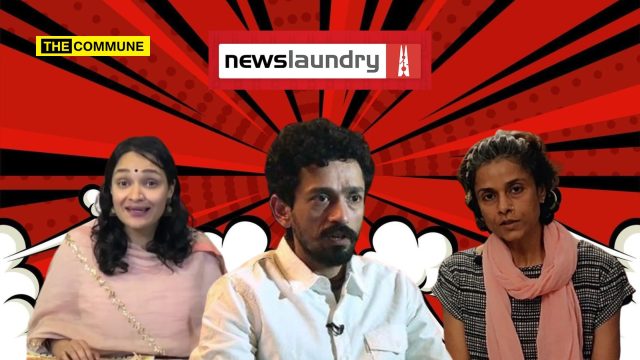
The removal of a controversial 2014 Newslaundry article defending former Tehelka editor-in-chief Tarun Tejpal has triggered fresh scrutiny of the publication’s past commentary on sexual assault, consent and rape including an earlier article written by Newslaundry co-founder Abhinandan Sekhri himself.
The controversy erupted after the Bombay High Court’s August 2026 judgment convicting Tarun Tejpal of rape and sentencing him to 10 years in prison brought renewed attention to the way the case had been discussed in sections of the media.
Following massive outrage on social media after the court verdict, Newslaundry removed a 2014 article written by Nirupama Sekhri, sister of Abhinandan Sekhri, titled “Letter To Ms Tehelka-Assault-Victim.”
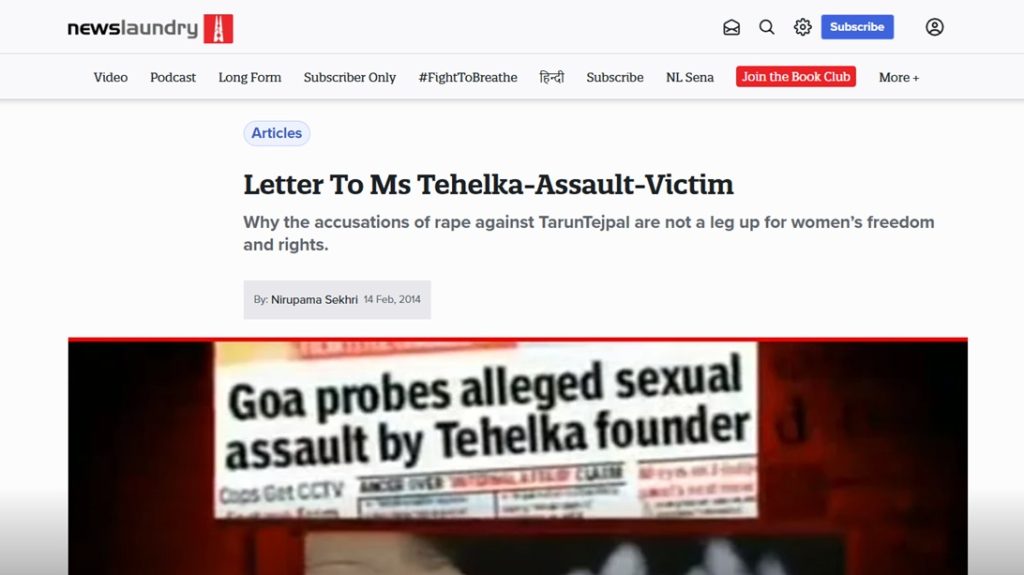
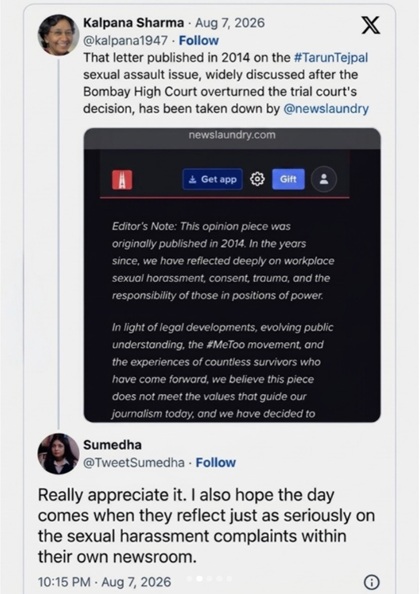
An editor’s note now displayed at the original URL states that the article no longer reflected the values guiding Newslaundry’s journalism, citing developments in law, changing public understanding, the #MeToo movement and the experiences of survivors.
That letter published in 2014 on the #TarunTejpal sexual assault issue, widely discussed after the Bombay High Court overturned the trial court’s decision, has been taken down by @newslaundry pic.twitter.com/aiTftcDmXp
— Kalpana Sharma (@kalpana1947) August 7, 2026
But the deletion has also brought renewed attention to Abhinandan Sekhri’s own past writing on rape and consent. When he published that 2014 article, he had called it a ‘counter perspective’ on rape.
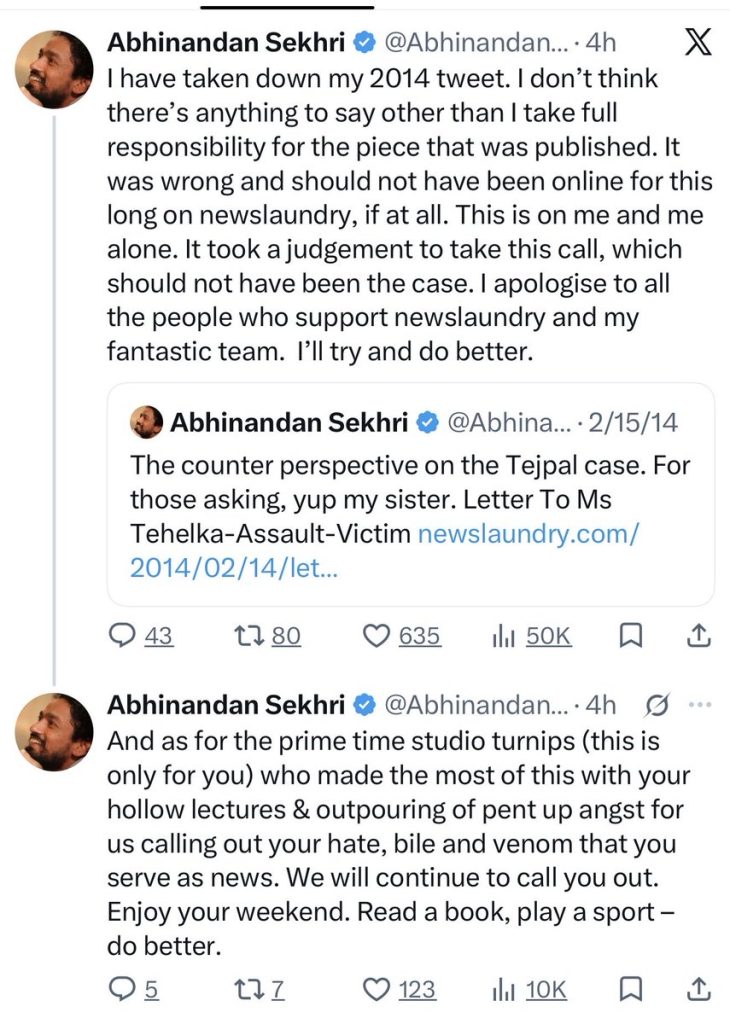
Abhinandan Sekhri’s 2017 Article On Rape And Consent
In September 2017, Abhinandan Sekhri wrote an article for Newslaundry titled “When a court decision on rape became fodder for TV debate.”
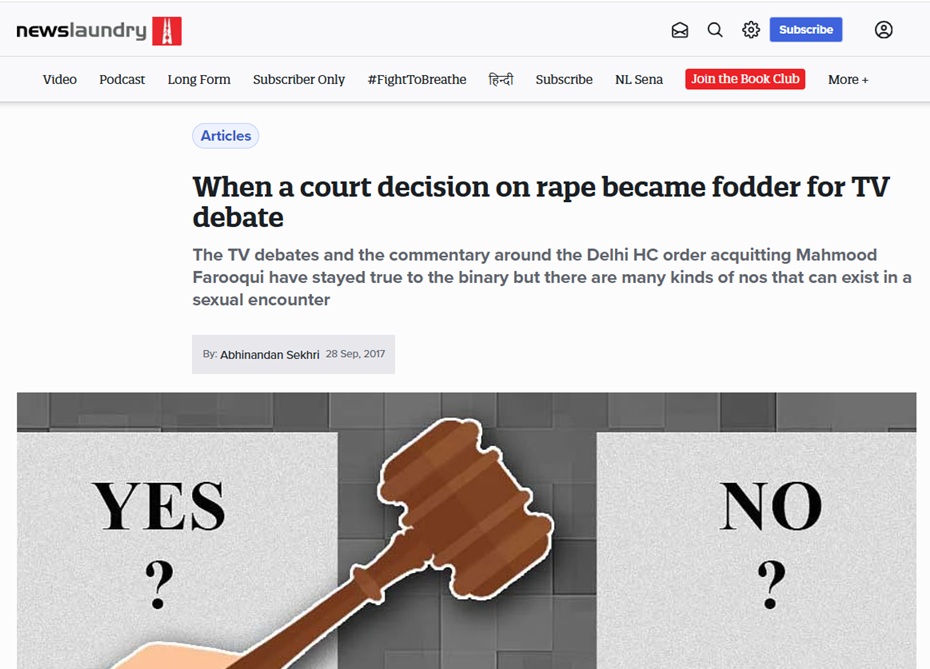
The article discussed the Delhi High Court proceedings involving Mahmood Farooqui and the broader debate over consent following the court’s decision in the case. He wrote, “…this is not an article on the judgment, how it is worded or the merits of the case that has triggered the conversation. This is a critique of the TV studio debates and commentary that want to force strict views on a complicated issue rather than explore and examine the layers of consent.”
In the article, Sekhri took issue with television commentary around the meaning of consent and specifically rejected the proposition that sexual activity following a refusal could necessarily be characterised as rape.
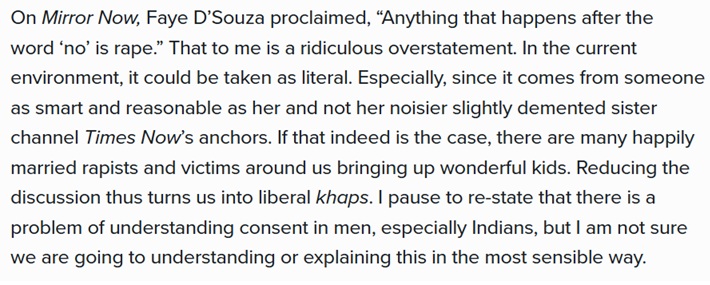
Writing about comments made by journalist Faye D’Souza on television, Sekhri stated, “Anything that happens after the word ‘no’ is rape.” That to me is a ridiculous overstatement.”
He went on to argue that such a formulation could be interpreted too literally.
Sekhri wrote, “In the current environment, it could be taken as literal. Especially, since it comes from someone as smart and reasonable as her and not her noisier slightly demented sister channel Times Now’s anchors.”
He then made a further comparison involving perpetrators and victims, writing, “If that indeed is the case, there are many happily married rapists and victims around us bringing up wonderful kids.”
Sekhri subsequently argued that reducing the discussion to such a binary understanding of consent was problematic. “Reducing the discussion thus turns us into liberal khaps.”
He nevertheless acknowledged what he described as a problem with men’s understanding of consent, particularly in India, writing, “I pause to re-state that there is a problem of understanding consent in men, especially Indians, but I am not sure we are going to understanding or explaining this in the most sensible way.”
The remarks are now attracting renewed attention because they sit alongside the controversy over Newslaundry’s decision to remove the 2014 article written by Sekhri’s sister.
The 2014 Letter That Newslaundry Has Now Removed
The 2014 article by Nirupama Sekhri was written in the aftermath of the allegations against Tarun Tejpal and directly addressed the young journalist who had accused him of sexual assault.
The article attracted criticism for its treatment of the survivor and its defence of Tejpal.
Among its most controversial passages was the statement, “I would like to establish quite clearly that I do not see you as a victim, unless it is of bubblegum feminism.”
The letter also questioned the survivor’s conduct and choices, including her decision to enter a hotel lift with Tejpal.
It accused the survivor of treating the episode as a form of “workplace currency” rather than advancing women’s freedom and rights.
The overall thrust of the piece was also highly sympathetic towards Tejpal, portraying him as the target of a campaign rather than focusing primarily on the allegations against him.
Following the Bombay High Court’s August 2026 judgment in the Tejpal case, Newslaundry removed the article from its website.
The editor’s note accompanying the removal stated that the publication had “reflected deeply on workplace sexual harassment, consent, trauma, and the responsibility of those in positions of power” and concluded that the old piece did not meet the values guiding its journalism today.
Yet Another Instance Of Justifying Rape & Pedophilia
On 3 May 2025, during Episode 535 of its Hafta podcast, Newslaundry was accused of intentionally framing the rape of a minor in Nainital as a communal issue, instead of treating it as a grave criminal act.
During the discussion, panelist Raman Kirpal reportedly referred to the case involving a 75-year-old Muslim man, Muhammad Usman, accused of raping a 12-year-old Hindu girl, as an incident being framed communally due to an alleged “affair” between a Muslim male and a Hindu female. Kirpal described the situation as one in which Muslims were being unfairly targeted, claiming that tensions in Nainital escalated after the supposed affair came to light. He referred to the unrest as a “small incident” and said that Muslim-owned shops were attacked and shut down as a result.
Speaking in the podcast, Kirpal stated, “In Nainital yesterday, one boy had an affair, or some problem, with a girl. They started beating the Muslims. They shut down those shops, very prominent shops in Nainital. They beat them up, and today the entire place is closed. They are going against the Muslims.” Co-hosts Abhinandan Sekhri and Manisha Pande did not object to this framing during the episode.
Their most of the articles are pure propaganda targeting, India, Hindus, Modi govt
They are also repeat offender of justifying rape & pedophile. In April 2025, a 73 year old Usman raped a 13 year old Hindu girl in Uttrakhand and NL said it was small incident of love affair.
You… pic.twitter.com/cW0vwFxXEz
— STAR Boy TARUN (@Starboy2079) August 10, 2026
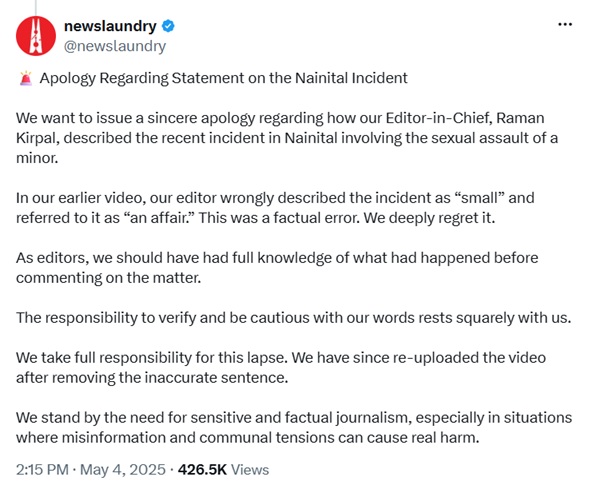
After massive outrage, they issued a token baseless apology on its official X account, stating, “Apology Regarding Statement on the Nainital Incident. We want to issue a sincere apology regarding how our Editor-in-Chief, Raman Kirpal, described the recent incident in Nainital involving the sexual assault of a minor. In our earlier video, our editor wrongly described the incident as “small” and referred to it as “an affair.” This was a factual error. We deeply regret it. As editors, we should have had full knowledge of what had happened before commenting on the matter. The responsibility to verify and be cautious with our words rests squarely with us. We take full responsibility for this lapse. We have since re-uploaded the video after removing the inaccurate sentence. We stand by the need for sensitive and factual journalism, especially in situations where misinformation and communal tensions can cause real harm.”
“I Also Hope The Day Comes…”
The removal, however, did not end the controversy. It prompted former Newslaundry employees to publicly question whether the publication had applied the same standards to allegations concerning its own workplace.
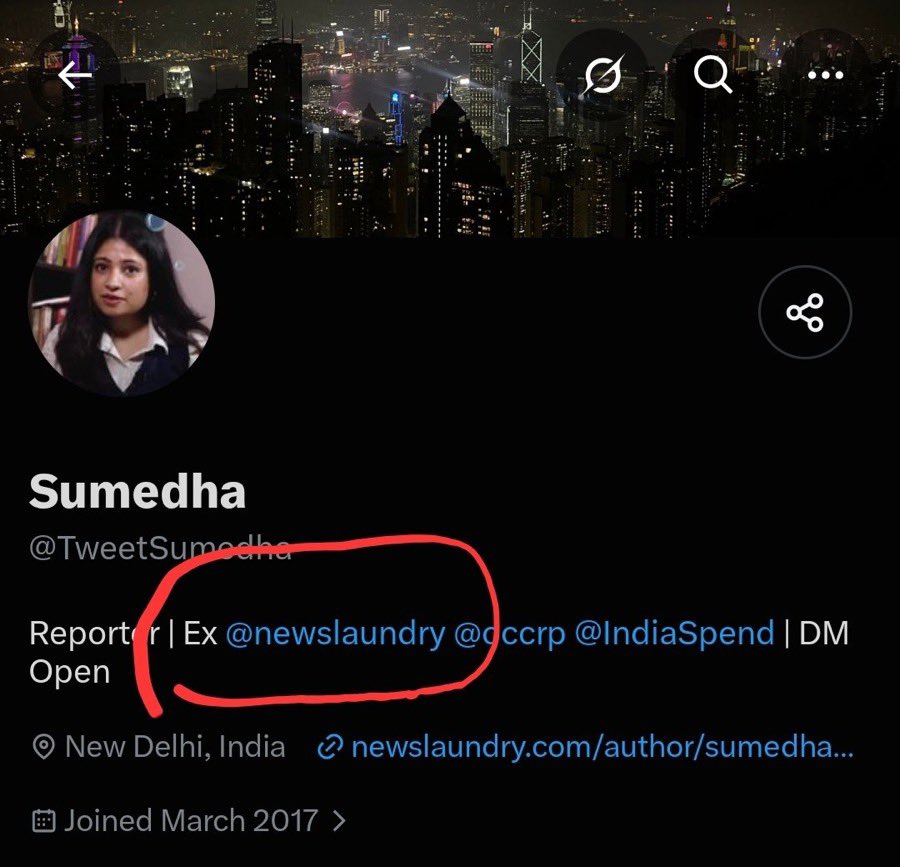
Former journalist Sumedha Mittal responded to a post discussing the deletion, writing: “Really appreciate it. I also hope the day comes when they reflect just as seriously on the sexual harassment complaints within their own newsroom.”
Another former Newslaundry writer, Sayantan Ghosh, also came forward with a detailed account of his experience at the organisation.
Ghosh said he joined Newslaundry as a trainee journalist in 2016 after leaving a content-writing job in Bengaluru.
According to his account, the working environment he experienced was “extremely toxic”, particularly because of the language allegedly used by Abhinandan Sekhri towards employees.
He wrote, “The language used by Abhinandan Sekhri towards employees was deeply hurtful to me.”
Ghosh said colleagues had told him that such behaviour was simply “normal” in the media and that journalists needed to develop a thick skin.
He disagreed.
“But it was not normal to me.”
Ghosh compared his experience at Newslaundry with his earlier internships at The New Indian Express and The Telegraph, saying that he had not encountered editors abusing reporters or interns in the manner he claimed to have experienced at Newslaundry.
He recalled one particular incident after he had written a story concerning Section 66A.
“One day, after I wrote a story on Section 66A, the abuse was so harsh that I remember lying to the person I was reporting to and fleeing.”
He said he remained in Delhi for another week until his parents could arrange a train ticket, after which he returned to Kolkata.
Ghosh said he had considered writing about his experience several times but had been reluctant because he feared being bullied or intimidated.
“I knew how people could be bullied and intimidated, and for a long time I doubted myself.”
He concluded, “Today, as many people are talking I think it was important for me to speak up.”
I think it is time to speak up.
I joined Newslaundry as a trainee journalist in 2016—I cannot recall the exact month—with a dream. I had just passed out of college and wanted to do the kind of independent journalism I believed in. At the time, I was working as a content writer… https://t.co/DPIQsiW8Lj
— Sayantan Ghosh (@sayantan_gh) August 9, 2026
Questions Over Newslaundry’s POSH Mechanism
The former employees’ allegations have now raised questions over Newslaundry’s own handling of workplace sexual-harassment complaints and the functioning of its Internal Committee under the Prevention of Sexual Harassment (POSH) framework.
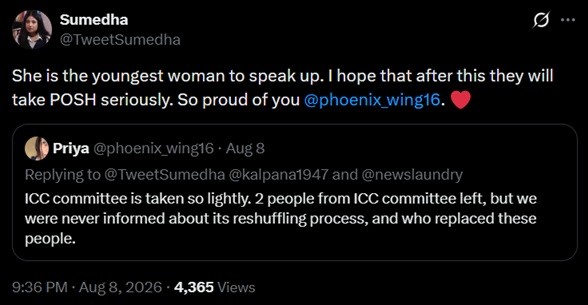
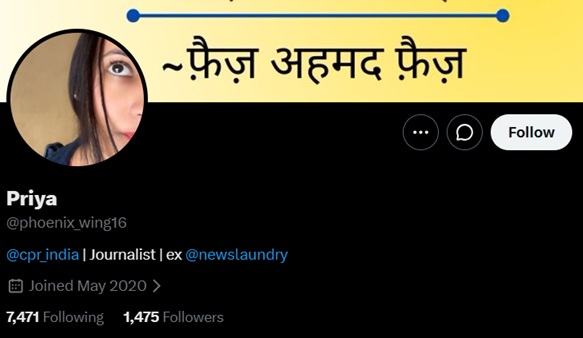
A post by another former employee, Priya, also questioned the functioning of the organisation’s Internal Complaints Committee.
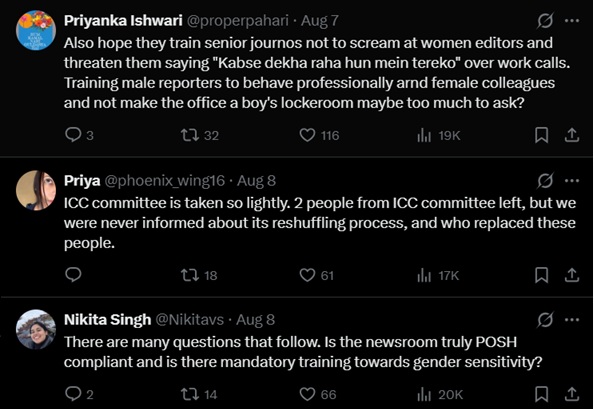
She wrote, “ICC committee is taken so lightly. 2 people from ICC committee left, but we were never informed about its reshuffling process, and who replaced these people.”
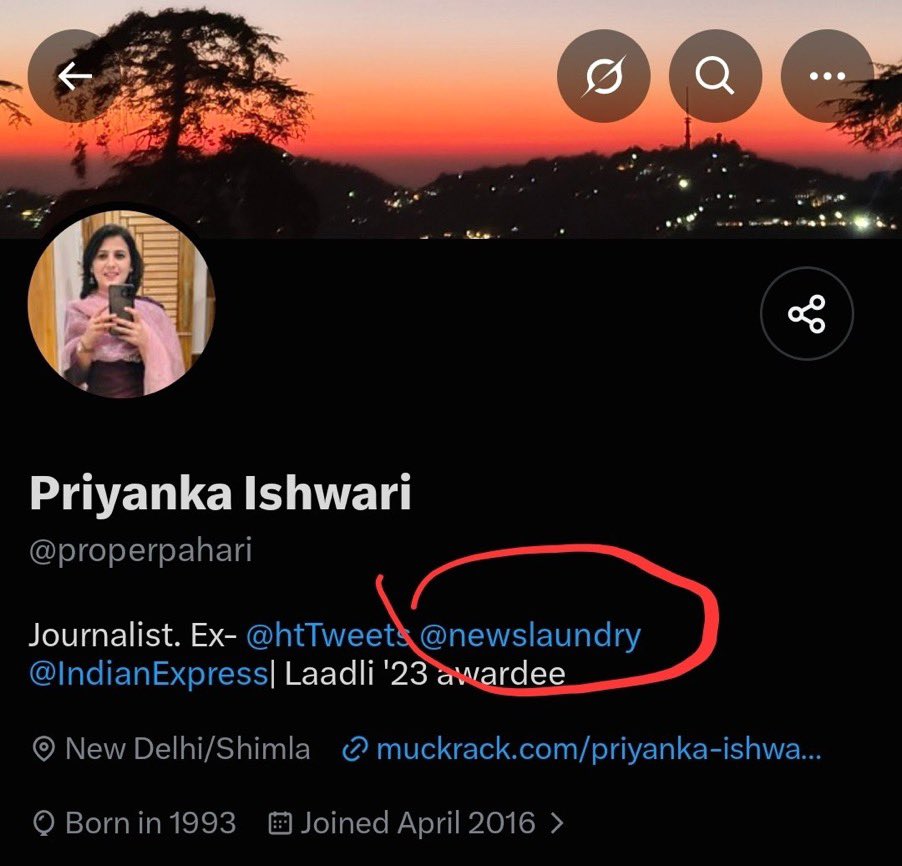
Another former employee, Priyanka Ishwari, raised separate concerns about the treatment of women employees and alleged inappropriate behaviour by senior journalists.
She wrote, “Also hope they train senior journos not to scream at women editors and threaten them saying ‘kabse dekha raha hun main tereko’ over work calls. Training male reporters to behave professionally and female colleagues and not make the office a boy’s lockerroom maybe too much to ask?”
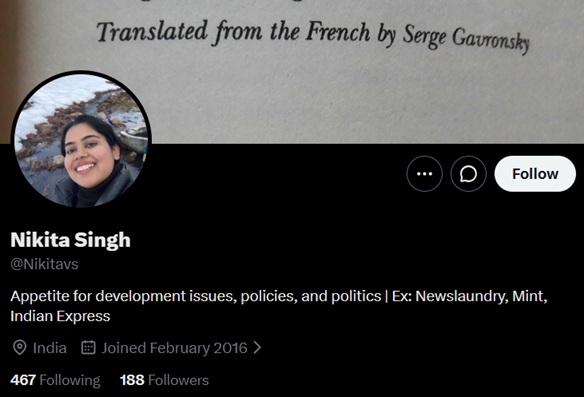
Another former employee, Nikita Singh, wrote, “There are many questions that follow. Is the newsroom truly POSH compliant and is there mandatory training towards gender sensitivity?”
These are allegations made publicly by former employees and should not be treated as established findings. It is also not clear from the available material whether the former employees had formally filed complaints against Abhinandan Sekhri or other senior editors through Newslaundry’s internal mechanism.
Preaching From The Pulpit
The problem becomes harder to ignore when the preacher himself has repeatedly indulged in the kind of conduct his platform claims to scrutinise. On Newslaundry and The News Minute podcasts, Abhinandan Sekhri has been using crude, sexist and toxic language while discussing women and workplace issues – behaviour that is often reduced to “banter” and met with laughter rather than accountability. When senior leadership itself normalises such conduct, the message to the newsroom is clear: the rules being preached to others do not necessarily apply at the top. Far from challenging toxic behaviour, such a culture only legitimises it and gives others licence to take it even further.
Newslaundry’s Editorial Record Faces More Questions
The questions surrounding Newslaundry do not end with its handling of sexual harassment. Its editorial record has also faced serious criticism over its coverage of tuberculosis and the drug bedaquiline.
In 2018, Newslaundry published “TB and the woeful state of health reporting in India,” which criticised reporting on bedaquiline, including coverage published under Vidya Krishnan’s byline. The article argued that the reporting had focused on access to the drug while overlooking what it described as procedural issues surrounding its rollout.
About @newslaundry: B/w 2015–17, as TB patients & activists were fighting for access to lifesaving new drugs available worldwide, they ran a relentless, deeply uninformed campaign against-w. real consequences for patients
The drug is now part of India’s national TB policy FYI pic.twitter.com/lxy4BxXkva
— Vidya (@VidyaKrishnan) August 10, 2026
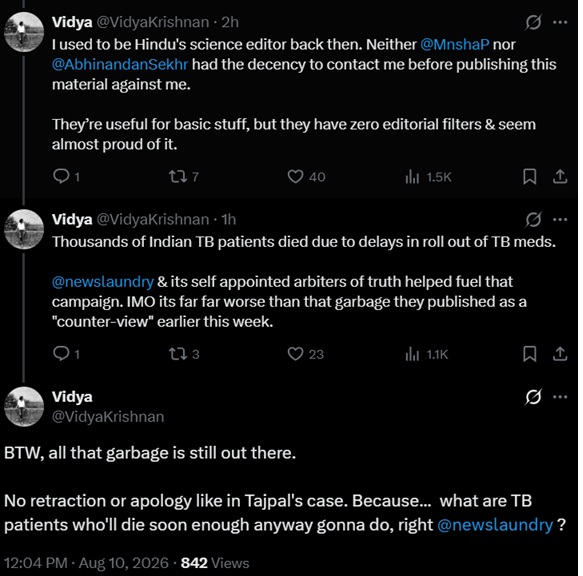
Krishnan has now resurfaced the episode, alleging that Newslaundry itself ran a “relentless, deeply uninformed campaign” against TB patients and activists fighting for access to newer medicines. She said she was Newslaundry’s science editor at the time and that neither Abhinandan Sekhri nor another senior editor contacted her before publishing material concerning her work.
She has also accused the organisation of having “zero editorial filters”, alleging that its coverage helped fuel a campaign with real consequences for TB patients. She pointed out that bedaquiline subsequently became part of India’s national TB policy and has questioned why Newslaundry has never issued a retraction or apology over the reporting.
The allegation adds another dimension to the questions now confronting Newslaundry. A publication that routinely positions itself as an arbiter of journalistic ethics cannot demand accountability from everyone else while treating questions about its own editorial decisions, internal culture and the consequences of its reporting as someone else’s problem.
Hypocrisy, Thy Name Is Newslaundry
The issue is no longer just about one 2014 article. Newslaundry built its brand around ‘exposing’ hypocrisy, sexism and institutional failure yet its own record now shows that it was exactly indulging in the same. Its decision to quietly remove the Tejpal piece does not erase what was published, who was given a platform, or the views that were defended at the time. Nor does it answer the allegations raised by former employees about workplace conduct, POSH mechanisms and editorial accountability. For a publication that routinely lectures others on ethics, routinely pleads for financial support from general public, that makes the questions surrounding its own editorial standards and workplace culture even harder to brush aside. If readers are being asked to put their money behind an organisation in the name of ‘independent, ethical’ journalism, they are entitled to ask whether those standards are actually being upheld inside the organisation itself. Reader funding cannot become a one-way transaction in which Newslaundry asks the public to trust its journalism while resisting scrutiny of its own conduct.
Subscribe to our channels on WhatsApp, Telegram, Instagram and YouTube to get the best stories of the day delivered to you personally.