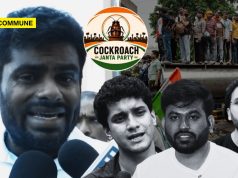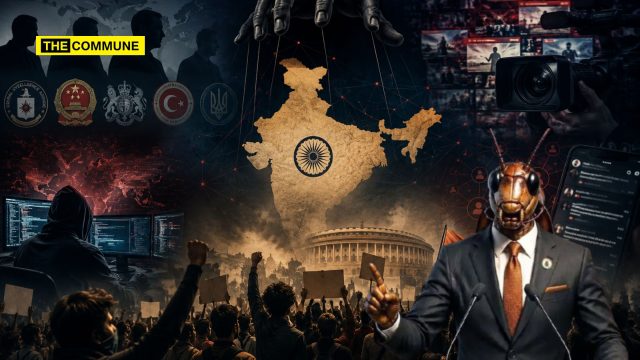
The Cockroach Party seemed to have begun organically but with time, the usual suspects started appearing one by one. Slowly, they descended into the same blueprint of protests over ‘government failures’. But what seemed like a legitimate cry of desperation from India’s Gen Z, fueled by real grievances, from medical entrance exam scandals affecting 2.3 million aspirants to persistent youth unemployment hovering near 14% in urban areas, has increasingly shown signs of being hijacked by forces far beyond student discontent.
The movement’s evolution reveals a troubling pattern. When CJP founder Abhijeet Dipke, operating from the United States, called for street mobilisation, hundreds of students, professionals, and families gathered peacefully at Delhi’s Jantar Mantar demanding Education Minister Dharmendra Pradhan’s resignation. This slowly morphed into demands for resignation of PM Modi, overthrowing the government and calling for regime change while also calling for the assassination of the PM.
It is an open secret that India is increasingly facing what can be described as an unprecedented hybrid warfare campaign, with multiple foreign intelligence agencies including the CIA (United States), China’s Ministry of State Security (MSS), Britain’s MI6, Turkey’s National Intelligence Organization (MIT), and Ukrainian intelligence allegedly working in tandem to engineer a coup or coup-like situation in the country.
While such operations rarely leave behind direct documentary evidence, the convergence of geopolitical developments, information warfare, foreign media narratives, and coordinated digital influence campaigns points towards a concerted attempt to destabilise India.
The ongoing Cockroach Janta Party (CJP)-led protests in New Delhi over education reforms and alleged examination paper leaks have become the latest flashpoint in this broader contest. As the agitation gathered momentum, several foreign journalists arrived on the ground to cover the demonstrations. Among them was Ellie Grounds, the South Asia correspondent for Australia’s national broadcaster ABC News, who was seen reporting from the protest site.
The journalist in the image is Ellie Grounds, the South Asia correspondent for Australia’s national broadcaster, ABC News.She was seen on the ground in New Delhi covering the massive youth-led Cockroach Janta Party (CJP) protests regarding education reform and paper leaks. pic.twitter.com/LtgBvVelFm
— MajorSammerToor (@MajorSammerToor) July 21, 2026
Such operations are consistent with the modern doctrine of hybrid warfare, where intelligence agencies rely less on conventional espionage and more on information operations, influence campaigns, cyber capabilities, proxy networks, and narrative manipulation to weaken adversaries from within.
Hybrid warfare does not seek to defeat an adversary through military invasion alone. Instead, it combines information warfare, psychological operations, cyber capabilities, economic pressure, diplomatic influence, proxy networks, media narratives, lawfare, and the mobilisation of domestic actors to weaken a nation from within. The objective is not merely to change governments but to erode public trust in institutions, deepen social fault lines, paralyse governance, and create conditions favourable to external strategic interests.
India, too, has previously identified and responded to instances of foreign interference. Indian authorities have, over the years, investigated or alleged activities involving espionage, cyberattacks, extremist financing, support for separatist movements, and foreign influence operations by both state and non-state actors. However, these activities have varied significantly in their objectives and scope and do not necessarily constitute attempts to overthrow the government.
While one may wonder if there is direct corroborative evidence, there may not be something that would pinpoint the truth, but if one connects the dots of the various sources available on the internet, it will become clear that the recent protests are not organic but engineered with the sole motive of destabilizing the country.
One of the defining characteristics of hybrid warfare is narrative dominance. Before political outcomes can be influenced, public perception must first be shaped. International media outlets, social media platforms, NGOs, influencers, and advocacy networks often become force multipliers by amplifying particular narratives while suppressing competing ones. Whether by design or coincidence, controlling the information environment is central to every modern influence campaign.
Take for example the way the BBC has reported the protests over the past month.
In India, tens of thousands of Gen Z protesters have taken to the streets of the capital Delhi, calling for the resignation of the country’s education minister. Read more: https://t.co/p1xH4wPPQ0 pic.twitter.com/T98Xk5DoSq
— BBC News (World) (@BBCWorld) July 21, 2026
It is noteworthy that when foreign media starts portraying the reality with their version of truth or rather a prepared narrative, there surely is a foreign hand in the process.
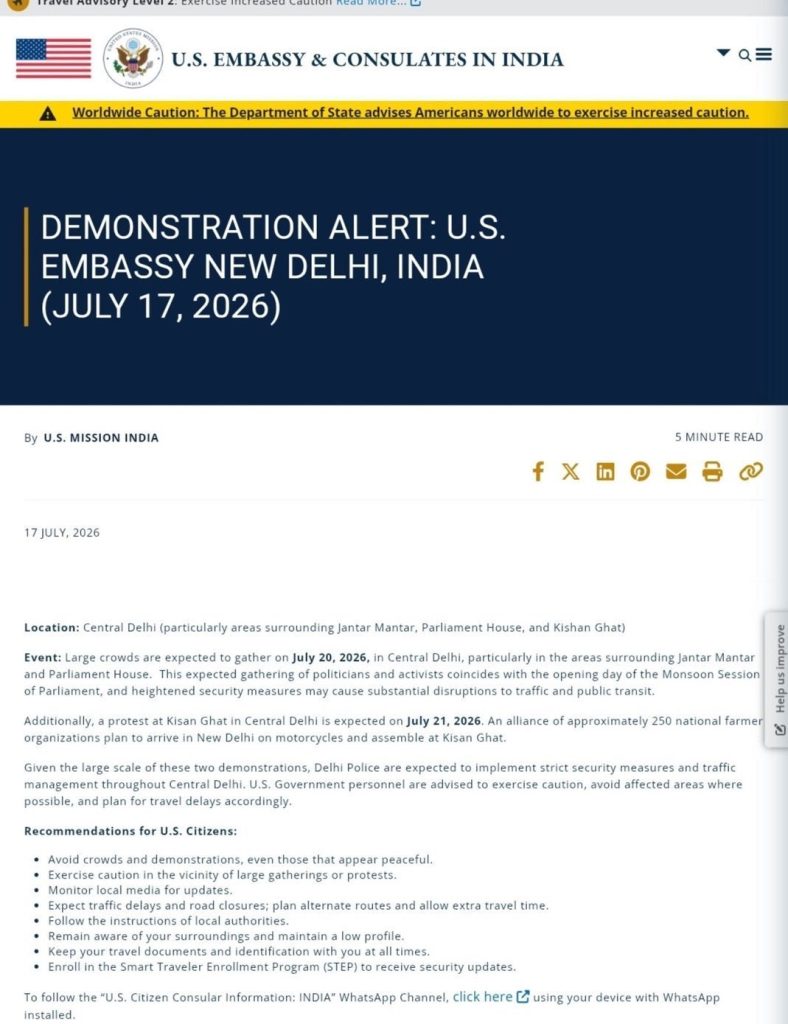
Another recurring feature of hybrid conflicts is the presence of diplomatic signalling before periods of unrest. Several days before the 20 July demonstrations, the U.S. Embassy in India issued an advisory warning its citizens about an upcoming protest on 21 July 2026 – this was not announced anywhere in the media. While embassies routinely issue security advisories, the timing of this alert has prompted questions over how advance information regarding a protest that had not been widely publicised became available.
Security experts generally describe contemporary geopolitical competition through the framework of hybrid warfare, which encompasses cyberattacks, information operations, economic coercion, influence campaigns, and the use of proxy actors rather than conventional military interventions or coups. Democracies, including India, are frequently regarded as targets of attempts by different foreign actors to influence public discourse or exploit existing political and social divisions.
A Multiple foreign intelligence agencies such as the CIA (United States), MSS (China), MI6 (United Kingdom), Turkey’s MIT, and Ukrainian intelligence—are jointly attempting to engineer a coup or coup-like situation in India .These claims are equally strong and backed by… pic.twitter.com/4GV6mSPUL2
— MajorSammerToor (@MajorSammerToor) July 21, 2026
Hybrid Warfare Extends Beyond The Streets
Modern hybrid warfare is not limited to protests alone. It often combines funding networks, international advocacy organisations, think tanks, legal interventions (lawfare), sanctions campaigns, lobbying, diplomatic pressure, and coordinated media messaging to create sustained pressure on a target state. Rather than relying on military force, the objective is to stretch state capacity across multiple fronts simultaneously, making domestic instability appear entirely organic.
How Social Media Is Fuelling Unrest
If traditional media shapes international narratives, social media serves as the battlefield on which hybrid warfare is actually fought.
Social media has emerged as the primary battleground for contemporary unrest, transforming online anger into offline mobilization with unprecedented speed. In India, the Cockroach Janta Party (CJP) protests, which began as a satirical Instagram campaign over unemployment and exam paper leaks, amassed over 15 million followers within days, demonstrating digital platforms’ unparalleled capacity for mass coordination and narrative construction.
However, these same platforms have become conduits for destabilizing disinformation. During the July 2026 protests, viral videos falsely claiming police used nail-fitted batons on students were debunked by Delhi Police, while PIB Fact Check dismissed widespread social media posts alleging a protester’s death. Simultaneously, casteist attacks branding protesters as “Bhimtas” flooded X, shifting public debate away from state accountability and toward social polarization.
The foreign footprint in this digital information war is increasingly visible. X’s “About this account” transparency feature has revealed that numerous (alleged) Indian political influencers particularly those critical of the government operate from foreign locations including Pakistan, Germany, and the United States. During the Jantar Mantar violence, Delhi Police specifically investigated Pakistani social media handles that spread false claims about deaths and injuries, examining whether cross-border misinformation played a role in escalating tensions.
The pattern is not unique to India. The 2024 Bangladesh uprising saw a surge in coordinated disinformation campaigns amplified through social media echo chambers. Approximately 44% of disinformation originated from Facebook pages, utilizing altered videos, out-of-context images, and AI-generated deepfakes, while diaspora networks across 39 countries played pivotal roles in amplifying protest narratives.
The structural mechanics of social media make it uniquely susceptible to weaponization. Algorithms reward sensational, emotionally charged content over factual reporting, creating echo chambers where misinformation thrives. Low media literacy among users, partisan mistrust, and the declining credibility of traditional media allow false claims to achieve viral reach before fact-checkers can intervene. The UK’s 2024 Southport riots demonstrated a structured disinformation lifecycle, where false narratives seeded in anti-immigrant echo chambers years earlier were explosively amplified during the crisis.
This convergence of rapid mobilization, cross-border influence operations, algorithmic amplification, and declining institutional trust has made social media an active driver of instability, capable of manufacturing crises that would not otherwise exist. The very platforms that enable democratic expression have become weapons in an ongoing information war, with foreign-owned corporations holding unprecedented power over what narratives survive and which are suppressed.
Alleged Foreign Hand In Asian Regime Changes (2020–2026)
Multiple political upheavals around the Indian subcontinent region since 2020 have been shadowed by allegations of foreign interference.
In Pakistan (2022), Prime Minister Imran Khan was ousted via a no-confidence vote. Khan and his allies have consistently alleged a U.S.-backed conspiracy, citing a leaked diplomatic cable (the “cipher“) in which a U.S. official reportedly suggested ties would improve if Khan were removed. Washington denies any role.
Sri Lanka (2022) saw mass protests force President Gotabaya Rajapaksa to resign. Opposition politicians, including Namal Rajapaksa, have called for investigations into alleged foreign funding of the “Aragalaya” movement, though the protests are widely seen as organic and citizen-driven.
In Bangladesh (2024), Prime Minister Sheikh Hasina’s government collapsed amid student-led protests. A former minister alleged that U.S. organizations like USAID and the IRI funded destabilization efforts, while intelligence assessments also pointed to Pakistan’s ISI as an external actor. Hasina herself has made similar accusations.
Most recently, Nepal (2025) witnessed Gen-Z protests toppling KP Sharma Oli’s government. Leaked documents allegedly show U.S.-funded organizations (NED and IRI) trained young activists in protest tactics over years, though Washington denies direct facilitation.
These allegations follow a pattern, and, in each case, the existing government was toppled and a new one installed. This was ably aided by the foreign media.
Against this regional backdrop, India’s recent cycle of mass protests should also be examined through the lens of hybrid warfare and foreign influence operations.
We have been seeing protests in India ever since the Modi government came back to power for the second time in 2019. We saw the anti-CAA/NRC protests, the Farm Law protests by the so-called farmers, the 2023 wrestler’s protest, the Manipur unrest and protests from 2023, the Ladakh protest (although isolated to Ladakh region) ended in violence, the 2024/25 farmers protest in Shambhu border and now the Cockroach protests with anarchist Sonam Wangchuk at the centre of the hunger strike.
India’s Challenge In The Age Of Hybrid Warfare
Hybrid warfare is deliberately designed to remain below the threshold of conventional conflict. Unlike military invasions, it leaves behind no declaration of war, no identifiable battlefield, and often no single piece of conclusive evidence. Instead, its effects emerge gradually through the cumulative interaction of information campaigns, cyber activity, diplomatic signalling, economic pressure, and the exploitation of domestic grievances.
This inherent ambiguity makes attribution exceptionally difficult, which is why analysts increasingly rely on patterns, convergence of events, and behavioural indicators rather than isolated incidents when assessing potential influence operations. As India continues its rise as a major geopolitical and economic power, strengthening resilience against such multifaceted threats, while distinguishing legitimate democratic dissent from foreign influence operations, will remain one of its most significant national security challenges.
Subscribe to our channels on WhatsApp, Telegram, Instagram and YouTube to get the best stories of the day delivered to you personally.