
The Joseph Vijay TVK government may be presenting the search for Chennai’s second airport as a swift response to the cancellation of the Parandur project. But the two locations now being discussed: Gummidipoondi and Cheyyur raise a more fundamental question:
Were these sites actually selected because they are viable for an airport, or because they are locations that could face major hurdles before the project gets off the ground?
The government has indicated that two locations are under consideration. Gummidipoondi is one. Cheyyur, along the ECR beyond Mahabalipuram and Kalpakkam towards Puducherry, is the other.
Of the two, Gummidipoondi raises questions over whether an airport there would serve Tamil Nadu’s interests effectively at all.
Located close to the Andhra Pradesh border, the area already has strong economic links with neighbouring Andhra districts. An airport at Gummidipoondi could end up benefiting businesses and workers from Andhra more than southern and central Tamil Nadu.
For people travelling from districts such as Kanyakumari, Madurai, Sivaganga, Ramanathapuram and other parts of southern Tamil Nadu, the location would remain far removed from the economic centre of gravity of Chennai.
That raises a basic question: if the airport is intended to strengthen Chennai and Tamil Nadu’s economic position, why choose a site so close to Andhra Pradesh?
But Cheyyur presents an entirely different set of problems.
Cheyyur: The Site With Too Many Obstacles?
Cheyyur has reportedly emerged as a preferred location for the new airport. The area lies along the ECR, roughly 30 kilometres beyond Kalpakkam towards Puducherry.
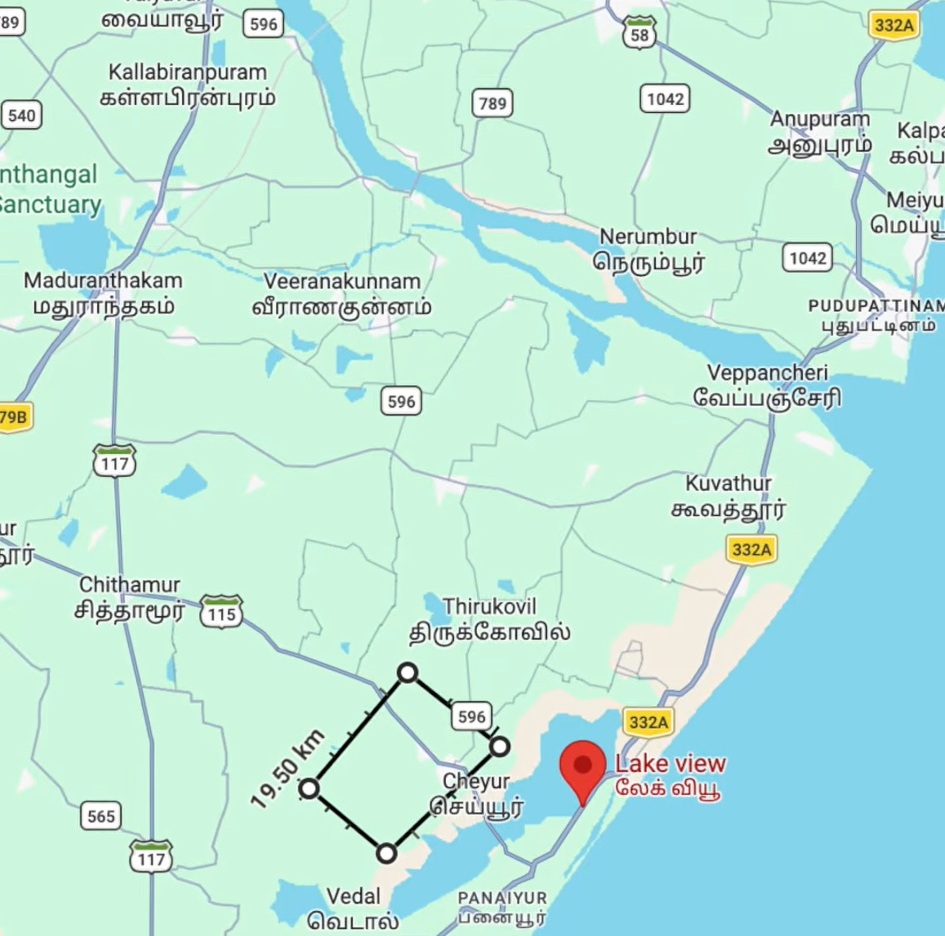
At first glance, its location may appear attractive.
But an airport is not simply a matter of identifying an open patch of land on a map.
A project of this scale requires thousands of acres, extensive land acquisition, environmental clearance, aviation-related approvals, connectivity and the absence of serious safety hazards.
And Cheyyur appears to face questions on each of these fronts.
The proposed requirement is understood to be around 5,000 acres. Yet the available land in the immediate Cheyyur area is nowhere near that scale without involving multiple settlements.
Villages including Zamin Pudur, Devanur and Sitharkadu could potentially fall within the larger acquisition footprint.
That means the project could involve the displacement or relocation of hundreds of families, potentially 500 to 1,000 households, according to the concerns being raised.
Land acquisition alone could therefore become a prolonged and politically sensitive process.
Then Comes Odiyur Lake
The more serious concern is the presence of Odiyur Lake, near Cheyyur.
The lake is known as an important habitat for migratory birds, with reports of more than 77 species visiting the region.
These include birds arriving from distant parts of Europe, Siberia, Kazakhstan, the Middle East and China.
Some species travel thousands of kilometres during their migration.
That creates a direct aviation-safety question. Bird strikes are a recognised hazard for aircraft.
Airports therefore have to carefully assess bird activity in and around proposed flight paths. The concern is not restricted to whether birds occupy one particular lake on one particular day.
Migratory birds can move between wetlands and water bodies depending on conditions.
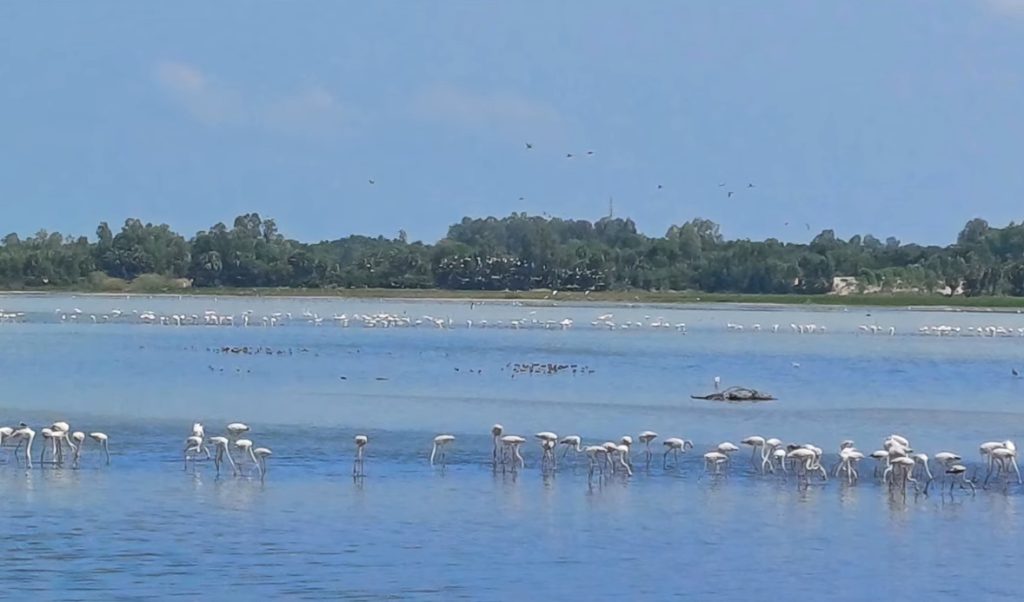
That means the wider ecological landscape around an airport site matters.
If Cheyyur’s proposed airport footprint overlaps with a major migratory-bird habitat, the government would have to establish through detailed environmental and aviation studies whether the location can safely receive the necessary clearances.
Until such studies are completed, simply announcing Cheyyur as a preferred site proves very little.
The Land Cost Could Be Another Problem
There is also the question of money.
The Parandur project involved a massive land-acquisition exercise, but the cost of acquiring land there was considerably lower than what could be expected along the ECR.
Land prices around Cheyyur and the ECR corridor are significantly higher.
If thousands of acres have to be acquired, the bill could run into several thousand crore rupees, with estimates being raised as high as ₹10,000 crore, depending on the final acquisition area and compensation.
That creates a basic financial question: Where will the money come from?
The government has already abandoned a project that had been under consideration for years. If the replacement project requires substantially more expenditure merely to acquire land, the financial viability of the proposal itself has to be examined.
Transmission Lines Add Another Hurdle
The site also has major electricity transmission infrastructure.
Large high-voltage transmission lines and towers passing through or around the proposed acquisition area would create another planning challenge.
If the airport’s runway, terminal or associated infrastructure conflicts with those corridors, the government could be required to relocate or reroute transmission infrastructure.
That would mean additional costs, additional approvals and additional delays.
Once again, the question is not whether the government can technically overcome the obstacle.
It is whether Cheyyur is genuinely a better airport site than the alternatives when all these costs and complications are taken into account.
What About Kalpakkam?
There is another factor that cannot simply be ignored. Cheyyur is relatively close to Kalpakkam, home to major nuclear facilities. The distance alone does not automatically make an airport impossible.
But a project involving a 5,000-acre airport and large-scale flight operations in the vicinity of such sensitive infrastructure would inevitably require detailed assessment by the relevant authorities.
That is precisely why the government’s site-selection process needs to be transparent.
Before celebrating the announcement, the public needs to know what studies were conducted, what alternatives were examined and what the authorities concluded.
Why Was Cheyyur Chosen?
This is ultimately the central question. The Parandur airport project had been under development for around a decade before being cancelled. Tamil Nadu still needs a second airport for Chennai.
There is therefore enormous pressure on the government to demonstrate that it is moving quickly. But speed in announcing a site is not the same as speed in building an airport.
A location can be announced today and remain stuck for years because of land acquisition, environmental objections, wildlife concerns, aviation clearances, transmission infrastructure or financial constraints.
That is why the government must release the technical assessment behind the selection.
- What did the feasibility study say?
- How many acres are actually available?
- How many families would have to be relocated?
- What is the projected land-acquisition cost?
- What does the bird-hazard assessment say?
- What is the status of Odiyur Lake?
- What happens to the transmission lines?
- What are the aviation safety implications of the site’s proximity to Kalpakkam?
And most importantly: Why was Cheyyur considered superior to Parandur or other alternative sites? These are basic questions, not political objections.
Is the Government Setting Up Another Delay?
The choice of Cheyyur could ultimately produce a familiar outcome: announce a new airport site, generate political publicity around the decision and then allow environmental, land-acquisition or aviation objections to stop the project.
If that happens, the government could claim that it had acted swiftly but that the project was blocked by external factors.
That would effectively buy more time while Chennai continues without its urgently needed second airport. Such an outcome would also have economic consequences.
While Tamil Nadu debates locations and approvals, neighbouring Andhra Pradesh is aggressively expanding its airport and industrial infrastructure.
Andhra Pradesh is also pursuing large-scale land-bank and industrial-development strategies aimed at having land ready when companies arrive.
The concern, therefore, is not merely about where Chennai’s second airport will be located.
It is about whether Chennai will lose another several years while competing cities and states move ahead.
The Bigger Issue
The government cannot treat the airport announcement as the achievement. The achievement will be obtaining clearances, acquiring land, completing construction and actually opening the airport.
If Gummidipoondi is unsuitable because of its location and economic utility, that needs to be demonstrated.
If Cheyyur is unsuitable because of land acquisition, migratory birds, environmental concerns, transmission infrastructure, cost or proximity to sensitive facilities, those concerns need to be addressed before the site is presented as a solution.
Otherwise, the government risks repeating the same cycle: cancel the old airport, announce a new site, face predictable objections and lose more years.
Tamil Nadu does not need another airport announcement. It needs a site that can actually survive scrutiny.
And that is why the most important question today is not “Which site has Vijay chosen?” It is: “On what technical basis was that site chosen — and can it actually clear the approvals required to build an airport?”
Subscribe to our channels on WhatsApp, Telegram, Instagram and YouTube to get the best stories of the day delivered to you personally.