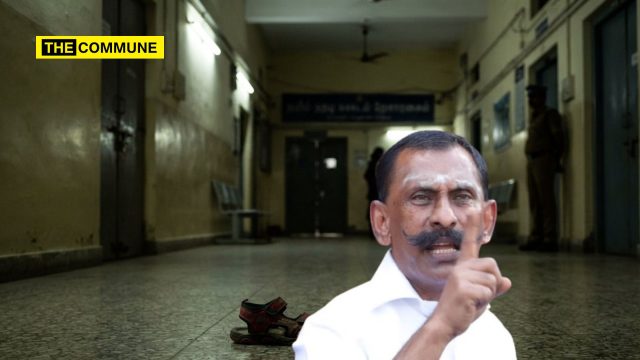
Former Idol Wing Inspector General Pon Manickavel has raised serious questions over the number of children, particularly girls, who remain untraced in Tamil Nadu, alleging that thousands of missing children have not been accounted for by the police.
Addressing a press meet, Manickavel questioned successive governments over their record in tracing missing children and argued that the more important figure is not how many cases the police solved, but how many children they failed to trace.
According to figures cited by him, 1,062 children remained untraced in 2017. The number, he stated, rose to 1,295 in 2018 and 1,410 in 2019.
For 2020, he cited another 1,624 untraced children, describing it as the highest figure in the period he was discussing.
He then cited 1,590 cases in 2021, followed by around 1,500 in 2022, and 1,485 in 2023.
Manickavel said these figures concerned girl children, particularly those missing between infancy and the age of 18.
‘Don’t Tell Me How Many Were Found. Tell Me How Many Were Not’
Taking aim at the way governments present crime statistics, Manickavel said the public should be asking a different question.
Instead of merely highlighting the number of missing children who were traced, he said authorities must disclose how many remained untraced.
“How many crimes could not be detected? That is what I am talking about,” he said, arguing that this was more relevant to the public.
He also questioned why governments and police authorities do not prominently disclose the number of missing children who remain untraced.
Questions Over Government Hospitals
Manickavel also raised concerns about the locations from which children allegedly go missing.
He stated that a significant number of such incidents occur around government hospitals and other public spaces.
He questioned whether government hospitals were becoming vulnerable points for child abduction and demanded accountability from officials responsible for security and administration.
“If this is happening predominantly in government hospitals, are government hospitals becoming centres for abducting girl children?” he asked.
He questioned the responsibility of hospital deans, police officers and other officials in charge of such institutions.
‘Who Is Responsible?’
Manickavel repeatedly stressed that government officials are paid by taxpayers and must therefore be answerable to the public.
He questioned why senior officials should not be held accountable when children disappear from locations under government control.
“If I am paying the salary, the person receiving it has to do the job. We will question them,” he said.
He also argued that questioning a Chief Minister or government official over administrative failures was not an insult, but a basic part of democracy.
‘Where Are These Children?’
Manickavel’s central question was simple: where are the children who remain untraced?
He questioned whether authorities could establish what happened to children who disappear and remain missing for years.
He referred to possibilities ranging from abduction to death and demanded that authorities provide answers to the families waiting for their children.
He also pointed to vulnerable circumstances in which children can disappear, including women leaving their homes with their children after domestic disputes, families sleeping in public places and crowded locations such as festivals.
According to him, such circumstances can leave young children particularly vulnerable to abduction.
‘Answer the Children’
Manickavel also challenged political leaders to respond to the families of missing children rather than treating the issue merely as a statistical matter.
He asked whether the children of senior police officers or senior government officials had disappeared in similar circumstances, suggesting that the issue disproportionately affects vulnerable families.
Subscribe to our channels on WhatsApp, Telegram, Instagram and YouTube to get the best stories of the day delivered to you personally.