In a significant development in what is suspected to be a large-scale scam involving Class 12 public exams in Tamil Nadu, a CB-CID team arrested nine individuals, including four government employees, in Madurai on 25 July 2024. The arrests were made for allegedly altering the answer sheets of two Class 12 students in three subjects during the 2023 board exams.
According to sources from the CB-CID, those arrested include superintendent Rama Prabakaran and junior assistant Kannan from the Madurai District Education Officer (Elementary) office; Paramasivan, a government schoolteacher from Melur; Karthick Raja, a lab assistant at Kottampatti government school; the parents of the two students, and one of the students involved. Authorities are still searching for the second student, who is currently on the run. Both students attended a private school in Madurai city.
The malpractice came to light in 2023 when an exam official noticed that the answer sheets of the two students had similar handwriting during a super check. Further investigation revealed the same handwriting across answer sheets for mathematics, physics, and chemistry.
The school education department responded by issuing memos to the students, questioning why they should not be barred for five years due to the malpractice. Their mark sheets were also withheld. Initially, the students maintained that their answer sheets were genuine but later retracted their statements.
One of the parents took the matter to the Madurai Bench of the Madras High Court, seeking to quash the memo and compel the department to issue the mark sheet to his son. The court directed Tallakulam police to register a formal case based on a complaint from the joint director (higher secondary), which was later transferred to the CB-CID in November 2023. Another parent filed a similar petition, but the court dismissed it.
During the investigation, police discovered that Kannan and Prabakaran, with assistance from Paramasivan and Karthick Raja, had replaced the students’ answer sheets for a payment of ₹1 lakh per paper. Handwriting analysis revealed that one of the four government staff members’ handwriting matched that on the answer sheets. The answer sheets have been sent for further analysis, sources said to TNIE.
A vlogger was attacked by a group of women from Tamil Nadu in Palakkad on 26 July 2024 for allegedly posting obscene videos and making derogatory comments against women in a WhatsApp group. The incident occurred within the Agali police station limits when a group of women from various parts of Tamil Nadu confronted the vlogger, Mohamadali alias Jinna, 39, a native of Kottathara Chantakada.
Jinna, who runs a textile shop in Agali, was confronted by around 15 women who questioned him about his actions on social media. According to the police, the women claimed that Jinna had posted obscene photos and comments in a women’s group on WhatsApp as well as Instagram.
It is alleged that he has an Instagram handle, Romantic Jinna, where he posts such photos and videos of women without their permission.
The confrontation escalated into a physical altercation. As per the complaint, TOI reported that Jinna allegedly tore women’s clothes during the scuffle, prompting them to tie his hands and assault him. Agali police registered cases against both parties based on their complaints.
The women accused him of morphing and circulating obscene pictures of many women through social media platforms such as Instagram. The group, consisting of individuals from Thoothukudi, Salem, Tirupur, Trichy, Hosur, and Dharmapuri, travelled to Palakkad to confront Jinna.
Police arrived at the scene while Jinna was still tied up and being beaten. He was taken to the hospital for treatment. Cases have been registered against him for insulting women and against the 13 women based on his complaint.
It is worth noting that this ‘Romantic Jinna’ had more than 57 thousand followers on his Instagram handle, raising concerns about the kind of subscribers
Subscribe to our channels on Telegram, WhatsApp, and Instagram and get the best stories of the day delivered to you personally.

The News Minute has been spreading propaganda by publishing former IAS officer Devasahayam’s misleading critique of the NDA government’s decision to lift a 58-year ban on government employees participating in RSS activities. Devasahayam falsely links the RSS to Gandhi’s assassination, distorting historical facts and ignoring the organization’s positive contributions.
The outlet’s uncritical amplification of his baseless claims undermines journalistic integrity and contributes to misinformation.
The Modi-led NDA government at the centre lifted a 58-year ban on government employees participating in activities of theRashtriya Swayamsevak Sangh (RSS). This move sparked a political controversy. The ban was issued 58 years ago, in 1966, whereby government employees were forbiddenfrom taking part in the activities of the Rashtriya Swayamsevak Sangh. The ban was imposed because, on 7 November 1966, there was a massive anti-cow-slaughter protest at the Parliament. RSS-Jana Sangh mobilised support in huge numbers and many people died in police firing. On 30 Nov 1966, shaken by the RSS-Jana Sangh clout, Indira Gandhi banned government staff from joining the RSS.
The leftist mouthpiece, The News Minute, came up with a tirade of an article on their portal written by former IAS officer and now a self-styled ‘activist’ and a ‘devout Christian‘ Devasahayam.
Very conveniently, he uses this news to once again peddle the propaganda that RSS killed Mahatma Gandhi. He wrote,“The RSS was initially declared an unlawful organisation in 1948 due to concerns over its activities after a member, Nathuram Godse, assassinated Mahatma Gandhi. Sardar Vallabhbhai Patel, the then Union Home Minister who imposed the ban, wrote to RSS Chief MS Golwalkar on 11 September 1948.
He then quotes the letter Patel wrote to Golwalkar linking it to another leftist rag, The Caravan. He quotes Patel as having written,“Organising Hindus and helping them is one thing but going in for revenge for its sufferings on innocent and helpless men, women and children is quite another thing… All their speeches were full of communal poison. It was not necessary to spread poison in order to enthuse the Hindus organize for their protection… As a final result of the poison, the country had to suffer the sacrifice of the valuable life of Gandhiji. Even an iota of the sympathy of the Government, or of the people, no more remained for the RSS. In fact, opposition grew. Opposition turned more severe, when the RSS men expressed joy and distributed sweets after Gandhiji’s death. Under these conditions, it became inevitable for the Government to take action against the RSS…”
Calling the present government “communal and anti-secular“, he claims they lifted the ban to allow government servants to take part in the activities of the RSS. He also quotes the Central Civil Services (Conduct) Rules, 1964, clause 5, to understand what it says about government servants participating in politics. Well, Devasagam has probably wantonly overlooked the fact that RSS is not a political organization but a volunteer organization. He calls the government’s interpretation of the rules “unconstitutional“. He also goes on to claim that,“The truth is that the BJP, which is ruling the country and many states, is the political wing of the RSS.”
Devasahayam then shares a Venn diagram that describes the “Hindutva Family of Hate“. Well, Devasagayam is pouring hate in the form of the article he wrote. He calls the RSS gargantuan in size and that its octopus-like tentacles can be seen from the Venn diagram.
The Venn diagram shows the “Hindutva Family of Hate” to consist of the VHP, ABVP, BJP, and Sewa Bharathi. Interestingly, the ‘devout Christian’ activist alleges that Sewa Bharathi International and the US-based IDR often use humanitarian crises in India to raise funds and then allegedly “divert donations to Hindutva projects like missionary efforts (ghar wapsi)“.
Source: Reddit
Then he goes on ranting about the history of the Janata Party, how and why the BJP was formed, and claims that the BJP existed because the Janata Party raised the issue of dual membership as it did. He continues claiming that RSS is a political entity that is an integral part of the governance system and that it has been “made to grow colossal and like the carnivorous Madagascar Tree is sucking out and draining all democratic institutions that are fast losing their strength and vibrancy.”
He further goes on to claim that the RSS’s influence was “detrimental to democratic institutions” and could potentially make RSS membership a qualification for government service.
He quotes a report from The Print, which allegedly indicates that an RSS-backed IAS institute, Samkalp Foundation, has been grooming ‘nationalist‘ civil servants since 1986, boasting a high success rate in the UPSC exams, especially “at a time when minority institutes like Jamia and Zakat Foundation are in the middle of a row over the rising number of Muslims cracking the Civil Services Examination”. He also claims that the IAS Academy at Mussoorie also allegedly shows shades of an RSS shakha!
What Devasahayam Did Not Bother To Mention Or Understand About RSS
Devasahayam, in his lengthy tirade, only spewed venom against the RSS for allegedly being a political outfit, for influencing the IAS cadre, for grooming civil servants, etc. He also conveniently peddles the Godse-RSS connection to MK Gandhi’s killing. For the well-read, it is clear how much the RSS was “involved” in the act. Godse had left the RSS and had joined the Hindu Mahasabha, a political entity that was sworn to protect the interest of Hindus amidst the partition of India. He had become disillusioned with the RSS for not being “radical enough”. It was an act of the individual and not of the organization.
If that’s the case, can we blame Congress as a party of mass murderers because its workers targeted innocent Chitpavan Brahmins and Sikhs after Gandhi’s murder and Indira Gandhi’s assassination, respectively?
Devasagayam also failed to read about how ministers in the Nehruvian cabinet turned to the RSS for help during the 1948 violence. A recently discovered letter from 1947 reveals that India’s then-Defence Minister sought help from the RSS to rescue 20,000 women in Lahore amidst the chaos of partition. The letter, written by Defence Minister Sardar Baldev Singh to Home Minister Sardar Patel, highlighted the urgent need for assistance as Hindu and Sikh communities faced widespread violence and abductions. Singh recommended utilizing RSS resources and proposed appointing rescue officers with police and military support to aid in the operations. The letter also suggested using local informants, including those willing to adopt Islam, to gather intelligence.
Nehru, who was typically critical of the RSS, occasionally praised the Sangh Parivar, especially when Pakistan attacked Jammu and Kashmir shortly after independence, and Sangh volunteers went to assist.
While Devasahayam mentioned that Sardar Patel banned the RSS, he never mentions in the article that Patel lifted the ban on the RSS approximately 18 months later.
Babasaheb Dr Ambedkar had an election agent who was an RSS worker – Shri. Dattopant Thengadi. In 1952, Ambedkar’s Scheduled Caste Federation allied with Bharatiya Jansangh for the Madhya Pradesh elections. Ambedkar’s first formal interaction with the RSS was in 1935 at their Maharashtra training camp in Pune, and he visited an RSS shakha in Dapoli. In 1939, he attended another RSS training camp in Pune and met RSS founder Dr K.B. Hedgewar, who was impressed by the lack of caste discrimination among the volunteers.
In September 1949, RSS chief M.S. Golwalkar thanked Ambedkar in Delhi for helping lift the ban on the RSS, which had been imposed after Mahatma Gandhi’s assassination. In June 1953, senior RSS leaders met Ambedkar in Aurangabad, where he requested more information about the RSS’s outreach activities.
The RSS had already been active in aiding those trapped in Pakistan, organizing transport and security for evacuations. The book “Now It Can Be Told” by AN Bali details these efforts. Congress leaders in Punjab also sought RSS help to protect their families. Home Minister Patel later acknowledged the RSS’s crucial role in safeguarding Hindu society during these tumultuous times.
He bundles up other Hindu organizations, such as the VHP, ABVP, and Sewa Bharathi, as part of the Hindutva Hate Family. He calls Sewa Bharathi’s work of ghar wapsi as “missionary” work. So, does he acknowledge that missionary work involves illegal religious conversion?
His allegations that Sewa Bharathi raises money in the name of crises in India are unfounded. It shows how ignorant he is about the organization itself. If raising funds from Hindus abroad is not okay, then NGOs showing poverty porn to their financers inside and outside the country (especially Church-linked missionary organizations) is also illegal? Will Devasahayam concede to this fact?
With the Rashtriya Swayamsewak Sangh on its way to completing 100 glorious years, allegations such as these do hardly any harm to people who know how much the organization has impacted the people at the grassroots level.
The fact that RSS remains the most democratic and rooted organization is evident from how Mohan Bhagwat views the Congress.
While the BJP calls for ‘Congress Mukt Bharat’ (Congress-free India), the Sarsanghchalak said “It is not the language of the RSS. The word ‘mukt’ (free or liberated) is used in politics. We never use the language of excluding anyone.“, despite the continuous tirade and hate spewed by Rahul Gandhi about RSS.
The hate for RSS that stems from people like Devasahayam doesn’t arise from their concern for secularism but because the Sangh fights the menace of religious proselytization tooth and nail.
Subscribe to our channels on Telegram, WhatsApp, and Instagram and get the best stories of the day delivered to you personally.

Former Tamil Nadu Congress Committee (TNCC) state president E.V.K.S. Elangovan has sparked controversy by accusing Sivaganga Congress MP Karti Chidambaram of being self-serving and critical of the alliance after securing his election victory.
In a recent interview with ABP Nadu, Elangovan, the MLA for Erode East Assembly constituency, remarked that Karti Chidambaram’s desire for a cabinet position reveals his selfishness. According to him, being part of the DMK alliance extends beyond just winning elections; it involves working together to counteract forces like the BJP and Modi, who seek to “divide the nation.” Elangovan argued that voicing dissent against the coalition is inappropriate given these broader objectives.
Elangovan further highlighted that during the Lok Sabha elections, the Congress made no significant contribution to the campaign effort, with the DMK being the sole force driving the victory. He contended that any criticism of the coalition in this context is unjustified. Elangovan stressed that, “In the Lok Sabha elections, no one from the Congress worked, only the DMK worked. We won because of the DMK. In this case, such talk is wrong.”
The INDI Alliance secured all constituencies in Tamil Nadu, with the DMK playing a crucial role in this success. Elangovan noted the strong camaraderie between DMK President M.K. Stalin and Congress President Rahul Gandhi, who share a common goal of opposing fascist and sectarian forces. He stressed that maintaining support for this alliance is vital and that personal opinions that undermine it are unacceptable.
Elangovan also mentioned that despite Chidambaram’s affluent background, no matter how prominent an individual may be, erroneous opinions should not be tolerated.
E.V.K.S. Elangovan’s criticism comes in response to Congress MP Karti Chidambaram’s recent comments on 20 July 2024, regarding the party’s performance in Tamil Nadu. Karti Chidambaram expressed concerns about the Congress party’s diminishing visibility and relevance in the state, emphasizing the need for corrective actions to address public issues and regain influence.
Karti Chidambaram, the MP for Sivaganga, noted that while other allies in the DMK-led coalition are actively asserting their positions, Congress has been hesitant to do the same. Although he commended the DMK government’s policies, he stressed that Congress must address pressing issues like quotation killings, police encounters, and electricity tariff hikes in Tamil Nadu, similar to the efforts of other alliance partners such as the VCK and CPI(M).
He argued that only by confronting these issues would the public pay attention to Congress again. Chidambaram also questioned the lack of action from Congress regarding the murder of Jayakumar Dhanasingh, the party’s Tirunelveli East district president, noting the absence of arrests and the party’s failure to demand answers.
Chidambaram pointed out that Congress is currently neither in power nor a strong opposition in Tamil Nadu, which has led to perceptions that the party lacks significance. He rejected the notion that Congress’s role is diminished solely because of its alliance with the DMK, asserting that while the party’s vote share in Tamil Nadu may not be large, it remains crucial to the alliance’s success. He emphasized that minorities in Tamil Nadu support the alliance with Congress, and that Congress’s position influences their votes.
“Congress adds value to the alliance,” Chidambaram said, noting that voters seeking to reject the BJP at both the state and national levels often look to Congress’s stance for guidance.
Earlier, TNCC President Selvaperunthagai met with a same fate at the state general committee meeting on 11 June 2024, by questioning the party’s ongoing reliance on allies. He urged the Congress to achieve self-reliance and reflect on its historical strength, challenging the party’s dependency on coalition partners.
Selvaperunthagai’s comments came in the wake of the 2024 Lok Sabha election results, where the AIADMK-led coalition faced a crushing defeat, while the Congress, despite winning all contested constituencies, saw its performance overshadowed by the BJP’s improved vote share. The victory was widely attributed to support from the DMK, which led Selvaperunthagai to question the party’s future if it continues to rely on others.
During the meeting, Selvaperunthagai asked, “How long will we depend on others? The Congress has a rich history and a unique ideology that other parties lack. The Congress must strive for independent growth rather than constantly depending on alliances.” His remarks sparked significant discussion within the party, highlighting the need for greater self-reliance and internal strength.
In response, former Congress leader and current Erode MLA EVKS Elangovan defended the alliance, emphasizing the crucial role of the DMK in the Congress’s success. He cautioned against allowing ambition to become greed, stressing that the focus should remain on defeating political adversaries rather than purely on achieving victory. Elangovan underscored that the success in Tamil Nadu was largely due to the support from DMK and its leader, Stalin, and warned against undermining this collaboration.
Earlier, in May 2024, Selvaperunthagai had similarly criticized the party’s dependence on other entities for electoral success and advocated for the Congress to reclaim its influential role, reminiscent of its past prominence. His comments have created ripples within the I.N.D.I Alliance in Tamil Nadu, prompting an internal reflection on the party’s strategic direction and alliances.
The assassination of K. Armstrong, the state president of the Bahujan Samaj Party, on 5 July 2024, sent shockwaves throughout Tamil Nadu, particularly within the Scheduled Caste community. This incident led to severe criticism directed at the ruling DMK government in Tamil Nadu and the Viduthalai Chiruthaigal Katchi (VCK) party for their failure to condemn the DMK, given their alliance.
In this context, Kollywood film director Pa. Ranjith, who had previously supported Dravidian ideology, withdrew his support and criticized the DMK government. Meanwhile, VCK leader Thirumavalavan claimed that their response to Armstrong’s assassination should be unique to their party and that there was no need for collaboration with others. He also noted that the VCK had not sought the support of any movements opposing the DMK.
On 20 July 2024, Thirumavalavan addressed his Facebook followers live, accusing politically naive individuals who are paid to speak on social media of exploiting Armstrong’s murder to spread false accusations against the VCK rather than targeting the DMK. He advised his party members to avoid participating in events where such forces might contribute to the ongoing defamation of the VCK.
This sparked immediate backlash, with many believing Thirumavalavan was referring to the ‘March for Justice‘, rally organized by Pa. Ranjith’s Neelam Cultural Centre, scheduled for 21 July 2024. The heated exchange between Thirumavalavan and Pa. Ranjith escalated into a war of words, with Pa. Ranjith responding to the criticisms on July 21, and tensions have remained high ever since.
In this context, Vanni Arasu, Deputy General Secretary of the Viduthalai Chiruthaigal Katchi (VCK), recently criticized Kollywood film director Pa. Ranjith in an interview, making several allegations against him and labeling the rally he organized a failure.
Arasu stated that Ranjith’s intention to hold the rally might have been genuine, but the objective was flawed. He accused Ranjith of aiming to prevent the VCK chief from participating and claimed that Ranjith exploited Armstrong’s assassination for personal gain. Arasu further criticized Ranjith for focusing solely on the DMK despite the involvement of BJP, AIADMK, and TMC cadres, who were officially dismissed from their parties. Arasu questioned what role the DMK had played in the situation.
He also pointed out that Ranjith did not reach out to anyone for support, yet still criticized those who did not attend, implying that Ranjith’s objective was misguided. He then questioned Ranjith’s trustworthiness, citing an instance of Ranjith’s forgetfulness regarding past help. Vanni Arasu recounted that after completing the film ‘Attakathi’, Ranjith’s next project, ‘Madras’, under Green Studios, faced a setback when another production claimed ownership of the story. Ranjith sought assistance to resolve the issue, and Arasu helped him out. Despite this, Arasu noted that Ranjith has never expressed any gratitude for the support provided.
Vanni Arasu explained, “After finishing Attakathi, he was working on the film Madras, the film was produced by Green Studios Gnanavel Raja. The film was gearing up for release, but immediately a lawsuit was filed. They went to court stating that the story belonged to Gopi Nainar and Karuppar Nagaram was the title, and thus should be stayed,” He continued, “I’m sharing this for the first time, I didn’t say this anywhere, my friend Madipakkam Vetriselvan, who was also murdered, called him (Ranjith) to meet me at Le Meridien hotel, we sat and discussed that the situation was like this. The Karuppar Nagaram’s producer Balu was Tirunelveli Valiyoor, Veerakumar’s own brother, who (Veerakumar) is my best friend, he (Balu) was the one who produced the film, and he said that the movie was half completed and the story was his, hence they initiated a case. He (Vetriselvan) came to me and said that he (Ranjith) has completed the film so ask them (Balu) to withdraw the case and everyone says the career of him (Ranjith) is based on the film.”
I then reached out to the film’s producer, suggesting they resolve the issue by withdrawing the lawsuit. The producer mentioned that they would consider dropping the case if Ranjith could cover the expenses already incurred. However, when I relayed this to Ranjith/Veera Kumar, he responded that Gnanavel Raja would say that ‘Are you planning to extract money from me by initiating a a lawsuit through your community.‘ Hence, I decided to let it go to avoid this type of further complications.
— Vishwatma 🇮🇳 ( மோடியின் குடும்பம் ) (@HLKodo) July 25, 2024
“As a result, I faced severe criticism from the South, even though Ranjith’s career depended on the help I provided. Despite my support, Ranjith never contacted me or acknowledged my role when the movie was released. He didn’t even maintain the relationship afterward. While we have continued to stay in touch with many others whom we’ve helped, Ranjith only reached out when he needed something and then disconnected us once we were no longer in need. This is why I consider him untrustworthy.“, he said.
Then, Vanni Arasu deriding Pa. Ranjith, declared that Ranjith’s rally was a failure. He questioned, “Did Armstrong’s family attend? Did his wife come? Even the BSP did not participate significantly; even they did not like it and did not trust you.” Arasu continued, “The rally should have been a success, but it is a failure. the rally was held with an intention that no one should make that rally very successful, does a rally with a mere 1000-1500 people become a successful rally?”
Vanni Arasu ultimately criticized Pa. Ranjith, accusing him of falsely claiming that they had mobilized Chennai, while in reality, no other protests occurred across Tamil Nadu except those organized by the VCK. Arasu alleged that Ranjith used the rally merely to attack the DMK, positioning himself as a mouthpiece for anti-DMK interests.
Subscribe to our channels onTelegram, WhatsApp, and Instagram and get the best stories of the day delivered to you personally.
The Madurai Bench of Madras High Court recently expressed shock after a petitioner, claiming to be a practising lawyer, filed a plea seeking protection to run a brothel in Tamil Nadu’s Kanyakumari district. Advocate Raja Murrugan sought to quash the FIR lodged against him, arguing that his actions were based on adult consensual sex rights. The court, however, dismissed his petition and imposed a fine of ₹10,000.
The bench, led by Justice B Pugalendhi, strongly disapproved of Murrugan’s defense, citing that he had misunderstood the context of the Supreme Court’s judgment in the Budhadev case, which aimed to prevent trafficking and ensure the rehabilitation of sex workers. The court emphasized that running a brothel remains unlawful despite voluntary sex work not being illegal.
In his petition, Murrugan disclosed that his trust offered services such as consensual sex between adults, counselling, and therapeutic oil baths for individuals over 18. He argued that the police crackdown was against a Supreme Court order. However, the court clarified that the Supreme Court’s order was intended to create conditions for sex workers to continue their work with dignity or seek rehabilitation, not to protect brothels.
The Additional Public Prosecutor informed the court that Murrugan, a B-Tech graduate, holds a Bar Council Identity with an enrollment number. Still, they were unable to verify his law degree. The court demanded Murrugan present his enrollment certificate and law degree to verify his legal education and bar association membership.
The court also criticized the Bar Council for allowing graduates from unreputed law colleges to practice, stating that the reputation of advocates is declining. Justice Pugalendhi urged the Bar Council to ensure that only graduates from reputable institutions are enrolled as advocates.
The Madurai Bench of the Madras High Court dismissed Murrugan’s request for protection to run a brothel and ordered the trial court to complete the trial within six months. The Bar Council was directed to verify the genuineness of Murrugan’s law certificates and take appropriate action.
For time immemorial, Srimad Bhagavad Gita has been the repository of invaluable, timeless knowledge enunciated by Sri Krishna. As the famous celebrated novelist Hermann Hesse said, “The marvel of the Bhagavad Gita is its truly beautiful revelation of life’s wisdom which enables philosophy to blossom into religion.” The appeal of this sacred epic spans the limited boundaries of geography, cultures, and human intellect. Embracing the seekers with open arms, Gita provides a multi-pronged path to achieve one’s goals and objectives in life. Human behavioural scientists, HR professionals, and Leadership trainers have benefited immensely by deriving nuggets of wisdom from this epic. This book aims to conceptualise the principles of Karma Yoga as explained by Sri Krishna in a simple form such that it can be accessed by one and all, even those uninitiated.
The author, Gopinath Chandra Das, an IITian turned monk with ISKCON, is also a life coach and motivational speaker. He tries to expound the deep principles of the eternal wisdom of Karma Yoga, into a relatable set of principles with some live examples from modern society as well as driving from some interesting anecdotes from books, sports, and movies. His love for sports icons and movies is quite apparent in the generous spread of examples from some iconic movies over the years.
The challenges and problems of modern life are explained through the existential crisis faced by Arjuna on the battlefield and his dialogue with mentor cum friend cum brother-in-law, Sri Krishna. The book focuses on the first 5 chapters of Srimad Bhagavad Gita as part of the explanation. In the initial chapters of the book, the author explains the mental block faced by Edwin Land that led him to resist change and the ultimate demise of the organisation, he had painstakingly built. Early in the book, the author quotes various verses from inspirational chapter 2 of Bhagavad Gita, where the importance and permanence of larger life goals as compared to the transitionary short-term objectives are highlighted eloquently with various examples.
Rafal Nadal’s inspirational journey is an integral part of the book, finding multiple mentions across various chapters. His rise from a promising 11-year-old champion to a legendary sports icon is truly inspirational and laden with multiple lessons for everyone to imbibe. The author has captured these nuggets effectively in various parts to drive home the message. The war between the Vietcong and the Americans finds ample mention with various lessons in single-minded focus and dedication derived from the same. These episodes provide a unique perspective to those unfamiliar with this part of world history.
Yajna as a concept is described in exhaustive detail referring to various verses from Chapter 3 of Bhagavad Gita. The concept of Want-Driven vs Purpose-Driven is established via multiple examples and the deeper intricacies are illustrated quite well. The life history of an iconic founder of one of the world’s foremost companies is another example that the author derives extensively from. The equanimity of the eras gone by is replaced by the constant overflow of information in the modern age, whose impact is felt deeply in everyone’s lives. To realise the futility of the expectation that one controls one’s destiny is perhaps the first step towards equanimity, a concept that the author tries to establish in the book at various junctures.
The inspirational stories of Oskar Schindler and Viktor Frankl are referred to in the same context of the Holocaust and how their individual journeys are laden with inspirational tidbits with radical ramifications. One of the most profound statements from Man’s Search for Meaning is definitely haunting – “The salvation of man is through love and in love.” A very simple, but one of the most complex statements to comprehend and believe in, especially in the face of extreme adversity. Similarly, Indian business icons like Jamnalal Bajaj and Arvind Mafatlal’s life journeys and distinctive experiences are also referred to establish some of the concepts ascribed in the book.
The book also captures the puzzling nature of modern society, especially interpersonal relationships. The story of the Soviet spy well captures the transactional nature of modern society. One can’t help but relate to this at a deeper level, where the transactional nature has permeated every fabric of society, be it in the personal or professional space. Humans cease to be humans and are plain resources.
Like any fine work, the book has a beautiful crescendo towards the end with the inspirational life of Nelson Mandela and the famous Rugby World Cup that formed the backdrop of national integration in South Africa. Immortalised on the screen as Invictus, this inspirational tale is a must-read for everyone to understand the psyche of a man who could forgive his tormentors. The end goals of a truly motivated team are astonishing to even read about, let alone comprehend the civilisational impact left behind by these icons.
While there are some very bright and positive aspects of the book, I feel that the author has generalised a few concepts with some sweeping adjectives and oversimplifications. For example, in the first chapter, the author mentions Duryodhana as a megalomaniac. While Duryodhana as one of the antagonists of the epic Mahabharatha has his own share of inadequacies, to term him as megalomanic without supporting references seems a little far-fetched and exaggerated.
In a couple of instances, the author provides obvious insights in hindsight. In the case of Ariadana Gutierrez in 2015, the author expects the contestant to exhibit a very high level of yogic composure in the moments of ecstasy that quickly change into horror. While the analysis of the event and subsequent reactions are scrutinised in great detail, one has to consider the mental state of the individual in question. Going from being crowned Miss Universe to quickly being stripped of the crown due to human error, it is apparent that human emotions would have burst out like a volcano. This standard human behaviour is termed or perhaps judged as need by the author is quite broad and perhaps could have been avoided. Maintaining composure in moments of extreme happiness or sadness requires a very high level of self-control that requires aeons of sadhana, which is not feasible for common humans. It is pretty easy to comment on but difficult to comprehend. Stitha Prajna as a state is an end goal to many, not something that one is born with or bestowed.
Another part of the book which I personally disagree with is the example of V. G. Siddhartha. One really doesn’t know what transpired in the minds of the legendary entrepreneur to take such an extreme step. However, I don’t subscribe to the author’s generalisations and strongly feel that this portion could have definitely been avoided.
Lastly, some of the Gita verse translations have been extended beyond the traditional meanings provided in the most commonly available translations. Perhaps, the author could have been consistent in the source of the translations rather than being preferential in certain places. These translations come across a little differently, especially to those who may have read/studied Gita earlier. Some of the phrases like “tasting of the spiritual blood” could certainly been avoided, while establishing the same point differently.
This book is a roller coaster of emotions, deeply engaging in large part with some sporadic divergences. It grows on the reader over the course of chapters. The narrative clearly indicates that this book is written with an international audience in mind, with generous examples derived from the American culture. This could also perhaps explain the absence of verses in the Devanagari script, which I feel could have accentuated the overall reading experience to another level. Even though the book is not free from its shortcomings, these are small and far and are clearly overshadowed by the richness of the examples and illustrations from various historical figures and events. I would definitely recommend this as a RECOMMENDED READ, but with the caveat that interested readers should continue this journey by reading a good translation of Srimad Bhagavad Gita.
Eternal timeless wisdom to imbibe in everyday life.
Gee Vee is an engineer and avid fan of itihasas, puranas and books.
Subscribe to our channels on Telegram, WhatsApp, and Instagram and get the best stories of the day delivered to you personally.
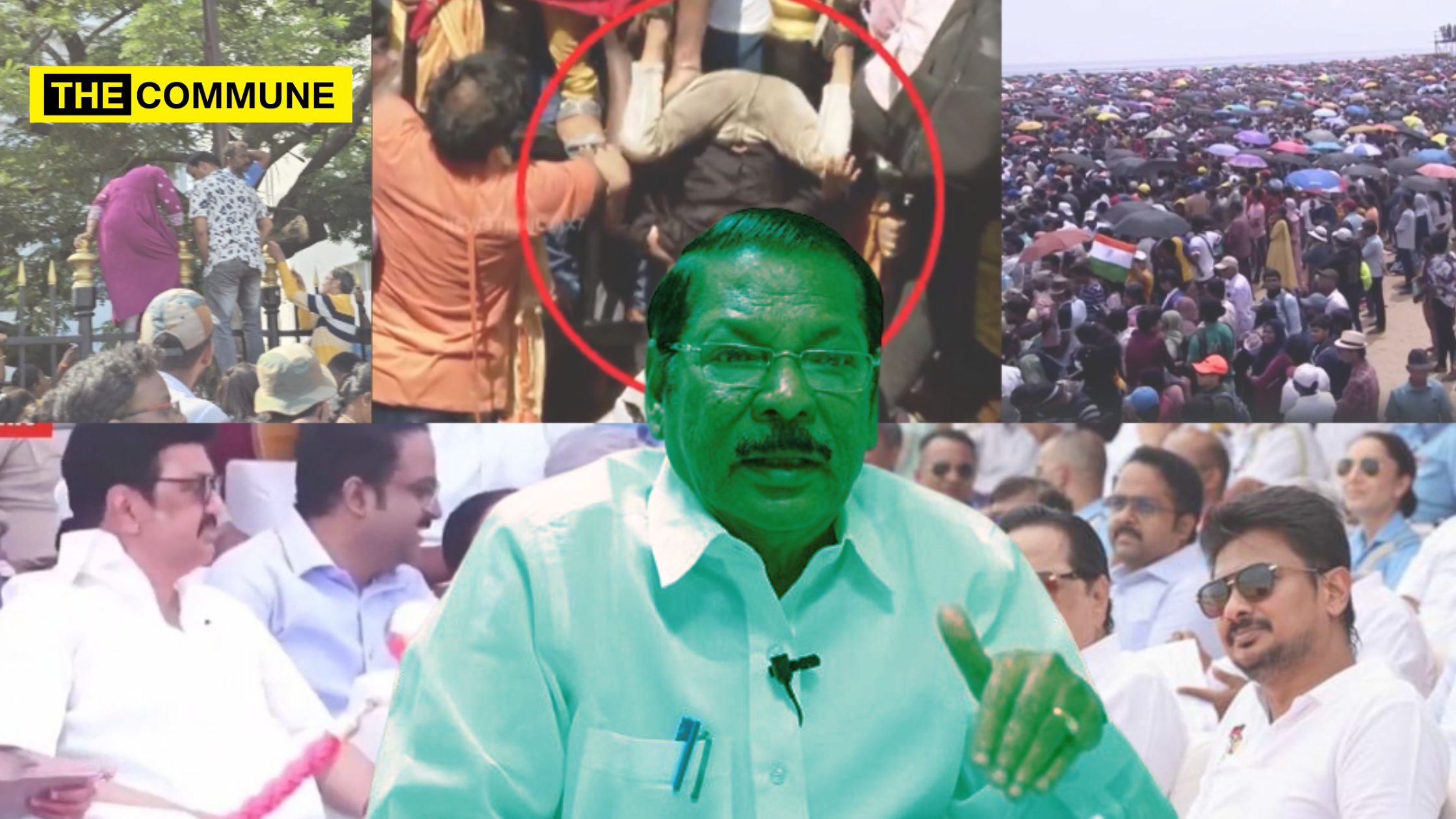
Under the pretext of public disruption and inciting religious animosity, the DMK government has initiated legal action against Ashvathaman, the Tamil Nadu BJP State Secretary. This case stems from Ashvathaman’s participation in a memorial event for Thangammal, the wife of Hindu activist T. Muthukrishnan, who was killed in a parcel bomb blast on 3 July 1995 in the then Nagai Qaid-e-Milleth district.
A 1995 report from India Today and Rajya Sabha debate highlighted Tamil Nadu’s declining reputation due to a series of violent incidents. The latest tragedy involved a parcel bomb that killed Thangammal, who was opening a Ramayana book when the bomb exploded. The attack, aimed at her husband, T. Muthukrishnan, a leader of the Hindu Munnani organization, resulted in her death and injuries to her daughters. The blast was part of a disturbing trend of violence in the region, including previous attacks involving RSS and Munnani offices and other bombings.
Every year, a memorial event is held to honour Thangammal’s death, but recently, the DMK government has obstructed these gatherings. Last year, the authorities arrested several attendees and barred them from participating. This year, despite initially denying permission, the BJP secured approval through legal channels. However, as anticipated, the DMK police filed an urgent FIR at 8:00 PM on 23 July 2024 against those who spoke at the event held on 7 July 2024.
The FIR noted: “I (Deva Kumar) am working as the Village Administrative Officer in Nagapattinam District, including Nagore, I report that on July 7, 2024, a public meeting was held to commemorate the 29th anniversary of Thangammal, the wife of Tanga Muthu Krishnan, on Nagore Main Road, near Kamakshi Amman Templeon that day from 17.10 pm to 20.44 pm on the said public meeting platform. 1. Thanga Muthukrishna – Activist from Nagore, 2. Bala – State General Secretary, Hindu Makkal Katchi Anuman Sena 3. Vijay Krishna – State Spokesperson, Shiv Sena, 4. Kannadasan – Lawyer, 5.Subramaniyan M. R. – Member, Cauvery Farmers Association, 6. Prabhu R. D. – State President, Hindu Munanni 7. Rajaguru – State President, Hindu Athiradipadai, 8. Ashvathaman – State Secretary, Bharatiya Janata Party (BJP) 9. Selvam V. K – Organization Secretary, Hindu Makkal Katchi. During the meeting, these individuals reportedly referred to Muslims as terrorists, labeled the Muslim religion as divisive, and made statements that disturbed public peace, offended religious sentiments, and incited hatred between Hindus and Muslims. Their remarks also included criticism of alleged dereliction of duty. Therefore, I request that appropriate legal action be taken against those who spoke in a manner that fosters religious animosity.”
The plaintiff’s complaint was registered under sections 196, 299, 353(1), 353(2), and 352 of the Bharatiya Nyaya Sanhita (BNS), 2023 on 23 July 2024, following receipt of the petition.
This action against Ashvathaman appears to be a deliberate attempt by the DMK to suppress criticism of terrorism and silence those who speak out against it, despite there being no apparent criminal activity in the speeches given.
Subscribe to our channels onTelegram, WhatsApp, and Instagram and get the best stories of the day delivered to you personally.
Illegals entering India from Bangladesh is not a new phenomenon. However, when such things are made into YouTube videos for audience engagement, it becomes a problem.
A year ago, Bangladeshi YouTuber DH Travelling Info posted a 21-minute video on how to enter India from Bangladesh without a passport or visa. In it, he demonstrated how he successfully crossed the border and entered India with a few people.
In the video, he goes towards the border Bangladeshi area of Jumgaw Garo village, supposedly in Sylhet, Bangladesh, from where he says he can easily access Cherrapunji in Meghalaya. Around 7 minutes into the video, he reaches the final frontier where a board says, “The last frontier of Bangladesh—international border. Crossing is prohibited. By order: Authority”
At this location, he shows a milestone which shows India and Bangladesh on either side.
However, there is no fencing or any such thing at this border. He then continues walking into what he calls Indian land and, at a distance, shows the fencing.
He goes towards the fencing as he and his group of friends walk further close to the fencing, weare shown pipelines. The person on camera claims that people can enter through these “pipelines” and this is a direct route to India.
Then there comes a river and a boatman. The text “Meghalaya/India” also flashes on the screen at this moment.
While the YouTuber does not enter India, towards the end, he emphasizes not entering without a visa or passport, warning that doing so could be dangerous and that the risk would be on the individual. However, critics argue that the demonstration of how to enter India illegally is concerning. His advising against doing so seems hypocritical. It’s akin to cigarette packets displaying health warnings, yet despite the warnings, many continue to engage in harmful behaviours.
Another video that surfaced on social media platform X is that of Bangladeshis again. In this video, travel blogger Boni Amin shares a video about a Bangladeshi individual who travelled to Delhi to apply for a European visa. Amin said they sold biryani in Paharganj when the visa application was rejected. This raises concerns about why the Indian government permits such situations.
SECURITY CONCERN PART – 2 🚨
Travel blogger Boni Amin shared a video where a Bangladeshi individual traveled to Delhi to apply for a European visa. When, their visa was rejected, and they ended up selling biryani in Paharganj. This raises questions about why the Indian… pic.twitter.com/Lwz4eB6LCV
Critics argue why the government has been issuing over 1,000 visas per day to Bangladeshis. Many Bangladeshis are entering India daily, either legally or illegally, by crossing the border.
This is indeed a serious issue that the government needs to address with stricter measures. These videos may not be from the recent past, yet it is evident that the problem persists as Bangladeshis continue to enter India for visas or other reasons.
Subscribe to our channels onTelegram, WhatsApp, and Instagram and get the best stories of the day delivered to you personally.
Andhra Pradesh Chief Minister N Chandrababu Naidu launched a fierce rebuttal against his predecessor Y.S. Jaganmohan Reddy in the state assembly on 25 July 2024, drawing a controversial comparison to Colombian drug lord Pablo Escobar. This criticism followed a protest by Reddy in Delhi, where he showcased images and videos highlighting alleged violence in the state, accusing Naidu and his party of targeting YSR Congress workers and leaders.
In the assembly, Naidu remarked, “Pablo Escobar is a Colombian drug lord, he is a Narco terrorist. He turned politician and then started his cartel to sell drugs. He earned 30 Billion Dollars at that time, now it’s 90 Billion Dollars worth. He was arrested in 1976 and in 1980 he became the number one richest drug lord in the world. One can become richer by selling drugs as well. What was the aim of former Chief Minister (YS Jagan)? Tata, Reliance, Ambani have money and he aspired to become richer than them. Few have needs, few have greed and few have mania and these maniacs do these kinds of things.”
#WATCH | In Andhra Pradesh Assembly, CM N Chandrababu Naidu says, "Pablo Escobar is a Colombian drug lord, he is a Narco terrorist. He turned politician and then started his cartel to sell drugs. He earned 30 Billion Dollars at that time, now it’s 90 Billion Dollars worth. He was… pic.twitter.com/z7JGGj05DF
In his speech, Chandrababu Naidu vowed to review all criminal cases from the YSR Congress regime, pledging to hold accountable police officers who allegedly fabricated charges against thousands. He blamed the lawlessness from 2019 to 2024 on a police-criminal nexus exacerbated by some YSRCP leaders pursuing personal vendettas.
Naidu criticized Reddy’s leadership, likening him to Pablo Escobar, and condemned the rise in murders, assaults, and drug-related crimes during his term. He released a white paper detailing the law and order situation in the state from 2019 to 2024, asserting that Reddy’s administration exhibited traits of ‘state terrorism’ driven by an extreme pursuit of power.
Naidu also highlighted issues such as the mysterious murder of former MP Y.S. Vivekananda Reddy, the alleged murder by YSRCP MLC Ananta Satya Udaya Bhaskar, and other severe incidents, which he attributed to a sadistic mindset among Mr. Reddy and his associates.
Furthermore, he criticized the subjugation of police officers under YSRCP rule, noting their forced transfer to ‘vacancy reserve’ where they faced salary stoppages and pressure. He cautioned lawmakers against retaliatory actions, urging them to avoid actions that could lead to further trouble for the government.