Home Blog Page 860

USCIRF, A Self-Appointed Guardian Of Religious Freedom Having Christian Supremacists As Office Bearers With Ties To Islamic Terror Orgs, Supports Khalistani Terrorists

The United States Commission on International Religious Freedom (USCIRF) is a U.S. federal government commission created by the International Religious Freedom Act (IRFA) of 1998. USCIRF Commissioners are appointed by the President and the leadership of both political parties in the Senate and the House of Representatives. USCIRF’s principal responsibilities are to review the facts and circumstances of violations of religious freedom internationally and to make policy recommendations to the President, the Secretary of State, and the Congress.

This US government organization has been very vocal in its support for Khalistani terrorists and thugs.

This came after the killing of Khalistani terrorist Hardeep Singh Nijjar by unknown gunmen in Canada. On their official X handle, they shared the press release stating that the organisation was “deeply concerned by India’s transnational repression against religious minorities”.

In the statement, USICRF Commissioner Stephen Schneck said, “The Indian government’s alleged involvement in the killing of Sikh activist Hardeep Singh Nijjar in Canada and the plot to kill Gurpatwant Singh Pannun in the United States are deeply troubling, and represent a severe escalation of India’s efforts to silence religious minorities and human rights defenders both within its country and abroad. We call on the Biden administration to acknowledge the Indian government’s perpetration of particularly severe religious freedom violations and designate it as a country of particular concern (CPC).

Another Commissioner David Curry stated, “Within its own borders, Indian authorities have repeatedly used draconian legislation like the Unlawful Activities Prevention Act and anti-conversion laws to systematically crack down on religious minorities, journalists, and activists. Extending this repression to target religious minorities from India living abroad, including intimidation tactics against journalists, is especially dangerous and cannot be ignored. We urge the U.S. government to continue its active engagement with senior Indian officials and international partners to ensure religious minorities can live and express themselves without fear of reprisal, whether in India or elsewhere.”

Stop Hindu Hate Advocacy Network shared a thread that unmasked all the people involved with the UCISRF. The problematic connections of each of the members/people associated with the organisation come to the fore with this thread.

Let us start from the top.

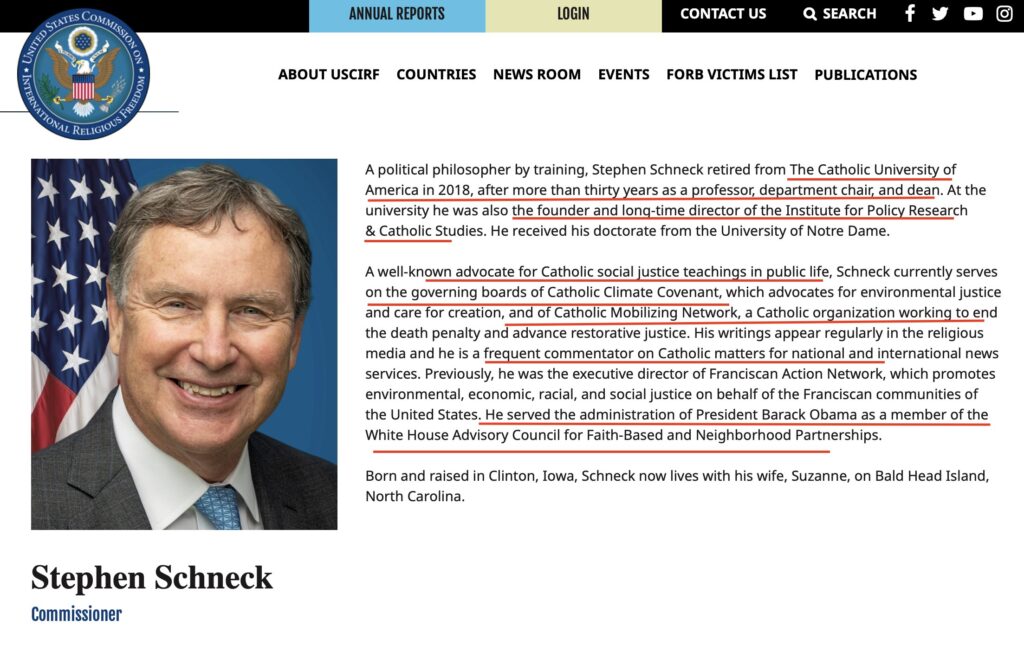
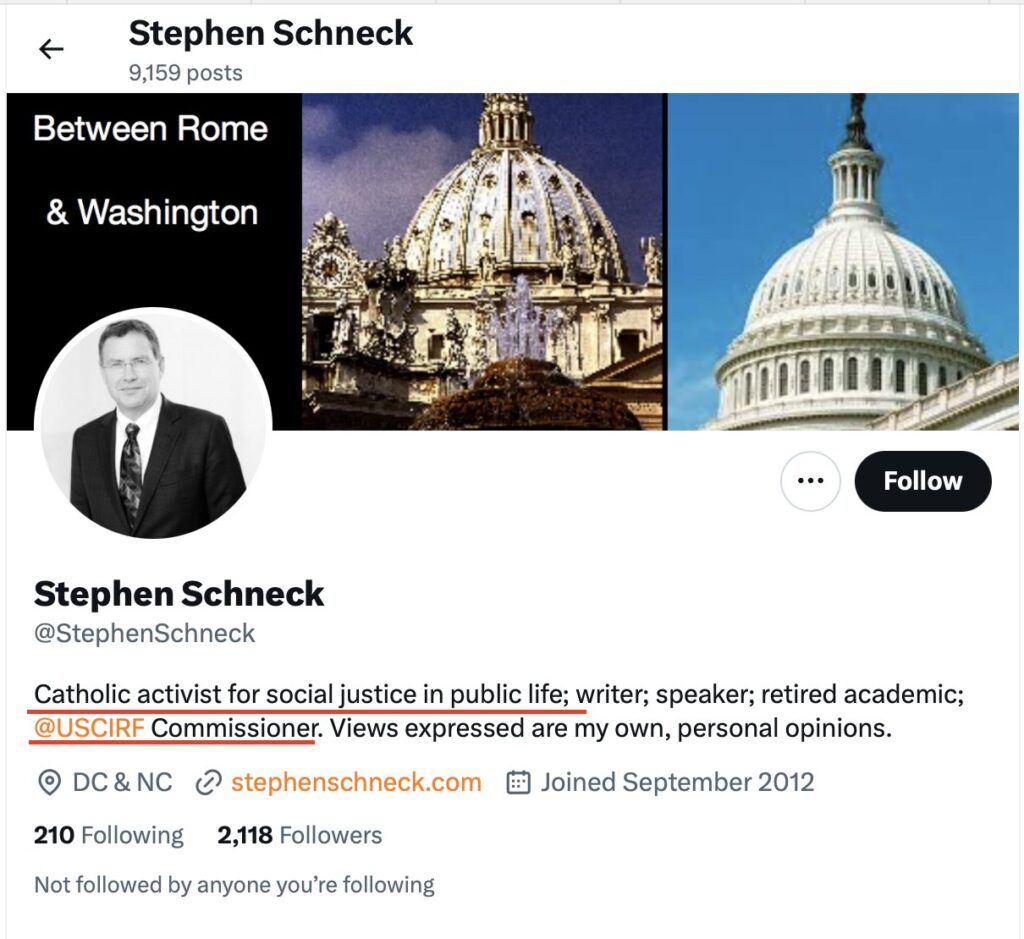
USCIRF Commissioner Stephen Schneck

Per his profile on their website, Schneck is “A well-known advocate for Catholic social justice teachings in public life, Schneck currently serves on the governing boards of Catholic Climate Covenant, which advocates for environmental justice and care for creation, and of Catholic Mobilizing Network, a Catholic organization working to end the death penalty and advance restorative justice. His writings appear regularly in the religious media and he is a frequent commentator on Catholic matters for national and international news services. Previously, he was the executive director of Franciscan Action Network, which promotes environmental, economic, racial, and social justice on behalf of the Franciscan communities of the United States. He served the administration of President Barack Obama as a member of the White House Advisory Council for Faith-Based and Neighborhood Partnerships.”
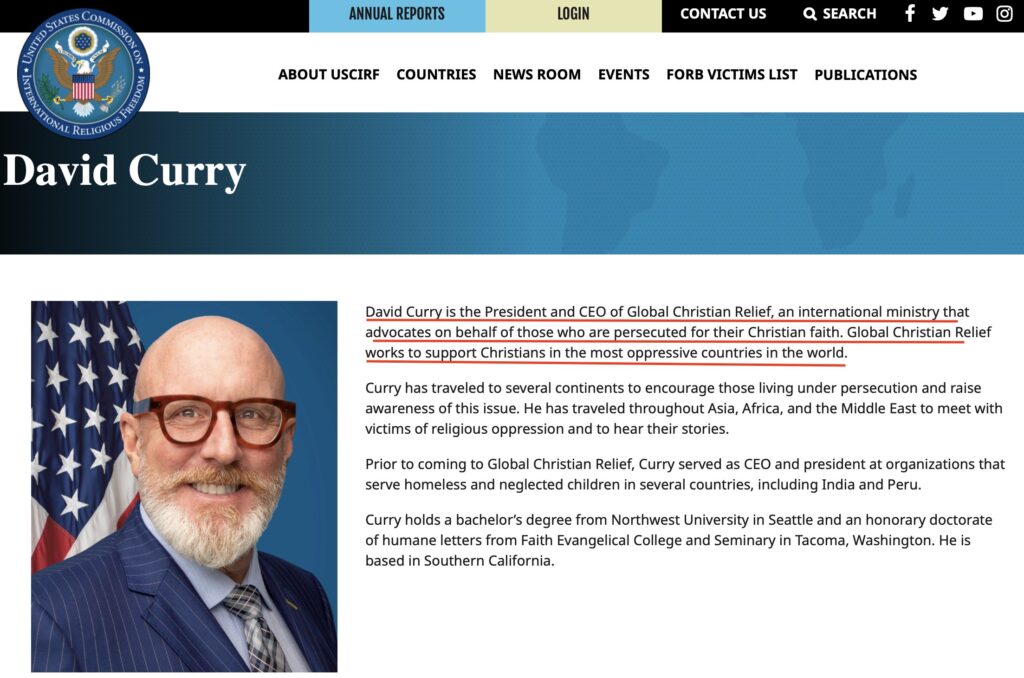
Commissioner David Curry 

His profile on the website states, “David Curry is the President and CEO of Global Christian Relief, an international ministry that advocates on behalf of those who are persecuted for their Christian faith. Global Christian Relief works to support Christians in the most oppressive countries in the world. Curry has traveled to several continents to encourage those living under persecution and raise awareness of this issue. He has traveled throughout Asia, Africa, and the Middle East to meet with victims of religious oppression and to hear their stories.”
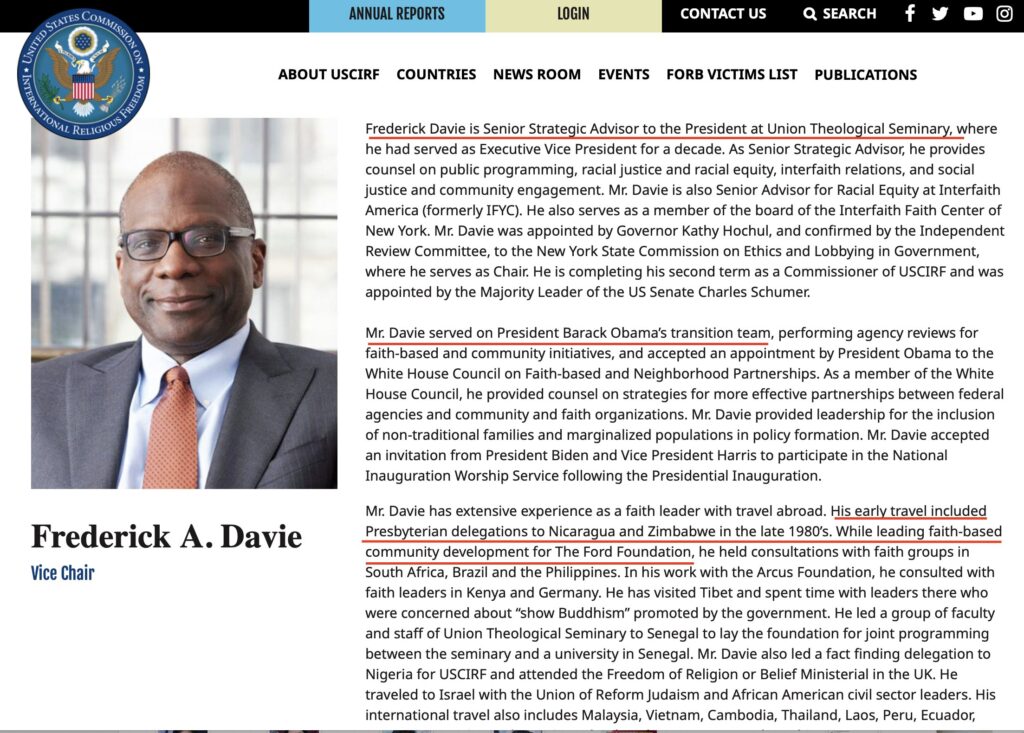
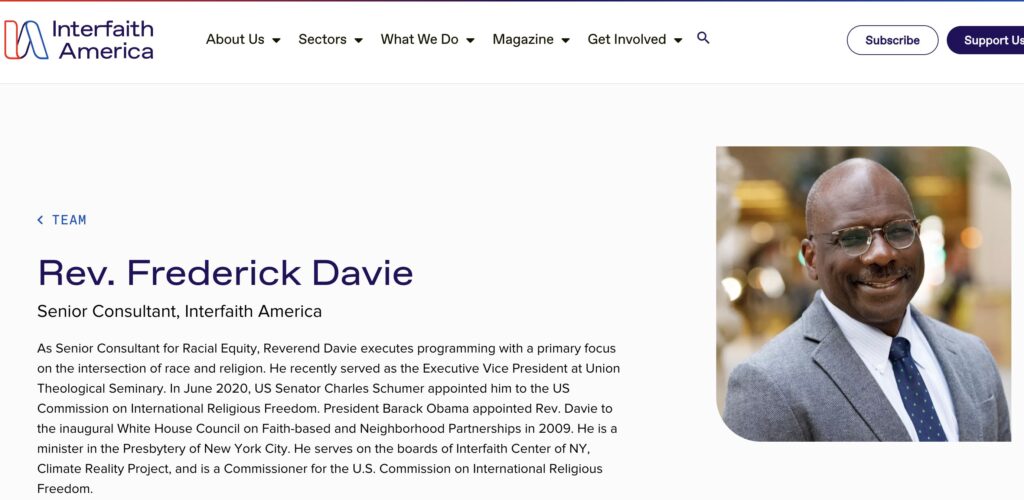
Vice Chair Frederick A. Davie

The website states, “Frederick Davie is Senior Strategic Advisor to the President at Union Theological Seminary, where he had served as Executive Vice President for a decade. Mr. Davie served on President Barack Obama’s transition team, performing agency reviews for faith-based and community initiatives, and accepted an appointment by President Obama to the White House Council on Faith-based and Neighborhood Partnerships. His early travel included Presbyterian delegations to Nicaragua and Zimbabwe in the late 1980’s. While leading faith-based community development for The Ford Foundation, he held consultations with faith groups in South Africa, Brazil and the Philippines.”
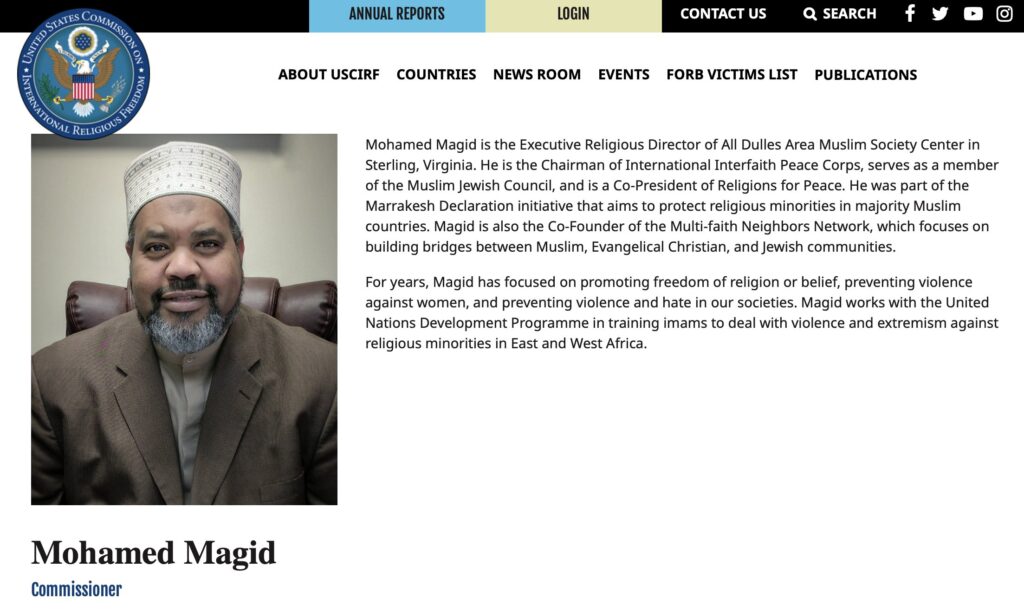
Commissioner Mohamed Magid

This is his bio on the website: “Mohamed Magid is the Executive Religious Director of All Dulles Area Muslim Society Center in Sterling, Virginia. He is the Chairman of International Interfaith Peace Corps, serves as a member of the Muslim Jewish Council, and is a Co-President of Religions for Peace. He was part of the Marrakesh Declaration initiative that aims to protect religious minorities in majority Muslim countries. Magid is also the Co-Founder of the Multi-faith Neighbors Network, which focuses on building bridges between Muslim, Evangelical Christian, and Jewish communities.” 
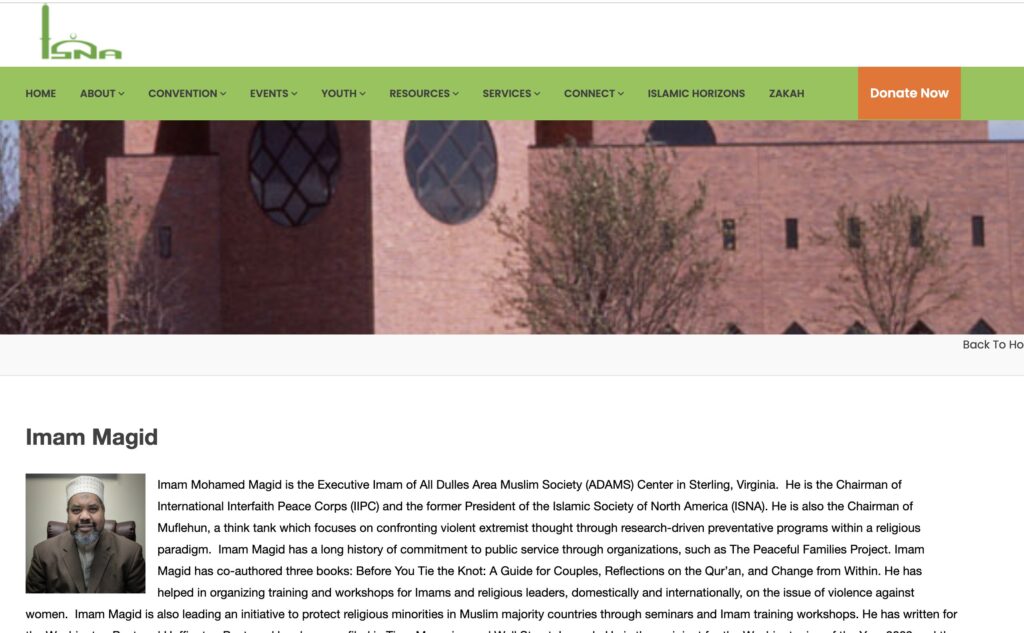
Interestingly, Magid is the former President of ISNA (Islamic Society of North America) a Muslim Brotherhood front. 
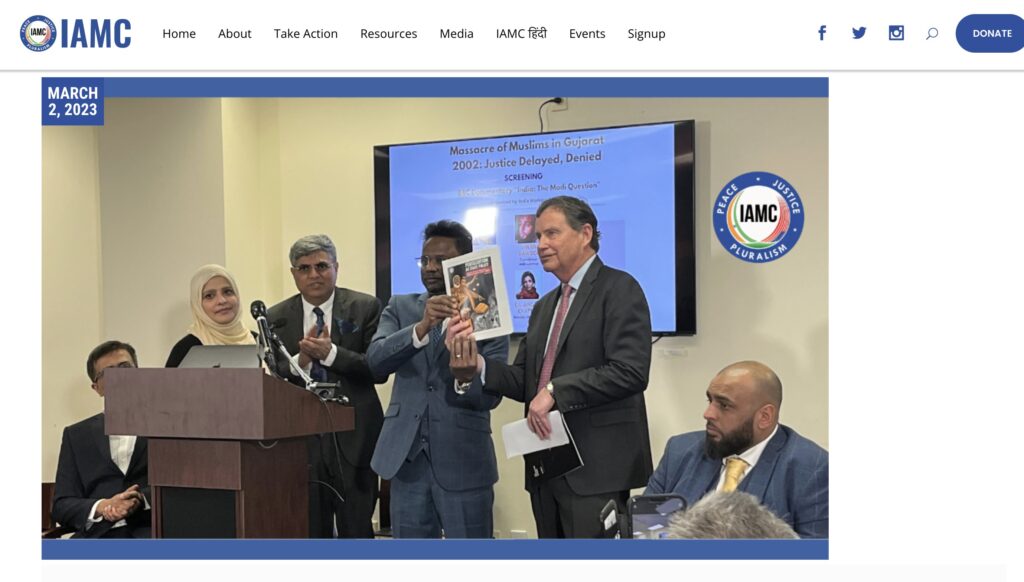
Both Stephen Schneck and David Curry frequently attend events organised by the Jamat-e-Islami front, IAMC. Additionally, Stephen Schneck was observed in the company of Pakistan’s Ambassador to the US, Masood Khan, who previously referred to Hizbul Mujahideen terrorist Burhan Wani as “Kashmir’s most beloved freedom fighter.” Khan has a history of supporting the Taliban and Jihad. 
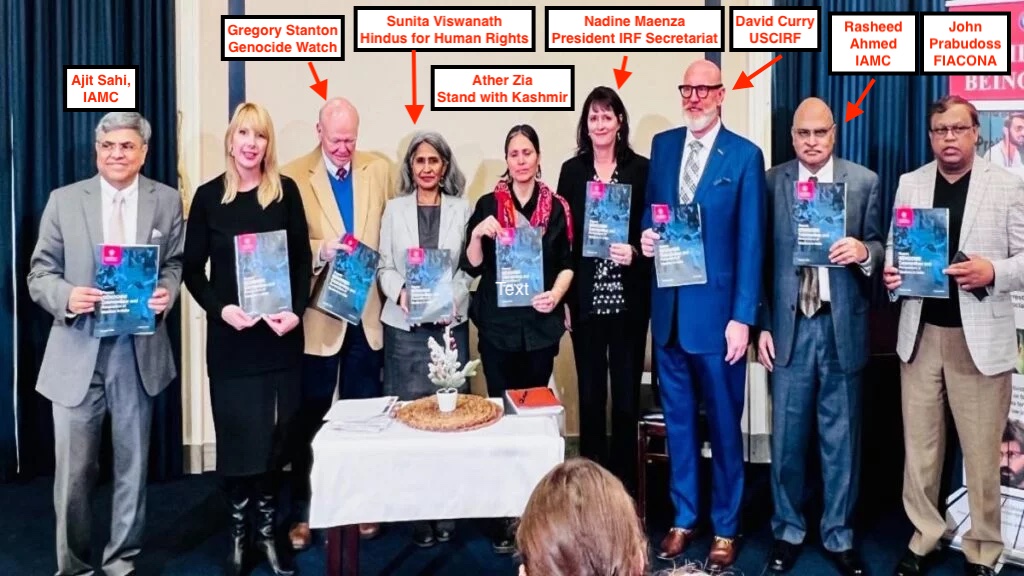
During a February 2023 IAMC event, Schneck advocated for classifying India as a ‘Country of Particular Concern.’ He asserted, “The Indian government at the local, state, and national level continues to create policies that negatively impact Muslims, Christians, and other religious minorities…Application of these policies has created a culture of impunity for national campaigns of violence against Muslims and Christians. The U.S. must designate India a country of particular concern. We at USCIRF continue to press President Biden and congress to do so.”

 

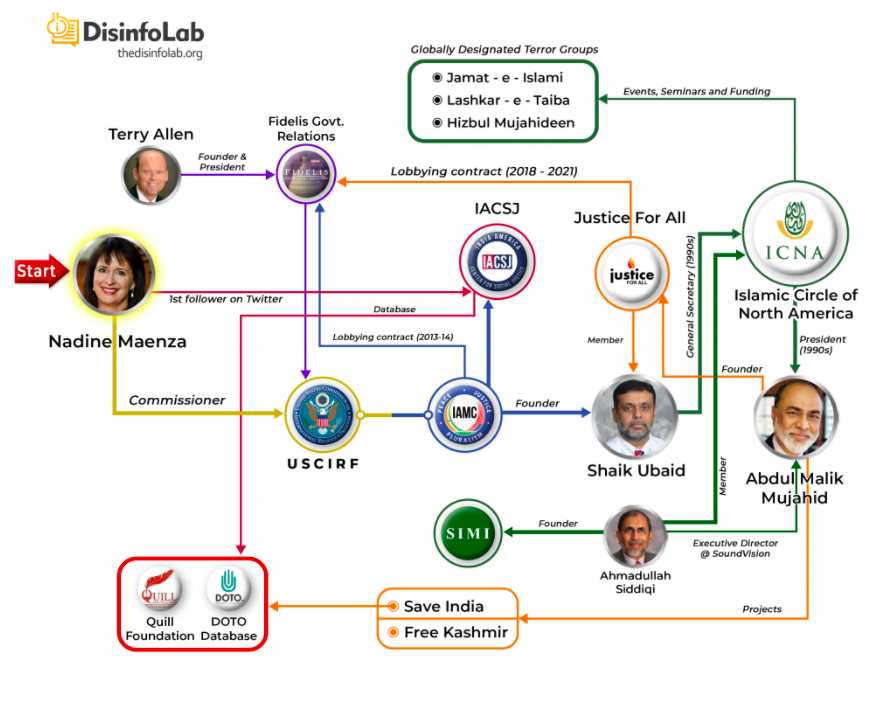
Fake news buster Disinfo Lab brought out the connection between USCIRF and the Islamists in an article

Image Source: Disinfo Lab

Last but not least, Anurima Bhargava who was an Open Society Foundation fellow, was also a Commissioner with USCIRF. 
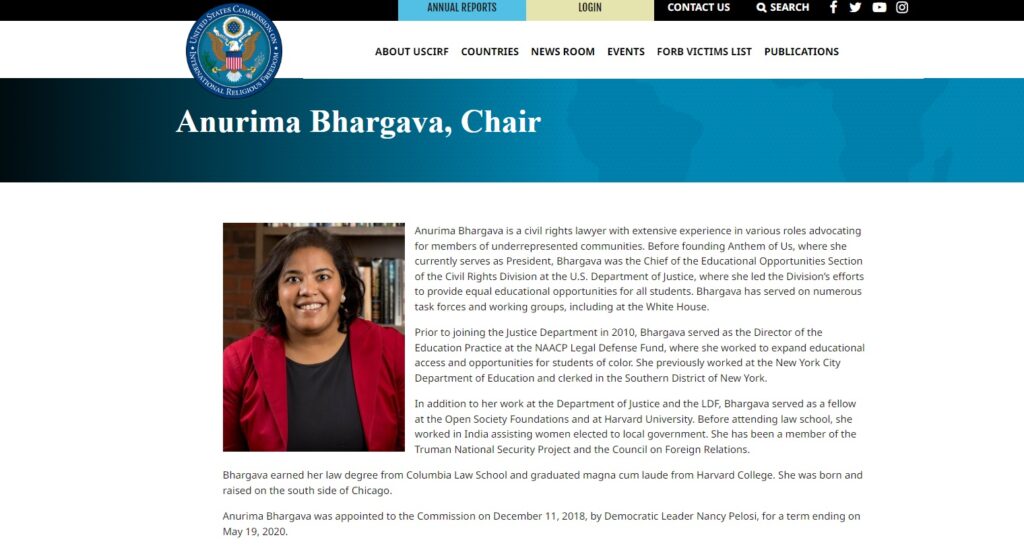
Bhargava is said to have played a critical role in blacklisting India and calling for sanctions against our country. 

Anurima moved to Doc Society, a US-based documentary & multimedia house known for its documentary on Ravish Kumar. It is noteworthy that Doc Society also receives funds from Open Society Foundation. 

The same media house is also said to have partnered with the Ford Foundation and Bertha Foundation for the documentary on Ravish Kumar.

Ultimately, it all boils down to Soros and the usual suspects who are involved in destroying the sovereignty of India.

Subscribe to our channels on TelegramWhatsApp, and Instagram and get the best stories of the day delivered to you personally.
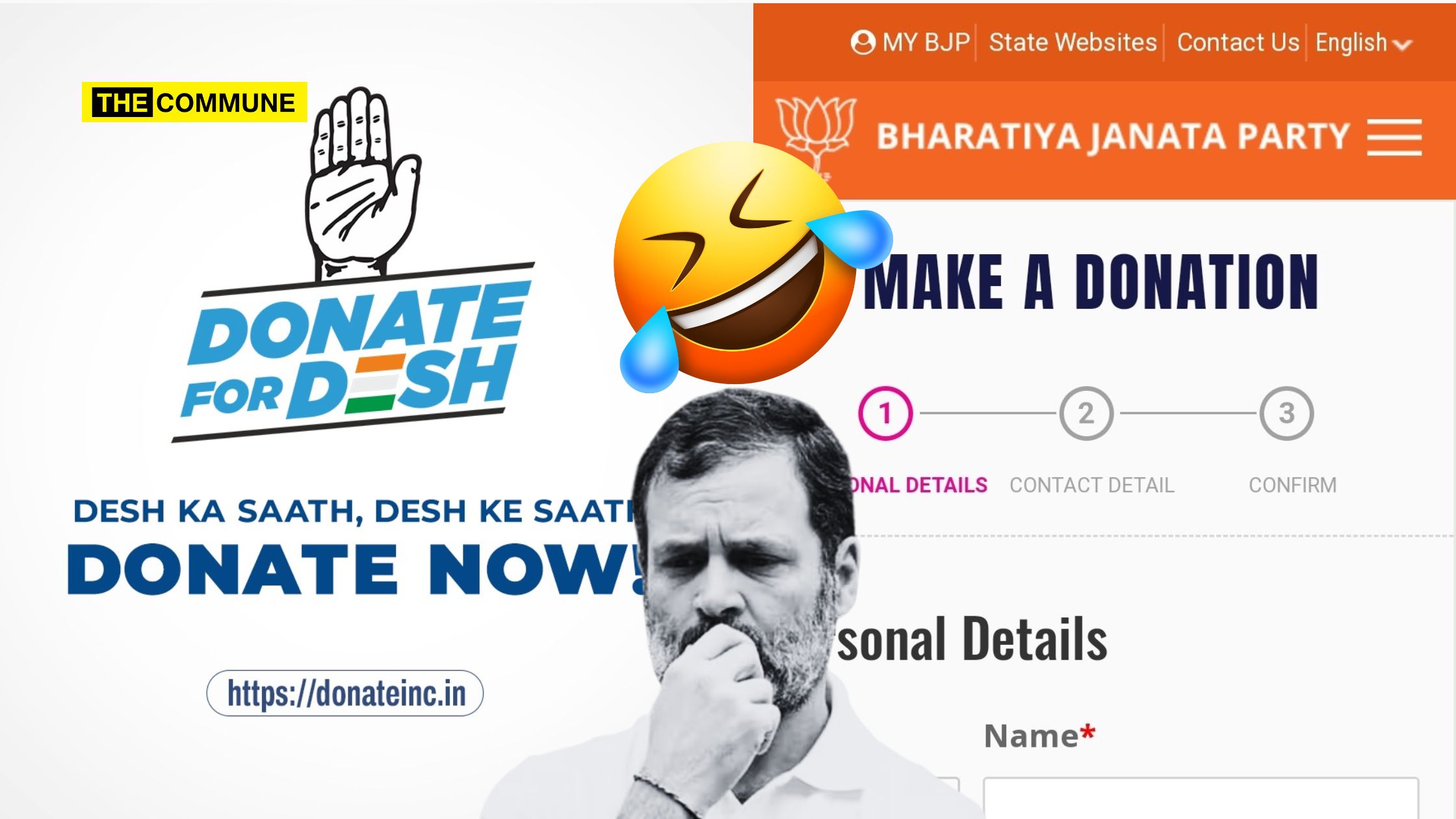
Congress’ Moye Moye Moment: As Congress Fails To Register ‘DonateForDesh’ Domain, Traffic Gets Diverted To BJP’s Donation Page

A couple of days ago, the Congress party announced that it would launch the “Donate for Desh” online crowdfunding campaign on 18 December 2023, inspired by Mahatma Gandhi’s “Tilak Swaraj Fund.” AICC treasurer Ajay Maken encouraged donations in multiples of 138 to commemorate the Congress’s 138th anniversary. 

On 18 December 2023, Congress president Mallikarjun Kharge officially launched the campaign, featuring online portals www.donateinc.in and www.inc.in. Kharge officially initiated the party’s “Donate for Desh” crowdfunding campaign, urging people to “combat unemployment and soaring costs”. Kharge personally contributed ₹1,38,000 to kickstart the initiative, emphasising the importance of public support over-dependence on the wealthy. 

The campaign aims to collect funds from small donors, fostering a collective effort for national progress. Treasurer Ajay Maken stated that contributions of ₹138, ₹1,380, or ₹1,38,000 are welcome, symbolizing the party’s 138 years. Ground campaigns are said to follow, targeting contributions of at least ₹138 from each household. 

However, netizens pointed out that instead of registering the domain donatefordesh, Congress has chosen to use donateinc.in as the domain name raising questions about the intent of the crowdfunding campaign. 

Unfortunately, they failed to secure the corresponding domain names in advance. Consequently, BJP seized control of DonateforDesh.org, and clicking on the link directs visitors to BJP’s donation page. OpIndia, another website, also acquired two related domains associated with the Donate for Desh campaign, redirecting them to their own donation pages.


BJP also shared a clipping of the 1984 Hindi film Inquilaab where the characters talk about “mixing white money from the public with black money to launder the illegal funds”. This was a jibe at Congress concerning the massive haul obtained from Cong MP Dhiraj Sahu’s residences. In a post on social media platform X, they wrote, “The story and characters in this clip are not imaginary. Resemblance with Congress MP Dhiraj Sahu’s party’s call to seek crowdfunding is intended…”

Subscribe to our channels on TelegramWhatsApp, and Instagram and get the best stories of the day delivered to you personally.
BJP’s Yogi Model Vs DMK’s Dravidian Model: Uttar Pradesh Overtakes Tamil Nadu To Become Second Largest Economy In India

In a massive stride towards achieving Chief Minister Yogi Adityanath’s ambitious target of reaching the $1 trillion milestone by 2027, Uttar Pradesh has successfully secured the position of India’s second-largest economy. This achievement, as reported by the online blogging platform soic.in and covered by The Times Of India, surpasses Tamil Nadu, Gujarat, and West Bengal.

According to the report posted on X, Uttar Pradesh now commands a notable 9.2% share in the country’s gross domestic product (GDP), positioning itself just behind Maharashtra, which leads with a 15.7 percent share. This represents a noteworthy rise for Uttar Pradesh, which previously held the third position.

In terms of GDP share, Uttar Pradesh has surpassed states such as Tamil Nadu (9.1%), Gujarat (8.2%), and West Bengal (7.5%). States like Karnataka (6.2%), Rajasthan (5.5%), Andhra Pradesh (4.9%), and Madhya Pradesh (4.6%) lag significantly behind Uttar Pradesh.

Under the leadership of Chief Minister Yogi Adityanath, Uttar Pradesh has made rapid progress in various sectors over the past seven years. Organized crime in the state has now been eradicated, and the industrial sector is advancing swiftly. UP has also climbed from the 14th to the 2nd position in the ‘Ease of Doing Business’ rankings.

Furthermore, owing to improvements in law and order, connectivity, and infrastructure, the state has attracted investment proposals exceeding ₹ 40 lakh crore through GIS 2023, which are expected to be implemented soon. This will result in the creation of over one crore employment opportunities in the state.

At present, the state is exporting goods valued at nearly ₹2 lakh crore. The loan-deposit ratio of banks has risen from 42-43% to 56 %, with efforts underway to increase it to 60%.

Uttar Pradesh has become a revenue surplus state, with 56 percent of its population employed. Additionally, approximately 96 lakh MSME units have been established.

CM Yogi has positioned Uttar Pradesh, once considered a BIMARU state, at the forefront of the development race. These accomplishments will not only make UP the growth engine of the country but will also contribute to achieving the goal of making the state a $1 trillion economy.

Subscribe to our channels on TelegramWhatsApp, and Instagram and get the best stories of the day delivered to you personally.

‘Periyarist’ Woman ‘Lu Lu Deva Jamla’ Apprehended For Alleged Facilitation Of Sexual Exploitation Disguised As Feminism; Granted Bail

‘Lulu’ Deva Jamla, who is a part of ‘Periyarist’ gang residing in Australia has reportedly been apprehended after allegations of running clandestine social media groups that allegedly brainwashed women into a purported “sexual trap”.

Lulu Deva Jamla, shortened to ‘Lulu’, is said to be from Kanyakumari and is currently believed to be residing in Australia. The Faceboook group of Lulu was reportedly started in 2017 and had around 180 members initially. Her husband Moses was earlier associated with Vaiko’s Marumalarchi Dravida Munnetra Kazhagam (MDMK).

Earlier The Commune had reported on the massive sex racket named ‘Lulu Group’ aka ‘Women Stress Buster (WSB)’, a Facebook group that allegedly targets young married women to have illicit sexual relations with men.

It was reported that ‘Lulu’ has been inducting and inciting ‘sexually unsatisfied’ women (mostly married) to have illicit relationships with other men. They were also forced to send their private pictures in the form of “challenges”.

The arrest of Lulu happened a few days back, following a complaint filed by a woman at the Adyar Women Police Station in Chennai back in 2020.

The complainant detailed a disturbing narrative, accusing the 45-year-old woman named Lulu Deva Jamla from Kanyakumari of orchestrating a secret WhatsApp group that lured woman into illicit relationships. Under the guise of promoting forward ‘progressive’ thinking, Jamla was allegedly manipulating women, enticing them with promises of limitless sexual freedom. The complaint further asserted that these women were coerced into staying in luxury accommodations, where they were purportedly sexually exploited.

The victim urgently implored the police to take immediate action against Jamla, who was reportedly residing in Australia at the time. 

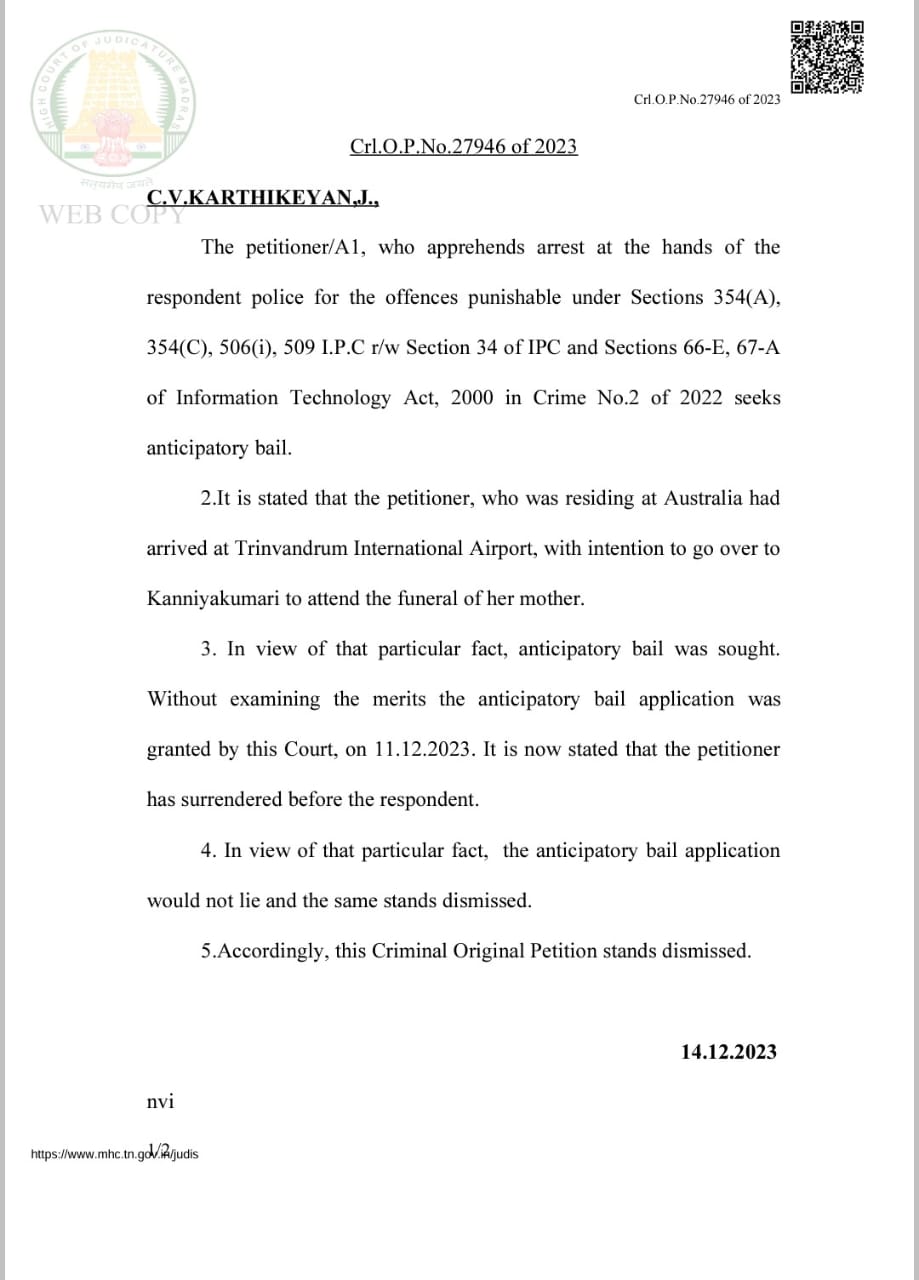
Facing charges under IPC Sections 354(A), 354(C), 506, and IT Act Sections 66-E, 67-A in Crime No.2 of 2022, Jamla sought anticipatory bail, citing the need to attend her mother’s funeral in Kaniyakumari after arriving from Australia. Anticipatory bail was granted by the court on 11 December 2023 without examining merits.

Airports were put on alert, with a lookout notice issued by Police. When Jamla landed at Kerala’s Thiruvananthapuram airport, she was reportedly apprehended by officers, and was later handed over to the Neelankarai Police. Following her arrest, Jameela was taken to the Saidapet Court and was later granted bail on 15 December 2023 according to sources aware of the matter.

Subscribe to our channels on TelegramWhatsApp, and Instagram and get the best stories of the day delivered to you personally.
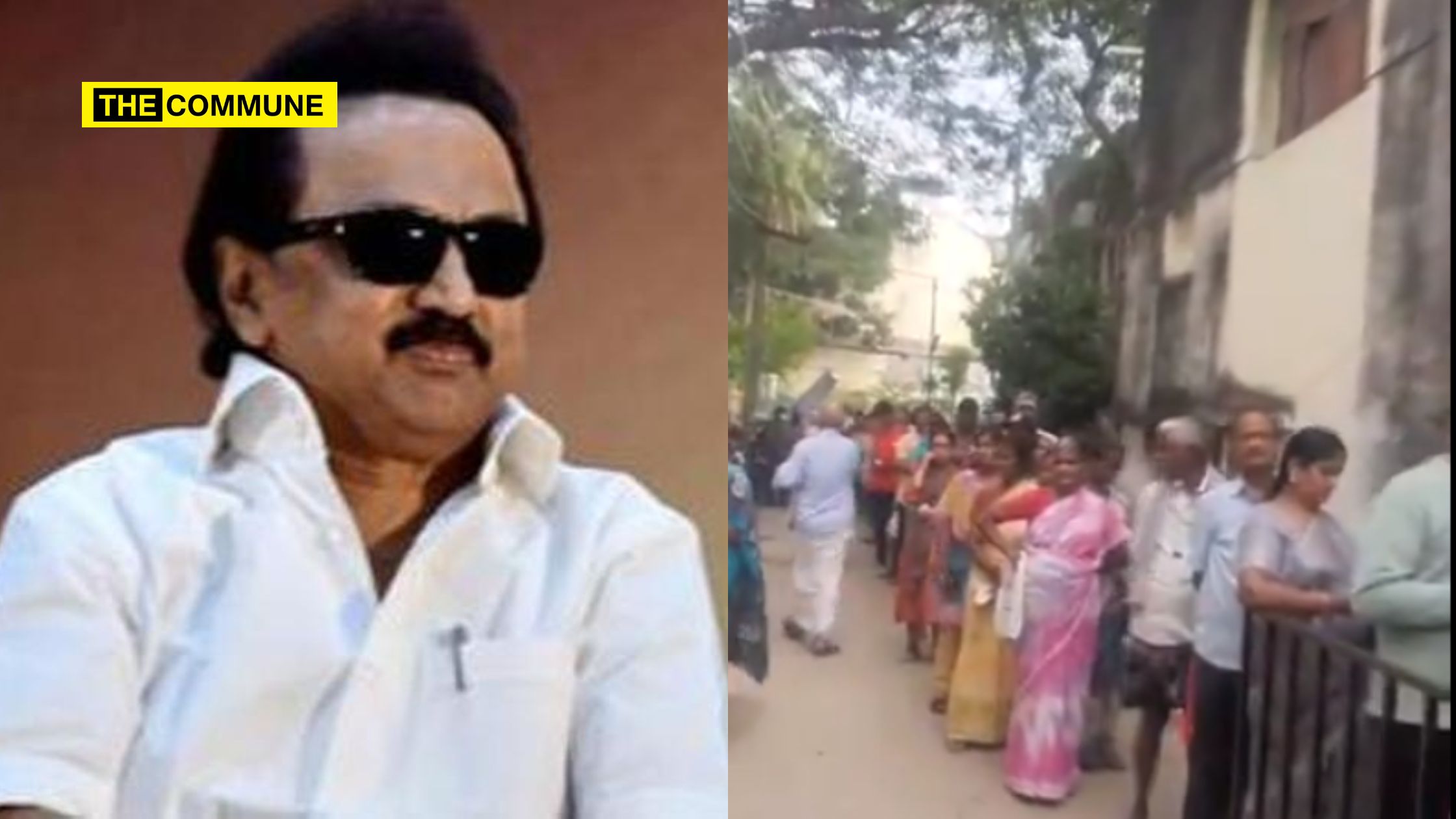
Flood-Affected Chennai Residents Encounter Long Queues To Get Tokens For ₹6000 Relief

The Dravida Munnetra Kazhagam-led Tamil Nadu state government has come under scrutiny for its handling of the distribution of relief funds to flood victims, as citizens decry the inefficient and demeaning process involved in claiming the allocated ₹6000. The criticism has sparked calls for a shift towards more modern and direct transfer methods.

Despite technological advancements and the widespread use of digital solutions such as internet banking and Aadhaar verification, citizens across Chennai were seen standing in long queues over the weekend to collect tokens for the flood relief funds. This manual process is seen as outdated and unnecessary and has raised concerns about the dignity of affected individuals and the overall effectiveness of the relief effort.

In various areas of the city, reports indicate that the distribution process has been marred by inefficiencies and discrepancies. Long queues formed outside ration shops as people sought to verify their eligibility for the relief funds. Complaints about the uncertainty and time-consuming nature of collecting tokens have been voiced, with some citizens, including senior citizens, enduring hardship during the process.

Speaking to Times of India, an Ambattur resident Muralidharan lamented, “I stood from 2.30 pm to 4 pm in the park but returned empty-handed because my name was not on the list,”. Similar scenes were witnessed across the city, with individuals being turned away despite being in need of assistance.

Critics argue that the state government’s insistence on a manual token system reflects a lack of transparency and efficiency in the relief distribution process. Calls have been made for the list of beneficiaries to be made public online to ensure transparency and accountability.

In Nanganallur as reported by TOI, concerns were raised as only 700 tokens were issued to approximately 1,500 individuals holding rice ration cards. V. Rama Rao, secretary of the People’s Awareness Association, highlighted the uncertainty surrounding the token distribution process, adding that it was particularly challenging for senior citizens.

The state government’s decision to utilise traditional methods for relief disbursement has sparked accusations of sadism and unnecessary hardship, especially considering the availability of digital alternatives. Critics argue that in the 21st century, with advanced technologies like UPI at our disposal, the manual distribution process is out of step with the state’s claim of being a developed region.

https://twitter.com/anbezhil12/status/1736603759525175443


As citizens endure long queues and uncertain processes, questions linger about the necessity of such antiquated methods in the face of contemporary digital solutions. The public awaits a response from the authorities regarding the number of families that have received tokens and demands for greater transparency in the relief distribution process.

Subscribe to our channels on TelegramWhatsApp, and Instagram and get the best stories of the day delivered to you personally.
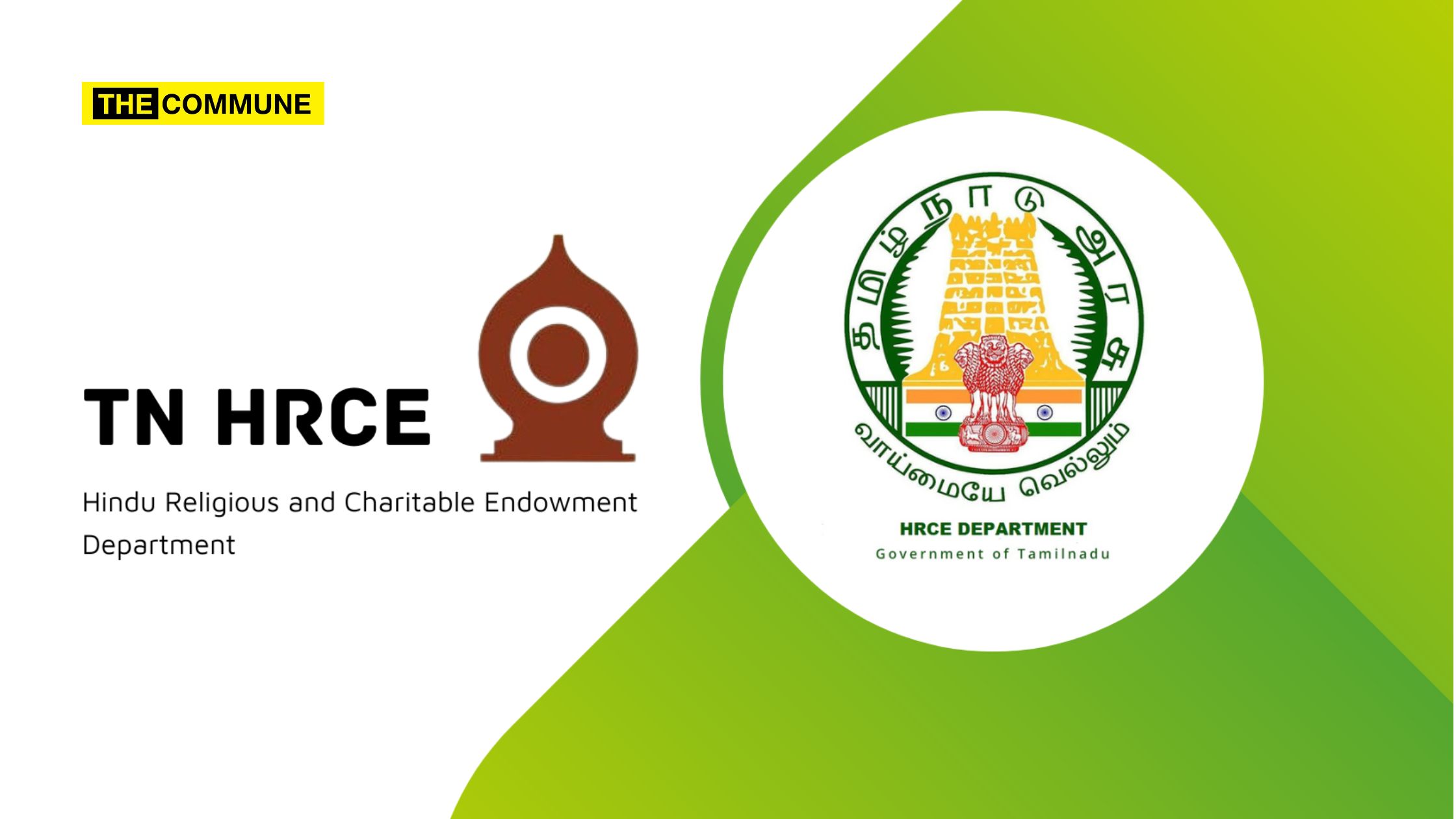
TN HR&CE Dept: No Transparency & Accountability, Website Does Not Show RTI Information

Tamil Nadu Temples Under HR&CE Dept Allegedly Face ₹5,900 Crore Annual Losses, Temple Activists Demand Trustees Take Control

The Tamil Nadu Government’s Hindu Religious and Charitable Endowments (HR&CE) Department is under scrutiny for its alleged violation of the Right to Information Act, 2005, as concerned citizens raise questions about the department’s transparency and accountability.

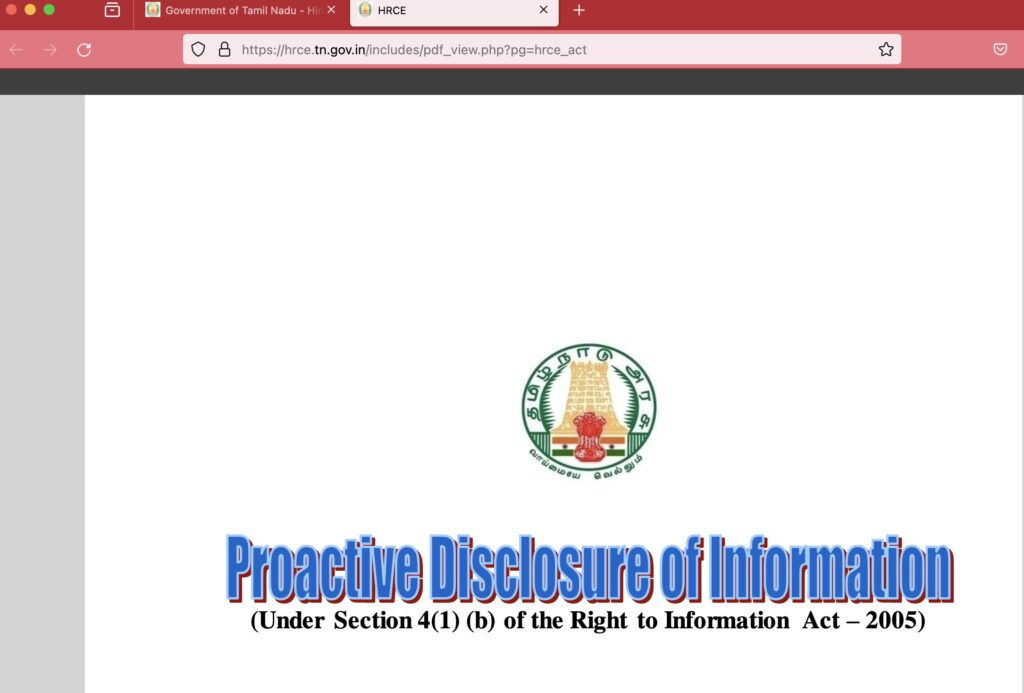
A recent investigation by temple activist TR Ramesh reveals that the HR&CE Department, notorious for being one of the worst offenders of the Right to Information Act in Tamil Nadu, has failed to provide any information under the said Act. 

The department’s official website, https://hrce.tn.gov.in/hrcehome/index.php, displays either a conspicuously empty page titled “Proactive Disclosure of Information” or a peculiar message instructing visitors not to leave the mouse on the page.

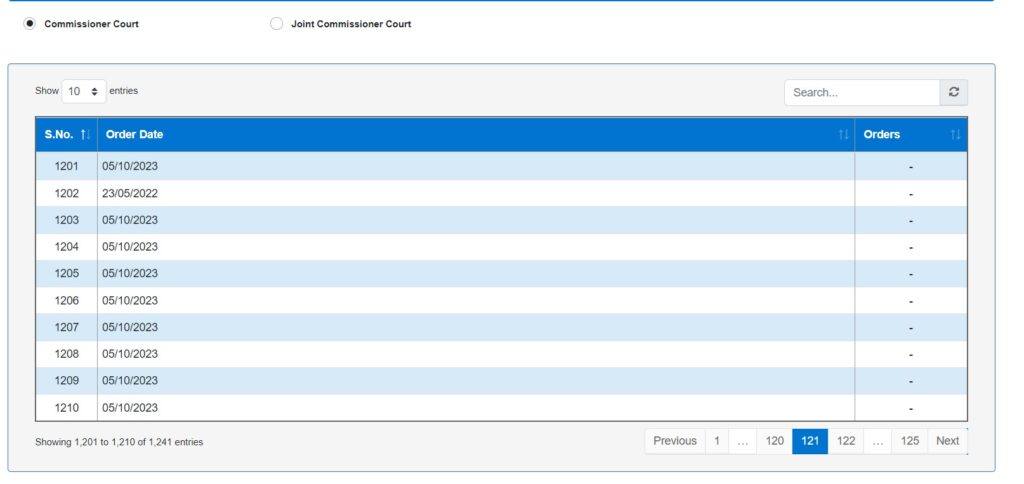
The lack of information disclosure under the RTI Act raises concerns about the department’s commitment to transparency and public accountability. Circulars and orders on the website have not been updated since 2 August 2022, potentially indicating a reluctance to publish information that could be legally contested.

Out of 1241 court orders (as indicated by the serial number), only 264 are listed. These include court orders from 2022 and 2023. There are several from 2021 and before that have not been updated in the website. 

Furthermore, there is a noticeable absence of any government orders related to Hindu temples on the website. It is alleged that the department may be avoiding the publication of orders to prevent potential legal challenges from temple activists, accusing them of issuing illegal orders without proper authority.

One of the primary grievances voiced against the HR&CE Department is its financial practices, particularly the collection of 12% of temple income as “Administration Fees” and an additional 4% as “Audit Fees.” It is alleged that such financial practices, coupled with the department’s alleged failure to protect temple properties and misuse of temple funds for non-temple purposes, reflect a lack of commitment to the well-being of Hindu temples.

What Else Is There On The Site?

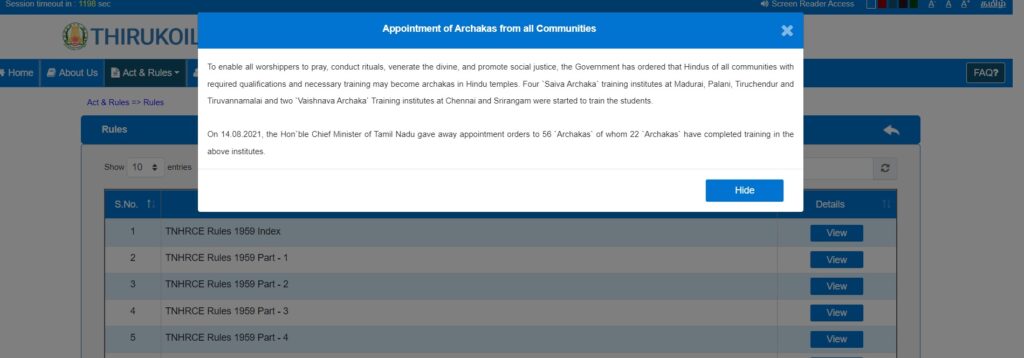
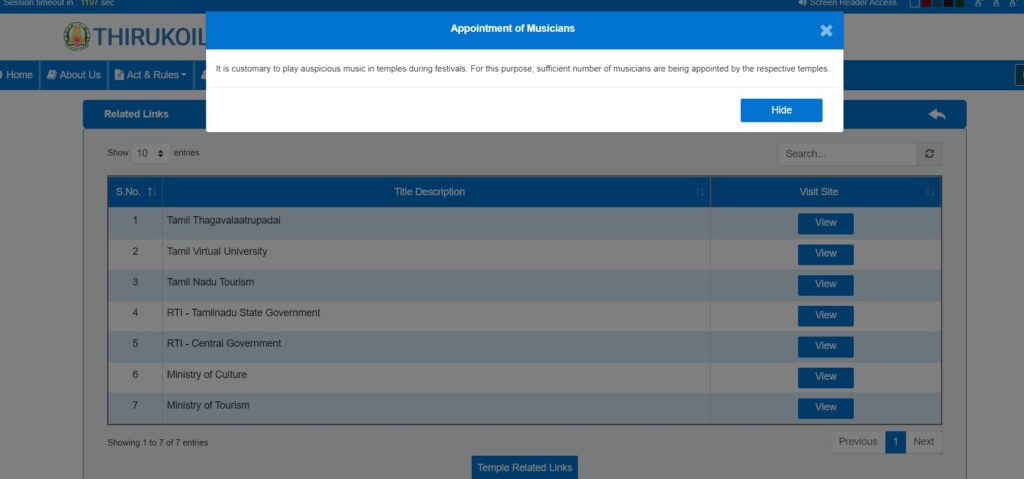
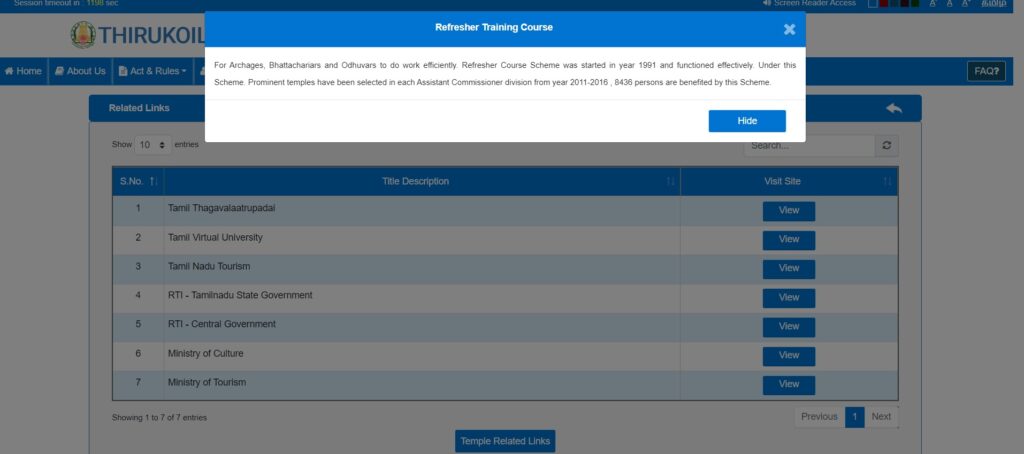
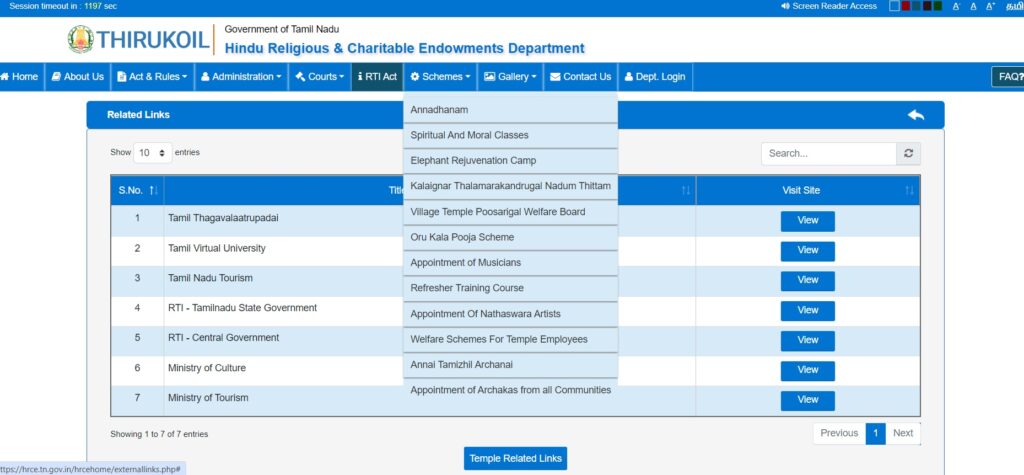
Under the Schemes tab, several schemes of the department are enlisted.

Of these, not every sub heading has detailed information. Some are vague or are not updated. 

\

Critics argue that it is high time for the department to be held accountable in the courts and, in some quarters, for its closure to be considered to ensure the protection and proper administration of Hindu temples in Tamil Nadu.

Subscribe to our channels on TelegramWhatsApp, and Instagram and get the best stories of the day delivered to you personally.
The Sacred Cow In Tamil Culture: A Symbol Of Reverence, Rituals, And Harmony

Tamil culture, with its rich tapestry of traditions, rituals, and deep-rooted beliefs, holds the cow in high esteem as a sacred and integral part of its heritage. From religious ceremonies to agricultural practices, the cow plays a significant role in shaping the cultural landscape of Tamil Nadu and the sacredness of the cow is woven into the very fabric of Tamil identity. The Tamil word for cow is pasu, which also means animal in Sanskrit. Thus, the cow personifies animals in general, sanctifying all animals. The cow stands as an enduring symbol of reverence, tradition, and interconnectedness in Tamil culture. As the culture continues to evolve, the deep-rooted respect for this gentle creature persists, serving as a testament to the enduring values that shape Tamil society.

This article explores various facets of the cow’s sacred status in Tamil culture, shedding light on practices like Maatu Pongal, Jallikattu, the use of cow-related products, and the cultural significance associated with the bovine presence in homes and temples.

1. Maatu Pongal: A Festival Of Gratitude

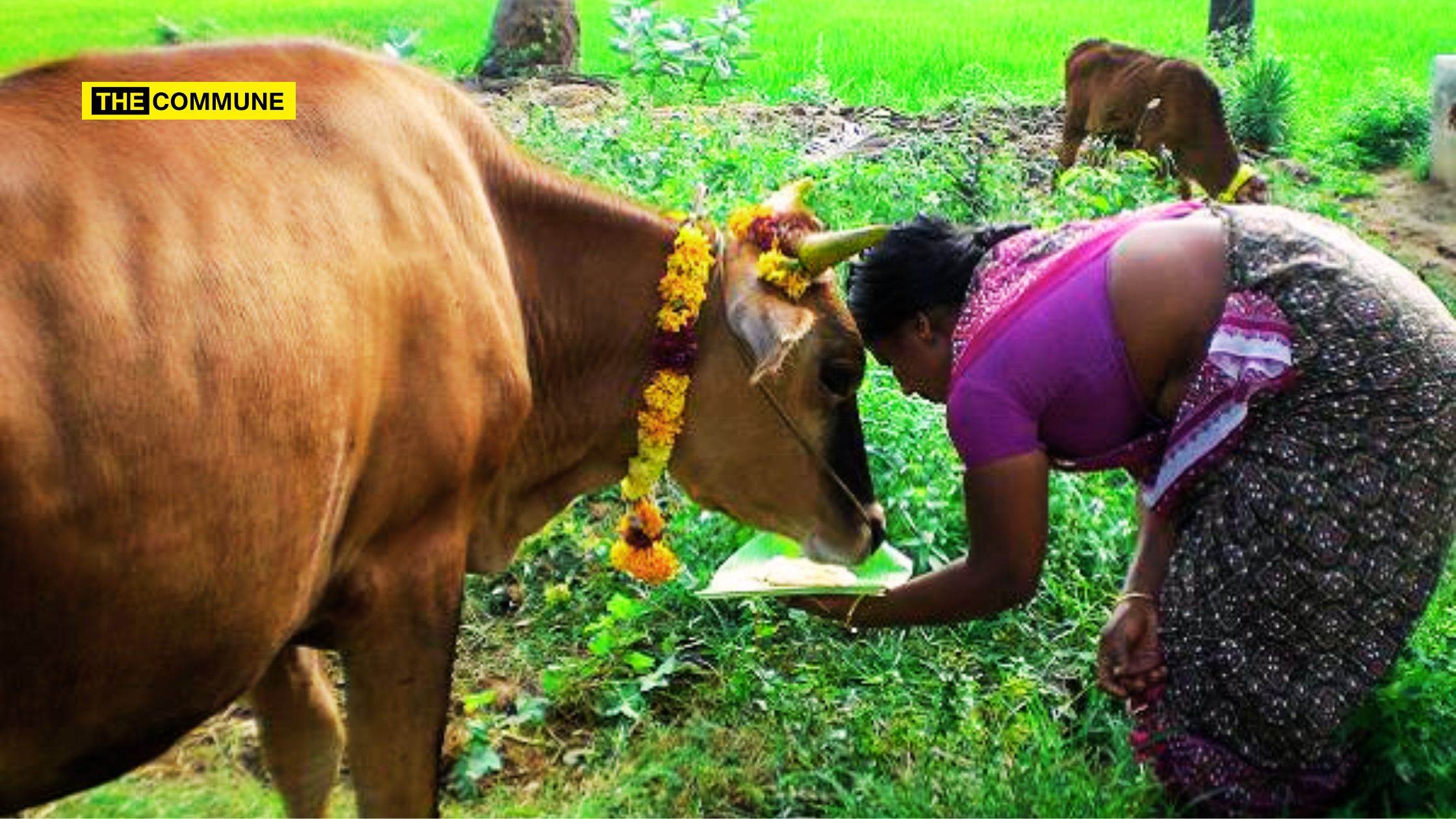
Every year, Tamilians and all South Indians, as a part of Sankranthi festival, celebrate Maatu Pongal, a unique festival dedicated to expressing gratitude to the cows for their indispensable contribution to agriculture. This celebration goes beyond the conventional Pongal festivities, emphasizing the vital role that cows play in rural life. Devotees worship the cows with offerings, decorate them with colorful accessories, and express their gratitude for the nourishing milk they provide.

2. Jallikattu: A Traditional Sport And Cultural Spectacle

Jallikattu, a traditional bull-taming sport, is deeply ingrained in the cultural fabric of southern Tamil Nadu. While controversy surrounds this practice, proponents argue that it is a manifestation of the deep bond between humans and bulls. The event serves as a testament to the valor of both the participants and the revered animals, symbolizing the interconnectedness of man and beast in Tamil culture.

3. Sacred Cow In Rural Agriculture

The significance of the cow in Tamil culture can be traced back to ancient times. The Tamils, one of the oldest surviving civilizations, have maintained a close relationship with agriculture and animal husbandry. The cow, as a domesticated animal, played a pivotal role in the agrarian economy of ancient Tamil society. Its contribution to plowing fields, providing dairy products, and serving as a source of manure for fertilizing crops solidified its status as a symbol of sustenance and prosperity.

In rural Tamil Nadu, agricultural families consider the cow and its milk highly sacred. Offering cow’s milk to temples is a common practice, signifying the importance of this gentle creature in sustaining life. Mistreating a cow is viewed as a serious offense, and immediate pariharam (atonement) is undertaken to seek forgiveness. This reflects the deeply rooted belief in the sanctity of the cow within the societal and religious framework.

4. The Cow In House Warming Event

In the unique cultural landscape of Kongu Nadu, the cow takes center stage even in the construction of homes. During housewarming ceremonies, the cow is the first to enter the newly built home, symbolizing prosperity and abundance. Additionally, the application of cow dung, especially from native breeds, on floors and open spaces is a traditional practice that persists even in modern homes, connecting the present to the architectural heritage of the past.

5. Saamy Maadu: The Sacred Bull In Temple Towns

Amman Temples in villages across Kongu Nadu house a sacred bull known as ‘Saamy Maadu’ (God’s bull). This revered creature roams freely without a leash and is allowed to graze in farmlands. Rather than viewing its presence as a nuisance, farmers feel blessed when the bull feeds on their crops, reinforcing the symbiotic relationship between humans and animals. This scene can also be seen in all major temple towns of Tamil Nadu.

6. Gosaalai And Temple Mutts

Institutions like the Isha Foundation in Coimbatore and various temple maths across Tamil Nadu maintain gosaalais, dedicated spaces for cows. These institutions recognize the spiritual significance of the cow and provide shelter and care for these sacred animals, underscoring their commitment to upholding cultural values.

7. Death Of A Cow: A Grief-Stricken Ritual

The death of a cow is treated with the same reverence as the passing of a family member in Tamil culture. Villagers visit the homes of the owner to offer condolences and support, highlighting the emotional connection between humans and cows. In Kongu Nadu villages, the last rites for a deceased cow are conducted with solemnity, mirroring the rituals observed for human members of the community.

8. Literary References: Manu Needhi Cholan And Chandeshvara Nayanar

Tamil literature provides evidence of the profound respect accorded to cows. Manu Needhi Cholan, a legendary king, went to the extent of sacrificing his own son to ensure justice for a cow. Similarly, Chandeshvara Nayanar, in a poignant display of devotion, cut his father’s leg when the latter interrupted his worship of the Nandi.

Manuneedhi Chozhan
Chandeshwara Nayanar

9. Nandi In The Sri Lankan Tamil Flag

The Sri Lankan Tamil flag contains picture of a Nandi (holy Bull), which symbolizes the deep-rooted connection between Saivism and the sacredness of the bull in Tamil culture. This representation underscores the enduring influence of cultural and religious practices beyond geographical boundaries.


10. Nandi And Linga Worship

The ritualistic worship of Nandi and lingas, as seen in Chandeshvara Nayanar’s story, is a central aspect of Tamil Shaivite practices. Linga worship symbolizes the formless nature of the divine and the devotee’s direct connection with the cosmic energy.

11. Lord Kamadhenu: Deity Of Plenty And Fulfiller Of Desires

In Tamil Nadu, Lord Kamadeenu is venerated as the divine giver of plenty and the fulfiller of all desires. Often depicted as a celestial cow, Kamadeenu symbolizes abundance, prosperity, and the benevolent fulfillment of the wishes of the devotees. The cow’s sacred status is thus elevated to a spiritual plane, reinforcing the cultural and religious significance of the bovine in the hearts of Tamil devotees.

12. Gopuram: The City Of The Cow In South Indian Temples

The intricate entrance gateways of South Indian and Southeast Asian temples, known as gopurams, find their roots in the early Vedic tradition. Originally designed to prevent cattle, including sacred cows, from wandering away, these gates evolved into elaborate structures that now serve as iconic features of temple architecture. The gopuram, with its ornate carvings and towering presence, stands as a symbolic representation of the divine city of the cow. The transition from the original wooden gopurams to stone structures, replicated even in places like Sanchi and reaching as far as China and Japan, underscores the enduring influence of this cultural motif.

13. The Cow And Constellations (Nakshathirams)

In Tamil culture, the cow is associated with specific constellations or nakshathirams, namely Avittam and Uthirattathi. These celestial connections add a layer of cosmic significance to the cultural reverence for the cow. The alignment of the cow with these constellations highlights the integration of celestial elements into the everyday fabric of Tamil life, emphasizing the interconnectedness between the terrestrial and the divine.

Mohit Kumar is a freelance writer.

Subscribe to our channels on TelegramWhatsApp, and Instagram and get the best stories of the day delivered to you personally.
F4 Street Racing Infrastructure At Chennai’s Nerve Centre Dismantled, ₹30 Cr ‘Investment’ Abandoned

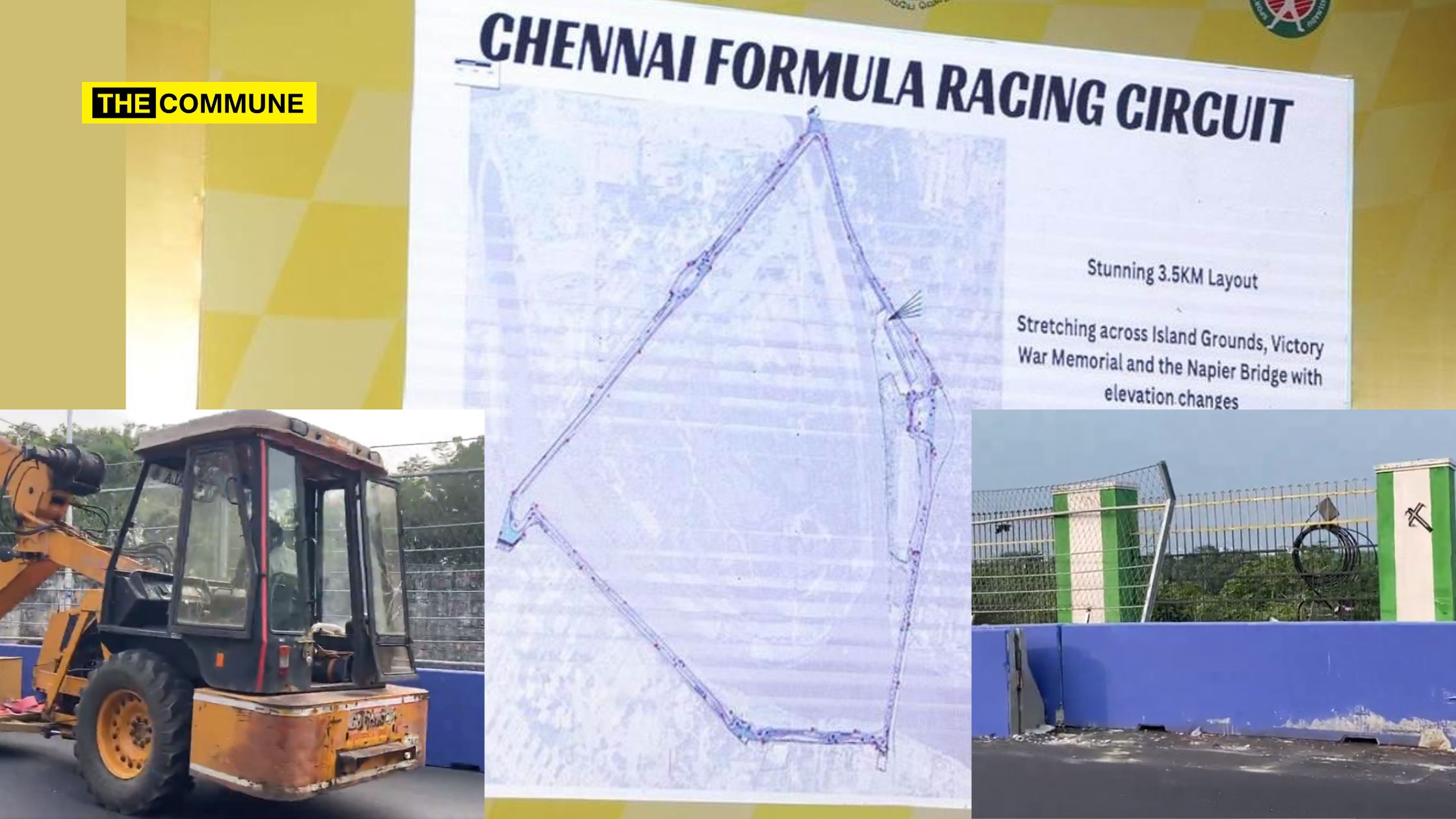
The F4 street racing infrastructure, meticulously set up just last month around Island Grounds, is now being dismantled by authorities owing to the cancellation of the event in the city that was set to happen on December 9-10, 2023. The high-energy event, which was initially slated to take place at the nerve centre of Chennai, has been relocated, prompting the unwinding of a significant investment.

Out of the whopping ₹40 crore budget earmarked for the ambitious venture, nearly ₹30 crores have already been expended on the now-defunct Island Grounds setup. The Tamil Nadu government is now trying to salvage approximately ₹7-8 crores from the dismantling process.

The financial fallout from the relocation is evident as substantial alterations were made to the urban landscape. Roads were dug up and meticulously re-laid, medians were obliterated, streetlights were removed, and pavements razed to accommodate the needs of the F4 street racing spectacle.

Approximately ₹30 crore had been allocated for advertising, promotion, leasing viewing galleries, installing barricades, implementing safety measures, streetlights, and road reconstruction. According to report by Times of India, the government could not recover the expenses for leasing viewing galleries and VIP lounges.

A closer look at the financial breakdown reveals that around ₹7 crores were directed towards civic infrastructure, while additional funds were allocated for leasing viewing galleries and stands. Unfortunately, the lion’s share of these expenses is deemed non-retrievable, adding a layer of fiscal complexity to the situation.

Organizers of the event are now contemplating the future of the roads around Island Grounds, hinting that a reassessment and potential redo might be necessary if the F4 race is slated to return to the venue next year.

The TOI report noted that the roads once done have to undergo FIA international certification and that it cannot even have even small bumps. It was also noted that additional money would’ve to be spent to redo the roads based on its wear and tear at that time.

The fallout extends beyond the financial realm, with the once vibrant and purposeful infrastructure now lying dormant and abandoned around Island Grounds.

The relocation of the F4 race to Irungattukottai adds another dimension to the narrative, with close to ₹30 crore already spent before the event’s change of venue.

Subscribe to our channels on TelegramWhatsApp, and Instagram and get the best stories of the day delivered to you personally.


BJP TN Functionary Booked For Social Media Post Again, This Time For Targeting DMK MP On Parliament Security Breach Issue

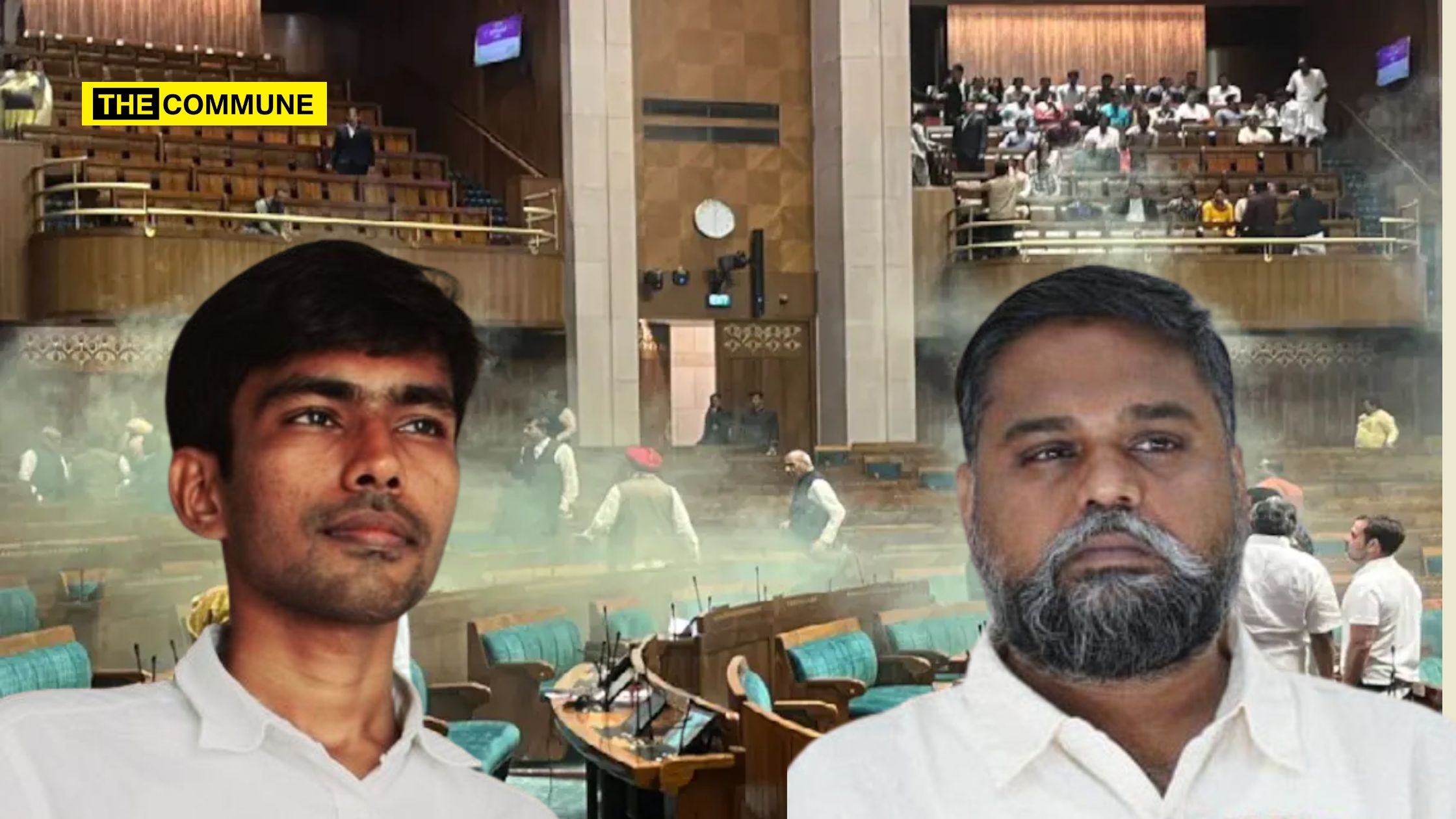
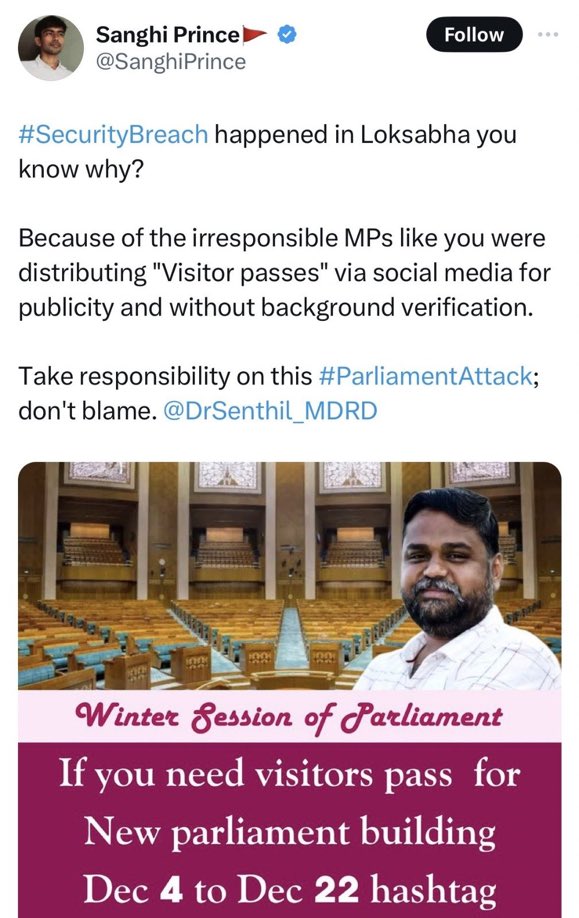
Pravin Raj, a Tamil Nadu BJP social media functionary has been booked for a social media post targeting Dharmpuri DMK MP Senthilkumar over the recent Parliament security breach incident.

A political activist and the social media in-charge for Bharatiya Janata Yuva Morcha (BJYM) Tamil Nadu had posted on his X “#SecurityBreach happened in Loksabha you know why? Because of irresponsible MPs like you were distributing “Visitor passes” via social media for publicity and without background verification. Take responsibility on this #ParliamentAttack; don’t blame. @DrSenthil_MDRD


This social media post of Pravin Raj was made on 13 December 2023 and was later deleted after it gained much traction.

He has now been under sections 504 (intentional insult to provoke breach of peace), 505(1)(b) (intending to cause fear or alarm to the public, potentially leading to offenses against the State or public tranquility) of the Indian Penal Code (IPC), and section 66 (computer-related offenses) of the Information Technology (IT) Act.

The News Minute which jumps into the fray whenever a BJP social media functionary is booked/arrested has carried an article about Pravin Raj’s arrest saying “TN police book BJP functionary for spreading fake news on Parliament breach“. The article claims that Pravin Raj “insinuated that the DMK MP distributed passes to the miscreants who jumped inside the Parliament“. 

While Pravin Raj didn’t explicitly mention that DMK MP Senthilkumar was responsible for the Parliament attack, his comments were construed as attempt to spread fake news against the legislator.

Pravin Raja aka Sanghi Prince was earlier arrested for allegedly publishing an ‘obscene video of Rahul Gandhi and Priyanka Gandhi’, the video in question being an actual incident of Rahul Gandhi publicly kissing his sister Priyanka Gandhi in which the latter can be seen virtually at discomfort.

Subscribe to our channels on TelegramWhatsApp, and Instagram and get the best stories of the day delivered to you personally.
Former DMK Municipal Councillor Nagaraj Arrested For Sexual Assault On Minor In Coimbatore

A former DMK municipal councillor, identified as Nagaraj, has been apprehended by the police on charges of sexually assaulting a minor girl. Nagaraj, a 63-year-old individual who once held the position of councillor in Kavundampalayam in Coimbatore, is now arrested under POSCO.

The accused who is a member of the DMK party, resides with his family in Kavundampalayam. According to law enforcement authorities, Nagaraj purportedly lured a 14-year-old girl to his residence on 11 December 2023, evening. The victim, who was returning from school, fell prey to a sexual assault allegedly perpetrated by Nagaraj.

The gravity of the situation came to light when the traumatized girl recounted her harrowing experience to her parents. In response, the distressed parents wasted no time and promptly reported the incident to the All-Women Police Station in Coimbatore central on 12 December 2023.

(With inputs from The Hindu)

Subscribe to our channels on TelegramWhatsApp, and Instagram and get the best stories of the day delivered to you personally.