Home Blog Page 83

Manchester Synagogue Terror Attack: Jihad Al-Shamie Rams Car, Stabs People On Yom Kippur Leaving 2 Dead; Terrorist Shot Dead By Police

Manchester Synagogue Terror Attack Leaves Two Dead, Three Injured On Yom Kippur; Suspect Shot Dead

Armed police officers stood guard inside a cordon near the Heaton Park Hebrew Congregation synagogue in Crumpsall, north Manchester, after a car-ramming and stabbing attack on Thursday that left two people dead, and three others injured. The attack, which took place on Yom Kippur, the holiest day in the Jewish calendar, is being treated as a terrorist incident by Greater Manchester Police.

United Kingdom Prime Minister Keir Starmer condemned the attack, stating, “While this is not a new hate, this is something Jews have always lived with… We must be clear, it is a hatred that is rising once again, and Britain must defeat it once again.”

Timeline of the attack

The assault began around 9.30 am, local time, when Greater Manchester Police received reports that a car had been driven into people outside the synagogue. Witnesses said the vehicle rammed into the gates before the driver emerged with a knife and began stabbing worshippers.

By 9.38 am, armed officers who had rushed to the scene shot the attacker dead after issuing repeated warnings. In those seven minutes, chaos unfolded as congregants, who had gathered in large numbers for Yom Kippur prayers, tried to seek safety.

Chava Lewin, a resident living next to the synagogue, told The Times, “I thought it might be a firework. My husband went outside and then ran back inside and said, ‘There’s been a terrorist attack’.” Another witness said, “She thought maybe he had a heart attack. The second he got out of the car, he started stabbing anyone near him. He went for the security guard and tried to break into the synagogue. He was in the courtyard. Someone barricaded the door.”

Chief Constable Sir Stephen Watson confirmed that worshippers and security staff managed to prevent the suspect from entering the synagogue building. A video circulated on social media showed armed police aiming their weapons at the suspect outside the gates, as bystanders shouted warnings that he appeared to have a bomb. Police later confirmed the vest he was wearing looked like an explosive device but was not viable.

One witness could be heard shouting, “He’s got a bomb on his f***ing jacket. He’s going to blow himself up. He’s trying to press the button.” Moments later, officers fired again, killing the man.

By 10.30 am, police declared the immediate danger over but continued to urge the public to stay away from the area.

Suspect identified

The attacker was later identified as 35-year-old Jihad Al-Shamie, a British citizen of Syrian descent who came to the UK as a young child and was granted citizenship in 2006 as a minor. Police said his name did not appear in Prevent, the UK government’s counter-terrorism programme, and his motive remains unclear.

Three other people, two men in their 30s and a woman in her 60s, were arrested on suspicion of committing acts of terrorism within hours of the attack.

Victims

Police confirmed that two Jewish men were killed in the attack. Three others were critically injured, including a security guard who was stabbed outside the synagogue. Authorities are yet to release the identities of the victims, and it remains unclear whether the guard was serving in a professional or voluntary capacity.

Reactions

Prime Minister Keir Starmer cut short his participation in a European summit in Copenhagen and returned to London to chair an emergency security meeting. He condemned the “vile individual” responsible for the attack and said Jews were attacked “because they are Jews.” Starmer pledged to guarantee the security of Britain’s Jewish population, “starting with a more visible police presence.”

King Charles III and Queen Camilla expressed their condolences, saying they were “deeply shocked and saddened to learn of the horrific attack in Manchester, especially on such a significant day for the Jewish community.”

Local residents expressed disbelief, with one man telling Sky News, “This is an extremely tolerant community, where people of many faiths, including Jews and Muslims, have lived side by side for years, and I am stunned by what has taken place.” Rabbi Jonathan Romain of Maidenhead synagogue told The Times, “The incident was every Jewish person’s worst nightmare. Not only is this a sacred day, the most sacred in the Jewish calendar, but it’s also a time of mass gathering, and the time when the Jewish community, however religious or irreligious, gathers together.”

Antisemitism concerns

The attack has sparked wider fears about the rise of antisemitism in the UK. Opposition Tory leader Kemi Badenoch called the incident “vile and disgusting” and condemned “the rise in antisemitism that we’re seeing in our country.”

According to the Community Security Trust (CST), a charity monitoring antisemitism in the UK, 3,528 antisemitic incidents were recorded in 2024, the second highest annual figure ever. Nineteen of those involved damage to synagogues. The highest number was in 2023, with 4,296 incidents recorded.

(With inputs from First Post)

Subscribe to our channels on TelegramWhatsApp, and Instagram and get the best stories of the day delivered to you personally.

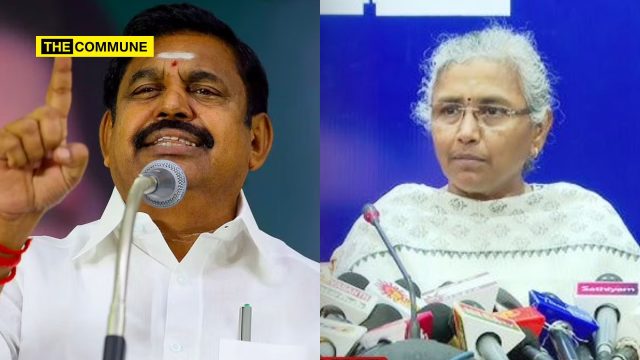
“Are Govt Officials Politicians? What Is The Necessity?” EPS Questions Need For Bureaucrats To Speak Supporting DMK Govt Over Karur Stampede

AIADMK general secretary and Leader of the Opposition Edappadi K. Palaniswami (EPS) on 2 October 2025 placed the blame for the Karur stampede on the DMK government. Speaking at the ‘Makkalai Kaapom, Tamizhagathai Meetpom’ event in Dharmapuri, he said that “the stampede occurred because of the failure of the Tamil Nadu government to provide proper safety and protection to the crowd gathered at the rally”.

Calling the deaths an unparalleled tragedy, Palaniswami said, “The 41 lives lost in Karur is an unprecedented tragedy, which will never be forgotten,” and added that it was the duty of the chief minister to ensure that all party leaders and people participating in any political event remain safe and protected. “So, the government must take responsibility for the Karur incident,” he said.

He also pointed to the commission of inquiry set up by the state, saying, “The people are seeking answers from the government. Now, the state has formed a one-man commission of inquiry. We shall wait for its report. When we held a meeting in Karur, we were also not provided the (safe) venue near the Karur bus stand.” Commenting further on the probe, he said, “It’s for the commission to explain what had happened in Karur. But why are senior IAS officials and police officials trying to justify themselves. This is unacceptable.”

Palaniswami argued that the DMK would have ensured extensive security if it had organised such a meeting. “Had the DMK conducted a meeting, security would have been deployed everywhere, even at vacant places,” he remarked.

Earlier in the day, the AIADMK leader paid tributes to those who lost their lives in the Karur incident. Taking exception to the press conference held by revenue secretary P. Amudha and other senior officials, who denied allegations of mismanagement by the government side at TVK president Vijay’s rally in Karur on Saturday, he raised suspicion that the briefings were an attempt to sway the inquiryIn his post on X earlier, the opposition leader questioned the need for bureaucrats to take the lead in public communication. He wrote, “Following the tragic incident in Karur, the Stalin government is in a state of complete disarray. It appears that the government’s sole aim is to quickly cover up its failure to protect the people and shift the blame for this accident onto others. When there are elected representatives and ministers, what is the necessity for the Revenue Secretary to give interviews to the media? When a commission of inquiry, headed by retired High Court Judge Mrs. Aruna Jagadeesan, has already been appointed and has begun its work, what is the necessity for a secretary, even in the capacity of a government spokesperson, to speak on such matters? Should this not be considered an attempt to influence the opinions of that commission and an affront to justice? However, the Stalin government lacks any form of ethics or morality; their primary concern is to escape responsibility for this horrific incident in which 41 innocent people lost their lives. Furthermore, the fact that this government has staged such a drama to conceal the truth of the incident has created significant suspicion among the public.”

The AIADMK also questioned the state government for not releasing the Government Order on the formation of the Aruna Jegadeesan Commission of Inquiry, saying the terms of reference of the commission should be made public.

(With inputs from The New Indian Express)

Subscribe to our channels on Telegram, WhatsApp, and Instagram and get the best stories of the day delivered to you personally.
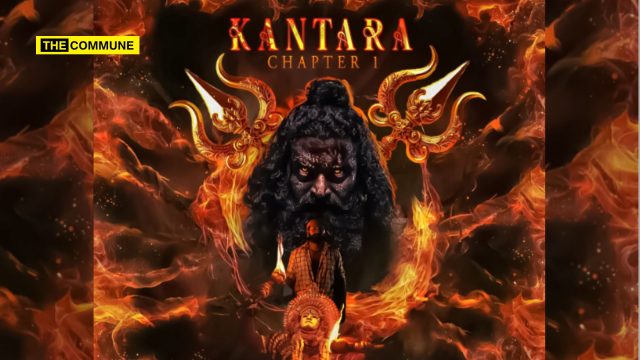
Kantara – Chapter 1 Review: Rishab Shetty’s Epic Visual Spectacle Is A Flawed Roar But The Perfect Antidote To The Divisive Dravidianist Poison

When Rishab Shetty released Kantara in 2022, it became more than a film—it was a cultural phenomenon, a spiritual storm that gripped the nation. Now, with Kantara: Chapter 1, Shetty dives deeper, crafting a prequel that transports audiences to the misty forests of Kadamba-era Karnataka, where myth, faith, and human frailty clash in a blaze of cinematic grandeur. The film isn’t just a story—it’s an invocation, a spectacle that thunders with both divinity and philosophy, while daring to counter the divisive narratives of Dravidianist cinema.

But does this ambitious saga live up to its predecessor? The answer lies somewhere between spiritual magnificence and cinematic imperfection.

A Spectacle Forged In Fire And Faith

From the opening frame, Kantara: Chapter 1 declares itself a visual and sonic odyssey. Cinematographer Arvind S. Kashyap paints the forests as both sanctuary and battlefield—mist curling around ancient trees, fire consuming ritual altars, and armies clashing in bursts of primal energy. The dense jungles themselves are a feast for the eyes, captured with a richness that makes the screen breathe with life. It’s the kind of world-building that feels mythic yet tangible, like stepping into a legend told around tribal fires centuries ago.

The VFX, a noticeable leap from the original, doesn’t scream technology but whispers devotion. Animals—majestic and godlike—emerge as symbols of power and reverence. The divine possession sequences, where Shetty’s Berme channels the deity Panjurli, transcend performance. They don’t feel staged; they feel summoned. Only a person with sincere devotion and guided by the divine could’ve pulled it off!

And then there’s B. Ajaneesh Loknath’s music. If the film is the body, the score is its heartbeat. Tribal drums pound like war cries, flutes soar like whispers of the divine, and crescendos crackle with energy. The nerve-shredding clash between the tribes and the kingdom—erupts with a force that leaves audiences breathless at the interval. The climax is just audacious, an equivalent to Lord Krishna revealing his Vishwaroopam avatar that leaves the viewers mesmerized in devotion.

Performances Anchored In Devotion

Rishab Shetty is the film’s soul. As Berme, the tribal leader, he embodies both primal fury and spiritual surrender. This isn’t mere acting—it feels like a man possessed, channelling something larger than himself. His sincerity seeps into every frame, convincing you that only someone guided by devotion could pull off such a role.

Rukmini Vasanth rules the screen as Princess Kanakavathi, balancing elegance with sharp intelligence as she navigates a patriarchal court. Jayaram lends gravitas as King Vijayendra, while Gulshan Devaiah’s Kulasekhara, though compelling, doesn’t get the narrative space he deserves. Still, the ensemble holds strong, with Shetty’s raw energy anchoring the storm.

Where The Film Stumbles

For all its grandeur, Kantara: Chapter 1 isn’t flawless. The screenplay takes its time—too much time—meandering through exposition-heavy setup before the story truly ignites. What should feel like mythic immersion occasionally drags like a heavy trek. The editing, too, could have been tighter; several stretches would have benefitted from sharper cuts to sustain rhythm and urgency.

Then there’s the humor. In a film steeped in mysticism and reverence, the clunky jokes and misplaced banter fall embarrassingly flat. Instead of offering relief, they rupture the atmosphere, leaving viewers shifting uncomfortably in their seats. The gags “hardly tickle your ribs” and feel like filler in an otherwise thunderous narrative.

The Philosophical Counterpoint

But the true power of Kantara: Chapter 1 lies not just in its cinematic craft but in its philosophy. At its heart, the story pits the Kantara tribe—guardians of the sacred forest—against a kingdom blinded by greed and arrogance. This echoes the eternal oppressed-versus-oppressor trope, yet Shetty flips the narrative lens.

Unlike Pa Ranjith or TJ Gnanavel, whose films (Kaala, Jai Bhim) reduce oppression to caste binaries—vilifying Brahmins, Vanniyars, or Thevars as monolithic villains—Shetty refuses to demonize entire communities. Instead, the oppressor here is not a caste but an exploitative system of hubris motivated by individual greed of those in power.

On one side stand Dravidianist propagandists like Pa. Ranjith, dismissing the Chola era as a ‘dark age’ simply because the dynasty openly upheld Vedic Hinduism. On the other side, we have filmmakers like Rishab Shetty, who rise above petty politics and instead seek to unite people through the realm of spirituality.

This is where the film becomes an antidote to the poison of hate. Berme’s resistance, rooted in his communion with Panjurli, is not a call to resentment but a spiritual rebellion against desecration. The climax doesn’t end with vengeance; it ends with restoration of dharma. Unlike Dravidianist cinema that thrives on anti-Hindu hate and confrontation, Shetty’s story finds resolution in transcendence and spirituality. Justice here is divine, not divisive.

It’s a radical narrative choice—and a powerful one. Instead of perpetuating blame, Kantara reasserts that unity lies in aligning with the divine, not in tearing communities apart. This is the film’s greatest victory: a reclamation of cultural pride that uplifts rather than divides.

Final Verdict: Flawed, But Towering

Yes, Kantara: Chapter 1 has its faults. The dragging first half tests patience, the humor misfires, and parts of the narrative feel uneven. The editing could have been leaner, sharpening the storytelling without compromising depth. Yet when weighed against its ambition, its sincerity, and its spiritual firepower, these shortcomings seem minor.

This is not just another prequel cashing in on a franchise—it is a statement, a cultural beacon. Cinematically, it demands the big screen. Philosophically, it dares to counter the rhetoric of hate with the resonance of faith. Spiritually, it revives an old truth: that dharma, not division, restores balance.

Rishab Shetty has not just made a film—he has offered an experience. Kantara: Chapter 1 is flawed, yes. But it is also magnificent, a towering achievement that roars with devotion and resonates with hope in a fractured world.

Subscribe to our channels on TelegramWhatsApp, and Instagram and get the best stories of the day delivered to you personally.

Yet Another Startup Moves Out Of Dravidian Model Tamil Nadu – Agritech Startup Fragaria Announces Move To Bengaluru

Why Are StartUps Leaving Dravidian Model Tamil Nadu To Bengaluru? startup tn

In yet another instance of a Tamil Nadu-based startup moving out of the state to neighbouring Karnataka, an agritech company Fragaria announced that they were shifting to Bengaluru.

Taking to LinkedIn to announce the move, the co-founder Harish Varadarajan wrote, “Fragaria is moving to Bengaluru! 
As a Tamil boy, I dreamt of building a truly global product right from Tamil Nadu. We gave it everything in Chennai — and proved premium strawberries can be grown here against all odds. 
But the climate, market access, supportive laws for agriculture, expat livability, and the thriving startup ecosystem have made the move to Bengaluru inevitable. That said, Chennai will always be our first home. Our R&D farm will continue there, and I hope to find many more reasons to bring farms back to Tamil Nadu in the future.”

While one might argue that they are incorrectly blaming climate, one must note that he has addressed the point by saying “proved premium strawberries can be grown here against all odds.”- this points us to the other reasons that may have triggered the move.

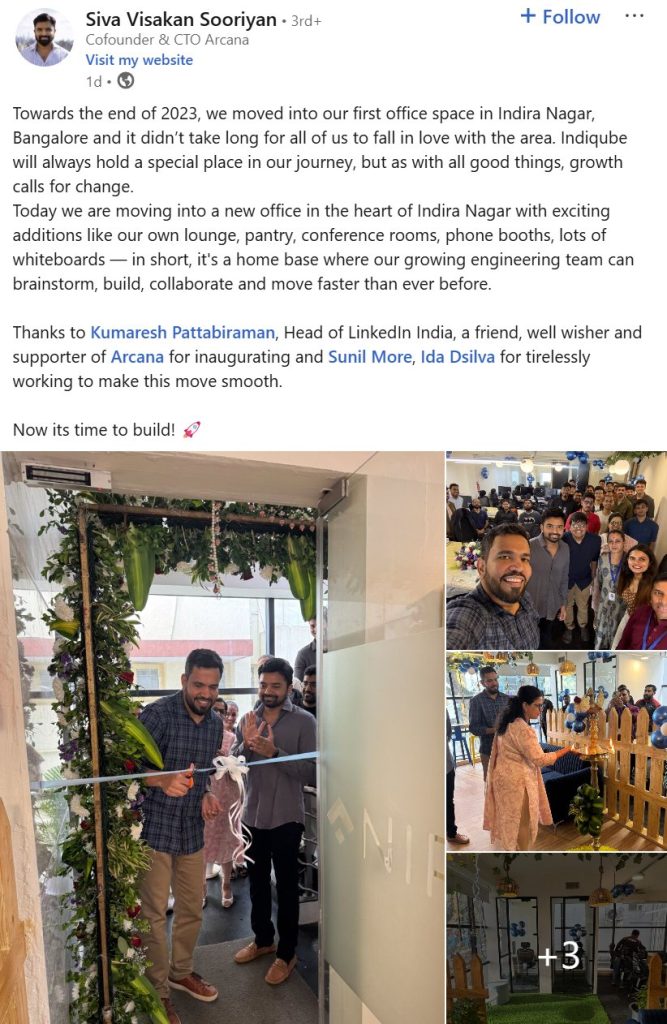
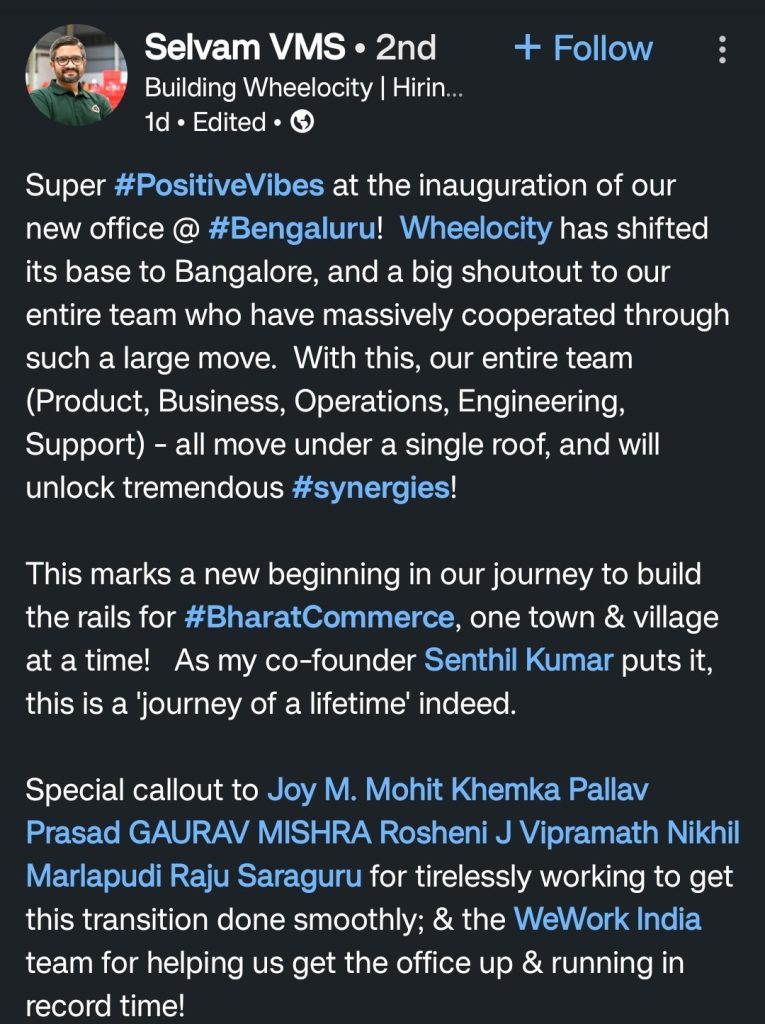
This is not the first time in recent months that a startup has moved out of Tamil Nadu. Earlier this year, startups like Wheelocity and Arcana announced their move from Tamil Nadu to Bengaluru.

The exodus of startups from Tamil Nadu to Bengaluru signals a glaring failure in the Dravidian model state’s ability to retain innovation and enterprise. Even though the DMK government claims that the state is a favoured investment destination, Tamil Nadu’s startup ecosystem suffers from chronic underfunding, a lack of risk-taking culture, and an absence of local champions in high-growth sectors.

Why Are TN Startups Shifting To Bengaluru?

A January 2025 report from Times of India highlights that startups in Tamil Nadu are often seen as more “tortoises” than “unicorns,” reflecting a slower growth pace compared to other regions. Despite being the second-largest economy in terms of gross national income, Tamil Nadu continues to lag in the startup scene. Last year was especially challenging, with venture capital funding for startups in Tamil Nadu dropping 44% from the previous year, according to data from Venture Intelligence. This marks the lowest funding since 2020, even as national funding saw a recovery in 2024.

Arun Natarajan, founder of Venture Intelligence, acknowledges that while Tamil Nadu’s funding ecosystem is underdeveloped compared to other startup hubs, this doesn’t pose a significant issue for the right kind of entrepreneurs. Many startups have demonstrated that founders can easily reach out to venture capitalists (VCs) in other cities for funding. However, due to a lack of local seed capital and the more conservative nature of Tamil Nadu’s entrepreneurs, startups here tend to approach external investors much later than those in cities like Bengaluru or NCR.

The absence of role models, particularly in the consumer sector, is another challenge, according to Natarajan. While founders like Girish Mathrubootham have successfully scaled B2B software ventures, there are fewer success stories in the consumer-focused, cash-burning startups like Swiggy or Zepto, which take years to turn profitable. Moreover, there is a lack of local investors willing to back such ventures.

According to data from Tracxn, just over 250 startups in Tamil Nadu have raised Series A funding or beyond, and around 10 startups have reached unicorn status. This includes companies like Uniphore, Freshworks, Chargebee, and Zoho, but is still far fewer compared to other startup hubs like Bengaluru and Mumbai. Most of Tamil Nadu’s ventures are B2B-focused, primarily working in enterprise applications and financial services.

I.A.S. Balamurugan, managing partner and co-founder of Anicut Capital, emphasizes that Tamil Nadu’s startup ecosystem needs to evolve beyond just funding. While a few software and fintech firms in the state have received significant capital, Balamurugan hopes to see the growth of sectors like manufacturing tech and automobiles. He advocates for an ecosystem that supports both profitable and risky startups, allowing them to fail if they’re not viable businesses. Without a risk-taking mentality, the ecosystem will struggle to nurture high-potential ventures.

Arvind Subramaniam of Enlighten Capital, a micro-VC, believes that while Tamil Nadu startups have traditionally been conservative and reluctant to raise external capital, the situation is changing. Entrepreneurs are becoming more open to funding as they gain exposure to other hubs, and former employees of successful startups are now starting their own ventures with seed capital from experienced founders.

Sivarajah Ramanathan, CEO of startupTN, points out that Tamil Nadu’s startup ecosystem has a lower failure rate compared to other regions. He believes that alternative funding sources, such as debt or a company’s turnover and profitability, should also be considered. Ramanathan is optimistic about the future of the state’s ecosystem, noting that efforts are underway to improve access to funds. In the past six months, the state has facilitated 90 crores in cumulative funding.

An executive from a well-known startup investor firm suggests that their philosophy aligns more with slow, steady growth—like the tortoise—rather than the pursuit of unicorn status. This mindset, shared by some Tamil Nadu startups, raises the question of whether these “tortoises” will ultimately win the race over the “unicorns.”

Subscribe to our channels on TelegramWhatsApp, and Instagram and get the best stories of the day delivered to you personally.

Aintham Tamilar Sangam Throws Slippers & Burns Lord Rama Effigy Ahead Of Vijayadasami, No Action Taken By DMK Govt

Aintham Tamilar Sangam Throws Slippers & Burns Lord Ram Effigy Ahead Of Vijayadasami arrested

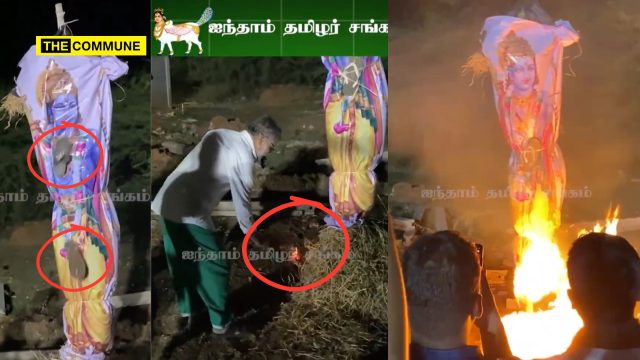
In what seems to be following the footsteps of the 2016 act of the Thanthai Periyar Dravidar Kazhagam in burning the effigy of Lord Rama during Vijayadasami, the Aintham Tamilar Sangam carried out a similar act a few days ago.

The group also threw slippers at the effigy of Lord Rama.

They shared the video of the act reportedly carried out by the Sangam leader Pandian on 30 September 2025 amid cries of “Ravanane Potri”. But there seems to be no action taken yet on the group for the provocative hateful act by the ruling DMK government.

Instead, the DMK Govt was busy arresting RSS Swayamsevaks who were marking Vijayadasami and Centenary celebrations

This was condemned by BJP leader SG Suryah who wrote, The barbaric act of burning Lord Shri Ram’s effigy is a direct continuation of the vile legacy started by E.V. Ramasamy, who garlanded #LordRam with slippers. The poison of Hindu-hatred sown then is being harvested now under the DMK regime is highly condemnable. This is not a fringe act; it’s the result of an ideology you nurture. These anti-Hindu elements operate without any fear of the law under the #DMK government. Thiru @mkstalin, will you uphold your ideology of hate or the law of the land? Your immediate action in arresting these criminals will be your answer. The silence is deafening.”

This is not a… pic.twitter.com/sutaWj0Jwk

In 2016, about 40 members of the Thanthai Periyar Dravidar Kazhagam (TPDK) gathered at the Sanskrit College in Mylapore, Chennai, to burn effigies of Ram, Sita, and Lakshman, calling it “Ravanan Leela” in protest against Hindu cultural practices like Ram Leela. Despite tight police security, the group managed to burn some effigies, and 11 participants were remanded. TPDK leaders condemned the Ramayana’s depiction of Dravidians as demons and said the act was a response to perceived cultural hegemony. They also claimed to have appealed to the Prime Minister to stop Ram Leela in Delhi. Ravanan Leelas have historical roots among Periyarist groups, dating back to the 1970s.

Subscribe to our channels on Telegram, WhatsApp, and Instagram and get the best stories of the day delivered to you personally.

DMK Stooge ‘The Week’ Journalist Lakshmi Peddles Fake News About Vijay Over Karur Stampede, Doesn’t Delete Post Despite Being Fact-Checked

The ruling dispensation in Tamil Nadu has many affiliates working in different media houses. One among the many is Lakshmi Subramanian of The Week.

When the news of the Karur stampede broke, instead of doing what a journalist must do – report the truth, Lakshmi resorted to peddling fake news.

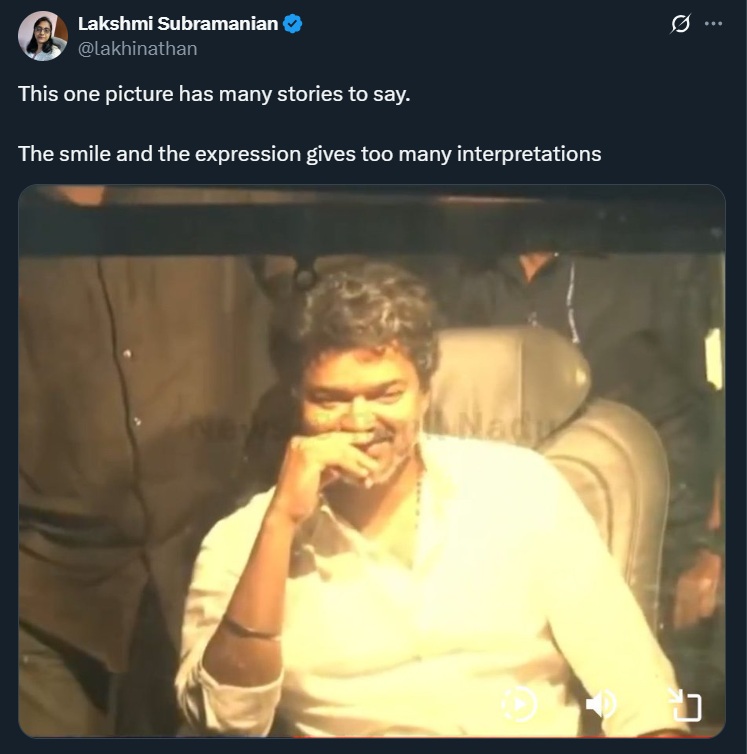
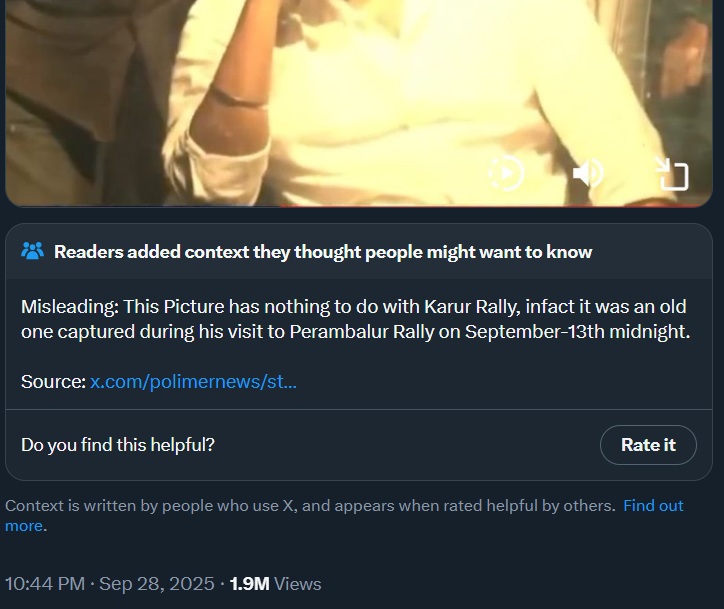
In a post on X that she has not deleted yet, she shared a screenshot of Vijay smiling inside his caravan at his supporters and captioned it, “This one picture has many stories to say. The smile and the expression gives too many interpretations”

She posted this image on 28 September 2025, a day after the stampede occurred. Despite being fact-checked in the Community notes section that the image/video was from a rally in Perambalur when the staff switched on and off the light inside the caravan and Vijay was enjoying his fans’ reaction, she has not deleted the post at the time of publishing this report.

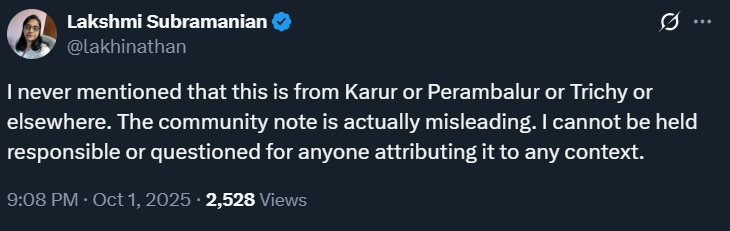
When she was called out, she defended herself saying, “I never mentioned that this is from Karur or Perambalur or Trichy or elsewhere. The community note is actually misleading. I cannot be held responsible or questioned for anyone attributing it to any context.” 

At a time of such a tragedy, instead of reporting facts, when a mainstream journalist makes such a post buttressing the ruling DMK, the credibility of both her and the national magazine like The Week where she works, comes to naught.

Lakshmi Subramanian is said to be working at The Week for over a decade – 13 years as per her LinkedIn profile.

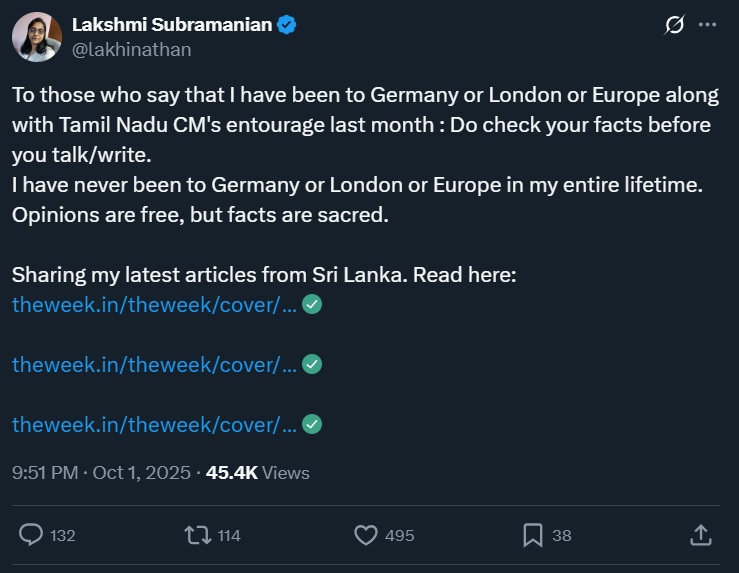
It is alleged that she was a part of the entourage that went to Germany and London with chief minister MK Stalin recently.

However, she refuted these claims saying, “To those who say that I have been to Germany or London or Europe along with Tamil Nadu CM’s entourage last month : Do check your facts before you talk/write. I have never been to Germany or London or Europe in my entire lifetime. Opinions are free, but facts are sacred. Sharing my latest articles from Sri Lanka. Read here:
https://theweek.in/theweek/cover/2025/09/27/sri-lanka-economic-recovery-anura-dissanayake-sri-lanka-stability.html

https://theweek.in/theweek/cover/2025/09/27/what-ranil-wickremesinghes-arrest-means-for-sri-lankan-democracy.html

https://theweek.in/theweek/cover/2025/09/27/we-need-more-investment-for-lasting-growth-anil-jayantha-fernando.html”

https://t.co/rJ5EJW7j4x pic.twitter.com/dtVew3LDqc

A Quick Look At Her Past

Lakshmi Subramanian has indulged in spreading misinformation about the RBI’s 25-basis-point repo rate hike in February 2023. She posted that home loan interest rates were 11% and implied this would harm people’s lives, despite many banks offering loans at much lower rates. Critics said her post emotionally targeted citizens and diverted attention from the DMK government’s rate hike impact on Tamil Nadu’s textile industry.

During a press meet in Coimbatore in October 2022, journalists Shabbir Ahmed (TNM) and Lakshmi Subramanian questioned the then BJP Tamil Nadu President Annamalai over a previous remark in which he compared aggressive media behavior to monkeys. Annamalai defended himself, refused to apologize, and criticized what he called agenda-driven reporting by certain media, highlighting inconsistencies in how the media treated DMK leaders versus BJP leaders.

In February 2022, after a petrol bomb attack on the BJP office in T. Nagar, Chennai, Lakshmi Subramanian posted in Tamil, calling the location “not even worthy of bombings, idiots.” The tweet was widely criticized for appearing to justify attacks based on the site’s perceived importance. She later deleted the post following public backlash, which highlighted the potential irresponsibility of her commentary.

Subscribe to our channels on TelegramWhatsApp, and Instagram and get the best stories of the day delivered to you personally.

Why Appoint A Commission And Waste Taxpayer’s Money If DMK Govt Is Going To Use Officers To Entirely Blame TVK?

The tragic Karur stampede that claimed 41 lives, including children, has exposed contradictions in the DMK government’s crisis management. Within hours, the Tamil Nadu government deployed top bureaucrats and police officers to hold detailed press conferences, presenting video evidence, timestamps, and crowd analyses that systematically blamed the Tamilaga Vettri Kazhagam (TVK) for the disaster. Yet simultaneously, Chief Minister MK Stalin established a judicial commission headed by retired Justice Aruna Jagadeesan to investigate the same incident.

This approach raises questions about the misuse of taxpayer money. If the DMK government was confident enough to field Additional Chief Secretary P. Amudha, ADGP Davidson Devasirvatham, and other senior officials to present “evidence,” what purpose does an expensive judicial commission serve?

Pre-emptive Damage Control

The September 30 press conference was a pre-emptive strike to control the narrative. Officials presented crowd estimates, security deployment ratios (1:20 instead of the standard 1:50), and minute-by-minute accounts of the incident, including video evidence showing alleged TVK violations.

Additional Chief Secretary Amudha detailed venue selection and crowd management logistics, while ADGP Davidson Devasirvatham offered technical explanations of police deployment and response. Essentially, the government conducted its own investigation before the judicial commission began its work.

The timing was also telling: just hours after TVK chief Vijay released a video statement challenging the government, alleging conspiracy. This suggests the press conference was less about accountability and more about narrative control.

The Commission: Redundant And Wasteful Expenditure

Justice Jagadeesan’s commission appears to be a costly formality, collecting information already analyzed by government officers. The absurdity is clear – the officials who publicly defended the government’s actions will provide the “evidence” to the commission, compromising its independence.

Tamil Nadu has a history of such wasteful commissions. In 2018, the Madras High Court criticized the state for spending ₹4.5 crore on the Justice Regupathy Commission, which remained non-functional for three years. The court emphasized that taxpayer money should be spent judiciously. The same principle applies here: if the government already conducted investigations, why burden the public with another expensive, largely redundant exercise?

The TVK Blame Game

The DMK’s strategy is clear: use bureaucrats to immediately blame TVK while appointing a judicial commission to provide legal cover. FIRs against TVK leaders Mathiazhagan, Bussy Anand, and C.T. Nirmal Kumar echo the government’s press conference points. Interestingly, Vijay himself was not named, suggesting selective targeting to avoid confrontation with a popular actor while targeting his party machinery.

The government highlights TVK’s alleged violations: delayed arrival, inadequate crowd control, ignoring police warnings, and cadres climbing structures. Yet, these also raise questions about government preparedness and security adequacy, questions unlikely to be seriously examined by a commission already fed a government-sanctioned narrative.

Political Insurance At Taxpayer Expense

The judicial commission acts as political insurance. When criticism grows, officials can deflect by pointing to an “independent” inquiry. The commission’s eventual report, likely months away, will provide institutional legitimacy to the government’s version of events, at a cost of crores to taxpayers. The exercise is largely performative, providing political cover while consuming public funds.

By briefing the media before an inquiry begins, the DMK government undermines the credibility of institutional processes. Administrative officers act as investigators, prosecutors, and defenders simultaneously, turning what should be an independent judicial inquiry into a theatrical exercise. Opposition leader Edappadi K. Palaniswami questioned why officials briefed the media when a commission was already appointed.

A Call For Real Accountability

Tamil Nadu’s citizens deserve genuine accountability for the Karur tragedy, not political theater. If the government is confident in its handling, it should present evidence through proper legal channels rather than bureaucrat-led press conferences. If independent investigation is truly needed, the government must avoid prejudicing it through pre-emptive damage control. Conducting both simultaneously wastes public resources and insults the memory of the victims.

The Karur tragedy reveals that institutional processes are being used as political tools rather than mechanisms of accountability. Until this changes, Tamil Nadu taxpayers will continue funding expensive exercises in political theatrics while real accountability remains elusive.

Subscribe to our channels on TelegramWhatsApp, and Instagram and get the best stories of the day delivered to you personally.

Dravidian Model: Book Smuggling Scandal In Theni Government School, Teacher & Cleaner Suspended

Dravidian Model: Book Smuggling Scandal In Theni Government School, Teacher & Cleaner Suspended

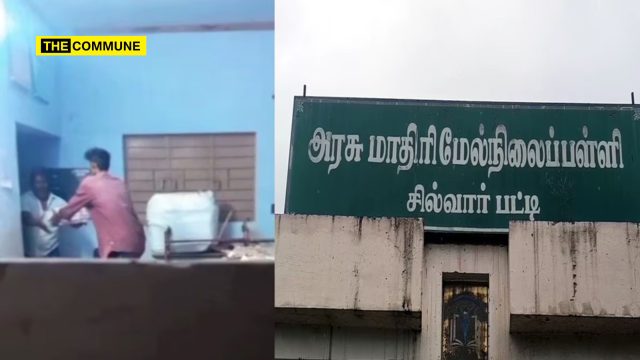
A shocking incident unfolded at a government model higher secondary school in Silvarpatti village near Periyakulam, Theni district, where notebooks and textbooks were stolen by a teacher and a cleaner. The school, which caters to more than 1,200 students from classes 1 to 12, has been left reeling after the theft.

On the night of 26 September 2025, unknown individuals entered the school premises using a cargo vehicle and a two-wheeler. Local students and members of the public, noticing the suspicious activity, followed discreetly and watched from behind. The intruders proceeded to open the school’s book room, which stores textbooks and notebooks meant for the students, and loaded the materials into the cargo vehicle. Students who witnessed the theft secretly recorded the incident on their cell phones.

After removing the books and notebooks, the perpetrators quickly fled the scene in the cargo vehicle and the two-wheeler. The video captured by the students later went viral on social media, causing widespread shock among parents and the local community.

When the school principal, Pandian, was questioned about the incident, he initially claimed that the books had been taken without his knowledge and that he had no involvement. He later changed his statement, asserting that the materials removed were old papers damaged by termites. Following the circulation of the video, Principal Pandian lodged a complaint with the police seeking action against those responsible for the theft.

Students who witnessed the incident described the events in detail. They said they had been playing football on the school grounds that evening when the school watchman and peon, Vijayan, told them to leave. Suspicious of the situation, the students hid and observed the unfolding events. They saw unidentified individuals enter the school in a tempo and two bikes, and coordinate with teacher Bharathiraja to remove bundles of books. The students managed to secretly record the incident before the teacher and the intruders noticed the video being taken. Upon realizing this, the group hurriedly left the premises.

A local resident later approached the students, urging them to delete the video, warning that public exposure of the theft would create major problems. The resident even offered money to ensure the video was not shared. The students reported the matter to the police.

Following an investigation, authorities have temporarily transferred both teacher Bharathiraja and the cleaning staff involved in the incident. Parents have expressed outrage and demanded that the teacher be dismissed for the theft.

(With inputs from ABP Tamil)

Subscribe to our channels on Telegram, WhatsApp, and Instagram and get the best stories of the day delivered to you personally.

Love Jihad In Rajasthan: AIMIM Leader Kashif Zubairi Rapes Hindu Woman And Forces Her To Convert, Blackmails To Leak Explicit Photos

Feature Image Credits: OpIndia

A former state secretary of the All India Majlis-e-Ittehadul Muslimeen (AIMIM), Kashif Zubairi, faces allegations of raping a Hindu woman and coercing her to convert to Islam.

On September 30, the victim lodged a zero FIR at Tonk police station. According to Tonk SP Rajesh Meena, since the incident occurred in Jaipur, the zero FIR was transferred to the appropriate Jaipur police station for further action.

Reports indicate that the victim, a married woman with a child and a practicing advocate, has been living apart from her husband due to domestic issues. Allegedly, Zubairi, also an advocate, exploited her vulnerability, engaging in sexual relations with her under the false promise of marriage.

Some accounts claim Zubairi took the woman to a flat in Jaipur, where he gave her tea spiked with sedatives and raped her. When confronted, he allegedly reassured her with marriage promises. The victim further stated that Zubairi repeatedly pressured her to divorce her husband and had sexual relations with her multiple times in the Jaipur flat. She became pregnant once but suffered a miscarriage.

Zubairi later refused to marry her and allegedly blackmailed her using explicit photos and videos. Additionally, the victim claimed Zubairi coerced her and her 10-year-old child to convert to Islam and forced her to sign blank papers.

On August 15, the victim visited Zubairi’s parents in Tonk to discuss the matter, but they rebuked her and sent her away. On September 30, she approached Zubairi again in Tonk, but he dismissed her and threatened her life, prompting her to file a police complaint.The police are currently investigating the case.

(With inputs from OpIndia)

Subscribe to our channels on TelegramWhatsApp, and Instagram and get the best stories of the day delivered to you personal.

Tamil YouTuber Felix Gerald Gets Conditional Bail After Arrest by DMK Govt Over Videos Suggesting Sabotage In TVK Karur Stampede

Felix Gerald, a Tamil YouTuber who runs the RedPix channel, was arrested by the Cyber Crime Division for allegedly circulating false information related to the Karur stampede, which occurred during a political campaign by actor and Tamilaga Vettri Kazhagam (TVK) leader Vijay. The tragic incident led to the deaths of 41 people.

Police officials stated that Gerald uploaded misleading content concerning the stampede, prompting legal action.

According to The New Indian Express, When produced before the XI Metropolitan Magistrate Court for judicial remand, Gerald was instead granted conditional bail that same night. Advocates Pulianthope Mohan and D. Johnson, representing him, told TNIE that the court was unconvinced by the police’s justification for keeping him in custody.

The bail conditions included restrictions on publicly expressing opinions regarding the incident linked to his alleged offence.

Gerald was taken into custody from his Nungambakkam residence in the early hours. Later, his wife, Jane Felix, spoke to reporters, expressing distress over the arrest and insisting that her husband was simply “bringing out the truth.” She questioned whether freedom of expression still exists in the country and appealed for justice.

It is worth noting that Gerald had previously been arrested last year alongside YouTuber Savukku Shankar for comments made against women police officers, and he was subsequently granted bail.

Separately, Tamil Nadu police arrested three others on Monday for allegedly spreading rumours about the Karur stampede online. The Greater Chennai Police stated that cases have been filed against 26 social media accounts for circulating misinformation regarding the tragedy and the state government’s response.

Subscribe to our channels on TelegramWhatsApp, and Instagram and get the best stories of the day delivered to you personal.