Home Blog Page 806

Farmers’ Protest 2.0, Rahul Gandhi’s Tweets And Modi Govt’s Schemes
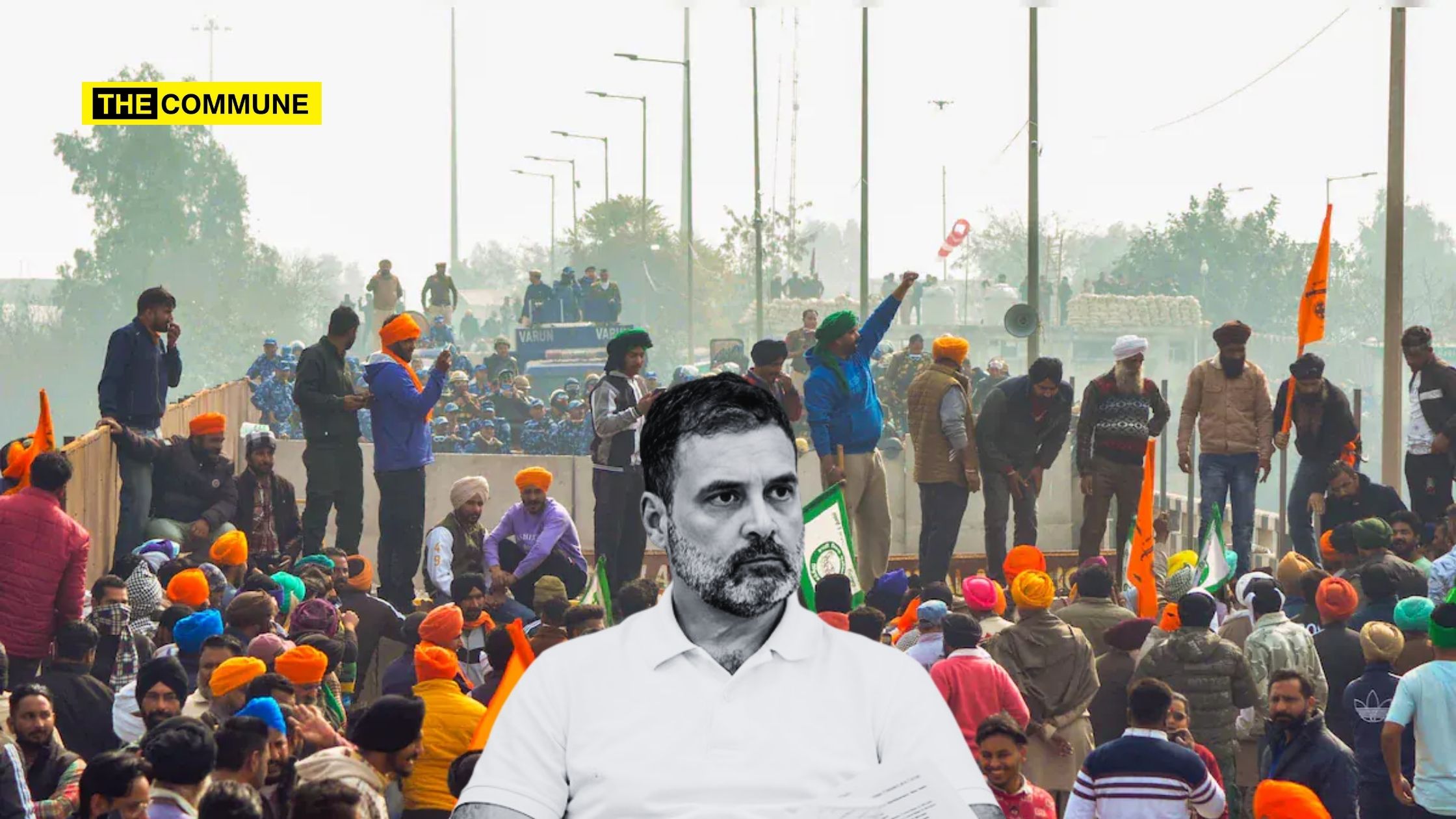
The Dilli Chalo March started by the farmers in Punjab commenced on 13 February 2024 . In contrast to previous demonstrations that primarily opposed three agricultural laws, the current protest, labelled under the banner of “Dilli Chalo,” incorporates a broader spectrum of demands.

These include securing legal assurances for the Minimum Support Price (MSP) for all crops, implementing the recommendations of the Swaminathan Commission, providing comprehensive debt relief for farmers, establishing pensions for farmers and withdrawal of cases against demonstrators involved in the 2021 protests. The leadership of the Farmers’ Protest 2.0 is held by the Samyukt Kisan Morcha and Kisan Mazdoor Morcha.

Farmers are also advocating for penalties against those engaged in the sale of counterfeit seeds, pesticides, and fertilizers. They are pushing for an increase in the number of work days in the rural employment guarantee scheme to 200 days. Additionally, the protesters are calling for India to withdraw from the World Trade Organization (WTO) and nullify all existing free trade agreements.

The agricultural community is requesting guaranteed floor prices, known as Minimum Support Price (MSP) for over 20 crops annually, to enable them to sell the majority of their produce at government-controlled wholesale markets or mandis. They are also urging the government to fulfill its commitment to doubling farmers’ income. They argue that cultivation costs have surged in recent years while incomes have stagnated, making farming economically unsustainable. With the new wheat crop ready for harvest in about a month, the farmers are well-prepared for sustained protests, reinforcing tent camps along highways while tending to their crops.

Union Minister for Agriculture Arjun Munda has expressed the Centre’s willingness to engage in further discussions with protesting farmers, provided a conducive environment is ensured. The protests, originating mainly from Punjab, Haryana, and parts of Uttar Pradesh, have entered their second day on 14 February 2024, with demands including legislation guaranteeing a minimum support price for agricultural produce.

BJP national spokesperson and MP Sudhanshu Trivedi stated that the government cannot enact new legislation at the moment as the Lok Sabha session has concluded. He highlighted the government’s sensitivity to farmers’ issues and noted that many of their demands have already been addressed. Trivedi deemed the demand for a new law at this juncture as technically unfeasible, given the adjournment of the Lok Sabha session, and emphasized the limitations on legislative action at this time.

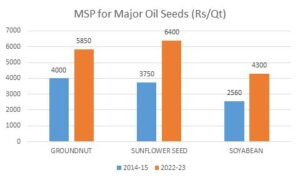
On 7 June 2023, the Union Cabinet approved an increase in the Minimum Support Price (MSP) for Kharif crops for the marketing season 2023-24. Union Minister Piyush Goyal, addressing a press conference, stated that this decision aims to guarantee profitable prices for farmers and promote crop diversification. The overall Kharif crop estimate for the current year is 330 million tonnes, a notable increase from the 285 million tonnes recorded in 2018-19.
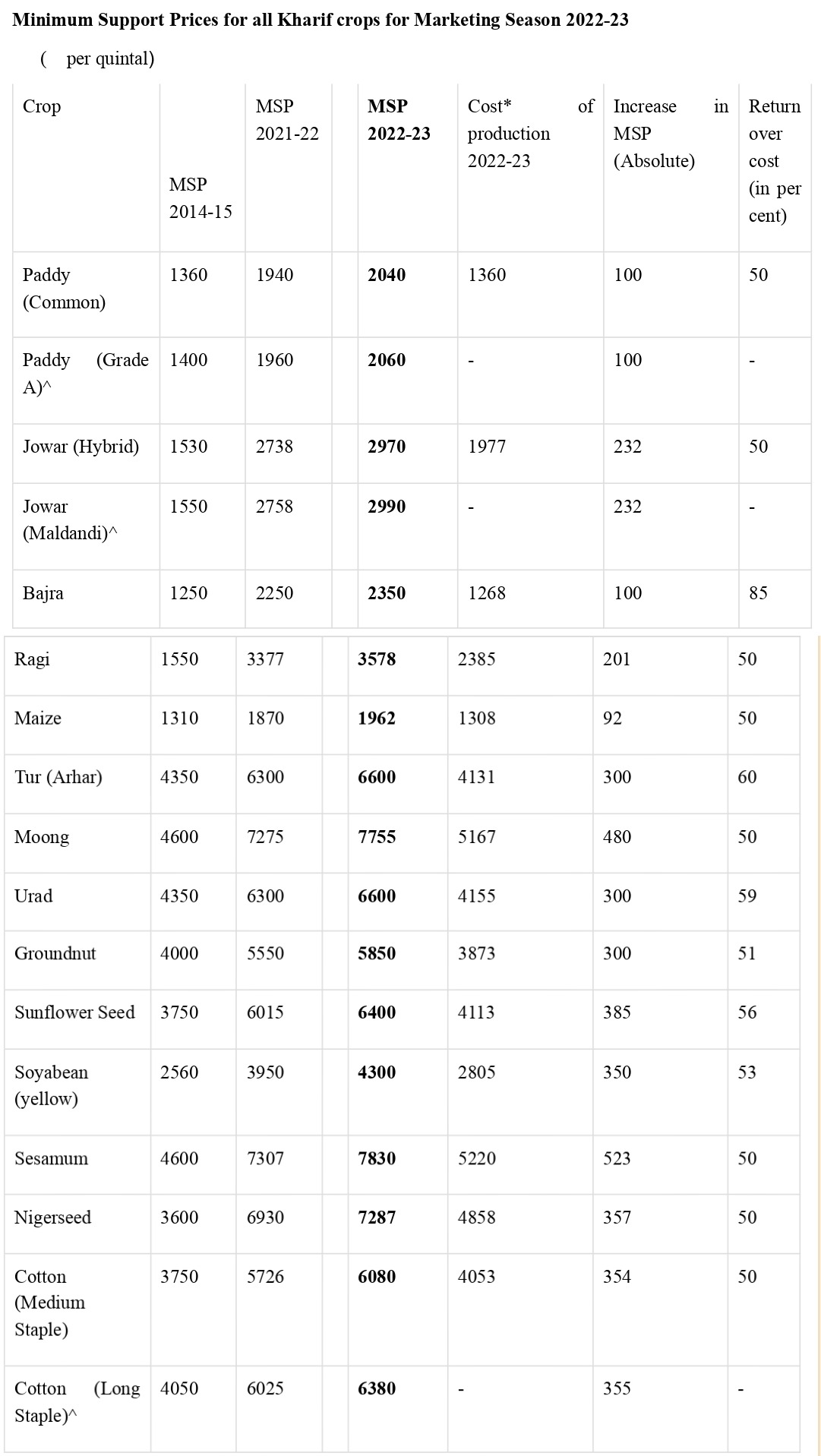
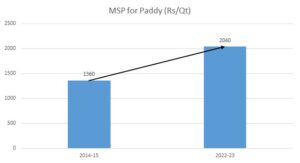
The MSP for the common grade variety of paddy has been raised by Rs 143 to Rs 2,183 per quintal for the 2023-24 crop year, up from Rs 2,040 in the previous year. The most significant increase in MSP is observed in moong, with a 10.4% rise to Rs 8,558 per quintal for the 2023-24 crop year, compared to Rs 7,755 per quintal in the previous year. Other pulses see an increase in MSP ranging from 6-7%. In cotton crops, the MSP hike ranges from 8.9% to 10%, linked to specific grades.
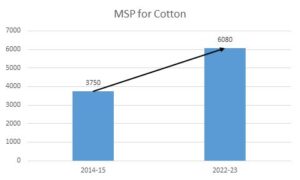
Over the past four years, there has been a 25% increase in pulses production and a 30% increase in oilseed production. The decision to raise MSP for Kharif crops aligns with the Union Budget 2018-19 announcement, aiming to set the MSP at a minimum of 1.5 times the All-India weighted average Cost of Production, ensuring reasonably fair remuneration for farmers. The anticipated margin to farmers over their cost of production is projected to be highest for bajra (82%), followed by tur (58%), soybean (52%), and urad (51%). For other crops, the margin to farmers over their cost of production is estimated to be at least 50%.

The government has been actively promoting the cultivation of crops beyond cereals, such as pulses, oilseeds, and Nutri-cereals, by offering an increased Minimum Support Price (MSP) for these crops. Moreover, various schemes and initiatives, including the Rashtriya Krishi Vikas Yojana (RKVY) and the National Food Security Mission (NFSM), have been launched to incentivize farmers to diversify their crop choices.

The Third Advance Estimates for 2022-23, the total foodgrain production in the country is projected to reach a record 330.5 million tonnes. This represents a substantial increase of 14.9 million tonnes compared to the previous year, 2021-22, marking the highest growth in the last five years.

But Reuters reported that state agencies only purchase rice and wheat at MSP, benefiting merely 7% of farmers who cultivate these crops. And suggested remedy to ease tensions, the government might consider offering a bonus above the minimum support price for 2024 as a concession to the protesting farmers.

Rahul Gandhi who is on his Bharat Jodo Nyay Yatra has indicated that he will join the protest. With regard to the protests, in what seems as if he is instigating the crowds, he wrote on his official X handle, “Our legal guarantee on MSP will bring 3 big changes in the lives of farmers. By getting the right price for the crop, the farmer will get rid of the problem of debt. No farmer will be forced to commit suicide. Farming will be a profitable business and farmers will become prosperous. And a prosperous farmer will change the destiny of the country.#KisaanNYAYGuarantee

In another post, he also mentioned “Modi, who ‘cultivates lies’ day and night, has only cheated the farmers in the last 10 years. By promising double the income, Modi also made the farmers yearn for MSP. Due to inflation, farmers’ debts increased by 60% due to not getting fair prices for their crops – as a result, about 30 farmers lost their lives every day. The one whose USP is deception, can only do politics with the farmers in the name of MSP, not justice. Those who put obstacles in the path of farmers are not worthy of trust, uproot them from Delhi, Congress will provide justice and profit to the farmers.

On 13 February 2024, he wrote, “Farmer brothers, today is a historic day! Congress has decided to give legal guarantee of MSP to every farmer on crops as per Swaminathan Commission. This step will change the lives of 15 crore farmer families by ensuring their prosperity. This is the first guarantee of Congress on the path of justice.”, thus making a promise to the farmers.

He has been writing multiple posts about the protests and utilizing the opportunity to target Prime Minister Modi. Here’s another post he wrote. It said, “Modi, his propaganda machinery and friendly media are the enemies of the poor and farmers. When it comes to the interests of those who built India, ‘government experts’ start worrying about the budget, but it is not about the budget, it is about the intentions. Silent on loans and tax waivers worth lakhs of crores of industrialist friends, silent on water, forests and land being gifted to them, silent on PSUs being sold at throwaway prices. But on the issue of guarantee of MSP to farmers, respect to householders and pension to firefighters – questions only questions. History is witness to the fact that Congress has never been afraid of taking big and revolutionary steps. Be it the Green Revolution, bank nationalization, creation of public sectors or economic liberalization, our decisions have always laid the foundation for the future of the country. Today, providing MSP to every farmer is the need of the hour and this decision of Congress will also prove to be a milestone. This will change the lives of crores of farmer families of the country including the rural economy. We take decisions not for politics, but for the country.”

But Sarwan Singh Pandher, the General Secretary of the Punjab Kisan Mazdoor Sangharsh Committee, stated during a press conference, “Congress party does not support us, we consider Congress equally responsible as much as the BJP. These laws were brought by Congress itself. We are not in favor of anyone, we raise the voice of farmers.”

Welfare Schemes For Farmers In The Modi Regime

During this crucial period, it is essential to recognize the various farmer welfare schemes implemented by the Modi-led Government aimed at empowering and uplifting the agriculture sector. Under Prime Minister Modi’s guidance, these initiatives have sought to enhance the lives of farmers by providing financial security, alleviating their financial burdens, fostering skill development, ensuring market access, and promoting sustainable agricultural practices.

Paramparagat Krishi Vikas Yojana (PKVY): Launched in 2015, PKVY promotes organic farming practices and the adoption of traditional methods, encouraging farmers to pursue organic farming certification and contributing to sustainable agriculture, improved soil fertility, and healthier farming practices.

Pradhan Mantri Kaushal Vikas Yojana (PMKVY): Launched in 2015, PMKVY aims to provide skill training to farmers and rural youth, empowering over 40 million individuals with essential agricultural skills, improving productivity, and generating employment opportunities.

Pradhan Mantri Krishi Sinchai Yojana (PMKSY): Introduced in 2015, PMKSY aims to enhance water efficiency and promote sustainable irrigation practices, positively impacting agricultural productivity and water conservation across the nation.

Soil Health Card Scheme: Introduced in 2015, this scheme provides personalized soil health reports to farmers, offering insights on soil nutrients and recommendations for balanced fertilization. By promoting proper soil management practices, it optimizes yields, reduces input costs, and enhances soil health across agricultural lands.

Pradhan Mantri Fasal Bima Yojana (PMFBY): Initiated in 2016, PMFBY offers comprehensive crop insurance coverage to farmers at affordable premiums, ensuring timely compensation for crop losses due to natural calamities, pests, or diseases. This scheme has brought financial security and stability to millions of farmers, safeguarding their livelihoods.

e-NAM (National Agriculture Market): Launched in 2016, e-NAM is an electronic trading portal that integrates agricultural markets throughout India, revolutionizing agricultural trade by enabling farmers to sell their produce online, discover competitive prices, and connect with buyers across the nation.

PM Krishi Sampada Yojana: Launched in 2017, this scheme focuses on modernizing the food processing sector and creating robust infrastructure for the agro-industry. It aims to reduce post-harvest losses, improve processing capabilities, and promote value addition, generating employment opportunities and enhancing farmers’ income.

Pradhan Mantri Kisan Samman Nidhi (PM-KISAN): Launched in 2019, PM-KISAN is an income support scheme designed to assist small and marginal farmers. Eligible farmers receive direct financial assistance of Rs 6,000 annually in three equal installments, significantly boosting their income and improving their quality of life, benefiting over 120 million farmers.

Pradhan Mantri Atmanirbhar Bharat Abhiyan (ABHA): Initiated in 2020, ABHA focuses on making India self-reliant in agriculture and food production through components such as crop diversification, productivity enhancement, and value addition, thereby increasing farmers’ income and fostering sustainable agricultural practices.

Subscribe to our channels on TelegramWhatsApp, and Instagram and get the best stories of the day delivered to you personally. 
Uttar Pradesh Will Prove PTR Wrong Much Sooner Than He Can Fathom, Here’s Why

Is it fair to juxtapose two states with disparate beginnings and then censure one for its pace of progress? 

In his thinkpiece titled, ‘Has Uttar Pradesh’s Economy Surpassed Tamil Nadu?’, published in Frontline on 7 February 2024, Palanivel Thiaga Rajan (PTR), Tamil Nadu’s Minister for Information Technology and Digital Services, presents the states as competitors, without acknowledging that Tamil Nadu enjoyed a head start from the outset. 

The unfair comparison has to be countered.

Comparison of the Key Indices of Uttar Pradesh and Tamil Nadu

A. Growth Rates Within HDI

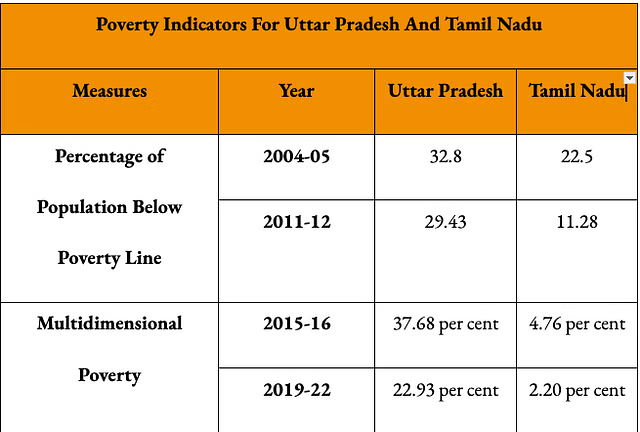
For instance, in the fiscal year 2004-05, while 22.5 percent of the total population of Tamil Nadu was below the poverty line, the corresponding figure for Uttar Pradesh stood at 32.8 percent.

Not only did Uttar Pradesh exhibit a higher percentage of the population below the poverty line than Tamil Nadu, but in absolute terms, the total population of Uttar Pradesh also exceeded that of Tamil Nadu by over 60 percent.

Thus, the population below the poverty line in Uttar Pradesh surpasses Tamil Nadu by a substantial margin, not by a mere ‘10 percent’, as one might think in the first instance. 

While Tamil Nadu has indeed experienced a noteworthy 50 percent reduction in the proportion of multidimensional poverty between 2015-16 and 2022, it is crucial to evaluate the recent performances of both states in absolute terms. 

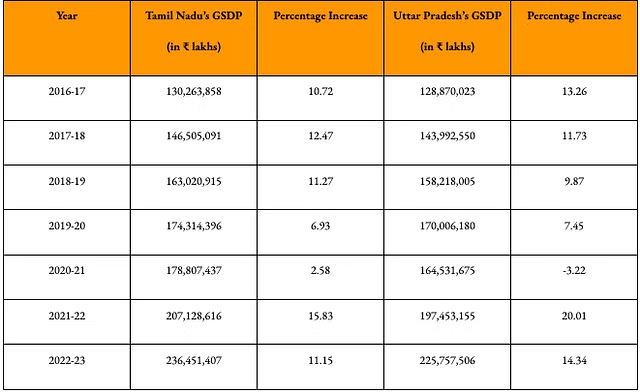
PTR rightly highlights that Uttar Pradesh’s Gross State Domestic Product (GSDP) has not yet reached the level of Tamil Nadu’s; however, one must not overlook the significant transformative impact that the state’s development initiatives may have in the coming years.

Under the leadership of Yogi Adityanath, the Uttar Pradesh government facilitated the escape of 3.38 crore individuals from poverty between 2015-16 and 2021-22, a figure much larger than that of Tamil Nadu.

Prima facie, this accomplishment not only underscores the earnest efforts of Uttar Pradesh but also indicates an increase in tax revenue, reflecting a positive trajectory in the state’s economic landscape.

B. Economic Growth Trends 

Between 2010-11 and 2021, foreign direct investment (FDI) into Uttar Pradesh surged by 131.18 percent. This is not to discredit Tamil Nadu’s commendable performance, as its FDI inflow in equity soared by 169 percent. Rather, it illustrates Uttar Pradesh’s trajectory of catching up with Tamil Nadu, a comparison that might have seemed outlandish even a decade ago.

In 2016, Tamil Nadu was amongst the top five states with 49 registered startups, while Uttar Pradesh was nowhere close to it with only 27 registered start-ups. However, the tables have completely turned since Yogi Adityanath assumed power in Lucknow.

UP today ranks fourth when it comes to registered startups and has already crossed Tamil Nadu’s number by a significant margin The impact of the same can be seen in the employment the start-up ecosystem generates in the two states with 67,694 direct jobs being created in UP between 2019-23, 69 per cent more than Tamil Nadu. These are publicly available facts that PTR ignores in his article.

To revisit our stance, we believe that it was never a competition amongst states to begin with but a marathon effort by all states resulting in a win for India. In fact, Tamil Nadu and Uttar Pradesh have been leading India’s electronic export journey and have been consistently among the top three exporter states for years. 

How A Good Decade Can Make All The Difference 

The economic transformation of Indian states in merely a decade is not unheard of, with Chhattisgarh being the biggest example of such a turnaround. At the time of its formation in 2000, Chhattisgarh accounted for just 1.4 percent of India’s total output and lagged most states on several development indicators.

However, under 15 years of the Raman Singh-led BJP regime, the state’s economy grew steadily. Between 2000-01 and 2014-15 (using data from the 2004-05 series), the Chhattisgarh economy grew at a compound annual growth rate (CAGR) of nearly 8 percent. 

A similar economic transformation is already underway in Uttar Pradesh. 

Uttar Pradesh has experienced a significant Foreign Direct Investment (FDI) surge in recent years. Data from the DPIIT and RBI indicate a fourfold increase in FDI between 2019 and June 2023 compared to the period from 2000 to 2017. 

In just five years, FDI has soared from Rs 3,000 crore to approximately Rs 11,000 crore. Hence, if it took only five years for UP to surpass 22 other states, then it will definitely take less than 60 odd years to become one of the most industrialised and developed states. PTR’s 64-year wager is up for anyone’s contention.

Even on the social front, in Uttar Pradesh, the Infant Mortality Rate (IMR) has decreased from 61.0 in 2010 to 38.0 in 2020, showcasing how right intentions yield substantial rewards. Such transformation is remarkable when one reflects on the handicapped start that UP had had. Even after a decade post-independence, when Tamil Nadu had a literacy rate of over 30 percent, UP was below 25 percent.

It is through mutual learning and drawing inspiration from each other that Indian states can collectively lead India towards a brighter future. The crucial 25-year period between now and 2047 calls for sharing best practices and working together to achieve developmental goals, and not for getting into a squabble over ‘who did it better’.

The GSDP Question

With the stable government in Uttar Pradesh, post-COVID-19, the economy has grown more than that of Tamil Nadu.

Since 2016, the GSDP has increased at an average of 10.13 percent yearly for Tamil Nadu – while Uttar Pradesh has kept pace with an average of 10.49 percent. CM Yogi Adityanath has laid a strong foundation of infrastructure development, pro-poor welfare policies, and focus on manufacturing and all-round development of institutions. This is sure to herald a period of monumental growth for Uttar Pradesh in the coming decades.

Cooperation, Not Competition 

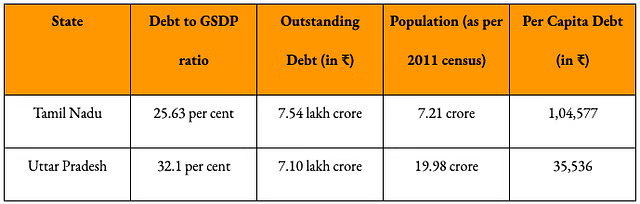
We see merit in PTR’s proposition that there should be a population factor while assessing the progress of the state. As per the budget estimates for 2022-23, Tamil Nadu has the highest outstanding debt in the country, closely followed by Uttar Pradesh. But let’s compare the Per Capita Debt of both Tamil Nadu and Uttar Pradesh. 

In fact, the declining state of Tamil Nadu’s finances makes every citizen in Tamil Nadu shoulder more debt than ever before.   

The pervasive corruption within the state of Tamil Nadu, acknowledged in audio tapes said to be of PTR himself, is bound to derail the state’s chartered growth patterns. Despite having a head start, Tamil Nadu’s trajectory is marred by a series of setbacks, largely attributed to the flawed policies and reckless freebies and protests of the “Dravidian Model.” 

If one were to, then, presume that Tamil Nadu is on the path of economic decline and UP on a steep incline, would it really take 64 years for the states to level with each other? As keen observers of the Indian political landscape at this juncture, we would advise against placing such unwise bets. Our money is on the steady and sure rise of a unified economic powerhouse, that is India.

Kritica Bisht, from Lucknow, and Gopinath Vijayaraj, from Chennai, are public policy researchers.

This article was originally published in Swarajya and has been republished here with permission. 

Subscribe to our channels on TelegramWhatsApp, and Instagram and get the best stories of the day delivered to you personally. 
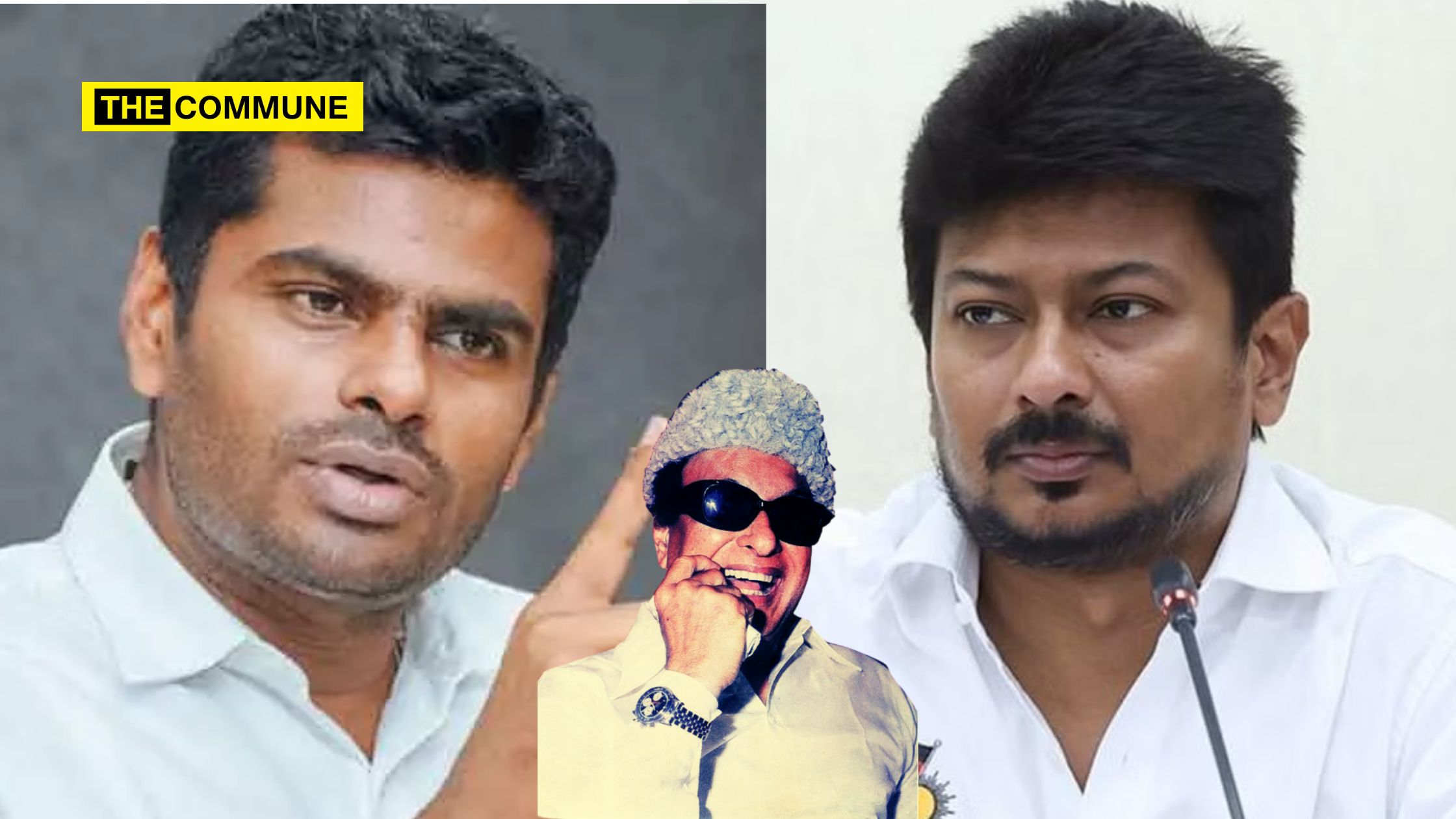
“What Is Udhayanidhi Stalin’s Achievement? He Got Everything Through Family Quota,” TN BJP Head Annamalai Slams DMK For Comparing Udhayanidhi Stalin To MGR

In a widely circulated video on social media capturing Tamil Nadu BJP president Annamalai’s press meet in Coimbatore on 14 February 2024, reporters questioned him about DMK Organization Secretary RS Bharathi’s recent statement comparing MGR to Udhayanidhi Stalin. Annamalai responded by sarcastically ridiculing they were currently sloganeering for Udhayanidhi Stalin indicating him as a third-generation politician. He also criticized the DMK for speaking about MGR cheaply during his political tenure and now using him for comparison.

To commemorate the Youth Welfare and Sports Minister and DMK Youth Secretary, Udhayanidhi Stalin’s birthday, a public meeting was organized by the Pudukottai North District DMK. During the event, DMK Organization Secretary RS Bharathi highlighted the significant victory achieved by DMK, attributing prominence to Udhayanidhi Stalin in the elections. Drawing parallels, he noted that just as people lined the streets to welcome MGR in the past, now they eagerly anticipate the arrival of Udhayanidhi Stalin, emphasizing the comparable reception given to both leaders.

While the reporters asked Annamalai about RS Bharathi’s statement that people are looking at Udhayanidhi like MGR. Annamalai responded immediately, “They feel like looking at MGR in the poster? How will it be to look at revolutionary leader MGR in a poster? Today, the situation is such that the slave crowd has increased. He is 80/82, someone who should have been a senior political leader. Someone is saying Utsavar, Moolavar, did you see that in Coimbatore? That Stalin is the Moolavar (main deity). What is the meaning that he is Utsavar? There is a group that thinks that if they lock up Stalin in a room and leave it locked, let go of him in 2024ave 2024, shout slogans praising Udhaynidhi and stick with him – they think they too will grow. How things have turned out in TN is that these slaves have now become Jaalra Goshtis – people who kiss up to their masters,” he said.

“The uniqueness of MGR is that he was a revolutionary leader, he came from the bottom and worked hard to make a place for himself in the film industry and became an individual and came to politics bound by the love of the people. If these people think of MGR when looking at him, then one must remember how badly they have spoken of MGR when he was in politics. Inspite of that, he emerged as a great leader and won the hearts of the people,” he further said.

“What is Udhayanidhi Stalin’s achievement? He was born in Gopalapuram, studied in a college in some family quota. After that, he went on to act in films under family quota, started Red Giant movies through family quota, won a seat through family quota. Post this, he became a minister through this family quota. Is there even 1% comparison between the two? There is not even 1% comparison. So the slave group enjoys watching Udhayanidhi Stalin like they did watching MGR in a poster. On the other hand, to understand the extent of this kissing up slaves over the past two day, you can check out the statements made – Utsavar/Moolavar, comparing MGR and Udhayanidhi,” he criticized.

Subscribe to our channels on TelegramWhatsApp, and Instagram and get the best stories of the day delivered to you personally. 
TN BJP President Annamalai Exposes DMK Govt’s False Claims In Governor’s Address, Debunks Ten Lies In Speech

Tamil Nadu BJP President K Annamalai exposed the Tamil Nadu government’s Fact Check Team for promoting a false narrative with a selectively edited video, specifically concentrating on his press briefing regarding one of the ten lies he exposed, namely the Innuyir Kappom Scheme in which the state government simply rebranded and took credit for a program similar to the Good Samaritan Scheme introduced by the central government..

During the press briefing, Annamalai said, “The Tamil Nadu government’s Innuyir Kaappom Scheme is India’s first ever scheme. This is also a lie, the centre introduced this scheme in 2021, with Good Samaritan status and an incentive of ₹5000 will be provided to those who admit accident victims in hospitals immediately. They are taking credit for the central government scheme.”

On 14 February 2024, the Fact Check Team of the Tamil Nadu government, led by DMK supporter and YouTuber Iyan Karthikeyan, responded to Annamalai’s claims, asserting that “Annamalai made accusations without having any understanding of the ‘Innuyir Kappom’ Project”.

Drawing a comparison between the central government’s Good Samaritan scheme (GSS) and the state government’s Innuyir Kappom Thittam (IKT), the Fact Check Team presented an illogical argument asserting their unrelated and distinct nature. The IKT, implemented by the Tamil Nadu state government on 18 December 2021, aimed to cover the total treatment cost for the initial 48 hours following an accident in any hospital in Tamil Nadu where the injured person is admitted. In contrast, the GSS, introduced by the union government on 3 October 2021, rewards individuals who promptly take road accident victims to the hospital with a sum of ₹5000.

In reaction to this, Tamil Nadu Bharatiya Janata Party President K Annamalai countered with news citations, delivering a fitting response and thanked Fact Check Team for accepting that the Good Samaritan Scheme was not an idea of DMK government through his official X platform. He wrote, After we exposed the ten lies in the Governor’s address yesterday, here comes another lie from the Fact Check unit of the TN Govt. Thank you for accepting that the Good Samaritan scheme is not the DMK Govt’s idea. But it was announced in Dec 2021 as part of the “Innuyir Kappom Scheme”—link to the article below. dinamani.com/tamilnadu/2021. Now, let me address other elements of your claim. Free hospitalisation for road accident victims is implemented under the PMJAY scheme & Motor Vehicle Accident fund of the Central Government, and it was sent to State Governments for consideration in July 2020 – Link below. hindustantimes.com/india-news/gov Under PMJAY, the TN Govt has received ₹1694 Crores from the Central Govt. We strongly suggest that the TN Fact Check unit read beyond the Murasoli to understand the world’s reality!” 

This comes against the backdrop of the Tamil Nadu Governor RN Ravi skipping his inaugural address in the legislative assembly on 12 February 2024 highlighting that the address provided to him by the State government and  intended for him to read, included numerous passages with which he vehemently disagreed, citing both factual and moral grounds.

Annamalai, through his official X handle, shared a video containing his press briefing, revealing the falsehoods present in the Governor’s address on 13 February 2024. He highlighted ten falsehoods in the speech, spanning across different schemes and policies. He also spoke of these lies/falsehoods at a press briefing.

Annamalai stated, “First lie that said was “Today the Dravidian model government of Tamil Nadu was the destination for global investors”. Everyone knows that companies are vacating TN. The investments received in the global investors meet are very minimal compared to other states. Tamil Nadu has received only ₹6.6 lakh crore, UP received ₹33 lakh crore, Gujarat received ₹26 lakhs crore and Karnataka received ₹10 lakh crore. Hence Tamil Nadu is not the destination of investors on any basis. There is a SIPCOT in Ulundurpet. Two years ago, the Tamil Nadu government said a footwear company is investing ₹2,000 crore. Not even ₹2 was invested there. We have come across 200 constituencies throughout Tamil Nadu, we have seen the status of SIPCOT and the industries sectors in TN. The power tariff has increased. The TN government has not even refunded the state GST. This alone amounts to over ₹1000 crore pertaining to various industries – this is a blatant lie. How will the Hon. Governor read out this lie?”

“The second lie is praising the ruling DMK government for good handling of the Chennai and south Tamil Nadu floods. When Chennai was gasping for life during the Michuang cyclone and when heavy rains hit south Tamil Nadu, the chief minister was in Delhi for the I.N.D.I alliance meeting. If in the assembly they want to praise themselves let them do so in their party functions. Nothing wrong in it but writing out a blatant lie and expecting the Governor to read it out and praise the CM and the government how will he do that? The governor himself has criticized them for not handling the flood situation in Chennai properly. How will he praise that?” he asked.

“The third lie – Tamil Nadu must be compensated with ₹20,000 crore to make up for the loss due to GST implementation. GST came into effect from 2017. The centre said states will be compensated for the next 5 years for a projected growth of 14%. Accordingly Tamil Nadu has received ₹27,959 crore as GST compensation from 2017-18 for 5 years. On top of it, TN received ₹14,336 crore to manage the deficit during the pandemic. Today the Tamil Nadu government must explain what kind of financial loss they are talking about. Everyone knows about the economy today. Before the GST was implemented, Tamil Nadu’s own tax revenue growth was 3% in 2013-14. It was 7% in 2014-15, 2% in 2015-16 and 7% in 2016-17. After the GST implementation, Tamil Nadu’s own tax revenue growth was 14% in 2018-19, it was 10% in 2019-20 and 2020-21 was pandemic period, in 2021-22 it was 16% and 24% in 2022-23. It is clear that the tax revenue of TN has increased after the implementation of GST. Then on what basis are they claiming that there has been a loss of ₹20,000 crore? Is there any financial paper or white paper on this? How could they expect the Hon Governor to read out something written out of thin air?” he questioned.

“The 4th lie – The state government prioritises maintaining law and order and religious harmony. Won’t people laugh if they say they are maintaining law and order? What is right in their law and order? The law and order situation in TN is in dire straits. The Governor too exception to it last time as well. No one in Tamil Nadu will accept that law and order is maintained. That is the reason governor did not read it out,” he said.

“The 5th lie – The TN government has delivered the election promise by offering the Magalir Urimai Thogai. Is providing the cash benefit to only 40% of women in Tamil Nadu an accomplishment?” he questioned.

“The sixth lie – 2.73 lakh women have benefited from the Puthumai Penn Scheme. They have aborted the Gold for Mangalsutra scheme implemented by the previous government and rechristened old schemes with new names saying people benefitted fron them. The free laptop scheme for students has also been stopped,” he added.

“The seventh lie – The Chief Minister’s morning breakfast scheme is India’s first ever such scheme. The central government introduced this scheme in 2020 with National Education Policy. The centre is also providing funds to states for the morning breakfast scheme. How could the Dravidian model government claim that it is the first state to implement this scheme. That too is a lie,” he added.

“The eighth lie – Tamil Nadu Action Plan 2024 for the Welfare of Adi Dravidar and Scheduled Tribes. The Schedule Caste Special Plan fund of ₹10,000 crore given to Tamil Nadu by the centre has been sent back without spending in 2022. Today how will governor read when they write praising themselves?” he questioned.

“The ninth lie – We will press the central government to conduct the caste census. Correct, the previous government constituted the Kulasekaran committee. But when chief minister MK Stalin came to power, he terminated the committee without providing an extension. What is stopping you from constituting a committee for caste census? Why did you terminate the Kulasekaran committee? They need to answer this rather than blaming the centre,” he stated.

“The tenth lie – The Tamil Nadu governments Innuyir Kaappom Scheme is India’s first ever scheme. This is also a lie. The centre introduced this scheme in 2021. If someone is in an accident, an incentive of ₹5000 will be provided to those who admit accident victims in hospital immediately. The DMK government is claiming credit for this central government scheme. To summarise, the speech given by the government to the governor is chief ministers self-bragging. The governor denied reading out something which has lots of lies and wrong data. Whether the governor’s decision to read or not is a separate debate but the speech written had a lot of lies,” he finally stated.

Subscribe to our channels on TelegramWhatsApp, and Instagram and get the best stories of the day delivered to you personally.
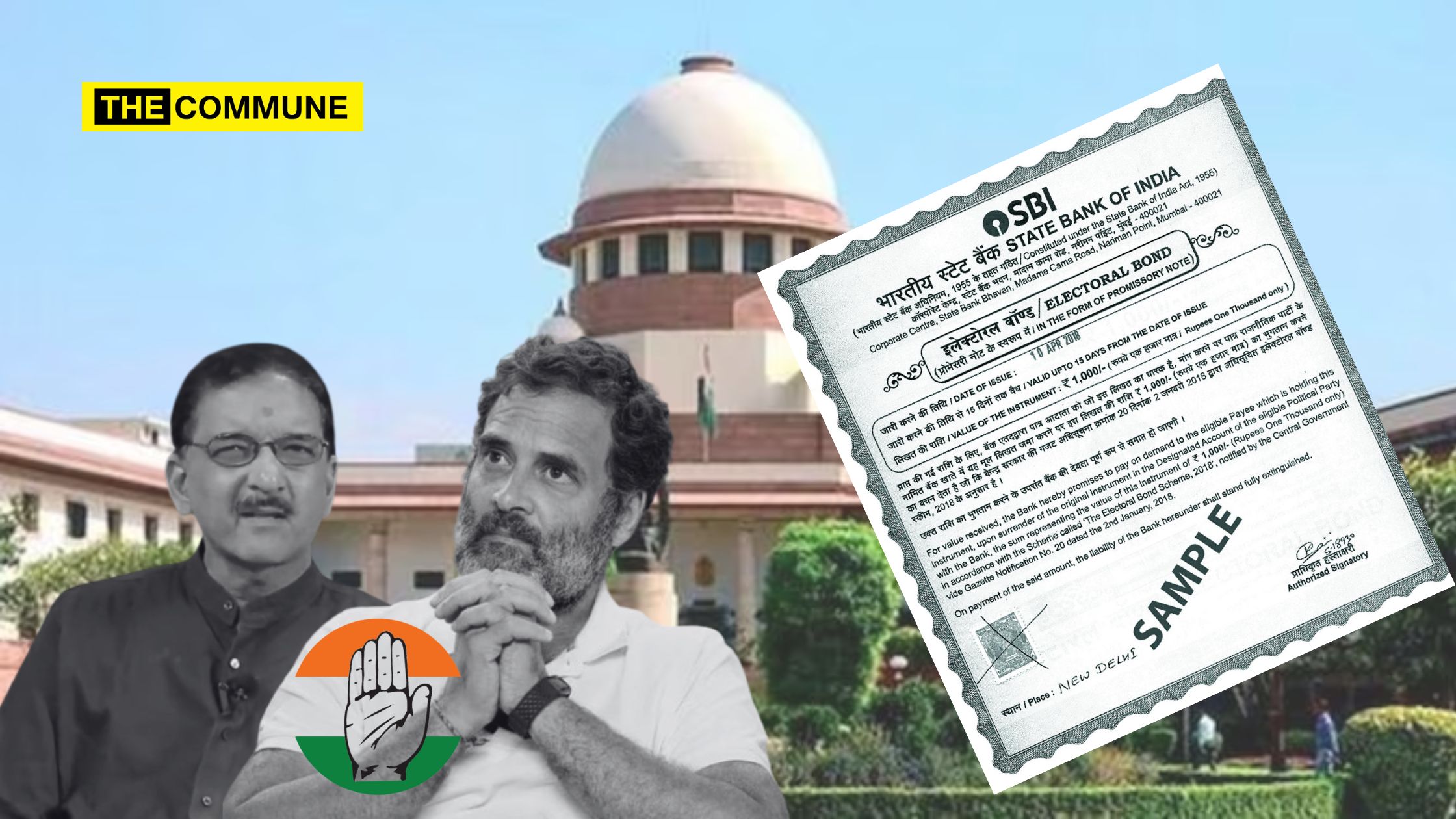
What Congress And Its Propagandist Like Sumanth Raman Won’t Tell You About Electoral Bonds

On 15 February 2024, the Supreme Court issued its long-awaited verdict on the electoral bonds case, declaring that anonymous electoral bonds infringe upon the right to information as outlined in Article 19(1)(a) of the Constitution. Consequently, the scheme has been deemed unconstitutional and has been invalidated.

Congress leader Rahul Gandhi wrote after the verdict was pronounced, “Another proof of Narendra Modi’s corrupt policies is in front of you. BJP had made electoral bonds a medium for taking bribe and commission. Today this matter has been approved.”

Neutral but pro-Congressi commentator Sumanth Raman found himself in a foot-in-mouth situation when he simped for the Congress leader Rahul Gandhi, yet again over the recent ruling on electoral bonds. 

Sumanth Raman wrote on his X handle, “Huge setback for Govt. Not only has the SC said that Electoral Bonds scheme is unconsituitional, it has also asked for details of bonds sold since April 2019 to be put out by the Election Commission on its website by 13th March 2024.”

While the Congressis and their propagandists were painting a picture as if it was the BJP was the one that would suffer because of this verdict, the reality is far different. 

What Congress & Its Propagandists Won’t Tell You

While on the surface it may seem like a setback for the ruling party, in reality, it is the opposition parties that have more problems in handling this. As per ADR reports, parties other than the BJP have been relying more on electoral bonds for their donations. Here is a break up of the percentage of donations that parties received through electoral bonds for the 6 years – 2016/17 to 2021/22:

  • BJP – 52% (5271.9751 cr)
  • Congress – 61.54% (952.2955 cr) 
  • TMC – 93.27% ( 767.8876 cr)
  • DMK – 90.703% (431.50 cr)
  • BJD – 89.81% (Rs 622 cr.)
  • TRS – 80.45% ( Rs 383.6529 cr)
  • YSRCP – 72.43% ( Rs 330.44 cr )

For the years 2021-22, the percentage of donations received through electoral bonds along with donations in cash below Rs. 20,000, etc. are as below:

  • TMC – 96.77%
  • Congress – 71.84%
  • BJP – 60.56%

DMK which was not in power until 2021 received the second-highest amount in electoral bonds. Furthermore, a noteworthy detail is that 90% of the total donations received by the DMK are attributed to electoral bonds.

Those propagandists reacting enthusiastically to the verdict as if these bonds were equivalent to illegal money fail to comprehend that electoral bonds are legitimate funds directed towards political parties.

The Supreme Court has asked the State Bank Of India to stop the issue of the bonds and provide comprehensive details on electoral bonds purchased from the court’s interim order on 12 April 2019, until the present date to the Election Commission of India (ECI). The court also mandated that the information should include the purchase date, purchaser’s name, and bond denomination. Additionally, the court instructed SBI to furnish details on political parties that have received contributions through electoral bonds within the same time frame, specifying the date of encashment and the denomination of each bond. This information has to be submitted by the SBI to the ECI by 6 March 2024. The ECI, in turn, is obligated to publish the received data on its website by 13 March 2024. 

Once these details are made public, it will be interesting to see who donated how much and to whom.

Subscribe to our channels on TelegramWhatsApp, and Instagram and get the best stories of the day delivered to you personally. 
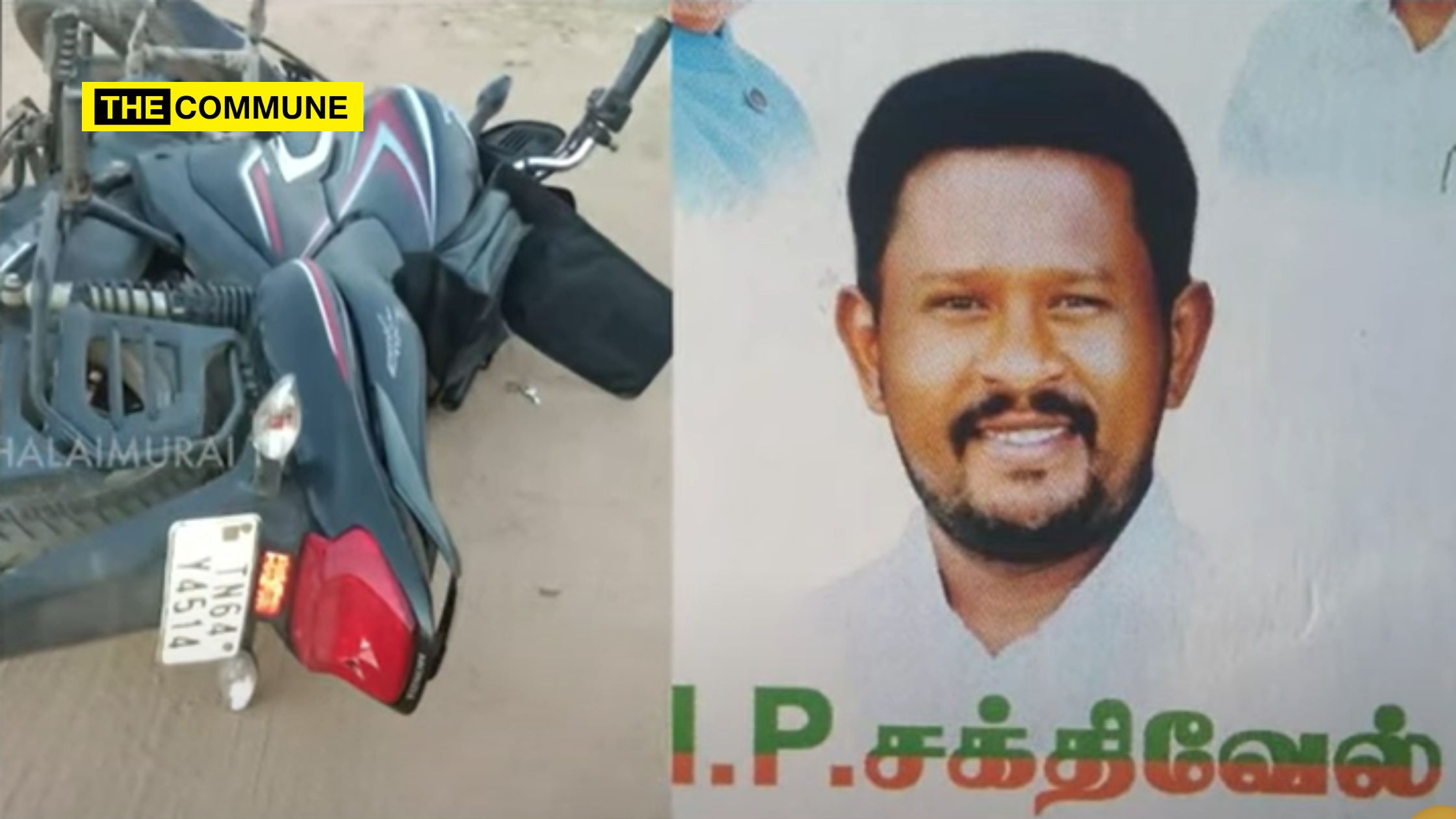
Madurai: BJP OBC Morcha Leader Sakthivel Brutally Attacked & Killed In Broad Daylight

Image Credits: Puthiya Thalaimurai

In a shocking incident that has left the city of Madurai in dismay, Sakthivel, a 34-year-old district secretary of the BJP in Madurai, was brutally murdered by an unidentified gang near the Vandiyur tollgate. The incident occurred as Sakthivel was on his way to his rice mill godown in the Sangu Nagar area early in the morning of 15 February 2024. 

Sakthivel, a resident of the Vandiyur Devar Kurinji Nagar area in Anna Nagar, also managed a rice mill in Chintamani. Additionally, he was known to be engaged in the finance business. Maalai Malar reports that there had been ongoing animosity, particularly concerning his rice mill, which is now being scrutinized by investigators.

The harrowing sequence of events unfolded when Sakthivel encountered a mysterious mob on motorcycles near the Vandiyur tollgate. Despite attempting to inquire about their identity and purpose, the gang remained silent. Matters took a grim turn when they brandished deadly weapons, causing Sakthivel to attempt an escape. Unfortunately, the assailants pursued him, cornered him, and unleashed a vicious attack with power sickles, resulting in his untimely death.

The Anna Nagar police were promptly alerted to the scene, and the body of Sakthivel was seized and sent to the Madurai Government Hospital for post-mortem examination. A case has been registered, and a special task force has been assembled to apprehend the perpetrators who swiftly fled the crime scene on motorcycles.

Initial investigations suggest that the murder may be linked to longstanding disputes, both in the context of the rice mill business and a recent disagreement over the sale of a cargo vehicle. Authorities are also exploring potential connections to financial dealings, adding layers of complexity to the ongoing probe.

The news of Sakthivel’s demise has drawn a crowd of BJP executives and volunteers at the government hospital, where the police have increased their presence to manage the heightened tension. As the city grapples with the shock of this brutal incident, authorities are diligently examining surveillance footage from major roads in the hope of shedding light on the identity and motive of the assailants.

Subscribe to our channels on TelegramWhatsApp, and Instagram and get the best stories of the day delivered to you personally. 

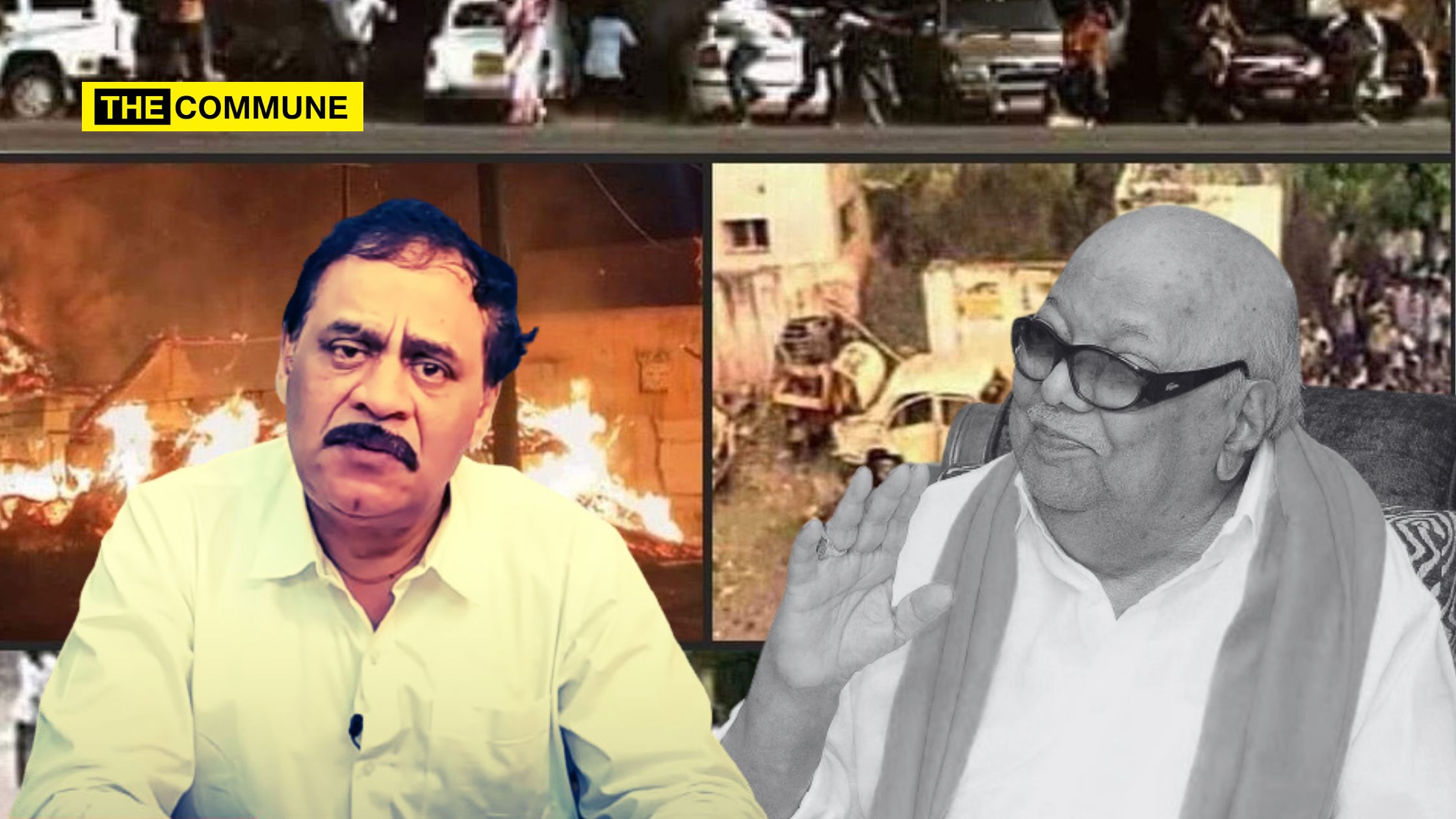
“You’ve Arrested People From Only One Religion, Arrest Others Also”: Ex Police Officer Reveals How Karunanidhi Played Appeasement Politics During 1998 Coimbatore Blast

The 1998 Coimbatore bomb blasts are still a very harrowing memory for the people of Coimbatore and Tamil Nadu. The recent release of three convicts involved in the blasts by the Tamil Nadu government, led by the Dravida Munnetra Kazhagam (DMK), just days before the anniversary of the tragic event on 14 February 2024, has reignited the pain, leaving a sense that the wounds are being reopened instead of allowed to heal.

A video of former police officer R Varadharajan who also hosts a YouTube channel named Netaji TV has surfaced in the backdrop of the Coimbatore blasts anniversary. In the video, Varadharajan narrates how former TN CM Karunanidhi refused to listen to the recommendations of the intelligence wing which ultimately led to the horrific blasts and what happened subsequently in the state in terms of minority appeasement.

Varadharajan starts by stating how the intelligence wing was aware of the possibility of the blasts much before 1998. He said, “When Jayalalithaa was the Chief Minister of Tamil Nadu (between 1991 and 1996). The police department handed over a report to Jayalalithaa. The report indicated that there was a risk of a bomb blast in Tamil Nadu. And that this blast can occur in Coimbatore at any point in time. Jayalalithaa immediately called the police department and asked how this was possible. So the intelligence department handed over the evidence to the then CM. She asked them to tell what could be done to prevent this. The intelligence department informed her that gelatin sticks that were used in the bomb preparation were being smuggled into TN from Kerala by terrorists. So a check post must be built between the two states to check the entry of these gelatin sticks. Only if that is done can we prevent the blast. They also advised that check posts were also necessary inside Coimbatore. Additionally, they asked her to arrest a few people (5-6) under the Goondas Act because if they were free, the chances of the blasts were higher.”

He further added, “Upon hearing the input from the intelligence department, Jayalalithaa ordered the DGP to action all the requests. A few people were arrested under the Goondas Act. A check post was erected between Kerala and TN so also inside the Coimbatore town to check for gelatin sticks smuggling.”

Here’s what happened after Jayalalithaa lost the 1996 Assembly elections and Karunanidhi came to power. Varadharajan said, “As soon as he (Karunanidhi) took the reins, he instructed for the release of those who were arrested under the Goondas Act. He also asked for the removal of all checkposts. The intelligence department warned him of the fact that the gelatin sticks were being smuggled into TN through the border, the blasts could occur, and that the check posts needed to remain. But he (Karunanidhi) looked at it as an election ploy and asked for the removal of the check posts.”

He added, “An IG-Intelligence wrote a note to Karunanidhi saying it was a dangerous thing that he had done and that there would surely be blasts in Coimbatore. Karunanidhi rejected it saying it was not necessary. Then the blasts occurred in 1998. What he did after the blasts was, he transferred the officer who warned him of the consequences of his actions (of removing check posts, releasing prisoners jailed under Goondas, etc).”

“When the officer questioned why he was being transferred despite giving him a clear warning of the consequences, Karunanidhi asked him to stay away for a while to manage the situation,” he further stated.

Varadharajan states, “Terrorists belong to a certain religion. Criminals do not have caste, creed, or religion. Based on the recommendation of the intelligence wing, the police department arrested 20 people in Coimbatore. Many do not know what happened. Overruling the intelligence department, Karunanidhi said, you have arrested 20 people belonging to the same religion. Arrest 20 people from another religion. So the intelligence department said that they could only arrest the offenders, we cannot arrest innocent people for your politics and to gain a name in your political circles, and that they could not accept that. Karunanidhi insisted they do it but the police department refused to accept it.”

He added, “The blasts occurred because he (Karunanidhi) refused to accept the recommendations of the intelligence wing. Police department again arrested those who were arrested (under Goondas) and then released.”

Subscribe to our channels on TelegramWhatsApp, and Instagram and get the best stories of the day delivered to you personally. 
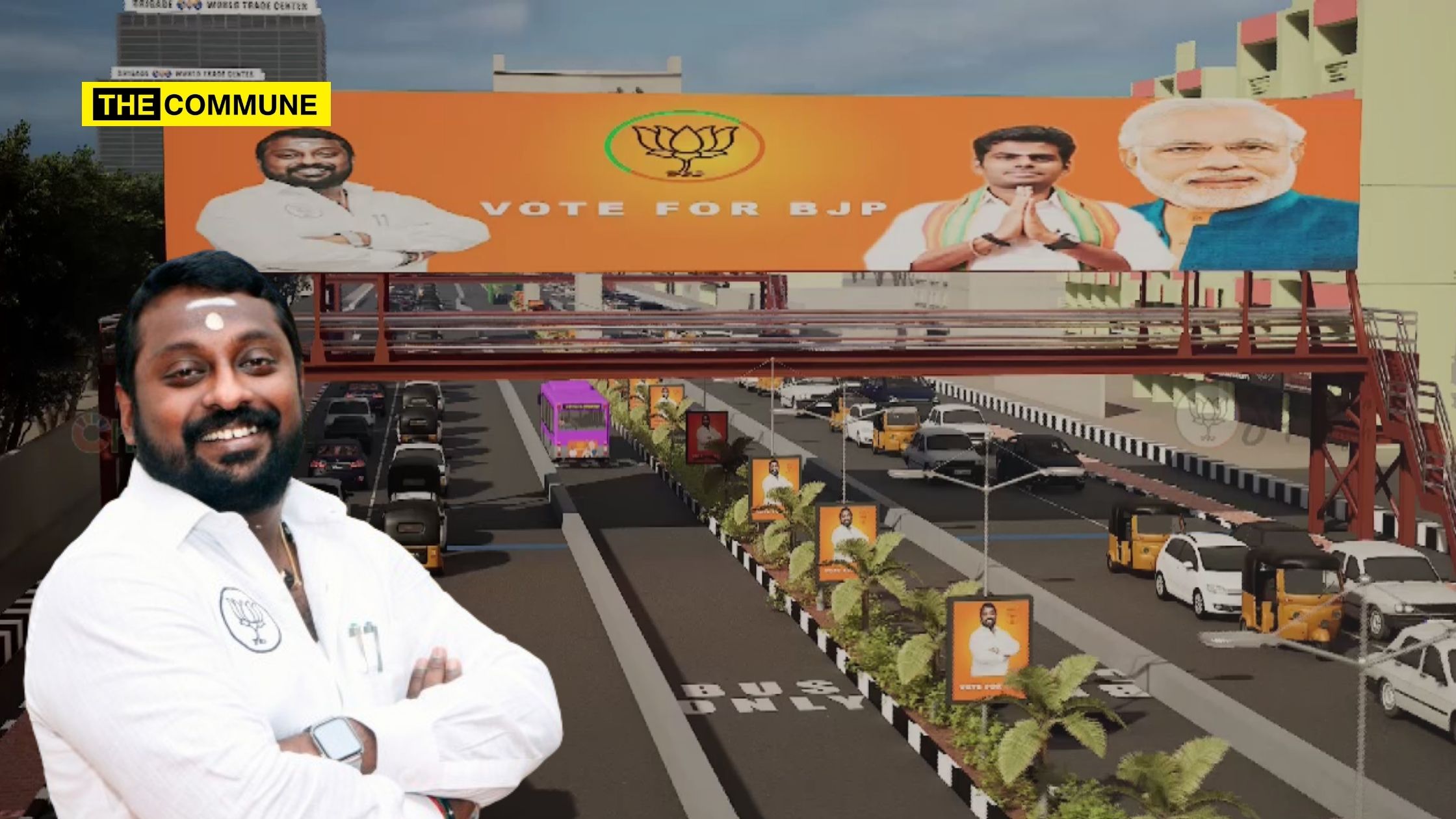
TN BJP Leader SG Suryah Proposes Bus Rapid Transport System To Alleviate OMR’s Traffic Woes

The Old Mahabalipuram Road (OMR) in Chennai, known for its bustling nature with educational institutions, IT parks, and residential complexes, faces severe traffic congestion. With over 1.6 lakh vehicles and 3 lakh people commuting daily between Madhya Kailash and Tiruporur, the 20-km stretch encounters significant delays, especially during peak hours.

With many entertainment zones like malls, theatres, parks and other recreational activities coming along this region, it has made things worse. The recent congestion that happened during the AR Rahman’s Marakkuma Nenjam concert exposed how inadequate and encroached the road has become.

Frustrated residents report spending up to two hours traveling from Madhya Kailash to Siruseri.

Numerous calls for solutions have been made, emphasizing the lack of grid-road connectivity and delays in proposed flyovers and an elevated road.

Speaking on the problem, BJP leader SG Suryah said that implementing the Bus Rapid Transport System (BRTS) is the way to go to streamline vehicular traffic in the route.

“This system is already in there in cities like Surat, Ahemdabad, Delhi, Pune, etc. Even a smaller city like Amritsar has this system. I wonder what prevents those in power today to implement BRTS in a huge metropolitan city like Chennai which is much needed.”, Suryah said.

Suryah has also released a video of how the proposed project would look like and its impact for people residing in South Chennai.

The dedicated bus corridor would run from Saidapet to Sholinganallur, covering a 22-km stretch with stops at important points like – Madhya Kailash, Thiruvanmiyur, Perungudi, Thoraipakkam.

The implementation of BRTS, according to estimates, is expected to significantly reduce travel time from 1.5 hours to just 30 minutes and decrease private vehicle usage by 43%. This reduction in traffic congestion will have broader environmental benefits by lowering emissions.

Suryah emphasizes the impact on residents during the sweltering summer months, noting that the air-conditioned buses with well-ventilated stops will provide a comfortable travel experience

The BJP leader also said “It’s not just about congestion. Chennai gets extremely hot in summer and people get baked under the sun in sweltering heat. We hear about so many people suffering sun stroke. An ordinary middle class working person travels in that heat to go to their work place to earn a decent living. I can’t even fathom the pressure they through in summers. Since these buses will be airconditioned and the stops will have good ventilation, people will feel comfortable to travel.”

“I think the people of this city deserve better.”, Suryah said.

Subscribe to our channels on TelegramWhatsApp, and Instagram and get the best stories of the day delivered to you personally. 
Hindu Munnani Along With Villagers Prevent Proselytization By Christian Missionaries Near A Temple In Kanchipuram District

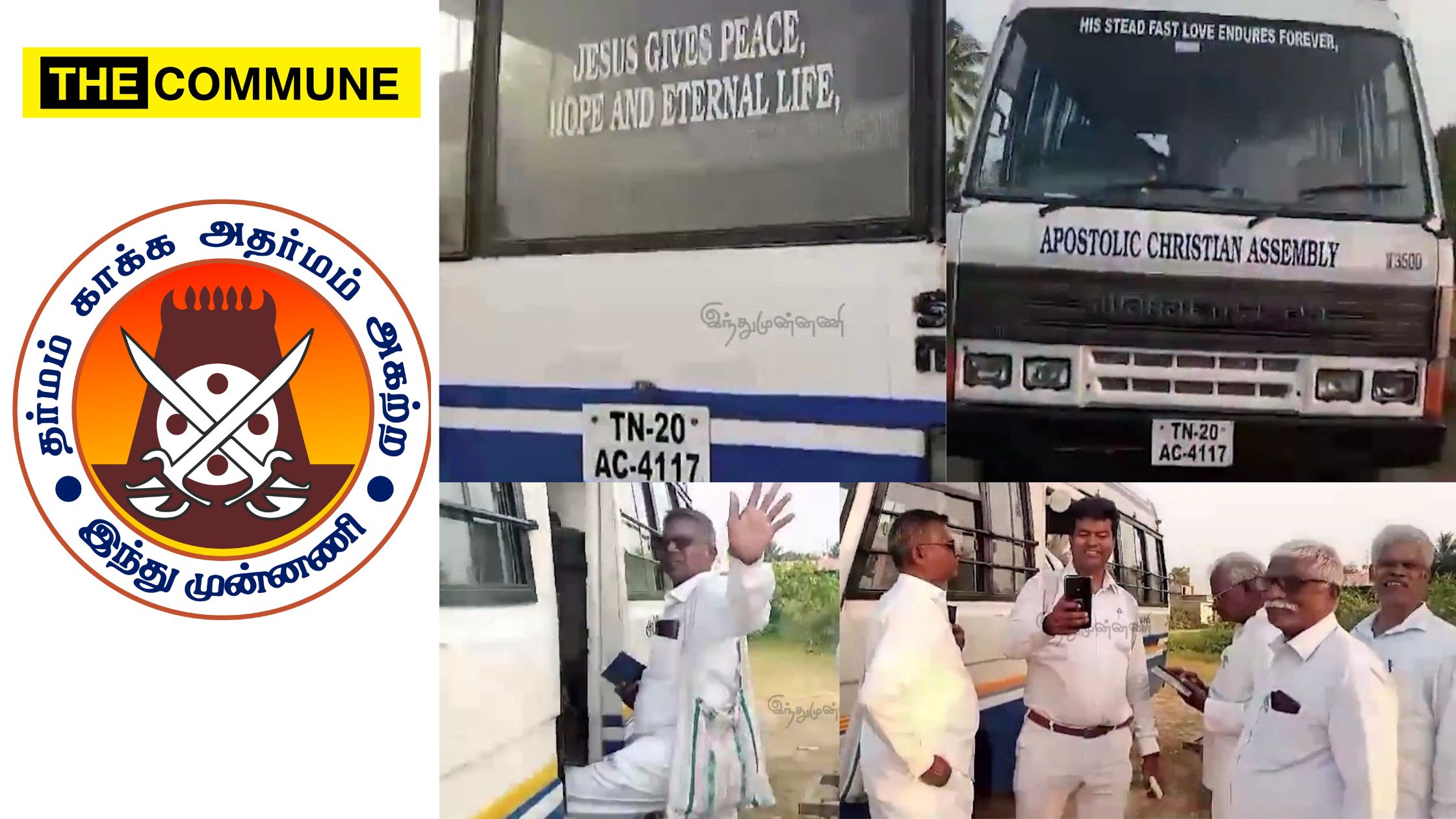
Christian missionaries belonging to the Apostolic Christitian Church who were indulging in proselytization near a temple at a village in Kanchipuram were driven away by residents and members of the Hindu Munnani.

Over 50 individuals associated with the Apostolic Christian Church in the Purisai region of Kanchipuram District were observed going from house to house, distributing pamphlets, and actively involved in conversion activities. Members of the Hindu Munani, along with local residents, collectively thwarted the group of individuals who were attempting to convert the village.

In a video shared on social media by Hindu Munnani, the resident capturing the footage exclaimed loudly. “Sir, sir please do not do this in front of our temple. Do not do this in front of our temple. Do not do this in front of our temple! This is a temple! Doesn’t this look like a temple to you? Should we come to your church and Ayyo Amma Andavare!?”

One of the missionary man can be heard saying “Call Emmanuel” to which the resident replies “call him

Without hesitation, the missionary man swiftly pulled out his phone to capture the incident and chuckled “How many people like you have we seen before this? to which the villagers reply “Yes this is your duty”

The missionary man further says “go and correct murderer and robbers”

An angry resident goes on to shout saying “You correct them. Who has asked you to come here? What you are doing here is wrong!”

This occurrence is not unfamiliar in Tamil Nadu. In the past, there have been numerous incidents similar to this one, where Hindu Munnani along with local residents took it upon themselves to expel missionaries involved in conversion activities.

In October 2023, Saravanan Joseph, the head of the Christian Munnani, sparked a controversy by proposing a change in the name of Chennimalai, a revered Hindu site dedicated to Lord Murugan, to ‘Yesumalai’. A massive protest by Hindu Munnani, BJP and other Hindu outfits led to his arrest.

In March 2022,  there were allegations that Christian missionaries were involved in forcible conversion by setting up a prayer hall in front of a private school in Velampatti of Krishnagiri district, which was later resisted by locals and Hindu Munnani.

A Christian woman was accused of proselytization and converting people, in the Gudalur area of Theni which was thwarted by Hindu Munnani members.

An attempt to open a Christian prayer hall, ‘Grace Assembly Hall’ in front of Sakthi Kaliyamman temple in Seelanaickenpatti, Salem, was successfully stopped by the Hindu Munnani in December 2021.

Hindu Munnani plunged into action when construction of an illegal Christian prayer hall near the Sugreeswarar temple in Tirupur district came to light.

In October 2021, members belonging to the Hindu Munnani successfully stopped proselytization attempts by Christian missionaries at a village in Tiruvallur district, Tamil Nadu.

In the district of Kanchipuram in May 2023, the Hindu Munnani successfully intervened in a reported Love Jihad incident near Uthiramerur. The individual at the center of the incident was Selvi, an 18-year-old who had recently completed her schooling. She had been enticed by a Muslim man named Imran and had been pressuring her to convert and marry him. Under the name Asma Fathima, her Muslim marriage (nikkah) was scheduled for June 1, 2023. The victim herself provided a written statement, revealing that Imran had used persuasive tactics and coercion to compel her into the marriage and disclosed that her name was changed to Asma Fathima without her family’s consent.

Subscribe to our channels on TelegramWhatsApp, and Instagram and get the best stories of the day delivered to you personally. 
Kerala: Communists Prevent Ganapati Homam At School Premises; School Manager Arrested

Image Credits: TrueVision News

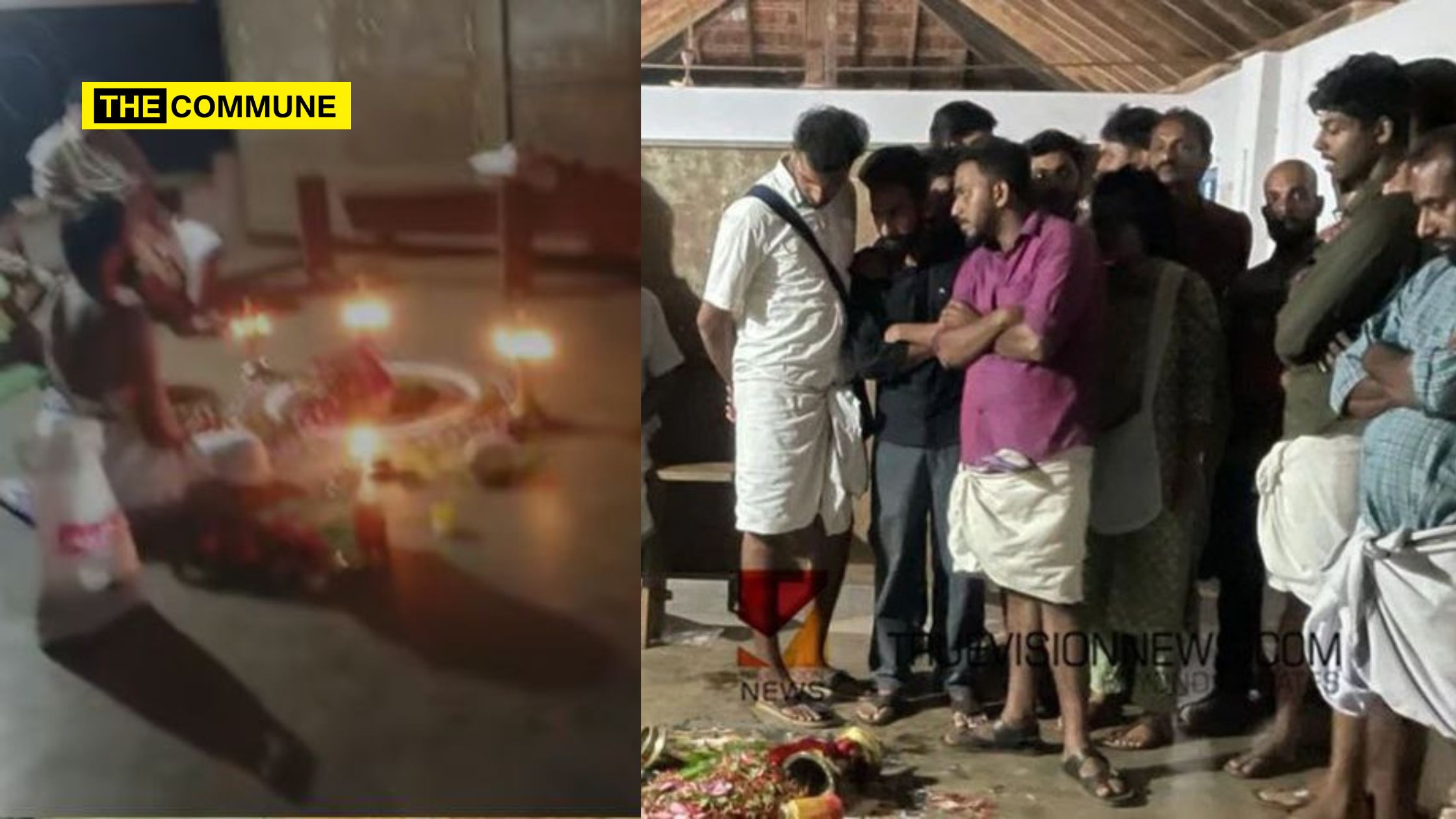
A Ganapathi puja (homam) was taking place at night at the Nedumannur LP school in Kayakkody district in Kozhikode, Kerala. The puja took place at 8 pm on 13 February 2024. Villagers reached the premises after witnessing several cars outside the school. That was when they realised it was a Ganapathi homam that was taking place in the school. Around this time, members of the SFI and DYFI also reached the premises. It turned out to be a protest in a big way.

When the cadre reached, the homam/puja was underway. The cadre alleged that under the supervision of the BJP, the school manager and his son were indulging in these pujas. Subsequently, Thottilpalam police reached the premises and took the school manager into custody.

The villagers also gathered in large numbers and stopped the puja. DYFI cadre said that since these pujas are not allowed on school premises, they will intensify their protest against the manager and the ones supervising the conduct of the pujas.

It is noteworthy that the Ganapathi Pooja was conducted to mark the inauguration and Bhumi puja of the new school building. As per Hindu customs, commencing any sacred endeavour starts with the observance of Ganesha Pooja. Ganapati pooja serves as the fundamental ritual conducted to remove hindrances, mitigate difficulties, and promote prosperity.

Another important point to note is that it is crucial to acknowledge that the management of the school aligns with individuals supportive of the Congress, and the BJP had no involvement in coordinating this ceremony.

Subscribe to our channels on TelegramWhatsApp, and Instagram and get the best stories of the day delivered to you personally.