Home Blog Page 686

TN: Newly-Converted Christian Family Constructs Illegal Church On Public Land in Fully Hindu Village in Tirunelveli

Newly-Converted Christians Construct Illegal Church in Hindu Village

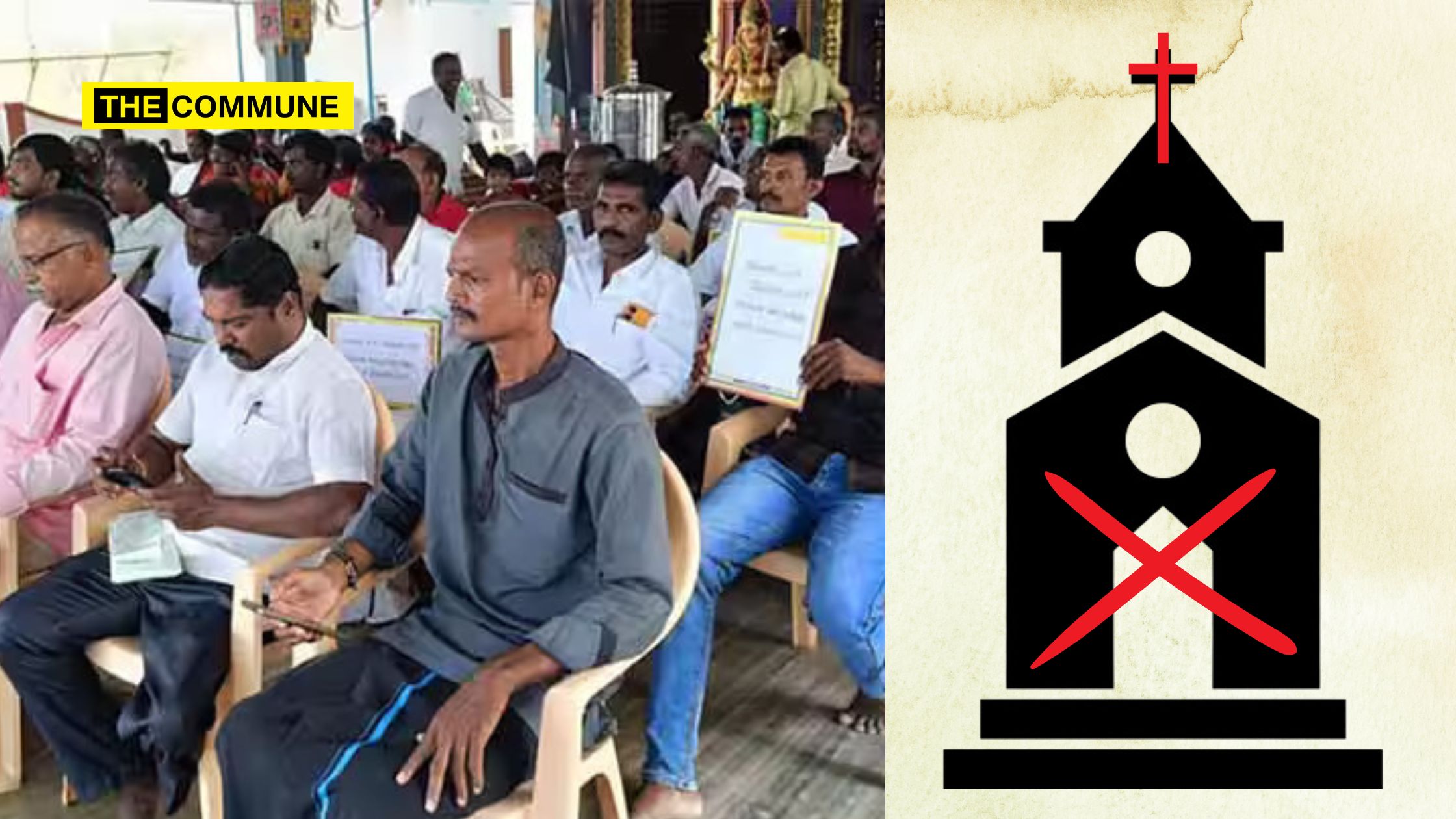
A Christian family in Tamil Nadu is allegedly constructing a church on public land in a predominantly Hindu village where they are the only Christians. Despite objections from residents, who suggested that the family either worship at home or build the church on their private land, the family has chosen to build it on public land, which has become a major point of contention.

The village of South Eranthai near Thisayanvilai in the Tirunelveli District is home to 130 Hindu families. It is alleged that one of the families recently converted to Christianity and is now building a church for their use. This decision has faced strong opposition from the Hindu community. Locals argue that the Christian family could worship privately and criticize their use of public land for church construction without proper authorization, raising concerns about potential conflict.

The previous day, residents staged a hunger strike at the Uchimakali Amman temple to protest the unauthorised church construction. To underscore their protest, they displayed black flags over their homes.

Village leader Dhana Singh said, “Since their conversion, the family has disrupted Hindu temple ceremonies. They are now constructing a church without the necessary approvals from the revenue department or police. Despite authorities’ orders to halt construction, work continues. We demand action on this issue, or we will be forced to stop sending our children to local schools and colleges and intensify our protest.

Illegal Constructions To Convert Hindus

Recently, the Hindu Munnani lodged a formal complaint with the Thittacheri police station in Nagapattinam district, calling for a ban on an illegal prayer house opposite the Vinayaka temple in Marungoor main road that was trying to convert temple visitors.


Subscribe to our channels on TelegramWhatsApp, and Instagram and get the best stories of the day delivered to you personally.

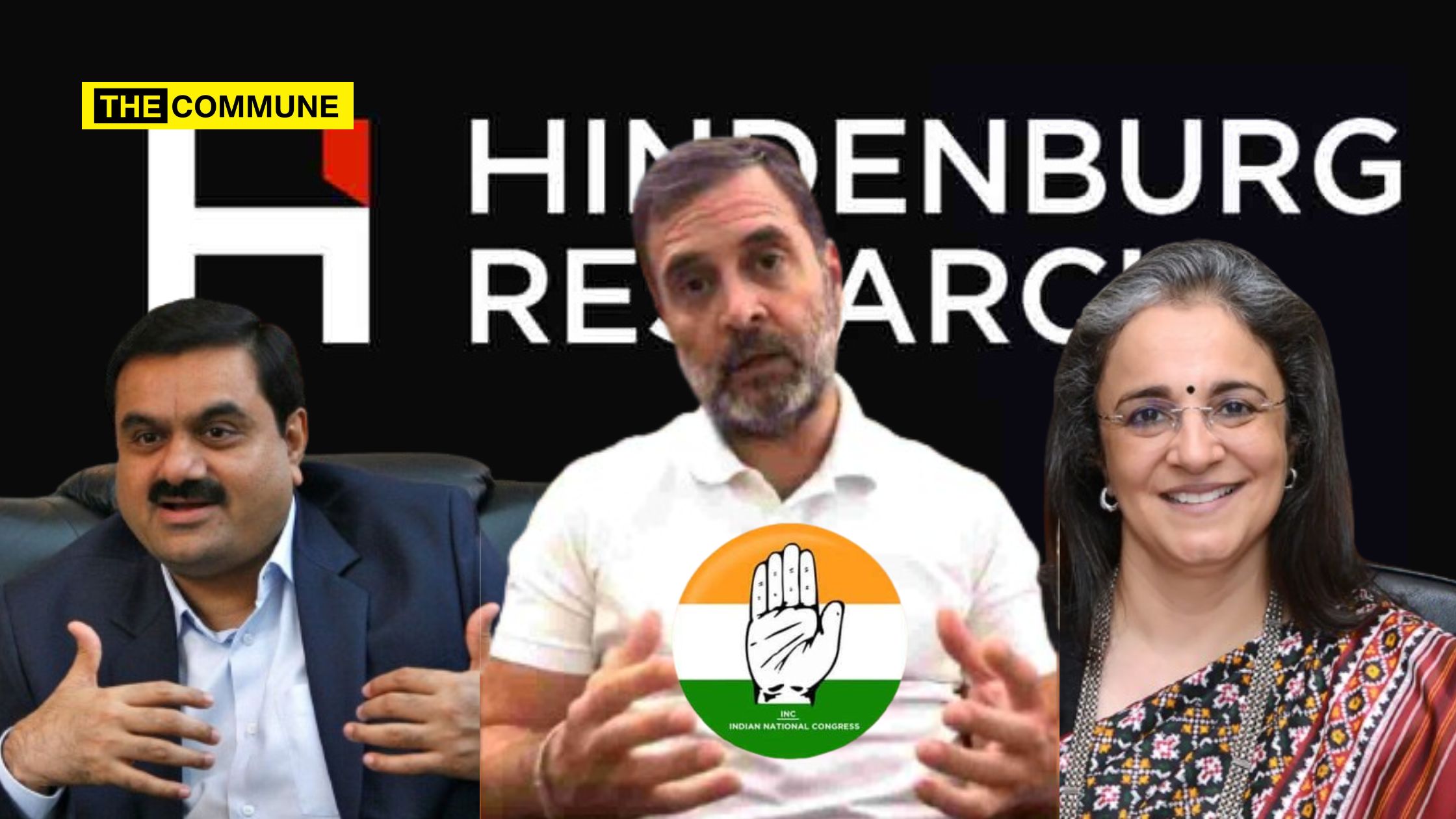
Stock Market Stable: Hindenberg’s Agenda Amplified By Rahul Gandhi Flops As NIFTY Goes Up

Stock market Stable. Rahul Gandhi Flops.

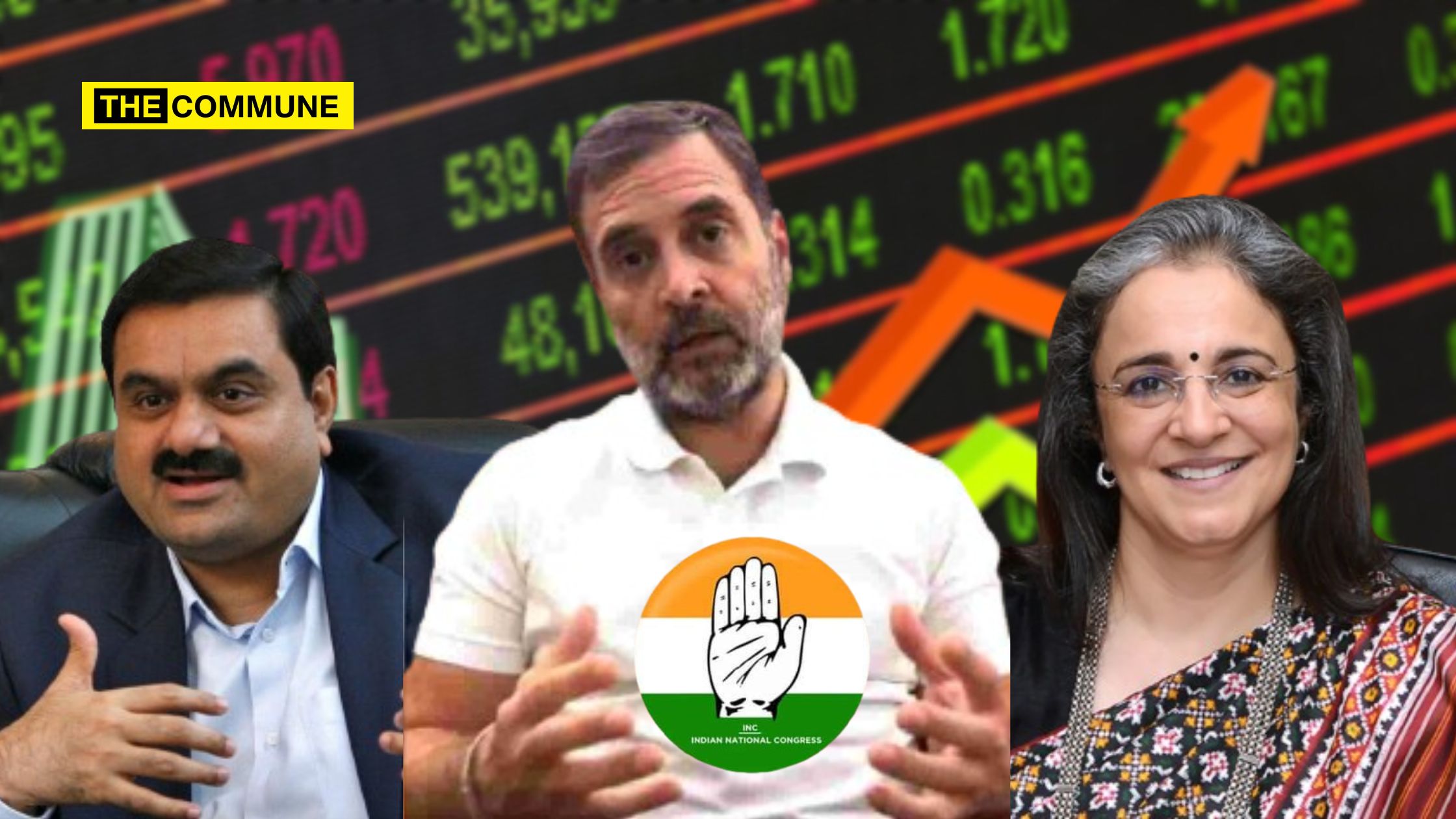
The Indian stock market, which has been relatively stable, delivered a tight slap to Hindenburg Research, a US-based short-selling firm, as well as to opposition parties in India, such as Congress and its sympathisers. Their economic conspiracy theories did not yield the results they had hoped for and ultimately backfired.

On the morning of 12 August 2024, there was no major movement in the stock market. The market opened lower than the close on 9 August 2024 but soon regained ground. By noon, the BSE Sensex had risen by over 200 points and the Nifty 50 by 50 points. Most major stocks traded within a narrow range, except Adani Group shares, which had declined since the morning. The BSE Sensex was up 209 points at 79,904, while the Nifty was at 24,412, showing a 50-point increase during the day.

Despite fears of a significant drop following the release of the Hindenburg Research report which alleged that the SEBI chief had connections with offshore funds allegedly used by the Adani’s to manipulate their share prices—the major stock indices remained relatively steady and traded within a limited range.

However, Adani Group’s stocks suffered notable losses, estimated at $13.4 billion, according to Reuters. The S&P BSE Sensex, which had opened 375 points, managed to recover some of the losses throughout the day, ending with a slight drop of 57 points, or 0.07%, at 79,649. Similarly, the NSE Nifty-50 index closed down by 20.50 points, or 0.08%, at 24,347.

Commenting on the market’s subdued reaction, Arun Kejriwal, founder of Kejriwal Research & Investment Services, told The Hindu, “Investors and institutions understand that this [Hindenburg Report] is an extension of the previous report and is largely a personal attack on a regulator, which has already issued a show-cause notice. Hence, the personal allegations against the SEBI chief have been largely disregarded.

He noted that the recent losses for Adani Group stocks were “minimal” compared to the significant declines experienced following the first Hindenburg report released 18 months ago. On 12 August 2024, eight out of ten Adani Group stocks closed lower, including Adani Enterprises (-1.09%), Adani Ports (-2.02%), Adani Power (-0.65%), Adani Energy Solutions (-3.70%), Adani Total Gas (-4.03%), Adani Wilmar (-4.14%), NDTV (-3.08%), and ACC (-1.55%).

Since the release of the first Hindenburg report in January 2023, both the NIFTY index and investors, including Foreign Institutional Investors (FIIs) and Domestic Institutional Investors (DIIs), have approached the market with caution. As of 9 August 2024, the NIFTY has risen by approximately 6,249 points. During this period, FIIs have invested a total of about ₹2.1 lakh crores, while DIIs have contributed around ₹4.4 lakh crores. This indicates that investors are not swayed by disruptive actors like Hindenburg Research but instead maintain a “calm and due diligence” approach before reacting to such negative reports or claims.

(With inputs from The Hindu)

Subscribe to our channels on TelegramWhatsApp, and Instagram and get the best stories of the day delivered to you personally.
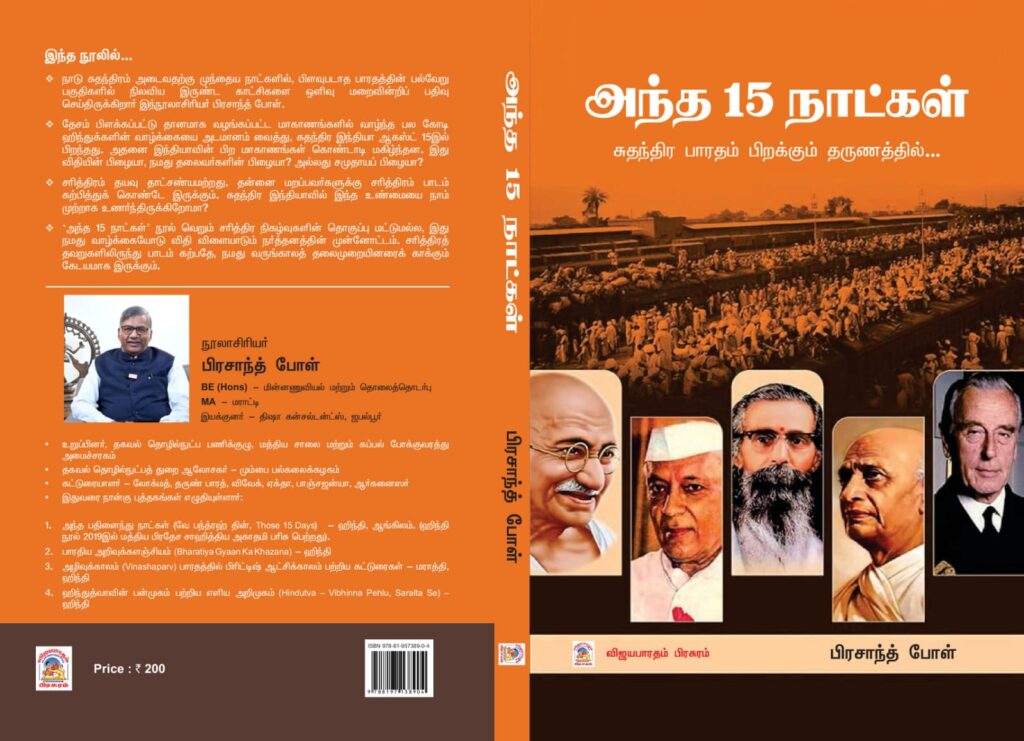
“Andha 15 Naatkal” – Tamil Translation Of Prashant Pole’s Book On Partition Announced

Andha 15 Naatkal - Tamil Translation Of Prashant Pole's Book On Partition Announced

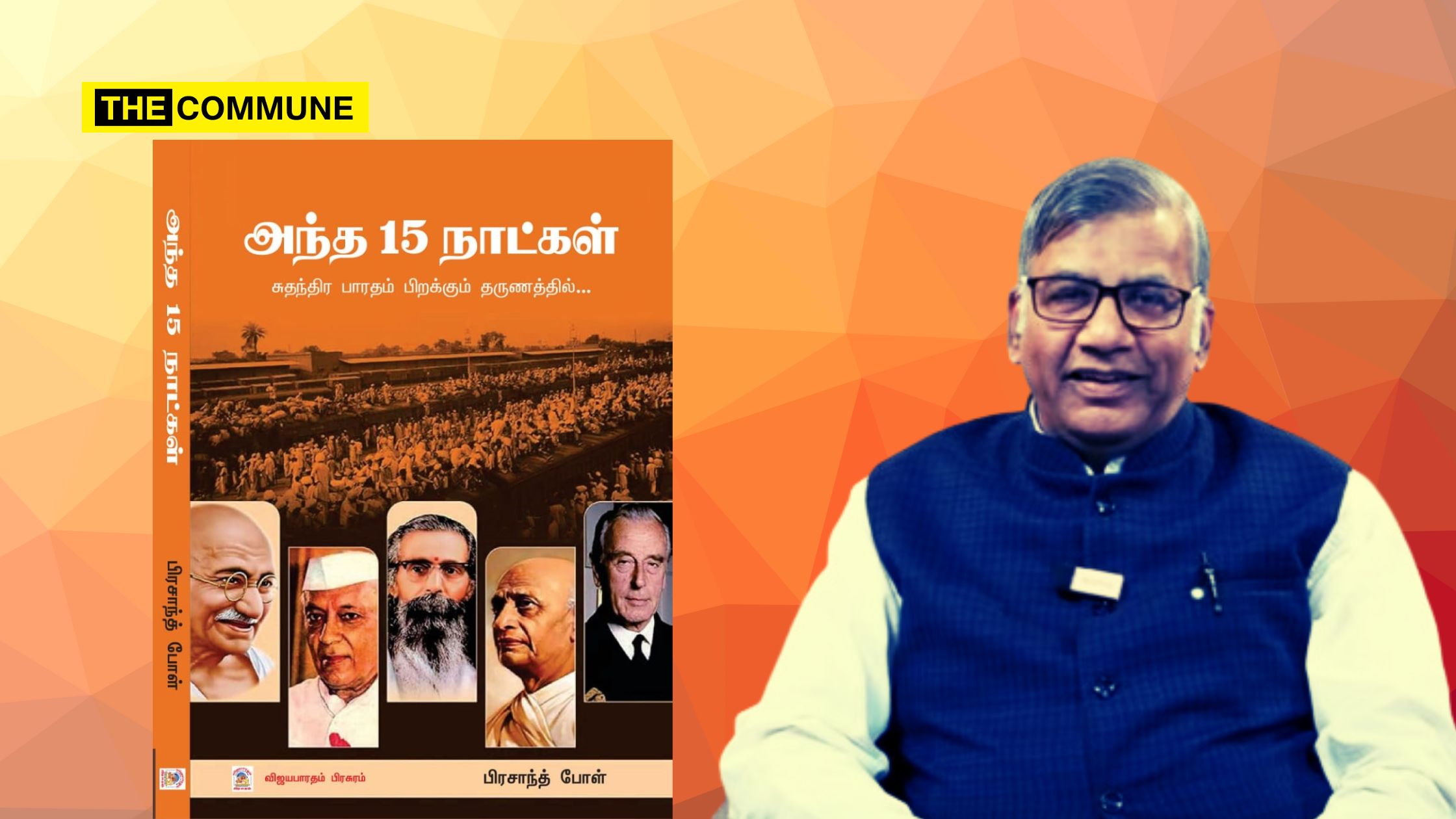
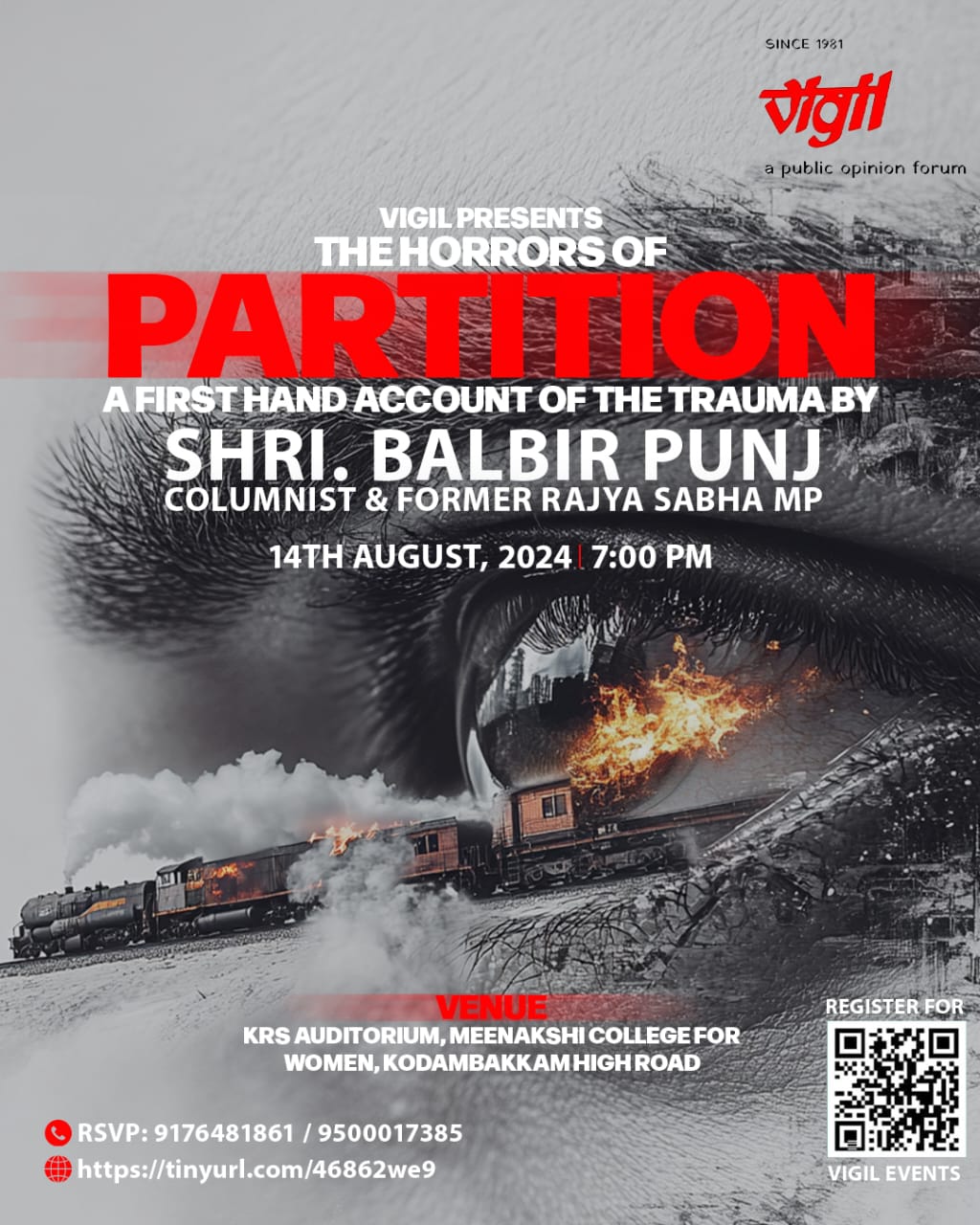
Andha 15 Naatkal – the Tamil translation of author Prashant Pole’s significant historical work, “Those 15 Days,” will be officially launched at a special event hosted by the Vigil Forum in Chennai on Partition Horrors Remembrance Day.

The book, titled “அந்த 15 நாட்கள்” in Tamil, sheds light on the dark and bloody days leading up to India’s independence, particularly focusing on the atrocities faced by Hindus and Sikhs during partition.

The launch event is scheduled for 7:00 PM on 14 August 2024 at the KRS Auditorium, Meenakshi College for Women, Kodambakkam High Road, Chennai. Former Rajya Sabha MP and senior journalist Balbir Punj will attend.

Prashant Pole’s book vividly brings to life the horrors experienced in regions like Hyderabad, often overshadowed by the brutalities in East and West Pakistan. The book is available for Hindi readers as ‘Ve Pandraha Din’.

‘Andha 15 Naatkal’ serves not only as a historical account but also as a cautionary tale, reminding readers of the continuing relevance of these events in light of current developments in neighbouring countries like Bangladesh.

Focus of ‘Andha 15 Naatkal’

The book sheds light on the crucial period leading up to India’s independence on August 15, 1947. It reveals lesser-known events and the actions of leaders from 1 August to 15 August 1947, focusing on the joy of independence intertwined with the sorrow and fear of partition. ‘Andha 15 Naatkal’ highlights the intense atmosphere in regions like Lahore and Karachi, where Hindus and Sikhs faced severe persecution, with no political party stepping in to protect them.

The author emphasises the role of the Rashtriya Swayamsevak Sangh (RSS), particularly its leader Guru Golwalkar, who visited Sindh in early August to support and organise Hindus and Sikhs amidst widespread violence. Despite the Congress’s surrender to the Muslim League, Golwalkar encouraged unity and resilience among Hindus.

The book argues that partition, driven by religious division, led to the tragic dismemberment of India. It calls attention to the ongoing decline of Hindu populations in Pakistan and Bangladesh, urging Indians to remain vigilant about the lessons of partition to protect the nation’s unity and sovereignty.

This translation will allow Tamil readers to engage with a critical part of India’s history, ensuring that the lessons from those harrowing 15 days are not forgotten.

The event will also hear a first-hand account of the horrors of partition by Balbir Punj. This event offers a rare glimpse into the trauma and resilience of that time.

Pre-registration for the event is mandatory and interested people can register to attend using the link – https://tinyurl.com/46862we9

VIGIL

VIGIL, a public forum for discussions and public dialogue, was an initiative of various public-spirited citizens of Chennai and was active from the 1990s until 2010. Various intellectuals and luminaries, like Swami Dayananda Saraswati, have graced VIGIL occasions.

Partition Horrors Remembrance Day

In 2021, Prime Minister Narendra Modi declared that the 14th of August will be observed as Partition Horrors Remembrance Day. This day is dedicated in memory of the millions of people who were displaced and killed due to mindless hate and violence during the partition of India in 1947.

Subscribe to our channels on TelegramWhatsApp, and Instagram and get the best stories of the day delivered to you personally.
How U.S. Diplomatically “Engages” With Bangladeshis – A Pattern Repeating Itself In India

How U.S. Diplomatically "Engages" With Bangladeshis - A Pattern Repeating Itself In India

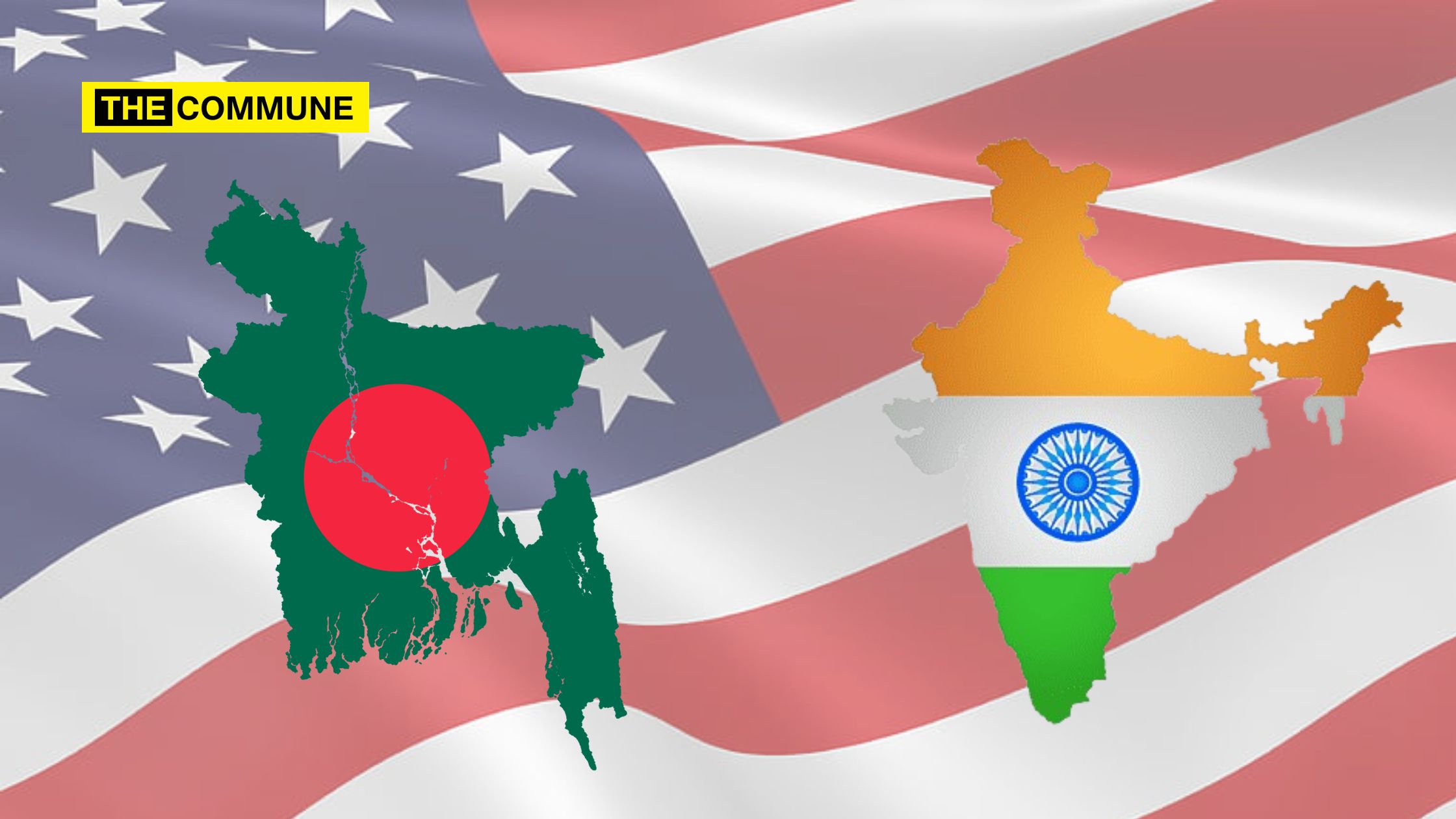
After Sheikh Hasina fled Bangladesh during a coup on August 5, 2024, she accused the U.S. of orchestrating her ouster due to her refusal to cede Saint Martin’s Island, a strategically important location in the Bay of Bengal. Such claims, though denied by the Americans, match the pattern that emerged in India ahead of our general elections. 

Her allegations follow an October 2023 meeting between a key member of the banned Jamaat-e-Islami outfit and a U.S. diplomat, which raised suspicions due to its political significance.

The Island is geographically significant due to its location in the Bay of Bengal and proximity to China and Myanmar. Hasina alleged that the U.S. had long been interested in establishing a military base on the island to gain strategic control over the Bay of Bengal. 

The U.S. has denied these allegations. However, this pattern of engagement was also found in India, where the U.S. has interacted with social media influencers and politicians before the 2024 general elections.

How US Officials Engaged with Bangladeshi Politicians and Civil Society Over Years

In October 2023, ahead of the elections in Bangladesh, a key Jamaat-e-Islami official, Dr. Syed Abdullah Mohammad Taher, met with Matthew Bey, the US Embassy’s first Political Secretary, at the American Club in Dhaka ahead of the opposition BNP’s planned grand rally. This meeting, which lasted over an hour, drew media attention due to its timing and the political significance of the upcoming rallies.

It is noteworthy that the Jamaat-e-Islami is a banned organisation in Bangladesh. Sheikh Mujibur Rahman himself banned it since its members were involved with the formation of auxiliary forces such as Razakars. On August 1, 2013, the Bangladesh Supreme Court annulled the registration of the Jamaat-e-Islami, deeming the party ineligible to participate in national elections. Following this, the government imposed a complete ban on the party on 1 August 2024.

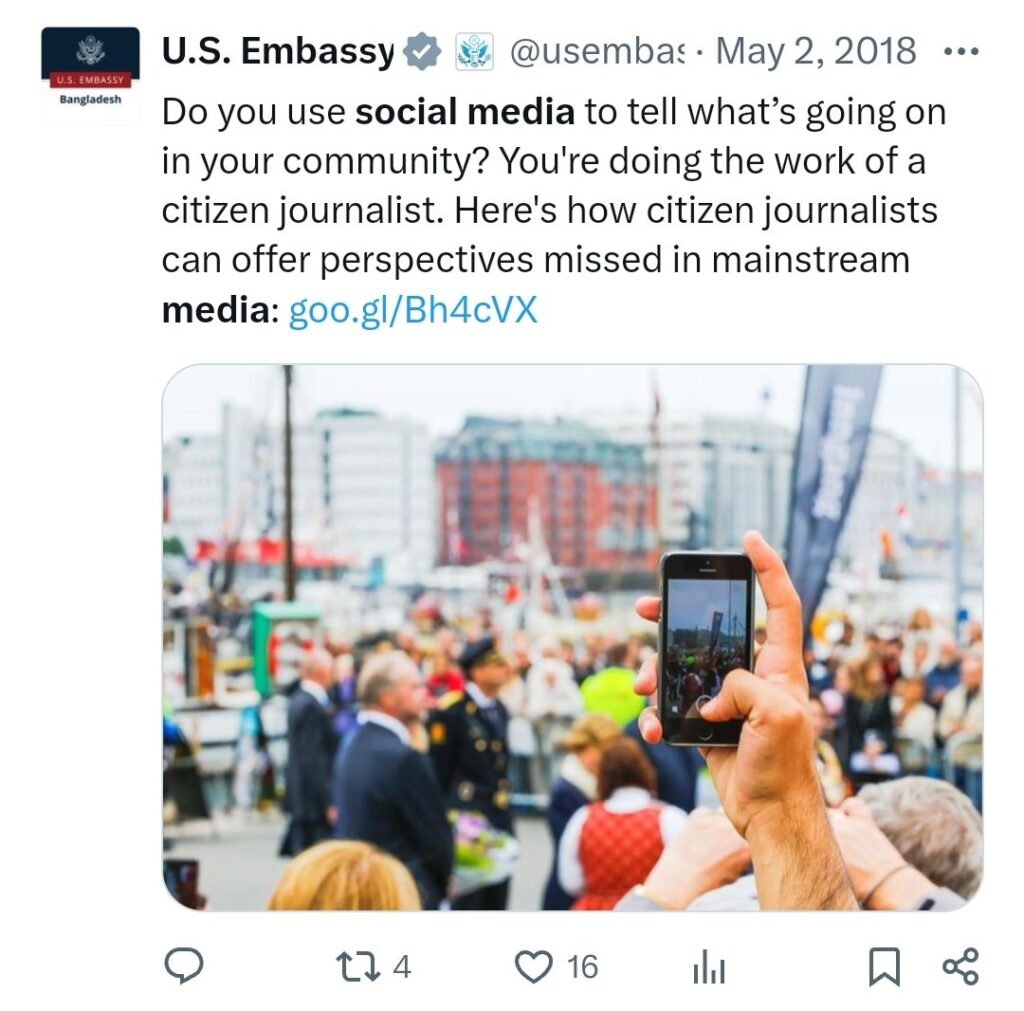
The US Embassy has regularly engaged with the opposition and social media influencers in Bangladesh. In 2018, the US Embassy in Dhaka had already ‘activated’ the social media ‘citizen journalist’ work.

In May 2021, Ambassador Miller spoke about his experience in Bangladesh and U.S. government initiatives for Bangladeshi students in an interview with Radio Padma.

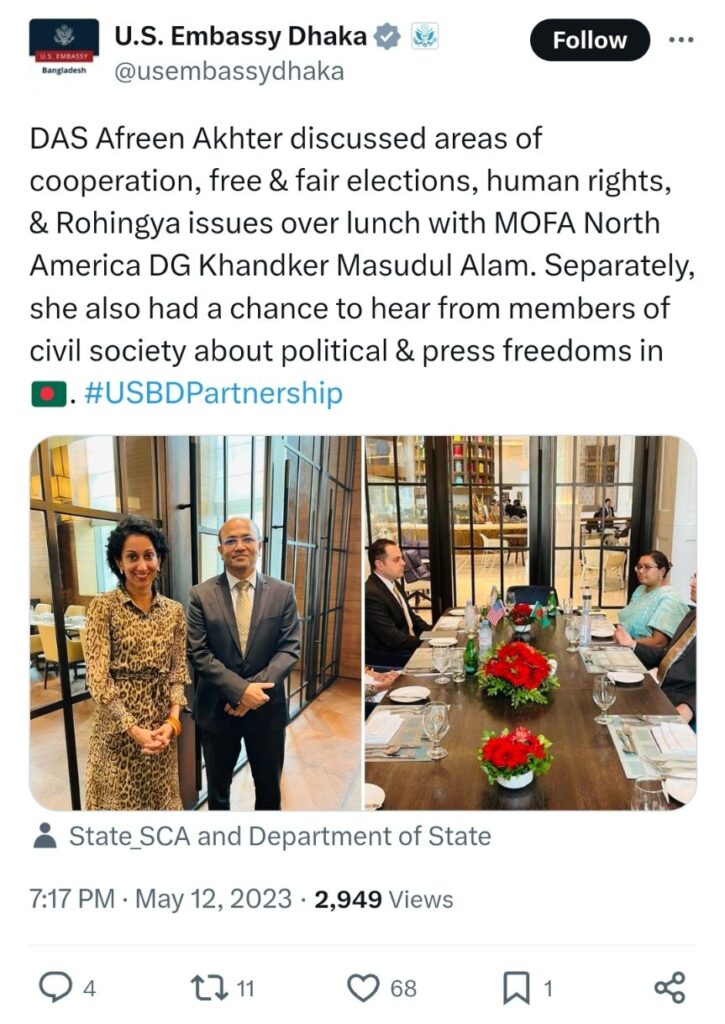
In May 2023, DAS Afreen Akhter discussed “areas of cooperation, free & fair elections, human rights, & Rohingya issues over lunch with MOFA North America DG Khandker Masudul Alam“.


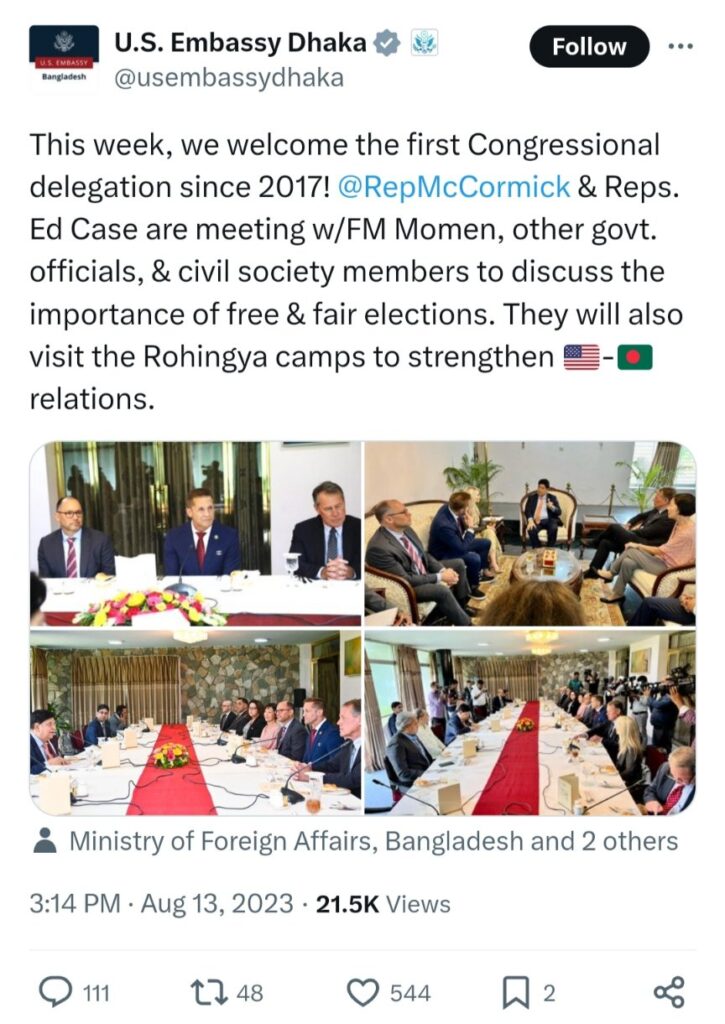
Three months later, in August 2023, Rep McCormick and Reps. Ed Case met with FM Momen, government officials, and civil society members to discuss the importance of ”free and fair elections”

In September 2023, Deputy Assistant Secretary Mira Resnick met with “civil society leaders promoting positive civic engagement in Bangladesh despite obstacles and resistance.”

All these events happened in the run-up to the Bangladesh elections last year.

In June 2024, Ambassador Haas and Assistant Secretary Don Lu engaged with three of Bangladesh’s social media influencers on climate action and other topics.

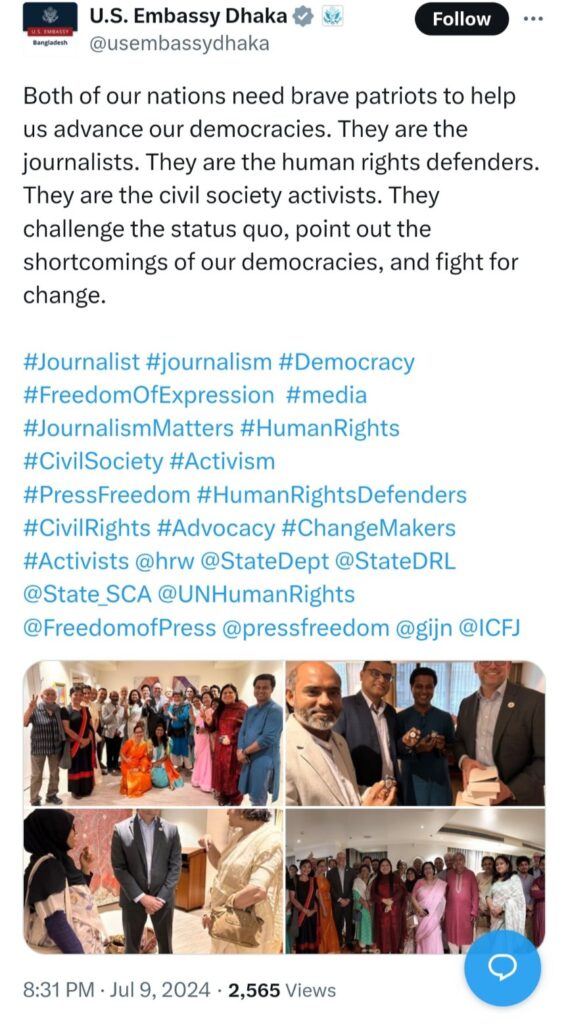
In July 2024, the US Embassy in Bangladesh met with “brave patriots” who help” advance the democracies. They meant – journalists, human rights defenders, and civil society activists, who “challenge the status quo, point out the shortcomings of our democracies, and fight for change.”

Similar Pattern in India

This pattern is also seen in India. It is noteworthy that the US Embassy nominated fake news spreader RJ Sayema as the equality ambassador in March 2023.

YouTuber and fake news peddler Akash Banerjee of The DeshBhakt was also invited to deliver a talk at a programme titled “Influence to Impact”. The post made by US Embassy India handle read, “Are you a social media influencer or a content creator curious about impactful content that drives real change? Here’s your chance to learn from the best! Join us at American Center New Delhi for “Influence to Impact” with @TheDeshBhakt Akash Banerjee.”

More recently, on 12 August 2024, the US Consul General in Hyderabad met with AIMIM chief Asaduddin Owaisi. The post caption read, “Thank you, Member of Parliament and leader of AlMIM @asadowaisi for your kind hospitality and for sharing your informed and important views on a range of shared issues and concerns. I look forward to continuing our discussions! #USIndiaFWD”

The US has been trying to implement a regime change in India for quite some time. However, PM Modi continues to be at the helm. Had something drastic taken place, it is possible that India would have had someone else as Prime Minister.

Subscribe to our channels on TelegramWhatsApp, and Instagram and get the best stories of the day delivered to you personally.
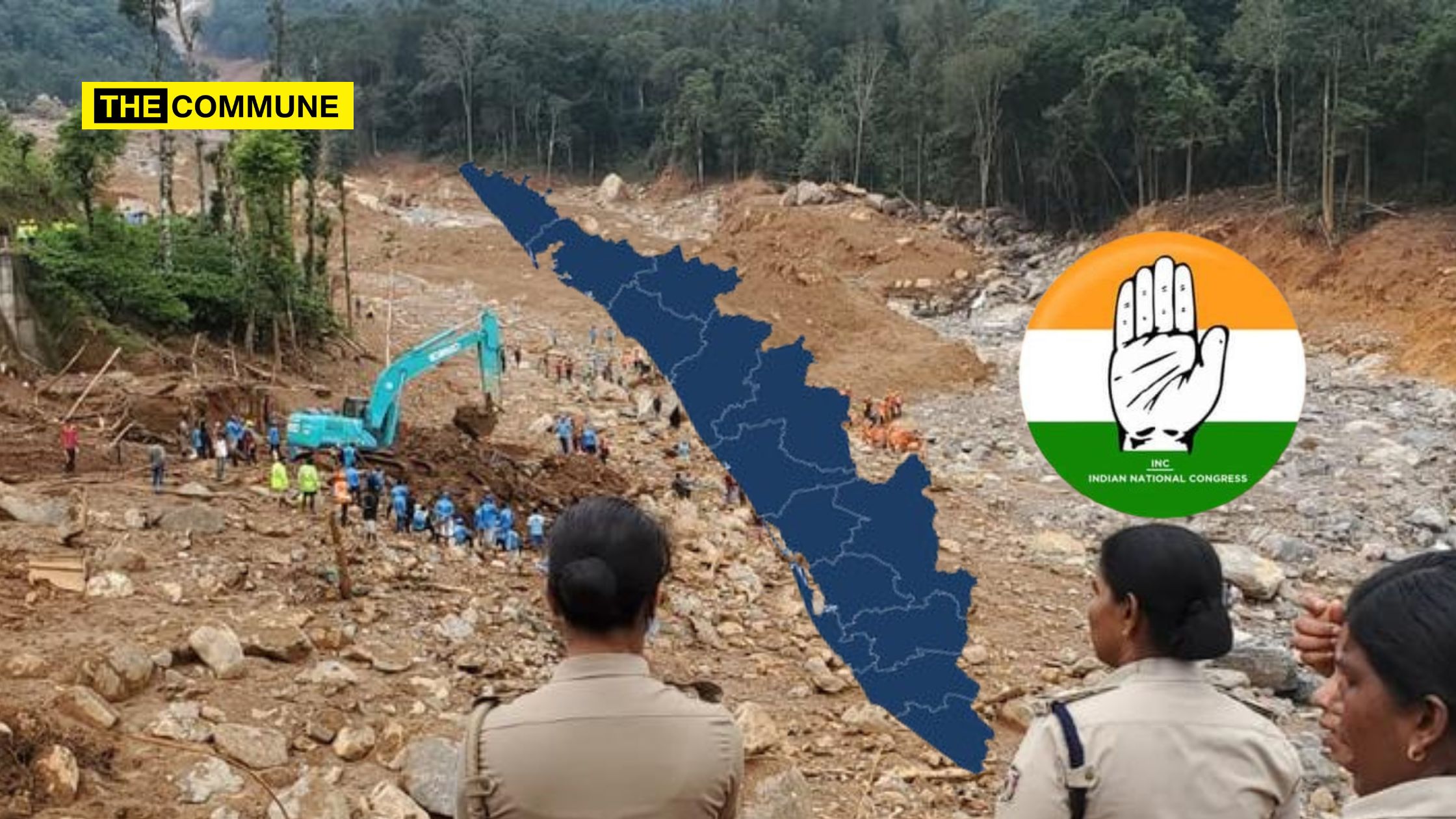
Kerala: Chelannur Congress Members Allegedly Embezzled Wayanad Landslide Relief Funds

The Chelannur unit of the Congress party’s youth wing has recently been embroiled in significant controversy due to accusations of embezzlement. The allegations pertain to funds collected for relief efforts following the Wayanad landslide.

According to reports, Ajal Divanandan, the President of the Youth Congress for the Chelannur constituency, has complained with Rahul Mamkootathil, the IYC State President, alleging that two Youth Congress members misappropriated the relief funds.

In the complaint, Divanandan accuses the Chelannur unit’s Vice President Aswin Edavalath and fellow worker Anas of raising funds in the name of KSU State Secretary Sanuj Kuruvatur and then misappropriating those funds. He also claims that these individuals did not participate in the fundraising activities in Chelannur and that their actions have obstructed any further fundraising efforts. Divanandan has called for disciplinary action against the accused.

In response, Aswin Edavalath stated that he would file a counter-complaint with the state leadership, alleging that the accusations are unfounded and part of internal conflicts within the Youth Congress. He has pledged to resign from public activities if the allegations are true.

Following the backlash over the embezzlement allegations, the Chelannur unit has issued a clarification denying wrongdoing. The constituency president, who initially reported the scam, has since retracted his complaint, calling it false after it was leaked to the media, intensifying the controversy. The leadership of the Chelannur unit and the Youth Congress district leadership have denied that any such complaint was filed. In contrast, the state leadership of the Youth wing has claimed they have not received any complaints regarding the fund collection from Chelannur.

On 30 July 2024, a devastating landslide struck the Wayanad district due to severe rainfall, resulting in 229 deaths and leaving over 130 people missing. Prime Minister Narendra Modi visited the affected areas, promising full support from the Central government for relief and rehabilitation efforts. During his visit, he conducted an aerial survey of the disaster-stricken regions, accompanied by Kerala Chief Minister Pinarayi Vijayan and Governor Arif Mohammed Khan.

(With inputs from OpIndia)

Subscribe to our channels on TelegramWhatsApp, and Instagram and get the best stories of the day delivered to you personally.
Hindenburg: Why Rahul Gandhi Is A Hypocrite Of The First Order

Rahul Gandhi Is A Hypocrite Of The First Order

Congress chief Rahul Gandhi, who is using the questionable Hindenburg research to cast doubt on India’s stock markets, is a hypocrite for keeping a hefty 42% of his declared assets invested in the very markets he’s warning others about.

Backlash against Gandhi

Gandhi, the scion of the Congress party, is facing severe criticism for his unabated support of the allegations raised by Hindenburg, a US-based short-selling company, against SEBI, the Indian stock market regulator.

To endorse the report released on 11 August 2024, Gandhi provoked a backlash from citizens, investors, and political figures. Since the Congress party assumed the role of opposition, Gandhi and his allies have consistently challenged the ruling BJP government, often placing blame even when it’s not warranted.

Aligning with a foreign entity and a short-selling firm that previously failed in India, Gandhi and the Congress party are now being criticised for what many perceive as an attempt to undermine the credibility of India’s financial markets.

Following the allegations from the Hindenburg report against the Securities and Exchange Board of India (SEBI) chairperson on 10 August 2024, Gandhi took to his official X account to cast doubt on the integrity of the Indian stock market. Many saw this move as a blatant attempt to erode confidence in the country’s economy.

Congress misinformation against SEBI

On his X account, Gandhi remarked,The integrity of SEBI, the securities regulator entrusted with safeguarding the wealth of small retail investors, has been gravely compromised by the allegations against its Chairperson. Honest investors nationwide have pressing questions for the government: – Why hasn’t SEBI Chairperson Madhabi Puri Buch resigned yet? – If investors lose their hard-earned money, who will be held accountable—PM Modi, the SEBI Chairperson, or Gautam Adani? – In light of the new and very serious allegations that have surfaced, will the Supreme Court look into this matter suo moto once again? It is now abundantly clear why Prime Minister Modi is so afraid of a JPC probe and what it might reveal.” 

Adding a video message, he said,  Imagine you are watching the International cricket match, between India and Australia…and every single person is watching the match and those playing the match know that the umpire is compromised… what would happen to the match…what would happen to the fairness of the match…what would happen to the outcomes…How would you feel as somebody participating in the match… this is exactly what is happening in the Indian stock markets…over the last few years larger and larger number of people have been investing in the Indian stock markets. They invest their hard-earned, honestly earned savings in the stock market and it is my duty as the Leader of the Opposition to bring to your notice that there’s a significant risk in the Indian stock market because the institution that governs the stock markets is compromised.

Now I will explain to you exactly how and why it is compromised. A serious allegation against the Adani Group was illegal share ownership and price manipulation using offshore funds. It has now emerged that SEBI Chairwoman Madhabi Buch and her husband were interested in one of those funds. This is an explosive allegation because it alleges that the umpire herself is compromised, and the savings of billions of Indians, both hard-earned and honestly earned, are at risk. It is, therefore, imperative that this matter be investigated. Retail investors, Honest investors, and Pensioners have three questions: why hasn’t SEBI Chairperson Madhabi Puri Buch resigned yet? – If investors lose their hard-earned money, who will be held accountable—PM Modi, the SEBI Chairperson, or Gautam Adani? – In light of the new and very serious allegations that have surfaced, will the Supreme Court look into this matter suo moto once again? It is abundantly clear why Prime Minister Modi is so afraid of a JPC probe and what it might reveal.”

Why Rahul Gandhi Is A Hypocrite

In a striking display of hypocrisy, Gandhi advises investors to stay away from the Indian stock market. He is casting doubt on its stability, which indirectly benefits foreign entities. However, his personal financial interests reveal a different story.

According to his election affidavit for the 2024 Lok Sabha elections, Gandhi holds investments worth ₹8,32,05,831 ~8 crore in bonds, debentures, and shares within the Indian stock market. Notably, 42% of his declared assets are invested in Indian markets, reflecting his personal confidence in their performance.

He is a hypocrite for stopping Indians from benefitting from a market that is giving him good returns on his investments.

Gandhi’s investments include shares (₹4.3 crores), mutual funds (₹3.8 crores), and gold bonds (₹15 lakh). His movable assets have surged by 59% since 2019, underscoring the strength of the Indian markets he publicly criticises. 

Here is a snapshot of his investments:

  • Young Indian: 1,900 equity shares of ₹100 each – ₹1,90,000
  • Alkyl Amines Chemical Ltd: 373 shares – ₹7,39,211
  • Asian Paints Ltd: 1,231 shares – ₹35,29,954
  • Bajaj Finance Ltd: 551 shares – ₹35,89,407
  • Deepak Nitrite Ltd: 568 shares – ₹11,92,033
  • Dr. Lal Pathlabs Ltd: 516 shares – ₹10,43,429
  • Fine Organic Industries Ltd: 211 shares – ₹8,56,301
  • Divis Laboratories Ltd: 567 shares – ₹19,76,222
  • Garware Technical Fibres Ltd: 508 shares – ₹16,43,075
  • GMM Pfaudler Ltd: 1,121 shares – ₹14,00,073
  • Hindustan Unilever Ltd: 1,161 shares – ₹27,02,460
  • ICICI Bank Ltd: 2,299 shares – ₹24,83,725
  • Info Edge (India) Ltd: 85 shares – ₹4,45,502
  • Infosys Ltd: 870 shares – ₹14,21,580
  • ITC Ltd: 3,093 shares – ₹12,96,276
  • LTI Mindtree Ltd: 407 shares – ₹21,14,100
  • Mold-Tek Packaging Ltd: 1,953 shares – ₹14,95,510
  • Nestle India Ltd: 1,370 shares – ₹35,67,001
  • Pidilite Industries Ltd: 1,474 shares – ₹42,27,432
  • Suprajit Engineering Ltd: 4,068 shares – ₹16,65,439
  • Tata Consultancy Services Ltd: 234 shares – ₹9,87,305
  • Titan Company Ltd: 897 shares – ₹32,58,980
  • Tube Investments Of India Ltd: 340 shares – ₹12,10,621
  • Vertoz Advertising Ltd: 260 shares – ₹1,89,085
  • Vinyl Chemicals (India) Ltd: 960 shares – ₹3,24,240
  • Britannia Industries Ltd: 5.5 NCD – ₹1,558
  • HDFC MCOP DP GR: ₹19,58,249
  • HDFC Small Cap DP GR: ₹17,89,032
  • ICICI EQ&DF D Growth: ₹19,03,179
  • PPFAS FCF D Growth: ₹19,76,536
  • HDFC Small Cap Reg-G: ₹1,23,85,545
  • HDFC Hybrid Debt Fund-G: ₹79,01,329
  • ICICI Prudential Reg Savings-G: ₹1,02,19,702
  • Sovereign Gold Bond: 220 units – ₹15,21,740

Agenda 2.0 – Hindenburg Research Report

On 10 August 2024, the US-based short-seller Hindenburg Research made serious allegations against Madhabi Puri Buch, the chairperson of the Securities and Exchange Board of India (SEBI), and her husband, Dhaval Buch. The report claims that the Buchs held stakes in obscure offshore funds involved in the Adani Group’s alleged financial misconduct.

According to Hindenburg, the Buchs were invested in a complex offshore fund structure linked to high-risk jurisdictions and overseen by a company with connections to the Wirecard scandal. Gautam Adani’s brother, Vinod, reportedly used these funds to manipulate financial markets. The report also suggests that shortly before Madhabi Buch’s appointment to SEBI, her husband shifted their investments into his sole ownership, potentially to evade scrutiny related to her new regulatory position.

Madhabi Puri Buch has vehemently denied these allegations, labeling them as asad case of character assassination and asserting that their financial dealings are fully transparent. The Adani Group also rejected claims of commercial relationships with individuals or issues highlighted in the report.

The Supreme Court had earlier dismissed calls for a CBI or court-monitored probe into the Adani-Hindenburg matter, expressing confidence in SEBI’s investigation.

This new revelation follows a previous Hindenburg report from 18 months ago, which accused the Adani Group of stock manipulation and accounting fraud—a claim the conglomerate has denied. But the US-based firm, unexpectedly earned only $4.1 million from betting against Adani Group securities. This amount is insufficient to cover their research costs. Critics argue that, in light of this, Hindenburg may be resorting to fresh allegations against SEBI’s independence and integrity as a new strategy to justify their earlier claims.

Subscribe to our TelegramWhatsApp, and Instagram channels and get the best stories of the day delivered personally.

Open Letter By Authors, Academics, Professionals & Public Figures, Call to End Hindu Genocide In Bangladesh

Leaked Telegram Messages Reveal Islamist Agenda Against Bangladeshi Hindus.

Voicing Our Concern About The Ongoing Hindu Genocide In Bangladesh

We, the undersigned, are writing to convey our profound concern regarding the escalating violence and persecution faced by the Hindu community in Bangladesh. Recent incidents have brought global attention to a renewed and alarming pattern of targeted violence against Hindus in the region.

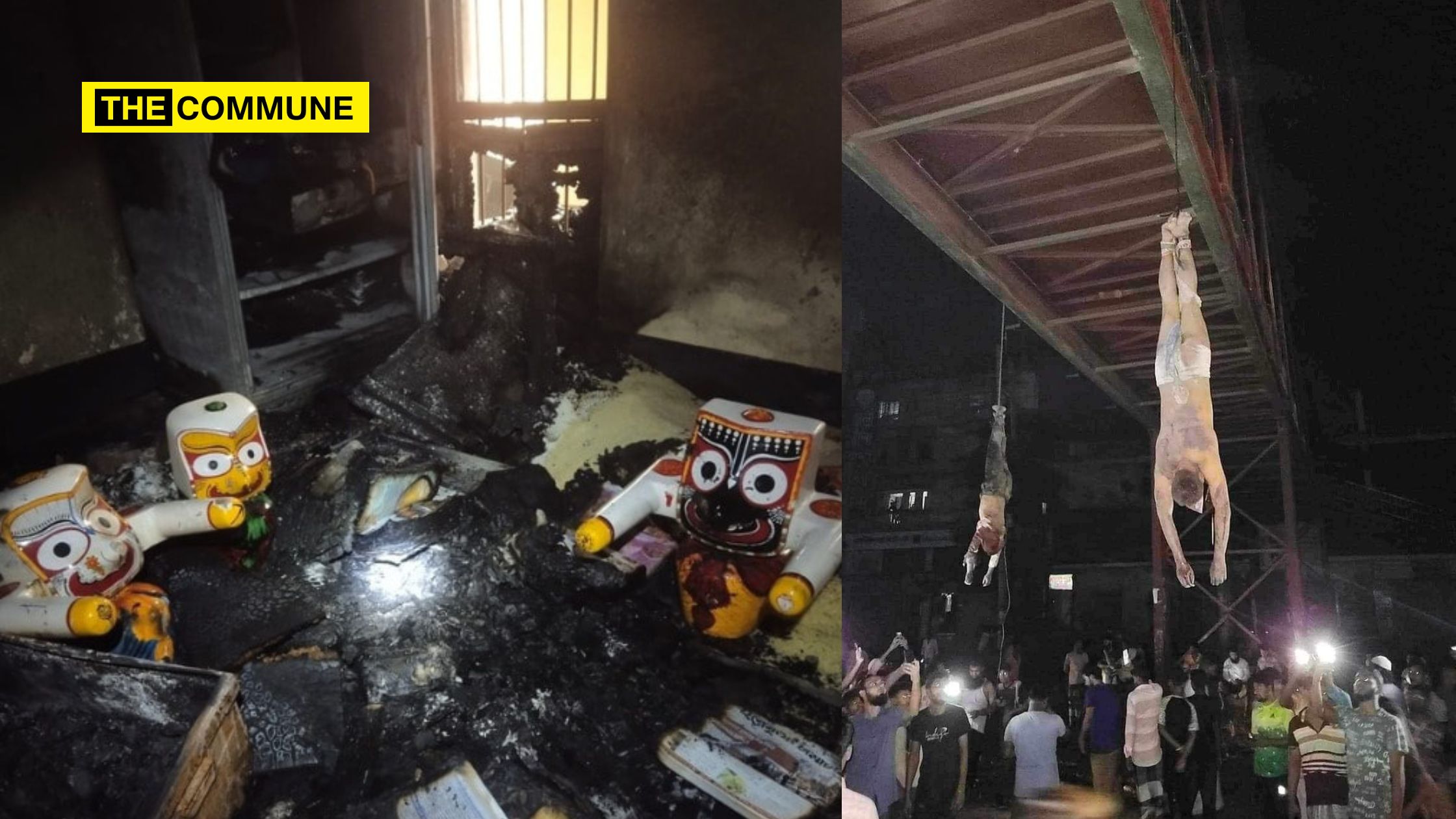
In recent days we have observed deeply troubling events, including the burning of an ISKCON center in Meherpur, the vandalism of multiple Hindu temples across the country, and the dissemination of videos showing rioters celebrating the lynching of Hindus.

Tragically, these acts of violence are neither isolated nor are they without precedent. The Hindu population in Bangladesh has historically endured repeated waves of persecution, which often intensify during periods of political instability. Since 1971, when 2.5 million Hindus were murdered by the Pakistani regime before the formation of Bangladesh, there has been an ongoing and systematic pogrom against Hindus. Reports indicate that there have been over 3,600 attacks on Hindus in Bangladesh since 2013.

The current developments in Bangladesh have further destabilized the situation, resulting in increased attacks on minority communities. These events are reminiscent of the tragic exodus of Hindus from Bangladesh in previous decades, underscoring a recurring cycle of violence that must be urgently addressed.

Given the severity of these circumstances, we respectfully request your immediate intervention to bring this matter to the attention of your elected representatives, urging them to address this issue at the highest levels of government.

We, the undersigned, urge the Indian Parliament to:

  • Pass a unanimous resolution recognizing the ongoing violence against Hindus in Bangladesh and condemning this wave of communal violence.
  • Collaborate with international bodies, such as the United Nations, to press the Bangladeshi authorities to take concrete steps to protect their Hindu minority and hold the perpetrators accountable.
  • Advocate for the provision of humanitarian assistance and asylum options for Hindus fleeing persecution in Bangladesh.

It is imperative that immediate action is taken to prevent further atrocities and to uphold the fundamental human rights of the Hindu community in Bangladesh. Your support is crucial in mobilizing international action and ensuring that these vulnerable populations receive the protection they so urgently need.

Signed By,

Dr. A. K. Singh, Neurosurgeon

Abhishek Banerjee, Author and columnist

Abhinav Agarwal, Author

Amish Tripathi, Author

Dr Amit Thadhani, Consulting General Surgeon, Social activist and Author

Anand Ranganathan

Aneesh Gokhale, Author

Anirudh Joshi

Aparna M Sridhar, Chief Editor, Conversations, Indica

Arun Krishnan, Author

Ashwin Sanghi, Author

Avatans Kumar, Columnist

Deepak M R, Author and Trainer

Dushyant Sridhar, Speaker and Author on Hindu scriptures

Gurpreet Chopra, Author, Financial Analyst

GV Shivakumar, Author, Director – INDICA

Harsh Gupta Madhusudan, Author and Investor

Hindol Sengupta, Author

J Sai Deepak, Advocate, Supreme Court of India and Author

Jataayu, Tamil Scholar and Cultural Commentator

Kavita Krishna Meegama, Author

Lila Krishna, Columnist

Mathukumalli Vidyasagar, Scientist

Megh Kalyanasundaram

Nagaraj Patauri

Neelabh Pratap Singh, Author

Dr. Nidhi Shendurnikar, Independent Media Educator & Researcher, Vadodara (Gujarat)

Nithin Sridhar, Author, Speaker & Director, INDICA Center for Moksha Studies

Pankaj Sahay, Professor

Pankaj Saxena, Author, Co-founder Brhat

Pingali Gopal, Doctor, Author

Pranshu B Saxena, Author & Founder – The Real Mahabharata of Sage Vyasa

Raghava Krishna, Founder & CEO, Brhat

Dr Ratan Sharda – author, TV panelist

Rajeev Mantri, Author

Rajeev Srinivasan, Columnist

Ram, Founder, hindumisia.ai

Ramaharitha Pusarla, Editor, MyInd

Ramesh Rao, Professor, Columbus State University

Ratul Chakraborty, Author

Roopal G Vaish, Author

S Anuradha, Author

Saiswaroopa Iyer, Author and Academic

Semanti Chakraborty, Teacher and Author

Shailendra Marathe, Author, Educationist

Smita Barooah, Author

Soumitra Banerji – Author & Consultant

Srinidhi Balasubramanian, Author

Srivalli Rekha, Author

Sumedha Verma Ojha (Historian and Author)

Sunil Kumar, Author

C Surendranath, Columnist and Speaker

Dr Swetha Prakash, Author

Vaijayanthi Chakravarthy

Vaishali S, Author

Dr. Vikram Sampath, Author, Historian and Fellow of Royal Historical Society UK

Dr Yogini Deshpande, Practising Civil Engineer & Co-Founder IndicA Today

Subscribe to our channels on TelegramWhatsApp, and Instagram and get the best stories of the day delivered to you personally.
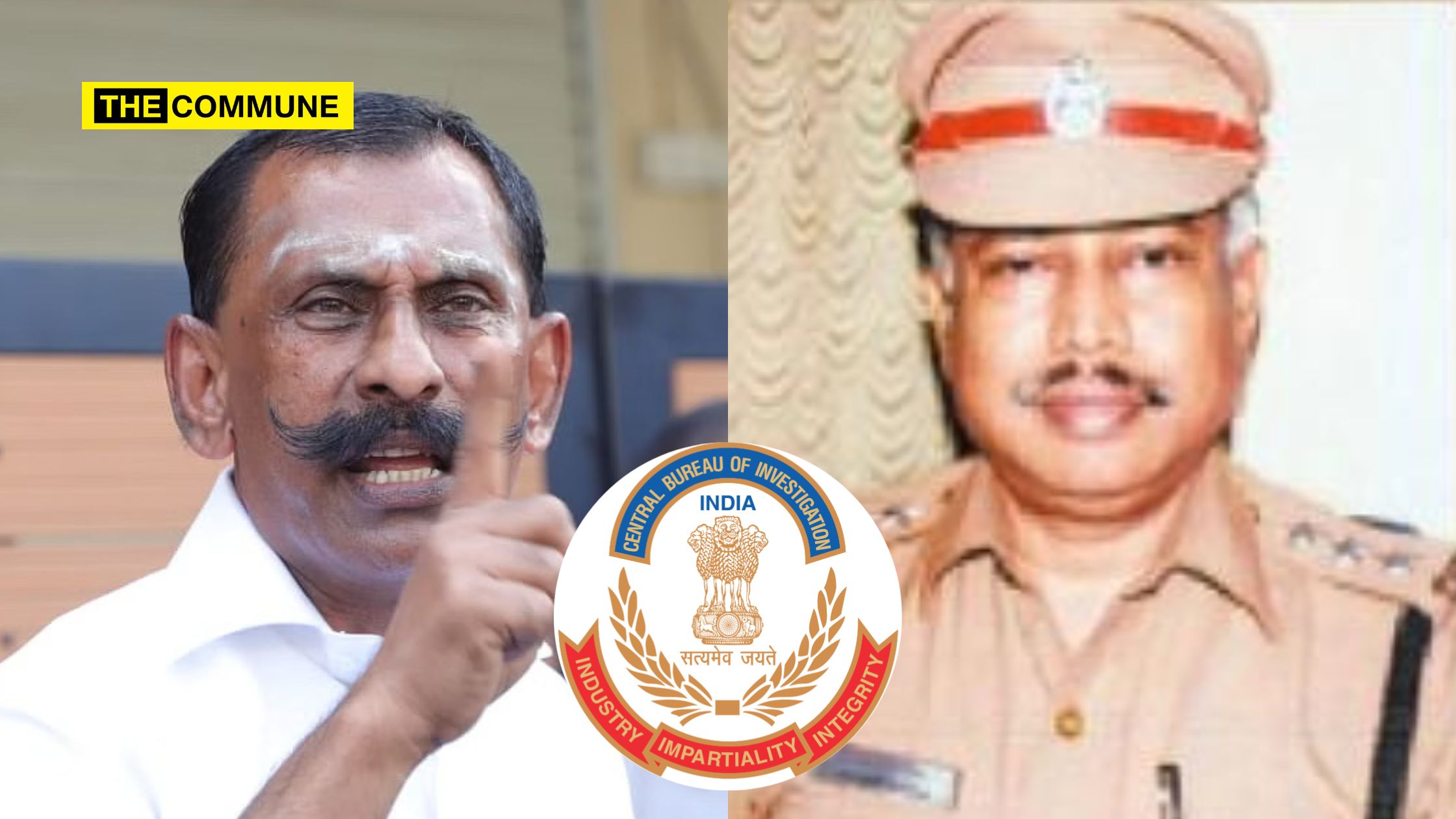
‘Till I Die I Will Be Under Investigation For Cases I Investigated’, Says Ex-Idol Wing IG Pon Manickavel As CBI Questions Him In Theft Case Filed By Ex-DSP Kader Batcha

CBI investigates ex-Idol Wing IG Manickavel

On 10 August 2024, the Central Bureau of Investigation (CBI) questioned former Idol Wing IG Pon Manickavel at his residence in Palavakkam regarding an idol theft case. This investigation was prompted by a High Court order following a petition filed by former Deputy Superintendent of Police (DSP) Kader Batcha. The questioning, which continued into the evening, involved collecting various documents related to the case.

The case dates back to 2022, when the CBI re-registered a First Information Report (FIR) initially filed by the Idol Wing CID in 2017. The FIR accused the wing’s DSP and two other officers of stealing three idols from a Thirunelveli temple and selling them for ₹15 lakh through a dealer named Deenadayalan. The CBI took over the case as directed by the Madras High Court, which was hearing Batcha’s petition challenging the FIR filed against him when Pon Manickavel led the wing. Batcha alleged that Manickavel had wrongfully implicated him in the theft case.

The court instructed the CBI to investigate whether any officers had falsified evidence or fabricated details in the case and to report their findings. Subsequently, the CBI filed a new FIR on the 8th of August, naming Pon Manickavel as an accused based on Batcha’s representations.

According to the FIR, Batcha had sought the Madras High Court’s intervention in 2019 to direct the registration of a case against Manickavel. On 22 July 2022, the court ordered the CBI to conduct a preliminary inquiry into the allegations made in Batcha’s representations and to proceed if any criminal activity was found.

The FIR alleges that the preliminary inquiry revealed that Manickavel was involved in offences such as falsely implicating Batcha, illegal arrest, and fabricating documents with false statements. Manickavel has denied the allegations, claiming that the accusations against him are a coordinated attempt to discredit him and asserting that they will not succeed.

Speaking to the reporters former Idol Wing IG Pon Manickavel stated, “Not one or two cases there are a thousand cases against me. Till I die, I will be under investigation for the cases I have investigated. I already have said the reason a hundred times. Even after retirement, I’m filing complaints regarding missing idols, which you’ve seen in many places; hence, this (investigation) will be regular to me. I have already, after assessment, provided the documents from my side and helped them.”

The former idol wing IG clarified the purpose of the CBI inquiry, emphasising that it was not an illegal raid but a legitimate investigation. He noted that he has numerous old documents and that the officers had never questioned his integrity. He explained that the inquiry stemmed from his case against DSP Kader Batcha. The CBI had previously visited him and had returned for further investigation.

Later, Pon Manickavel alleged, “The local and international accused are all ganging up. They want to start their old business. To revive that business, they have to dilute all the cases I’ve initiated, and to dilute the case, they are giving me problems. You know me, they could not disturb me as they liked. This is my duty: I’ll joyously go to the court; I’ll face anything and won’t give up.”

Subscribe to our channels on TelegramWhatsApp, and Instagram and get the best stories of the day delivered to you personally.
Bangladeshi Hindus Send Distress Messages To Hindus In India For Help

Bangladeshi Hindus Send Distress Messages To Hindus In India For Help

Following thestudent protestsand subsequent military coup in Bangladesh that caused former PM Sheikh Hasina to depart from the country, Hindus in Bangladesh have been facing attacks from all sides by Islamists. Hindus in Bangladesh, a minority constituting only about 8% of the total population, are in great peril.

However, leftists and otherplacard-holdinginfluencers are continuously downplaying the looming threat, and the incessant atrocities meted out against the Bangladeshi Hindus in mainstream media. 

An example of this threat can be fathomed when we read this message shared in a BNP private Telegram group, which was later forwarded to a public Jamaatis channel – the message urged thatHindus need to be taught a lesson, so they never find the courage to protest again” and instructed that their suffering be portrayed as a political conspiracy by the Awami League. The message also mentioned plans to infiltrate Hindu protests with Awami flags to discredit their cause.

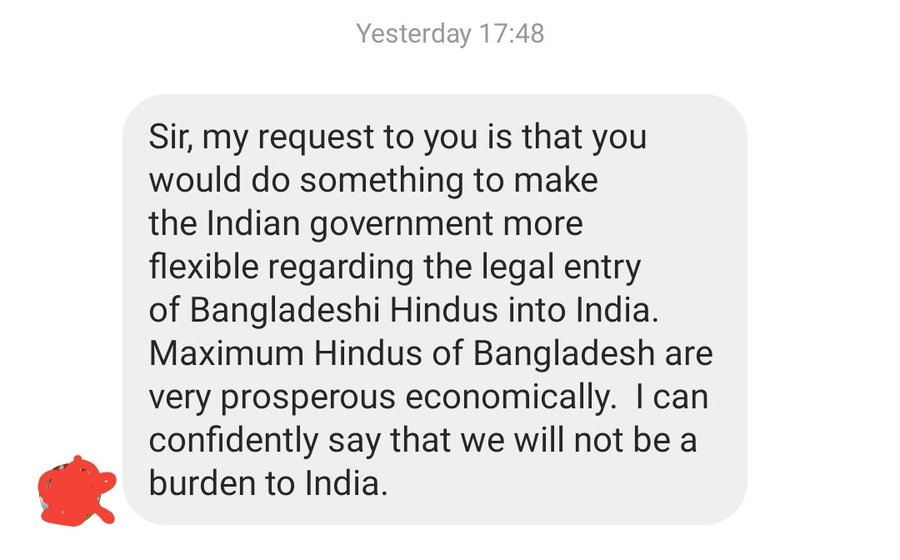
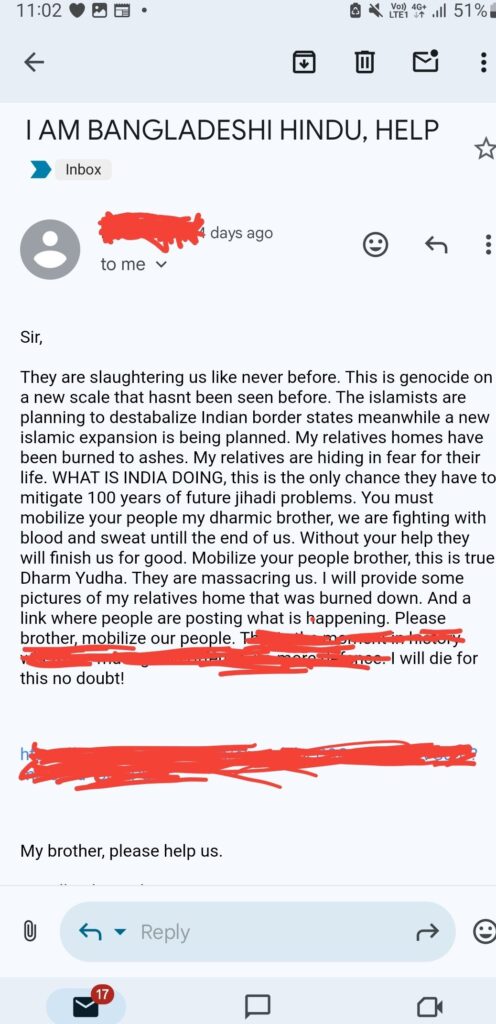
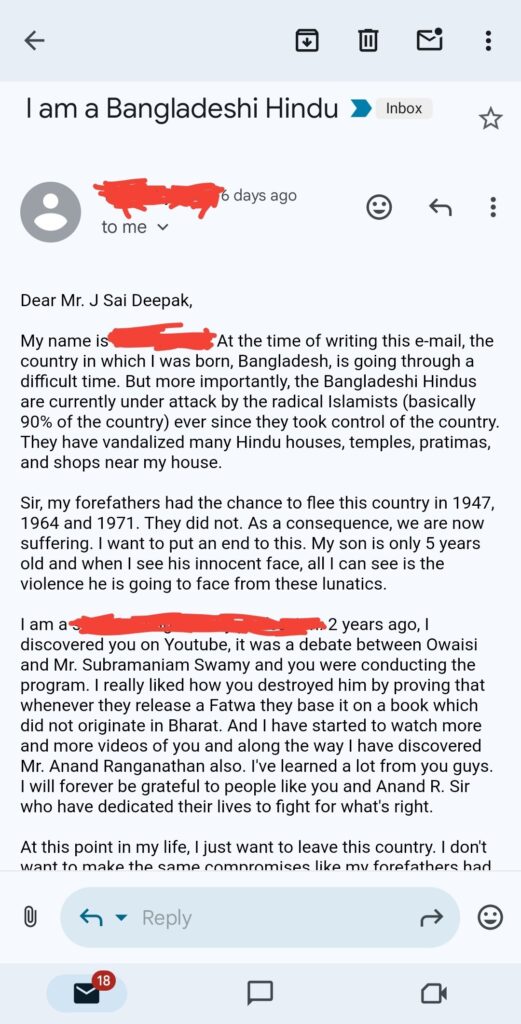
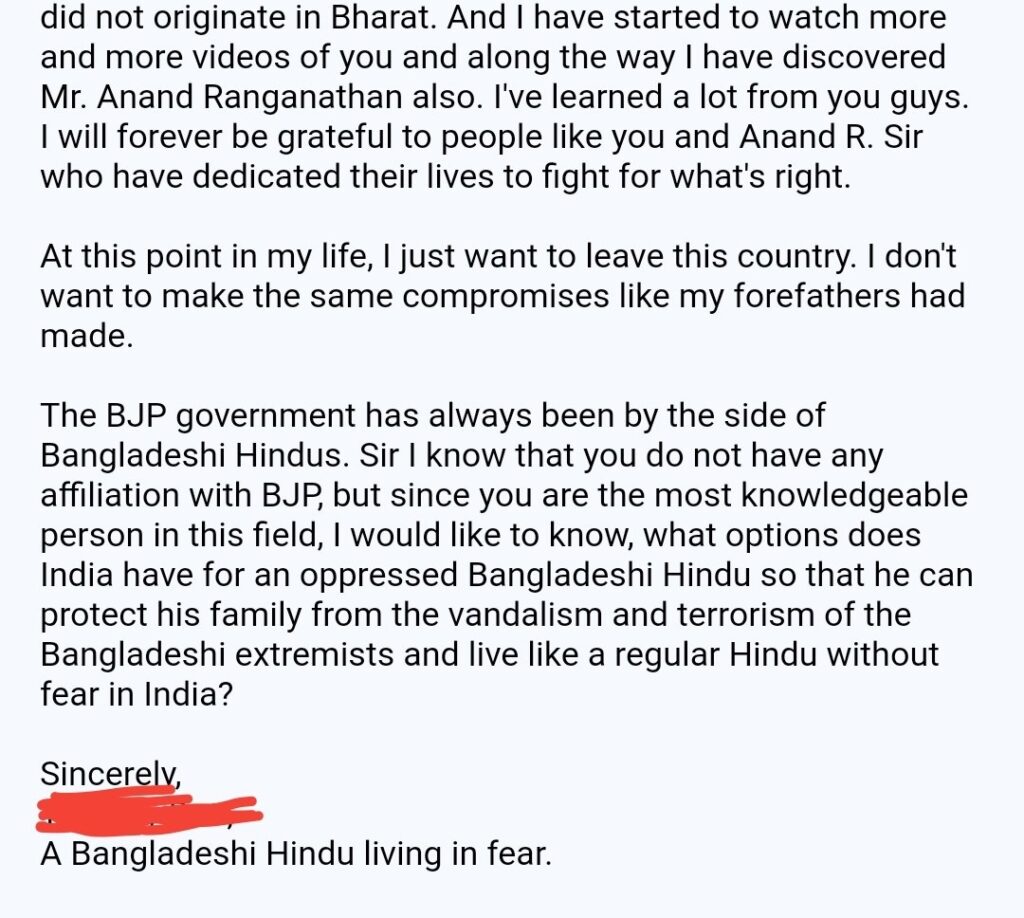
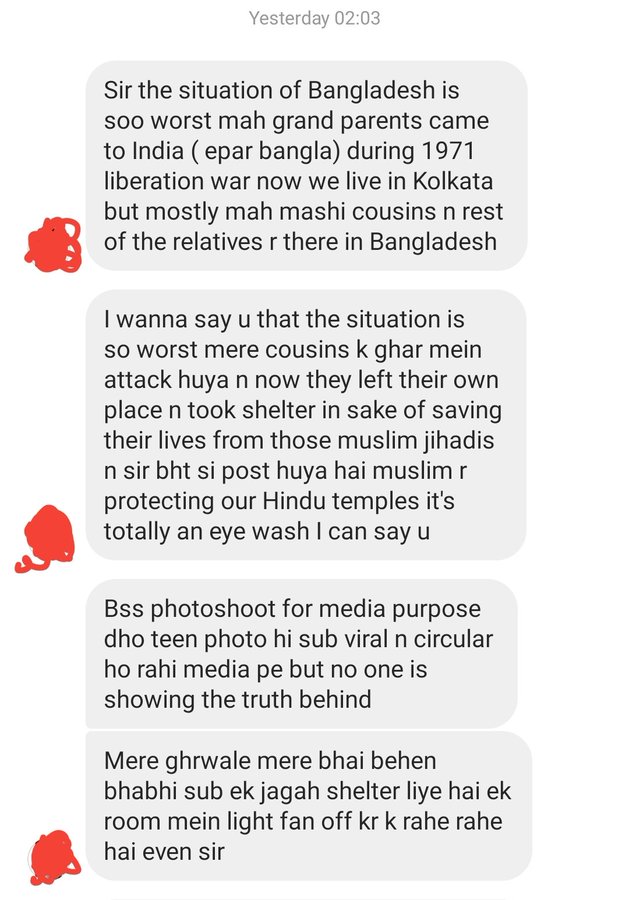
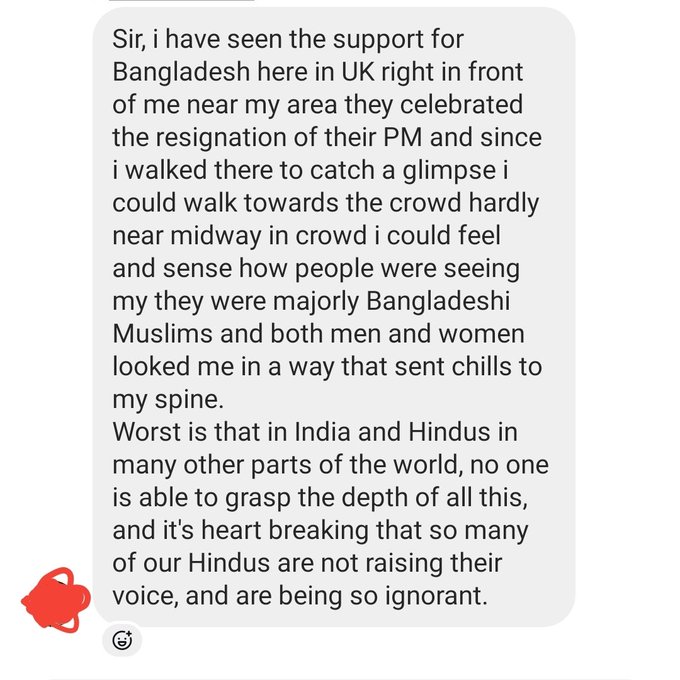
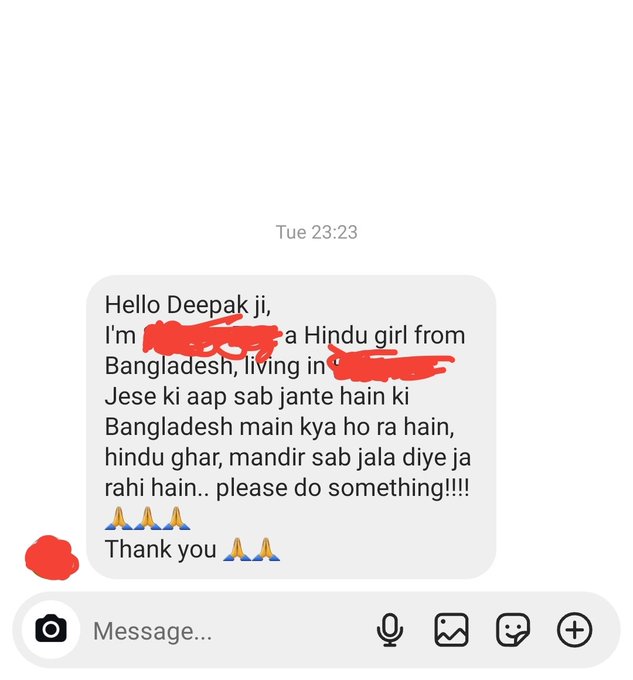
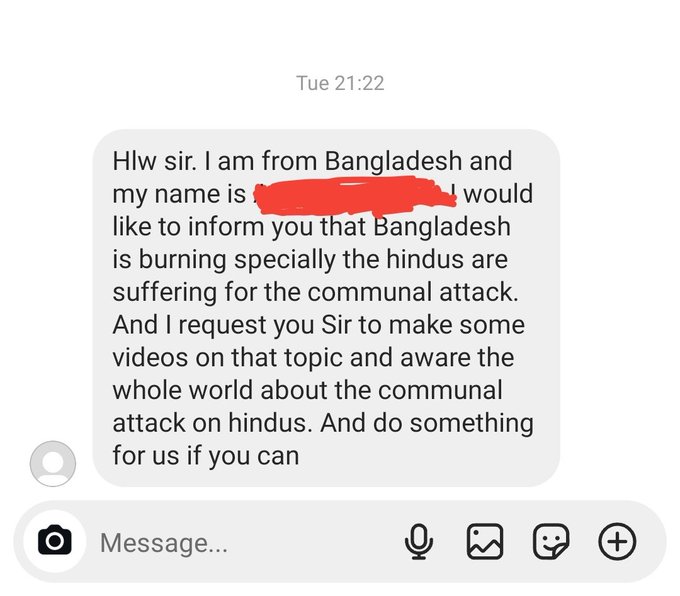
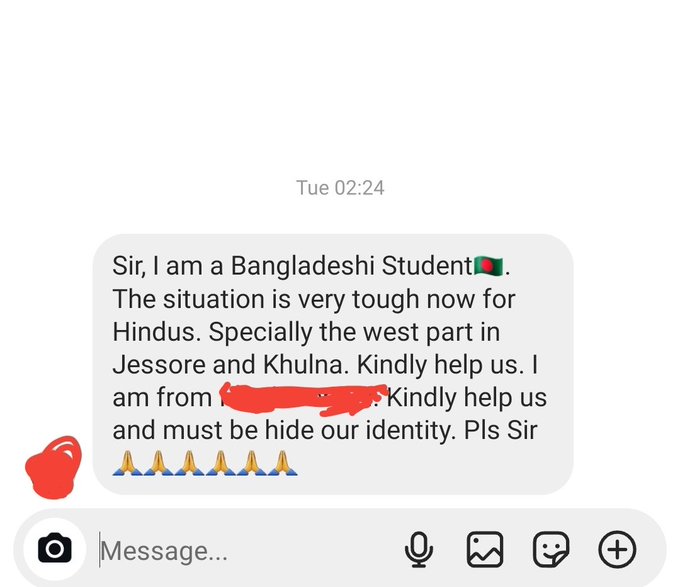
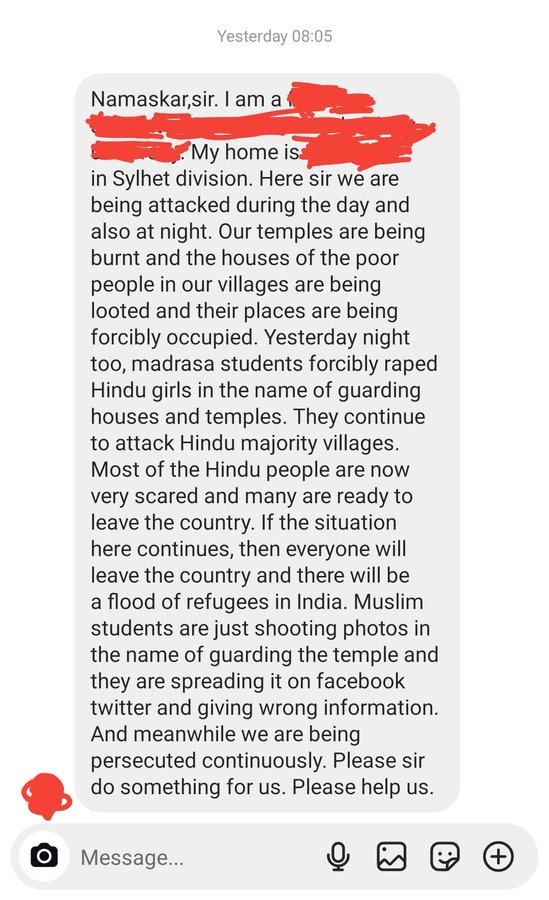
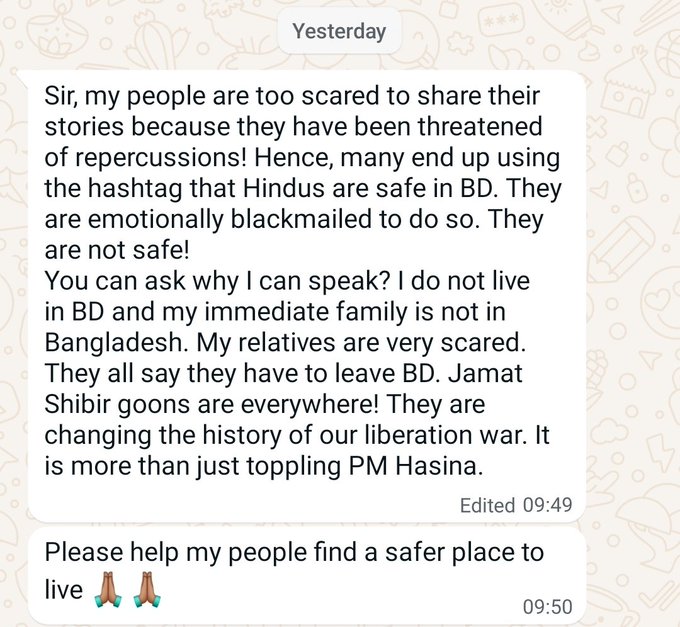
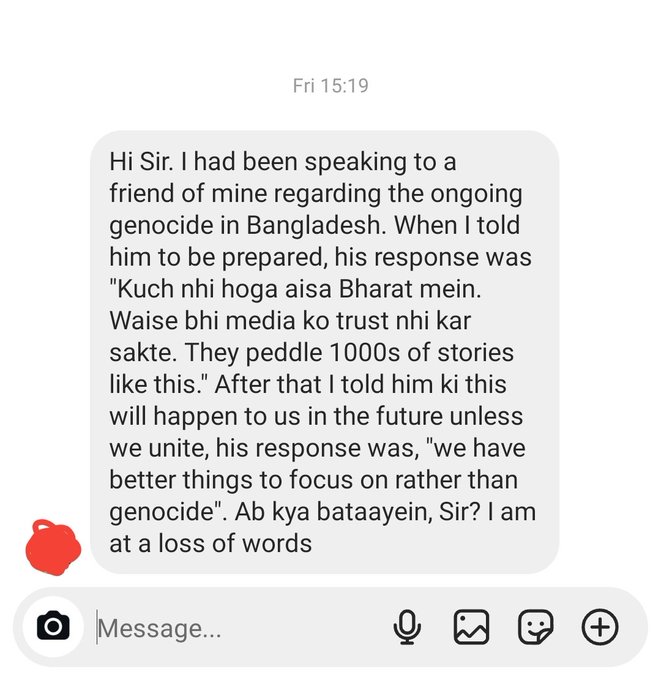
Over the past few days, Bangladeshi Hindus have been sending several distress messages to various Hindu organisations and notable pro-Hindu personalities on social media platforms. Below are messages that Supreme Court advocate J Sai Deepak received on his messenger and email.

These distress messages reflect the terror they live in and that immediate action is necessary.

One Hindu requested that the Indian government be more flexible regarding the legal entry of Bangladeshi Hindus into India, emphasising that most Bangladeshi Hindus are economically prosperous and would not be a burden to the country.

Another Bangladeshi Hindu urgently appealed for help, stating that Hindus are facing an unprecedented genocide, with homes being burned and relatives hiding in fear for their lives. The message warned of Islamist plans to destabilise Indian border states and expand their influence, urging the mobilisation of people to prevent further massacres. The person expressed a willingness to fight until the end and called this a trueDharm Yudha,asking for support to prevent the extermination of their community.

A Bangladeshi Hindu parent expressed deep concern about the increasing violence against Hindus in Bangladesh by radical Islamists. He shared his family’s history of suffering due to staying in the country during past conflicts and that he fears for his young son’s future. The individual, who has been following Mr. Deepak’s work, asked for guidance on the options available for an oppressed Bangladeshi Hindu to seek protection in India and live without fear.

A Hindu from Kolkata, whose grandparents fled Bangladesh during the 1971 liberation war, described the dire situation currently faced by their relatives in Bangladesh. They reported that their cousins’ homes were attacked, forcing them to flee and seek shelter in a single room, living in fear with lights and fans turned off to avoid detection by Islamist extremists. The person also criticized recent media coverage, claiming that photos of Muslims protecting Hindu temples are staged and do not reflect the true severity of the situation.

Someone in the UK also messaged Sai Deepak about observing Bangladeshi Muslims’ celebration in the country, marking the resignation of their Prime Minister. When the Hindus approached the crowd, they felt intimidated by how people looked at them. They expressed frustration that many Hindus in India and elsewhere are not fully grasping the seriousness of the situation and are not raising their voices, which they find heartbreaking.

Yet another message from a Hindu girl living in Bangladesh, expressing distress over the recent violence against Hindus and temples in the country. She urged action to address the situation and thanks the recipient.

The message is from someone in Bangladesh who requests the recipient to make videos to raise awareness about the suffering of Hindus due to recent communal attacks in the country. They urge the recipient to help and inform the world about the situation.

The message is from a Bangladeshi student who reports that the situation is particularly difficult for Hindus in the Jessore and Khulna regions. They request assistance while asking to keep their identity confidential.


The message describes severe attacks on Hindus in the Sylhet division of Bangladesh, including the burning of temples, looting, and forced occupation of homes. It reports incidents of rape by madrasa students and widespread fear among the Hindu community. The sender urges immediate action to address the violence and prevent a potential refugee crisis, criticising misinformation spread by some Muslim students on social media.

The message highlights that people in Bangladesh are too frightened to share their experiences due to threats of repercussions, leading some to falsely claim that Hindus are safe. The sender, who does not live in Bangladesh, reports that their relatives are terrified and feel they must leave the country. Such distress messages describe the presence of Jamat Shibir goons and the distortion of historical facts, emphasizing that the situation is more severe than just political opposition. The sender requests assistance in finding a safer place for their people.


Hindus Living In Ignorance

A Hindu shared their frustration with a friend who dismissed concerns about the ongoing genocide in Bangladesh. The friend was skeptical, saying that nothing like this would happen in India and that the media is untrustworthy, often spreading countless stories like this. When warned that such events could occur in the future unless people unite, the friend’s response was that they hadbetter things to focus on than genocide,leaving the person at a loss for words

Looting, arson, lynchings, rapes, gang rapes, live rapes, temple destruction, and the ruin of libraries and heritage sites—these atrocities are reminiscent of past horrors like the destruction of Hampi in 1565, the events of 1971, and the 1992 violence. Now, we face similar devastation in 2024. The narrative will likely portray this as a peasant rebellion led by impoverished Bangladeshi Muslims against wealthy Hindus who were seen as informers for India. This so-called secular student-led uprising has led to the burning of Hindu temples and other forms of violence.

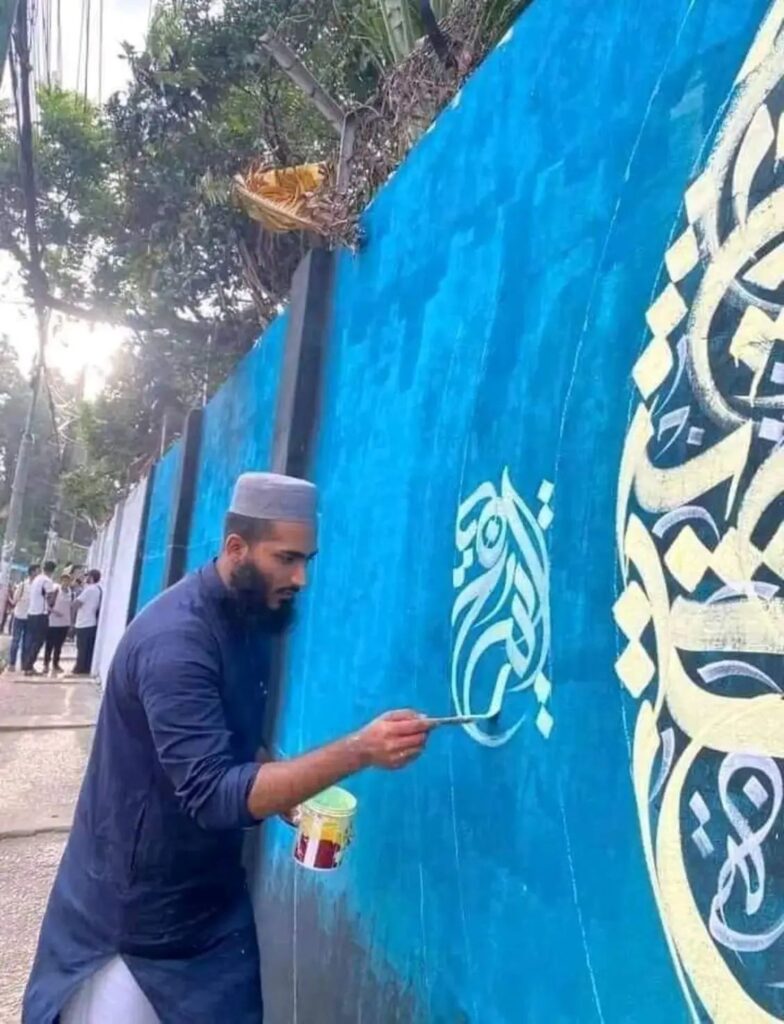
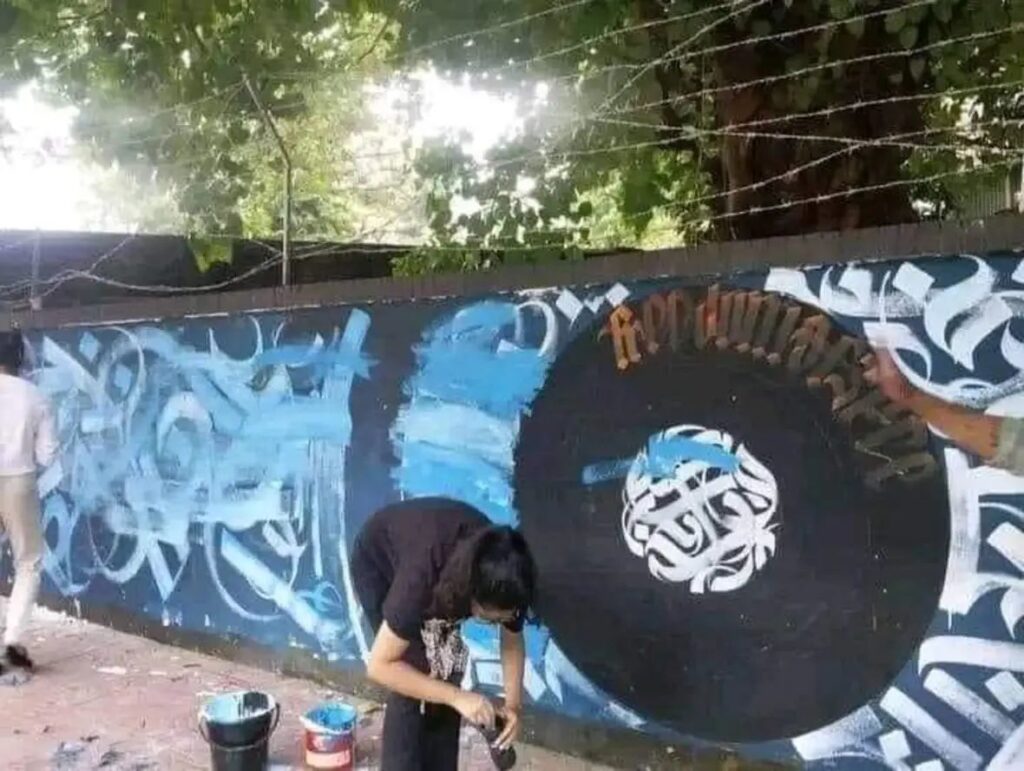
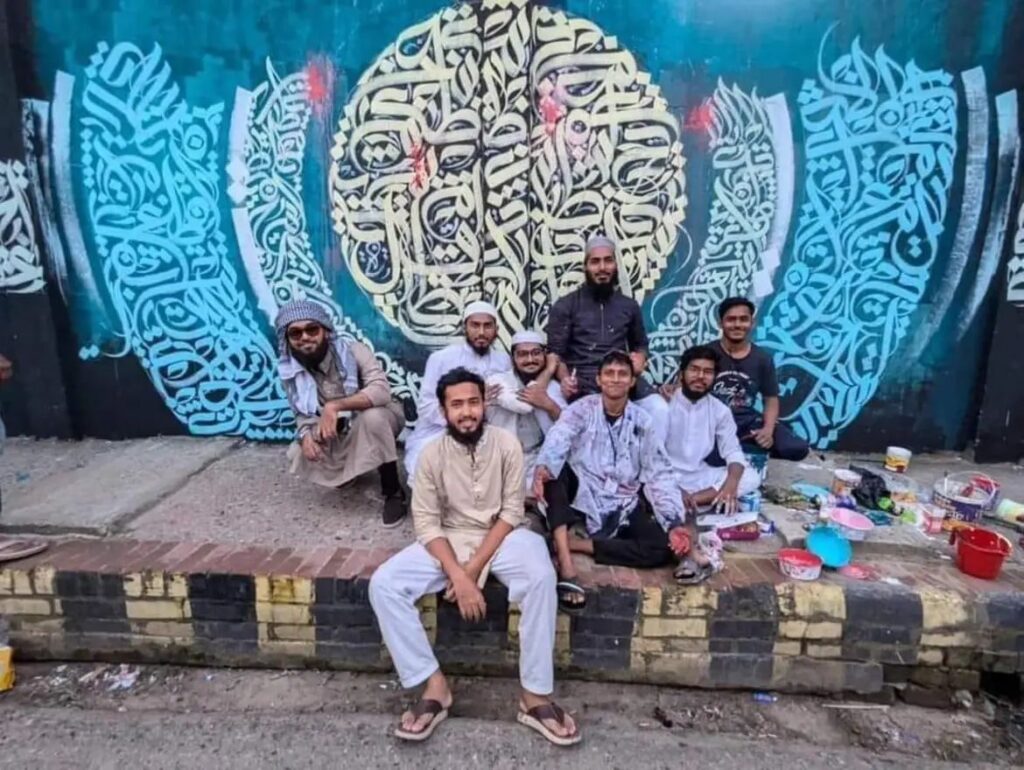
Meanwhile in West Bengal, an example of Ummat prevailing over language, culture, and the concept of universal harmony is the Arabic calligraphy that overshadows the Bangla language movement of 1952. This calligraphy is displayed on the wall next to the Shaheed Minar, which was originally a symbol of the struggle for the Bangla language.


As the situation is yet to come to normal in Bangladesh, the number of these attacks and lootings will only continue to increase unless action is taken.

The harrowing accounts shared by Bangladeshi Hindus in these distress messages paint a grim picture of the persecution they face. Despite the global media spotlight on the crisis, the situation continues to deteriorate, with reports of widespread attacks, killings and the destruction of Hindu homes and temples.

The silence of the international community and the indifference of left-leaning institutions in India has emboldened the Hindu-hating perpetrators. Until concrete steps are taken, these distress messages will continue to echo and serve as a haunting reminder of how we stand to fail a community on the brink in Bangladesh.

(This article is based on an X thread by J Sai Deepak)

Subscribe to our channels on TelegramWhatsApp, and Instagram and get the best stories of the day delivered to you personally.
Strategic Reclamation: Advantages For India In Reclaiming Land In Northern Bangladesh

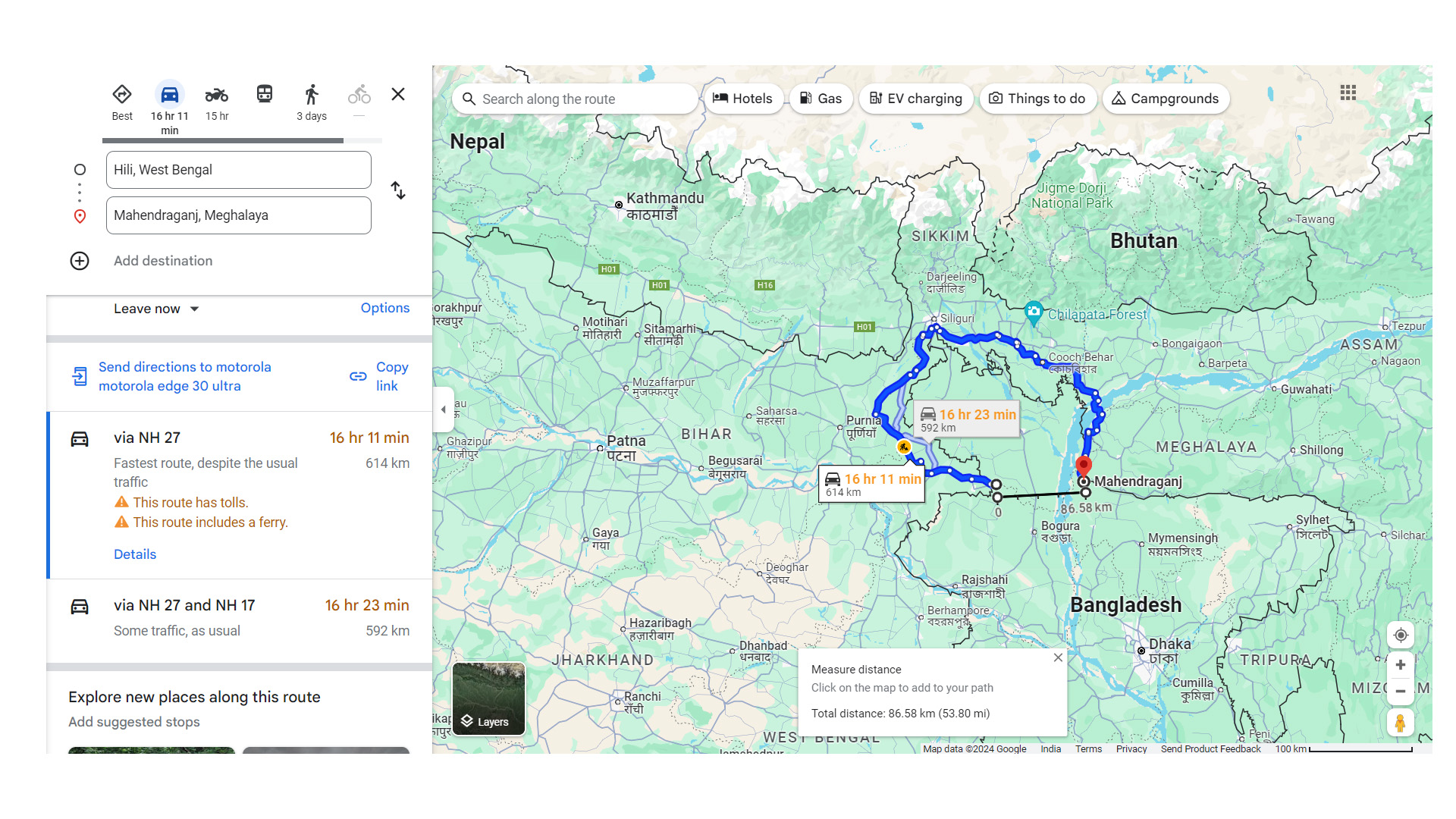
India’s strategic interests in South Asia are closely tied to its geographic, economic, and security concerns. One of the most pressing territorial issues involves land reclamation in northern Bangladesh, particularly in the regions historically connected to Hili in West Bengal and Mahendraganj in Meghalaya. This potential reclamation could yield significant advantages for India, addressing both longstanding demographic concerns and the critical “Chicken’s Neck” problem while also fostering a win-win situation for both India and Bangladesh.

The “Chicken’s Neck” Problem: A Strategic Vulnerability

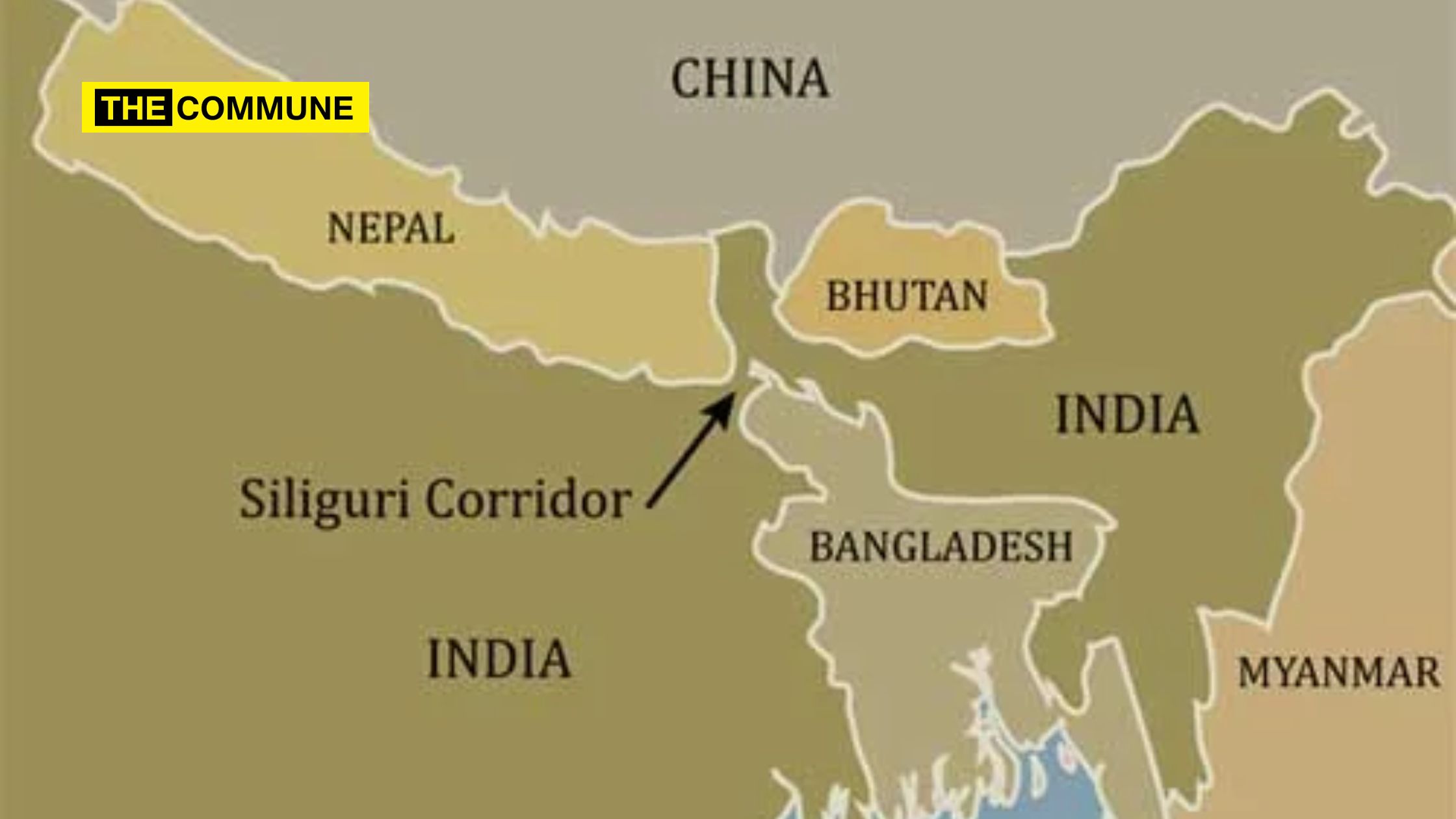
The “Chicken’s Neck,” also known as the Siliguri Corridor, is a narrow strip of land connecting India’s northeastern states to the rest of the country. At its narrowest point, it is just about 22 kilometres wide, making it one of the most strategically vulnerable regions in India. The corridor is bordered by Nepal, Bhutan, and Bangladesh, placing it at the intersection of multiple international borders.

This narrowness poses significant security risks. In the event of geopolitical tensions or conflicts, the Siliguri Corridor could easily be cut off, effectively isolating the northeastern states from mainland India. This vulnerability has been a longstanding concern for Indian defence planners, and reclaiming land in northern Bangladesh could significantly alleviate this problem.

By reclaiming the territories in Hili and Mahendraganj, India would gain better control over a broader expanse of land, effectively widening the access routes to the northeastern states. This would not only reduce the strategic risks associated with the Siliguri Corridor but also enhance India’s overall border security, ensuring that crucial transport and communication links remain intact even in times of crisis.

Demographic Changes And Historical Context

The regions of Hili in West Bengal and Mahendraganj in Meghalaya have witnessed significant demographic changes over the past several decades. Following the partition of India in 1947 and the creation of East Pakistan (now Bangladesh), these regions experienced a shift in population dynamics. The influx of people and the redrawing of borders led to a complex demographic landscape that, in some cases, has fueled tensions and challenges related to identity, land ownership, and resource allocation.

Reclaiming these territories would allow India to address these demographic concerns by reintegrating historically Indian lands and populations back into the country. This could help stabilize the region by ensuring that the local populations, who often have cultural and historical ties to India, are reconnected with the Indian state. Additionally, India could implement policies aimed at inclusive development, infrastructure improvements, and social integration, thereby fostering a more cohesive and stable demographic environment.

Strategic Advantages: Reducing Distance And Enhancing Connectivity

One of the most immediate and tangible benefits of reclaiming these territories is the drastic reduction in travel distance between key points in West Bengal, Assam, and Meghalaya. Currently, the journey around the borders of West Bengal, Assam, and Meghalaya spans approximately 614 kilometers. However, by reclaiming the land in northern Bangladesh, this distance could be reduced to just 85 kilometers, providing a more direct route between these regions.

This reduction in distance would have profound implications for both civilian and military logistics. It would enable faster and more efficient movement of goods, people, and military personnel between the northeastern states and the rest of India. This improved connectivity would also stimulate economic activity in the region, encouraging trade, investment, and tourism, which in turn could contribute to the overall development of the northeastern states.

A Win-Win Situation for India and Bangladesh

The reclamation of land in northern Bangladesh could be framed as a mutually beneficial arrangement between India and Bangladesh. For India, the advantages are clear: enhanced border security, improved connectivity, and greater regional stability. For Bangladesh, the benefits could come in the form of increased economic cooperation, infrastructure development, and strengthened bilateral relations with India.

Bangladesh has historically maintained strong ties with India, and resolving this territorial issue could further solidify this relationship. Bangladesh could benefit from Indian investments in infrastructure projects, cross-border trade, and regional development initiatives. Additionally, a stable and prosperous northeastern India would serve as a valuable trading partner and ally for Bangladesh, fostering a more integrated and cooperative South Asian region.

Moreover, by addressing and resolving historical territorial disputes through peaceful and diplomatic means, both India and Bangladesh would set a positive example for regional cooperation and conflict resolution. This would enhance their standing in the international community and contribute to the overall stability and security of South Asia.

Reclaiming the land in northern Bangladesh from Hili in West Bengal and Mahendraganj in Meghalaya offers India significant strategic advantages, particularly in addressing the “Chicken’s Neck” problem and improving regional connectivity. By reducing the distance between key regions, enhancing border security, and addressing demographic concerns, India would strengthen its position in South Asia while fostering a win-win situation for both India and Bangladesh. This strategic reclamation, if handled diplomatically and with mutual cooperation, could mark a new chapter in Indo-Bangladeshi relations and contribute to the long-term stability and prosperity of the region.

Ganesh Kumar is a geo-political analyst.

Subscribe to our channels on TelegramWhatsApp, and Instagram and get the best stories of the day delivered to you personally.