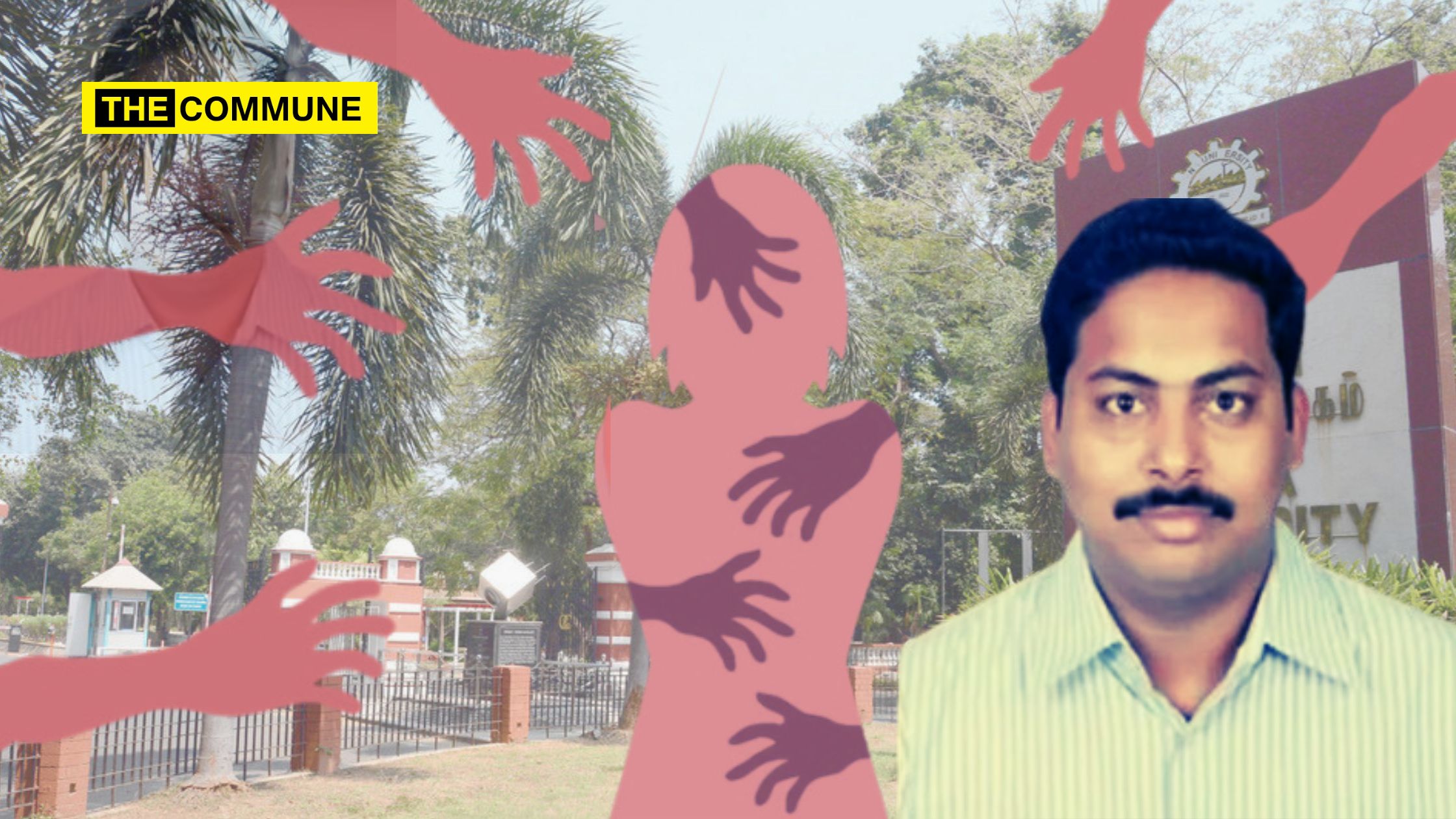
State Cyber Crime Deputy Superintendent of Police (DSP) Raghavendra Ravi, who was part of the special investigation team (SIT) in the Anna University student rape case, has recused himself from the investigation, citing serious allegations against the handling of the case.
The incident, which took place on 23 December 2024, involved the sexual assault of a student at Anna University in Chennai. The case sparked widespread outrage, and based on the victim’s complaint, the Kotturpuram police registered a case and arrested the accused, Gnanasekaran, a local resident, who was subsequently sent to jail.
The Madras High Court took the initiative to oversee the investigation and formed a special team comprising three women IPS officers, led by Annanagar Deputy Commissioner Sneha Priya, to handle the case. This move was part of the court’s efforts to ensure a thorough and impartial investigation.
A petition was later filed in the Saidapet 9th Court, requesting permission for a 7-day police custody for Gnanasekaran to facilitate further questioning. The court granted the request, and the SIT began interrogating the accused at the prison office in Egmore.
However, DSP Raghavendra Ravi, who was part of the SIT, announced his withdrawal from the investigation. He alleged that the female IPS officers had obstructed his ability to perform his duties effectively, which led to his decision to recuse himself from the case.
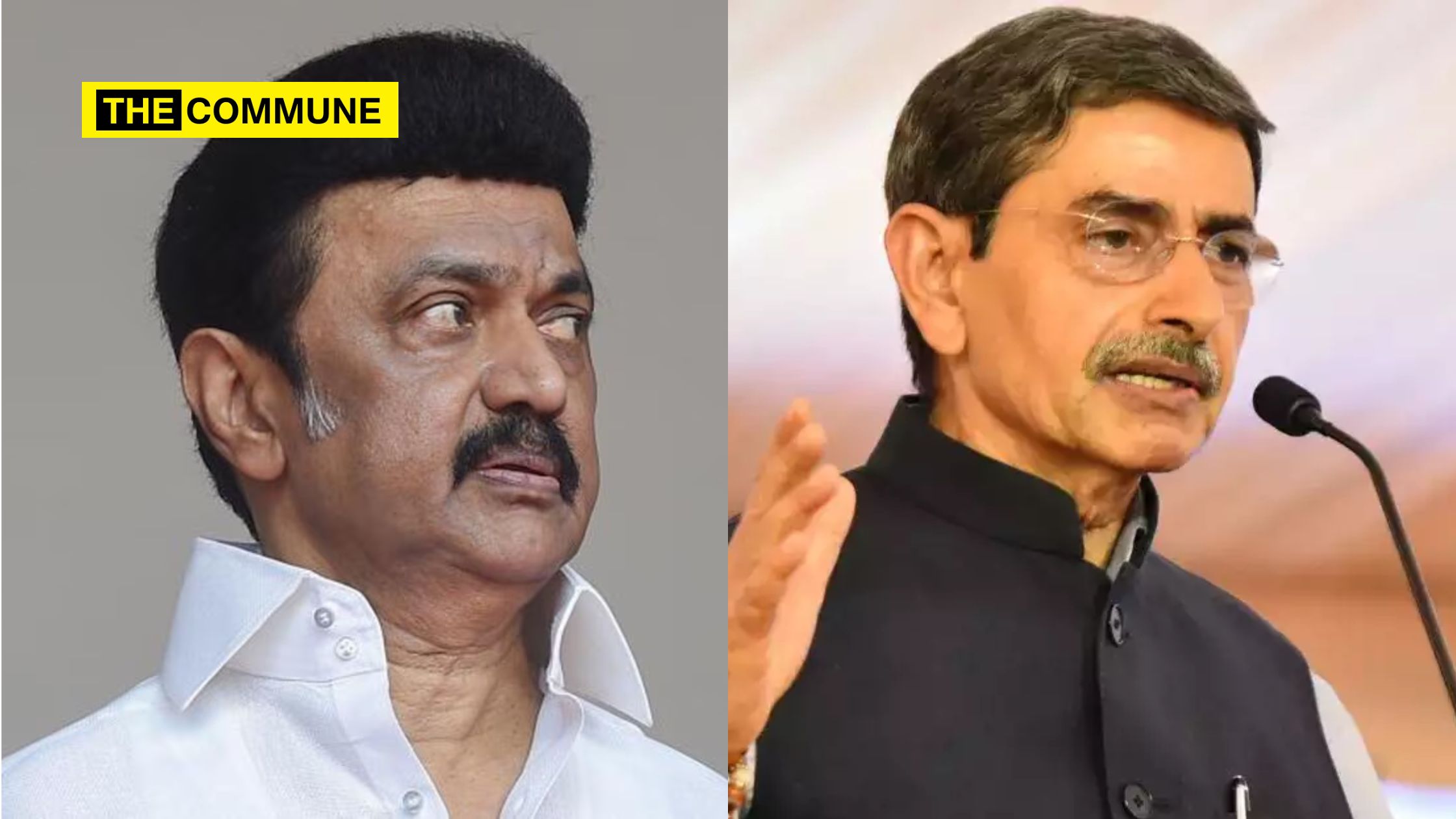
Tamil Nadu Governor RN Ravi has publicly criticized the state government for allegedly showing disrespect to Mahatma Gandhi by not organizing significant events at the Gandhi Mandapam in Chennai. The Governor’s remarks came after he paid tribute to the Father of the Nation and shared his concerns on the social media platform X on the official handle of Raj Bhavan.
Ravi emphasized that Gandhi Mandapam, a monumental tribute to Gandhi built by former Chief Minister K. Kamaraj in 1956, is situated on a large plot of land near the Guindy National Zoological Park in Chennai. He questioned the appropriateness of holding memorial events marking Gandhi’s birthday and martyrdom day at a corner of the city museum, as opposed to the iconic Gandhi Mandapam.
In his post, the Governor stated, “Gandhi Mandapam is a grand memorial of the Father of the Nation built over a sprawling land adjacent to the Guindy National Park, Chennai by K. Kamaraj in 1956. Does it make any sense to do Gandhi memorial events – his birthday and martyrdom day in a corner of a city museum? My repeated requests to the Chief Minister to accord due respect to the Father of the Nation and hold such events in a befitting manner at the Gandhi Mandapam met with stubborn refusal. During his life time Gandhi Ji was vigorously opposed and mocked by the followers of Dravid ideology. But should he continued to be mocked at even today?”
"Gandhi Mandapam is a grand memorial of the Father of the Nation built over a sprawling land adjacent to the Guindy National Park, Chennai by K. Kamaraj in 1956. Does it make any sense to do Gandhi memorial events – his birthday and martyrdom day in a corner of a city museum? My…
Ravi’s comments reflect his ongoing concerns about the wayGandhi’s legacy is treated in Tamil Nadu. He pointed out that despite Gandhi’s central role in India’s independence movement, his followers continue to face criticism from certain sections of the state’s political spectrum.
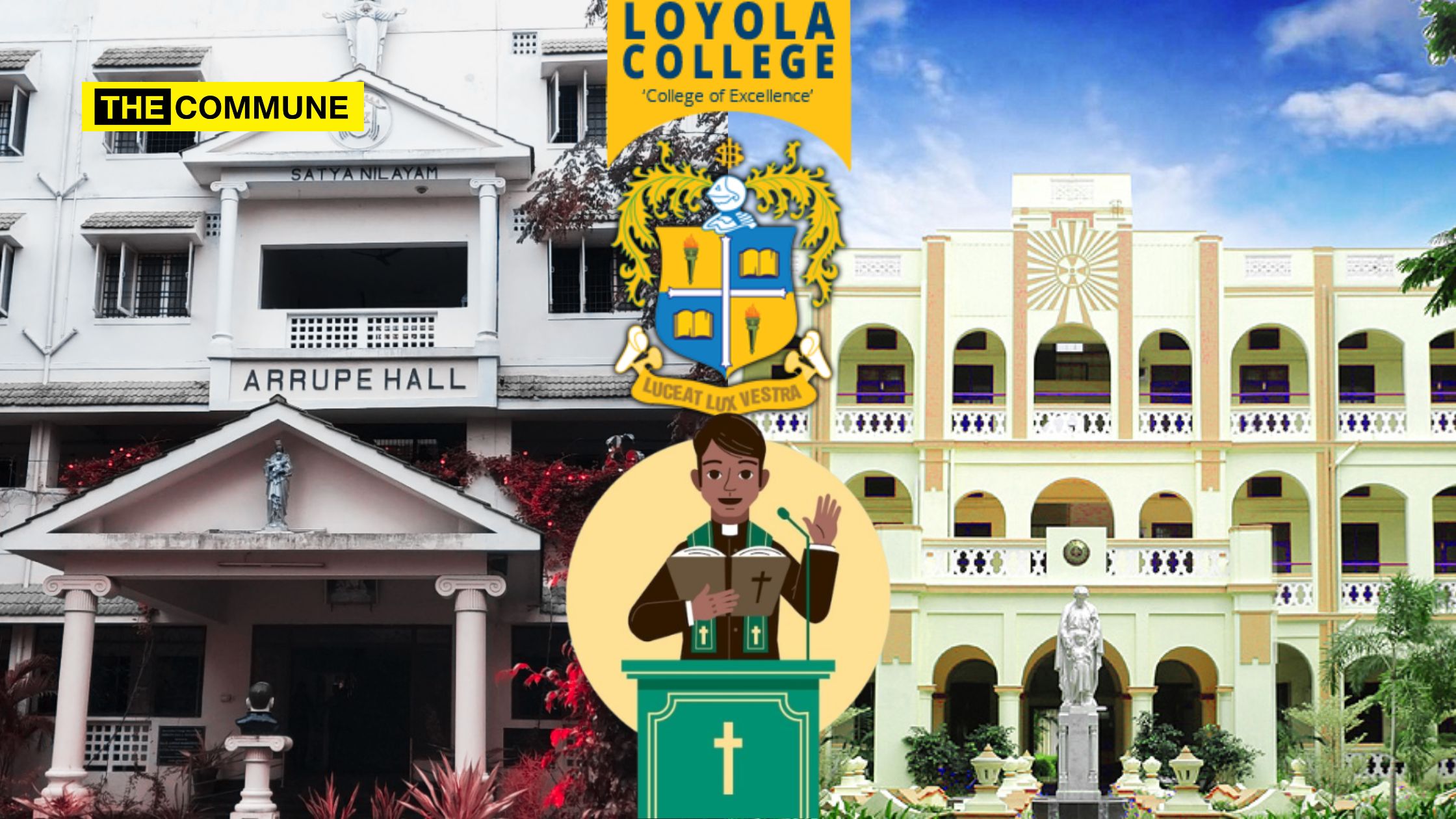
Loyola College, Chennai, is under intense scrutiny following a series of allegations that include operating an unauthorized off-campus recruitment program, misusing government funds, violating academic regulations, and engaging in questionable financial practices.
The Sathya Nilayam (Abode of Truth) Functioning Under False Premise?
There is an institution called Sathya Nilayam campus in Thiruvanmiyur, Chennai. While Loyola College is affiliated with the University of Madras, it has been found that this extension campus operates under separate conditions that raise legal and ethical concerns. The MA Philosophy program run at Sathya Nilayam appears to cater exclusively to Catholic students, particularly those training for religious missionary work of the Society of Jesus.
This raises the question: How can a university-affiliated institution restrict admission based on religious criteria? Under normal university regulations, courses should be open to students of all backgrounds. Yet, Sathya Nilayam’s own website suggests a clear alignment with the Jesuit order’s religious objectives, rather than a secular academic mission. This is in direct violation of the policies set by the University of Madras, which mandates that accredited courses be open to all eligible students.
Manipulation Of Certification And Degrees
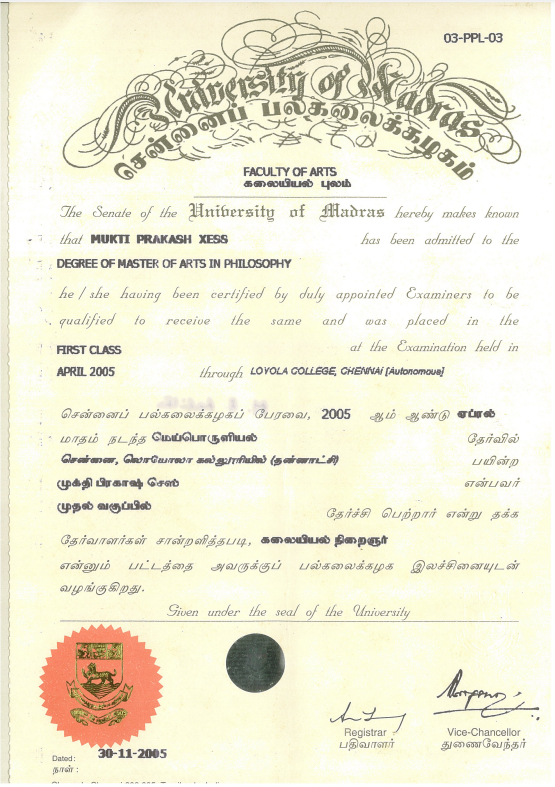
Another disturbing revelation involves degree certification irregularities at Loyola College. Reports indicate that students who complete their M.A. Philosophy studies at Sathya Nilayam receive degree certificates that falsely indicate their enrollment at Loyola College’s main campus, allowing them to obtain credentials under misleading pretenses.
Such practices violate Madras University regulations and constitute academic fraud, raising serious legal implications. Documentary evidence, including an e-Sanad verified certificate from a past student, suggests clear discrepancies in how Loyola College has been issuing degrees over the years.
Furthermore, concerns have emerged that graduates from Sathya Nilayam’s religious-oriented courses are subsequently placed in missionary assignments across India, particularly in states like Arunachal Pradesh, Jharkhand, and Sikkim—regions known for religious conversion activities. This suggests that students may be funneled into missionary work under the guise of academic training, while simultaneously benefiting from government-funded educational schemes.
Exorbitant Fee Structure And Questionable Financial Practices
While Loyola College claims to be a minority institution serving the Christian community, the financial burden on students tells a different story. Compared to other government-aided institutions, Loyola College reportedly charges exorbitant fees. For instance, courses like B.Com, which could be completed at other government aided colleges like Pachiappas College & Vivekananda College for nominal fees, cost significantly more at Loyola, with additional hidden costs related to hostel accommodation and other expenses.
Many students are reportedly forced to stay in hostels, further increasing their financial burden. Unlike other colleges that maintain transparency in fee structures, Loyola College’s fee policies remain opaque, making it difficult for students and parents to understand the true cost of education.
UGC Scandal
The Commune had earlier published an extensive report on misappropriation of UGC funds by Loyola College.
A complaint to the Chairman of UGC had stated that the two individuals who orchestrated the scam are now in senior positions at Loyola College Chennai, with Dr. M. Selvanayagam being promoted to Head of Research of LICET Loyola I-Cam College of Engineering and Technology and Fr. Francis P. Xavier serving as Rector.
An interview of Rev Fr. Albert Muthumalai, quoted him as saying, “such a great institution meant to educate students, with high ethics and moral values has become a den of unquestionable corruption.”
Legal Challenges And Potential Consequences
The mounting allegations against Loyola College have led to calls for a formal investigation. If found guilty of academic fraud, financial misconduct, and violating university regulations, the institution could face severe consequences, including:
– Revocation of its affiliation with the University of Madras
– Legal action for financial misappropriation and misuse of government funds
– Loss of its minority institution status
– Increased regulatory scrutiny over its foreign funding and financial transactions
Expose By Maridhas
These revelations have been brought to light by Maridhas, a well-known YouTuber, analyst, and commentator on Tamil Nadu’s socio-political issues. He has also referred to Loyola College as a “Den of Wolves,” highlighting the severity of the alleged misconduct. Maridhas has further stated that he will not be intimidated by defamation cases foisted by Loyola College, indicating his commitment to exposing what he perceives as systemic corruption.
Maridhas says that the allegations against Loyola College go beyond administrative inefficiencies—they point to a deliberate misuse of educational privileges for financial and religious gains. Given the serious nature of these claims, an independent investigation is warranted. The Central Government, state government and the University of Madras must take immediate steps to ensure transparency and accountability in Loyola College’s operations.
Subscribe to our channels on Telegram, WhatsApp, and Instagram and get the best stories of the day delivered to you personally.
The ASER 2024 report reveals significant shifts in foundational literacy and numeracy levels across India, highlighting both recoveries and disparities in educational outcomes post-pandemic. The data underscores substantial progress in some states, particularly in regions that historically lagged behind, such as Uttar Pradesh, which showed remarkable improvement despite the challenges posed by the COVID-19 pandemic. However, Tamil Nadu, often heralded for its educational advancements, has fallen behind, especially in government school performance.
Despite numerous claims by DMK ministers since 2021 that their efforts have greatly improved access to education, the current statistics stand in stark contrast, exposing the truth behind those boasts. Despite receiving funding from the central government and state allocations, Tamil Nadu continues to lag behind Uttar Pradesh in both arithmetic and reading abilities. Notably, Uttar Pradesh, once considered a weak performer in education, has made remarkable strides, while Tamil Nadu, traditionally regarded as a pioneer in educational reforms, now faces severe setbacks in government school education, a sector overseen by the DMK government.
Comparative Study – Uttar Pradesh Vs Tamil Nadu
Unfortunately, while northern states that historically lagged in educational performance have shown significant improvement, Tamil Nadu, governed under the Dravidian model, lags behind. Despite claims of being a leader in education, with the ruling government often crediting Dravidian ideologue E.V. Ramasamy Naicker for advancing Tamil education, the state still falls behind places like Uttar Pradesh in terms of progress.
Reading Skills
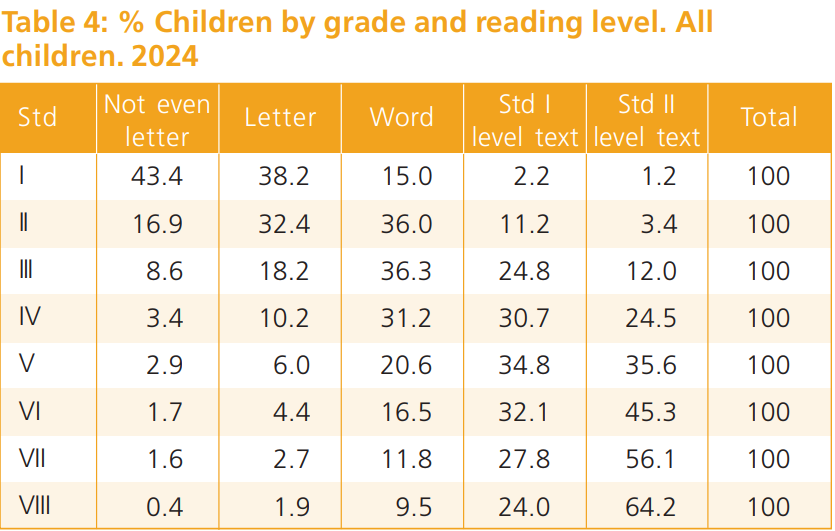
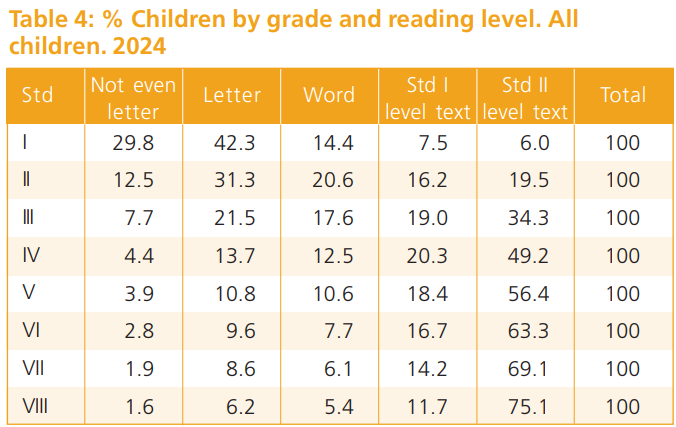
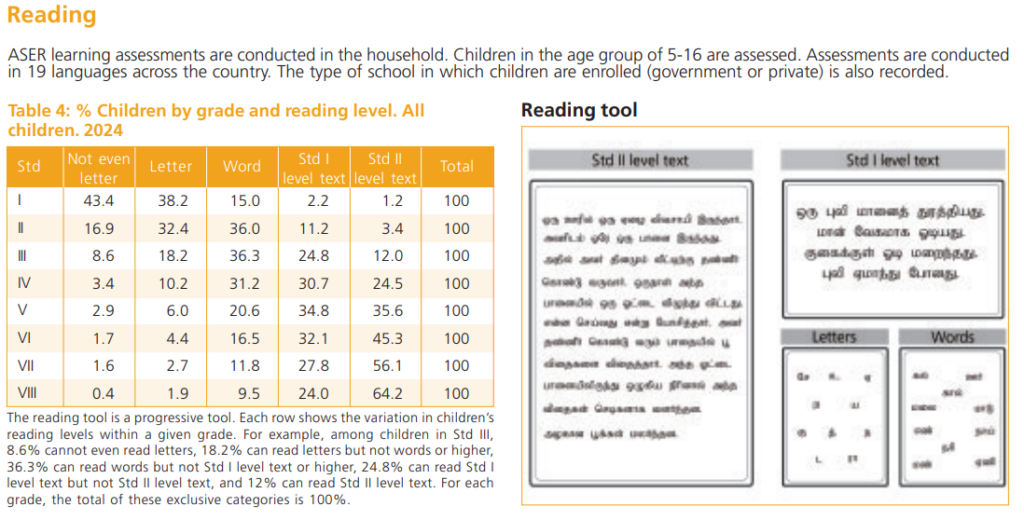
When comparing the literacy levels of children in Standard III between Tamil Nadu and Uttar Pradesh in 2024, Uttar Pradesh appears to have made more progress, especially in terms of children able to read at the Standard II level. In Tamil Nadu, 8.6% of children cannot even read letters, 18.2% can read letters but not words or higher, 36.3% can read words but not Standard I level text, 24.8% can read Standard I level text but not Standard II level text, and only 12% can read Standard II level text. In contrast, Uttar Pradesh shows better results: 7.7% of children cannot read letters, 21.5% can read letters but not words or higher, 17.6% can read words but not Standard I level text, 19% can read Standard I level text but not Standard II level text, and 34.3% can read Standard II level text. Despite both states facing challenges, Uttar Pradesh stands out with a significantly higher percentage of children able to read at the Standard II level, indicating that it has made greater strides in improving foundational literacy compared to Tamil Nadu, which has traditionally been seen as a leader in education but still has a considerable portion of children struggling with basic reading skills.
What is particularly concerning in Tamil Nadu, according to the survey, is that 45.3% of children in Class VI, 56.1% in Class VII, and 64.2% in Class VIII can only read at a Standard II level but are unable to read above that level.
(ASER – Tamil Nadu)
(ASER – Uttar Pradesh)
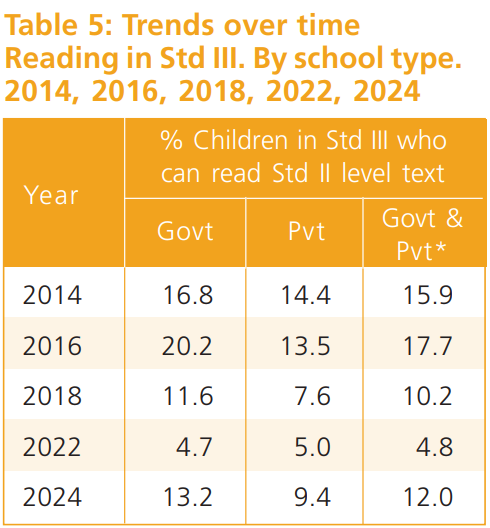
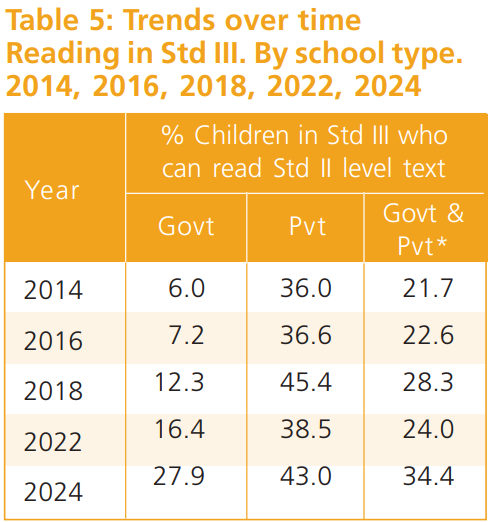
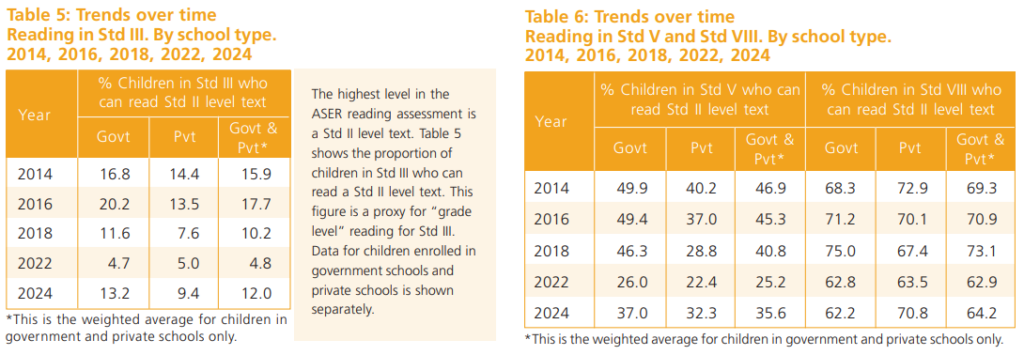
In the long-term progressiveness in tend analysis of maintaining the reading ability, the percentage of children in Standard III in Tamil Nadu who can read at a Standard II level text showed a concerning trend. In 2014, it was at 16.8%, and it slightly improved to 20.2% in 2016. However, there was a sharp decline to just 2.2% in 2022, likely due to the impacts of the COVID-19 pandemic. Despite Tamil Nadu’s claims of implementing schemes like Illam Thedi Kalvi to improve foundational literacy, the state could not even reach the 2014 level, despite spending public funds.
(ASER – Tamil Nadu)
In contrast, Uttar Pradesh, which had only 6% of children who can read Standard II level in 2014, managed to maintain a 16.4% level in 2022, even during the pandemic. By 2024, Uttar Pradesh saw a significant improvement, reaching 27.9%, showing consistent progress in literacy levels.
(ASER – Uttar Pradesh)
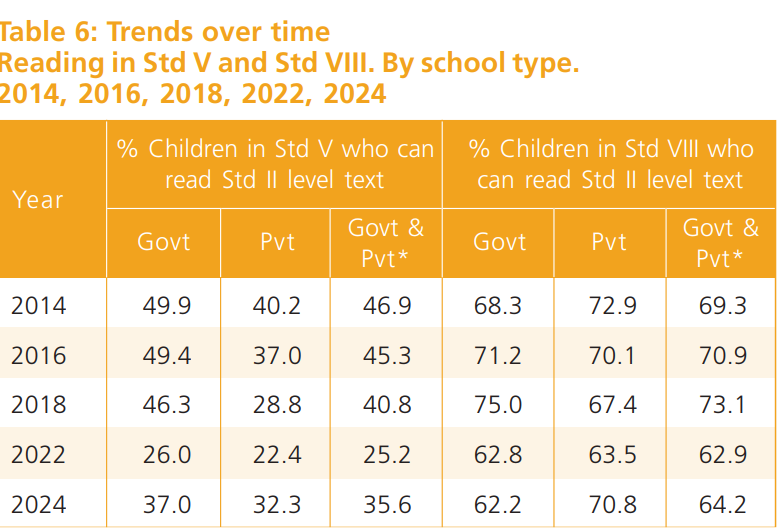
Similarly, the ASER 2024 report highlights significant gaps in Tamil Nadu, with the percentage of children in Standard V and Standard VIII who can read at a Standard II level dropping to new lows. This suggests that despite the Dravidian model government announcing schemes for government schools during the pandemic, there was little to no tangible impact on the ground, and no real improvement in the performance of government school students.
Arithmetic Ability
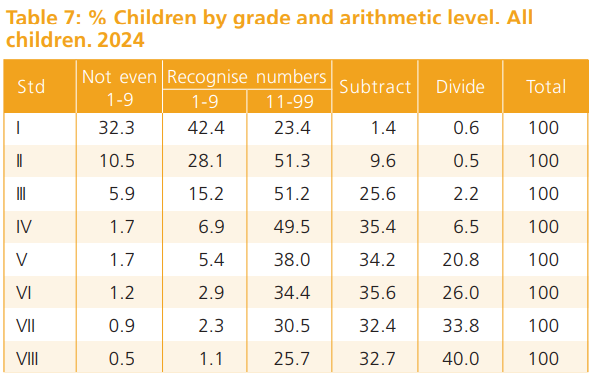
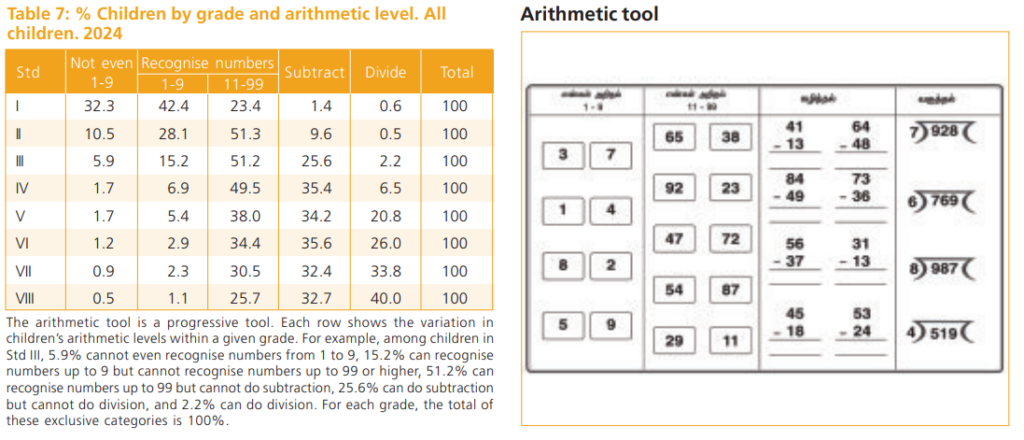
In Tamil Nadu, the performance of children in Standard III shows concerning gaps in arithmetic skills. Among these children, 5.9% cannot even recognize numbers from 1 to 9, while 15.2% can recognize numbers up to 9 but cannot recognize numbers up to 99 or higher. Additionally, 51.2% can recognize numbers up to 99 but are unable to perform subtraction, 25.6% can do subtraction but cannot perform division, and only 2.2% can do division.
(ASER – Tamil Nadu)
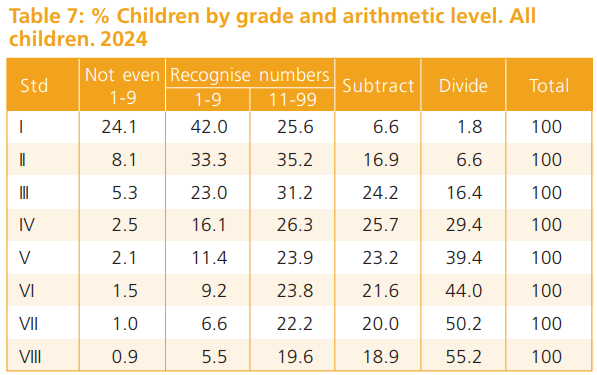
In contrast, Uttar Pradesh’s performance shows slightly better results. Among Standard III children, 5.3% cannot recognize numbers from 1 to 9, but 23% can recognize numbers up to 9 but cannot recognize numbers up to 99. A smaller proportion, 31.2%, can recognize numbers up to 99 but cannot perform subtraction, while 24.2% can do subtraction but cannot perform division. Notably, 16.4% of children in Uttar Pradesh can perform division, a significantly higher percentage than in Tamil Nadu.
(ASER – Uttar Pradesh)
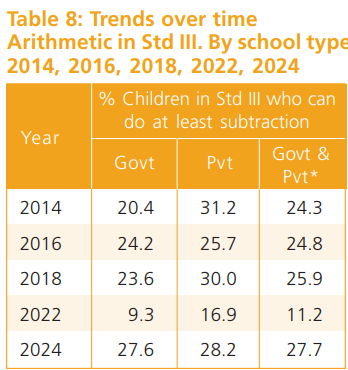
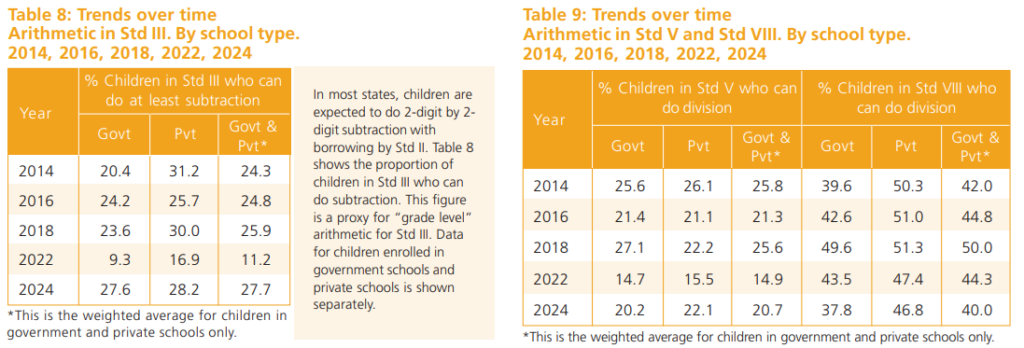
The trend analysis of the percentage of children in Standard III who can perform at least subtraction from 2014 to 2024 shows a fluctuating pattern in government schools in Tamil Nadu. In 2014, only 20.4% of children were able to do subtraction, which slightly improved to 24.2% in 2016, then dropped to 23.6% in 2018. A sharp decline was seen in 2022, with only 9.3% of children being able to do subtraction, likely due to the effects of the COVID-19 pandemic. However, by 2024, the figure rose to 27.6%.
(ASER – Tamil Nadu)
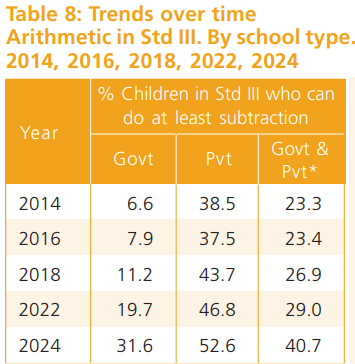
In contrast, Uttar Pradesh, which lagged behind Tamil Nadu in 2014 with just 6%, showed significant improvement over the years. The state rose to 7.9% in 2016, 11.2% in 2018, and despite the pandemic, it maintained 19.7% in 2022. Remarkably, by 2024, Uttar Pradesh reached 31.6%, surpassing Tamil Nadu’s performance since 2022. This shows that Uttar Pradesh’s progress has been consistently stronger, even outpacing Tamil Nadu in recent years.
(ASER – Uttar Pradesh)
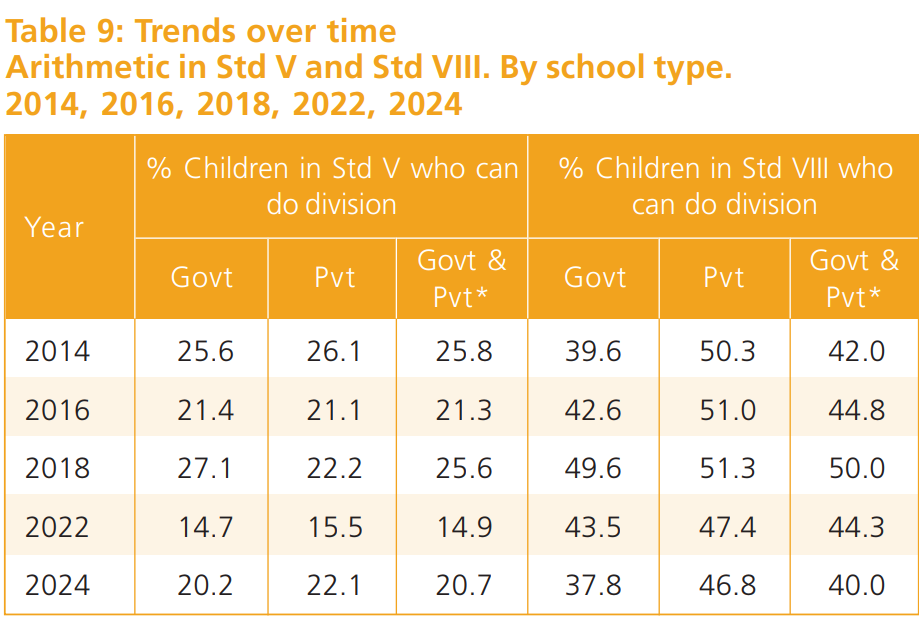
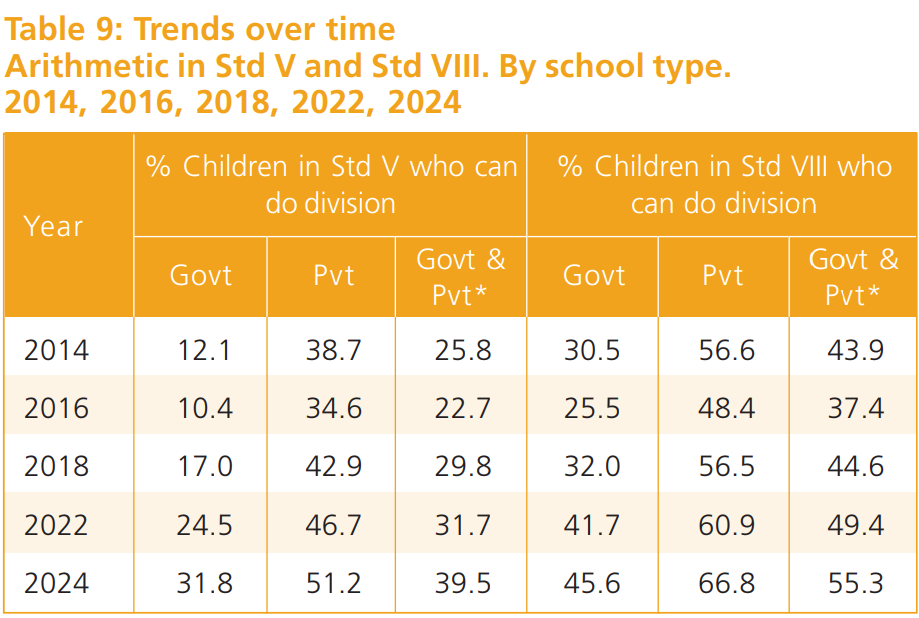
Looking at the trend over time for the percentage of children in Standard V and Standard VIII who can perform division from 2014 to 2024, we see a contrasting performance between Tamil Nadu and Uttar Pradesh. In Standard V, Tamil Nadu had 25.6% of children able to do division in 2014, but this figure dropped to 20.2% in 2024. On the other hand, Uttar Pradesh showed significant improvement, rising from 12.1% in 2014 to 31.8% in 2024.
For Standard VIII, Tamil Nadu saw a decline in division skills, with 39.6% of children able to perform division in 2014, which decreased to 37.8% in 2024.
In contrast, Uttar Pradesh made a notable leap from 30.5% in 2014 to 45.6% in 2024, surpassing both its own previous performance and that of Tamil Nadu in terms of arithmetic ability.
In conclusion, as the old moral story suggests, a donkey worn out becoming an ant symbolizes a struggle for identity and purpose. Similarly, Tamil Nadu has become a state that seems to lack genuine interest in supporting government school students, especially those from marginalized backgrounds who rely solely on government-provided education. Despite the Dravidian model government’s claims of EVR’s legacy in shaping the state’s educational foundation, the data paints a different picture. Poor-performing states have now outperformed Tamil Nadu, leaving the claims of progress looking more like a mockery.
Subscribe to our channels on Telegram, WhatsApp, and Instagram and get the best stories of the day delivered to you personally.
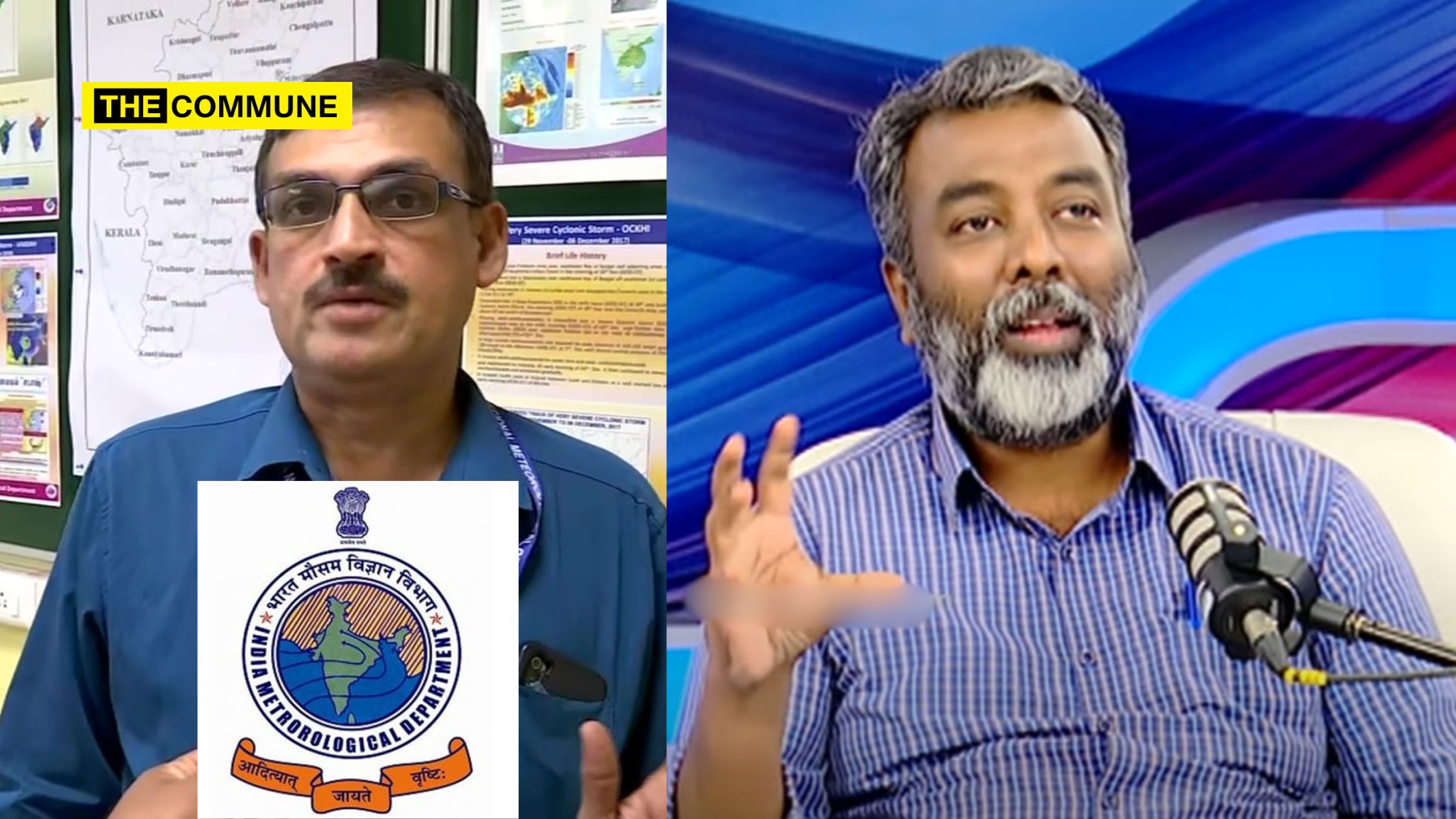
Pradeep John, popularly known as the Tamil Nadu Weatherman, has strongly derogated the Indian Meteorological Department (IMD) in the wake of recent weather forecasting controversies, accusing the government-run body of failing to predict critical weather events accurately. John’s remarks came in response to a statement made by Balachandran, the head of the Chennai Meteorological Department, who had previously criticized private meteorologists for speaking out during heavy rains in pursuit of fame.
Speaking at an event held at Queen Mary College, Chennai, on 29 January 2025, Balachandran criticized private weather forecasters, particularly during the rainy season, for seeking attention and recognition rather than focusing on accurate predictions. He said, “During heavy rains, private weather bloggers speak anything for fame, and no one should pay heed to it.”
He also said that during monsoon season it was necessary to confirm several scientific data and hence the IMD officials take extra care and attention to do it. He also spoke about the aid of ₹2000 crore rupees that the central government had given to modernize the institution. He said, “It is going to come under the Mission Mausam project – they have announce 2000 crores, to help make predicting weather better. More predicting, more data is going to come into the picture, better analysis, otherwise just for popularity you do, it is a different issue.”
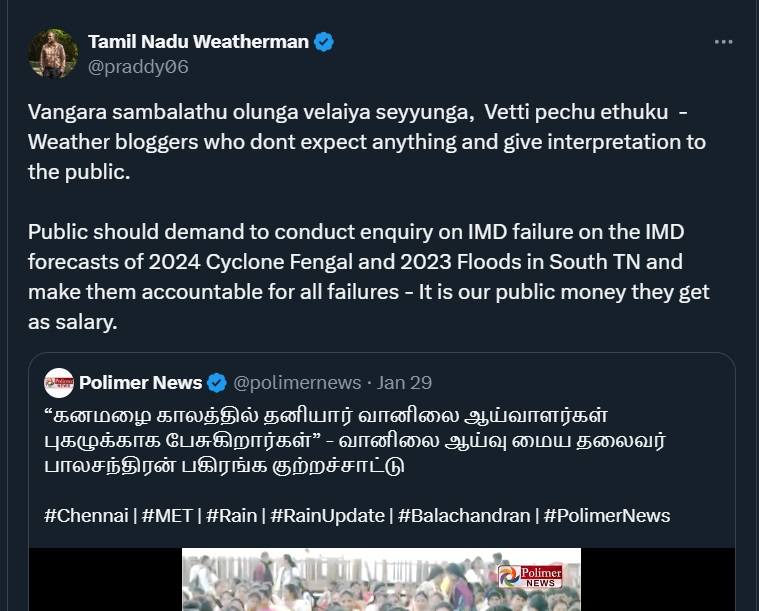
However, John, in a scathing response, took to social media to defend the private meteorologists. In what seems to be an edited post, he first wrote,“Work properly for the salary you receive. Why make pointless talk? Weather bloggers who dont expect anything and give interpretation to the public. Public should demand to conduct enquiry on IMD failure on the IMD forecasts of 2024 Cyclone Fengal and 2023 Floods in South TN and make them accountable for all failures – It is our public money they get as salary.”
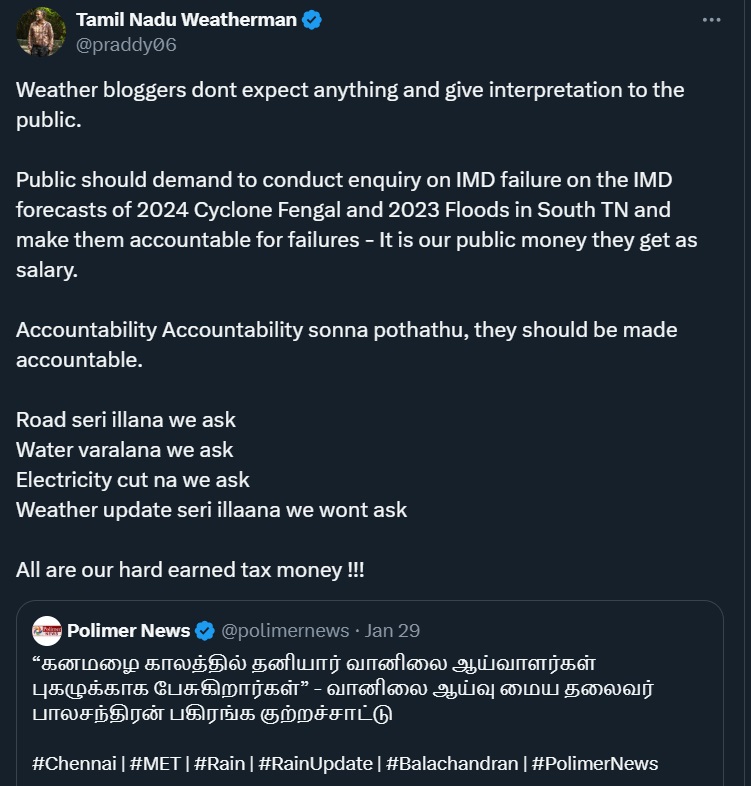
He later edited it multiple times and the final post read,“Weather bloggers dont expect anything and give interpretation to the public. Public should demand to conduct enquiry on IMD failure on the IMD forecasts of 2024 Cyclone Fengal and 2023 Floods in South TN and make them accountable for failures – It is our public money they get as salary. Accountability Accountability sonna pothathu, they should be made accountable. Road seri illana we ask Water varalana we ask Electricity cut na we ask Weather update seri illaana we wont ask All are our hard earned tax money!!!”
It is noteworthy that the same self-styled weather blogger Pradeep John had justified the stagnation and flooding due to rains in the DMK regime.
In an interview with Galatta, he said, “We can withstand and manage rain up to 15cm. We can manage somewhat when we receive 20cm of rainfall. Yes, water will stagnate for a day, if we receive 30cm of rain, surely the localities like Pallikaranai marshlands, Pulianthope, Mudichur, Paruthipattu, Thiruverkadu, Mugalivakkam, will see stagnation – all these places have water bodies near them. If we receive 40cm of rain, we will surely see water stagnating for 4 days because we know we have those problems.”
Weatherman gives the best possible solution for Chennai Rains
— Indhavaainko (இந்தாவாய்ங்கோ) 👊 (@indhavaainko) October 15, 2024
He also said, “People are expecting rainwater to drain out immediately after it stops raining. It doesn’t happen even in developed countries. If you look at intense rains, about 50-60mm rains fall within 30-40 minutes. I have already mentioned that ours is a flat surface. We cannot compare with Delhi, Mumbai or Hyderabad.If you observe from the TNagar area to the beach, it is very flat. So it takes time for water to drain out. There will be 1-2 hours of stagnation. We cannot call it flooding by any definition. If we receive 150mm of rain, water will stagnate for 6 hours surely. And if we receive more than 200mm, the water will stagnate for a day. Stormwater drains are laid for roads. We cannot lay SWD for cyclones like Michaung where we received 400mm rain. In that case, we have to dig up the roads and make it a drain. That is not feasible. We cannot make SWDs for heavy rains that come once in 100 years.”
In an interview with Karthigaichelvan of News18 Tamil, Pradeep echoed the DMK’s narrative regarding the tragedy at the IAF Marina Air Show, attributing the loss of lives to humidity. He seemed to blame the people for not taking enough water with them and not staying hydrated throught the event. This indirectly downplayed the acknowledged inefficiencies and mismanagement by the event organizers.
Weather Blogger Pradeep John’s Fudged Data During 2023 Floods
During the Michaung Cyclone that caused significant devastation to residents of Chennai, leading to widespread flooding across the city, the private weather blogger Pradeep John appeared at a press meeting with DMK ministers, where he manipulated the 36-hour rainfall data by comparing it to 24-hour data, claiming that the current administration is performing better. It’s important to note that Pradeep rose to prominence during the 2015 floods.
In reality, the city was inundated like no other. Areas that had never been flooded even during the 2015 floods like Annanagar, Madambakkam etc which do not flood during the monsoon season, were all inundated and water had entered most of the ground floor homes by 4 December 2023. Kollywood actor Vishal who took to social media platform X shared his plight from his Annanagar home. He said, “During such rains, we all know what will happen and is happening. First, they switch off the power, then waterlogging starts on the streets and then it enters homes. I am in Annanagar and water has entered my home. If this is the state of Annanagar, then imagine how it will be in low-lying areas. In 2015, we were able to help others as much as possible, but after 8 years, the situation is even worse. They announced a stormwater drain project, I am not able to find anything related to that – when was it started, when did they finish it, I have no idea. This is a request as a voter in the state, all MLAs from Chennai, please come out of your homes and have a look at the city and do whatever your constituency needs. This is not a political remark, this is a remark against the waterlogging problem. Even for a small rain, water gets logged in T Nagar but this time the entire city is waterlogged, and it is a disgusting and embarrassing situation we are in. Please take immediate measures for resolving this.”
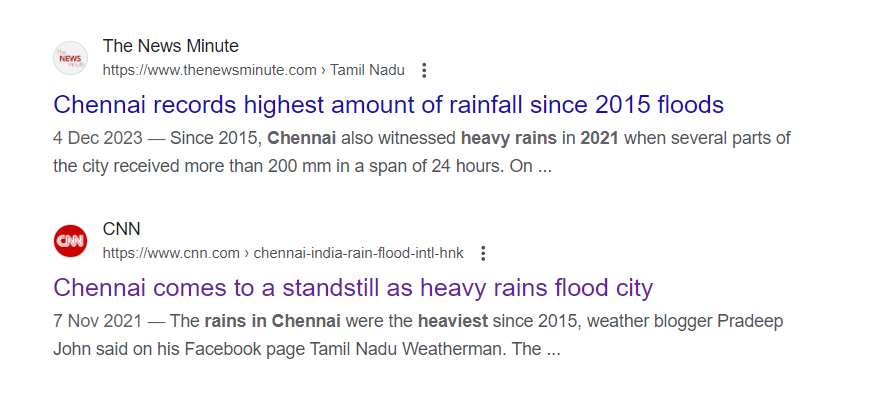
“2021 Rains Were Heaviest Since 2015”
In 2021, when the DMK government had just come to power, it was peddled that Chennai, along with 11 other districts, received more than 20 cm of rain. This stage was set by Pradeep John on his weather blog and the same narrative was carried out in 2023 floods as well.
Despite Pradeep John claiming that he worked equally with both the Dravidian governments over the years with respect to weather predictions, it is clearly seen that he buttresses the DMK unfailingly. And he has the audacity to speak disrespectfully about an institution that has been there even he or his parents were born!
Prime Minister Narendra Modi on Thursday said that the National Critical Minerals Mission, approved by the Cabinet, aims to reduce import dependence, strengthen domestic value chains and support India’s ‘Net Zero by 2070’ goal.
Responding to an article written by Union Minister G Kishan Reddy on National Critical Mineral Mission (NCMM), PM Modi posted on X: “Union Minister Shri @kishanreddybjp elaborates on how the National Critical Minerals Mission aims to reduce import dependence, strengthen domestic value chains and support India’s ‘Net Zero by 2070’ goal.”
National Critical Mineral Mission (NCCM) is being launched with an outlay of Rs 16,300 crore and expected investment of Rs 18,000 crore by public sector undertakings (PSUs).
It will encompass all stages of the value chain, including mineral exploration, mining, beneficiation, processing, and recovery from end-of-life products.
The mission will intensify the exploration of critical minerals within the country and in its offshore areas. It also aims to create a fast-track regulatory approval process for critical mineral mining projects, according to an official statement. Additionally, the mission will offer financial incentives for critical mineral exploration and promote the recovery of these minerals from overburden and tailings.
Critical minerals such as lithium, chromium, nickel, graphite, cobalt, titanium and rare earth elements are essential raw materials for sectors like electronics, electric vehicles, renewable energy, defence and high-tech telecommunications.
Currently the extraction of these minerals is dominated by a few countries such as China which makes the supply chain vulnerable to geopolitical uncertainties. India is viewed as part of the alternative supply chain that needs to be developed to break China’s dominance in this crucial segment. India at present relies mainly on imports to meet its demand.
It is also exploring opportunities for mining abroad. The country has entered into a collaboration with Australia, the world’s top producer of Lithium accounting for as much as 47 per cent of the mineral.
A government-to-government agreement has been signed between the Ministry of Mines and DSIR, under which five projects of Lithium and cobalt have been selected where project feasibility is being carried out.
As part of the ‘Atmanirbhar Bharat’ initiative, and recognising the indispensable role of critical minerals in high-tech industries, clean energy, and defense, the government has undertaken several initiatives over the past two years to address challenges in the critical minerals sector.
–IANS
Subscribe to our channels on Telegram, WhatsApp, and Instagram and get the best stories of the day delivered to you personally.
The Madras High Court has ordered increased security inside the court campus following allegations that country bombs were exchanged among accused individuals linked to the murder of BSP leader Armstrong. The court directed the Tamil Nadu State police to implement additional security measures to safeguard the premises, which include the city civil court, family court, tribunals, and lawyers’ chambers.
The CISF manages the security of the High Court building itself, but the broader court complex falls under the purview of the Tamil Nadu State Police. A bench of Justices SM Subramaniam and M Jothiraman issued directions for the installation of baggage scanners and frisking equipment at the court premises, emphasizing the need for thorough security checks.
The court specifically instructed the state police to ensure the security of lawyers, litigants, and court staff by enhancing measures at the entrances and conducting discreet checks. The justices also recommended deploying plainclothes officers to gather intelligence and carry out necessary actions according to the law. CCTV cameras were also suggested to be installed in strategic locations within the court complex to further bolster security.
In a bid to improve compliance with these measures, the court called on lawyers and bar association members to cooperate with security protocols, including scanning and frisking. Lawyers were encouraged to arrive at court in advance to facilitate these procedures without causing undue delays. The court also granted lawyers the right to approach police authorities with any grievances regarding the security measures.
The recent calls for tighter security come in the wake of the murder of BSP leader Armstrong on 5 July 2024, which has been linked to a retaliatory motive involving the death of history-sheeter Arcot Suresh in 2023. The investigation has led to charges against 30 individuals, with several also being detained under the Tamil Nadu Goondas Act. However, the preventive detention orders are currently being challenged in court.
During a previous hearing, the Additional Advocate General (AAG) revealed that the accused had allegedly exchanged country bombs within the court campus. This raised concerns about the safety of the individuals involved and prompted the court to order a status report on the investigation.
The court expressed concern over the present state of security, stressing that the High Court premises, as a sensitive area, must be protected to prevent dangerous incidents.“What if tomorrow someone brings in knives or swords? We have to secure the lives of innocent lawyers,” the bench remarked. While acknowledging that security measures may cause some inconvenience, the court emphasized that such measures were essential to instill a sense of deterrence and ensure the safety of all within the court premises.
The Annual Status of Education Report (ASER) 2024 has exposed the dire state of education in Tamil Nadu, highlighting a systemic collapse in foundational literacy and numeracy. Yet, The News Minute (TNM), led by Dhanya Rajendran, has shamelessly twisted these alarming findings into a tale of “progress” and “improvement.” This is not journalism—it’s a calculated effort to mislead the public and shield the Dravidian Model from scrutiny. By selectively using the abysmal 2022 data as a benchmark, TNM paints a false picture of recovery, ignoring the harsh reality that Tamil Nadu’s learning outcomes remain stagnant or worse compared to pre-pandemic levels. The truth? Tamil Nadu’s students can barely read or do basic maths, and TNM is running interference to protect those responsible.
Let’s dissect the lies and distortions peddled by TNM.
Framing Decline As Progress
TNM’s article claims there are “improvements in reading and arithmetic skills” since the COVID-19 pandemic. This is a blatant misrepresentation. The truth is that learning outcomes in 2024 remain worse or stagnant compared to pre-pandemic levels. Instead of acknowledging Tamil Nadu’s failure to recover, TNM cherry-picks data from the pandemic-ravaged 2022 numbers to create a false sense of progress.
The reality: There is a serious learning crisis in Tamil Nadu. Let’s take a look at the data.
Class 5 Reading Levels
TNM highlights that 37% of Class 5 government school students can read a Class 2-level text, up from 26% in 2022.
What they conveniently omit: In 2018, this number was 46.3%. Instead of progress, this is a failure to regain pre-pandemic learning levels.
The truth: 64.4% of Class 5 students still cannot read a simple Class 2-level text in Tamil.
Class 8 Reading Levels
TNM notes 62.2% of Class 8 students can read a Class 2-level text, slightly down from 62.8% in 2022.
What they ignore: In 2018, this number was 75%. The decline is undeniable. This means almost 40% of Class 8 students are functionally illiterate beyond second grade.
Class 3 Reading Levels: A Catastrophe
8.6% cannot even read letters.
18.2% can read letters but not words.
36.3% can read words but not a Class 1-level text.
Only 12% can read at a Class 2 level.
The Learning Crisis In Government And Private Schools
86.8% of Class 3 government students cannot read a Class 2 text.
90% of private school students in Class 3 also fail this benchmark.
63% of Class 5 government students can’t read a Class 2 text, while even 32.3% of private school students fail this basic test.
TNM claims Tamil Nadu has “shown progress” because Class 5 reading levels improved from 26% (2022) to 37% (2024). But they deliberately ignore that this number was 46.3% in 2018. Tamil Nadu students were far better off before COVID, and the state still hasn’t recovered.
Instead of reporting this learning collapse, TNM chooses to compare 2024 data to 2022—a period of severe pandemic-related disruptions—to manipulate the narrative.
Whitewashing The Numeracy Disaster
TNM’s article briefly mentions arithmetic challenges but fails to convey the full extent of the crisis. The ASER 2024 report reveals a steep decline in numeracy skills, showing that Tamil Nadu’s students are struggling with even the most basic math concepts.
80% of Class 3 students struggle with simple subtraction.
60% of Class 8 students cannot solve a basic division problem.
67.3% of Class 8 students cannot even perform subtraction.
The gap between government and private schools is equally alarming:
Only 27.6% of Class 3 government students and 28.2% of private school students can perform subtraction.
By Class 8, just 37.8% of government school students and 46.8% of private school students can solve a basic division problem.
This is not just a post-pandemic issue—it’s part of a decade-long decline. In 2018, 49.6% of Class 8 government school students could do division. That number fell to 43.5% in 2022 and now stands at just 37.8% in 2024.
Even among private school students, division proficiency in Class 8 is at 46.8%—still far below pre-pandemic levels.
The ASER report also shows a steady decline in Tamil Nadu’s division skills since 2014.
Yet TNM tries to spin this as “recovery”, ignoring the fact that Tamil Nadu’s math proficiency has been in freefall for years. Instead of exposing this alarming trend, they focus on small gains from 2022 while conveniently overlooking how much worse students are compared to pre-pandemic levels.
Selective Reporting on Enrollment Declines
Tamil Nadu is seeing a drop in school enrollment, but TNM glosses over this alarming trend.
Enrollment for boys in Classes 1-5 has fallen from 71.1% in 2022 to 62.2% in 2024.
For girls, it has dropped from 75.4% to 67%.
In Classes 6-8, enrollment for boys has dropped from 76.2% to 71.3%, and for girls, from 80.8% to 75.3%.
Instead of investigating why Tamil Nadu’s school system is failing to keep students enrolled, TNM distracts its readers with irrelevant digital literacy stats. While access to smartphones and digital skills are important, they cannot compensate for the catastrophic failure to teach children basic reading and math.
Digital Literacy: A Convenient Distraction
TNM highlights increased access to smartphones and students’ ability to browse the internet. But how does that help when children can’t even read or do basic math? What’s the point of knowing how to set an alarm on a smartphone when a student can’t read a second-grade textbook?
This is nothing more than a smokescreen. Digital skills cannot replace foundational literacy and numeracy. TNM knows this but chooses to distract from the actual crisis.
The Bigger Picture: A Decade of Decline
TNM’s article completely ignores the long-term trends highlighted in the ASER 2024 report. For instance:
– The percentage of Class 8 students capable of doing division has been steadily declining since 2014.
– Reading levels in Tamil Nadu have consistently lagged behind national averages, with no significant improvement over the past decade.
By focusing solely on the 2022-2024 comparison, TNM is obscuring the fact that Tamil Nadu’s education system has been in decline for years. This is not just a post-pandemic issue; it is a systemic failure that demands urgent attention.
Why Is TNM Covering Up the Truth?
Instead of exposing the Dravidian Model’s failures in education, TNM is busy whitewashing the crisis. Why?
Their entire narrative is based on propping up the Tamil Nadu government while demonizing other states.
They downplay the disastrous drop in learning levels since 2018 and instead compare 2024 numbers to the rock-bottom 2022 figures to claim progress.
They refuse to acknowledge that Tamil Nadu’s pre-COVID education system was significantly stronger – is it because someone else other than the DMK was in power?
They completely ignore the fact that even private school students are underperforming, showing that the crisis is widespread and not limited to government schools.
It would do well for The News Minute to change its current named to The New Murasoli as they keep buttressing the DMK’s Dravidian Model time and again.
The Bottom Line: Tamil Nadu’s Education System Is In Crisis
The ASER 2024 report is a wake-up call: Tamil Nadu’s students cannot read, cannot do basic math, and are falling behind year after year. The numbers prove it.
But instead of honest journalism, The News Minute has chosen outright propaganda for their Dravidianist paymasters. They are manipulating statistics to fool the public into thinking things are improving when, in reality, the state’s education system is falling apart.
Subscribe to our channels on Telegram, WhatsApp, and Instagram and get the best stories of the day delivered to you personally.
Maharashtra Minister for Minorities Development & Aukaf, Dattatray Bharane has decided to soon launch Geo-mapping of the properties and lands under the jurisdiction of the state Waqf Board.
This comes amid the parliamentary panel’s move to clear the report on the Waqf (Amendment) Bill despite the opposition’s dissent. The Maharashtra government’s decision will hit those illegally occupying the scattered and unmeasured lands across the state.
The Minister has asked the department to soon start the Geo-mapping survey of such properties across the state to know the present status.
A department source said, “Geo-mapping will provide accurate official information about the number of Waqf properties in the state and the extent of encroachment on them, and will put a stop to encroachments. Various organisations and political parties, including the Maharashtra Waqf Board, have claimed there are 23,566 registered Waqf properties in the state and their total area is 37,330 hectares. However, as per the estimates of the Minorities Department, the number of Waqf properties is around 27,000 and their area is 40,468 hectares. Geo-mapping will be done to remove the discrepancies in this data and ensure accurate registration of properties.”
A survey of Waqf properties was conducted in 1997 through physical inspection. However, it was considered to be a rough estimate. Of these properties, 60 to 70 per cent of the plots are encroached upon and thousands of plots are under litigation.
The department source said that many cases of illegal encroachments on Waqf properties have come to light. However, due to discrepancies in the data, no measures were taken to deal with the situation. “Now, geo-mapping technology will bring clarity to the properties and encroachments and official information will be available at the government level. There is still uncertainty about the exact number of Waqf properties in the state. There is no information about the exact purpose for which these properties are being used and what rates are being charged while renting out these lands,” the source added.
The Mahayuti Minister said Geo-mapping will reveal illegal possessions and, thereafter, the government will be able to take necessary action. The Minorities Development’s decision comes at a time when the parliamentary panel cleared 14 amendments proposed by NDA MPs while 44 suggested by the Opposition were rejected. All the 44 amendments proposed by the Opposition were reportedly against the changes planned in the Bill to the Waqf Act of 2013.
–IANS
Subscribe to our channels on Telegram, WhatsApp, and Instagram and get the best stories of the day delivered to you personally.
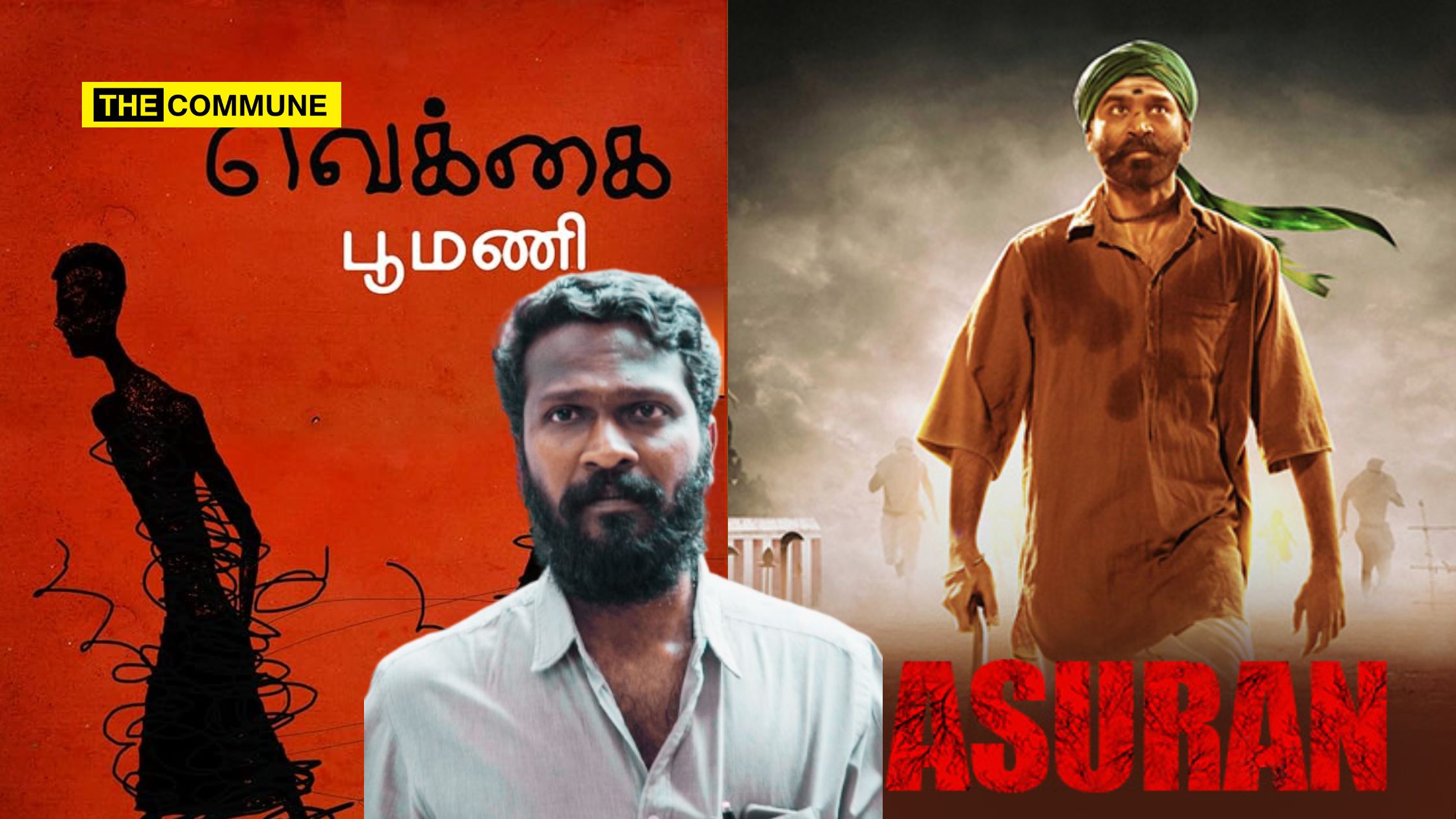
Asuran Director Vetrimaaran has come under scrutiny for distorting the original story of Poomani’s Vekkai to promote Dravidianist “oppressed, depressed, suppressed” narratives. The film Asuran, which was originally about the long struggle of the Panchami land issue, was altered to frame the story as a Dalit struggle against caste-based oppression, misrepresenting the true essence of the novel. Author Jeyamohan criticized this shift, highlighting that Vekkai was not about untouchability but a fight over land rights, a crucial detail that was lost in Vetrimaaran’s portrayal.
Vetrimaaran’s Bad Girl
The release of the teaser of the Dravidianist director-produced film Bad Girl has sent several ripples across social media platforms and days after its release, people are still debating about the teaser and about the producers, especially about the left-leaning Dravidianist director Vetrimaaran and his Brahmin-hate and caste-based films.
Netizens questioned if the producers and other supporters like Pa Ranjith and Vijay Sethupathi would prefer if their daughters or the women in their families would follow what was preached in the film.
Vetrimaaran, a true-blue Dravidianist, hails from a family that owes its allegiance to the DMK. His maternal uncle Ela. Pugazhendi was a 3-time DMK MLA from Cuddalore. It was Pugazhendi who named him Vetrimaaran. Pugazhendhi’s father Ere. Elamvazhuthi was also a DMK MLA from Cuddalore and had worked closely with rabid anti-Hindu demagogue E.V. Ramasamy Naicker (known as Periyar by his followers) and also with CN Annadurai and Karunanidhi. So, the anti-Hindu DNA runs in the family. He has regularly peddled the Dravidian Stockist propaganda in his films.
Did you know that the film Asuran was supposed to be based on a story titled Vekkai? But what is interesting is that Vetrimaaran distorted the original story written by Sahitya Akademi award winner Poomani to peddle the Dravidianist “oppressed, depressed, suppressed” propaganda.
Here’s what author Jeyamohan had to say about it. Speaking at an event, he said, “The problem with this is that whenthe story of Vekkai was made in the name of Asuran. Neither those who directed it nor the people who released the film know the background of the Pallar community. They changed it into a Dalit issue. They depicted the story as if these people were not allowed to wear slippers when walking in the village. The community people got angry because no such thing happened. No one says that Pallars should not wear slippers. To add to this, people will advise you to not get beaten up by Pallars. So, they changed the story of another caste into their caste issue, there was a big social divison and the novel was misunderstood. The story of Vekkai is not about untouchability or caste-based cruelty or oppression but it is about land that was unlawfully grabbed and the story of the struggle to reclaim it.”
It is noteworthy that the story of Vekkai is about the long struggle of the Panchami land issue told in a more compassionate way and realistically while conveying the message subtly.
Also, Vetrimaran twisted the context of the novel that he made into movie to show the community in a different way. Author of the novel cameout openly stating movie doesn't represent his work. Jemo on that topic here. https://t.co/puCa1nEXGppic.twitter.com/34KIvWqFdu
How He Chickened Out And Yielded To Pressure From Mukkulathor Community To Mute ‘Aanda Parambarai’ Word In Asuran Film
In a past interview, Vetrimaaran discussed his challenges with Asuran, mentioning that the Dravidian movement’s strong influence in Tamil Nadu has allowed filmmakers the freedom to present their ideologies. He said, “The challenge I had with Asuran was that it’s not just a non-political film, it’s a Dalit film where the protagonist is a Dalit, and he’s not meek—he stands up for what’s right and brings down upper-caste people. This was the most challenging aspect for me, as there was a lot of speculation during pre-production and shooting. We didn’t want to offend anyone because we were simply stating facts, and we wanted people to understand the film. We wanted Dalits to see themselves represented, and for non-Dalits to understand what happened in the past and how their parents or grandparents were responsible. That was the challenge we faced, which is why we refrained from mentioning any specific caste.”
Despite this approach, Vetrimaaran’s portrayal of a Dalit protagonist in Asuranwas met with criticism. In 2019, when Vetrimaaran inserted the “Aanda Parambarai” dialogue in Asuran, several community members including actor-politician Karunas personally contacted the director, urging him to remove the line from the theatrical version. The phrase means ‘Ruling Clan’, and the community members felt it referred to their Mukkulathor community.
Audio recordings of these calls surfaced on YouTube, showcasing how respectfully he agreed to mute the dialogue in response to the callers.
In the leaked audio recordings, representatives from the community like Aapanadu Maravar Sangam, andMukkulathor Munnetra Sangam, among many speak to him about the said phrase and how the scene involves people talking about land and money grabbing portraying their community in a negative light. They advised him that films should promote social harmony and said that they were upset with the developments while asking him to make changes to the film. To this, we find Vetrimaaran responding very politely saying he will do what he can to make the changes within a couple of days. A subsequent caller from the community called once again only to get the response that he was going to remove the phrase in a day. He also adds that it was not his intention to hurt anyone and that it was a mistake. He also explains why it takes the given amount of time to remove the phrase.
He also promises to release a press note and make a public announcement with respect to the same issue. People from the community also mildly warn him not to do anything similar in the future.
As a result, the line was eventually removed in the censored version, which was redistributed across theaters.
Vetri took great care to not explicitly spell out any "dominant" comm in Asuran.
Because he know there'd be consequences.
But a free pass is given to all D directors to represent Tamil Brahmins however they want, cuz there's no fear of consequences. pic.twitter.com/3RWuPjdj5X
Vetrimaaran also said that art is for people and that it should reflect the society in which we live. He talked about the ‘erasure of identities’.
“We should handle art responsibly. If we don’t, our identities will be taken from us. Constantly our identities are being snatched away.”, he said.
Vetrimaaran should have thought twice before making this statement. In his film Vada Chennai, he portrayed the people of (Meenavar) fishermen community of north Chennai as if they were involved only in piracy, drugs, goondaism, and crime. He had shown the women folk as lacking decency and using cuss words. The Meenavar community which includes communities like Pattanavar, Paravars, and Sembadavars have a glorious history in seafaring. The Pattanavars are a maritime community densely populated in Chennai, Kanchipuram, Cuddalore, Vizhupuram, and Nagapattinam districts of Tamil Nadu. They have traditionally been involved in fishing, shipment, navy, and trade. They had served as naval forces under various Tamil kings. According to historian Hermann Kulke, the Pattanavars were instrumental in the organization and exploits of the Chozha Navy. Yet, Vetrimaaran chose to snatch away this glorious history and identity of Meenavars and showed them as uncouth people.
Overall, it is pretty clear that the likes of Vetrimaaran want to carry out a certain propaganda and it is clear as crystal that it is the Dravidianist propaganda – insert lies and plant fake stories, use the Brahmin as your punching bag and rake in the benefits.
Subscribe to our channels on Telegram, WhatsApp, and Instagram and get the best stories of the day delivered to you personally.