A government function attended by Tamil Nadu Deputy Chief Minister Udhayanidhi Stalin in Chepauk has sparked public outrage after slum areas near the venue were obscured with temporary screens ahead of the event.
The function, held in Lock Nagar today, marked the inauguration of a new multi-purpose building. Deputy Chief Minister Udhayanidhi Stalin, Chepauk MLA, presided over the event, alongside senior leaders including Minister K.N. Nehru and Chennai Mayor R. Priya.
Ahead of the event, the Buckingham Canal area and adjacent slum settlements were shielded with large temporary hoardings for a stretch of nearly 200 metres on either side of the road. The move has prompted backlash, with critics questioning whether the screening was done by the Chennai Corporation or political operatives from the ruling DMK. The area in question includes a densely populated settlement of economically disadvantaged families and daily-wage workers living in hutments.
Images and videos of the screens have gone viral on social media, prompting comparisons to similar actions taken by the central government in the past—criticized then by DMK leaders themselves.
Notably, in September 2023, Udhayanidhi Stalin had accused the BJP-led central government of resorting to cosmetic beautification by concealing slums during the G20 summit in Delhi. Speaking at a public meeting, he had compared the BJP to a “venomous snake” and accused it of masking poverty under the guise of development. “People should not give space to either BJP or AIADMK in Tamil Nadu,” he had stated at the time.
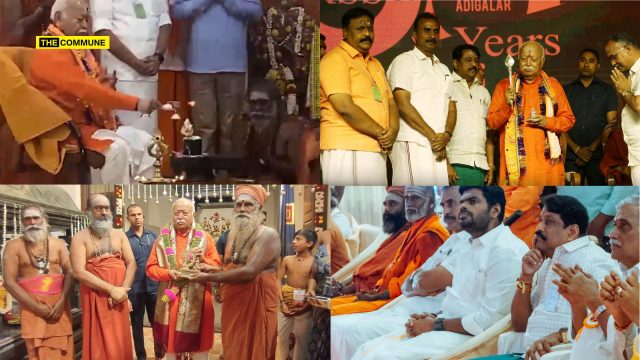
Rashtriya Swayamsevak Sangh (RSS) Sarsanghchalak Mohan Bhagwat today participated in the centenary celebrations of the Perur Aatheenam and the RSS organization held at the historic Perur Aatheenam Math in Coimbatore. Former AIADMK minister S.P. Velumani, along with his brother Anbarasan and Hindu Makkal Katchi leader Arjun Sampath, were also present at the event.
Apart from these leaders, Tamil Nadu Bharatiya Janata Party leaders such as TN BJP chief Nainar Nagendran, Mahila Morcha President and Coimbatore MLA Vanathi Srinivasan, and K Annamalai were also present.
Sarsanghachalak Mohan Bhagwat visited the Perur Aatheenam where he took part in a special puja ahead of the centenary functions.
The traditional Shiva Velvi Puja was conducted between 6:00 and 7:15 AM, following which abhishekam was performed to the main Shivalinga at the temple.
Shanthalinga Marudachala Adikalar of the Perur Aatheenam, along with Kumaragurupara Swamigal of Siravai Aatheenam, briefed reporters on the significance of the event a few days ago. They noted that the celebrations commemorated the 100th birth anniversary of Shanthalinga Ramasamy Aatheenam, the 24th Guru Mahasannidhanam, who played a pivotal role in reviving Tamil Saiva traditions and empowering marginalized communities through religious outreach.
The saints emphasized the cultural and social importance of the event, citing Ramasamy Adigalar’s work in education, public health, and religious inclusion. They stated that the participation of RSS chief Mohan Bhagwat underscored a shared commitment to cultural preservation and national values.
The event concluded with a public meeting open to devotees and residents, where Bhagwat remained present till 11:00 AM.
In a post on his X handle, former TN BJP chief Annamalai wrote, “Thismorning,atraditionalShivavelviPoojawasheldattheCoimbatorePerurAdheenam.Followingthis,IhadtheprivilegeofparticipatinginthecentenarycelebrationofthePerurAdheenam’s24thGuruMahasannidhanam,ThavathiruShanthalingaRamasamyAdigalar,andthe @RSSorg organization,andIamdelightedbythisopportunity.ThayvathiruShanthalingaRamasamyAdigalarissomeonewhocherishedSaivismandTamilastwoeyes.Heexcellentlycarriedoutworksineducation,society,medicine,tradition,andculture.Withtheaimofpreservingournation’scultureandheritage,the @RSSorg organizationhasbeenactivelyworkingforthepasthundredyears.ItistrulyspecialthatthisyearmarksthehundredthyearforbothAdigalar,whotirelesslyworkedthroughouthislifefortherevivalofreligionandsociety,andthe @RSSorg organization,whichselflesslyservestoprotectournation’sculture.Insuchaprestigiousevent,Iamoverjoyedtohaveparticipatedalongsidetherespectednationalleaderof @RSSorg,Hon.Shri @DrMohanBhagwat,thestatepresidentof @BJP4Tamilnadu,brotherShri @NainarBJP,seniorleaders,officials,andfriendsfromallparties.”
இன்று காலை, கோவை பேரூர் ஆதீனத்தில் பாரம்பரிய சிவவேள்வி பூஜை நடைபெற்றது. அதனைத் தொடர்ந்து நடைபெற்ற பேரூர் ஆதீனத்தின் 24-ஆம் குருமகாசந்நிதானம், தவத்திரு சாந்தலிங்க இராமசாமி அடிகளார் மற்றும் @RSSorg அமைப்பு நூற்றாண்டு விழாவில் கலந்து கொள்ளும் பாக்கியம் பெற்றதில் மகிழ்ச்சி.… pic.twitter.com/T3Ebllq36J
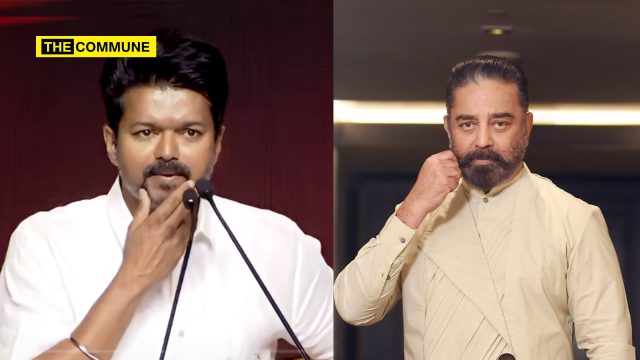
Part-time politician turned full-time DMK stooge Kamal Haasan—who effectively leased out his party to the DMK in exchange for a lone Rajya Sabha seat now appears more like a full-time DMK loyalist than an independent politician. For the first time in five years, Kamal has skipped wishing Vijay on his birthday. A grudge, perhaps? Seems likely after all, Vijay has now launched his own party, Tamilaga Vettri Kazhagam, which is directly challenging the DMK.
Back in 2021, when Kamal was leading MNM and stood as a vocal critic of the DMK, he tweeted, “Happy birthday to my beloved brother @actorvijay who has captivated Tamil hearts with his talent and love.”
தன் திறமையாலும் அன்பாலும் தமிழ் உள்ளங்களை வசீகரித்துள்ள என் அன்புத் தம்பி @actorvijayக்கு இனிய பிறந்தநாள் நல்வாழ்த்துக்கள்.
However, in 2025, after accepting a Rajya Sabha seat through the DMK quota, Kamal Haasan—once a self-proclaimed “independent voice that shattered DMK TV”—has maintained stoic silence on Vijay’s 51st birthday. The sudden break in this annual tradition has triggered speculation: Has Vijay’s launch of Tamilaga Vettri Kazhagam (TVK), a party poised to take on the DMK, shifted Kamal’s affections to political allegiance?
From wishing warmly as an “actor-friend” to cold silence as a DMK-nominated MP—has Kamal Haasan traded camaraderie for compliance?
Subscribe to our channels on Telegram, WhatsApp, and Instagram and get the best stories of the day delivered to you personally.
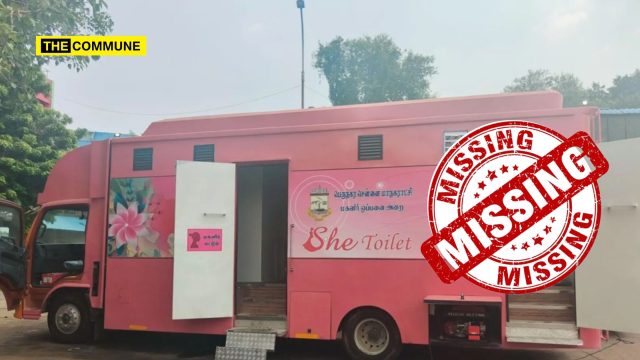
Nearly two years after their much-publicised launch in September 2023, the 15 ‘She’ mobile toilet buses introduced by the Greater Chennai Corporation (GCC) have disappeared from public view. The ₹4.5 crore initiative, aimed at improving sanitation access for women in high-footfall areas such as Chennai Central, Koyambedu, Guindy, and T Nagar, has reportedly failed in implementation.
Each air-conditioned bus was designed with four toilet cubicles, a shared wash basin, and a sanitary napkin dispenser. The plan involved daily deployment based on demand. However, field visits to designated locations revealed that none of the units were operational or visible.
Commuters, students, and even women police personnel reported never having seen the facilities in use. Some mentioned the buses were briefly seen post-launch but have since vanished.
Sources in the corporation cited unresolved technical issues, particularly battery failures linked to continuous tank operation. These maintenance problems were not adequately addressed. Corporation officials acknowledged the lapse and indicated steps are being taken to monitor operations more effectively, including real-time updates from the mechanical department.
Women’s rights groups have highlighted the lack of accessible sanitation as a serious concern, particularly in a state with high female participation in higher education. They have urged the GCC to restore and maintain the mobile toilet service without delay.
Chennai Mayor @PriyarajanDMK in Sept 2023 launched 15 mobile toilet buses with great fan-fare. Now, these buses have completely gone off-the-radar ‼️
Launched with fanfare nearly two years ago by Greater Chennai Corporation (GCC), the 15 ‘She’ mobile toilets have gone missing… pic.twitter.com/xlLG3PsIjD
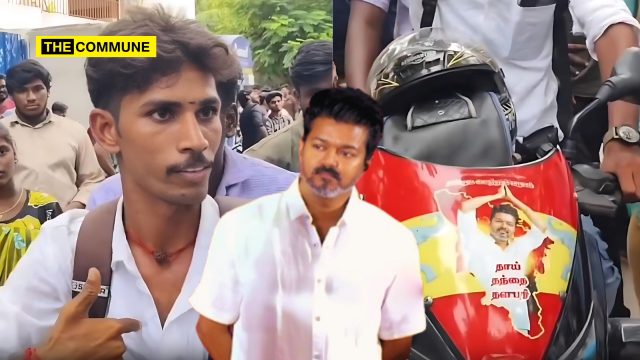
A video featuring a disappointed fan of actor-turned-politician Vijay, who is also a member of Tamilaga Vettri Kazhagam (TVK), has gone viral. The fan, identified as Ayyappan from Salem, expressed his dismay after traveling overnight to Neelankarai with hopes of seeing Vijay on his 51st birthday – only to be left disappointed when the actor did not make a public appearance.
Speaking to reporters, Ayyappan said, “I left Salem at 11:30 PM on my bike and reached Vijay’s residence around 6:30 AM. But he didn’t come out to greet us. We were told he’d appear by 12:30 PM, then at 1 PM, but that didn’t happen. Later, someone said he had quietly left in his car. No one saw him. It’s frustrating and hurtful.”
Comparing Vijay to other actors like Rajinikanth who usually step out to greet fans on special occasions, Ayyappan added, “Would it harm him to wave at us for two minutes? We came all this way just to wish him on his birthday. I’m done. I won’t vote for TVK in 2026. I’ve never supported DMK or AIADMK, but now, even TVK is off my list. I’ll just vote for NOTA.” In response, women members of TVK present at the scene reportedly told him, “Go ahead, one vote won’t make a difference.”
"2 நிமிஷம் வெளிய வந்து பார்த்துட்டு போக விஜய்க்கு என்ன..?" சேலத்தில் இருந்து 6 மணி நேரம் டிராவல் பண்ணி வந்தேன்.. அவருக்கு எங்களை பார்க்க விருப்பமில்லை.. எங்களுக்கும் 2026-ல் அவரை பார்க்க விருப்பமில்லை.. விஜய் ரசிகர் ஆவேசம்..#TVKVijay | #HBDVijay | #TVK | #VijayFans |… pic.twitter.com/lXLWBllr1I
Despite the incident, Vijay’s birthday was celebrated across Tamil Nadu with various welfare activities. TVK General Secretary Bussy Anand distributed gold rings to newborns who share Vijay’s birthday, and party members organized food drives for the underprivileged in several districts. Vijay’s mother, Shoba, also arranged food distribution at the Sai Baba temple in Chennai and urged well-wishers to continue sending birthday greetings to her son. Devotional rituals in Vijay’s name were conducted at several temples as well.
Traditionally, fans expect stars and political leaders to step out and acknowledge their supporters on special occasions. With actors like Rajinikanth known for such gestures, many fans feel Vijay should also uphold this tradition, especially now as he enters active politics.
The city of Chennai is set to witness a dazzling display of illusion and wonder as one of India’s most celebrated magician families returns to the spotlight. P.C. Sorcar (Pourush), the youngest in the legendary Sorcar lineage, has brought the iconic Indrajal magic show to the Music Theater in Egmore, promising audiences an unforgettable journey into the world of enchantment.
Back again after 10 years in Chennai, the show kicked off on 14 June 2025 and will run across weekends in June and July. The dates are June 21, 22, 28, 29 and July 12, 13, 26, 27 – with two performances each day at 5:00 PM and 7:00 PM. Each show runs for 1 hour and 15 minutes and is open to all age groups. Tickets start at ₹500, making it a family-friendly event for Chennai’s magic lovers.
Rooted in the grand legacy of Indian stage magic, Indrajal is more than a performance; it’s a tribute to the craft perfected by P.C. Sorcar (Senior), often referred to as the father of modern Indian magic. Famous for saying, “When asleep I breathe Magic; when awake I work Magic,” Sorcar Sr. was instrumental in bringing Indian magic to global prominence.
P.C. Sorcar (Young), dubbed the “Leonardo da Vinci of India,” carried this legacy forward with innovation and international acclaim. Now, his son Pourush steps onto the stage, not only as a magician but also as a painter and musician, bringing a fresh creative energy to the classic illusions that have mesmerized audiences for generations.
The Chennai edition of Indrajal is expected to be a major cultural attraction, drawing families, students, and magic enthusiasts from across the city. Organizers have ensured the venue is easily accessible, with the location shared on Google Maps for convenience.
For those planning to attend, tickets are available online via BookMyShow. With the curtain rising on Indrajal, Chennai audiences can expect not just sleight of hand—but a spellbinding celebration of India’s magical heritage.
Subscribe to our channels on Telegram, WhatsApp, and Instagram and get the best stories of the day delivered to you personally.
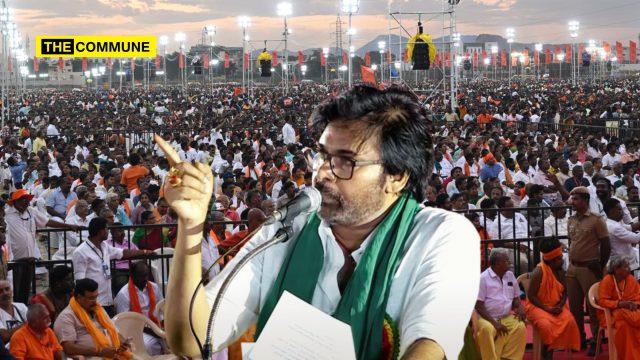
Jana Sena Party chief and Andhra Pradesh Deputy CM Pawan Kalyan issued a strong warning to those who mock or belittle Hindu beliefs under the guise of secularism referring to a Tamil proverb, “Saadhu mirandaal kaadu kolladhu”—meaning “Even the forest cannot withstand the anger of a sage!”, cautioning that the patience and tolerance of devout Hindus should not be mistaken for weakness.
Pawan Kalyan began his address at the Murugan Bakthargal Maanadu (Murugan Devotees Conference) hosted by Hindu Munnani in Madurai by reflecting on a grim chapter in the city’s history. He spoke about the devastating invasion led by Malik Kafur, which plunged Madurai into darkness for nearly 60 years. It wasn’t until the late 14th century, he said, that light returned—when Prince Kumara Kampana of the Vijayanagar Empire rekindled the lamp of hope and revival, restoring peace and cultural pride.
Drawing from this historical episode, Pawan Kalyan emphasized a powerful lesson, “Our national faith is indestructible, no one can destroy it. Our culture is so deep that no one can shake us. From Kanyakumari to Kashmir, our Dharma was deep, it is deep today and will always be deep. This is the strength of this divine land.”
Without explicitly naming the DMK, Kalyan criticized political figures who questioned the rationale behind hosting the Murugan Conference in Tamil Nadu rather than in states like Uttar Pradesh or Gujarat. He said such remarks reflect an intent to stir divisions and discredit cultural events tied to the Tamil Hindu identity.
He slammed such thought are divisive, “Today, they are questioning Murugan; tomorrow, they might question Lord Shiva or the Goddess Amman. This line of thought is extremely dangerous.” Recalling his own religious background, he said, “I went to Sabarimala when I was 14. I’ve seen people go to Thiruthani for Thai Poosam. When I studied in Mylapore, Chennai, I went to school with sacred ash (vibuthi) on my forehead. After a short while, I noticed a change. Then, in the next 10 years, people started questioning applying vibuthi on the forehead. So, even at the age of 14, I faced these kinds of questions. Everyone might have had this experience. We didn’t make a big deal out of it because we Hindus are secularists.”
Then Kalyan called out the selective outrage targeting of Hinduism by pseudo-secularists. he said, “A Christian can be a Christian. A Muslim can be a Muslim. But for them, it’s a problem if a Hindu simply remains a Hindu. If someone is a Hindu, they are labeled a fundamentalist. This is their fake secularism. I have the right to celebrate my faith. Who are you to question that? We don’t question your beliefs; practice the same civility. Even if you don’t show respect for my religion, at least don’t disrespect it. You who question Murugan, can you ask the same questions about the religions that came from Arabia? Do you have the courage for that? That’s why I’m telling you, don’t provoke us! Don’t provoke us! Even a forest cannot withstand the anger of a sage! Even a forest cannot withstand the anger of a sage! (Sadhu Mirandaal Kaadu Kolladhu).”
Describing Lord Murugan as a deity revered not only in Tamil Nadu but across the Indian subcontinent, he said, “Murugan is Karthikeya in the North, Subrahmanya in Andhra and Karnataka. This conference is not about regional politics but about our shared spiritual heritage.”
He expressed deep concern over the trend of religious mockery, especially incidents involving ridicule of sacred hymns like the Kanda Sashti Kavasam. Such actions, he said, amount to direct attacks on the sentiments of Tamil Hindus.
He also reflected on the Kanda Sashti Kavacham controversy in Tamil Nadu and urged everyone to defend their faith and culture. “They ridicule our songs and traditions. Who gave them the right to insult others’ beliefs?” he asked, urging Hindus to stand united in protecting dharma. “Change is inevitable,” he concluded.
Blasting pseudo-secularist once again Pawan Kalyan said, “In our country, secularism is a convenient word for a lot of people, specifically atheists who don’t believe in God. What do atheists say? “They don’t believe in God.” If they say they don’t believe in God then they shouldn’t believe in any god. But in our country, atheists are such that they only don’t believe in Hindu gods. That is the definition of atheist secularism in our country. This is the issue in our country. Secularism is no discrimination against anybody in the name of religion, but our country’s secularists have no discrimination against anybody in the name of religion, except Hinduism, Hindu gods, and Hindu culture. They abuse Hindu culture and abuse Hindu gods; that is secularism for them. They don’t have the guts to point out any other religion except Hindu Dharma. This group of atheists, this group of secularists, has been given a weapon by the constitution: freedom of speech. They have gotten used to speaking whatever they want and abusing our gods. If they abuse our gods, we shouldn’t get angry or worried because it’s freedom of speech. They’ll keep abusing, and we just have to be peaceful because we are Hindus. This has to change. If this doesn’t change, it will be very difficult to sustain our religion and dharma. Anywhere in our country, being a Hindu… “I am not a fanatic Hindu, I am a committed Hindu.” I respect Islam, I respect Christianity, but what I ask is: Don’t disrespect my Hindu dharma. Don’t speak about our ‘aram’ (righteousness/values). This is my pleading.”
Subscribe to our channels on Telegram, WhatsApp, and Instagram and get the best stories of the day delivered to you personally.
Now that Israel is in the news for its war against Iran, propagandists like YouTuber Akash Banerjee have begun peddling lies and narratives that are not only antisemitic but also vilify the Jews.
In his latest video titled “How Israel Came To Control American Politics & Foreign Policy”, Banerjee echoes antisemitic tropes and conspiracy theories that portray Jews and the state of Israel as shadowy manipulators of American politics and global affairs. Throughout the 20-minute video, Banerjee uses provocative language and unverified claims to suggest that Israel — and by extension, Jews — exert sinister and disproportionate influence over the United States government.
What starts as a critique of American foreign policy quickly descends into a textbook case of antisemitic narrative-building, complete with accusations of financial manipulation, political blackmail, and even involvement in the assassination of U.S. President John F. Kennedy. Let’s take a look at his allegations and propaganda statements.
Jews Control American Finance and Politics
Banerjee openly states that major financial institutions in the United States are “under Jewish control,” a classic antisemitic trope historically used to paint Jews as economic puppet masters. He says, “Funding is just one part of Israel’s control over America. Big companies like Goldman Sachs, JPMorgan Chase, BlackRock, DE Shaw, PayPal are the top American firms that are directly or indirectly under Jewish control. They control big money, and they have been accused of pro-Israel lobbying for years but no one has been able to touch them. Their hold is strong. In the end, the money that is coming and suppressing others is a dangerous game that is played.”
He further claims that these firms are complicit in pro-Israel lobbying and systemic corruption, framing this as a well-funded and insidious campaign. “Lobbying is just a whitewashed term for systematic corruption Like we have paisa do, contract lo … similarly there is strategic partnership in America.”
Indian liberal Youtubers now pumping pure poison
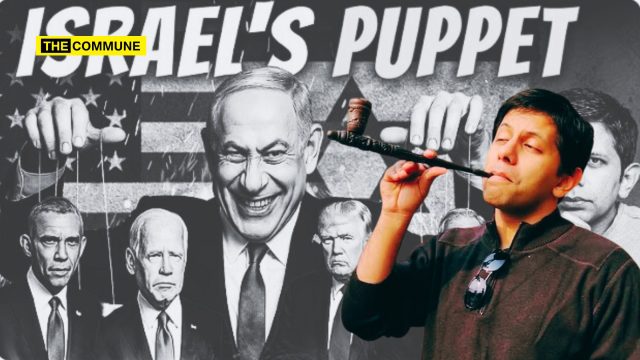
Akash Banerjee says big money global corporations are Jewish controlled!
A thumbnail showing US Presidents on puppet strings
Do you realize who these hardcore anti-Semitic tropes cater to?
Banerjee targets the American Israel Public Affairs Committee (AIPAC), accusing it of engineering U.S. elections, “Through AIPAC, Israel injects millions of dollars into the US elections every year to elect Ted Cruz and Tom Cotton.” He goes on to paint American politicians as puppets who prioritize Israeli interests over their own constituents, stating, “You enter American politics to defend another country.”
Banerjee plays up the idea that U.S. lawmakers “worship” Israel and serve foreign interests over national loyalty — another dangerous generalization often found in antisemitic literature. He says, “It is clear that Israel worship is going on in America… What kind of magic is this?”
Blackmail And The Mossad Conspiracy
Banerjee then plunges into dark conspiracy territory, reviving old claims about Mossad — Israel’s intelligence agency — using sexual blackmail to control U.S. leaders. He says, “Mossad’s job is to collect dirt on US officials… and starts blackmailing from the back channel.”
He links this to Jeffrey Epstein, suggesting — with no evidence — that Epstein may have been working for Mossad. He says, “Conspiracy theorists believe that Epstein was a Mossad spy or at least working for Mossad. His job was to trap big American businessmen and political leaders in a honey trap.”
Even more egregiously, Banerjee repeats an unsubstantiated theory that Mossad may have played a role in the assassination of U.S. President John F. Kennedy, saying, “One conspiracy theory is that Mossad was involved in the case because Kennedy had found out the secret of Israel’s nuclear weapons.”
Such accusations of global Jewish conspiracy, manipulation, and assassination echo dangerous rhetoric historically used to incite hatred — straight out of a Nazi propaganda textbook.
Though Banerjee frames his podcast as political critique, the pattern of themes, language, and scapegoating aligns disturbingly with antisemitic propaganda. The accusations of Jewish financial dominance, manipulation of media, foreign loyalty of elected officials, and clandestine intelligence operations all serve to demonize Jews and Israel as global puppet masters, a narrative rejected by mainstream academics and watchdogs as hateful and dangerous.
Banerjee, known for his consistent anti-Hindu/anti-India stance and sympathetic coverage of Congress and Left-leaning coalitions, has often criticized the current Indian government’s relationship with Israel. However, his latest video suggests a shift from legitimate foreign policy critique to outright demonization of an entire ethno-religious group. The reliance on conspiracy theories — many of them long discredited — suggests a willingness to trade factual discourse for virality and ideological appeal.
It is noteworthy that Banerjee was invited to be part of a programme conducted by the US Embassy in India titled “Influence to Impact”.
Are you a social media influencer or a content creator curious about impactful content that drives real change? Here's your chance to learn from the best! Join us at American Center New Delhi for "Influence to Impact" with @TheDeshBhakt Akash Banerjee.
So, to show his loyalty to the US, is Banerjee doing his bit to portray the US, which has also bombed Iran in the ongoing war, as a naive partner who is being bullied into doing it by Israel?
Subscribe to our channels on Telegram, WhatsApp, and Instagram and get the best stories of the day delivered to you personally.
The Murugan Devotees Conference saw a rousingly massive attendance of devotees, religious leaders, and political leaders from across the state and outside Tamil Nadu.
Former Tamil Nadu BJP president K. Annamalai made a strong appeal to safeguard India’s cultural heritage and religious practices emphasizing that no one should be permitted to dismantle the nation’s cultural symbols, and strongly opposed religious conversions from Hinduism, asserting that those who have already converted should be encouraged to return to the faith.
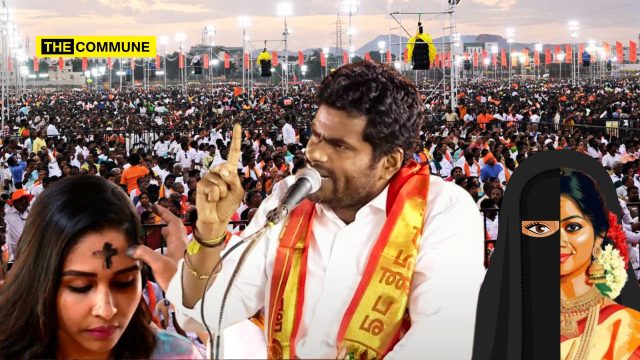
Speaking at the Murugan Devotees Conference held by Hindu Munnani on 22 June 2025 in Madurai, Annamalai stated, “Our traditional way of life must remain untouched. Children should proudly go to school wearing sacred ash (thiruneer) on their foreheads. From this point forward, we must not allow our cultural identity to be eroded. Religious conversions must stop, and efforts must be made to bring back those who have left our faith.”
Drawing a comparison with global events, he referred to the Jewish community, which constitutes a mere 0.2% of the world’s population, noting that they have stood their ground against external interference. He cited Israel’s measures to defend its way of life, including closing schools and moving hospitals underground during conflict. “Israel boldly states that any threat to its way of life will be met with resistance. We must learn from that determination,” he remarked. He also pointed to the 22 April killings in Jammu and Kashmir, where 26 Hindus were shot dead for their beliefs, and said retaliatory actions were taken. “But even that becomes controversial for some,” he added.
Annamalai said the key purpose of the conference was to awaken and empower Hindus to embrace the traditional path of their forebears. He highlighted that Hinduism remains the majority faith in only two nations globally, underlining the need for unity and preservation.
He also criticized the administration of Tamil Nadu’s temples under the Hindu Religious and Charitable Endowments (HR&CE) Department and explained why the conference is being held. “Approximately 44,000 temples in Tamil Nadu are under the purview of the Tamil Nadu Hindu Religious and Charitable Endowments Department. Do you know when this came into existence? It started as an Endowment Board in 1925. Then, in 1951, it became a law. This government body, managing 5.25 lakh acres of land, administers these 44,000 temples. Out of these, 344 temples are over a thousand years old and are under the HR&CE’s control. Ask around, and you’ll find out if the HR&CE Department functions properly anywhere. They treat one way for the rich, another for the poor. All of this needs to change. This Murugan conference is being held not just for a government that champions spirituality in a new way, but for society itself to guide itself with spirituality as its foundation,” he asserted.
He added, “Everyone who has come here has arrived as a devotee of Murugan, but don’t forget that when we are leaving, we leave also as Veerabahu.”
Addressing the issue of religious conversions, Annamalai warned that such trends are leading to the erosion of cultural identity. He emphasized that the nation’s sacred symbols must be preserved, asserting that no one should be allowed to convert away from Hinduism, and those who have done so should be guided back to their roots.
He said, “I mentioned there are 230 Crore Christians. Over the last 10 years, the global Christian population has increased by 12 Crore. I also mentioned there are 200 Crore Muslims. In the last 10 years, the Muslim population has increased by 35 Crore. If the current trajectory continues, by 2050 or 2055, the world will become Muslim majority. Look at Christians today. There are more Christians in North Africa than in the entirety of Europe. We need to understand all this. Our cultural symbols should not be destroyed by anyone anywhere. Not a single person should convert, and those who have converted should be brought back. Our community, which is the fourth-largest majority community in a world of 120 Crore people, must continue to remain so.”
He also took a jibe at the Dravidian ideology, slamming their distortion, “The reason is, if you look at the political landscape of Tamil Nadu today, they have separated Tamil from spirituality and literature. But in our land, you can’t separate them like that. We have a unique pride that no other language possesses: Tamil, spirituality, and literature are one unified blend in our way of life.”
A massive gathering of nearly five lakh devotees marked the culmination of the Murugan Devotees’ Conference, organized by the Hindu Munnani, at Amma Thidal near the Madurai Pandi Temple. The event featured cultural performances, devotional recitations, and speeches by prominent political leaders. Replicas of the six sacred abodes of Lord Murugan – the Arupadaiveedu attracted visitors in the days leading up to the conference.
Andhra Pradesh Deputy Chief Minister Pawan Kalyan attended the conference as a special guest, while Uttar Pradesh Chief Minister Yogi Adityanath canceled his scheduled participation due to unavoidable reasons. Senior BJP leaders including Tamil Nadu State President Nainar Nagendran, former party president K. Annamalai, and Tamilisai Soundararajan were present, along with AIADMK leaders R.P. Udayakumar, Sellur Raju, and Kadambur Raju.
Annamalai’s Remarks
Speaking at the conference, former BJP state president K Annamalai characterized the Murugan gathering as more than a religious event — framing it as a cultural assertion. He compared India’s recent military operation, Operation Sindoor, to global actions taken by other nations to defend their cultural identity. He suggested that criticism of such operations stemmed from discomfort with India’s assertion of its own values.
He argued that the Pahalgam attack, which had targeted Hindu pilgrims, exemplified threats to the Hindu way of life and that India was now responding firmly. Annamalai claimed that such threats had persisted over time, and he accused political actors of exploiting religious divisions, assuming Hindus would remain disunited.
Annamalai emphasized the importance of Hindu unity, particularly among the youth. He urged that Hindu children be raised with confidence in their identity, wearing symbols like Rudraksha beads and wearing the sacred vibhuti without hesitation.
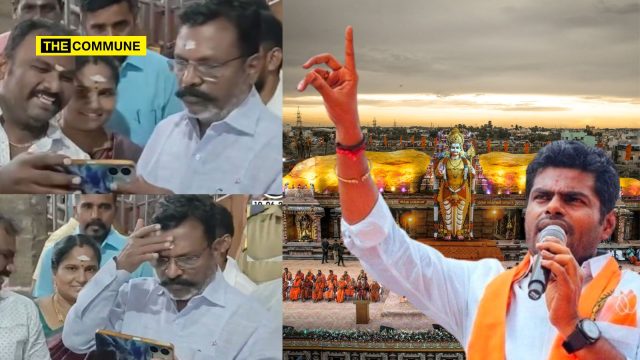
Taking a dig at VCK chief Thirumavalavan who recently was seen rubbing off the vibhuti from his forehead after his visit to a temple, Annamalai said, “Such conferences will continue to be conducted. Whenever a problem arises, we will unite and fight it. But more than that, it is important to be aware of why we are uniting. We must be courageous to wear our religious symbols and markings; there is a necessity to do that now. We are not anyone’s enemy. Even though we are a majority in only two countries, we are not anyone’s enemies. Show that (you are a Hindu) bravely. Recently, an MP, a politician was at Thirupparankundram temple. He is the leader of an important party. He can be seen coming out of the temple after having darshan of the deity, just a few days back. A lady requests him to take a selfie with her. He rubs off the vibhuti from his forehead and takes the picture. The same people will come begging for votes to us for the 2026 elections. Even that day, he will go to the temple. He will even speak about us. Hindus must realise this – that we are no one’s enemy and we must have the clarity that those who we do not consider as enemies consider us as their enemies.”
— PuthiyathalaimuraiTV (@PTTVOnlineNews) June 22, 2025
Thirumavalavan’s act of rubbing off the sacred ash drew criticism from various quarters, with many accusing Thirumavalavan of attempting to distance himself from Hindu symbolism for political or ideological gain but while during the same visit to Thirupparankundram, he proceeded to the nearby Sikkandar Hill dargah, where members of the Muslim community warmly received him and placed a skullcap on his head – an act he accepted with a smile.
Critics labelled this as an example of selective secularism and hypocrisy, arguing that true secularism means either staying equidistant from all religions or treating them equally. Appeasing one religious group while dismissing or disrespecting another, they say, amounts to political opportunism that risks alienating the sentiments of the Hindu community.
"இதற்கு பெயர் தான் மதச்சார்பின்மையா"???🚨
இன்று மதுரை திருப்பரங்குன்றம் சென்றிருந்த திருமாவளவன்,