Home Blog Page 453

NHRC Issues Conditional Summons To Madras University Registrar And UGC Chairman Over Loyola College’s Religious Discrimination In MA Course And Running Illegal Priest Training Institute
loyola college satya nilayam bible college

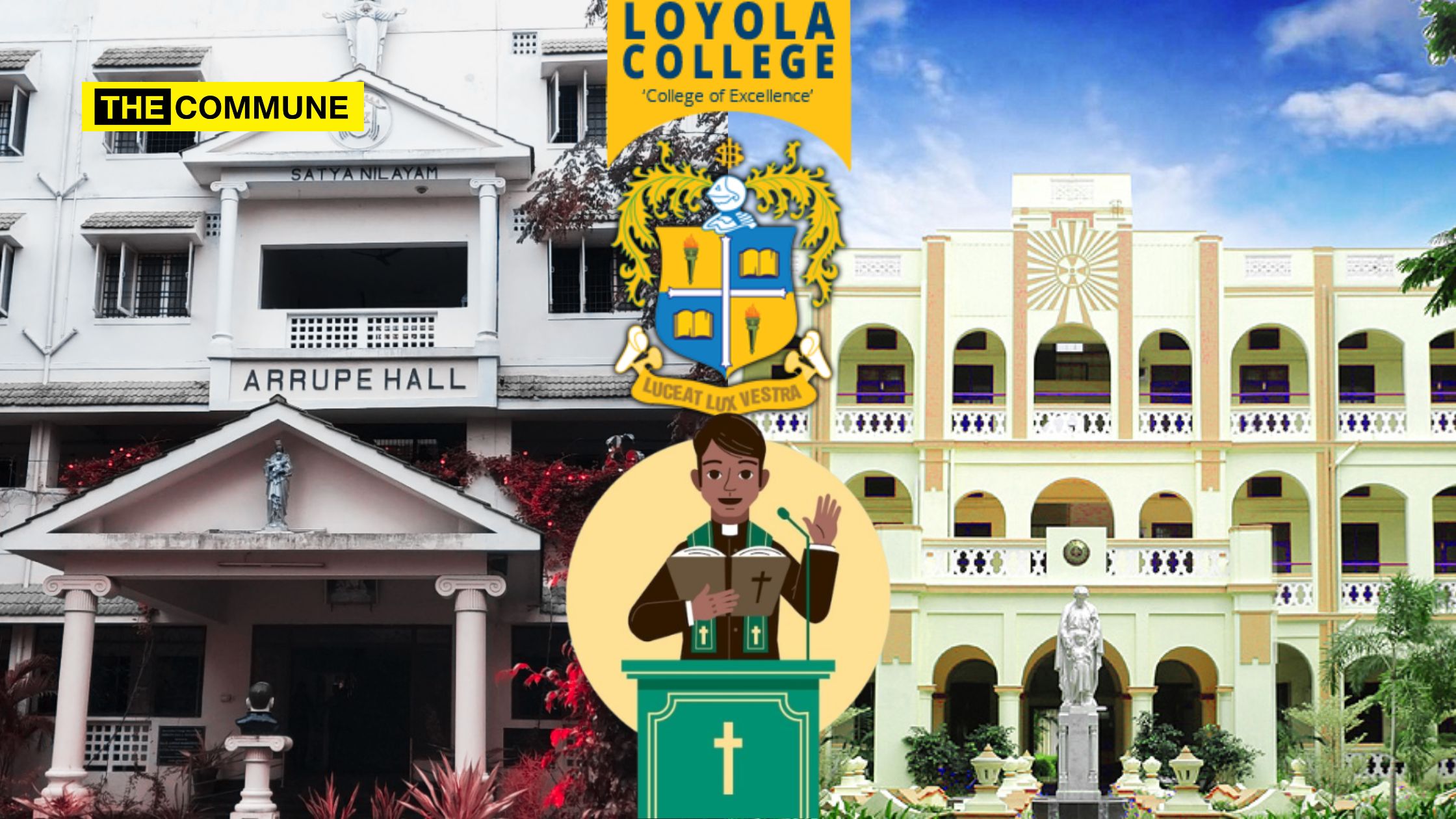
In a significant move, the National Human Rights Commission (NHRC) has issued conditional summons to the Registrar of the University of Madras and the Chairman of the University Grants Commission (UGC), directing them to appear before the Commission on August 19, 2025, at 11:00 AM. This action comes in response to serious allegations of religious discrimination and academic irregularities linked to the M.A. Philosophy programme offered by Loyola College (Autonomous), Chennai, at its off-campus Jesuit institution, Satya Nilayam.

The case stems from a complaint filed by Legal Rights Protection Forum (LRPF). The complaint alleges that the M.A. Philosophy course is being illegally conducted at an unauthorised off-campus centre and discriminates against non-Christian students, thereby violating Articles 15(1) and 29(2) of the Indian Constitution. Furthermore, it claims that Loyola College has been issuing degrees under the false pretense of affiliation with the University of Madras, using its name and emblem to lend credibility to the programme.

Earlier this year, the University of Madras submitted an action-taken report stating that it had appointed an Inspection Commission to investigate the allegations. However, in proceedings dated June 6, 2025, the NHRC expressed dissatisfaction with the report, calling it vague and lacking in substance. The Commission questioned why a second inquiry committee was set up when an inspection had already been conducted and noted that critical findings from the first inspection were not disclosed.

Despite repeated reminders, both the University of Madras and the UGC have failed to provide comprehensive and satisfactory responses. This prompted the NHRC to invoke its powers under Section 13 of the Protection of Human Rights Act, 1993, leading to the issuance of conditional summons. The Commission has made it clear that failure to appear without lawful justification could result in legal action under the Civil Procedure Code, 1908, including the issuance of warrants. However, it has allowed that personal appearance may be avoided if detailed and satisfactory reports are submitted at least a week before the hearing date.

The allegations at the core of this case are serious: running an academic programme without proper affiliation, restricting admissions based on religion, and misusing the University of Madras’ name and logo. The complaint underscores concerns about religious exclusion, institutional fraud, and regulatory oversight in higher education. Documents submitted to the NHRC include copies of previous proceedings dated April 7, May 22, and June 6, as well as follow-up reminders from the complainant dated July 7 and July 21.

With the hearing scheduled for August 19, 2025, all eyes are now on how the UGC and the University of Madras respond. The outcome of this case could have far-reaching implications, not only for Loyola College but also for the governance and accountability of autonomous institutions operating under university affiliations. The Legal Rights Protection Forum has urged the NHRC to take stringent action to protect students’ rights and uphold academic integrity in the country.

Subscribe to our channels on TelegramWhatsApp, and Instagram and get the best stories of the day delivered to you personally.

Loyola College Evades RTI Queries On Don Bosco Paris Collaboration, Responds After Deadline

loyola college don bosco paris rti

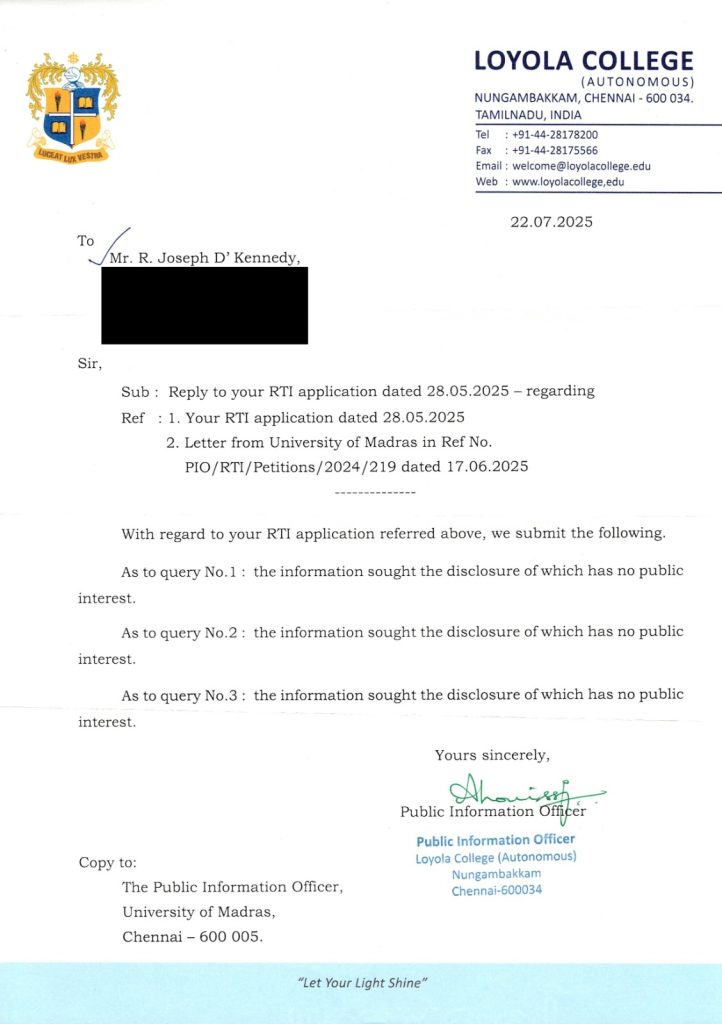
In what appears to be a shocking display of arrogance and deliberate attempt to evade accountability, Loyola College, Chennai has failed to provide clear responses to questions raised under the Right to Information (RTI) Act about its controversial collaboration with Don Bosco International Media Academy (DBIMA), Paris. The college not only issued an evasive reply but also did so beyond the legally mandated 30-day time limit, violating provisions of the RTI Act.

The RTI application, filed by R. Joseph Kennedy, a Loyola alumnus and Christian activist, was originally submitted to the University of Madras (UoM). However, rather than providing a response directly, UoM arbitarily forwarded the RTI to Loyola College — a surprising move, considering that Loyola is an affiliated institution under UoM and not an independent university.

Loyola responded well beyond the time limit stipulated under the RTI Act and has refused to comply with a Right to Information (RTI) query forwarded by the University itself. Shockingly, in its brief reply, the college refused to furnish any of the requested information, citing that the queries “have no public interest.”

“This is absurd,” says Kennedy. “My RTI was submitted to the University of Madras – the competent authority to supervise autonomous colleges – and it was rerouted to Loyola College, which now behaves as if it is a university unto itself. This is more than just another example of Jesuit arrogance, something I’ve seen far too often in the Chennai/Madurai Province. It’s my own Alma Mater openly defying the University of Madras and making a mockery of the RTI process.” Kennedy observed.

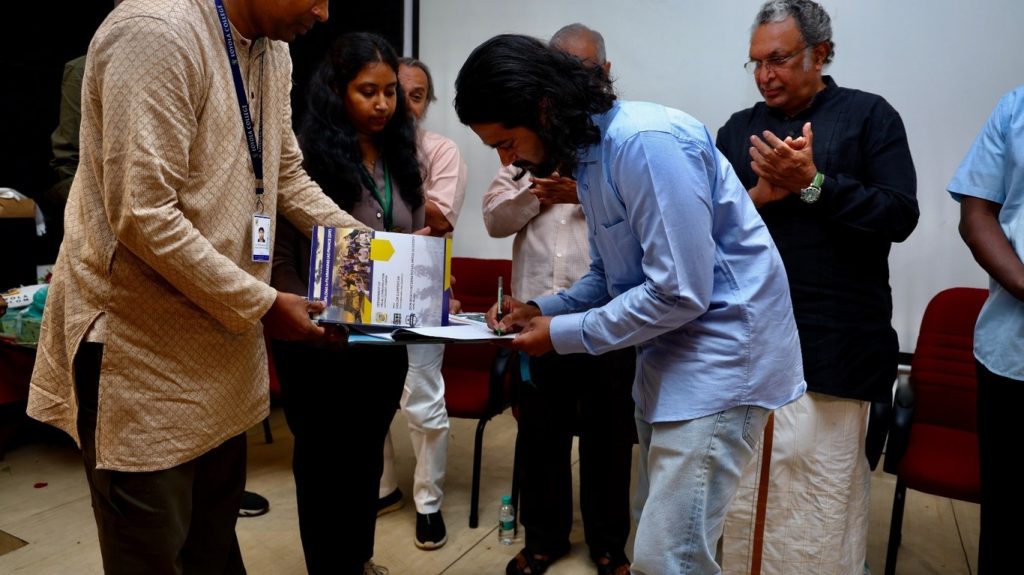
Despite holding public MoU ceremonies and issuing press material in the presence of faculty and students, the college has now claimed in an RTI response that the requested information does not serve any larger public interest. This contradicts its earlier public posturing, where both Loyola and DBIMA, Paris made elaborate announcements and held signing events with students and media presence. Photographs from the event clearly depict Loyola College officials and DBIMA representatives exchanging and signing MoUs.

What’s more disturbing is that Loyola College, which claims to uphold Jesuit values of truth and transparency, has continued promoting the second batch of this foreign diploma program, even as serious questions about its legality, academic recognition, and regulatory clearance remain unanswered.

“This is not an internal Jesuit affair anymore – this is about public accountability, safeguarding the future of students, and defending academic integrity. It seems clear that few corrupt officials within the University of Madras are enabling Loyola College to violate regulations and deceive students. Students are paying lakhs for a diploma that may not be worth the paper it’s printed on.” Kennedy said.

NHRC Takes Cognizance Of Complaint Against Loyola College & Don Bosco Paris

Based on a complaint from The Legal Rights Protection Forum (LRPF), a legal advocacy group, The National Human Rights Commission (NHRC) has officially taken cognizance of a serious human rights violation complaint against Loyola College, Chennai and its foreign partner, Don Bosco International Media Academy (DBIMA), Paris.

LRPF had filed a formal complaint with the University Grants Commission (UGC), Ministry of Education, and the University of Madras against Loyola College, Chennai, accusing Loyola College of running an unauthorized diploma program in filmmaking in collaboration with DBIMA, Paris, thereby violating key higher education regulations and potentially endangering the visa status of Indian students abroad.

This brazen disregard for public accountability and the RTI Act raises serious questions about collusion, regulatory failure, and corruption in Tamil Nadu’s higher education system. The University of Madras is urged to act swiftly and transparently to restore its credibility and take disciplinary action against Loyola College for flouting affiliation rules and obstructing lawful information requests.

Subscribe to our channels on Telegram, WhatsApp, and Instagram and get the best stories of the day delivered to you personally.
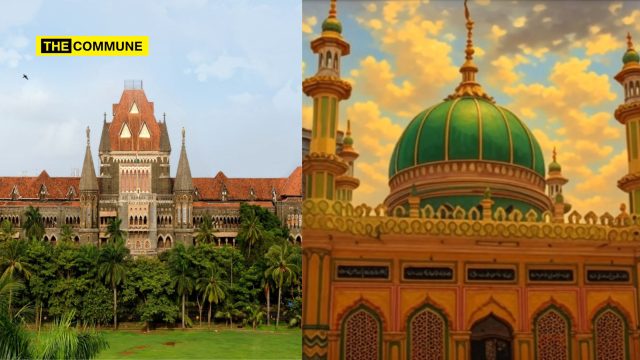
Bombay High Court Says Pardeshi Baba Trust ‘Usurped’ Land, Dismisses Plea To Stop Illegal Dargah’s Demolition

bombay high court dargah demolition thane

The Bombay High Court has dismissed an application filed by the Gazi Salauddin Rehmatulla Hoole alias Pardeshi Baba Trust seeking recall of its earlier order directing the demolition of an allegedly illegal Dargah structure in Thane district. The bench firmly held that mere “mob fury” or “footfall of people” on a piece of land cannot establish the legality of a religious structure.

A division bench of Justices Ajay Gadkari and Kamal Khata, while passing the order on 9 July 2025, noted that the Trust had expanded the structure, originally just 160 sq. ft. to over 17,610 sq. ft. without obtaining municipal permissions or demonstrating lawful ownership of the land. The land in question is privately owned, and the court held that the Trust had “usurped” the property without any valid legal claim.

“In our view, the Applicants have neither paid any consideration for acquisition of the land nor have taken any permission for constructing the structure. It is clearly a usurpation of rights based on a mere Notice publication by the Assistant Charity Commissioner. We find no merit in the contention that, by virtue of a Public Notice by the Assistant Charity Commissioner, one can claim ownership of structures and lands and thereby preempt the rightful owners from claiming the right to their property or objecting to illegal constructions being done on their property,” the court observed.

The High Court had originally passed the demolition order on 30 May 2025, upholding the Thane Municipal Corporation’s (TMC) decision to remove the unauthorised structure. However, following an interim order by the Supreme Court on June 17 granting liberty to the Trust to seek recall of the High Court order, the matter was re-heard.

The Trust argued that the structure existed before 1982 and that only 3,600 sq. ft. of the construction was under question, not the entire 17,610 sq. ft. as addressed in the High Court’s earlier order. However, the bench rejected the submission and reiterated that the Trust failed to prove any legal right over the land or the construction.

“We are unable to accept that a mob fury and the mere footfalls of people on a particular piece of land based on an assertion that, this is a Dargah can prove that it is a legal structure. This is a classic case of a usurpation of the land and such a method and for such a usurpation, the Court cannot grant its imprimatur,” the bench ruled.

The court also pointed out that the civil suit judgment dated April 5, 2025, passed by the Joint Civil Judge (Senior Division) at Thane, had found that the Trust had encroached upon the suit land and failed to prove ownership or adverse possession. In fact, the civil court’s judgment confirmed that the Dargah mentioned in a 1982 government gazette was situated elsewhere, not on the disputed property.

“The Judgment also clearly shows that the Defendants have failed to prove their title to the suit land either by a conveyance or by adverse possession. Interestingly, the Judgment observed that, the contention of the Applicant was that the present Writ Petition was regarding a different property and not the same as Dargah. Therefore, the Applicant has himself admitted that the Dargah pointed out in the Government Gazette of the year 1982 is on a different property and not on the property for which the Writ Petition was filed and Orders were passed,” the bench stated.

The bench further held that the TMC had followed due process and issued notices to the Trust prior to demolition, which were not responded to.  “It is evident that, they have not been able to produce a single piece of evidence to suggest that there was any structure owned or possessed by the Trust. The only contention raised by the Applicant is that, when they issued a Public Notice through the Charity Commissioner claiming ownership of the structure as a Dargah, there were no objections taken by anybody. The Trust being certified was therefore declared as the owner of the structure. This in our view can never be the basis of ownership of any structure on anybody’s land. The Applicants have not produced any document whatsoever to show ownership of the land or the structure at all. In our view, they have encroached upon the land and claimed rights on a structure that was never theirs,” the court remarked.

The judges clarified that entries in land records such as 7/12 extracts do not by themselves confer ownership. “The existence of a structure in a 7/12 extract cannot be evidence of anything whatsoever. Entry in the 7/12 extract cannot and does not prove anything as such,” the court stated.

They added, “Admittedly, there is no permission taken by the Applicants for even a one single square feet of construction. Admittedly, the so-called structure has been increased to a humongous structure of more than 20,000 sq. ft. Such a party in our view cannot claim any equities… He must state and produce all facts and documents on record to prove his ownership as well as the permissions taken for construction of a structure.”

Reiterating the legal position, the bench concluded, “The Trustees entirely failed in proving (i) that, they own the land or (ii) they have taken permissions from the Municipal Authorities to construct even a square inch on the land. In our view therefore, the Applicants have no right over the structure now constructed illegally or even the structure on the Petitioner’s land.”

Accordingly, the court dismissed the application to recall the May 30 order and allowed demolition to proceed.

(With inputs from LiveLaw)

Subscribe to our channels on Telegram, WhatsApp, and Instagram and get the best stories of the day delivered to you personally.
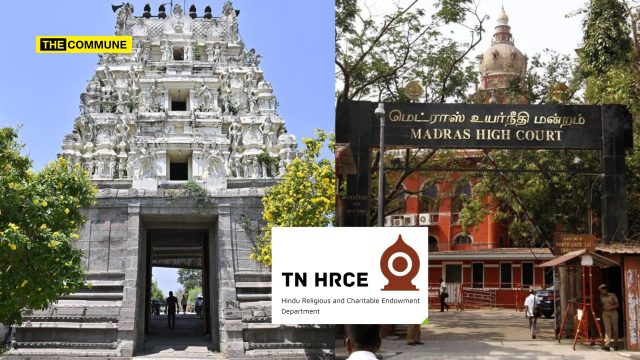
Madras High Court Directs HR&CE Dept To Restore 6th-Century Jalanatheswarar Temple In Thakkolam

thakkolam temple madras high court restoration hr&ce audit temple

In a significant directive aimed at heritage conservation, the Madras High Court on Tuesday ordered the Hindu Religious and Charitable Endowments (HR&CE) Department to undertake immediate restoration and repair of the ancient Arulmighu Jalanatheswarar Temple in Thakkolam, Ranipet district. The court was hearing a Public Interest Litigation (PIL) filed by advocate B. Jagannath, who sought urgent action citing the temple’s deteriorating condition and its historical importance.

The PIL was prompted by a March 2025 report in The Hindu by journalist Kolappan, which highlighted the crumbling northern outer wall, and a derelict temple tank overrun by debris and wild vegetation. The article also noted that the last kumbabishekam (consecration ceremony) was held over 15 years ago.

The petitioner emphasized Thakkolam’s status as a critical heritage site in Tamil Nadu, historically known as Thiruvural, and referenced its deep connection to the Chola dynasty. B. Jagannath pointed out that this was the battleground where Chola crown prince Rajaditya, son of Parantaka I, was killed in 949 CE while fighting Rashtrakutas – a turning point in South Indian history.

The temple, a 6th-century Pallava structure enriched by Chola and Nayak contributions, houses more than 50 inscriptions from the Pallava, Chola, and later dynasties. It is also one of the 275 Paadal Petra Sthalams glorified in the Tevaram hymns. Historians like Nilakanta Sastri and R. Kalaikovan have used these inscriptions to reconstruct Chola chronology. The CISF recently renamed its Recruits Training Centre at Arakkonam in memory of Rajaditya, further underlining the site’s historical prominence.

During the hearing, government counsel representing the HR&CE Department submitted that both the State-Level Expert Committee and Regional Committee had already approved the necessary restoration measures. The High Court recorded this submission and directed Respondents including various senior HR&CE officials- senior officials from the Hindu Religious and Charitable Endowments (HR&CE) Department including the Commissioner and Joint Commissioner (Thirupani HQ) in Chennai, the Joint Commissioner and Assistant Commissioner of Ranipet Division, and the Inspector/Executive Officer of Arulmighu Jalanatheswarar Temple in Thakkolam, to carry out the work within a reasonable timeframe. It also granted the petitioner liberty to approach the court again if there was any undue delay.

The PIL highlighted that urgent repairs were needed not only for the tank and outer wall but also for the rajagopuram and inscription-laden structures, warning that improper methods could permanently erase heritage that has survived over a millennium. Jagannath urged that all work be supervised by expert bodies and possibly the Archaeological Survey of India (ASI), given their heritage conservation experience. He also called for the appointment of an independent monitoring committee, preferably chaired by a retired High Court judge or a senior advocate from Thakkolam.

Subscribe to our channels on Telegram, WhatsApp, and Instagram and get the best stories of the day delivered to you personally.
Agra Conversion Racket: Goa Hindu Girl Converted By Kashmiri Students, Became Part Of Islamist Recruitment Network

conversion racket kashmiri students hindu girl

In a disturbing development, a Hindu student from Goa, identified as SB Krishna, was allegedly drawn into a religious conversion network while pursuing her MSc in Data Science at Panjab University, Chandigarh. The student, now known as Ayesha after her conversion to Islam, was reportedly influenced by a group of Kashmiri students on campus.

According to media reports, the students encouraged her to adopt Islamic practices, such as wearing the burqa and offering namaz. She eventually accompanied them to Kashmir and stayed there for several days, unbeknownst to her family. Concerned by her disappearance, her parents filed a missing person report in Delhi. Krishna later returned from the valley on her own, reportedly disillusioned with the experience.

After being brought back to Goa, her family confiscated her phone in an effort to disconnect her from external influences. However, six months later, she fled again this time to Kolkata where she formally converted to Islam and adopted the name Ayesha. It was in Kolkata that she became actively involved in organizing and raising funds for alleged conversion-related activities.

Wider Conversion Racket Uncovered

Police investigations revealed that Ayesha was part of a broader network operating across multiple states, allegedly led by Abdul Rehman, a key figure arrested in Delhi’s Mustafabad area. Rehman, originally named Mahendra Pal Jadoun from Firozabad, is said to have been working under Maulana Kaleem Siddiqui an Islamic cleric currently serving a life sentence for mass religious conversions.

Authorities have uncovered that Ayesha managed several WhatsApp groups for fundraising and maintained links with individuals involved in the conversion network. During questioning, several digital communications and videos have surfaced, further implicating her in the case.

Converted Individuals Recruited Across India

Five additional individuals, all of whom had converted from Hinduism to Islam, were also arrested in connection with the case. Among them was Mohammad Ali (formerly Piyush Pawar), arrested in Jaipur. He reportedly converted to marry a Muslim woman and later became affiliated with the banned organization Popular Front of India (PFI) through Kaleem Siddiqui.

Another accused, Mohammad Ibrahim (formerly Reeth Banik), was responsible for bringing two sisters from Agra to Kolkata. The sisters, who were later rescued, were believed to have been heavily indoctrinated and trained under Salafi ideologies. One of them even expressed a willingness to become a “Mujahida,” or female jihadist, indicating a deep level of radicalization.

Evidence of Radicalization and Propaganda

Authorities recovered several videos from Ayesha’s phone, including one showing Prime Minister Narendra Modi inaugurating the Ram Mandir, accompanied by an inflammatory voiceover suggesting temples should be demolished. Additionally, images of assault rifles, including AK-47s, were found on the social media accounts of one of the rescued sisters.

During the rescue operation, the sisters initially resisted leaving, claiming they had found their “true purpose.” Police female officers eventually persuaded them to return to their family in Agra. Investigators believe the girls may have been part of an ISIS-linked radicalization module, with significant social media contact between them and Abdul Rehman.

The case file includes documented conversations and digital evidence linking the individuals involved to broader efforts of religious indoctrination and recruitment. Authorities continue to investigate the network and are working to identify and support other possible victims.

(With inputs from OpIndia)

Subscribe to our channels on TelegramWhatsApp, and Instagram and get the best stories of the day delivered to you personally

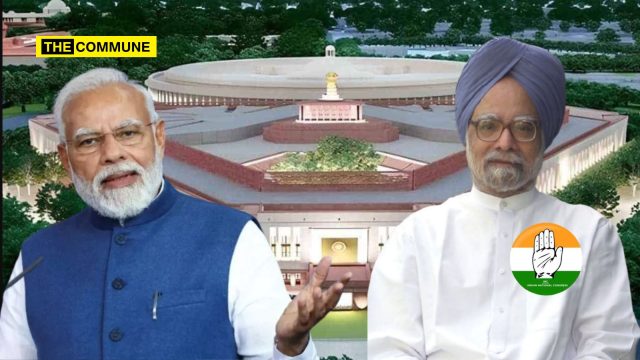
Frequently Absconding PM Was Manmohan Singh: Went Abroad 13 Times During 8 Out Of 11 Parliament Sessions In UPA-2 Period

congress pm modi

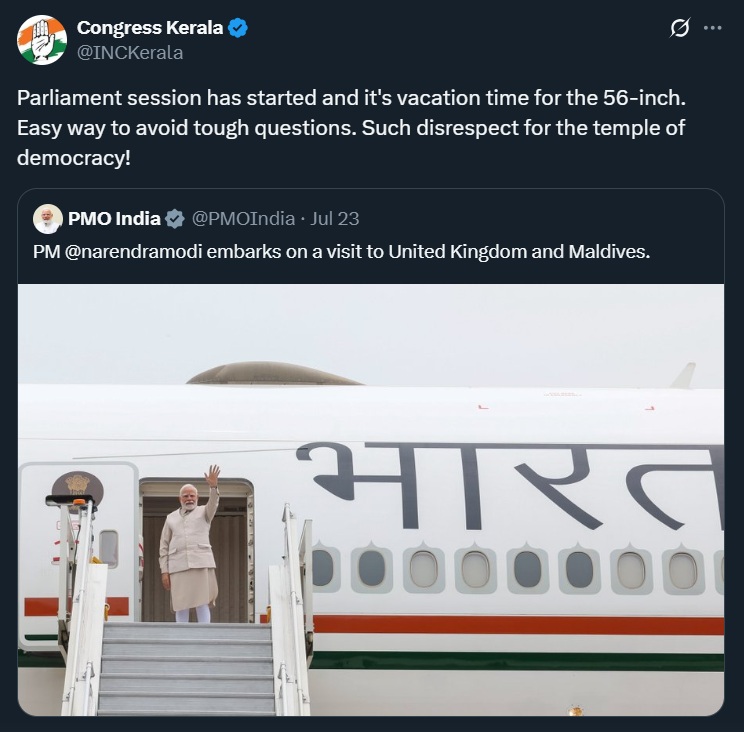
Congress has drawn criticism and ridicule once again after posting a jab on social media aimed at Prime Minister Narendra Modi’s diplomatic visits to the United Kingdom and Maldives, both pre-scheduled engagements.

Attempting to suggest that the Prime Minister times his foreign trips to coincide with the start of Parliament sessions, the party posted on X on 23 July 2025 stating, “Parliament session has started and it’s vacation time for the 56-inch. Easy way to avoid tough questions. Such disrespect for the temple of democracy!”

However, this accusation doesn’t hold up under scrutiny. According to the PRS Legislative Research, the Prime Minister, as a minister, is not required to sign the Parliament attendance register. As such, no official attendance records exist for him as they do for regular Members of Parliament.

Union Minister for Parliamentary Affairs Kiren Rijiju also clarified that Prime Minister Modi maintains one of the highest participation rates in Parliament, attending sessions regularly except when abroad on official duty. Rijiju added that Modi is always present during Question Hour when matters related to his ministry are discussed.

Double Standards?

Critics also pointed out Congress’s double standards, highlighting that during Dr. Manmohan Singh’s tenure as Prime Minister, foreign trips during Parliament sessions were quite common. An RTI response from the Prime Minister’s Office revealed that 15 out of 36 of Dr. Singh’s foreign visits occurred while Parliament was in session.

In fact, a review of UPA-II’s record shows that the Prime Minister traveled abroad during eight out of the 11 Parliament sessions analyzed missing as many as 35 working days. In 2010 alone, during the Budget session, Dr. Singh undertook three separate foreign tours. During the winter session of that same year, he missed four days of proceedings while traveling to South Korea, Belgium, and Germany even as Parliament was stalled over the opposition’s demand for a JPC probe into the 2G spectrum scam.

In contrast to the Congress-led UPA government’s approach during challenging times, Prime Minister Narendra Modi, returned from his official two-nation visit, promptly joined the Rajya Sabha debate. He not only participated but also agreed to the Opposition’s demand for a 16-hour discussion on Operation Sindoor and its aftermath.

This historical context raises questions about the Congress’s current criticism and whether it overlooks its own party’s past practices.

Subscribe to our channels on TelegramWhatsApp, and Instagram and get the best stories of the day delivered to you personally

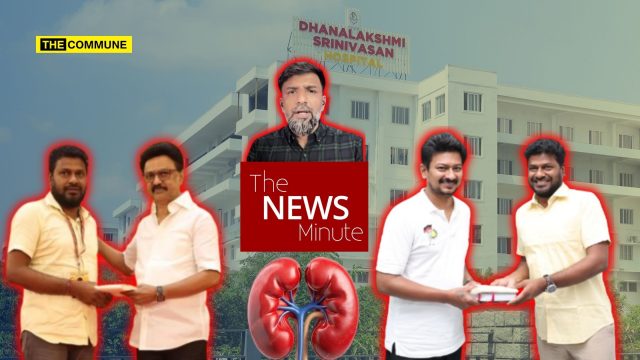
Tamil Nadu Kidney Trafficking Racket: DMK Functionary Key Accused, DMK MLA’s Hospital Involved But TNM Whitewashes The Facts To Blame Aadhaar, Modi And What Not!

tnm the news minute shabbir ahmed kidney trafficking racket scandal scam dmk namakkal trichy

A major kidney trafficking racket has come to light in Tamil Nadu. The main accused? A DMK functionary named Dravida Anandan, now absconding. The hospital where illegal transplants were allegedly carried out? Dhanalakshmi Srinivasan Medical College and Hospital in Namakkal, owned by DMK MLA A. Kathiravan.

Victims have come forward admitting they were paid ₹5 lakh in exchange for their kidneys.

When officials raided Anandan’s residence, they found forged documents, government seals, and even official-looking uniforms—indicating that the racket may have operated under a façade of legitimacy. There’s suspicion that some of the harvested kidneys were trafficked across state lines, and possibly smuggled into Sri Lanka.

Authorities say the true scale of the operation—and the involvement of hospital staff or other middlemen—will only be clear once Anandan is caught. But that may take time. Most of the women involved are too afraid to file complaints, fearing police cases and social backlash.

This should have been a clear-cut story about political-criminal nexus, abuse of medical systems, and state failure.

Instead, The News Minute ran a 30-minute episode titled ‘In Public Interest’, that never once mentioned either the DMK MLA or the accused DMK functionary. No names, no political affiliations, no direct accountability. The entire focus? Poverty, Aadhaar, and Modi.

Let’s break down how TNM whitewashed the issue.

Ignoring Key Facts, Erasing Political Nexus To Protect DMK?

While the interview with Dr. Shanthi of the Doctors Association for Social Equality touched on broader concerns around organ trafficking, Despite the main accused being a DMK insider and the hospital belonging to a DMK MLA, TNM conveniently omits this. Host Shabbir Ahmed vaguely says “Two private hospitals, one in Tiruchi and another one in Namakal have come under the scanner for allegedly facilitating illegal transplants.” –  as if this is just some generic medical lapse. No attempt is made to ask the obvious: How does a DMK-run hospital become the hub of a trafficking racket?

Instead, the discussion meandered into unrelated topics such as,

  • Aadhaar’s alleged flaws, despite the same system being previously criticized by leftist ‘liberals’ for “privacy violations.” Now, it’s suddenly the root cause of fake documents in organ trafficking.
  • Modi’s free ration scheme, bizarrely dragged into the debate as if poverty alleviation programs are somehow responsible for illegal organ trade.
  • Gujarat’s surrogacy industry, a random detour that served no purpose other than to take an indirect swipe at BJP-ruled states.
  • Demands to “strengthen public health in GDP,” a hollow, jargon-filled suggestion that does nothing to address the immediate racket or hold the guilty accountable.

While the speaker’s demand for public health reforms, calling for more dialysis centers and proper utilization of doctors is valid, both the interviewer Shabbir and the interviewee Dr Shanthi failed to demand criminal prosecution for the hospital directly implicated.

A Biased Speaker, A Convenient Narrative

Dr. Shanthi’s interview was riddled with politically convenient arguments while conveniently sidestepping the DMK’s glaring failures:

No mention of the DMK government’s inaction – Despite repeated cases of illegal organ trade in Tamil Nadu, the MK Stalin-led administration has done little to enforce stricter regulations or punish offenders.

No scrutiny of DMK-linked accused – The primary suspect is a DMK functionary, and the hospital in question belongs to a DMK MLA. Yet, TNM failed to question the state government’s role or possible complicity.

The highlight of the episode is just this apart from blaming PM Modi’s welfare schemes (free ration) and fake Aadhar racket.

What the Episode Actually Does

The TNM episode turns a criminal racket into a soft-focus “public health” story. The angle is that this is not a scandal, but a symptom of economic distress. While poverty is undoubtedly a factor in organ exploitation, this framing deliberately avoids the hard questions:

  • How did a DMK-run hospital enable illegal surgeries?
  • What role did the Health Department play in ignoring red flags?
  • How deep is the political protection that allowed this racket to thrive?
  • Why were inspections so lax in a hospital owned by a ruling party MLA?

By blaming “systemic issues,” The News Minute sidesteps the real, named, and politically connected individuals who should be investigated and arrested. The only winners from this deflection are the DMK party brass, the hospital management, and the brokers and agents who now get to hide behind a fog of socio-economic theory.

TNM claims to speak “in public interest,” but this episode is exactly what we call narrative manipulation. A DMK-linked hospital runs a criminal organ racket, a DMK functionary is the key accused, and TNM runs a segment that doesn’t name a single guilty party but blames Modi and all things sundry!

It is willful dereliction of duty. And it insults both the victims of the racket and the intelligence of the audience, basically political laundering.

Subscribe to our channels on Telegram, WhatsApp, and Instagram and get the best stories of the day delivered to you personally.
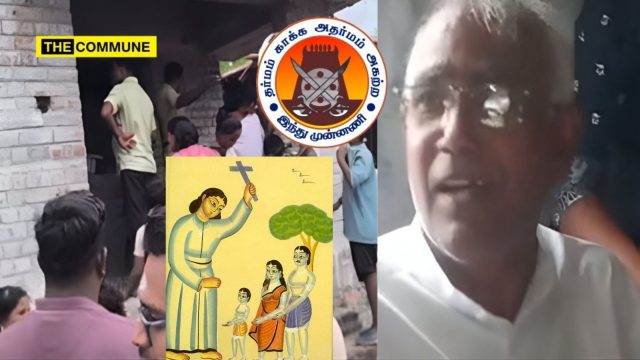
Hindu Munnani Thwarts Alleged Christian Missionary Attempt To Convert Narikuravar Community In Thuraiyur, Trichy

The Hindu Munnani has successfully thwarted an alleged attempt by Christian missionaries to convert members of the Narikuravar a semi-nomadic tribal community near Thuraiyur in Trichy district.

The incident occurred in Madurapuri panchayat, where over 300 Narikuravar individuals reside. The Hindu Munnani, reportedly received information that efforts were underway to convert locals to Christianity.

Upon visiting the area, they found that a preacher identified as Vincent was actively engaging with the community. Tensions rose when Hindu Munnani members confronted the preacher, leading to a heated exchange between both sides.

Local police arrived at the scene and, after issuing a warning to the preacher, asked him to leave. Following the incident, Hindu Munnani has urged authorities to take strict action against those attempting religious conversions within vulnerable communities like the Narikuravars.

Against this backdrop, Hindu Munnani has called on the government to enact an anti-conversion law. The organization also appealed to the Hindu community to actively oppose and resist the aggressive conversion efforts by Christian missionaries.

Subscribe to our channels on TelegramWhatsApp, and Instagram and get the best stories of the day delivered to you personally

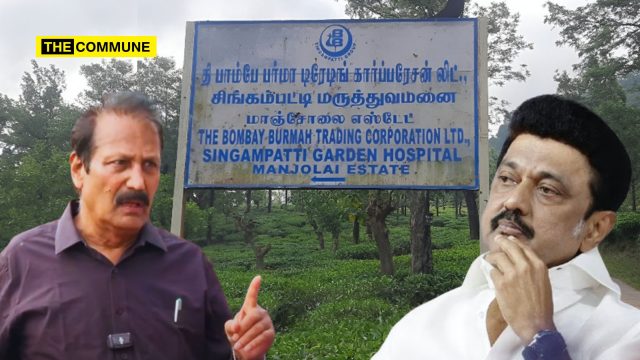
“These Are Citizens, Not Squatters”: Puthiya Tamilagam Chief Krishnasamy Slams DMK Govt For Forcing Out Manjolai Workers Despite Lease Till 2028

puthiya tamilagam manjolai workers

Puthiya Tamilagam Party leader Dr. K. Krishnasamy has accused the Tamil Nadu government of pressuring tea estate workers in Manjolai to vacate their homes by cutting off essential services. He claimed that over 350 families still live in the area and commute to the plains for work. Dr. Krishnasamy made these remarks while attending the 26th anniversary of the Manjolai labor massacre, where he paid tribute to the victims by offering flowers in the Thamirabarani River.

Addressing the media, he condemned the alleged violence against those protesting for land and human rights in Tirunelveli. He also revealed that a formal request had been made to allocate land near the river to build a memorial for those who lost their lives during the protest. “We are willing to construct the memorial with our own resources, but the government has yet to grant permission,” he said.

Dr. K. Krishnasamy claimed that the state is pushing out Manjolai residents prematurely despite their right to remain until 2028 by denying them essential amenities such as clean drinking water. In response, his party has taken the matter to the Supreme Court, where the case is currently pending.

Dr. K. Krishnasamy said, “They are entitled to rights under the 2006 Forest Rights Act, but the Tamil Nadu government is blindly claiming the act doesn’t apply to them. However, according to the 2006 Forest Rights Act, if a person has lived in a hilly area for over 25-30 years, that’s enough. They could even be a government employee working 100 kilometers away; as long as they’ve lived within the forest area, the law mandates they be granted residence there under the Forest Rights Act. But this government is turning a blind eye. I’ve argued this point at the High Court over ten times, and we even went to the Supreme Court, where the case is still pending. In the interim, we’ve lodged a complaint with the National Human Rights Commission.”

He added, “These people deserve basic rights, even setting aside land allocation for a moment. First and foremost, they are citizens of this state, and it’s the government’s responsibility to provide them with drinking water. This government was elected by these very people; you are not separate from them. While air comes naturally, the government has a responsibility to provide drinking water, electricity, transportation, and telecommunication facilities. Similarly, they should provide education and healthcare. Instead, they have slowly dismantled all these facilities, demolishing schools and closing hospitals. Furthermore, there is no legal provision in any law to evict the workers here before the 2028 agreement with BBTC expires.”

Dr. K. Krishnasamy accused Chief Minister M.K. Stalin of perpetuating injustice and warned that history will not forget such actions. He said, “They have every right to live there and every right to access all necessary facilities. Despite this, the son of the person who committed such an injustice against them in ’99 is now there (holds a position of power) harbors resentment and is trying to inflict another injustice upon them. History is filled with those who have committed such atrocities, and my plea is that Stalin should not be on that list. This government might use the police to forcibly evict the workers by cutting off their water, electricity, and transportation. However, history will never forgive them. We, as the Puthiya Thamizhagam party, will not accept such forced evictions. Millions of people are ready to do whatever it takes for this cause.”

Calling for the proper implementation of the Forest Rights Act of 2006, he demanded that each eligible family in Manjolai be allotted two acres of land. He pointed out that Parliament has acknowledged the allocation of 1.73 lakh hectares of forest land for other uses, arguing that Tamil Nadu should follow suit.

He strongly criticized the Chief Minister, accusing him of betrayal and warning that such actions would not be forgotten. “If the government insists on writing the final chapter for Manjolai, then the people will write the final chapter for this administration in the next assembly elections,” Dr. Krishnasamy declared.

(With inputs from Hindu Tamil)

Subscribe to our channels on TelegramWhatsApp, and Instagram and get the best stories of the day delivered to you personally

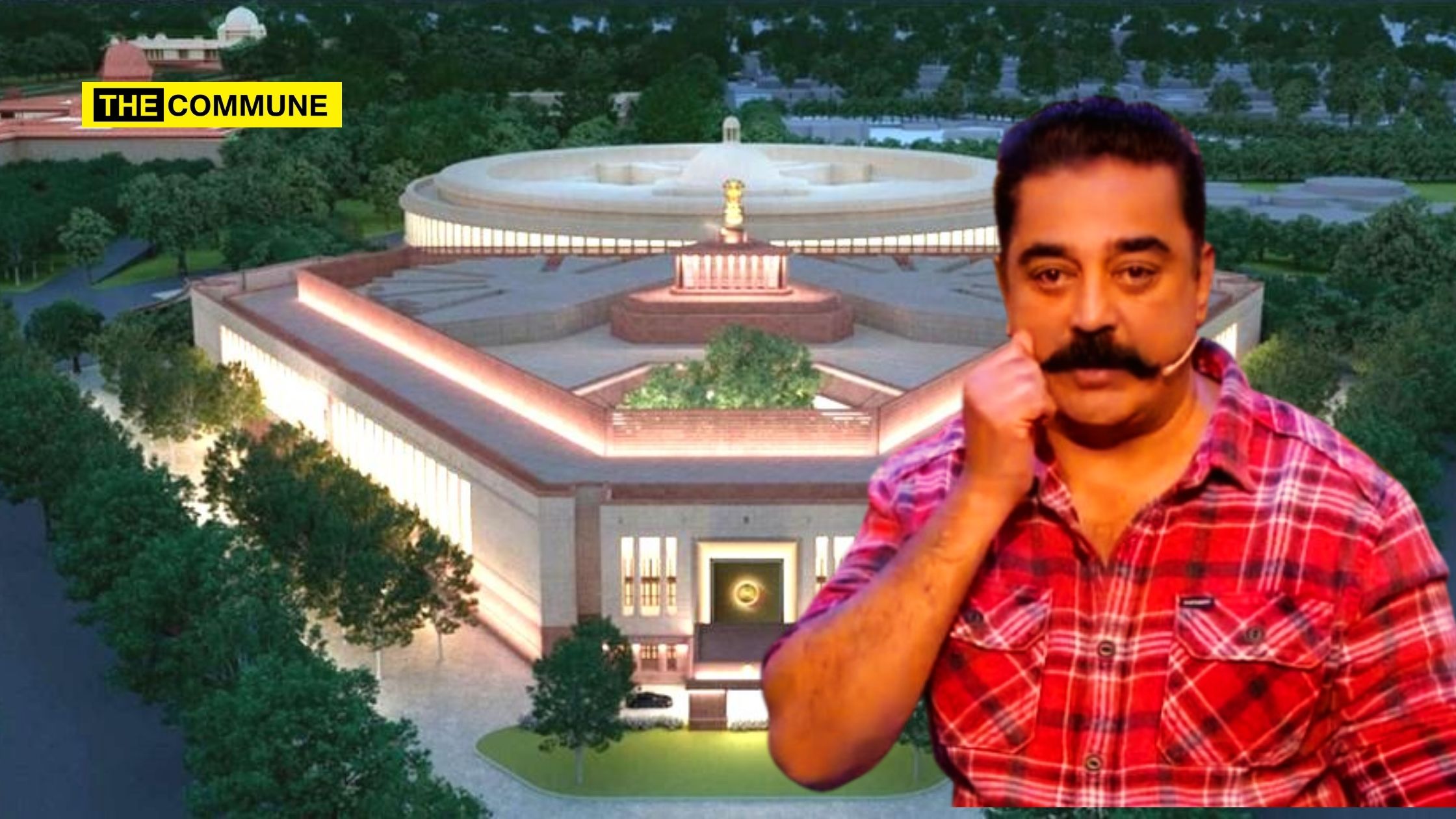
DMK Stooge Kamal Haasan To Take Oath In Rajya Sabha Today, Says He’ll ‘Fulfil Duty With Honour As An Indian’

kamal haasan dmk stooge

Actor-turned-politician and Makkal Needhi Maiam (MNM) chief Kamal Haasan, a well-known DMK stooge, is all set to be sworn in as a Member of Parliament in the Rajya Sabha on Thursday, 24 July 2025, marking his official entry into the Upper House of Parliament with the backing of the ruling DMK.

Speaking to reporters ahead of the swearing-in ceremony, Haasan said, “I am going to take the oath and register my name in Delhi today. I am going to fulfil this duty with honour given to me as an Indian.”

The MNM founder’s nomination to the Rajya Sabha comes as part of a political arrangement with the DMK-led alliance, which MNM formally joined in March 2024. In the run-up to the 2024 Lok Sabha elections, MNM chose not to contest and instead campaigned in support of the DMK and its allies. In return, the DMK allocated one of its Rajya Sabha seats to Haasan, a move that solidified MNM’s alignment with the ruling coalition and effectively ensured his unopposed election, given the alliance’s strength of 158 MLAs in the 234-seat Tamil Nadu Assembly.

Kamal Haasan’s political ascent to the Rajya Sabha comes despite MNM’s limited electoral footprint. The party secured just around 4 percent of the vote in the 2019 Lok Sabha elections and won 2.62 percent in the 2021 Tamil Nadu Assembly elections, where Haasan himself narrowly lost the Coimbatore South seat to BJP’s Vanathi Srinivasan. Nevertheless, the DMK rewarded his support with an Upper House seat following the 2024 alliance.

Haasan filed his nomination on 6 June 2025, in an event held at the Tamil Nadu Secretariat in Chennai. The ceremony was attended by top DMK leaders including Chief Minister M.K. Stalin and Deputy Chief Minister Udhayanidhi Stalin, along with representatives of alliance partners such as VCK’s Thol. Thirumavalavan, MDMK’s Vaiko, and Tamil Nadu Congress president K. Selvaperunthagai.

However, Haasan’s nomination stirred debate given the timing and symbolism surrounding the event. A vocal rationalist and frequent critic of religious customs, Haasan has previously declared that “saffron is the colour of violence” and openly dismissed religious rituals as “superstitious nonsense.” Yet, his nomination was filed on what astrologers deemed an auspicious day and notably after the inauspicious Rahu Kalam period ended, prompting criticism of hypocrisy from observers who noted the contradiction between his rationalist rhetoric and apparent adherence to astrological customs.

Critics point out that MNM’s vote share in past elections would not have merited a Rajya Sabha seat under normal democratic circumstances, but that political patronage secured Haasan’s entry.

(With inputs from News18)

Subscribe to our channels on Telegram, WhatsApp, and Instagram and get the best stories of the day delivered to you personally.