On 30 July 2025, Australian Prime Minister Anthony Albanese announced that children under the age of 16 will be banned from using social media platforms, including YouTube, starting in December 2025. Citing a government report revealing that 37% of minors had been exposed to harmful content on YouTube, he stressed the urgent need to protect children online and declared that the time had come for decisive action.
This report compiles 10 instances from 2018 to 2025 in which various countries around the world have implemented bans, strict regulations, or precautionary measures to limit social media use among teenagers.
#1 Australia to Ban YouTube for Minors Under 16
On 30 July 2025 announced that starting December 2025, Australia will ban children under 16 from accessing YouTube, adding the platform to its existing restrictions on Facebook, Instagram, Snapchat, and TikTok. The move follows a government report that found 37% of minors exposed to harmful content. Platforms that fail to comply could face fines up to $49.5 million (₹432.8 crore), according to Prime Minister Anthony Albanese.
#2 United States: State-Level Restrictions Take Hold
While the U.S. has no federal ban, states like Florida, Utah, and Texas have introduced laws requiring parental consent or setting minimum age for social media use. These laws often target TikTok, Instagram, and YouTube, with restrictions on data collection for users under 13. The fragmented approach reflects growing national concern over teen safety online.
#3 Netherlands Sets 15 as Recommended Minimum Age
On 18 June 2025, the Dutch government issued official guidelines advising that children under 15 should avoid social media altogether. While not a legal ban, the move is supported by surveys showing teens themselves are open to such restrictions with 69% of Dutch youth in favor of age limits. Recommendations also include limiting screen time to 3 hours and delaying smartphone use until the last year of primary school.
#4 Greece Launches ‘Kids Wallet’ App for Parental Control
In May 2025, Greece introduced “Kids Wallet,” a government app that lets parents verify age and monitor children’s internet use. Integrated with Greece’s digital ID and tax systems, the app supports enforcement of the legal digital consent age of 15. The measure aligns with broader EU goals for a safer internet for children.
#5 Italy Requires Parental Consent for Under-14 Users
In December 2024, Italy mandated parental permission for children under 14 to use any social media platform. Yet, enforcement remains a challenge. Reports from Italy’s Higher Health Institute reveal that many teens still use social media daily, and nearly 40% of 13-year-old girls show signs of problematic usage.
#6 UK Bans Social Media for Children Under 16
Under the Online Safety Act, the UK bars children under 16 from accessing social media. The November 2024 decision marked a major shift, with Technology Secretary Peter Kyle pledging further research into the mental health impacts of smartphones. The policy signals a national effort to prioritize online safety for youth.
#7 Norway Raises Age Limit to 15
In October 2024, Norway increased the minimum age for social media use from 13 to 15. Prime Minister Jonas Gahr Støre stressed the vulnerability of young minds to online pressure and labeled the decision a necessary, if difficult, step toward child protection.
#8 France Pushes EU-Wide Age Restrictions
Since June 2023, French law requires platforms to verify users’ age and secure parental consent for anyone under 15. Violations can result in fines up to 1% of a company’s global revenue. President Macron has called for a unified European regulation setting 15 as the minimum age for social media access with parental approval.
#9 Germany Upholds Parental Consent Law for Teens
Since November 2024, Germany mandates that users aged 13 to 16 can only access social media with parental consent, in accordance with GDPR. However, enforcement is difficult as many teenagers bypass age-verification systems, leading child protection groups to call for stronger implementation.
#10 Belgium Sets Minimum Age for Social Media at 13
Belgium enacted a minimum age limit of 13 for social media in March 2018. According to Child Focus, this reflects reality more than restriction, as 83% of 13–14-year-olds in Belgium are already online. The law, led by Philippe De Backer, aims to bring transparency and accountability to teenage online activity.
Subscribe to our channels on Telegram, WhatsApp, and Instagram and get the best stories of the day delivered to you personally.
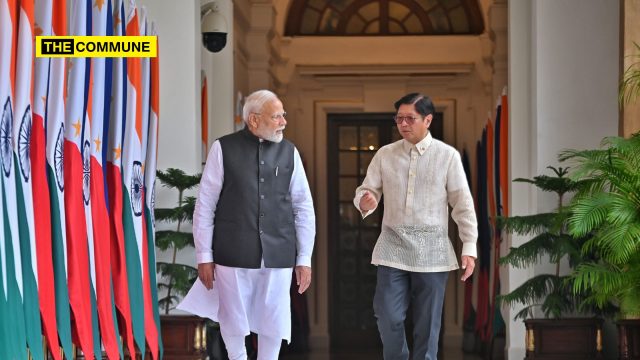
Philippines President Ferdinand R Marcos Jr. on 5 August 2025, expressed readiness to work with India towards a free and open Indo-Pacific while expressing satisfaction over the rapid pace of the Philippines ongoing defence modernization and the expanding capabilities and footprint of India’s indigenous defence industry as a partner in this undertaking that is exemplified by the Brahmos project.
Making a joint press statement with PM Modi following their bilateral discussions at the Hyderabad House in New Delhi, Marcos announced that the two nations will foster naval and coast guard interoperability via more port calls in cooperative activities and capacity building in the maritime sector. “We agreed to continue leveling up our collaboration in defence and security. We expressed satisfaction over the rapid pace of the Philippines ongoing defence modernization and the expanding capabilities and footprint of India’s indigenous defence industry as a partner in this undertaking exemplified by our Brahmos project. We concurred that we should be accompanied with intensified dialogue and exchanges between our defence establishments. So, we have agreed to establish mechanisms for service-to-service talks for information sharing and training exchanges amongst our militaries,” he said.
“We will foster naval and coast guard interoperability via port calls in cooperative activities and capacity building in the maritime domain. The economic sphere has been a steady engine driving our ties for seven-plus decades… We have decided to expedite the work that we are doing to forge a bilateral preferential trade agreement. We looked at leveraging mutual opportunities to boost two-way investment. Our fast growing innovated private enterprises will play an important role in our common march towards progress and development, facilitating innovation, technology transfer, and upskilling and generating employment for our people,” the Philippines President added.
Thanking the Indian Navy for rescuing Philippines citizens following a Houthi rebel attack last year, he stated that ties between two nations have entered a new epoch as he and Prime Minister Narendra Modi on 5 August launched the strategic partnership between the longstanding partners. The visiting leader also expressed the Philippines’ full solidarity with India over the heinous 22 April Pahalgam attack.
“As emissaries of our people, I bring with me the enduring friendship of the Filipino nation. I carry the message of our solidarity with India both over the tragic attack in Pahalgam earlier this year and in the broader fight against terrorism. Despite these challenges, I also bear felicitations on India’s remarkable transformation and inexorable march to become Vikit Bharat by 2047 under Prime Minister Modi’s guiding hand,” he said. He announced India and the Philippines have agreed to level up collaboration in defence and security, stating that India has become the fifth strategic partner for Philippines and emphasised that this new apex showcases the rapid growth and deepening of the bilateral ties.
“I again thank the Indian people and the brave men and women of the Indian Navy through Prime Minister Modi for your kind rescue of our nationals in 2024 after a Houthi rebel attack. We recognise India’s influence as first responder role in this critical area and we want to work with you for a free and open Indo-Pacific. We both have high stakes in the future of our Indo-Pacific region and in the world. The Philippines-India strategic partnership will doubtless resonate beyond the confines of our bilateral relationship. Prime Minister Modi and I have committed to bring our collaboration to bear on shared concerns. A free, open and inclusive Indo-Pacific region, security and rule of law in the maritime commons. supply chain resilience, food security, countering terrorism and other traditional and non-traditional threats,” he added.
The visiting leader thanked PM Modi for India’s support on the peaceful settlement of disputes and adherence to international law, especially the United Nations Convention on the Law of the Sea (UNCLOS) and the 2016 arbitration award on the South China Sea. He stated that India and the Philippines have also decided to expedite the work to forge a bilateral preferential trade agreement. “I come at a crucial juncture in our bilateral partnership. Today, our relationship enters a new epoch as Prime Minister Modi and I formally launched the strategic partnership between Philippines and India. For the Philippines, this is a momentous decision for we take a very considered path to such elevated partnerships. Today, India becomes only the fifth strategic partner for the Philippines. This new apex attests as much to the remarkably rapid growth, broadening and deepening of our 75-year-old bilateral relationship. The possibilities represented by the strong upward trajectory of our true economies as it does to the growing alignment of our interests and views on the challenges and imperatives of our time. This was also the auspicious context in which Prime Minister Modi and I engaged in far-reaching, productive and forward-looking discussions this past hour,” he said.
-IANS
Subscribe to our Telegram, WhatsApp, and Instagram channels and get the best stories of the day delivered to you personally.
“Tamil civilization was non-religious. Ancient Tamils were secular. Keezhadi excavations prove that Tamils have no connection with Hinduism.” – These are the kind of narratives that gets churned out by the DMK and its Dravidianist ecosystem in the media, academia and government. Notably, archaeologists K. Amarnath Ramakrishna who has been spearheading the Keezhadi excavations has been claiming that there was no evidence of religious symbols at the site which implying the ‘secular’ nature of the Tamil civilization.
However, a 2023 ground report by PoliTalks channel has revealed stunning evidences. The video evidence suggests that connections to Hindu faith near the site are being concealed, despite visible remnants of temples and idols just 100 meters from the dig location.
Since the Keeladi excavations began, they have revealed significant historical insights into ancient Tamil civilization. However, one point has been repeatedly emphasized: that no evidence of religious practice or worship has been found at the site. This has led to the assertion that Sangam-era Tamils lacked deities, spirituality, or any form of worship associated with Hinduism. But an on-site investigation by Team PoliTalks appears to contradict this narrative.
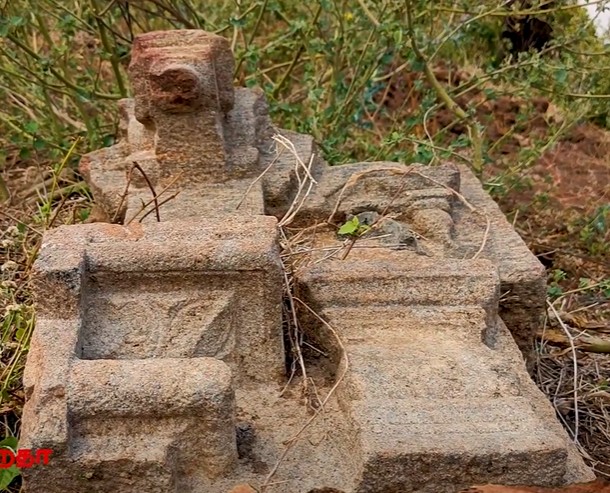
Their findings indicate that only a small section of what was likely a much larger city has been excavated. Crucial information could still lie in the unexcavated surrounding areas. Notably, within a 400-meter radius of the current site, there are visible signs of what appears to be a large temple complex. These include the top portion of a stone pillar, the foundation base of a temple, a half-buried Vishnu idol, and sculptures of other deities. Scattered large stones and column-like structures further indicate the presence of a grand temple that once stood in the area.
In addition to the presumed Shiva temple ruins, within just 100 meters of the main excavation zone, several idols can be found discarded, lying in debris or partially buried—prompting further concerns about the selective focus of the archaeological documentation.
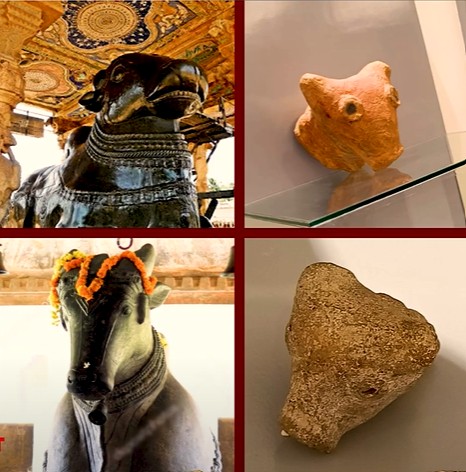
Three specific artifacts found directly at the Keeladi site also stand out:
A figurine of a bull’s head
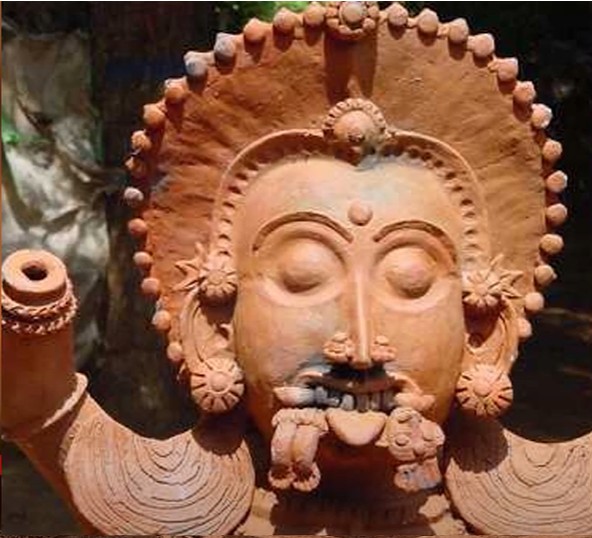
A female terracotta figure with a wide mouth and prominent teeth
A coral piece engraved with a pig’s image
These items have raised cultural and historical questions. The female figurine closely resembles depictions of Goddess Neeli, revered as a guardian deity of Madurai. The pig engraving is seen as potentially referencing a legend in which Lord Shiva assumes the form of a boar during his divine acts in Madurai. The bull’s head is believed by some to symbolize Nandi, the mount of Lord Shiva.
Despite these findings, researchers have reportedly overlooked these artifacts in discussions surrounding Keeladi. Critics argue that there has been little to no academic acknowledgment of the site’s spiritual or religious aspects. This concern extends to the recently inaugurated Keeladi Museum, which contains no mention or display of Tamil religious beliefs, practices, or associated artifacts from the site.
Allegations continue to circulate that ideological leanings particularly from Dravidianist circles are influencing the framing of Keeladi’s history, promoting a narrative that ancient Tamils had no connection to Hinduism or religious worship. The exclusion of religious evidence, despite the presence of idols, temple ruins, and supporting Sangam literature, should now become a central point the debate over the portrayal of Tamil heritage.
Subscribe to our Telegram, WhatsApp, and Instagram channels and get the best stories of the day delivered to you personally.
A few days ago, a video of a violent altercation between an Indian Army officer and SpiceJet ground staff at Srinagar Airport triggered public outrage and sparked the social media trend #BoycottSpiceJet, as conflicting versions of the incident continue to emerge.
The confrontation, partially captured on video and now widely circulated online, reportedly occurred over a dispute about excess cabin baggage. According to SpiceJet’s official complaint, the army officer attempted to carry 16 kg of hand baggage, well above the permitted limit, and allegedly refused to pay for the excess weight. The airline accused the officer of assaulting four staff members, claiming one suffered a spinal fracture while another sustained facial injury.
However, alternative accounts have surfaced challenging this version. Eyewitnesses quoted in multiple reports alleged that the officer was carrying only 8 to 9 kg in cabin baggage, which had already been cleared at check-in. They stated that he was traveling on emergency family leave and that tensions escalated only after he was allegedly mocked by SpiceJet staff and subsequently denied boarding when the gate was shut on him.
Following the denial, the officer allegedly punched a staff member. In response, multiple airline employees are reported to have assaulted him. During the scuffle, the officer was seen picking up a queue divider, reportedly in self-defence. The incident reportedly occurred on 26 July 2025, 9 days prior to the video surfacing.
After the footage gained traction online, SpiceJet filed an FIR and reportedly urged that the officer be blacklisted from flying. The Central Industrial Security Force (CISF), which handles airport security, has stated that it will take appropriate action following the investigation.
The Indian Army issued a statement emphasizing that it upholds the highest standards of discipline and is cooperating fully with the inquiry. However, the incident has prompted a wave of criticism on social media, especially from army veterans and supporters who accuse SpiceJet of disrespecting and mishandling a serving officer.
However, airline staff being rude is not an uncommon occurrance, especially with SpiceJet. The airline was once owned by the relatives of the DMK first family – Kalanidhi Maran.
Let us take a look at few other instances of rude staff behaviour of the same airlines. Many of these instances go unreported, so in this report we bring to you instances that have appeared online on social medla.
Just this week, a netizen shared his experience during check-in. He wrote, “Worst customer service experience with @flyspicejet staff at the gate. Intimidating and rude behavior by the manager and team during check-in for flight SG 0184 (DEL–CCU). Truly unacceptable.”
Worst customer service experience with @flyspicejet staff at the gate.
He further added, “To make things worse, the staff was blatantly lying to passengers during boarding. Despite people complying with early boarding requests, there was zero courtesy shown. Mr. Chandra Kishor Zha (Employee ID: 127981) was especially rude and disrespectful.”
To make things worse, the staff was blatantly lying to passengers during boarding. Despite people complying with early boarding requests, there was zero courtesy shown. Mr. Chandra Kishor Zha (Employee ID: 127981) was especially rude and disrespectful. @flyspicejet#SG0184
In December 2024, a netizen shared his experience with SpiceJet. He wrote, “SpiceJet Money Extortion by exploiting loopholes in Aviation policies. 1. Reached 15 mins late to the check-in counter 2. Bear with nonsense rude behavior of SpiceJet staff 3. Had to pay 17.5k to board with my entire luggage as hand luggage #AirSewa @MoCA_GoI @flyspicejet 4. Entire Hand luggage is taken as Check-in Luggage upon boarding. 5. Flight takes of 15 mins late. So if you’re 15 mins late to counter – You pay double the fare of ticket extra to just board. But @flyspicejet rescheduling flights and taking off late has no impact. @MoCA_GoI“
Spicejet Money Extortion by exploiting loopholes in Aviation policies. 1. Reached 15 mins late to the check-in counter 2. Bear with nonsense rude behavior of Spicejet staff 3. Had to pay 17.5k to board with my entire luggage as hand luggage #AirSewa@MoCA_GoI@flyspicejetpic.twitter.com/mVuC3UjrkM
Earlier in June 2025, a passenger mentioned that he had to weigh his laptop bag because SpiceJet demanded it. He wrote, “In 25 years of flying, I’ve never had to weigh my laptop bag — until @flyspicejet. Rude staff, exorbitant extra charge for hand baggage, and constantly changing flight time. Absolute mess. Never flying SpiceJet again. Looting customers in broad daylight.”
In 25 years of flying, I’ve never had to weigh my laptop bag — until @flyspicejet. Rude staff, exorbitant extra charge for hand baggage, and constantly changing flight time. Absolute mess. Never flying SpiceJet again. Looting customers in broad daylight.
An entrepreneur noted how SpiceJet resorted to extortion just yesterday. He wrote, “I am at airport and SpiceJet is harassing people here also. They took extra charge from me also even when I didn’t have any check-in baggage. I don’t know how the fuck this airline is still operating when they harass hundreds of people on daily basis!!@MoCA_GoI”
I am at airport and spicejet is harassing people here also. They took extra charge from me also even when I didn't have any check-in baggage. I don't know how the fuck this airline is still operating when they harass hundreds of people on daily basis!!@MoCA_GoI
Here’s another instance of poor behaviour of staff, overcharging and poor condition of the aircraft. The netizen wrote, “Just took a flight from @flyspicejet on SG 2473.Absolute horrendous experience. Flight delayed by almost 2hrs, rude staff and stupid charges just before boarding for hand baggages. On the top of that, no air conditioning in flight. Felt like literal hell. Never ever fly spicejet”
Just took a flight from @flyspicejet on SG 2473.Absolute horrendous experience. Flight delayed by almost 2hrs , rude staff and stupid charges just before boarding for hand baggages.On the top of that ,no air conditioning in flight.Felt like literal hell. Never ever fly spicejet
Another netizen narrated an instance where the staff are apparently weighing the baggage even after successful check-in. He wrote, “I had a similar bad experince with SpiceJet staff and can confirm that they indeed act like “Gunda Gang” at the airport mutiple times even after successful checkin at the counters carrying their weight machines around just to harass people and extract money out of them. @flyspicejet should shut down operations, i think it isn’t their cup of tea to run an airlines company!”
I had a similar bad experince with SpiceJet staff and can confirm that they indeed act like "Gunda Gang" at the airport mutiple times even after successful checkin at the counters carrying their weight machines around just to harass people and extract money out of them.… https://t.co/vcrCBSDWTP
Here is another netizen confirming how the staff have been indulging in this kind of behaviour. He wrote, “Msg recd from one of the travellers from Srinagar.. SpiceJet staff of Srinagar Airlines is just so rude ! They had this coming I faced a similar issue They run a scam where they let the passengers first go through security and then check weights of hand bags at the gate… it wouldn’t matter if you have just 10 kgs in your check in bags They will charge you extra I paid 3k extra at the boarding gate and at the same time a Hav who too was travelling on the same airline was asked to pay 18k or they wouldn’t let him board the flight Though at that time the matter was resolved as there were too many faujis and we spoke to them and the charges were reduced to 3k But still Gundagardi is still on I would say… SpiceJet had it coming..”
Msg recd from one of the travellers from Srinagar..
SpiceJet staff of Srinagar Airlines is just so rude ! They had this coming I faced a similar issue They run a scam where they let the passengers first go through security and then check weights of hand bags at the gate… it…
SpiceJet staff even harassed a pregnant woman over baggage weight. A netizen shared her friend’s experience saying, “Spice Jet staff totally deserves it, they harassed one of my pregnant friends over 700gm extra weight in check in luggage while she had no hand luggage due to her medical condition was traveling alone but they were so aggressive and annoying she had no choice to remove some clothes and carry in hand”
Spice Jet staff totally deserves it, they harassed one of my pregnant friend over 700gm extra weight in check in luggage while she had no hand luggage due to her medical condition was traveling alone but they were so aggressive and annoying she had no choice to remove some… https://t.co/62FRRbB8z9
On 11 July 2025 at Jaipur Airport, a crew member assaulted an ASI (Assistant Sub-Inspector) of the CISF. The officer was simply doing his job by preventing the SpiceJet ground staff entry through a gate that the crew member was not authorized to use. In response, the crew member slapped the security officer. This incident received significant media attention at that time.
The SpiceJet crew has a history of problematic behavior. Unfortunately, the airline seems to support these rogue actions by defending them. On July 11th at Jaipur Airport, a crew member assaulted an ASI (Assistant Sub-Inspector) of the CISF. The officer was simply doing his job… pic.twitter.com/ORivGl6HjD
— Lt Col Sushil Singh Sheoran, Veteran (@SushilS27538625) August 4, 2025
In May 2025, a Spicefjet flight was delayed by 2-3 hrs and no update or information was provided. Additionally, the netizen indicated the rude behaviour of the staff.
Still waiting… 😠 Our #SpiceJet flight has been delayed from 1:45 PM to 4:00 PM — with no proper resolution or update! We checked in 2 hours early in the morning, and it’s been hours of waiting now. Rude behaviour of staff.@flyspicejetpic.twitter.com/NhdZu8uRpf
**SpiceJet Woes**
SpiceJet’s flying, or so they say,
But cancellations come day by day.
Ground staff shrugs, “No promises here,”
Leaving passengers in anger and fear.
Here is a video from November 2022 where elderly people with medical issues were on the flight. The flight was delayed by 6 hours – they were flying from Guwahati to Jaipur. The flight was repeatedly rescheduled with no prior intimation on time and the staff was very rude.
This is to report a very sad incident at Guwahati airport today. Elderly people with medical issues were on flight. It’s regarding the 6 hour delay of SpiceJet flight from Guwahati to jaipur.
The flight was repeatedly rescheduled with no prior intimation on time. Staff very rude. pic.twitter.com/kK9LFeTKYG
In June 2025, passengers traveling from Mumbai to Gorakhpur faced major inconvenience as the SpiceJet flight was cancelled without proper assistance. Shockingly, the airline staff’s rude behavior only added to the distress. The flight was rescheduled for the next day and left the passengers disappointed.
A netizen shared his experience from 2023 on Reddit. He wrote that a few months ago, he missed a SpiceJet flight from Mumbai after their system failed to issue his web check-in boarding pass. Despite arriving an hour early with no check-in luggage, customer care tried to upsell him a paid seat to release the pass. At the airport, staff refused to help or prioritize his case, and the manager dismissed him, saying, “File a grievance if you want.” So he did, through the AirSewa portal, naming the manager. Within days, he got an apology, and two months later, a refund. SpiceJet’s service was abysmal, but at least they were held accountable because the passenger filed a complaint.
In a video from 2021, SpiceJet ground staff are seen responding rudely and dismissively to frustrated passengers after a flight cancellation. Instead of calmly explaining the situation, the staff member is seen talking over passengers, mocking their concerns, and repeatedly using the word “loot” sarcastically. When asked for clarity, the staff avoided direct answers, shows no empathy, and creates further confusion. Passengers expressed frustration over poor communication and felt cheated. The overall tone of the staff was unprofessional, provoking anger among passengers already inconvenienced by the cancellation.
SpiceJet is not a newly rude airline, they have been exhibiting such behaviour ever since they were launched it seems – that is what this TripAdvisor account from 14 years ago tells us. The passenger stated that their experience with SpiceJet at Chennai airport was absolutely horrible. The staff showed no understanding of customer service, especially during a delay that was entirely their fault. Instead of helping, they were rude and made the family rush around the airport unnecessarily. One staff member, in particular, was shockingly unprofessional and disrespectful. If they had handled the delay with basic courtesy, the passenger admits that they might not have complained. Sadly, their behavior was disgraceful and embarrassing.
A LinkedIn post from 2017 also tells us about the habitual rude behaviour of SpiceJet airline staff. The LinkedIn member traveling from Hyderabad to Vijayawada reported that SpiceJet staff refused to issue a boarding pass despite him arriving 40 minutes before departure. He explained that he had tried web check-in but the site was down. Despite acknowledging he was late, he requested assistance due to an urgent meeting, but staff remained uncooperative. One executive allegedly told him to “do whatever you want” and initially denied boarding, only relenting after a heated exchange.
These are just a few instances of SpiceJet’s staff behaviour towards passengers, and they have been consistently bad.
Subscribe to our channels on Telegram, WhatsApp, and Instagram and get the best stories of the day delivered to you personally.
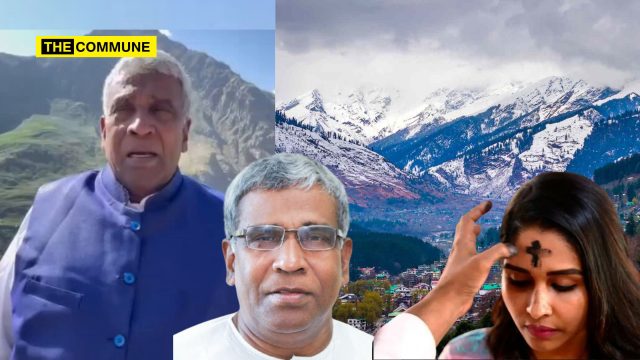
As left-leaning groups rally in support of two Catholic nuns recently arrested in Chhattisgarh on charges of human trafficking and forced religious conversion, a new controversy has emerged. An undated video has gone viral showing Pastor Jacob John, former General President of the Indian Pentecostal Church (IPC), in Himachal Pradesh, urging the deployment of more missionaries to spread the Gospel remarks that have drawn sharp criticism, with many interpreting them as a call for conversions in exchange for financial incentives.
In the video, Pastor John describes his vision of evangelizing remote mountain communities. He speaks passionately about the lack of Christian missionaries in the region, urging fellow believers especially Malayali Christians to train and send evangelists to spread the Gospel. Emphasizing the spiritual need in areas “beyond Manali and Rohtang,” he laments that “millions of souls” remain unreached and urges churches to invest in sending missionaries instead of spending resources on comfort or internal church affairs.
Without directly naming any denomination, he appeals to all Christian groups to unite in their efforts and “send thousands of missionaries” to unreached areas of India, specifically in the Himalayan belt. His call to action, framed as a divine mission, has come under fire from critics who view it as a push for religious conversion under the guise of spiritual service, potentially in exchange for foreign funding.
In the video, Pastor Jacob John says, “Dear servants of God. We are now beyond Manali and Rohtang. All around us, we see mountains covered in snow like seas. Great mountains. In these mountain regions, there are millions and millions of souls living. But there is no missionary, no servant of God, to bring them the Word. In these valleys, there are more people. But no one is there to send missionaries here. Isn’t it our responsibility to take the Word to them? Let us think. How many evangelists are there in our villages, wandering aimlessly? If they had been sent here, how many lives that have not heard the Word would have been saved, baptized, received the Holy Spirit, and joined the church. There are some people who think that if they give 50 or 100 dollars, the Word will be preached here. But my vision from God is that if you sow a servant of God for a few days or for a few years, millions and millions of souls will be saved here. Therefore, I want to say to all my Malayali friends who are listening, to the children of God, in whatever position you may be, in these Himalayan Mountain regions, in all the places where the Word has not been brought, missionaries must be sent. Don’t wander aimlessly in Kummur, or Morakka, or Punalur. Let’s not wander aimlessly in our Pentecostal circles. Missionaries must be trained and sent. May God prepare you for this. May God perform miracles. Therefore, I want to say to my dear friends, that missionaries must be sent to these Himalayan regions as soon as possible. I’ve been on tours for a day, and there’s almost nothing left of India. Only four or five states are left. The Word has not been heard in so many villages and cities. And we are living in comfort, spending millions and millions of dollars, crores of rupees. Let’s send missionaries to those places where the Word has not been received. Dear brothers and sisters, servants of God, I want to say to all of you who are listening, when will we bring the Word? When God asks us to give an account, may our hands not be without strength and our feet not without firmness. Therefore, send missionaries. Whom should I send? Who will go for us? May God help all of you who are listening to do great things for the Gospel. May God use our hands and feet for the evangelization of the Himalayas and India. May God open our eyes. Without saying, “I am from IPC, or Church of God, or Assemblies of God, or Sharon, or independent Pentecostal churches, or Christian assemblies,” may God help you to send thousands of missionaries. Your humble servant of God, Jacob John, servant of God from Bethania. May God bless you.”
“Himachal and Uttarakhand are lying untouched , no one’s coming here to preach the Gospel. We must baptize the entire Himalayan region with our teachings. If we give them ₹50 or ₹100, they’ll convert easily.”
This is not evangelism. This is exploitation of poverty.
This video emerged shortly after the controversial arrest of Sisters Preeti Mary and Vandana Francis, both Catholic nuns from Kerala, along with Sukaman Mandavi, a tribal woman, at Durg railway station in Chhattisgarh on 25 July 2025. The trio was reportedly detained after a Train Ticket Examiner (TTE) noticed they did not have valid platform tickets. They were subsequently charged under Section 143 of the Bharatiya Nyaya Sanhita (BNS) for alleged human trafficking and under Section 4 of the Chhattisgarh Religious Freedom Act, 1968, which pertains to religious conversion. If convicted, the offenses carry a maximum penalty of 10 years in prison.
Their arrest sparked political controversy, with the Congress party accusing the BJP-led state government of targeting religious minorities and misusing legal provisions to stifle missionary work. After spending several days in custody, the three were granted bail by an NIA court on 2 August 2025.
Subscribe to our Telegram, WhatsApp, and Instagram channels and get the best stories of the day delivered to you personally.
All India Anna Dravida Munnetra Kazhagam (AIADMK) Member of Parliament C Ve Shanmugam has filed a contempt of court petition against Tamil Nadu Public Department Secretary Reeta Harish Thakkar and Health Secretary P. Senthil Kumar for allegedly violating a Madras High Court order prohibiting the naming of government schemes after living personalities.
The petition follows the launch of the ‘Nalam Kaakkum Stalin’ health scheme on 2 August 2025, just days after the High Court had issued an interim order on 31 July 2025, barring the state from using the names of living individuals in any official welfare programme.
The contempt plea is expected to be listed before the first Division Bench comprising Chief Justice Manindra Mohan Shrivastava and Justice Sunder Mohan.
In an affidavit filed through his counsel K. Gowtham Kumar, Shanmugam said the Bench had issued a “detailed interim order” clarifying that “the nomenclature of no government scheme should bear the name of a living personality.”
The MP pointed out that the Tamil Nadu Public Department Secretary had filed a petition on 1 August 2025, within hours of the order being made public, seeking a clarification that the interim order would not apply to the ‘Ungaludan Stalin’ and ‘Nalam Kaakkum Stalin’ schemes. However, the clarification or modification petition was not listed for hearing that day, and the court had not passed any subsequent order granting exemption or relief.
Despite this, the state government went ahead with the launch of the ‘Nalam Kaakkum Stalin’ scheme on 2 August 2025, allegedly in direct violation of the court’s directive.
In his affidavit, Shanmugam said the act amounted to contempt of court. “The filing of the modification/clarification petition by itself was sufficient to prove the officials were well aware of the prohibition imposed by the court on naming government schemes after living personalities,” he stated.
“In effect, the respondents have reduced the modification petition to a mere formality and an eyewash to escape the clutches of contempt and have proceeded to use the name of the scheme (Nalam Kaakkum Stalin) in contravention to the orders passed by the court. The respondents have used the modification petition as a shield against their illegalities. They cannot be allowed to blow hot and cold at the same breath,” the affidavit read.
On 31 July 2025, the Kochi Zonal Office of the Enforcement Directorate (ED) conducted search operations at two premises in Kasaragod, Kerala. The action was taken under the provisions of the Foreign Exchange Management Act (FEMA), 1999, following suspicions of irregularities in foreign funding involving the Kunhahmed Musliyar Memorial Trust.
ED, Kochi conducted searches on 31.07.2025 in Kasaragod, Kerala under FEMA, 1999 at the premises of Kunhahmed Musliyar Memorial Trust & its Chairman Ibrahim Ahmad Ali (NRI) in a case involving receipt of Rs. 220 Crore foreign contribution without FCRA registration and investing…
The searches are linked to financial dealings involving the Kunhahmed Musliyar Memorial Trust and its chairman, Ibrahim Ahmad Ali, an NRI. Initial findings suggest the Trust received over ₹220 crore since 2021 from Ibrahim, with the amount entered in its financial records as “unsecured loans.” However, ED noted the absence of any formal loan agreements, interest terms, or repayment schedules and no repayments have been made to date. The funds reportedly originated from Universal Lubricants LLC, a UAE-based firm.
Due to the lack of proper documentation, the ED observed that the transactions appear to fall under the definition of “foreign contribution” as per Section 2(1)(h) of the Foreign Contribution Regulation Act (FCRA), 2010. The issue arises because the Trust is not registered under the FCRA, nor does it hold the necessary approval or designated FCRA bank account required to legally accept such foreign funds.
The investigation also uncovered that a portion of the funds was used to acquire agricultural land, which breaches further legal provisions. Additionally, the Trust is said to have accepted ₹2.49 crore in cash from Ibrahim Ahmad Ali, in violation of FEMA regulations.
During the searches, officials seized several incriminating materials, including financial records, ledger entries labeled as unsecured loans, the Trust’s cash book, and a hard disk containing related data. The ED stated that these findings point to serious violations of FEMA, 1999. The investigation is currently ongoing.
Over the past decade, cases of Love Jihad, where Hindu girls are lured into relationships with Muslim men under false pretenses and later coerced into conversion, have surged across India. What was once dismissed as a “conspiracy theory” by left-liberal circles has now become an undeniable reality, with police records, court cases, and victim testimonies exposing a systematic pattern of exploitation.
Alarmingly, the methods employed by Islamic fundamentalists have evolved beyond traditional deception. Investigations reveal that Hindu girls are now being targeted through drug addiction, social media grooming, online gaming traps, and even cafe-based exploitation rings raising serious concerns about the safety of young women in India.
Narcotics Jihad: Drugging, Exploitation, and Forced Conversions
Recent cases from Bhopal, Indore, Nainital, and Bijnor highlight a disturbing trend where Hindu girls are first addicted to drugs, then sexually exploited, and ultimately blackmailed into converting to Islam.
Bhopal Drug Gang Bust (July 2025): Police arrested Yasin Machli and Shahwar Machli, who were part of a narcotics syndicate targeting Hindu college girls. Investigations revealed that the gang supplied MD drugs to victims, physically exploited them, and later pushed them into drug peddling and conversion.
Indore’s Musakhedi Case: Zeeshan Khan posed as Abhishek Thakur to trap a Hindu girl, made her drug-dependent, and then blackmailed her with intimate videos to force conversion.
Nainital Horror (July 2025): A 30-year-old Muslim man trapped an 11th-grade Hindu girl in a “love trap,” drugged her, and turned her against her family. Hindu organizations had to intervene to rescue her.
Even Bishop Mar Joseph Kallarangat of Kerala’s Syro-Malabar Church had warned about “Narcotics Jihad”, where girls are first addicted to substances and then brainwashed into converting.
Karnataka isn’t immune: In Mangaluru, a Hindu girl disappeared, and an investigation led to drug smuggler Shahrukh of Puttur being implicated. The mechanism alleged in all these instances remains largely the same – introduce drugs, compromise the victim, collect incriminating material, then initiate relentless pressure to convert.
Celebrities and Drug Conversion Angle
Not just ordinary individuals, but even well-known personalities have reportedly been affected. For example, a 2020 case involving a Kannada actress emerged as a potential intersection of drugs and religious brainwashing; she had allegedly been introduced to Islamic teachings over a decade. The rise of such cases led to increased calls for investigation into the “drug angle” behind religious conversion.
“Love Trap” – The Expanding Arsenal
Several notorious cases have captured nationwide attention:
Shraddha Walkar (Delhi, 2023): Killed and dismembered by Aftab, with alleged elements of manipulation and serial deceit.
Priya-Kashish Case (Meerut, 2020): Priya and her daughter Kashish were murdered by Shamshad, who had posed as Amit Gurjar.
Pinky Gupta (Ghaziabad): Victim of identity fraud and suicide after being misled by a married man masquerading under a false name.
These cases are not isolated; reports suggest over 150 such cases were covered by OpIndia in 2023 alone, continuing a pattern also observed in previous years. The expanding reach of social media has reportedly facilitated this, enabling perpetrators to connect with girls beyond their immediate neighborhoods and increasingly across state lines.
Role of Social Media: Instagram and Facebook
Social media platforms are frequently cited as tools of deception. Perpetrators allegedly create false identities on Instagram and Facebook, using Hindu names and religious symbols to lower suspicion. Once trust is established, victims are lured into physical meetings, compromised, and then blackmailed with images and videos leaving conversion as the only perceived escape from social disgrace.
Multiple recent cases illustrate this:
Shahbad Dairy (Delhi, 2023): A girl befriended on Instagram was brutally murdered by Mohammad Sahil.
Gautam Buddha Nagar (2025): Mubassir, posing as Sachin, reportedly trapped multiple girls via Instagram, marrying and then pressuring them for conversion.
Mainpuri (UP): The disappearance of a 17-year-old was traced to her Instagram contact, Abdullah, who allegedly kidnapped her.
Priya-Shamshad and Similar Facebook Cases: Victims lured into marriages before discovering the true identity of the perpetrator.
Online Gaming and New-Age Brainwashing
The domain of online gaming has emerged as a platform for grooming and brainwashing. “Operation Kalanemi” exposed a pan-India criminal network leveraging online games to befriend Hindu minors, followed by indoctrination, identity alteration, forced marriage, and conversion. Specific cases detailed Pakistani and Dubai-based handlers, with gangs funding and tutoring girls in Arabic and encouraging conversion. The use of “reverted Muslims”, people who themselves had converted, was reported as a tool for convincing new targets.
Other notable incidents include:
Kutch, Gujarat (2024): A minor seduced on a gaming platform by “Jigar,” later revealed as Ziyad (Sameer Sheikh), subjected to blackmail through incriminating photos.
Jabalpur: A girl, lured during a game, was trafficked after meeting the perpetrator in Mumbai.
Bihar-Madhya Pradesh: Salman, a local egg vendor, allegedly used the PUBG game to introduce himself under a Hindu pseudonym, later compelling religious conversion after meeting in person.
Cafes and Clubs: Modern Venues for Exploitation
Recent revelations suggest that cafes and clubs have become venues for criminal networks, sometimes with the complicity of business operators:
Dehradun’s 7th Heaven Cafe, Vikas Mall: Alleged love jihad incident surfaced when a Hindu girl sought help from Bajrang Dal supporters.
Bhilwara, Rajasthan (March 2024): A cafe was cited in a case of gang-rape and subsequent conversion threats, resulting in eight arrests.
Beawar (February 2025): Reports of systematic sexual harassment and conversion attempts inside cafes.
Club-90 (Bhopal): Claims of systematic exploitation and filming of Hindu students; administrative action commenced with lease cancellations and demolition of illegal structures.
Parallels with British “Grooming Gangs”
Observers draw comparison between the documented “grooming gangs” active in the UK from the 1980s to 2011, comprised largely of men of Pakistani origin, and the alleged patterns now being reported in India. In both settings, underage girls were targeted, drugged, sexually abused, blackmailed, or murdered, often with authorities initially unresponsive to victim pleas.
Victims’ statements, like that of “Emily,” who says she was raped over a thousand times since the age of 14 by such a gang in Britain, are invoked to underline the similarities in method and motive.
Love Jihad Is No Myth
Despite earlier claims that “love jihad” was a myth, the recent spate of high-profile cases and ongoing police investigations continue to attract widespread attention and concern. Methods now reportedly range from physical and digital deception, addiction, extortion, and forced conversion. As media and authorities expose new cases, community and religious organizations are reportedly becoming increasingly vigilant, and calls for increased parental awareness and intervention have grown louder.
BJP leader K. Annamalai has strongly criticized the DMK government and Chief Minister M.K. Stalin, accusing them of fostering a lawless environment where in, ‘criminals roam freely, while those who serve and protect the nation are left to beg for justice’.
Annamalai’s remarks follow a viral video of Kalavathi, a CRPF jawan posted in Jammu and Kashmir, who tearfully pleaded for action regarding a theft at her family home in Tamil Nadu. The Jawan, visibly emotional and in uniform, claimed that gold jewellery, cash, and a silk saree meant for her wedding were stolen, and that local police have failed to take effective action.
Kalavathi’s father, Kumarasamy (65), a resident of Narayanapuram near Katpadi in Vellore district, had returned home from his farmland on 24 July 2025, to find the house broken into. He reported that around 25 sovereigns of gold and cash had been stolen. A complaint was filed at the Ponnai police station, and a case was subsequently registered.
In her video, Kalavathi alleged that although a complaint was lodged, the police were slow to respond and had yet to recover the stolen items. The delay, she said, has left her feeling helpless and abandoned. She specifically mentioned that 22 sovereigns of gold, a silk saree, and ₹50,000 in cash were missing.
The police, in response, stated that the investigation is ongoing and that fingerprint experts had examined the scene. They claimed that around 80% of the inquiry is complete, and all key suspects, including Kalavathi’s estranged husband, have been questioned.
It’s worth noting that Kalavathi had been married to a soldier named Satya from the Ponnai area, but the couple separated within six months. Following her suspicion that he might be involved in the theft, police also questioned him.
Highlighting her plight, Annamalai shared the video on his X (formerly Twitter) handle, stating, “A CRPF jawan from Tamil Nadu, serving with honour at our nation’s borders in J&K, is forced to take to social media on police inaction on the case of jewellery theft from her residence near Katpadi in June this year. What kind of governance forces a woman in uniform to beg for justice online while wearing the nation’s flag on her shoulder? This is not just lawlessness, it’s the DMK’s model of governance, where criminals roam free and the protectors of our nation plead for help. Wake up, Thiru @mkstalin.”
A CRPF jawan from Tamil Nadu, serving with honour at our nation’s borders in J&K, is forced to take to social media on police inaction on the case of jewellery theft from her residence near Katpadi in June this year.
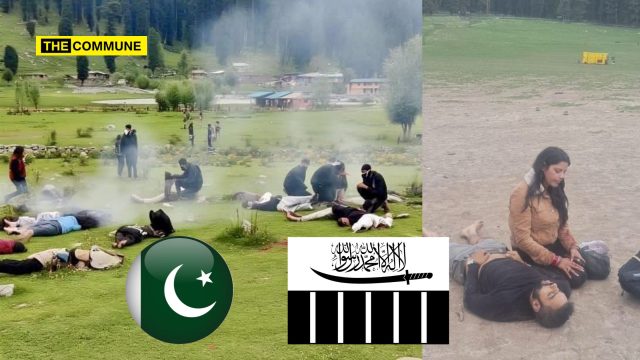
Indian security agencies on Monday, 4 August 2025, confirmed the nationality of the three terrorists killed in the aftermath of the Pahalgam terror attack, stating that all three were Pakistani nationals and senior Lashkar-e-Taiba (LeT) operatives. Officials said conclusive evidence, including government-issued Pakistani documents, biometric records, and communication logs, links the operatives directly to the April 22 attack in Baisaran meadow, Pahalgam, which claimed 26 lives.
The trio was killed in a gunfight on 28 July 2025 during Operation Mahadev in the Dachigam forest area near Srinagar, where they had been hiding since the attack. Security officials confirmed that no local militants were involved in the operation, and two Kashmiri men have been arrested for aiding the infiltrators.
A senior official told Times of India that, “For the first time, we have in our possession official documents issued by the Government of Pakistan that clearly establish the identity and nationality of the attackers involved in the Pahalgam massacre.”
Identities Confirmed via Official Documents and Biometric Records
The three militants have been identified as:
Suleman Shah alias ‘Faizal Jatt’ – classified as an “A++” category terrorist, and believed to be the lead shooter and mastermind of the attack.
Abu Hamza alias ‘Afghan’ – an “A-grade” LeT commander and second gunman.
Yasir alias ‘Jibran’ – also an “A-grade” commander and the third gunman involved.
From the possession of Shah and Hamza, forces recovered laminated voter slips issued by the Election Commission of Pakistan, which were linked to electoral rolls in Lahore (NA-125) and Gujranwala (NA-79). Additionally, a damaged satellite phone recovered from the scene yielded biometric data sourced from Pakistan’s National Database and Registration Authority (NADRA), including fingerprints, facial scans, and familial links, further verifying their Pakistani origin.
Authorities also recovered wrappers of Pakistani-manufactured chocolates such as CandyLand and ChocoMax, traced back to a May 2024 consignment sent to Muzaffarabad in Pakistan-occupied Kashmir (PoK). DNA recovered from the Pahalgam site matched the bodies of the deceased terrorists, and AK-103 rifles seized during the Dachigam encounter were confirmed as the same weapons used in the April 22 massacre.
Satellite phone logs indicated frequent communication with handlers in Pakistan, and voice analysis has identified Sajid Saifullah Jatt, LeT’s south Kashmir operations chief, as the principal coordinator. Intelligence also confirms that Rizwan Anees, LeT’s Rawalakot chief, visited the families of the deceased attackers on 29 July 2025 to organise a Ghaibana Namaz-e-Janaza (funeral prayers in absentia).
Investigators believe the militants infiltrated India via Gurez sector in north Kashmir in May 2022. Two Kashmiri men – Parvaiz and Bashir Ahmad Jothar – have been arrested for providing shelter to the militants before the April attack. GPS data from seized equipment has been matched with firing positions described by survivors of the Pahalgam incident.
Authorities said that all collected evidence will form part of an official dossier to be shared with the international community, underscoring Pakistan’s direct involvement in orchestrating the terror attack.