Postal services in Australia and Switzerland have become the latest to announce a suspension of deliveries to the United States, joining a growing list of countries halting shipments in response to the Trump administration’s sudden tariff changes.
The move comes ahead of new levies set to take effect on Friday, August 29. Several other countries, including India, the United Kingdom, France, Sweden, Germany, Italy, and Denmark, had already declared similar pauses in shipping goods to the United States.
Australia Post on Tuesday confirmed that it will “temporarily partially suspend postal sending to the United States (US) and Puerto Rico, effective 26 August 2025, until further notice.” The agency said the decision was necessary due to “recent significant changes the US Government has made to customs and import tariff rules for parcels sent to the US.”
It explained that the changes include the suspension of the De Minimis exemption for inbound goods valued below $800 and a requirement that tariffs be prepaid before items arrive in the US. As a result, Australian businesses will be unable to send products to American customers using Australia Post from Tuesday onwards.
Until now, parcels worth less than $800 (about AUD 1,230) entered the US tax-free, a loophole heavily relied upon by Australian retailers selling abroad, according to local media reports. That exemption will formally end on August 29, when all low-value parcels will be subjected to tariffs or flat fees. The decision, laid out in an executive order signed on July 30, has left many postal services around the world scrambling to comply.
In a parallel move, Swiss Post of Switzerland announced it will no longer accept postal consignments destined for the United States, with the exception of urgent express mail such as official documents and certificates. The agency said on Monday that it would temporarily halt parcel deliveries, citing new US customs regulations that obstruct the regular shipping process.
It added that the decision mirrors those taken by other European postal operators. Swiss Post noted that the US government’s sudden removal of the $800 exemption has created major uncertainty for global carriers. It is currently considering ways to allow limited consignments, such as gifts exchanged between private individuals valued at up to $100, to resume.
The postal service is also exploring alternative methods outside traditional postal networks to keep some flows of goods moving. Recently, India also confirmed that it will suspend the majority of parcel shipments to the US beginning August 25, with exceptions only for letters and small gifts.
France’s La Poste complained that the abrupt policy shift gave them no time to reconfigure digital systems to handle the new customs requirements. Meanwhile, the United Kingdom’s Royal Mail said it would suspend shipments starting Tuesday to ensure all deliveries cleared before duties come into force. According to CBS News, the new rules stem from a decree signed by President Donald Trump in July.
Beginning August 29, all international parcels previously covered under the de minimis rule will be subject to import duties. The only exemptions will be for letters, books, documents, and small gifts worth less than $100.
-IANS
Subscribe to our channels on Telegram, WhatsApp, and Instagram and get the best stories of the day delivered to you personally.
The Himachal Pradesh High Court has granted bail to a street vendor who was accused of sedition under Section 152 of the Bharatiya Nyaya Sanhita, 2023 (BNS) for allegedly sharing a Facebook post with the words “Pakistan Zindabad.” A Single Judge Bench of Justice Rakesh Kainthla observed that “merely posting ‘Pakistan Zindabad’, without denouncing India, was not seditious,” and noted that the complaint did not allege any intention to bring hatred or discontent toward the government established by law in India.
The petitioner, a poor and illiterate fruit vendor, had allegedly shared an AI-generated image of the Prime Minister with the phrase “Pakistan Zindabad,” which was deemed inflammatory. His counsel contended that the petitioner, being illiterate, could not operate social media, and that the Facebook account was managed by his son. It was further argued that the informant had access to the petitioner’s mobile phone and had shared the controversial content.
The court heard that the petitioner had been in custody since June 8, 2025, and sought regular bail. The petition was opposed by the Additional Advocate General, who highlighted the strained India-Pakistan relations at the time of the post and claimed that “writing Pakistan Zindabad was anti-national.”
In its analysis, the Court referred to multiple Supreme Court judgments, including Ajwar v. Waseem, (2024) 10 SCC 768, which held that while considering bail, courts must weigh “the nature of the accusations made against the accused, the manner in which the crime was alleged to have been committed, the gravity of the offence, the role attributed to the accused,” among other factors. The court also relied on Vinod Dua v. Union of India, (2023) 14 SCC 286, noting that sedition laws “applied to such activities which were intended, or which tend to create disorder or disturbance of the public peace.”
Citing Javed Ahmad Hajam v. State of Maharashtra, (2024) 4 SCC 156, the Court emphasized that “the intention of causing disorder or inciting people to violence was the sine qua non of the offence.” The bench noted that there was no evidence suggesting that the petitioner intended to incite hatred or public disorder, and that hailing another country without denouncing India did not amount to sedition.
Given that the police had seized the electronic device and filed the charge sheet, the Court found no need for custodial interrogation. Consequently, the Court allowed the petition and ordered the release of the petitioner on bail of Rs 50,000 with one surety of the like amount.
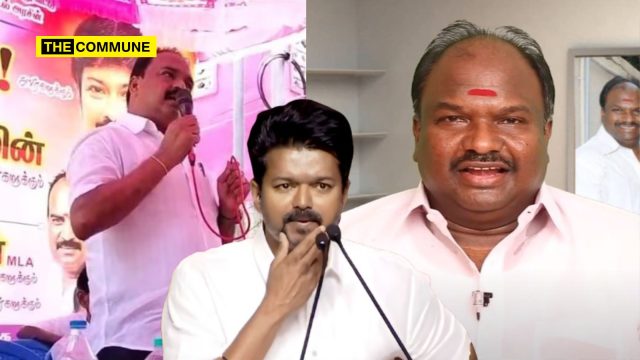
Actor-turned-politician Vijay is facing a barrage of backlash after addressing Chief Minister M.K. Stalin as “Uncle” during the second state-level conference of his Tamilaga Vettri Kazhagam (TVK) in Madurai. The comment has triggered sharp and highly personal responses from ruling DMK members, particularly two sitting MLAs who launched scathing verbal assaults.
During a land title distribution event in North Chennai the Thiruvottriyur DMK MLA K.P. Shankar mocked Vijay’s political ambitions, saying, “Today, those who are like Vijay (the actor), living like squirrels, don’t know anything. What would he know? All he knows is whether to go with Trisha or with Keerthy Suresh, nothing else. True governance is about feeling the struggles of the people and acting for them in education and healthcare. This Dravidian model rule is governing with these two, education and healthcare, as its two eyes.”
Shankar didn’t stop there. He took a personal dig, accusing Vijay of being incapable of taking care of his own parents or his wife, raising doubts about his ability to serve the public. “The same Vijay who now calls the CM ‘uncle’ once stood beside his father at Jayalalithaa’s residence in Poes Garden,” he pointed out.
He went on to say, “If our current Chief Minister were like Jayalalithaa, he would have stripped Vijay of clothes and made him run. But Stalin is a forgiving man, and so he let it slide.”
Adding to the controversy, another DMK MLA, V. C. Chandhirakumar, compared Vijay to a barking dog. “I’ll tell you one thing, sir. A dog barks at the sun. But the sun doesn’t get angry at the dog for it. That’s all. We know it’s a dog. Why should we take it so seriously? We are the sun. We are giving light to the whole world. So we’ll just keep doing our job,” he said. Without naming Vijay directly, Chandrakumar implied that reacting to such criticism was beneath the ruling party, comparing Stalin to the sun, which “shines on the world without getting involved in petty squabbles.” He also added, “I’ve just given a metaphor that a dog barks at the sun. If you choose to take it personally, I’m not responsible for that.”
The remarks, widely shared on social media, have sparked a fresh wave of political tension as Tamil Nadu approaches the 2026 assembly elections, with Vijay’s emergence clearly rattling the established players.
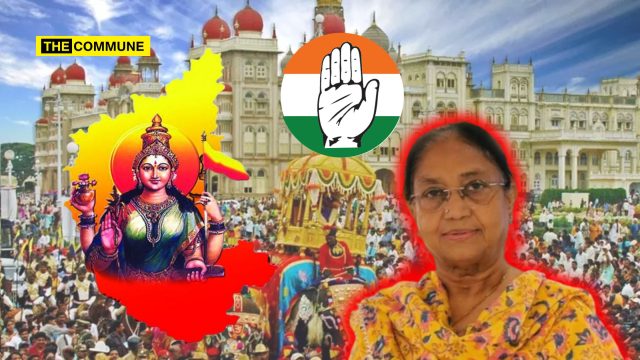
The Karnataka government has invited International Booker Prize-winning Kannada author Banu Mushtaq to inaugurate this year’s Mysuru Dasara celebrations, triggering a political controversy over faith and tradition.
Mushtaq, 77, will formally open the festivities on 22 September 2025, ahead of the grand Vijayadashami procession scheduled for 2 October 2025. Chief Minister Siddaramaiah announced her selection, describing it as a historic recognition of her literary achievements. Mushtaq’s acclaimed short story collection Heart Lamp, translated by Deepa Bhasthi, won the Booker Prize earlier this year for its portrayal of the lives of Muslim women in Karnataka.
The decision has drawn objections from some BJP leaders, who argued that the religious nature of the Dasara inauguration requires participants to publicly declare their belief in Goddess Chamundeshwari.
BJP MP Tejasvi Surya said that while he respected Mushtaq’s stature, the inauguration involves offering prayers at Chamundi Hills, and the faith of the chief guest should be made clear. He shared a 2023 video of Mushtaq where she is heard saying, “Sir, you spoke about the Kannada language, literature, and culture on that platform. As a minority woman, I am presenting my understanding of the Kannada language before you. Whether you like it or find it difficult, I don’t know. To grow Kannada as a language, for Banu Mushtaq to speak in Kannada, your family did not even give her the opportunity to speak in Kannada at home. You have made Kannada the ‘Kannada Bhuvaneshwari.’ Wearing red and yellow turmeric kumkum flags, why did you smear turmeric kumkum and take her away and seat her on a bench? Where should I stand? What should I see? How should I get involved? My exclusion didn’t start today; it began long ago. Today, it is coming to completion, that’s all. Please think about this because wherever a woman is worshipped as a goddess, when you seat a woman on a bench, the goddesses will be pleased. But here, you have seated Kannada Amma (Mother Kannada) in a temple and made her sit on a bench, how are you mistreating women, showing cruelty and violence? You are also abusing the Kannada language in this way. You are answerable to me; I am responding to a wall that should have answered me. My answer to you: make Kannada the Bhuvaneshwari, pull the chariot of Kannada, hold the festival of Kannada, organize the Kannada parishad (council), whatever you do, how many barriers do you need to exclude me at such a crucial time?”
The so-called Anti-Communal Task Force, the Hate Speech Bill, the Rohith Vemula Bill pushed at Rahul Gandhi’s insistence, the dubious Dharmasthala SIT, and now the Congress government’s decision to have Smt. Banu Mustaq – who has openly expressed her opposition to the worship of… pic.twitter.com/W8BqIWmfCa
Responding to the controversy, Mushtaq has declined to comment on the BJP leaders’ remarks but confirmed that she intends to attend the inauguration.
Siddaramaiah highlighted Mushtaq’s contributions beyond literature, noting her involvement with farmers’ organisations, Kannada agitations, and progressive movements. He called her selection a significant moment, particularly as a woman invited to inaugurate the centuries-old festival.
The Mysuru Dasara Mahotsava traditionally begins with prayers at Chamundi Hills, followed by ten days of cultural and religious events culminating in Vijayadashami.
Tamil Nadu’s state-run universities are facing a severe administrative crisis, with 14 of the 22 public-funded institutions currently functioning without vice-chancellors (V-Cs) and two more expected to become headless within four months.
The universities, many of which serve as affiliating institutions for colleges, risk broader disruptions across the state’s higher education sector, warn academicians.
The number of universities without V-Cs would have already reached 16 if not for a one-year extension granted by Governor R.N. Ravi last week, allowing the incumbents at Manonmaniam Sundaranar University and Alagappa University to continue beyond their three-year tenures. The extension received mixed reactions, with some emphasizing the need for leadership rather than interim convenors’ committees, while others criticized the governor for limiting the state government’s role in university administration.
The state government recently asserted its authority to appoint V-Cs, supported by the Supreme Court’s order granting “deemed assent” to 10 bills removing the governor’s powers over appointments in 18 universities. However, the Madras High Court has stayed the operation of nine of these bills, leaving the issue unresolved.
Experts note that the governor can only extend V-C tenures if the university statutes allow it. For example, Thiruvalluvar University’s statute does not permit such extensions, preventing its V-C from continuing beyond the term.
The tenures of the V-Cs at Mother Teresa Women’s University (MTWU) and Tamil Nadu Open University (TNOU) will end in January 2026. While MTWU allows extensions, TNOU does not. By that time, T N Dr. MGR Medical University and T N Dr. J Jayalalithaa Fisheries University will be the only state universities under the governor’s chancellorship with V-Cs in place. Universities such as TN National Law University and TN Jayalalitha Music and Fine Arts University are not affected, as their chancellors are the Chief Justice of the Madras High Court and the state chief minister, respectively.
Academician S.P. Thyagarajan expressed concern over the leadership vacuum, warning that a prolonged absence of V-Cs could affect the quality of higher education. “Amid this fight of ego and politics, ultimately the students are paying the price. The state government and the governor need to resolve this issue,” he said.
P. Duraisamy, former V-C of the University of Madras, added that temporary convenors’ committees are limited to managing daily operations, while crucial activities such as recruitment, curriculum updates, certification, and financial clearances face significant delays.
In yet another instance of denigrating Hinduism, a prime-time debate on Sun News, a channel owned by the DMK’s first family featured Srividhya, a Dravidianist speaker from the fringe group Dravida Natpu Kazhagam, claimed that Sanatana Dharma (Hinduism) is more dangerous than stray dogs.
The discussion on Kelvi Kalam was meant to examine whether the DMK had outpaced the AIADMK in winning over women voters. BJP spokesperson G.K. Nagarajan raised substantive concerns highlighting the twin threats of a growing stray dog population and the proliferation of TASMAC liquor shops, which he argued have resulted in social distress and a worrying rise in young widows. Instead of engaging with these real issues, Sri Vidya derailed the conversation with a provocative attack.
Nagarajan argued, “Tell the madam to get down and walk on the streets, then she’ll understand the trouble these dogs cause. Don’t you see it on social media? Don’t you see dogs chasing young girls and men? Isn’t this a social tragedy? Which family has fascism left without men? Come and see the villages. Come and see how many women have lost their ‘pottu’ and ‘poo’ (symbols of marriage and womanhood) because of liquor shops and street-corner bars.”
Instead of refuting Nagaraj’s point, she immediately reacted when he referenced womanhood and the marital status of women, Sri Vidya dramatically changed direction by mocking prime minister Narendra Modi as well as Sanatana Dharma stating, “What I’m asking is, the Prime Minister has a 56-inch chest, and is very brave, right? Can’t you issue an order that there should be no liquor shops all over India? If you have so much concern for the women of this country, you can do it, can’t you? Sanatana Dharma is more dangerous than a dog, more dangerous than alcohol.”
Her statement was not just a needless provocation it tripped the conversation into sensationalism, replacing a vital civic discussion with sectarian rhetoric. A platform that should have addressed urgent social crises became a stage for divisive commentary.
Though Sun News initially promoted Sri Vidya’s remarks with a provocative thumbnail and released the clip on YouTube to draw attention, the channel faced intense backlash for amplifying anti-Hindu sentiments.
Following public outrage, the video was quietly made private, yet the full debate remains available online, continuing to go viral and drawing widespread criticism for the channel’s deliberate platforming of derogatory views against Hinduism.
However, after a while, the video resurfaced on the Sun News YouTube channel.
Subscribe to our channels on Telegram, WhatsApp, and Instagram and get the best stories of the day delivered to you personally
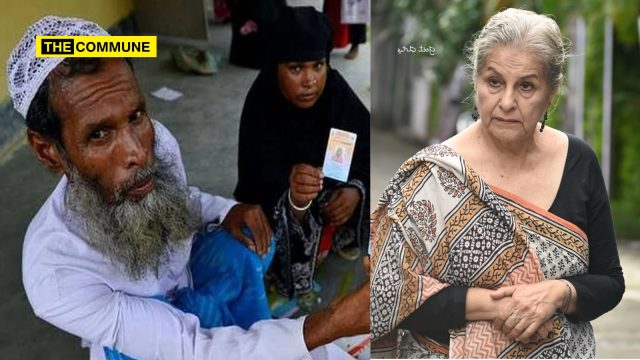
Syeda Saiyidain Hameed, a former member of the Planning Commission during the UPA regime, has stirred controversy during her visit to Assam by asserting that Bangladeshis have the right to live in India. Her remarks come amid ongoing efforts by the Assam government to evict illegal encroachers from state-owned lands and push back undocumented immigrants from Bangladesh.
Hameed was part of a visiting delegation that included several prominent left-leaning activists such as Prashant Bhushan, Harsh Mander, and Jawahar Sircar. Speaking to the media, she accused the Assam government of unfairly targeting Muslims by labeling them as Bangladeshis. “So what if they are from Bangladesh?” she said. “They are human beings too. The Earth is vast enough for them to live here. No one’s rights are being taken away.”
She went further, claiming that to argue illegal immigrants infringe on the rights of legal citizens is “deeply disturbing, misleading, and harmful to humanity.” Invoking religious sentiment, she added, “Allah created this earth for human beings, not for devils. Evicting someone standing on this land is like bringing doomsday upon Muslims.” Hameed also called for unity in preserving India’s shared cultural heritage, or Ganga-Jamuni Tehzeeb.
Meanwhile, activist Prashant Bhushan escalated the rhetoric, alleging that not only are illegal immigrants being deported, but Indian Muslims are also being forcibly sent to Bangladesh. “The Himanta Biswa Sarma-led Assam government is engaging in unlawful and unconstitutional acts,” he claimed, accusing the administration of forcefully evicting residents, demolishing homes, and pushing people across the border without due process.
The visiting team said their purpose in Assam was to engage with local communities and witness firsthand the impact of these evictions. However, Bhushan stated they were blocked from entering the Goalpara district, where some of the evictions had occurred on forest land.
Their visit was facilitated by Asom Nagarik Sanmilan, a civic group that invites intellectuals and activists from across India to speak on pressing social and political issues. Rajya Sabha MP Ajit Kumar Bhuyan, associated with the group, confirmed the team was invited to share perspectives on the recent developments in the state.
Earlier in the day, Assam Chief Minister Himanta Biswa Sarma responded strongly to the delegation’s presence. Referring to recent remarks from Jamaat-e-Hind demanding his removal, Sarma said a “Delhi-based team” including Harsh Mander, Wajahat Habibullah, Fayaz Shaheen, Prashant Bhushan, and Jawahar Sircar had now descended on the state. He accused them of attempting to reframe lawful eviction drives as humanitarian crises.
“This is a deliberate campaign to sabotage our efforts to reclaim state land from illegal encroachers,” Sarma said. “We are vigilant and resolute. No amount of propaganda or external pressure will deter us from safeguarding our land and cultural identity.”
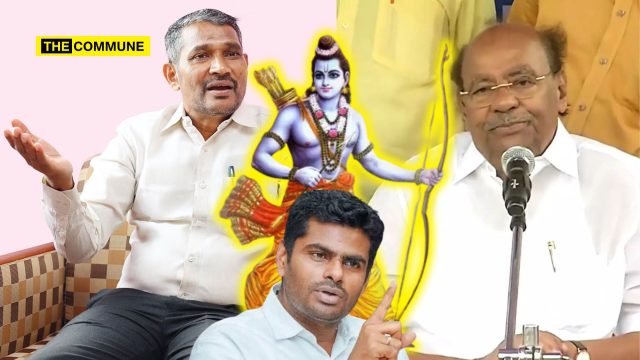
A seminar on honour killings held in Mylapore has triggered controversy after Viduthalai Chiruthaigal Katchi (VCK) deputy general secretary Vanni Arasu made provocative remarks about Hinduism, Lord Rama, and PMK founder S. Ramadoss. He repeated the comments made on Lord Rama and connected it to Dr Ramadoss.
Speaking at the seminar, Vanni Arasu claimed that the Hindu epic Ramayana itself contained caste-based oppression, citing the episode of Rama killing Shambuka, a lower-caste ascetic. He alleged that the act symbolised killings done to preserve Sanatana Dharma and the varna system. He said, “There is a prime character in Ramayana. There was a Brahmin outside Rama’s palace. He laments with his dead child on his lap. Rama your governance has gone bad. Rama came out of the palace and enquired. They are doing bad things in the name of Dharma. The Brahmin said go see in the jungle. Rama went to the jungle with his sword and horse. There he finds a man hanging upside down from a tree. Rama asks him, ‘Who are you? What are you doing?’ The man replies, ‘I am doing penance. My name is Shambuka. I belong to the Vettuva community, a tribal caste.’ Rama then asks, ‘How can a person of low caste perform this dharma? Dharma is for each caste separately. How can you cross that boundary?’ And then Rama cuts off his head. The story even says that the blood from this act revived a dead child.”
He argued that honour killings were rooted in the same ideology, saying, “Behind such murders, behind these so-called honour killings, lies a theory. That theory is Sanatana Dharma, the Varna system. This is what Dr. Ambedkar said must be destroyed. Hinduism is a religion that should be destroyed. There is no equality in Hinduism, there is no social justice in Hinduism. That is why Ambedkar converted out of it. So where does this violence come from? It comes from the need to protect Varna. This is the subtle politics at play. Rama was not a Brahmin, but he killed for Brahmins. Ramadoss is not a Brahmin, but he acts to uphold Brahmin ideology. Both are the same. Rama is one, Ramadoss is one. This ideology continues even today. Many are still absorbing it. That is the truth.”
His comments have sparked sharp reactions, with critics accusing him of denigrating Hindu beliefs and targeting Ramadoss. Supporters, however, claimed he was highlighting caste oppression and the ideological roots of honour killings.
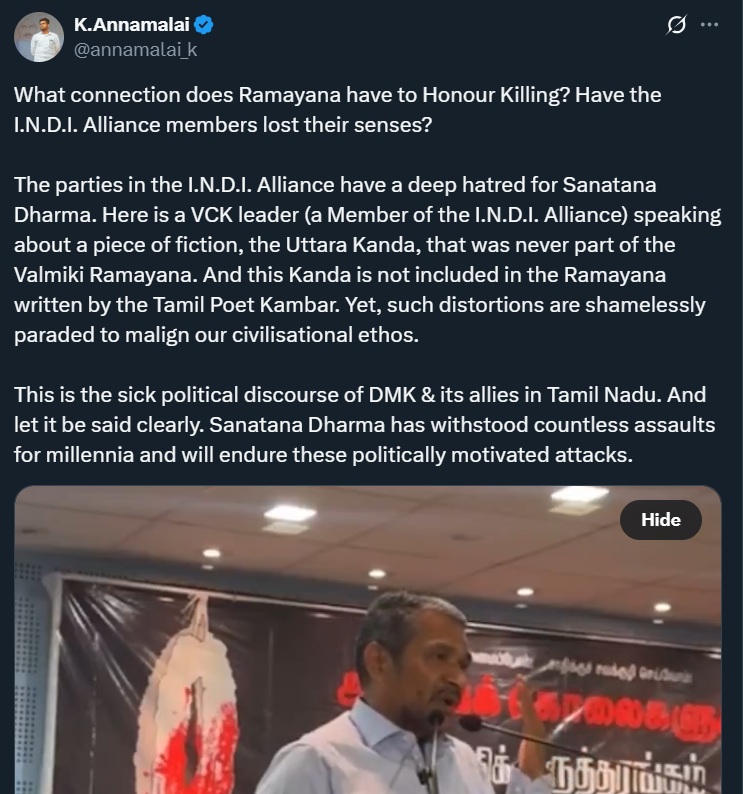
Reacting to this statement, BJP leader K Annamalai took to his X handle and slammed it. He wrote, “What connection does Ramayana have to Honour Killing? Have the I.N.D.I. Alliance members lost their senses? The parties in the I.N.D.I. Alliance have a deep hatred for Sanatana Dharma. Here is a VCK leader (a Member of the I.N.D.I. Alliance) speaking about a piece of fiction, the Uttara Kanda, that was never part of the Valmiki Ramayana. And this Kanda is not included in the Ramayana written by the Tamil Poet Kambar. Yet, such distortions are shamelessly paraded to malign our civilisational ethos. This is the sick political discourse of DMK & its allies in Tamil Nadu. And let it be said clearly. Sanatana Dharma has withstood countless assaults for millennia and will endure these politically motivated attacks.”
Who Is VCK Leader Vanni Arasu?
Vanni Arasu, the Deputy General Secretary of the VCK and a close ally of the DMK, has built his political career not on genuine service but on manufactured outrage, caste baiting, and dangerous alliances.
A man who claims Dalit identity while accused of misusing SC benefits after converting to Christianity, he routinely spews venom against the RSS and Indian nationalism, even glorifying separatist movements.
His record is littered with casteist slurs on the judiciary, vile personal attacks on political opponents, and photo-ops with convicted terrorists like SA Basha of the Coimbatore bombings.
Subscribe to our channels on Telegram, WhatsApp, and Instagram and get the best stories of the day delivered to you personally.
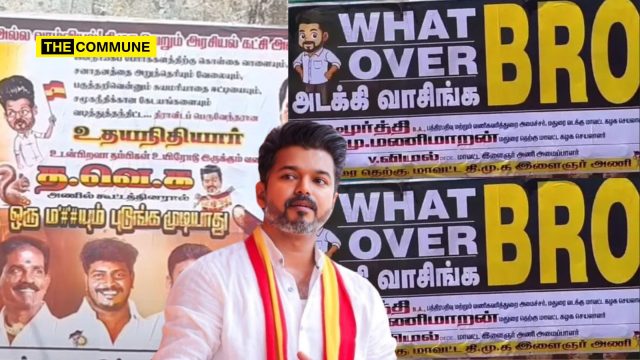
Following part-time politician Vijay’s second state-level convention of the Tamilaga Vettri Kazhagam (TVK) in Madurai, where he launched sharp criticisms against Chief Minister M.K. Stalin and took jabs at the AIADMK, an intense poster war erupted in response. The backlash came swiftly, with both the DMK and AIADMK district units issuing strong warnings and public condemnation of Vijay’s remarks.
In Madurai, the DMK plastered posters mocking Vijay, including caricatures and taunting slogans such as “What bro… Over bro… Know your limits (Adaki Vasinga) bro.” Another poster featured a more direct threat, “As long as our brothers stand strong, TVK’s anils can’t even pluck a strand of h*ir.”
The AIADMK followed suit with its own posters aimed at Vijay, declaring pointedly, “We are not chameleons that change colours,” suggesting that unlike TVK, their stance remains unwavering.
With just a few months remaining before the Tamil Nadu Assembly elections, these poster wars have set the stage for an increasingly confrontational political climate, signaling that the battle for influence has already begun.
With the lies and allegations around the alleged mass burials at Dharmasthala disproven, let us try to understand why the case crumbled so quickly. Why did the issue crop up all of a sudden (or was it) – was it done to tarnish the image of the Dharmadhikari and the institution by connecting it to the 2012 Soujanya murder case? Let’s take a look at the sequence of events. But before that, let us recap what happened in the Soujanya case.
Soujanya Alleged Rape & Murder Case
In 2012, a class 12 – 2nd year Pre Univ (PU) student aged around 17 years named Soujanya was allegedly raped and murdered in Dharmasthala. She was studying at the Sri Dharmasthala Manjunatheshwara College.
It is reported that on 9 October 2012, she went missing while returning from college. Despite extensive searches by her family and locals in heavy rain, she could not be found. Her last confirmed sighting was around 4:15 PM near the Netravati riverbank.
The next day, her body was discovered in a forested area near a local hospital. She had clearly been assaulted; her clothes were allegedly torn and undergarments missing. Public outrage was immediate.
The investigation saw multiple turns. Initially, local Belthangady police handled the case before it was transferred to the CID. The CID named Santhosh Rao, a hotel worker from Karkala, as the prime suspect and cleared four other individuals whom the family had accused. Widespread protests followed, leading the government to hand over the case to the CBI in 2013.
After a prolonged trial, the CBI special court acquitted Santhosh Rao in June 2023 due to insufficient evidence and investigative lapses. The court’s decision sparked further protests and calls for a reinvestigation under the “Justice for Soujanya” campaign. However, the Karnataka High Court rejected the plea for a fresh probe in 2024, stating it would serve no purpose.
Soujanya’s father, Chandappa Gowda, passed away in January 2024 after battling cancer, without ever seeing justice for his daughter. Over a decade later, the central question remains: who was truly responsible for Soujanya’s rape and murder? The case remains officially unsolved.
Unfolding Of The Conspiracy: A Timeline
February 2025 – YouTubers Publish Videos About Sowjanya Murder Case
Sometime in February end 2025, Sameer MD, through his YouTube channel Dhootha, posted a video titled “Dharmasthala Soujanya Case” which gained over 18 million views. The video revisited decades of crimes in Dharmasthala, focusing on the 2012 rape and murder of Soujanya, the wrongful conviction of Santhosh Rao, and alleged influence in investigations.
March 2025 – Propaganda Gains Steam
On 5 March 2025, Cowl Bazaar police filed an FIR against the video, citing that it hurt religious sentiments. Advocate A. Velan, representing Sameer, argued the FIR was misuse of law and violated free expression.
A writers’ convention scheduled for 9 March 2025 at the Kannada Sahitya Parishat (KSP) in Bengaluru was cancelled after the organisers received legal notices. The event was planned to demand justice for Sowjanya, a teenager raped and murdered in 2012, and to protest an FIR against YouTuber Sameer MD for his video on the case. The KSP withdrew permission, stating it only hosts literary events, not controversial or sub-judice matters.
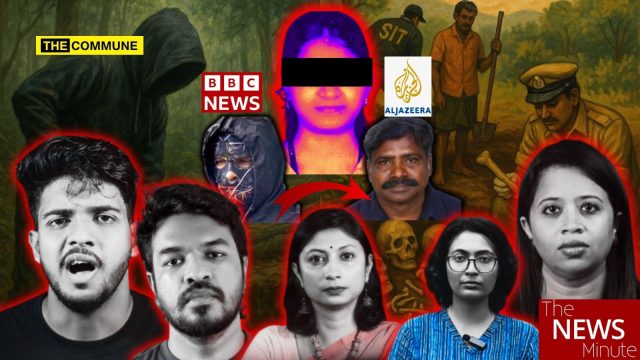
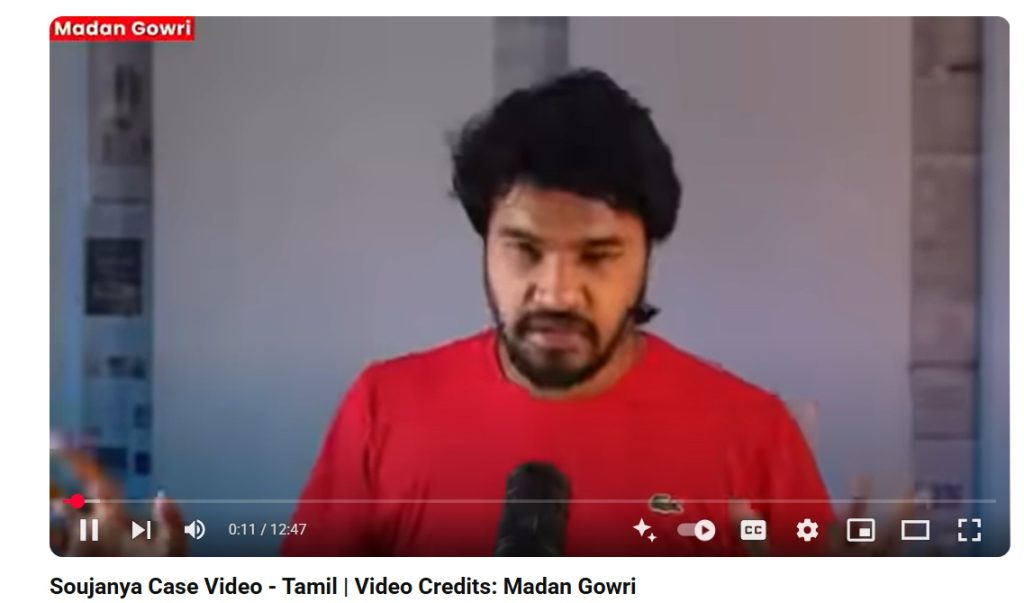
Around the same time, Tamil YouTubers like Madan Gowri is also seen posting videos after Sameer’s video is taken down. Madan highlighted that Sameer MD revived interest in the case by making a viral video alleging that influential figures connected to the Dharmasthala temple, including Veerendra Heggade and his circle, were involved in covering up the crime. He said that Sameer claimed Soujanya studied in a college managed by Heggade’s trust and suggested there were links. The video went viral, sparking heated debate and accusations that Sameer was targeting a Hindu religious leader because he was Muslim. Allegations circulated that Sameer was paid ₹35 lakh by Soujanya’s mother, though both she and Sameer denied this as absurd.
Madan Gowri
Following this video garnering more eyeballs, this one is also taken down. Several other Tamil YouTubers also do the same thing and do not post much about the Soujanya case.
15 March 2025 – The News Minute Enters
Around this time, The News Minute publishes a video using Sameer’s video takedown and linked it to other botched up police investigations such as the 2017 Kurnool hostel case (Geeta), the 2007 murder of student Ayesha Meera in Vijayawada, and Kerala’s 2017 Walayar sisters’ case. In each instance, crucial forensic evidence was ignored or tampered with, scapegoats were framed, and powerful suspects were shielded. Courts have noted police incompetence, but no meaningful accountability followed.
However, nothing much happens as takedown notices are implemented and the leftists and Dravidianists are unable to do anything at that time. By the time any further action can be taken, Pahalgam terror attack happens and the whole nation is in a frenzy – nothing will get attention now.
This was followed by Operation Sindoor – the attention towards the changing global situation continues till end of May 2025. Then on 12 June 2025, the Ahmedabad plane crash occurs, and the attention is again not there for the taking.
Now the conspiracists start making their move. Here’s a timeline of events that took place.
22 June 2025: Two Bengaluru lawyers, Ojaswi Gowda and Sachin Deshpande, met a former sanitation worker who claimed he could identify gravesites in Dharmasthala.
27 June 2025: The lawyers approached Dakshina Kannada Superintendent of Police requesting formal inquiry.
2 July 2025: The masked man, later revealed as Chinnaiah, filed written complaint with police, claiming he was forced to bury bodies of women and minors during 1995-2014
4 July 2025: FIR registered under Section 211(a) of BNSS
10 July 2025: Masked man granted police protection under Witness Protection Act
11 July 2025: Masked man appears before magistrate in Belthangady, produced a human skull and bones from a bag, claiming they belonged to a woman he had buried
15 July 2025: Sujatha Bhat files complaint claiming her daughter Ananya (medical student) went missing in Dharmasthala in 2003.
19 July 2025: Karnataka government constitutes Special Investigation Team (SIT) under DGP Pronab Mohanty following media and activist pressure.
20 July 2025: Dharmasthala temple administration issues statement supporting “fair and transparent” investigation.
25 July 2025: SIT formally takes over the case.
Between late July and early August, BBC and Al Jazeera jump into the picture – this came at a time when the leftists and other conspirators did not get the desired reaction from the public.
Al Jazeera
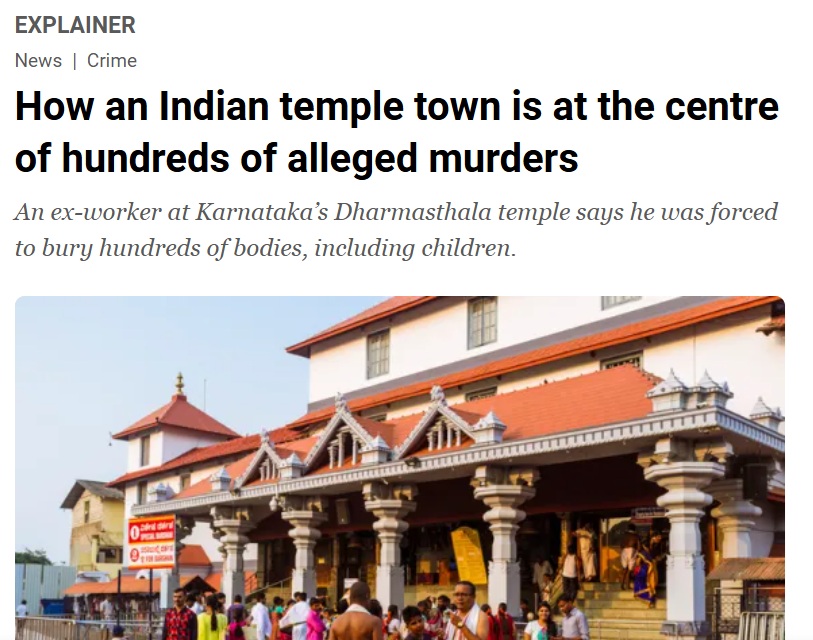
The Qatari government-funded propaganda outlet that is known for peddling anti-Hindu and anti-India narratives made even worse allegations than TNM and other leftist media. They first published an article on 22 July 2025, then went on to publish a video.
The video published on 25 July 2025 starts by framing the issue as “one of the worst serial killings in history.”
Then they shift to the “whistleblower” and identify him as “Dalit”, then they go on to say, “According to Hinduism’s caste system, the Dalits are at the bottom. They’re considered unpure and are often persecuted in India. As per tradition, temple administrators are from a higher caste.”
BBC – Tamil & Kannada
BBC’s video was in Kannada and they even interviewed Sujatha Bhat who recanted her statement saying she did not have a daughter, but she keeps making u-turns. BBC Kannada published the below video on 1 August 2025.
They published the Telugu version on the same date.
They published the same video in Tamil also, but 10 days later – on 10 August 2025.
SIT conducts excavations at 17 sites identified by masked man using ground-penetrating radar.
No human remains were found at the first five locations.
At a sixth site, partial skeletal remains of 15 bones (no skull) were found; initial reports suggested they were male.
No remains were found at the seventh, eighth, ninth, or tenth sites.
At an eleventh site, a human skull and a few bones were discovered.
At a fourteenth site, over 114 bones and a skull were found; preliminary reports indicated the remains belonged to a human male.
A PAN card and debit card were found at one site. The PAN card belonged to a man from Nelamangala who had died of jaundice and was cremated in his village.
Human remains found at only 2 sites out of 17 excavated nor were mass graves discovered despite extensive searches. The bones belonged to males.
18 August 2025
First major crack: Masked man retracts his claims, tells SIT he was coerced into making false statements. He stated that a gang approached him in Chennai in December 2023. The masked man revealed that the gang brought him to Karnataka, trained him on what to say in court, and even provided him with the skull and bone fragments he submitted as evidence which forensic reports later confirmed belonged to a man who died 30 years ago. He further confessed that he was instructed to coordinate his false testimony with another complainant, Sujatha Bhat, who had filed a missing person report for her daughter.
20 August 2025
BJP leader Gali Janardhana Reddy accuses Congress MP Sasikanth Senthil of being “mastermind” behind the campaign.
Senthil denies allegations calling them “baseless and ridiculous”
21-22 August 2025
Sujatha Bhat makes contradictory statements to media, first claiming she never had a daughter named Ananya, then retracting that statement too.
22-23 August 2025
SIT questions Chinnaiah extensively after finding major inconsistencies in his statements.
He confesses saying, “I’m only a player. The masterminds are somewhere else. They told me to say like this. So I said it. They told me to take the skull and hand it over to the court. So I did.”
He admitted having no knowledge of where the skull actually came from. Witness protection officially cancelled and masked man, now revealed as Chinnaiah is arrested for perjury.
23 August 2025
Chinnaiah is produced before Judicial First Class Magistrate in Belthangady. SIT is granted 10 days police custody for further investigation. Forensic reports confirm that the skull he presented was of a male, not female as claimed.
24 August 2025
BJP and JDS launched “Chalo Dharmasthala” rally demanding NIA probe.
Current Status (As of August 25, 2025)
BJP demands NIA investigation to expose “conspirators, foreign hands and funds”
Congress government under pressure, with some Congress MLAs demanding probe be stopped.
Deputy CM DK Shivakumar maintains government is on side of “justice”
Investigation Status
SIT continues investigation based on Chinnaiah’s confessions under custody
Temple administration vindicated – Dharmadhikari Veerendra Heggade says “truth is beginning to come out”
Questions remain about the identity of alleged “masterminds” Chinnaiah claimed were behind the conspiracy.
Some of the revelations of the case include:
– The evidence was fabricated – the skull was from a laboratory/unknown source, not from burial sites
– False testimony given – the primary complainant confessed to lying under oath Chinnaiah alleges he was pressured by unknown individuals to make false statements.
– No mass burials were found – despite extensive excavations at 17 sites, no evidence of mass graves.