Home Blog Page 374

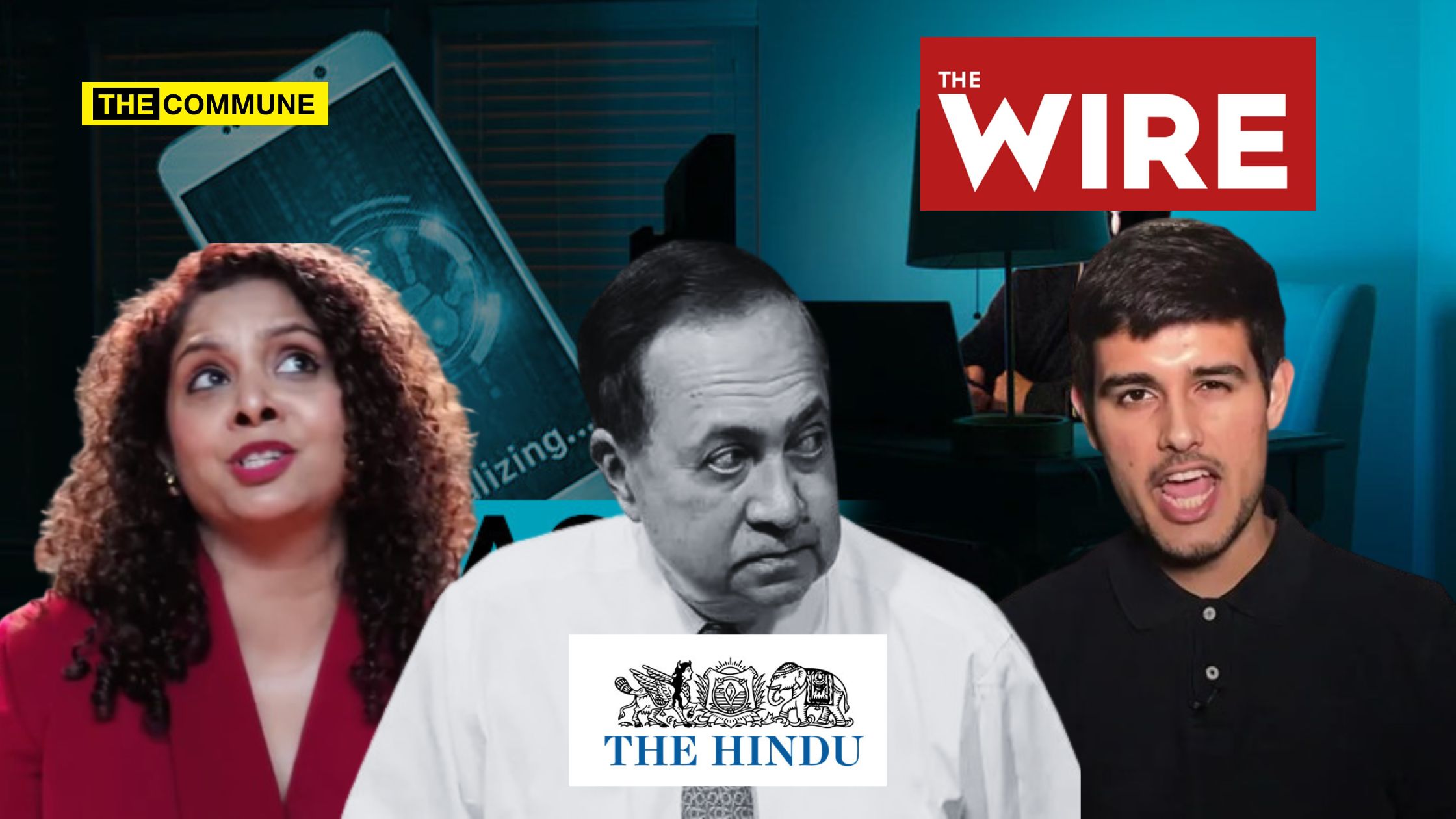
The Hindu’s Two-Bit Communist And Fascist DMK Buttressing Propagandist N Ram Calls Rana Ayyub As “Bravest Journalist”, Praises Dhruv Rathee, Cites “The Wire” As Proof For Pegasus Claims
N Ram is known for peddling lies during the alleged Rafale scam – one of the famous lie he peddled was when his publication The Hindu published cropped and incomplete pictures of documents on the Rafale deal during the run-up to the 2019 general elections.

In an interview with BBC’s HARDTalk, Ram portrays a picture of a “stifled” media, passionately critiques the alleged decline of press freedom under Prime Minister Narendra Modi, he conveniently overlooks his own publication’s history of biased reporting, selective narratives, and politically motivated journalism. Let’s dissect how Ram has been maintaining his one-sided leftist point of view all along that was exposed in this interview.

N Ram’s Hypocrisy on Press Freedom

N Ram lamented the decline of press freedom under Modi, but he conveniently ignored the fact that The Hindu, the publication he leads, has also been accused of bias and selective reporting. The Hindu is often criticized for its left-leaning editorial stance, which many argued was no less partisan than the so-called “Godi media” he now condemns.

Like a true DMK stooge, he praised TN media for being “credible”. He said, “There are still some exceptions. In the Indian languages, in Tamil Nadu, for example, where I come from, there are some perfectly credible television news channels, and maybe in West Bengal and other places as well.”

If Ram is so concerned about press freedom, why didn’t he speak out as forcefully when media houses were accused of bias during the Congress era? His selective outrage reeks of political vendetta rather than genuine concern for journalism.

Ram’s effusive praise for Rana Ayyub is telling. Ayyub has been peddling half-truths and sensationalism in her reporting. Her work on the 2002 Gujarat riots has been rubbished by the courts and relies on unverified sources. Responding to Sackur’s question on Ayyub, Ram said,
“Rana Ayyub is the bravest woman around the woman journalist I know, and she goes on, I got a message from yesterday that a new case, a first information report, has been ordered by a court against her writings. And she faces that threat, and yet she goes on showing that people like that can if you stand up. I think that’s the way to fight this this assault and there’s a repression. And she’s, I think, an extraordinary case. Fortunately, she’s able to write for The Washington Post and some other publications abroad. She’s respected, and I think people, we need people like that, and there are some others as well.”

By holding her up as a paragon of journalism, Ram reveals his own bias. Is he defending journalism, or is he defending a specific narrative that aligns with his ideological leanings?

The Pegasus Spyware Allegations: All Smoke, No Fire

Ram raised the Pegasus issue but admitted there’s no concrete proof that the Indian government used it to surveil journalists. This is a classic case of making sensational claims without evidence. When asked for proof, he says, “The proof is, I think there have been stories. This is the NSO group’s military great spyware, Pegasus, and I’m a petitioner in the Supreme Court of India. In fact, in the court, the government refused to confirm or deny that, had it acquired this spyware and so on, and it just and it just refused. The court could have compelled it, and we were disappointed it didn’t, but it set up a committee which then reported on it. It’s kept in a sealed cover.”

When pressed again for proof, Ram said, “There’s a strong suspicion, and there and other countries have investigated it. The New York Times did a story on this, pretty much indicating that this had been used. They’ve been, The Wire did investigations on this.”

If Ram is so sure about the government’s misuse of spyware, why hasn’t he produced any hard evidence? Instead, he hides behind vague suspicions and stories published in leftist rags like Washington Post and The Wire! This is not journalism; it’s fearmongering.

The “Godi Media” Smear

Ram’s use of the term “Godi media” (lapdog media) is a cheap shot aimed at discrediting media outlets that don’t align with his worldview. But what about the media houses that are openly critical of the government? Are they also “Godi media”? Or does the label only apply to those who don’t toe the leftist line? Ram’s hypocrisy is glaring. He fails to acknowledge that media bias exists on all sides, not just among those who support the government.

Ignoring the Role of Social Media

Ram praised ‘independent voices’ like Ravish Kumar and Dhruv Rathee, who have found success by peddling lies on YouTube. When
questioned that these “voices” have millions of subscribers, and nobody seems to be stopping them, Ram, flustered, replies, “They are trying to stop that. They’re struggling to see what can be done there. The new broadcast services bill was introduced there was opposition, so it’s been referred to a committee because the government has no majority, and maybe some of its allies have problems or qualms about it.”

Sackur calls India a noisy democracy and that voices like Ravish Kumar aren’t successfully stifled. Ram replies, “I fully agree with this, and I’d add Dhruv Rathee, who’s not a journalist, he was a sort of an educator on YouTube, and he then put out a frame, something that went viral, called, Is India a democracy? And then he had a sequel, and I believe, 50 million views.”

Ram has conveniently ignored the fact that these same voices on YouTube have been peddling misinformation and propaganda like him, is that why he endorsed them? If Ram is so concerned about disinformation, why doesn’t he call out the lies and half-truths spread by his ideological allies?

The Myth of Modi’s Authoritarianism

Ram accused Modi of incremental authoritarianism, but he provided no concrete examples of how this has stifled democracy. India remains a vibrant democracy with a free press, as evidenced by the fact that critics like Ram can freely express their views on international platforms like the BBC. If Modi were truly authoritarian, would Ram even be allowed to speak so openly? The reality is that India’s media landscape is more diverse and pluralistic than ever, and Ram’s doomsday predictions ring hollow.

Selective Amnesia on Congress Era

Ram’s criticism of the Modi government is rich, considering his silence during the Congress era. The Emergency of 1975-77, imposed by Indira Gandhi, was one of the darkest periods for Indian democracy and press freedom. Yet, Ram has been conspicuously quiet about the Congress’s authoritarian tendencies. His selective outrage suggests that his problem isn’t with authoritarianism per se, but with Modi specifically.

The Elite Media Bubble

Ram represents the old guard of Indian journalism—a privileged elite that has long dominated the media landscape. His criticism of Modi’s direct connection with voters through platforms like YouTube and X (formerly Twitter) reeks of elitism. Ram seems to resent
the fact that Modi has bypassed traditional media gatekeepers like him to communicate directly with the masses. It is not clear whether Ram’s real issue with press freedom or is it with losing his own relevance in the digital age.

The Disinformation Double Standard

Ram accused the BJP of being the primary source of disinformation, but he conveniently ignored the role of opposition parties and left-leaning media in spreading false narratives. From fake news about farm laws to exaggerated claims about communal violence, the opposition has been just as guilty of disinformation. Ram’s one-sided criticism exposes his partisan agenda.

It is an open secret that N Ram has nothing but contempt for the BJP and hatred for Prime Minister Narendra Modi and he has still not come to terms that the Rafale fighter deal was legitimate and continues to peddle the lie.

This HARDTalk interview is a masterclass in selective outrage, hypocrisy, and ideological bias. While he poses as a defender of press freedom, his arguments are riddled with contradictions, unverified claims, and partisan smears. If Ram truly cares about journalism, he should start by holding himself and his ideological allies to the same standards he demands of others. Until then, his criticisms of the Modi government and the Indian media landscape will remain nothing more than the rantings of a disgruntled leftist clinging to a bygone era.

Subscribe to our channels on Telegram, WhatsApp, and Instagram and get the best stories of the day delivered to you personally.
Beef Biryani Poster Ads Pasted On Temple Walls In Thiruthani Removed After Hindu Munnani Intervenes 

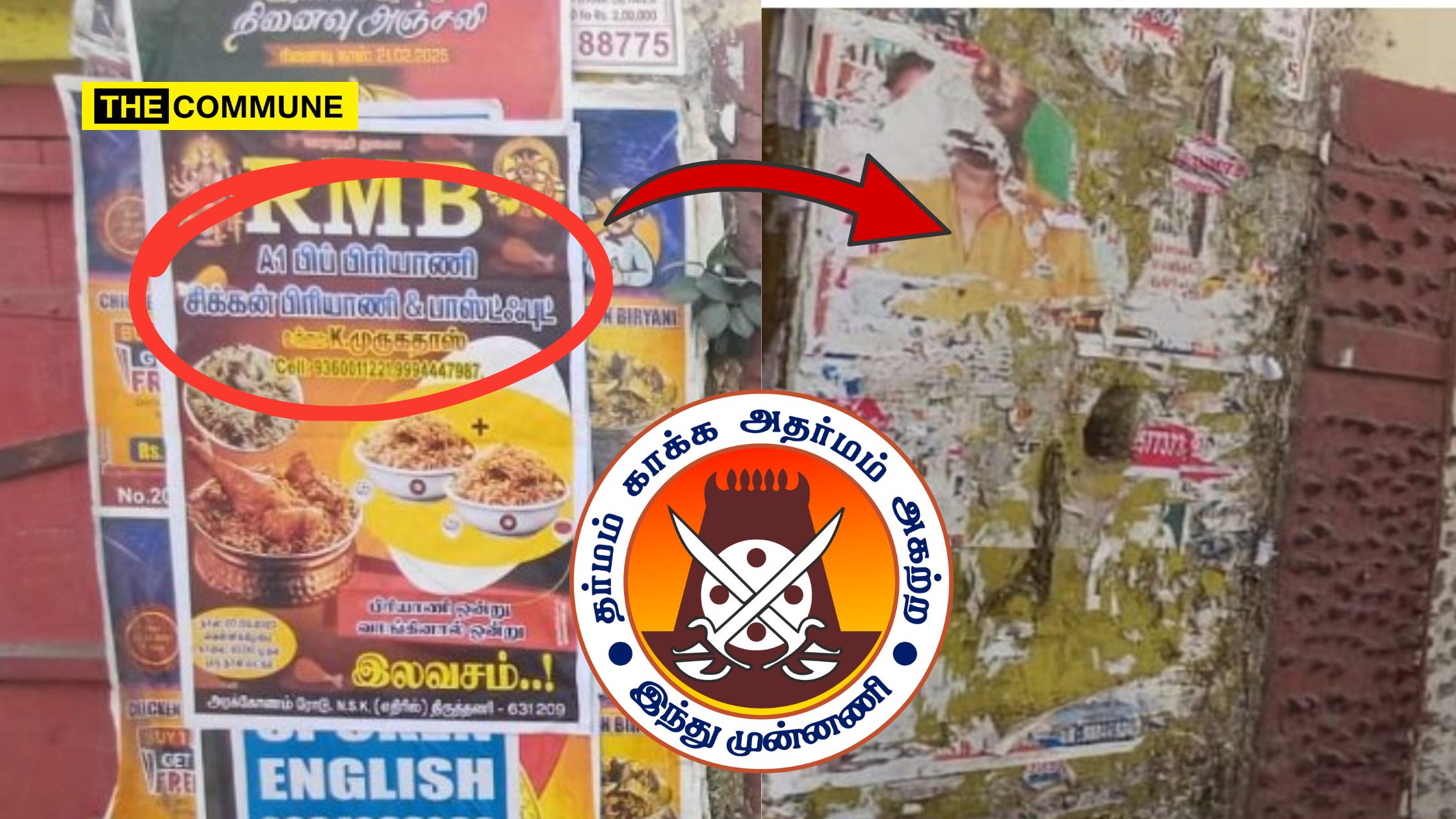
In an apparent attempt to defile temple property, controversial posters promoting the sale of beef biryani were pasted on the outer walls of the Sundara Vinayagar Temple, which is affiliated with the Thiruttani Murugan Temple. Following a formal complaint by Hindu Munnani, the posters were swiftly taken down by temple authorities.

The posters, allegedly put up by RMB Stall, advertised a “Buy One, Get One Free” offer on non-vegetarian dishes, including beef and chicken biryani. They were printed in black and red lettering, commonly associated with the DMK party, and were reportedly placed by an individual named Murugadoss.

Devotees, outraged by the attempt to provoke tensions and mock the sanctity of the temple, immediately alerted Hindu Munnani. The organization took up the issue with the Thiruttani Murugan Temple’s Joint Commissioner, leading to the prompt removal of the offensive posters.

In a similar incident of temple desecration, in December 2024, the Hindu Munnani has strongly criticized the HRCE Department, Nellaiappar Temple administration, and local municipal authorities for allowing a non-vegetarian food stall selling chicken and beef to operate near the Tirunelveli Nellaiappar Temple. The stall, which boldly displayed a biryani advertisement, was set up near the Vinayagar chariot, triggering outrage among devotees and Hindu activists.

Hindu Munnani’s State Secretary, K. Kutralanathan, took to social media to condemn the presence of a beef stall so close to the temple and questioned how such an act was permitted. In his statement, he directly addressed the Hindu Religious Endowments Department, the temple administration, and municipal authorities, demanding accountability.

He wrote, “A beef biryani board is set up right in front of the Pillaiyar chariot at the revered Nellaiappar temple. A biryani stall, with a tin roof extending all the way to the chariot, is occupying the road and that too near the Pillaiyar chariot. The beef biryani signboard has been placed to hide the security fence erected by devotees for the Pillaiyar chariot. How did the Corporation grant permission for this stall to operate near the Vinayagar chariot?” Kutralanathan urged the temple authorities, local officials, and police to take immediate action and remove the stall, calling the situation an insult to the sanctity of the temple.

Subscribe to our channels on TelegramWhatsApp, and Instagram and get the best stories of the day delivered to you personally.

How Asianet & SouthFirst Are Twisting The Koodalmanikyam Temple Row As A Caste Issue

Recent reports by Malayalam channel Asianet and subsequently by leftist/TNM wannabe media portal, SouthFirst have stirred a controversy surrounding the Koodalmanikyam Temple in Irinjalakuda, Thrissur, alleging caste discrimination against the appointment of a kazhakakar (temple worker) from the Ezhava community. However, a closer examination of the facts reveals a starkly different narrative—one that exposes the media’s sensationalism, misrepresentation, and disregard for the temple’s traditions and hereditary practices. Here’s the truth behind the headlines.

The Allegations: What Asianet And SouthFirst Claim

Caste Discrimination: Asianet and SouthFirst allege that the temple’s tantris (priests) opposed the appointment of BA Balu, an Ezhava community member, as a kazhakakar, citing caste bias.

Government Intervention: The reports claim that the Kerala Devaswom Board and the state government are standing up against caste-based discrimination, with Devaswom Minister VN Vasavan calling the incident “unacceptable and shameful.”

Human Rights Violation: The Kerala State Human Rights Commission (SHRC) has reportedly initiated an investigation into the matter, further amplifying the narrative of caste-based exclusion.

What Is The Truth?

No Mention of Caste in the Tantris’ Letter:

The tantris’ objection to Balu’s appointment was not based on caste. Their letter to the Devaswom Board explicitly highlighted the violation of hereditary rights of the 12 families traditionally associated with the kazhakam posts. These families have served the temple for centuries, and their livelihoods depend on these roles. The tantris’ protest was about preserving these hereditary practices, not about
caste.

Balu’s Denial Of Caste Discrimination

The affected party, Balu, himself clarified that he had never experienced caste abuse from the temple administration, employees, or community members. He stated that he had not personally seen any letter from the Tantris (priests) or the Devaswom Board regarding his removal.

The report suggested that the controversy was politically motivated, with Advocate Ajay Kumar, a Devaswom Board member, playing a role in fueling the claims. Community leaders, including Akiraman Kalidasa Bhattathiri, dismissed the allegations as a conspiracy to divide Hindu society and undermine temple traditions. They argued that such incidents were part of a broader trend to disrupt Hindu unity and interfere in temple affairs for political gains.

Illegal Government Takeover:

The Koodalmanikyam Temple was illegally taken over by the Kerala government, as declared by the High Court. Despite the court’s ruling, the government has refused to vacate the temple. This raises serious questions about the government’s moral authority to intervene in the temple’s affairs.

Displacement of a Long-Serving Worker:

The person displaced to make way for Balu had been working in the temple for over five years and was paid one-third of Balu’s salary. He was asked to leave without notice, raising concerns about fairness and the government’s motives.

Selective Outrage:

Asianet and SouthFirst have remained silent on similar appointments in other temples, such as Parassinikkadavu and Varka
la, where Ezhavas have been appointed to non-hereditary posts. This selective outrage suggests a politically motivated agenda rather than
genuine concern for social justice.

Misrepresentation of Tantris’ Role:

The tantris of Koodalmanikyam Temple, hailing from Tharananalloor Mana, have a long history of preserving temple traditions and supporting the livelihoods of shebaits (temple workers). Their protest was not against any individual or community but against the violation of Kshetra Niyamam (temple rules) and hereditary rights.

The Hypocrisy of Government And Media

Toilet Cleaning Jobs for SCs:

While the government portrays itself as a champion of backward communities, it has appointed Scheduled Caste (SC) individuals only for toilet cleaning roles in the temple. This raises questions about the government’s commitment to genuine social justice. Why are there no SC accountants or higher-level employees in the Devaswom office?

Lost Land Records:

The government’s administration of the temple has been marred by incompetence. The land records of the temple were lost in a mysterious
fire shortly after the government took over. This negligence further undermines the government’s credibility in managing the temple.

Media’s Role in Spreading Fake News:

Asianet and SouthFirst have twisted the tantris’ genuine concerns into a caste-based controversy, ignoring the Supreme Court’s verdict in
the Shivacharyar case, which upholds the rights of hereditary temple custodians. This misreporting has tarnished the reputation of the tantris and the temple.

The Bigger Picture: A Fight For Tradition And Rights

The Koodalmanikyam Temple controversy is not about caste discrimination but about preserving tradition and protecting the rights of hereditary workers. The tantris’ protest is rooted in their commitment to upholding the temple’s ancient practices and ensuring the livelihoods of the families who have served the temple for generations.

The government’s intervention, framed as a fight against casteism, appears to be a political maneuver to gain favor with certain communities. Meanwhile, the media’s sensationalism has only deepened the divide, spreading misinformation and undermining the temple’s traditions.

Subscribe to our channels on Telegram, WhatsApp, and Instagram and get the best stories of the day delivered to you personally.
No, Jairam Ramesh, Temples Are Not Being Taxed For Religious Activities – Here’s The Truth

Congress leader Jairam Ramesh has claimed that temples under the Hindu Religious & Charitable Endowments (HR&CE) Department are being subjected to Goods and Services Tax (GST), citing a report from Dinamalar. However, a review of official records and government statements reveals that his assertions are misleading and factually incorrect.

What Does the Law Actually Say?

According to the official response in Parliament dated 3 February 2025, temples and religious institutions enjoy comprehensive exemptions from GST for their core religious and spiritual activities. These exemptions include:

  • Prasadam distribution: No GST is levied on the sale or supply of prasadam in temples.
  • Religious ceremonies: Rituals and services conducted within temples for religious purposes remain outside the GST purview.
  • Premises rental below thresholds: Temples are exempt from GST on renting of halls, community spaces, or shops if the rental income remainswithin legally defined limits.

Additionally, services provided by temples for religious and spiritual purposes under various sections of the Income Tax Act are fully exempt from GST.

GST Applies Only to Commercial Activities, Not Religious Functions

Contrary to Ramesh’s claim that temples are being forced to pay crores in GST, the tax applies only to commercial activities conducted by temples—such as renting out large properties, shops, or lodges for commercial use. The imposition of GST on commercial property rentals is a standard policy applied across all sectors, including businesses, trusts, and religious institutions.

GST law mandates an 18% tax on rental income from commercial properties, applicable to all property owners, including religious institutions leasing out land or buildings. This is not a special provision targeting temples but a general tax law.

Congress’ Misplaced Outrage And Political Opportunism

Jairam Ramesh’s attempt to paint this as an attack on Hindu temples is ironic, given that the GST Council—responsible for tax policy decisions—includes representatives from both the Centre and State Governments, including Congress-ruled states and its INDI Alliance partners. If Ramesh had genuine concerns, he should have raised them with his own allies.

Furthermore, Congress’ sudden concern for temples contrasts sharply with the party’s track record. In Tamil Nadu, where the HR&CE Department is controlled by the ruling DMK (a Congress ally), temple funds have reportedly been diverted for non-religious purposes, including:

  • Purchasing office supplies for government departments using temple money.
  • Constructing commercial shopping complexes instead of temple maintenance.
  • Reports of devotees and priests being harassed by ruling party functionaries.

If Congress is truly worried about the state of Hindu temples, it should first address these real issues instead of misleading the public with false claims about GST. Jairam Ramesh’s claims about GST being unfairly imposed on temples are misleading and politically motivated. The law clearly exempts religious services and rituals from GST, with taxation applying only to commercial rentals—something that applies across the board, not just to temples.

Subscribe to our channels on Telegram, WhatsApp, and Instagram and get the best stories of the day delivered to you personally.
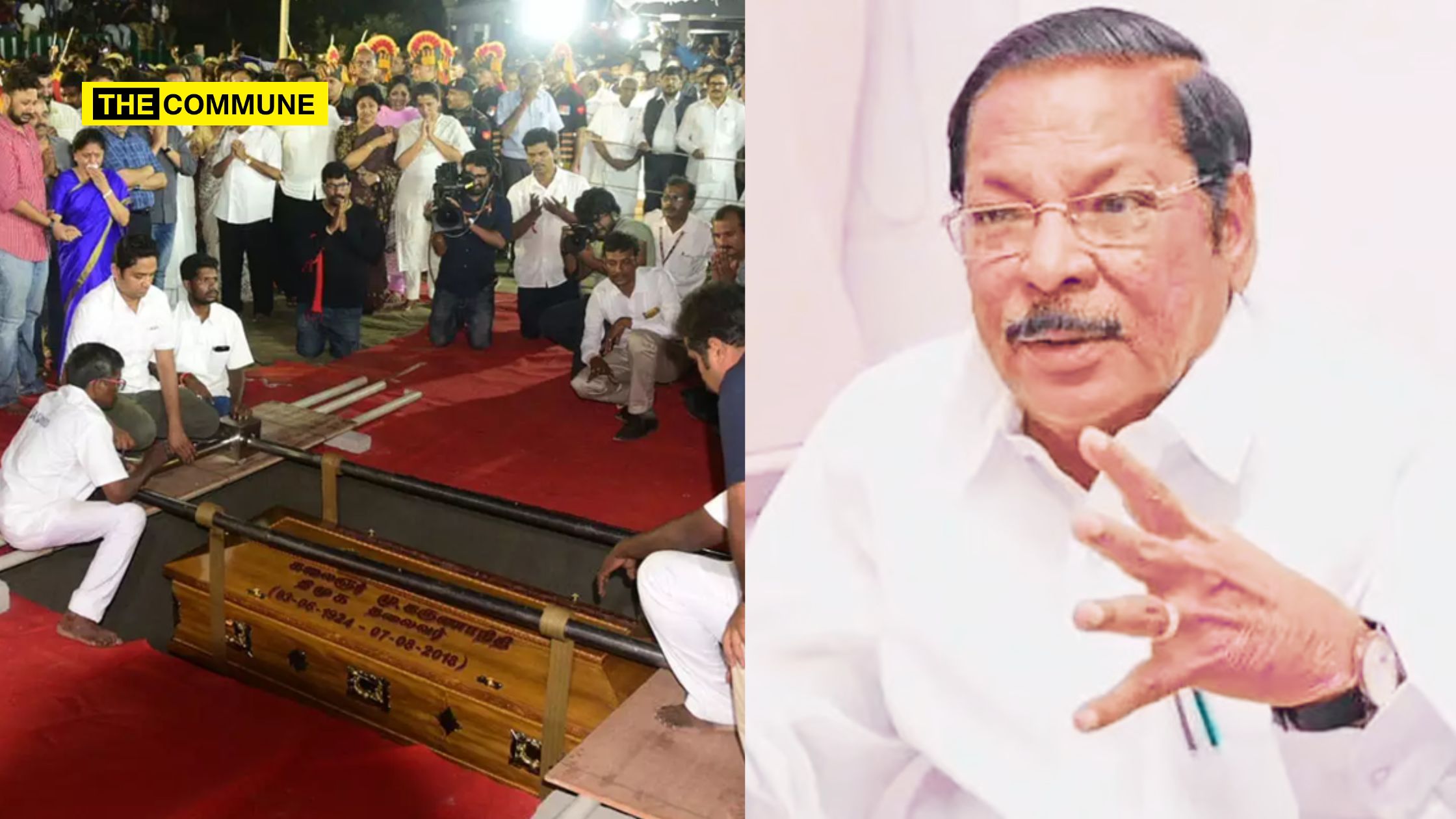
“Had The Judge Been A Brahmin, We Wouldn’t Have Won”, DMK’s RS Bharathi Peddles Canards About Judiciary, Claims Non-Brahmin Judge Favored Karunanidhi’s Marina Beach Burial

DMK leader RS Bharathi who is known to run his mouth about people and make racist comments about Hindi speakers, SCs, Nagas, and more, has done it yet again.

Speaking at a public meeting recently, he has openly derogated Brahmins. He recollected the incidents around former CM Karunanidhi’s death and how his body was buried at Marina Beach alongside other former Chief Ministers after a legal battle. While doing so, he claimed that the judge hearing the case was not a Brahmin and implied that had it been one, Karunanidhi would not have been buried where he is now.

He said, “Karunanidhi told us to bury him near Annadurai. When he (Karunanidhi) passed away, Thalapathy Stalin said that he should pursue the case in court himself. Continuing the case, Thalapathy accepted Kalaignar’s order and gave him a six-foot plot of land in Chennai through the court. Fortunately, had that judge had been a Brahmin (shows janeu/sacred thread with hand gestures), we would not have gotten it. Fortunately, he is one of us. I don’t delve deeper into this. Then the judge said at 11 pm, if you can somehow go and get this writ petition numbered in the High Court and send a notice to the government, I will hear this case in court at night itself.”

RS Bharathi has made derogatory statements about judges earlier.

He was arrested in May 2021 by the Central Crime Branch of the Chennai city police in May 2020 for allegedly making inflammatory remarks at a party meeting in February. In his speech, Bharati reportedly said that it was only because of the Dravidian movement’s alms (pichchai) that Dalits were able to become judges in Tamil Nadu. Referring to a judge, he reportedly said that many Dalits were inducted into the judiciary because of the indulgence of the DMK leadership during former chief minister M Karunanidhi’s tenure.

Speaking at an event in Anbagam (the DMK youth wing headquarters), in February 2020, he said “If Tamil Nadu remains the best state, it is because of the Dravidian movement. No Harijan has become a judge of the High Court in Madhya Pradesh. After Karunanidhi became Chief Minister A Varadarajan was appointed as HC judge. Seven or eight others from the Adi Dravidar community went on to become judges after that. It is the alms (picchai) given by the Dravidian Movement”. He later issued an apology for his remarks.

Subscribe to our channels on Telegram, WhatsApp, and Instagram and get the best stories of the day delivered to you personally.
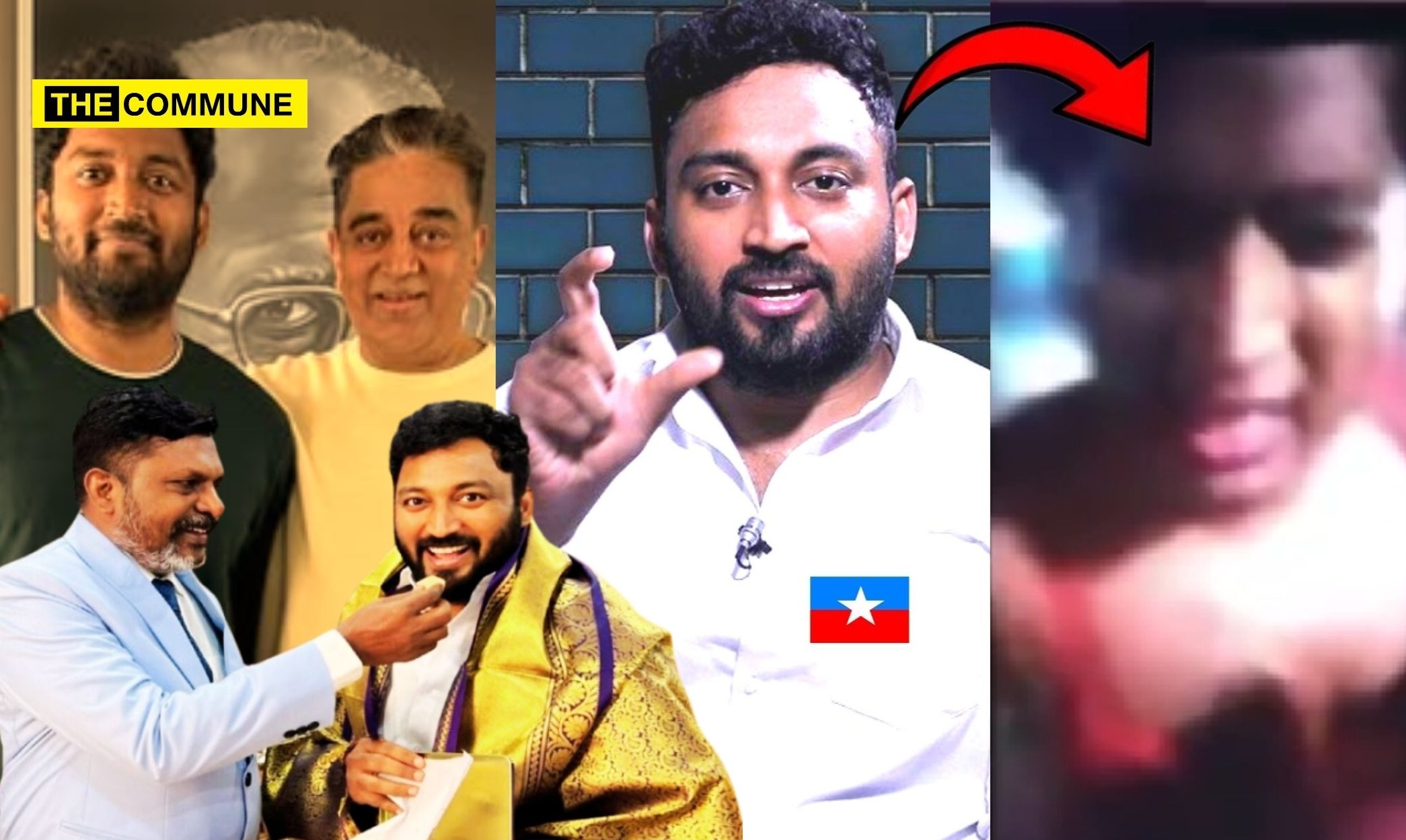
VCK Functionary Vikraman Refutes Allegations Of Sexual Assault, His Wife Says Viral Video Is Related To Film Shoot

A video went viral on social media, allegedly showing Vikraman, a Viduthalai Chiruthaigal Katchi executive and former contestant of Bigg Boss Tamil 6, dressed as a woman and sexually harassing a young man. However, Vikraman has refuted these claims, stating that the video was taken during the shooting of a movie and has been misrepresented to defame him.

The controversy erupted after the video surfaced online, with users alleging that Vikraman was caught red-handed engaging in inappropriate behavior. The claims gained further traction when reports surfaced that director Rajumurugan’s wife had filed a complaint regarding illegal activities in the apartment complex where Vikraman was residing. These rumors linked Vikraman to the alleged activities and accused him of wrongdoing.

In response to the accusations, Vikraman issued a statement on the social media platform X, asserting that he would pursue strict legal action against those spreading baseless allegations. He clarified that the video was part of a film shoot and had been taken out of context to malign his reputation. He wrote, “Strict legal action will be taken against those who spread defamation without any basis based on something that happened during a movie shoot. My heartfelt thanks to the management of Polymer Television for acting ethically and taking prompt action.”

Despite his explanation, social media discussions continued, with some individuals insisting that Vikraman was involved in a case where a 23-year-old youth was allegedly injured. Others suggested that Vikraman attempted to suppress the video by threatening those who recorded it and allegedly offering a large sum of money to destroy it.

Amid the growing controversy, Vikraman’s supporters urged him to release an official statement from the film’s production team, clarifying thecontext of the video. They emphasized that doing so would help counter the misinformation and clear his name.

Further, Vikraman’s wife has reportedly filed a complaint at the Tiruvekkadu police station, seeking legal action against those who have misrepresented the video and spread false allegations. She said that the video is related to a film shoot that she and her husband were working on.

“We had to film a video related to a shooting in the old house we lived in. It was taken for shooting purpose when I was away from town. That video has been mischaracterized and somebody has spread it to defame.”, she said.

When a reporter asked about the viral video having no camera or characteristics of a film shoot Vikraman’s wife said “I didn’t say it was a shoot. I said it’s a video related to shoot. It’s not a film shoot. We tried to do a test video for a shoot. That time I was in Madurai. So, I asked him (Vikraman) to shoot the video himself and send.”

(With inputs from Tamil Samayam)

Subscribe to our channels on Telegram, WhatsApp, and Instagram and get the best stories of the day delivered to you personally.
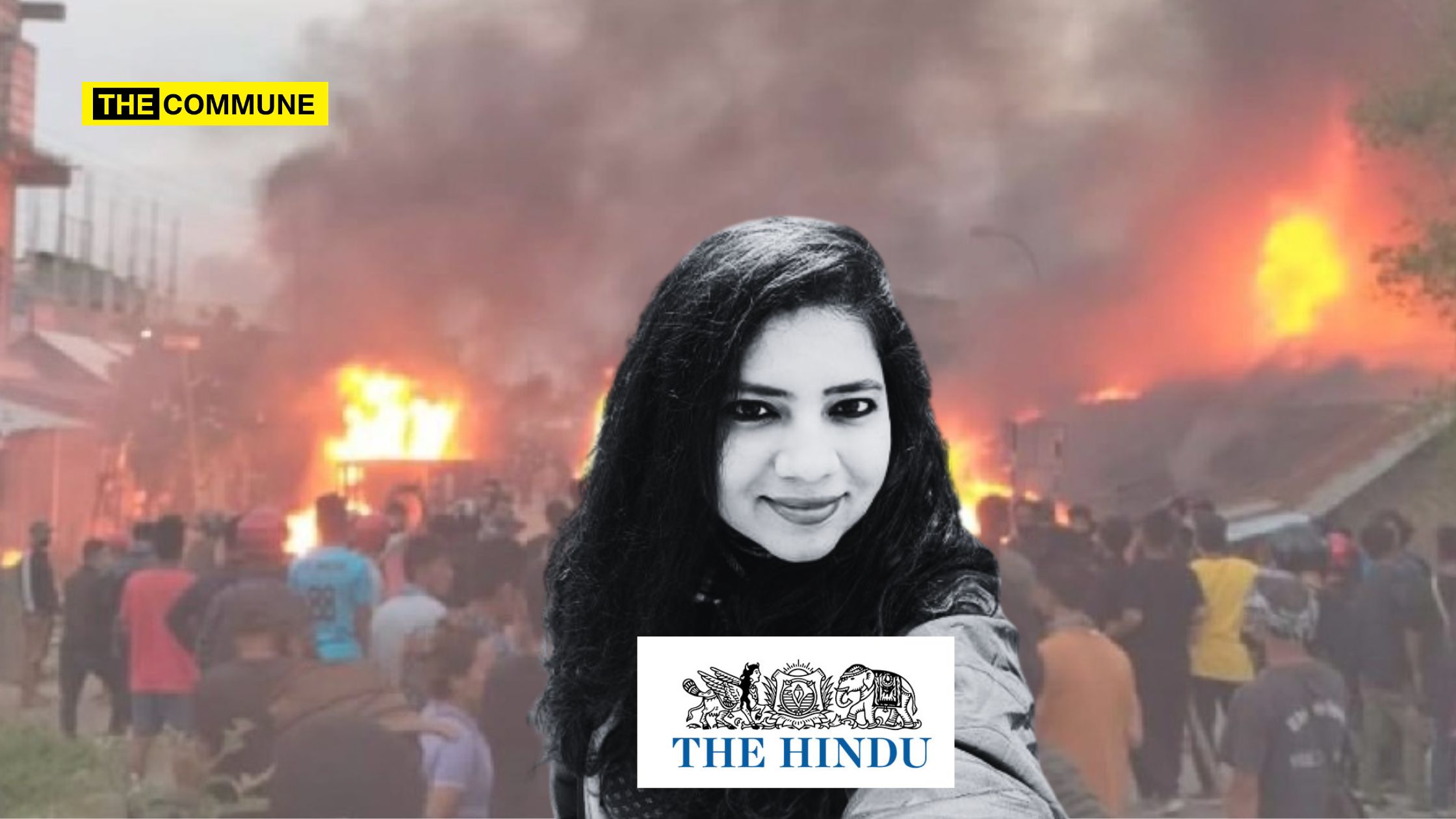
Exposing The Hindu’s Hidden Agenda: Vijata Singh’s Inflammatory Misreporting On Manipur

In a volatile state like Manipur, where ethnic tensions between the Meitei and Kuki-Zo communities have led to prolonged violence and unrest, the role of the media becomes critical. Responsible journalism is not just about reporting facts but also about ensuring that the narrative does not exacerbate tensions or mislead the public. Unfortunately, Vijaita Singh, a senior journalist with The Hindu, has been accused of repeatedly publishing inflammatory, vague, and misleading reports that risk fueling the already fragile situation in Manipur.  Here’s a closer look at how her reporting has contributed to the problem.

The Chronology Of Misreporting

Since 3 May 2023, when the violence in Manipur first escalated, Vijaita Singh’s reports have often been criticized for their tone and content. Her articles and tweets have been accused of lacking nuance, misrepresenting facts, and amplifying divisive narratives. Below are some examples:

Inflammatory Reporting on Protests

In a recent report dated 9 March 2025, Vijaita quoted Hai Hatchingthem Kipgen, a college student leading protests in Kangpokpi, who accused security forces of attacking protesters. She included a statement where a security force member allegedly told protesters, “We are not Indians.” While the claim was later clarified by the protester that the superior officer intervened immediately, Vijaita’s decision to highlight this statement without proper context risked inflaming anti-security force sentiments.

Why It’s Problematic: In a state where trust in central forces is already low, such reporting can deepen mistrust and provoke further unrest. The inclusion of unverified claims without adequate context is irresponsible.

Misleading Headlines And Erroneous Reporting

On 23 January 2024, The Hindu published a report by Vijaita with the headline: “Meitei MLAs call for ‘positive action.” The article claimed that 35Meitei MLAs had passed a resolution questioning the role of central forces. However, The Hindu later issued a clarification stating
that the headline and text were erroneous. The resolution was passed by 35 MLAs excluding the ten Kuki-Zo legislators, not exclusively by Meitei MLAs.

Why It’s Problematic: Such errors, especially in a sensitive environment, can deepen communal divides. By framing the resolution as a Meitei-only move, the report risked alienating the Kuki-Zo community and escalating tensions.

Sensationalizing Central Government’s Role

In another report, Vijaita highlighted that Manipur Chief Minister N. Biren Singh had skipped a North Eastern Council (NEC) meeting chaired by Union Home Minister Amit Shah. She also reported that Singh questioned the efficacy of central security forces in curbing violence in Moreh, a Kuki-Zo-dominated area.

Why It’s Problematic: While reporting on the Chief Minister’s actions is important, framing it as a direct confrontation with the central government risks politicizing the issue further. Such narratives can undermine efforts to restore peace and trust between the state and central authorities.

Did She Do A Barkha Dutt?

Singh is also accused of pulling an act similar to the one by the infamous journalist Barkha Dutt. Singh, whether intentional or unintentional, had leaked the names of Army officers from Manipur as below.

The Impact Of Irresponsible Journalism

Vijaita’s reports often focus on divisive statements and actions without providing the broader context. This can deepen existing fault lines between the Meitei and Kuki-Zo communities.

By highlighting unverified claims against security forces and central authorities, her reporting risks eroding public trust in institutions that are critical to maintaining peace.

In today’s digital age, journalists’ reports are often amplified on social media. Inflammatory or misleading reporting can lead to widespread
misinformation, further complicating efforts to restore normalcy.

While The Hindu has issued clarifications for some of Vijaita’s errors, the damage caused by such reporting cannot always be undone. In a state as volatile as Manipur, journalists must exercise maximum restraint and prioritize peace-building over sensationalism.

Vijaita Singh’s reporting on Manipur has repeatedly come under scrutiny for its inflammatory and misleading nature. While the media has the right to report freely, it also has a responsibility to ensure that its reporting does not exacerbate conflicts or spread misinformation. In a state like Manipur, where peace hangs by a thread, journalists must act as mediators of truth, not as amplifiers of division.

Going by the repetitive misreporting, one can’t help but wonder if the propagandists at The Hindu are in the payrolls of vested interests.

Subscribe to our channels on Telegram, WhatsApp, and Instagram and get the best stories of the day delivered to you personally.
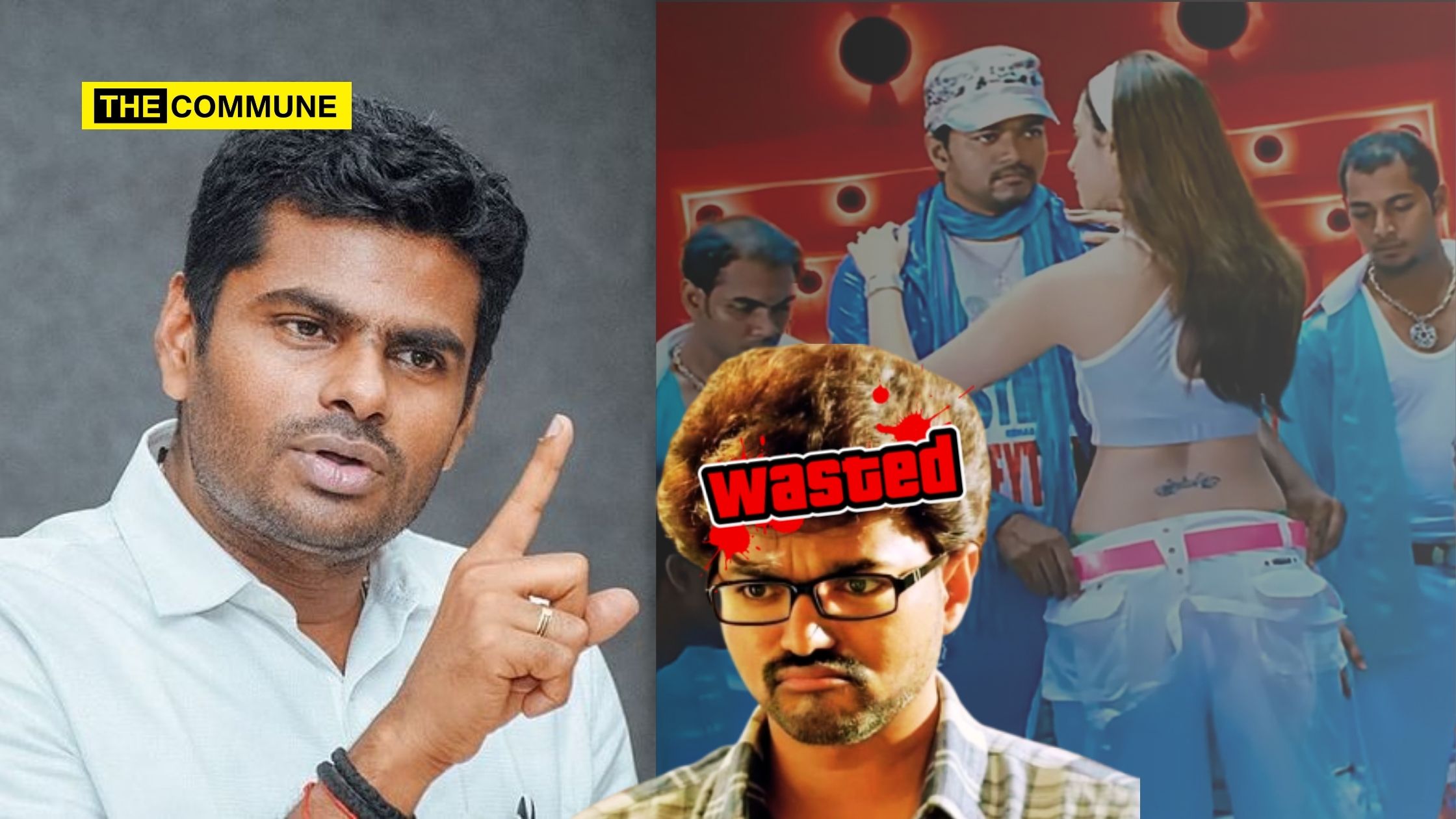
“Vijay Doing Work-From-Home Politics, Pinching Hips Of Actresses, He’s DMK’s B-Team”: BJP Leader Annamalai Ruthlessly Rips Apart Part-Time Politician And TVK Head Joseph Vijay

Tamil Nadu BJP President K. Annamalai pulled no punches in attacking part-time politician Vijay who had called BJP’s protest against 1000 crore DMK TASMAC Liquor scam as ‘drama’. Joseph Vijay had accused BJP and DMK of colluding while pretending to be opponents. “TVK is doing politics like school kids. They’ll do politics from cinema shooting is it? Vijay is doing politics by singing and pinching hips of actresses. I also know to talk. TVK should not cross its boundaries. I am trying to give respect to TVK.

Annamalai lambasted at Vijay. He further blasted him saying “Am I releasing statements like Vijay by piching hips of actresses and dancing with them? I am protesting on the field and talking from here.

He also took jibes at the part-time politician saying “Is Vijay doing ‘work-from-home’ politics? Who is doing drama? He got enlightened to enter politics only at 50 is it? Where did he go when he was 30?” Annamalai also said that TVK is the B-Team of DMK saying “Vijay is the B-Team of whom? Who is doing drama? BJP or Vijay?” Vijay is doing drama. Vijay is the B-Team of DMK. I am saying this surely with full confidence. After watching the activities of TVK I am saying this, TVK and Vijay is the secret project to bring DMK back to power. If they talk crossing civility, I also know how to talk. Give respect and take respect.

Annamalai also gave two hits on the go to ‘Bussy’ Anand, the right-hand of Vijay. “This ‘Pussy’ Anand, ‘Bussy’ Anand guy should not give statements simply. You guys are doing work-from-home politics. Come to the field if you can. You’re doing politics sitting comfortably and typing statements from your acting spot.

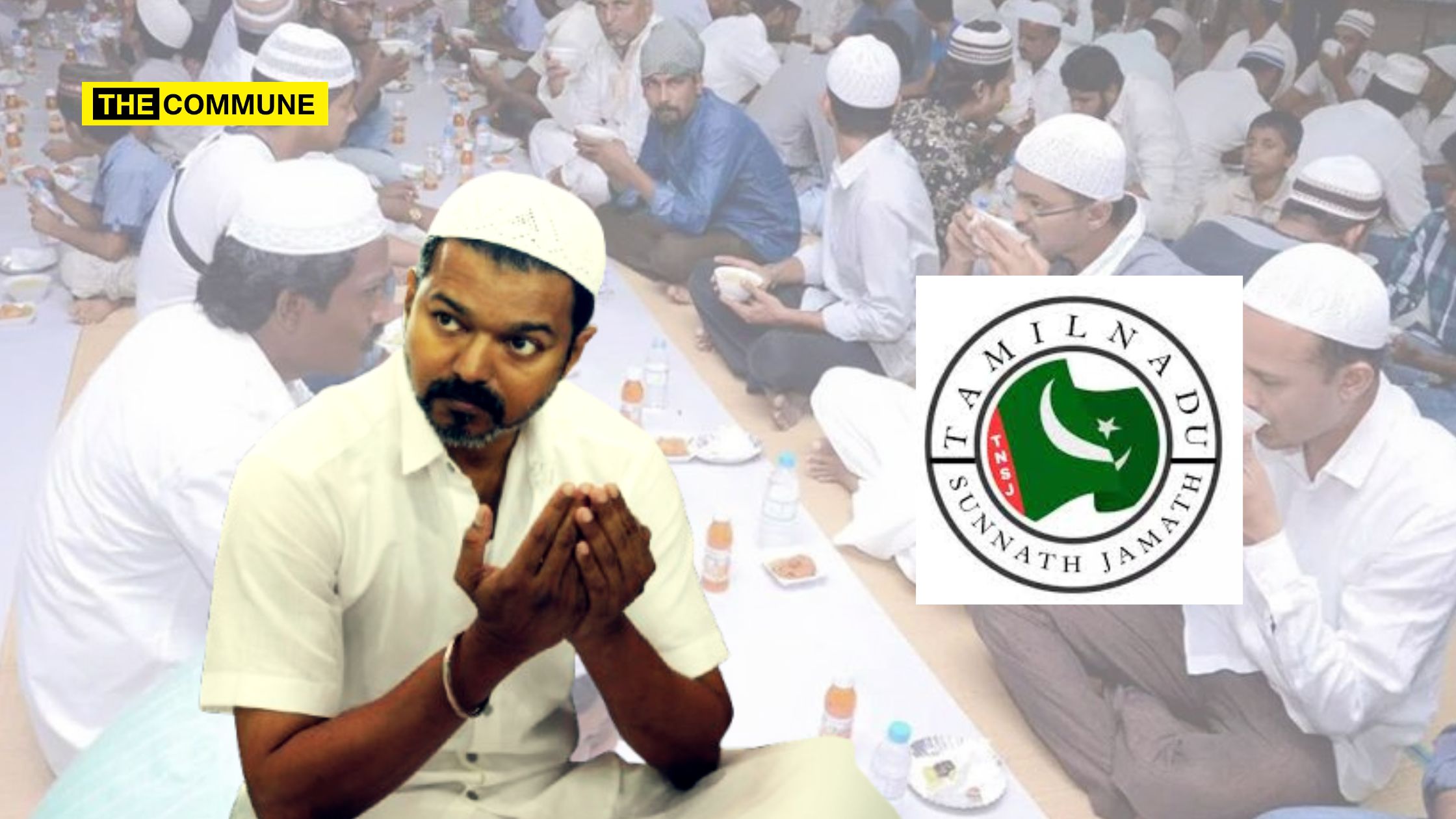
The BJP leader also called out Vijay’s hypocrisy saying “What do you know about people’s difficulties? You’ll smoke cigarettes in your movies. You’ll take drinks. What right does he have to talk about TASMAC? What was Vijay’s character in Master film? You think politics is about wearing skull cap one day and marking Iftar claiming to be on the side of minorities? So, I also know how to talk. This kinda of statements should be kept limits by the likes of ‘Bussy’ Anand and ‘Pussy’ Anand. Those who do work-from-home politics like kids shouldn’t come and fight with BJP.

TN Sunnat Jamaat Files Complaint Against Part-Time Politician Vijay Who Organized Iftar And Went Out Of The Way Wearing Skull Cap To Appease Muslims

The Tamil Nadu Sunnat Jamaat, an Islamic organization, has filed a complaint against Tamilaga Vettri Kazhagam president and actor Vijay at the Chennai Police Commissioner’s office. The complaint was signed by the organization’s treasurer, Syed Ghous.

According to the complaint, on 7 March 2025, Vijay’s Tamilaga Vettri Kazhagam organized an Iftar event, but it was allegedly conducted in violation of the sanctity of a traditional Iftar gathering. The organization stated that Iftar is a solemn and dignified religious occasion, not comparable to public conventions or political meetings.

The complaint alleges that “drunkards and rowdies” who had no connection to the event were present, while devout fasting Muslims were not allowed to attend. Furthermore, it stated that bouncers at the venue attacked and forcibly removed fasting attendees, beating and kicking them out.

Additionally, the organization criticized Vijay for arriving one and a half hours before Iftar, stating that it was inappropriate and against the norms of a traditional Iftar gathering. The organization has urged authorities to take legal action against Vijay for allegedly conducting the event in a way that disrespected religious practices.

(With inputs from Daily Thanthi)

Subscribe to our channels on Telegram, WhatsApp, and Instagram and get the best stories of the day delivered to you personally.
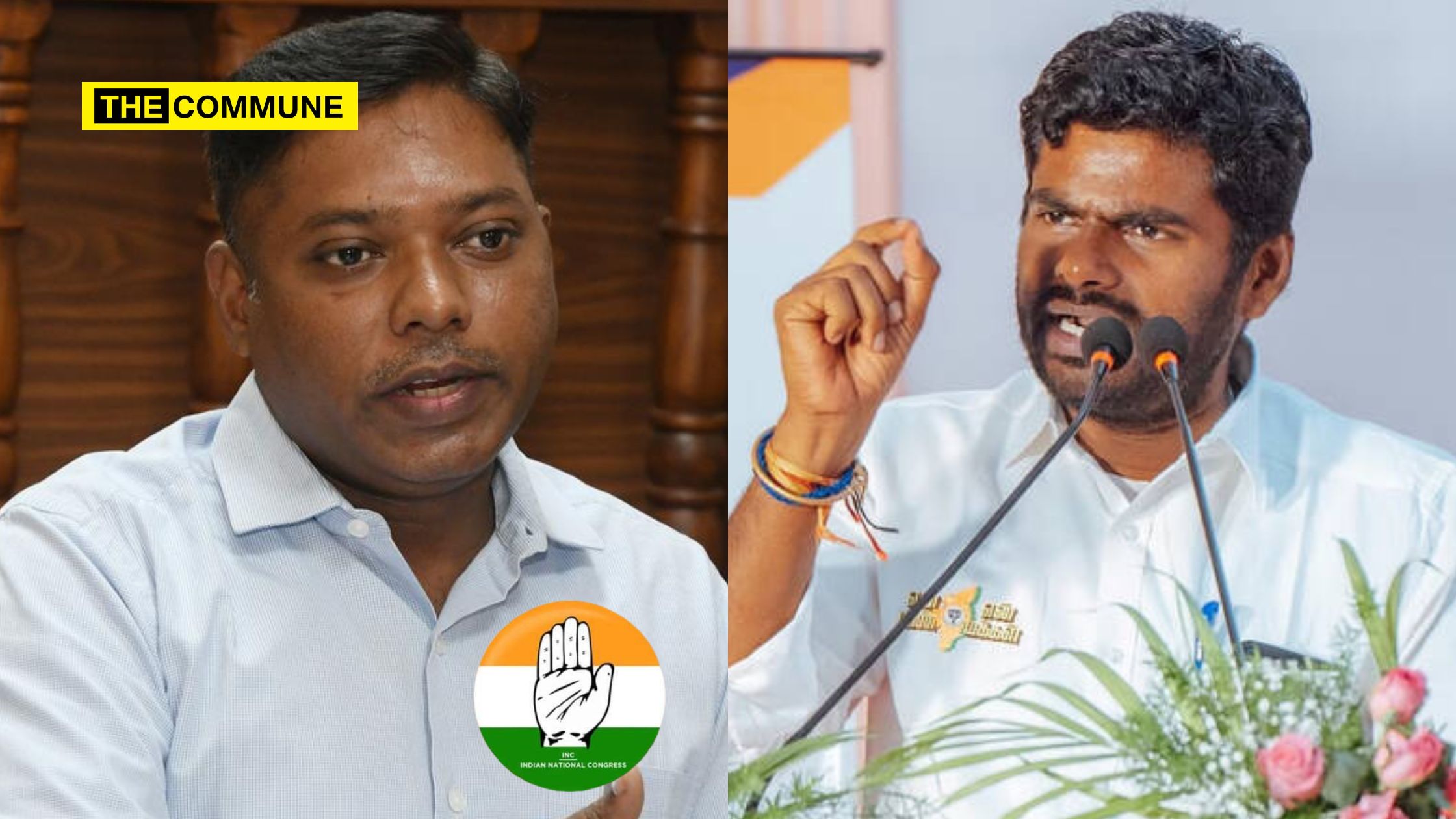
“Fake News Spread Like A DMK Henchman”, BJP TN Chief Annamalai Calls Out Congress MP Sasikanth’s Misleading Claims On TN’s UPSC Success Rate

Tamil Nadu BJP President K. Annamalai has strongly countered Congress Tiruvallur MP Sasikanth Senthil, who alleged that the decline in the percentage of Tamil Nadu candidates clearing the UPSC Civil Services Examination (CSE) was due to the central government’s policies. Senthil, a former IAS officer, also accused Annamalai of attributing the issue to Tamil students not knowing Hindi.

In his sharp rebuttal, Annamalai dismissed these claims, calling Senthil’s remarks “fake news spread like a DMK henchman for political gain.” He asserted that the real reason behind the declining success rate of Tamil Nadu candidates in UPSC exams is the DMK-Congress alliance’s failure in strengthening government schools, while they prioritized private institutions run by their leaders.

To further disprove Senthil’s allegations, Annamalai shared a video of his speech, clarifying that he never claimed Tamil students’ failure was due to a lack of Hindi proficiency. Instead, he emphasized that the state’s education policies under the ruling alliance were to blame.

Posting his formal response on his official X account, Annamalai stated, “Starting with the Tamil Nadu Chief Minister, the DMK, and all I.N.D.I. Alliance MPs, have made it a habit to lie. Mr. @s_kanth has falsely claimed that I said Tamil students failed the UPSC exams because they did not know Hindi. It is unfortunate that someone who held a high position in the government has stooped to the point of spreading fake news, like a DMK henchman, for sake of politics. I have attached a video of what I spoke about. It is true that the percentage of rural students from Tamil Nadu passing the UPSC exam has declined. However, the reason for this is that the DMK-Congress alliance has prioritized private schools they run while rendering government schools ineffective—not the central government. Does Mr. @s_kanth, who acknowledges that rural students have failed, also admit that the Tamil Nadu government’s curriculum is inferior to that of private schools? We hope he will, at the very least, support providing quality education to Tamil Nadu’s government school students through the National Education Policy.”

In the video attached Annamalai explained, “They look at only GER. GER is the only data the Tamil Nadu government brings to say, ‘Look at the Gross Enrolment Ratio we have crossed 50%’, I’m sure you know it has also dropped to 49%. Tamil Nadu’s Gross Enrolment Ratio is not 51% but dropping to 49%. If we look out all the indicators… In civil services, how many of us passed Civil Services? last year Tamil Nadu was 45 ten years back we were at 120. How many of us get into medical colleges, IIT? How many of us are getting into it? Tamil Nadu has become one of the state which has got least number of entrance into all these higher education institution. Why is not Tamil Nadu’s education minister looking at that? Education is not about number schools or number of colleges also about quality. Tamil Nadu scores because access to education because of more schools not by them but Kamaraj built 18,000 schools. Because of the access to education is good we are topping many parameters and when it comes to quality why Tamil Nadu is in the bottom of all tables?” 

Misleading Claims By Congress MP Sasikanth Senthil

This rebuttal from Annamalai is in response to Congress Tiruvallur MP Sasikanth Senthil, who, through his official account, falsely claimed that Annamalai attributed the decline in Tamil Nadu students’ UPSC success rate to their lack of Hindi proficiency.

In a video statement, Senthil acknowledged the drop in the number of successful candidates from Tamil Nadu, providing statistics to illustrate the trend. He stated that in 2013-14, out of 1,126 candidates who cleared the UPSC exam nationwide, 119 were from Tamil Nadu, making up 10.6%. However, by 2020, only 45 Tamil Nadu candidates qualified out of 781 nationwide, reducing the share to 5%. In the latest examination, out of 1,016 successful candidates across India, only 45 were from Tamil Nadu, further declining to 4.4%.

Despite these figures, Senthil conveniently blamed the central government for changes in the UPSC exam pattern, disregarding the fact that UPSC, as a constitutional body, independently determines its examination structure. He further propagated the false claim indirectly stating that these changes were introduced by the BJP after 2014, pushing a misleading narrative that held the central government responsible for the declining success rate of Tamil Nadu students.

However, the real fact is that the Civil Services Aptitude Test (CSAT), which replaced the Optional paper in the Preliminary Exam, was introduced in 2011 under the Congress-led government—not after 2014. The CSAT brought a shift in focus toward reasoning and problem-solving, and it was implemented during the UPA era, not under the BJP government.

In his video, former IAS officer and current Congress MP Sasikanth Senthil conveniently pushed the DMK’s agenda in Tamil Nadu, adopting a tone of sorrow while blaming competitive exams such as NEET, CUET, and others. He misrepresented these exams as being designed for the wealthy, completely ignoring their actual intent of ensuring a transparent and merit-based selection process.

Congress Tiruvallur MP Sasikanth Senthil via his official X account stated that, “Tamil Nadu BJP state president Mr. @annamalai_k has said that the reason why Tamil students do not succeed in the UPSC exam is because they do not know Hindi. In fact, the BJP came to power and changed the curriculum and education system, reducing the pass rate from 10.6 percent before 2014 to 4.4 percent today, which has made it impossible for rural students to even think about the UPSC exam.”

Subscribe to our channels on TelegramWhatsApp, and Instagram and get the best stories of the day delivered to you personally.