The Supreme Court on 15 September 2025 declined to entertain a petition challenging a Kerala High Court order that exempted political parties from the mandate of constituting Internal Complaints Committees under the Sexual Harassment of Women at Workplace (Prevention, Prohibition and Redressal) Act, 2013 (POSH Act).
A bench led by Chief Justice B.R. Gavai, along with Justices K. Vinod Chandran and A.S. Chandurkar, observed that political parties do not fall within the definition of “workplace” under the Act. “When a person enters a political party, it’s not a job; there is no payment,” the CJI remarked, indicating that there was no employer-employee relationship among party members.
The petition, filed by Advocate Yogamaya, challenged the Kerala High Court’s 2022 decision holding that political parties are not legally liable to establish Internal Complaints Committees under the POSH Act. The High Court had reasoned that membership in political parties does not constitute employment, and therefore the statutory requirement to set up ICCs does not apply.
Senior Advocate Shobha Gupta, appearing for the petitioner, argued that the High Court overlooked the broad scope of “aggrieved woman” under Section 2(a)(i) of the Act, which includes any woman, whether employed or not, who alleges sexual harassment at a workplace. She stressed that political parties “still function in an organised set-up. They have an organisation.”
The bench, however, remained unconvinced. “How do you put the political parties in a workplace?” the CJI asked, reiterating that the POSH Act envisages an employer-employee framework. The Court dismissed the Special Leave Petition, noting that a similar PIL filed earlier to bring political parties under the Act had already been withdrawn.
The Kerala High Court judgment under challenge had also clarified that film production houses are required to set up Internal Complaints Committees, since each unit functions as an “establishment” within the meaning of the Act.
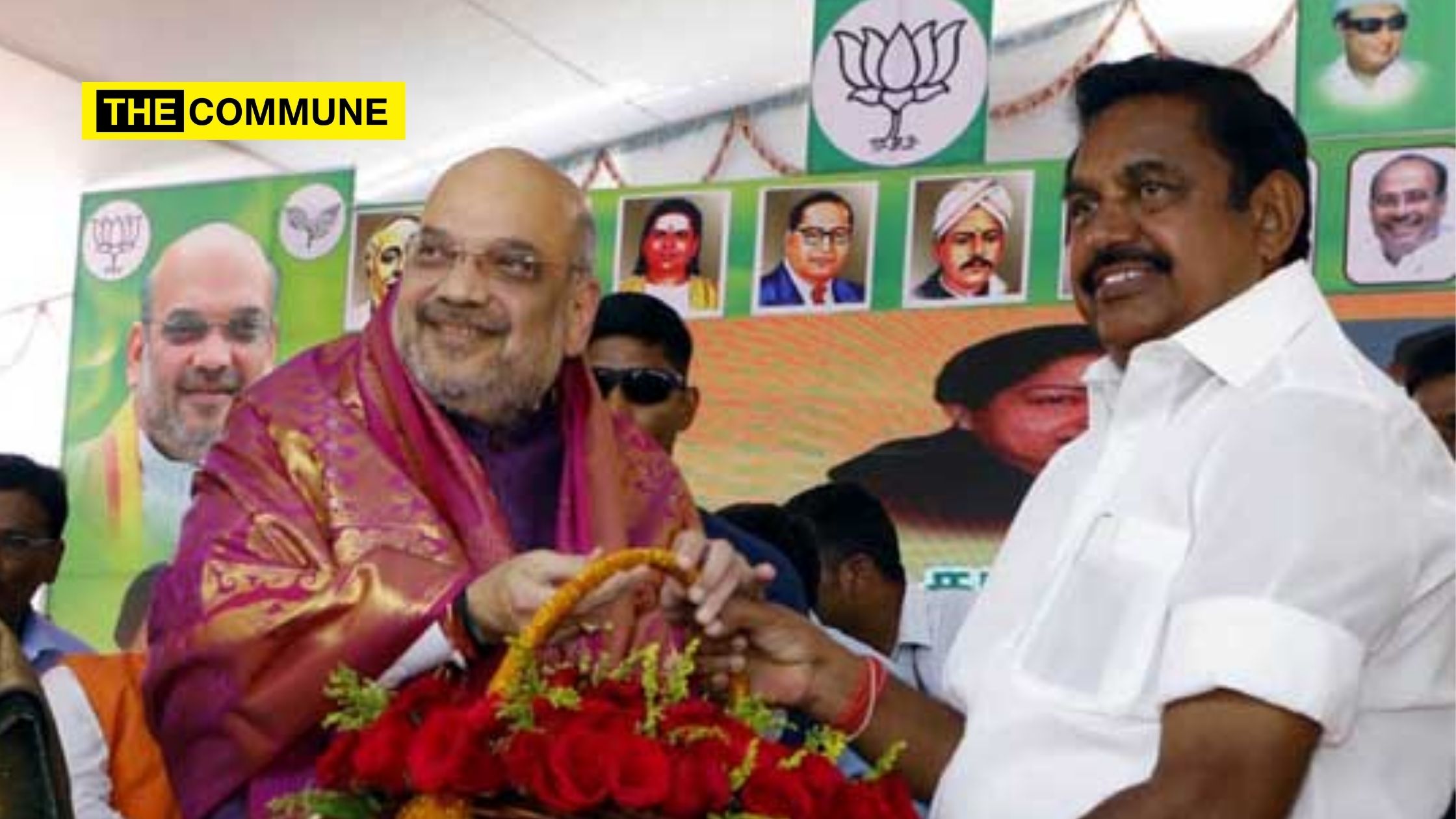
Hours before leaving for Delhi to meet Union Home Minister and senior BJP leader Amit Shah, AIADMK general secretary Edappadi K Palaniswami (EPS) openly acknowledged that the BJP-led central government had safeguarded his regime after the death of former Chief Minister J Jayalalithaa.
Speaking at a public meeting in Vadapalani to mark the 117th birth anniversary of former CM CN Annadurai, Palaniswami said loyalty to the BJP stemmed from the Centre’s role in protecting both his party and government during a political crisis.
“At all times, whether while in power or even today, those at the Centre have supported us. After Amma’s demise, some attempted to hijack the AIADMK and dissolve the government. But you all know who saved us… It was those in power at the Centre who came to our aid and safeguarded the party and its government,” he said.
Reciting the couplet “Nandri Marappadhu Nandrandru Nandralladhu…” from Tirukkural, Palaniswami said gratitude demanded that the AIADMK remain steadfast in its alliance with the BJP.
This marks the first time EPS has publicly credited the BJP with ensuring the AIADMK government’s survival for more than four years. Expelled AIADMK leader O Panneerselvam had made a similar claim earlier.
His remarks came ahead of his scheduled meeting with Amit Shah, who had played a central role in reviving the AIADMK-BJP alliance on 11 April 2025 and is reportedly active in managing the party’s ongoing internal turmoil. The visit also followed former minister KA Sengottaiyan’s meeting with Shah last week.
Palaniswami recently removed Sengottaiyan, the Gobichettipalayam MLA, from party posts after the latter pressed for unification with AIADMK splinter groups. Officially, the AIADMK maintained that EPS’s Delhi trip was meant to congratulate CP Radhakrishnan on his election as Vice-President.
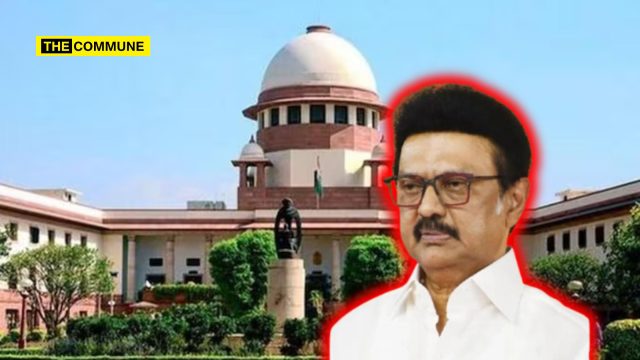
The Supreme Court on Tuesday strongly criticised the Tamil Nadu DMK government for failing to ensure equal pay for nurses employed on a contract basis in state-run hospitals and health centres. A bench of Justices Vikram Nath and Sandeep Mehta was hearing the state’s appeal against a Madras High Court order in April 2025 that had directed the government to pay contract nurses the same salary as their permanent counterparts.
The judges observed that the state was “exploiting” the services of contract nurses by paying them less despite similar duties. They said the government was “using them for selfish purposes” and questioned why they were not being made permanent.
When the state’s counsel argued that funds had not been released by the Centre, the bench dismissed the explanation, saying, “Don’t keep blaming the central government for everything. Isn’t it your responsibility to pay your employees?” The judges further remarked that Tamil Nadu, which projects itself as one of the most developed states, could not deny frontline health workers their due.
The bench also drew attention to the state’s expenditure on welfare schemes and elections, questioning how money was available for such purposes but not for paying nurses. “There is money to give freebies, but not to pay workers?” the judges asked.
Taking note of the state’s claim of financial difficulties, the court issued notices to the Union government as well as the Tamil Nadu MRP Nurses’ Association to file their responses. The case has been adjourned for further hearing, with the state directed to reply within four weeks.
Meanwhile, nurses across Tamil Nadu have continued protests demanding permanent appointments and equal pay, arguing that they have been kept on temporary contracts for years despite performing the same work as regular staff.
This order comes after several years of legal proceedings; the earlier Madras High Court directive required the state to grant equal pay and benefits to contract nurses within three months.
Subscribe to our channels on Telegram, WhatsApp, and Instagram and get the best stories of the day delivered to you personally.
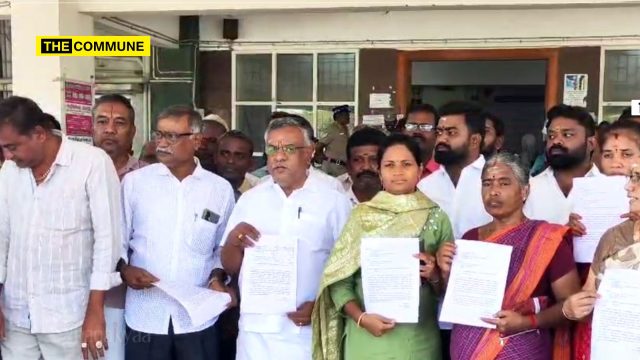
A petition has been submitted to the District Collector on behalf of the Hindu Front and local residents seeking action to stop what they described as the illegal construction of a mosque in the V.G. Garden area of Kangeyam, Tiruppur district.
According to the petitioners, the construction activity is taking place in a locality where the majority of residents are Hindus, and they urged the administration to intervene and prevent further work.
District authorities are yet to issue an official response to the petition.
In July 2022, members of the Muslim community staged widespread protests against an attempt to seal a mosque in Mahalakshmi Nagar, Velampalayam in Tiruppur. The mosque, functioning for nearly a decade without approval, had originally been sanctioned in 2011 for use as a banian factory, according to corporation officials. Local resident welfare associations petitioned the Madras High Court against the unauthorized construction, and in 2016 the court directed the revenue department to seal the building. After continued inaction, a contempt petition led the court to order closure by 30 June 2022.
When revenue and corporation officials, accompanied by police, arrived to implement the order, about 300 people picketed near the Tirupur corporation office, blocking roads and paralyzing traffic for several hours. The unrest also forced postponement of the civic body’s council meeting.
Subscribe to our channels on Telegram, WhatsApp, and Instagram and get the best stories of the day delivered to you personally.
The Supreme Court delivered its order for the case challenging the Waqf (Amendment) Act 2025 on 15 September 2025. Tamil Nadu Chief Minister MK Stalin claimed that the Supreme Court had stayed “key provisions” of the Union government’s Waqf (Amendment) Act, 2025, including the removal of the “Waqf by user” clause.
Taking to his official X handle, Stalin wrote, “Today, in the DMK’s petition and other writ petitions challenging the amendments to the #WaqfAct, the Hon’ble Supreme Court of India has stayed the following key provisions of the BJP Government’s amendments:
i) The mandatory 5-year practice requirement before dedicating a Waqf ii) The power to divest Waqf properties on mere allegation of being government property pending report of a designated officer or decision of Government iii) The Collector’s power to denotify ‘Waqf by user’ (property treated as Waqf after long period of religious use) iv) Inclusion of more than 4 non-Muslim members in the Central Waqf Board and more than 3 in the State Waqf Boards, thereby ensuring Muslim majority in these Boards
This order is a major step towards undoing the unconstitutional and illegal amendments made by the BJP Government. The DMK has consistently opposed these amendments from the time the Bill was introduced in Parliament. After it became an Act, the DMK challenged it in the Supreme Court and succeeded, alongside others. The DMK Government also passed an assembly resolution urging the Union Government to withdraw the #WaqfAmendment Bill, countering the BJP’s attempt to misuse governmental power. Today’s order strengthens the hope and trust that people place in the Hon’ble Supreme Court to safeguard the religious rights of the Muslim minority community and to uphold the Constitution.”
தி.மு.க.வும் மற்ற மனுதாரர்களும் வக்பு திருத்தச் சட்டத்துக்கு எதிராகத் தொடர்ந்த வழக்கில், ஒன்றிய பா.ஜ.க. அரசு கொண்டு வந்துள்ள முக்கியத் திருத்தங்களுக்குத் தடை விதித்து மாண்பமை உச்சநீதிமன்றம் இன்று உத்தரவிட்டுள்ளது.
— M.K.Stalin – தமிழ்நாட்டை தலைகுனிய விடமாட்டேன் (@mkstalin) September 15, 2025
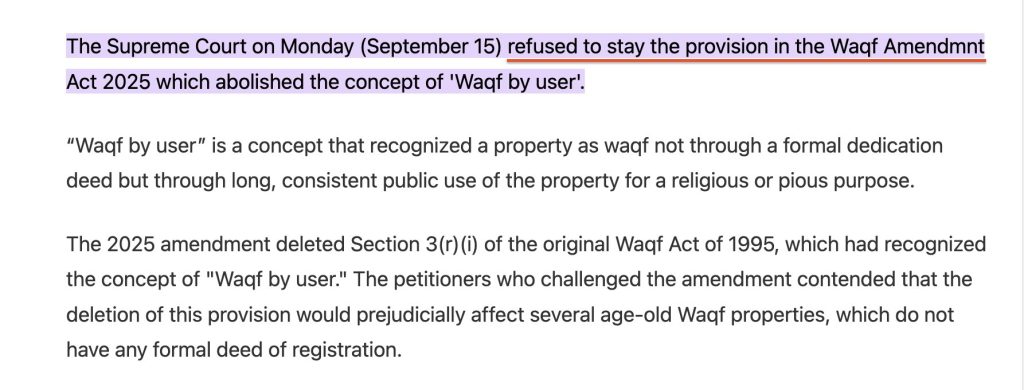
However, the Supreme Court’s ruling did not go as far as Stalin suggested. A bench led by Chief Justice B.R. Gavai and Justice A.G. Masih upheld the overall validity of the Waqf Amendment Act and allowed its implementation. The Court stayed only two provisions: the requirement that a person must have practiced Islam for five years to dedicate property as Waqf, and a clause empowering government officers to declare Waqf land as state land. It also clarified that while non-Muslims may be appointed to Waqf Boards, their number cannot exceed four in a 20-member central board or three in an 11-member state board.
Crucially, the bench refused to suspend the deletion of the “Waqf by user” provision, which had allowed properties to be treated as Waqf after long-term religious use. That amendment remains in force despite petitions challenging it.
The Court allowed the Act’s implementation, including the requirement for Waqf properties to be registered by users, noting that a similar registration mandate had existed between 1995 and 2013. However, it issued interim directions against enforcement of certain contested clauses.
Provisions Stayed by the Court
Five-year practice requirement: Section 3(1)(r), which required an individual to have practiced Islam for at least five years to dedicate a property as Waqf, has been put on hold until state governments frame clear rules to avoid arbitrary implementation.
Encroachment reporting power: A provision allowing a government-appointed officer to declare whether Waqf property encroaches on state land, thereby authorizing the government to alter Waqf records, was stayed. The bench ruled that such determinations must follow proper judicial process.
Non-Muslim membership cap clarification: The Court did not strike down provisions allowing non-Muslims to sit on Waqf Boards but limited their number to a maximum of four in a 20-member Central Board and three in an 11-member State Board, ensuring Muslim majority representation.
What the Court Did Not Stay
Importantly, the bench refused to stay the deletion of the ‘Waqf by user’ clause, which earlier allowed property to be treated as Waqf after long-term religious use. This provision remains in effect despite petitions challenging it.
The case stems from multiple writ petitions, including one filed by the DMK, against the 2025 amendments. While the Court provided limited interim relief, the larger question of the Act’s validity will be taken up later.
Subscribe to our channels onTelegram, WhatsApp, and Instagram and get the best stories of the day delivered to you personally.
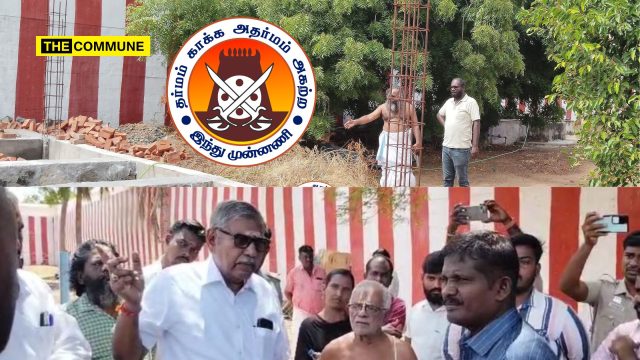
Hindu Munnani, said in a statement that the Makaranedunkuzhaykathan temple, one of the Navathirupathi shrines in Thenthirupparai village in Thoothukudi district, is the subject of an alleged violation of Agama and temple Vastu norms. The organisation said the temple’s “prakaaram” path, used by Swami Chapparam, is being obstructed by construction work.
The statement alleged that the Hindu Religious and Endowments Department (HR&CE) had begun building a goshala without obtaining clearance from the Archaeological Department and noted that permanent construction is prohibited in temples more than 100 years old without such permission.
Hindu Munnani said they had received information that work was being carried out at a new site, leaving the existing goshala and the area where the bhoomi pooja was performed unused while a new goshala was being constructed.
The statement added that State Vice-President V.P. Jayakumar, accompanied by State Executive Committee Member P. Sakthivelan, Nellai Divisional Secretary K. Brahmanayakam and district officials, inspected the site and demanded an immediate halt to the work.
According to the statement, the Eral Talukdar held a meeting and ordered that a peace meeting be held at the Talukdar’s office tomorrow and directed that no construction work should continue until that meeting takes place.
தூத்துக்குடி மாவட்டம், தென்திருப்பேரை ஊரில் அமைந்துள்ள #நவதிருப்பதி ஸ்தலமான, அருள்மிகு மகரநெடுங்குழைக்காதன்
திருக்கோவிலில் #ஆகம விதிமுறைக்கு மாறாகவும், கோவில் கட்டுமான #வாஸ்து விதிமுறைக்கு மாறாகவும் சுவாமி சப்பரம் உலா வரும் கோவிலின் பிரகாரப் பாதையில் அதற்கு இடையூறாக..
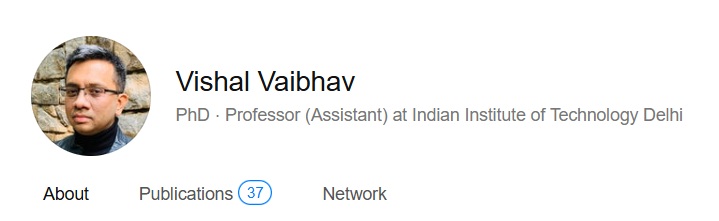
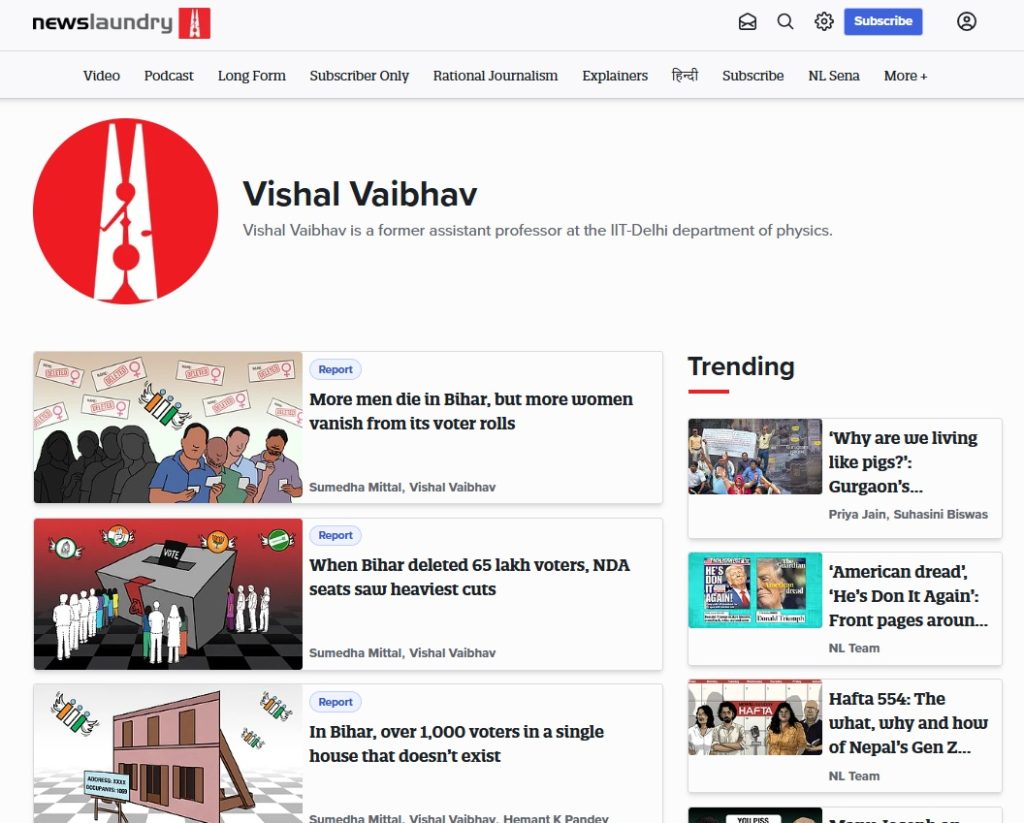
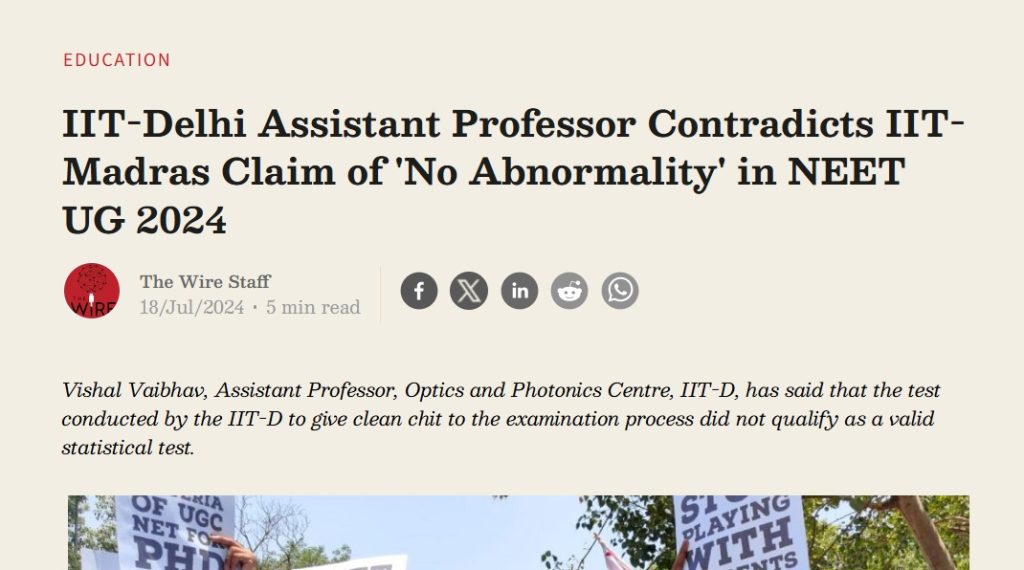
Vishal Vaibhav, a former Assistant Professor of Physics at the Indian Institute of Technology Delhi (IIT-D), who is currently working with rabid leftist Congress-supporting media Newslaundry is at the center of a major controversy following the emergence of highly offensive social media posts that disparage Hindu religious practices and sentiments.
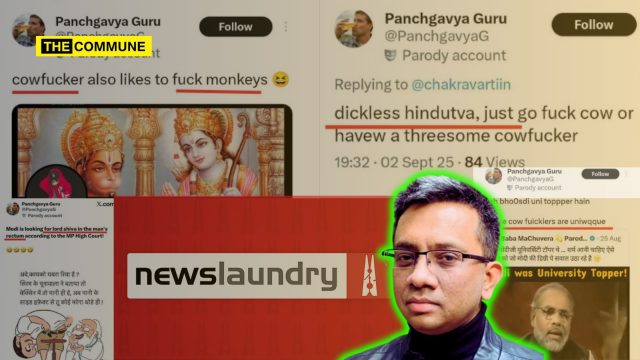
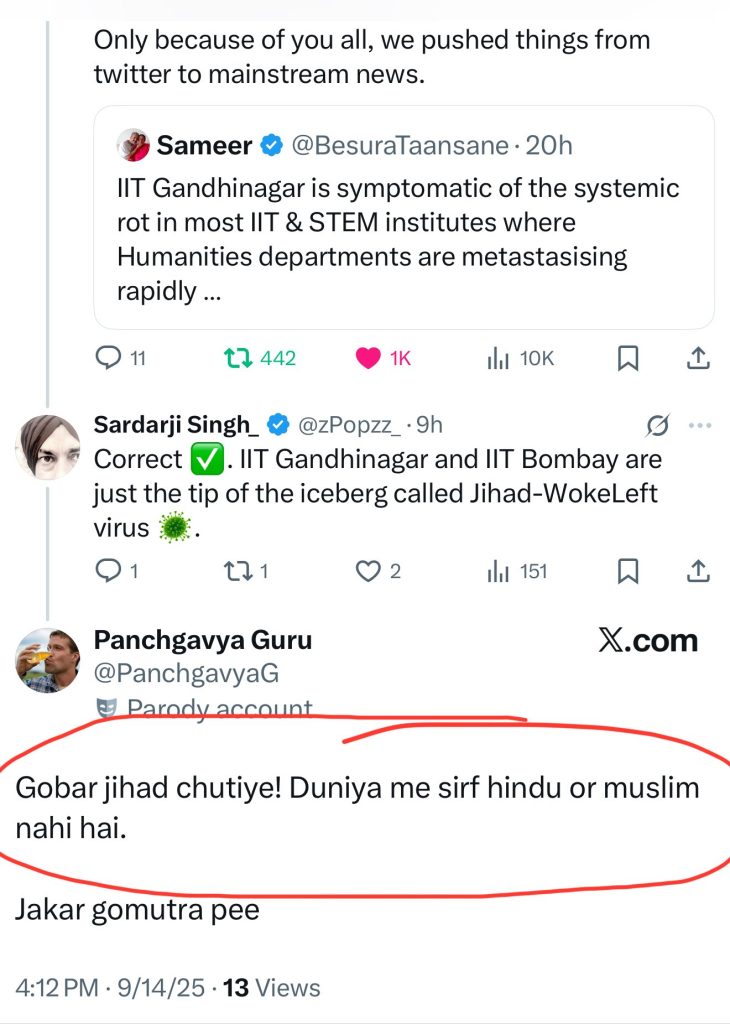
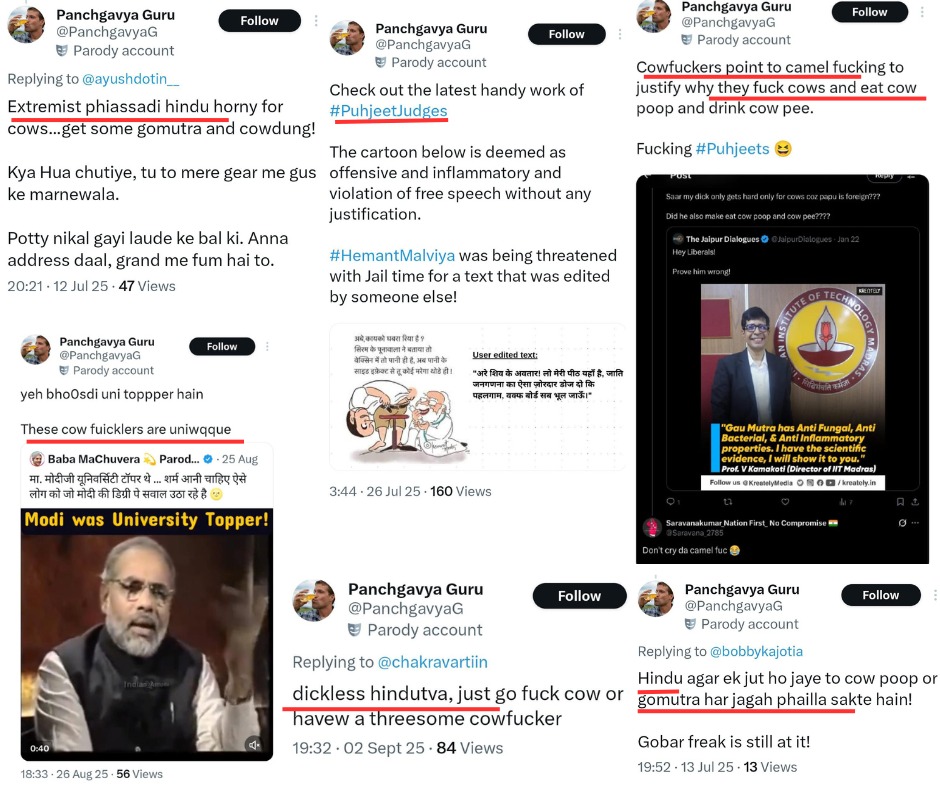
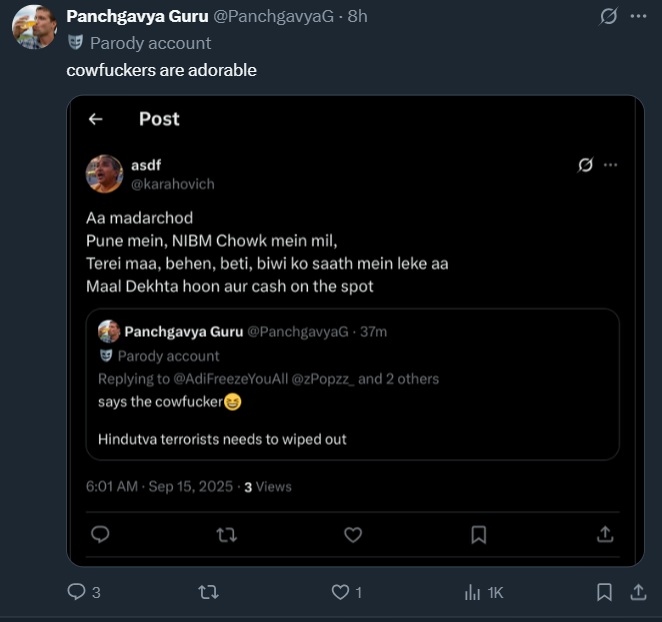
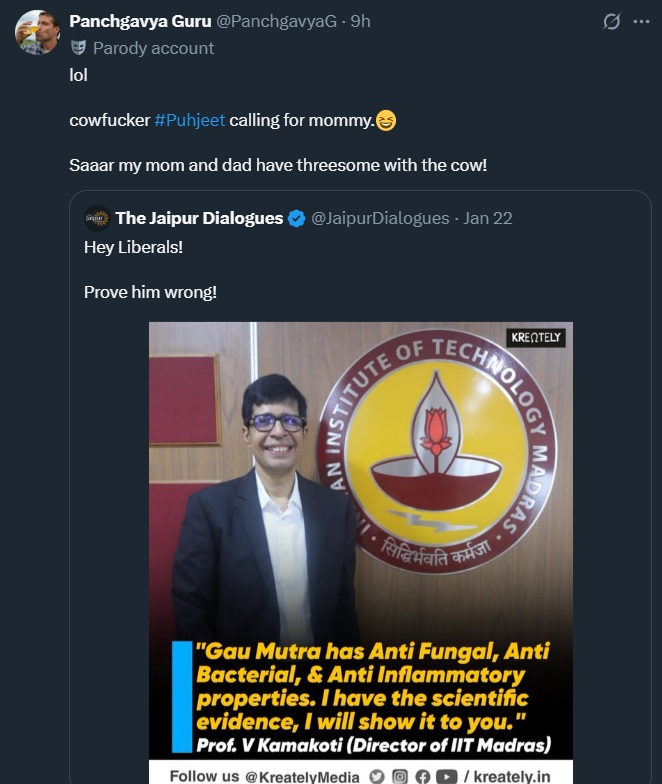
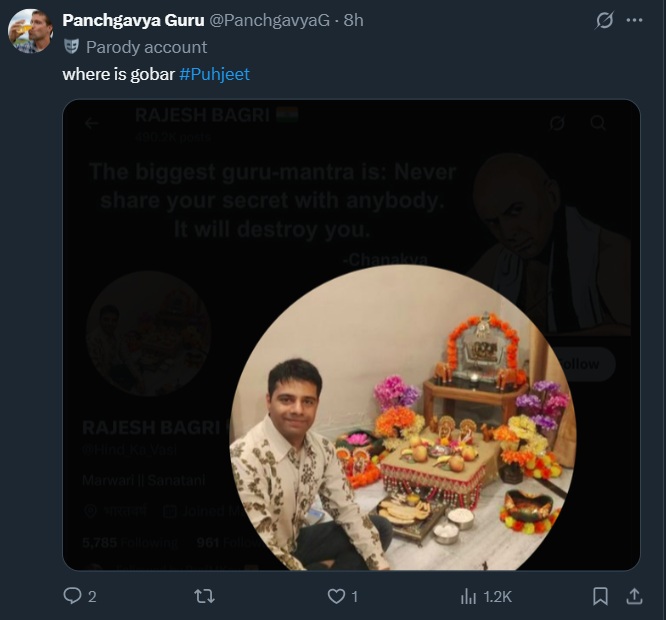
In his anonymous X (formerly Twitter) handle @PanchgavyaG (Panchgavya Guru) he can be seen employing the language used by Islamists against Hindus.
The posts specifically mock the use of cow dung (gobar) and cow urine (gomutra) in traditional practices, employing crass and offensive language to describe them. In one post, he reportedly stated, “Gobar jihad chutiye!… Jakar gomutra pee” (Gobar Jihad, idiot! Go drink cow urine). He also uses the term “cowfucker”, “dickless Hindutva” in many of the posts.
The language used extends beyond criticism into what many are calling outright hate speech, with slurs directed at the Hindu community.
This has prompted severe backlash from online users and community groups, who accuse him of abusing his influential position to spread religious intolerance.
Controversial Past At IIT-Delhi
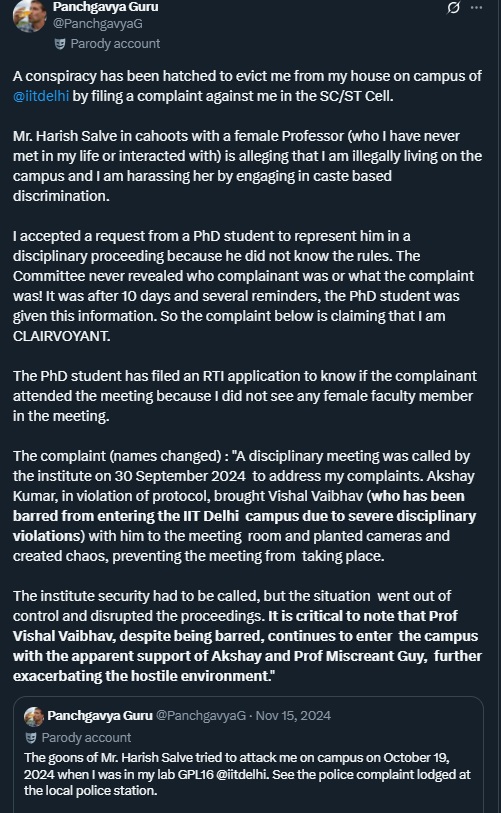
This is not Vaibhav’s first brush with controversy. His tenure at IIT Delhi was marked by significant institutional friction. In 2024, he publicly alleged a “conspiracy” to evict him from his campus residence, claiming a complaint was filed against him in the SC/ST cell by prominent lawyer Harish Salve and a female professor he claims to have never met. He was involved in representing a PhD student in a disciplinary proceeding, which further escalated tensions on campus.
A conspiracy has been hatched to evict me from my house on campus of @iitdelhi by filing a complaint against me in the SC/ST Cell.
Mr. Harish Salve in cahoots with a female Professor (who I have never met in my life or interacted with) is alleging that I am illegally living on… https://t.co/vTZ1qB1Ceh
Reports indicate that Vaibhav was eventually barred from the IIT Delhi campus due to “severe disciplinary violations.” His exit from the premier institute appears to be confirmed, as he is now identified as a former professor and is currently a writer for the online publication Newslaundry.
Political Alignment – Congress
Despite the personal controversies, Vaibhav has recently re-entered the public eye in a professional capacity. He was engaged by petitioners challenging the NEET-UG 2024 results to provide a statistical analysis countering the report submitted by IIT Madras to the Supreme Court. His critique, which argued the IIT-M report was “pseudo-scientific,” was covered by major publications like The Hindu.
In 2024, Vishal Kumar Vaibhav filed an RTI seeking detailed data on Assistant Professors’ probation, confirmations, and related DoPT guidelines since 2016. IIT Delhi denied the request under Sections 7(9) (voluminous request) and 8(1)(j) (third-party personal information). The First Appeal was rejected, and Vaibhav approached the CIC. The Commission held the request excessively broad, requiring compilation from personal files of third parties, exempt under RTI. Citing CBSE v. Aditya Bandopadhyay (2011), the CIC dismissed the appeal, upholding IIT Delhi’s refusal and advising judicious use of RTI.
He further filed a writ petition under Article 226 challenging the appointment of a professor via quo warranto. The Delhi High Court, presided over by Justice Jyoti Singh, noted objections to the Petitioner’s locus, citing his suspension and ongoing disciplinary proceedings. Respondents argued the Petitioner had engaged in abusive social media posts against faculty. The Petitioner undertook to file an affidavit within two days, refraining from derogatory posts or publicising the petition. Notice was issued, counter-affidavits to be filed, and the matter was listed for 21 April 2025 – which he failed to do and requested 4 more weeks’ time to submit.
The resurfacing of his alleged social media activity has intensified the criticism. Many have expressed outrage that an individual from a prestigious academic background would engage in such derogatory speech. The comments have been condemned as not only Hinduphobic but also as reflective of an anti-Sikh bias, with one user ominously noting that such rhetoric from influential figures can create a environment that leads to tragedies like the 1984 anti-Sikh riots.
Vishal Vaibhav’s descent from IIT Delhi professor to Congress-leaning propagandist at Newslaundry exposes a disturbing pattern. Shielded by the garb of “intellectual critique,” he spews venom against Hindu traditions while enjoying legitimacy from elite platforms. His case is not about free speech—it is about Hinduphobia being normalized and weaponized by those who claim moral high ground.
Police have arrested the president of the Samalapuram Town Panchayat, affiliated with the DMK, on charges of deliberately killing a local social activist by ramming his car into the victim’s two-wheeler.
The arrested official, identified as 60-year-old Vinayaka Palanisamy, allegedly struck down 57-year-old activist Palanisamy of Karugampalayam on the evening of September 10 near the Karugampalayam Government Primary School, along the Samalapuram–Karanampettai Road. Eyewitnesses said the victim was riding a two-wheeler when he was hit from behind by a speeding car, thrown off, and fatally injured. The accused reportedly fled the scene without stopping.
Initially booked as a traffic accident, the case took a serious turn after Mangalam police traced the vehicle to the Panchayat president. Investigations revealed that the deceased had earlier filed a petition with the Tiruppur District Collector opposing a Panchayat-funded road project allegedly meant for the private benefit of an individual. The suspension of this project reportedly created enmity between the activist and the chairman.
Police now suspect that the killing was an act of retaliation. Officers also stated that the chairman was under the influence of alcohol at the time of the incident. Based on these findings, the case has been altered from accidental death to murder under IPC Section 302.
The activist’s son has accused the DMK chairman of repeatedly threatening his father and demanded his immediate removal from both party and office. “My father only asked that public money be spent for the public. For this, he lost his life,” he said.
The body of the activist has been sent for postmortem at Tiruppur Government Medical College Hospital. Meanwhile, Vinayaka Palanisamy remains in judicial custody as further investigations continue.
Australia, the United Kingdom, New Zealand, and the United States should join hands with Canada to dismantle Khalistani extremist fundraising and propaganda networks globally, a report said on Monday.
It stated that key steps include coordinated monitoring of suspicious non-profit activities, intelligence sharing, and decisive political distancing from separatist lobbies, according to a report in The Australia Today. It further mentioned that the Khalistani extremism has long been treated as an “Indian issue“, but with Canada’s recognition, it is evident that the matter is a global security concern.
“If Five Eyes democracies truly believe in safeguarding pluralism and protecting their diverse communities, they must act together. Australia, with its growing Indian diaspora and deepening strategic ties with New Delhi, is well placed to lead this collective effort. Canada has broken the silence. Now it is time for its allies — Australia included — to stand firm and follow suit,” wrote Amit Sarwal, co-founder of The Australia Today.
The report stated that Canada, for the first time, officially confirmed that banned extremist groups such as Babbar Khalsa International and the International Sikh Youth Federation are engaged in promoting separatism and violence in the country. “Canada has taken a decisive step in acknowledging what India has long warned about: the presence and operations of Khalistani extremist groups on its soil. The 2025 Assessment of Money Laundering and Terrorist Financing Risks categorically identifies these groups as national security threats, marking a pivotal shift in Ottawa’s counterterrorism strategy,” he added.
The 2025 assessment warns that while their operations are largely directed at India, the activities have serious implications for Canadian national security and foreign policy. Sarwal stressed that the move reflects a broader pattern, building on the 2024 annual report of the Canadian Security Intelligence Service (CSIS), tabled in Parliament shortly after breakthrough talks between Prime Minister Narendra Modi and his Canadian counterpart Mark Carney at the Group of Seven (G7) Summit in Alberta in June 2025. The 2024 annual report said, “Canada-based Khalistani extremists (CBKEs) continue to pose a national security threat to Canada and Canadian interests.”
For the first time, the report said, the Canadian government labelled Khalistan supporters operating within its borders as “extremists.” India has, for long, voiced concerns over Canada providing a safe haven to such elements for decades, and the new acknowledgement marks a diplomatic breakthrough. “This is where Australia and other Five Eyes intelligence partners come in. Canada has finally drawn a red line between free expression and violent extremism — and the rest must follow,” the report noted.
-IANS
Subscribe to our channels on Telegram, WhatsApp, and Instagram and get the best stories of the day delivered to you personally.
Union Finance Minister Nirmala Sitharaman on 14 September 2025 shared the stage with representatives of the Tamil Nadu Chamber of Commerce and Industry at a special event where issues related to the Goods and Services Tax (GST) and the challenges of small traders were discussed.
In his address, Chamber president Vikrama Raja recalled the turbulence businesses faced during the rollout of GST in 2017. He said traders were initially shocked by the multiple tax brackets but had engaged in continuous dialogue with the Centre. Meetings with ministers, chief ministers, and even the prime minister, he said, eventually led to reforms in the GST framework.
Raja credited Sitharaman with being receptive to traders’ concerns. He recalled how she took note of the community’s complaints, including harassment by officials, and conveyed instructions that traders should not be intimidated. The minister, he added, had worked to simplify the four-slab GST structure into two tiers and had ensured that several essential commodities moved from the 18% bracket to just 5%. This, he said, was a “great blessing” for ordinary consumers.
The Chamber emphasized that lower tax rates must be passed on to the public, urging companies to reflect the reductions in their prices. Raja pointed out that many businesses had already agreed to price cuts of up to 10%, a move he described as proof that reforms were having an impact on the market.
Highlighting persistent issues, Raja said many GST department officials continued to exploit loopholes to impose penalties on minor errors such as spelling mistakes in invoices. He called for a monitoring committee that would allow regular dialogue between traders and the Finance Ministry, so that erring officials would be held accountable. He also suggested the establishment of a Business Welfare Board at the Centre to protect small traders from the growing influence of corporate giants and online retailers.
Turning to political leadership, Raja praised Prime Minister Narendra Modi’s journey from a “tea trader’s son” to head of government, saying the prime minister’s background inspired ordinary traders with hope. He said Modi’s policies had enabled Indian manufacturers to withstand international challenges, including steep tariffs imposed by the United States. “India today stands tall despite global envy,” Raja said, adding, “Modiji is the one who can fight back for the country.”
The Chamber chief also commended Sitharaman personally, noting that she had remained a “simple minister without pretension” and had the unique distinction of addressing Delhi in Tamil. He credited her with ensuring that the voices of Tamil Nadu’s business community were heard at the highest levels of decision-making.
Concluding his speech, Raja expressed hope that the GST system would soon be simplified further into a single-tier structure, describing the reforms already announced as a “Diwali gift” for traders. On behalf of lakhs of small businesses, he extended gratitude to the Union Finance Minister and reiterated demands for relief from bureaucratic pressure, simplified laws, and protection for grassroots traders.
Subscribe to our channels on Telegram, WhatsApp, and Instagram and get the best stories of the day delivered to you personally.