Home Blog Page 256

The Man Behind Congress’s ‘Vote Chori’ Stunt: Vikram Srinivas And His Western Connections

vikram srinivas vote chori congress

One of the more conspicuous failed attempts by the Congress party to stir public sentiment as the opposition was its dramatic “Vote Chori” (vote theft) allegation. Congress scion Rahul Gandhi leveled accusations against India’s top constitutional body the Election Commission of India (ECI) even before the electoral process had officially commenced. Ironically, the party’s claims quickly fell flat, with multiple numbers of Congress leaders found registered with the ECI’s systems, exposing a lack of credibility in their own narrative.

But this wasn’t just another political stunt. Many believe the real aim behind this spectacle was to erode public trust in a critical pillar of Indian democracy, the ECI, which oversees the electoral process in the world’s largest democracy. There are growing concerns that international actors may also have an interest in discrediting such institutions, using domestic influencers to do their bidding.

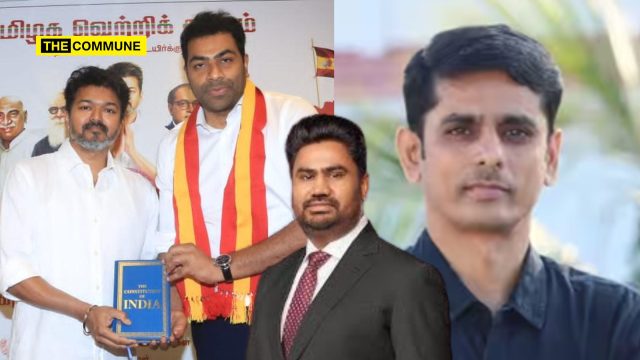
One such example appears to be Vikram Srinivas, a key figure behind the so-called “Vote Chori” propaganda presentation circulated by Congress.

Srinivas was previously affiliated with the Centre for Policy Research (CPR), a think tank that has received funding from the Ford Foundation an organization frequently linked with promoting Western geopolitical interests in India. Critics point out that the Ford Foundation has long been accused of acting as a soft power front for the CIA’s international influence campaigns. Before his association with the Congress party, Vikram was actively involved with CPR, shaping narratives and public policy debates.

His ideological leanings became more evident through his earlier public posts during the CAA-NRC protests, where he echoed typical leftist positions.

Adding to the scrutiny is the fact that Srinivas is an alumnus of one of India’s premier institutions, the Indian Institutes of Technology (IIT) which have long become fertile grounds for ideological indoctrination by left-leaning academics and NGOs.

More controversially, his wife, an assistant professor at IIT Delhi, joined the institution in 2021. Critics question whether ideological bias is creeping into academia, especially when family links between activists and academics come to light.

Organizations like the Transforming Rural India Foundation, which host figures like Srinivas, are also under the radar for receiving foreign funding while collaborating with Indian ministries raising serious questions about external influence on domestic policymaking.

A pressing question arises, why is the Congress party silent about its links to individuals connected to Western-funded institutions preparing campaigns to undermine constitutional bodies like the ECI? If the party genuinely had concerns regarding the Election Commission, the legal route was always open and indeed, they have recently approached the judiciary. However, as outcomes begin to unfold, their arguments are not just being dismissed but are beginning to backfire legally and politically.

Rather than strengthening democratic institutions through constructive engagement, it appears that Congress and its affiliated ecosystem are increasingly relying on theatrics, foreign-funded narratives, and ideological actors to question the credibility of India’s independent bodies. In the long run, such strategies risk not just political failure, but also a deeper erosion of public trust in the very institutions that uphold Indian democracy.

(This article is based on an X Thread By Vijay Patel) 

Subscribe to our channels on TelegramWhatsApp, and Instagram and get the best stories of the day delivered to you personally.
Woke Influencer, Who Simped For Pakistani Air Force Officer During Op Sindoor, Glorifies Nepal Violence; Asks ‘India When’

woke influencer nepal

At a time when Nepal is reeling from widespread unrest with youth-led uprisings shaking the very foundations of law and order it is deeply concerning to see segments of the Indian leftist and Congress-aligned ecosystem expressing not just sympathy, but veiled admiration for the chaos. Disturbingly, some are even pushing for a similar breakdown in India’s comparatively stable and peaceful democratic setup.

One glaring example is social media influencer Aishwarya Subramanyam, who operates under the handle @otherwarya. Known for her woke, left-leaning takes, she recently shared an Instagram story that raised eyebrows and tempers. The story highlighted a news piece titled “Nepal ministers cling to army chopper ropes to escape Gen-Z protesters,” with the caption, “India when.”

This offhand remark, perceived as a call for similar violent uprisings in India, was quickly called out on social media. Critics accused her of normalizing political violence and romanticizing the destabilization of democratic institutions all under the garb of progressive commentary.

But this isn’t her first brush with controversy.

During heightened India–Pakistan tensions following the pahalgam terror attack, Aishwarya Subramanyam posted a series of Instagram stories that was glorifying a Pakistani Air Force officer while mocking India’s military.

The posts were as follows:

A Collage of the Pakistani Air Force Officer accompanied with a Love Song:

The central image edited using CapCut with decorative red roses — featured a man in Pakistani Air Force uniform – who was none other than their Air Vice Marshal Aurangzeb. Overlaying the image was the caption and accompanied by old Hindi love song, “Hum Thumse Pyar Karte”

“Ye aesi nation se ap log larna chahte ho 😭😭😭 Sorry yaar 😭” (Translation: “You guys want to fight a nation like this 😭😭😭 Sorry, yaar😭”) The romantic filter, emojis, and tone were interpreted by many as infatuation or admiration, prompting anger from those who viewed it as disrespectful toward India’s armed forces.

The second story read: “Also, women (and men) have been thirsting over the airforce officer named Aurangazeb since he’s been in the press briefings .” @otherwarya responded with repeated “I SEE” texts, implying agreement with the sentiment.

In her third post, Aishwarya Subramanyam alludes to a claim that a female Indian Air Force officer had been captured by Pakistan. She backs this by referencing a cartoon-style advertisement released by a Pakistani soft drink company, which, according to her, indirectly confirmed the incident.

The advertisement in question draws on the real-life 2019 Balakot airstrike, when Indian pilot Wing Commander Abhinandan Varthaman was captured by Pakistan and famously served tea while in custody, a moment that became symbolic and politically charged. The new ad satirizes this event by replacing tea with the company’s energy drink and featuring a cartoon version of an Indian pilot calmly enjoying the beverage, implying a repeat scenario but with a female figure this time. The ad’s tagline, “No tea this time,” is seen as a deliberate jab, adding a layer of mockery to a deeply sensitive geopolitical issue.

Aishwarya’s caption reads: “Correct info hai. A local energy/color drink company even published a cartoonised ad yesterday of the captured female pilot having their drink instead of tea this time LOL,” followed by, “Wahhh show.” Her seemingly joking tone, combined with the mocking reference, sparked outrage among X users. Many perceived it as disrespectful to the Indian armed forces and inappropriate given the fraught history and current state of India-Pakistan relations.

This cavalier attitude toward such a sensitive geopolitical issue especially one involving the Indian armed forces sparked a wave of backlash. Netizens blasted her for her glib tone and for amplifying Pakistani propaganda at the expense of Indian military dignity.

The reaction to Aishwarya’s posts was swift and unforgiving. Social media users accused her of glorifying a hostile nation, mocking India’s military, and pushing a narrative that undermines national unity. Given the public’s respect for the armed forces, particularly in the wake of real sacrifices made during the India-Pakistan conflict, her posts were seen as not just provocative but anti-national in spirit. Air Vice Marshal Aurangzeb Ahmed, whom she indirectly praised, has reportedly made statements critical of India, adding further fuel to the outrage.

Aishwarya Subramanyam’s posts aren’t isolated incidents. They reflect a broader trend among certain sections of the online “woke” crowd who, in their performative activism and contrarianism, often end up romanticizing chaos abroad while belittling institutions at home.

At a time when responsible civic discourse is more crucial than ever, such narratives do little more than stir division and worse, embolden hostility.

Subscribe to our channels on TelegramWhatsApp, and Instagram and get the best stories of the day delivered to you personally.
Chennai Hits Rock Bottom In National Air Quality Rankings; Trichy Only South Indian City In Top 10

Chennai Hits Rock Bottom In National Air Quality Rankings; Tiruchy Only South Indian City In Top 10

Chennai has been ranked at the bottom among million-plus cities in the Swachh Vayu Survekshan 2025, the annual air quality management ranking released by the Ministry of Environment, Forest and Climate Change (MoEF&CC) on Tuesday.

The city finished 41st out of 41 large cities with a score of 115.3, far behind the top-ranked Indore, which secured a perfect score of 200. Other cities such as Jabalpur, Agra, and Surat also featured in the top three, earning the title of ‘National Clean Air City’.

The survey, part of the National Clean Air Programme (NCAP), assessed 130 cities across categories based on population. Cities were evaluated on parameters such as road dust management, vehicular and industrial emissions control, construction dust, solid waste burning, and public awareness campaigns.

While Chennai performed poorly, Tamil Nadu’s Tiruchy secured the 9th rank in the million-plus category with a score of 186, becoming the only South Indian city in the top 10. Madurai fared little better than Chennai, ranking 40th with a score of 116.1. In the smaller cities category, Thoothukudi was placed 36th out of 40 with 125.6 points.

Officials attributed Chennai’s poor performance to persistent issues such as vehicular emissions, construction and road dust, and weak waste management practices. Despite receiving ₹474.65 crore under NCAP and utilising ₹384.76 crore, including ₹337 crore on solid waste collection, little progress was made in tackling road dust and construction-related pollution.

Environmentalists pointed to rapid urbanisation, high dependence on private vehicles, and limited integration of public transport as key contributors to rising pollution levels. They stressed the need for measures such as expansion of public transport, faster transition to electric vehicles, stricter control of construction dust, and adoption of cleaner industrial fuels.

Government officials claimed that Chennai’s PM10 levels had shown a marginal dip but admitted shortcomings in dust management. They noted that while a few road dust collectors and water sprinklers had been deployed, their coverage was inadequate, and in many areas manual sweeping continued to worsen dust pollution.

(With inputs from The New Indian Express)

Subscribe to our channels on Telegram, WhatsApp, and Instagram and get the best stories of the day delivered to you personally.

Is US Becoming Unsafe For Indians? Indian-Origin Motel Manager Beheaded By Co-Worker At Workplace In Dallas, Texas

It's Official: US Is Unsafe For Indians - Indian-Origin Motel Manager Beheaded By Co-Worker At Workplace In Dallas, TX

Just hours after leading conservative commentator and activist Charlie Kirk was shot dead while speaking at a university in Utah, there was another horrific news that proves why US is unsafe, even more so for Indians.

A 50-year-old Indian-origin motel manager, Chandramouli “Bob” Nagamallaiah, was brutally killed in Dallas, Texas, after an argument with a co-worker escalated into a fatal machete attack.

According to the Dallas Police Department, the incident took place on Wednesday morning when Nagamallaiah, originally from Karnataka, instructed his colleague Yordanis Cobos-Martinez, 37, not to use a malfunctioning washing machine. Police said the instruction was relayed through another staff member, which allegedly angered Cobos-Martinez.

Surveillance footage showed Cobos-Martinez retrieving a machete and attacking Nagamallaiah. The victim fled towards the motel office, where his wife and 18-year-old son were present. Despite their attempts to intervene, Nagamallaiah was fatally assaulted in front of them.

Police confirmed that Cobos-Martinez, who has a prior criminal record including arrests for auto theft and assault in Houston, was apprehended shortly after the attack. He has been charged with capital murder and is being held without bond. If convicted, he could face life imprisonment without parole or the death penalty.

A disturbing video of the incident circulating online shows the accused carrying out the assault and disposing of the victim’s head in a dumpster.

The Consulate General of India in Houston expressed condolences to the victim’s family and confirmed it is coordinating with local authorities. “We are in touch with the family and offering all possible assistance. The accused is in the custody of Dallas Police. We are following up on the matter closely,” the Consulate said in a post on X.

Friends and members of the local Indian community described Nagamallaiah as a devoted husband, father, and well-respected member of society. “Bob’s life was taken in a brutal attack that occurred in front of his wife and son, who bravely tried to protect him. The shocking nature of this event has shaken our community,” a family friend said.

Police investigations are ongoing, while the Indian community in Dallas has begun mobilising support for the victim’s family.

(With inputs from CNBC-TV18)

Subscribe to our channels on Telegram, WhatsApp, and Instagram and get the best stories of the day delivered to you personally.
Child Abuse Crisis Deepens In Pakistan As 1,956 Cases Reported In Six Months

Child Abuse Crisis Deepens In Pakistan As 1,956 Cases Reported In Six Months

A massive rise in cases of sexual, physical, and psychological abuse in Pakistan has been recorded this year showcasing the country’s systemic failure in child protection mechanisms, a report revealed on Thursday.

Pakistan witnessed a 20 per cent increase in reported child sexual abuse (CSA) cases between January-June 2025 compared to the same period in 2024, according to Sahil’s Cruel Numbers report. As many as 1956 cases were reported in the first six months of 2025, which included 605 abductions, 192 missing children, 950 CSA cases, and 34 instances of child or compensation marriages.

“Deep-rooted stigma, fear of retaliation, and entrenched inefficiencies within law enforcement ensure that countless cases remain hidden. Families often choose silence over seeking justice, knowing that the system designed to protect their children may instead re-traumatise them,” a report in Greek City Times detailed citing the data from Islamabad-based Sahil which has been working since 1996 on child protection, especially against child sexual abuse, in Pakistan.

“The reasons behind the reported surge are multifaceted. Part of the increase stems from improved reporting mechanisms and awareness campaigns led by NGOs such as Sahil and VoicePK.net, alongside heightened media attention that encourages families to come forward. Yet these improvements in visibility do not fully explain the rising prevalence of abuse. Socioeconomic pressures — including rising inflation, unemployment, and pervasive poverty — have rendered children in low-income households particularly vulnerable. These vulnerabilities are compounded by digital exposure, as children encounter predatory threats on social media and other online platforms. Equally critical is the persistent weakness of Pakistan’s legal and protective framework,” it added.

According to the report, child protection laws exist in Pakistan, however, its implementation remains ineffective. Offenders take advantage of loopholes and systemic apathy, acting with near impunity. Sahil’s methodology showcases the reliability of its statistics. The organisation has gathered data from over 80 newspapers in Pakistan, confirming incidents with police reports when feasible, and divides cases into categories like sexual abuse, kidnapping, child marriages, sodomy, rape, and missing children. However, the dependence on media reporting demonstrates the limitations of official statistics.

Abuse that is not reported in newspapers as either incidents happen in remote areas or due to deliberate suppression goes unrecorded. “Punjab province accounts for a staggering 72 per cent of reported cases, influenced by its population size, stronger media networks, and active NGO presence. Yet experts warn that this should not be interpreted as a uniquely high incidence; rather, it reflects where abuse is more likely to be documented. Sindh, reporting 15–17% of cases, shows a similar pattern: urban centres like Karachi see higher visibility, while rural districts remain largely invisible. Khyber Pakhtunkhwa and Balochistan contribute 7–8 per cent and 3–4 per cent of cases, respectively, but these figures almost certainly underrepresent the actual situation. Sparse media coverage, traditional community-based dispute resolution, and weak institutional oversight leave countless cases unreported in these regions,” Paul Antonopoulos wrote in Greek City Times.

Children aged between 11–15 years constitute as the most vulnerable group, accounting for roughly one-third of all reported cases. In contrast to common perceptions, majority of children are threatened not by strangers in public spaces but by trusted people within their immediate environment. Nearly 47 per cent of the cases occurred in the home of victim and 16 per cent took place at the residence of the perpetrator.

The likelihood of justice is minimal even if families of victims overcome fear and report incidents to authorities. The report added, “Approximately 83 per cent of cases are formally registered with police, yet conviction rates remain distressingly low, hovering between 5–10 per cent. Legal proceedings are plagued by delays, dragging on for years while exhausting the financial and emotional resources of families. Witness intimidation is rampant, particularly when perpetrators hold social, political, or economic influence within their communities. Pakistan’s lack of witness protection mechanisms leaves victims and their families exposed to ongoing threats, perpetuating a cycle of silence.” 

-IANS

Subscribe to our channels on TelegramWhatsApp, and Instagram and get the best stories of the day delivered to you personally.
Mobocracy Overtakes Democracy In Bangladesh After Hasina’s Ouster

Violent protests in Bangladesh

When Sheikh Hasina fled the nation on 5th August last year, anti-Hasina forces who led the July uprising hailed that Bangladesh has regained its Independence. Since a year, these forces have been rolling their sleeves to establish that only in 2024, Bangladesh has seemed to gain ‘real’ liberation, often indulging in a narrative making of pushing 2024 uprising over 1971 Liberation War.

Soon after Hasina’s deposition, Bangladesh was faced with acute law and order crisis, expected in situation of sudden political transformation. Taking advantage of this political vacuum, something Bangladeshis did not face earlier, mob, largely Islamist extremists, gained prominence. Instead of ‘real’ democracy, Bangladesh is now plunged deep into mobocracy, as law enforcement forces are on a state of perpetually struggle to maintain law and order in the country.

The interim government, on the other hand, has been paying mere lip service of promising to serve justice without any fruition. If one has to look at the pattern of Bangladesh’s rising mob culture, one would notice its common targets—secularists, women and minorities. The resurgence of Islamists is one of the many doings of the interim government, and Bangladeshis, on many occasions, have been at the receiving end of its wrath.

On one hand, Bangladesh witnessed banned groups like Hizb ut-Tahrir openly demonstrating in Dhaka demanding for establishing Caliphate system in Bangladesh. On the other Towhidi Janata, an informed group of radical Muslims, has been disrupting public spaces to protest against what it claims to be ‘un-Islamic’ activities.

These groups have been particularly notorious for suppressing social and cultural events celebrating Bangladesh’s secular ethos, like Book Fair, Basant Utsav, Lalon Mela and Pohela Baishakh. Women’s public participation, something frowned upon by these Islamists, too came under their attack.

From openly preaching for bringing the purdah system back; launching physical assaults on women for not ‘observing’ Islamic dress code; protesting for the release of a Dhaka University’s male employee who physically harassed a woman student for her ‘inappropriate clothing’; objecting women’s presence in public events to threatening and vandalizing women’s sports events, Bangladesh’s new mob culture has been predominantly anti-women, besides anti-secular.

The state of religious minorities, however, is the most deplorable in this case. With law enforcement compromised, Bangladesh’s violent mob has been justifying its actions by labelling it as restoring justice. Religious minorities have been systemically targeted since August 5 last year, threatening their already vulnerable disposition.

According to Bangladesh Hindu Buddhist Christian Unity Council’s July report, there has been a staggering 2,442 incidents of communal violence since last August. Moreover, Ahmadiyas, Sufis, deemed as ‘heresy’ by Islamists, are also targeted, with more than a hundred incidents of attacks reported in the past year.

However, while the interim government has not only failed to take effective measures to curb these mob attacks but also downplayed this systemic violence as ‘political attacks’. Indeed, mob ‘justice’ has been fairly tolerable in New Bangladesh, especially if the enemy is Awami League and its allies.

From vandalism of murals, paintings of Sheikh Mujibur Rahman, demolition of his private residence 32 Dhanmondi; to attempt of desecrating the graveyard of Sheikh Mujibur Rahman in Gopalganj, there has rarely been a word of condemnation from the chief advisor. Instead, a clear narrative making has been at play—blaming ‘external forces’ behind these mob attacks.

The latest horrifying incidents of vandalism of shrines by what believed to be members of Towhidi Janata in Rajbari and Rajshahi is an extension of new Bangladesh establishment’s silence and tolerance of mob culture, giving way for the country’s mobocracy. The deplorable act of exhuming and burning of the body of self-proclaimed spiritual leader Nurul Haque, popularly known as Nurul Pagla was so bone chilling that even the Islamic parties, who usually provide silent support to this group, have condemned this incident.

The attack and vandalism of Aziz Bhandari Khanka Sharif’s shrine in Rajshahi, occurred on the same day of Rajbari violence, despite the presence of police. The spiritual leader of the shrine has also alleged that the police took no action to prevent mob violence, despite prior warnings from the intelligence agencies.

The home advisor in charge of restoring the country’s law and order, had always denied Bangladesh’s law and order situation to be worse, rather claimed the situation to improve, despite reports telling otherwise. However, recently he agreed that the situation to be ‘somewhat worse’ in light of recent incidents.

The interim government, established primarily to restore the country’s lawlessness has utterly failed in this. Now that the country is gearing up for national election early next time (whether it’s plausible remains to be seen), it can be said with certainty that the inefficiency and deliberate nonchalance of the interim government have led ‘new’ Bangladesh towards mobocracy, perhaps, to a point of no return.

-IANS

Subscribe to our channels on TelegramWhatsApp, and Instagram and get the best stories of the day delivered to you personally.

Nepal In Limbo: Constitutional Hurdles Stall Interim Government Formation

nepal gen-z

One would have expected that there would be an interim government in place in Nepal at the earliest. The nation descended into chaos following a massive uprising which led to the ouster of the Prime Minister and several other ministers who have been accused of large scale corruption.

Swearing in an interim Prime Minister faces a constitutional hurdle as it allows only for a sitting member of Parliament to become one. While the experts are trying find ways to abide by the Constitution and have an interim government in place, fears have set in about the country being run by an army backed caretaker regime.

The army is completely on the side of Gen Z. It has made it clear that the GenZ which carried out the protests will have a say in any future dispensation. While they were united during the protest some divisions have been found when it comes to finding a leader who would lead the negotiations. While one section is in favour of former Chief Justice Sushila Karki, the others are backing Kathmandu Mayor Balendra Shah.

This has led to a delay in the negotiations, which has raised fears about a possible army-backed caretaker government. What Nepal cannot afford at this moment is a prolonged political vacuum. If an interim government is formed, several other parties such as the Communist UML and the Nepali Congress would want some space in the same.

The problem, however, is that the Gen Z would reject this, which would again prolong the negotiations. Like many, even the army wants radical change in the country and has made it clear that those who fought for it must have the major say in any future dispensation. Even those who were backing the return of the monarchy are in the mix today. However, a return of the monarchy is highly unlikely, Nepal watchers would say as this would require amendments to the Constitution.

Intelligence agencies say that for now the protests are limited to Kathmandu, Biratnagar and Pokhara, which are urban areas. There is a danger of the protests spilling into the rural areas as well and if this takes place, it would hard to control. In the midst of all, the economy of Nepal cannot afford a crisis and if shops and establishments are shut for a prolonged time, it would take a toll on the common man.

While in Bangladesh, following the ouster of Sheikh Hasina, a caretaker government was put in place, the scenario in Nepal is slightly more complex than that. One option is to declare an Emergency Rule under Article 273 when Parliament is dissolved. Further, the President can appoint anyone under articles 76 and 77.

This appointment of a neutral figure can take place only if no party is able to form a majority government. While the army backs the Gen Z, it has, however, made it clear that it is not interested in a military takeover. It wants a quick resolution so that law and order can be restored. The Nepal Army, currently, does have enough power to force the political parties to reach a deal and find a suitable candidate to be the interim chief.

While this is a possibility, there is also the risk of other political parties moving the court challenging this decision. At this moment, to overcome these challenges, a Constitutional amendment, too, is not a possibility as for it to be enforced, a two-third majority in Parliament would be needed. Under the current circumstances, that is impossible. Declaring an Emergency would have other repercussions and the situation could get worse.

Currently, the only option available is to have a consensus candidate as the interim chief and for this all parties need to be on the same page.

-IANS

Subscribe to our channels on TelegramWhatsApp, and Instagram and get the best stories of the day delivered to you personally.
Supreme Court To Hear Bail Pleas Of 2020 Delhi Riots Accused Sharjeel Imam, Umar Khalid, And Others Today

Supreme Court To Hear Bail Pleas Of 2020 Delhi Riots Accused Sharjeel Imam, Umar Khalid, And Others Today

The Supreme Court will hear the bail pleas of four accused, Sharjeel Imam, Umar Khalid, Meeran Haider, and Gulfisha Fatima, in the 2020 Delhi riots conspiracy case on Friday. The accused, booked under the stringent Unlawful Activities (Prevention) Act (UAPA), have challenged the Delhi High Court’s decision to deny them bail in connection with the alleged larger conspiracy behind the North-East Delhi riots.

A bench comprising Justice Aravind Kumar and Justice N V Anjaria will hear the petitions filed by Sharjeel Imam, Umar Khalid, and Gulfisha Fatima. Meanwhile, a separate bench led by Chief Justice D Y Chandrachud and Justice K Vinod Chandran will take up the bail plea of Meeran Haider.

The 2020 Delhi riots, which erupted in the backdrop of widespread protests against the Citizenship Amendment Act (CAA), resulted in the deaths of over 50 people and injuries to hundreds. The Delhi Police had alleged that the violence was part of a premeditated conspiracy, orchestrated during the anti-CAA protests, and invoked UAPA provisions against several activists and student leaders.

Sharjeel Imam, a former student of Jawaharlal Nehru University (JNU), was arrested on January 28, 2020, from Jehanabad in Bihar for allegedly making inflammatory speeches at Jamia Millia Islamia and Aligarh Muslim University. He has been in custody since then and was later booked under UAPA charges for his alleged role in the riots.

Umar Khalid, also a former JNU student, moved the apex court on September 10 after the Delhi High Court rejected his bail plea in the UAPA case. Gulfisha Fatima and Meeran Haider, associated with student activism, are also facing similar charges under UAPA, which has been strongly contested by civil rights advocates and legal experts.

The case has drawn significant national attention due to the nature of the charges and the prolonged incarceration of the accused. The Supreme Court’s decision on the bail pleas is expected to have major implications for how UAPA cases linked to protest movements are interpreted and handled.

-IANS

Subscribe to our channels on TelegramWhatsApp, and Instagram and get the best stories of the day delivered to you personally.
Brazil’s Former President Jair Bolsonaro Sentenced To 27 Years For Coup Plot

brazil former president bolsonaro coup jail

Former Brazilian President Jair Bolsonaro was sentenced to 27 years and three months in prison after four out of five Supreme Federal Court justices voted to convict him of attempting a coup. Justices Carmen Lucia and Cristiano Zanin cast their votes to convict him on Thursday, Xinhua news agency reported.

Bolsonaro was found guilty on five counts — plotting a coup d’etat, attempted violent abolition of the democratic rule of law, participation in an armed criminal organization, aggravated damage, and deterioration of listed heritage sites.

The Supreme Federal Court opened the case on September 2, with a conviction requiring a majority of the five-justice panel reviewing the case. Justices Alexandre de Moraes and Flavio Dino on Tuesday found Bolsonaro guilty of the related charges, while Justice Luiz Fux on Wednesday voted for acquittal. The 70-year-old former president is currently under house arrest. He may still appeal the verdict to the full Supreme Federal Court of 11 justices.

Bolsonaro did not attend this final phase of the trial in person. But he has in the past said it was designed to prevent him from running in the 2026 presidential election – even though he had already been barred from public office on separate charges. He has also called it a “witch hunt”. His words have previously been echoed by US President, Donald Trump, who imposed 50 per cent tariffs on Brazilian goods, framing them as retaliation for Bolsonaro’s prosecution.

Reacting to the guilty verdict, Trump said he found it “very surprising” and compared it to his own experience: “That’s very much like they tried to do with me. But they didn’t get away with it at all.”

-IANS

Subscribe to our channels on Telegram, WhatsApp, and Instagram and get the best stories of the day delivered to you personally.
It’s Time We Call It Out: The Radical Left-‘Liberalism’ Is As Dangerous As Radical Islamist Terrorism

The assassination of commentator Charlie Kirk sent a shockwave through the American political landscape. For years, the public discourse has been dominated by a singular, relentless narrative: that the greatest threat to our safety and democracy emanates from the far-right. This narrative, however, has been shattered by the brutal reality of political violence from the opposite direction.

For the past decade, we have been endlessly lectured by the cultural elites and the media establishment about the supposed dangers of “Right-wing extremism.” Every time there is a lone-wolf attack or a violent incident, it is amplified to frame the political Right as the greatest threat to civilization. Yet, as the events of the past few years have shown, the far greater danger often comes not from those they vilify but from the quarters they excuse – the radical Left and Islamist extremism.

The assassination attempts on President Trump, the murder of United Healthcare CEO Brian Thompson, and now the attack on Charlie Kirk are stark reminders that the violence we were told to fear from the Right is in fact being unleashed by the Left. This is not an accident; it is a worldview, one that mirrors the same authoritarian logic as radical Islam.

The Mathematics Of Mass Murder

Let’s start with the numbers that progressives desperately want you to ignore. Communist regimes murdered approximately 110 million people between 1900 and 1987 representing “near two-thirds of all those killed by all governments, quasi-governments, and guerrillas” during that period. The Soviet Union alone killed approximately 61 million people, while communist China murdered between 35-87 million.

To put this in perspective: Communist regimes killed 154 people every hour from November 1917 to the mid-1990s North Korean famine. That’s more than 3.5 people every minute, around the clock, for nearly eight decades. By comparison, the Spanish Inquisition – history’s poster child for religious persecution, executed approximately 1,250 people over 356 years. The difference isn’t statistical; it’s categorical.

Meanwhile, Islamic terrorism, despite its spectacular brutality, has killed approximately 250,000 people globally since 1979.

Image Source: Fondapol
No. of Islamic terror attacks since 1979
Image Source: Fondapol

That’s horrific, but it represents roughly 0.2% of communist mass murder totals. Even including civilian casualties from conflicts in Islamic-majority countries, the death toll pales in comparison to the systematic extermination campaigns of communist regimes.

Europe’s Red Resurrection

Today’s progressives dismiss communist violence as “historical,” but left-wing terrorism is experiencing a dangerous resurgence across Europe. Between 2006 and 2020, 414 left-wing and anarchist terrorist attacks occurred across the European Union. In 2020 alone, Italy witnessed all 24 completed left-wing terrorist attacks in Europe.

The most chilling development is the increasing sophistication and transnational coordination of these groups. The recent prosecution of the Lina Engel network in Germany reveals a new generation of left-wing terrorists employing systematic violence against political opponents. These weren’t spontaneous riots; they were carefully planned assassination attempts where the attackers were “willing to accept that their target might die”.

The Budapest attacks of February 2023 demonstrate the international reach of these networks, with German left-wing terrorists traveling to Hungary to assault suspected right-wing activists. Several suspects remain at large, establishing an underground network that spans multiple countries.

A Shared Playbook Of Violence And Intolerance
Both radical Islam and radical leftism share a common theological structure that makes them uniquely dangerous to free societies. Both believe they possess absolute truth that justifies unlimited violence. Both view compromise as betrayal and coexistence as capitulation. Both demand complete submission to their ideological vision.
Islamic terrorists justify mass murder through religious doctrine, claiming divine mandate for their violence. Communist terrorists justify mass murder through historical determinism, claiming scientific certainty about the inevitable triumph of their revolution. The packaging differs; the totalitarian core remains identical.

The most glaring parallel between the two ideologies is their identical response to criticism: elimination.

Radical Islamism operates on a theological imperative. The Quran and the Hadiths are replete with commandments to fight and subjugate non-believers until they submit to Islamic rule. The concept of “peace” in this worldview is not coexistence; it is the peace of a conquered people who have ceased to resist. The 1,400-year history of jihadist expansion, from the conquest of Persia and Byzantium to the modern-day caliphate of ISIS, is a testament to this enduring mission. Criticism of the prophet or the faith is not seen as free speech but as blasphemy – a capital offence.

The radical Left, though secular in its aesthetics, has developed its own sacred dogmas and blasphemy laws. Its religion is a fusion of critical theory, post-modernism, and neo-Marxism. Its prophets are academics who preach that our institutions are inherently oppressive and must be torn down. Its blasphemy is “hate speech,” a term elastic enough to encompass any dissent from its ever-shifting orthodoxy on race, gender, and power.

The punishment for this blasphemy is not a fatwa from a cleric, but a “cancel culture” directive from the mob. The methods are different but the goal is the same: ruin. They seek not to behead, but to de-platform, de-bank, de-job, and de-humanize anyone who dares to step out of line. They don’t use scimitars; they use smartphones and HR departments to achieve the same end: the destruction of the heretic.

Consider the parallels:

Sacred Texts: Islam has the Quran and Hadith; Marxism has Das Kapital and the Communist Manifesto. Both provide detailed justifications for violence against “enemies.”

Martyrdom Culture: Islamic terrorists promise paradise for dying in jihad; communist terrorists glorify revolutionary sacrifice for the people’s struggle.

Purification Through Violence: Islamic extremists seek to purify society through eliminating infidels; communist extremists seek to purify society through eliminating class enemies.

Global Ambition: Both movements explicitly aim to establish worldwide dominance of their ideology, viewing national boundaries as illegitimate obstacles.

The Campus-to-Cemetery Pipeline

Today’s radical left terrorism doesn’t emerge from foreign training camps – it incubates in Western universities. Lina Engel, the leader of Germany’s most significant left-wing terrorist network in decades, was a university student. The ideological foundation for her violence was laid in lecture halls where professors regularly justify political violence as necessary for “social justice.” You can say the same for India as well – we have JNU, Ashoka University for starters. We also have Indian voices spouting support for “causes” like Palestine in Western universities.

This academic radicalization pipeline operates with impunity because universities have been captured by the same ideological framework that produces terrorists. When professors teach that capitalism is inherently violent, that police are occupying armies, and that revolution is morally necessary, they create the intellectual justification for terrorism. The transition from classroom rhetoric to street violence becomes inevitable.

The Red Army Faction terrorists of the 1970s followed the same pattern – middle-class university students radicalized by Marxist professors who told them violence was not only justified but morally required. They murdered businessmen, judges, politicians, and police officers with methodical precision, believing they were advancing human liberation.

Italy’s Red Brigades followed an identical trajectory, emerging from university activism to systematic assassination campaigns. Their kidnapping and murder of former Prime Minister Aldo Moro in 1978 demonstrated the deadly consequences when academic radicalism transitions to revolutionary action.

The Silence Of Complicity

The most disturbing aspect of left-wing terrorism isn’t the violence itself; it’s the systematic cover-up by institutions that should be exposing it. Media outlets that dedicate extensive coverage to right-wing extremism barely mention left-wing terrorist attacks. Academic researchers who publish endless studies on “fascist violence” ignore communist mass murder.

This can simply be called ideological protection. The same people who claim to be fighting “misinformation” actively suppress information about left-wing violence because it threatens their political narrative. They understand that honest examination of communist history would demolish their carefully constructed mythology about progressive politics.

The Red-Green Alliance: When Left Meets Islamism

Today’s radical left increasingly embraces the same targets and tactics as Islamic extremists. Both movements target Jews (non-believers for Muslims) with particular venom, sharing antisemitic conspiracy theories about Jewish power and influence. In India, they target Hindus, the Left in India is especially abusive towards the Brahmins (remember “Smash Patriarchy”). Both exploit immigration and demographic change as weapons against traditional societies.

The “Red-Green Alliance” between radical leftists and Islamic extremists isn’t theoretical, it’s operational. Left-wing terrorist groups in Europe coordinate with Middle Eastern terrorist organizations. Academic departments dominated by Marxist professors provide platforms for Islamic extremist speakers. Progressive politicians defend Islamic terrorist groups while condemning Western military responses.

This convergence makes perfect sense ideologically. Both movements share the same fundamental enemy: liberal democratic capitalism. Both want to destroy the same institutions: constitutional government, market economics, individual rights, and pluralistic society. Their temporary alliance serves their mutual goal of civilizational destruction.

The International Terror Network Nobody Talks About

Modern left-wing terrorism operates as an international network coordinating across national boundaries. The Budapest attacks involving German terrorists demonstrate this transnational coordination. Environmental extremists coordinate across Europe and North America. Antifa networks share tactics and targets across continents. We saw how the farmer protest toolkit originated from – remember Rihanna’s “support” for the protest? And how Greta exposed the toolkit?

This international coordination mirrors Islamic terrorist networks but receives none of the same intelligence focus. While security agencies track every Islamic extremist communication, left-wing terrorist networks operate with relative impunity because academic and media establishments refuse to acknowledge their existence.

The result is a growing international movement dedicated to destroying Western civilization that faces no serious opposition because acknowledging its existence would require confronting uncomfortable truths about progressive politics.

The Common End Goal: Death Of Democracy

Both ideologies are inherently opposed to the foundations of Western liberal democracy: free speech, individual liberty, and pluralism.

Radical Islamism seeks to impose a theocratic state (Sharia law) where divine law supersedes human law. There is no separation of mosque and state, no freedom of religion away from Islam, and no concept of individual rights that contradict religious decree.

The Radical Left seeks to dismantle the existing societal structure to install a system based on “equity” (equal outcomes, not equal opportunity) and identity-based Marxism. This requires the deconstruction of free speech as a tool of “oppression,” the erosion of the nuclear family, calling it a patriarchal construct, and the dismissal of meritocracy as a racist myth. Their goal is a revolution that overthrows the constitutional order in favour of a system where dissent is not tolerated because the “correct” ideology is deemed settled.

Both see the individual as subordinate to the collective, whether the Ummah (global community of Muslim believers) or the oppressed “marginalized groups.” Both reject debate, as their truths are considered self-evident and beyond question. For both, the ends justify the means, whether those means are lying for a cause (taqiyya in Islamist doctrine; “strategic misinformation” in leftist activism) or using violence to achieve a “righteous” goal.

The Unholy Alliance Against Civilization

The most dangerous development of our time is the tactical alliance between these two forces. This is a marriage of convenience between two totalitarianisms, each believing it can use the other. The Left provides intellectual cover and apologetics for Islamism on university campuses and in media, while Islamists provide the visceral street power and a stark example of a functioning anti-Western movement.

The assassination of Charlie Kirk is a potential watershed moment. It must serve as a wake-up call that the threat to our lives and liberties is not mono-directional. The ideology that demands we “say her name” but remains silent about the honor killing of Saman Abbas, that preaches “tolerance” while cheering the cancellation of those who draw cartoons, is not a progressive force. It is a regressive, authoritarian one.

The defense of our civilization requires clarity and courage. We must reject both the sword of the jihadist and the mob of the woke. We must defend the right of every individual from Charlie Kirk to a critic of Islam to speak without fear. For if we do not, the list of names will only grow longer, and the space for freedom will grow ever smaller.

Subscribe to our channels on Telegram, WhatsApp, and Instagram and get the best stories of the day delivered to you personally.