Home Blog Page 245

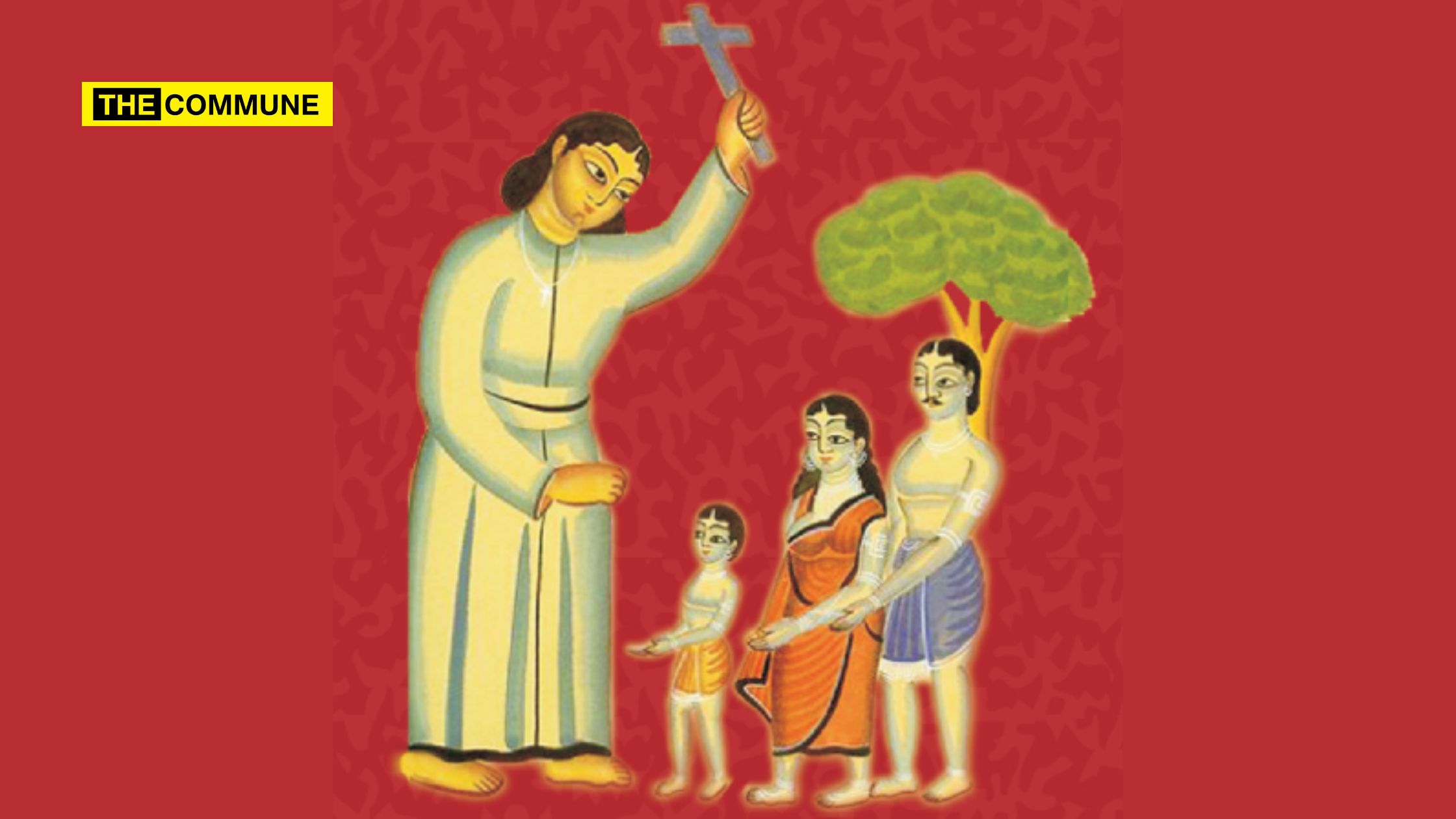
Alleged Proselytisation At Children’s Camp In Haryana; Similar Case Reported In Madhya Pradesh

Proselytisation haryana madhya pradesh children attempting to convert christianity sultanpur forced conversion missionary

A summer children’s camp organised at a local church in Ambala, Haryana, has come under scrutiny after Bajrang Dal activists confronted the organisers over alleged religious indoctrination of minors. A video of the altercation, which has since surfaced online, purportedly shows members of the organisation questioning the church staff about religious content being imparted to children under the guise of a vacation camp.

Activists alleged that children attending the camp were being taught Christian doctrines and urged to accept the faith, raising concerns about violation of constitutional and child protection norms. Police have yet to confirm if a formal complaint has been filed in the matter.

The incident has drawn comparisons to a case in Chaubara Jagir village of Sonkutch Tehsil, Dewas district, Madhya Pradesh, where a similar alleged conversion operation involving tribal minors was reported earlier this month. On 20 June 2025, police at Sonkutch Police Station registered FIR No. 409/2025 under the Madhya Pradesh Freedom of Religion Act, 2021.

According to the complaint filed by local resident and Hindu activist Gajraj Singh Sendhav, a group was conducting what was presented as a free coaching class for tribal children. However, the complainant alleged that the initiative was a front for religious conversion, involving inducements such as money, education, and other material benefits.

The FIR stated that five individuals, identified as Manju, Kiran, Mahida, Sachin, and Mithun, were found conducting a religious session at the residence of one Bhagnu Jiyaji, where Christian posters were displayed and sermons were delivered that allegedly disparaged Hindu deities. The complainant reported that the accused told those gathered that their gods could not protect them and promised blessings upon converting to Christianity.

The accused reportedly offered ₹50,000, free school admissions, and other incentives in exchange for religious conversion. Following a confrontation with local residents, police arrived at the scene and detained the group. They were subsequently booked under Sections 3 and 5 of the Madhya Pradesh Freedom of Religion Act, which prohibit conversion by allurement or coercion, particularly when involving minors or Scheduled Tribes. Convictions under these sections carry penalties of up to five years’ imprisonment.

Videos from the site allegedly showed children seated on mats in a house repurposed as a classroom, with religious posters prominently displayed. One of the posters read, “Jesus says, allow children to come to me. Only they will go to heaven who send their kids to me.”

Gajraj Singh told Organiser that he and others had been monitoring the group’s activities and claimed that children were being asked to pray to Jesus. One of the accused reportedly fled with a bag believed to contain religious literature.

This incident in Dewas is the latest in a string of reported cases in tribal-dominated areas of Madhya Pradesh, such as Jhabua, where activist groups have alleged systematic proselytisation efforts. Reports from Jhabua have highlighted covert religious meetings in forested areas and the use of inducements to convert vulnerable communities.

As regards the Dewas case, the Madhya Pradesh Freedom of Religion Act, 2021, requires prior approval from the district magistrate for any religious conversion and includes provisions to nullify conversions made solely for the purpose of marriage. The law places the burden of proof on the accused and imposes enhanced penalties when victims are minors, women, or members of Scheduled Castes or Tribes.

(With inputs from Organiser)

Subscribe to our channels on Telegram, WhatsApp, and Instagram and get the best stories of the day delivered to you personally.

Dravidian Model: Open Alcohol Consumption In Maraimalai Nagar Alarms Residents, Demand Removal Of TASMAC Shops Near Residential Areas

maraimalai nagar open alcohol consumption tasmac

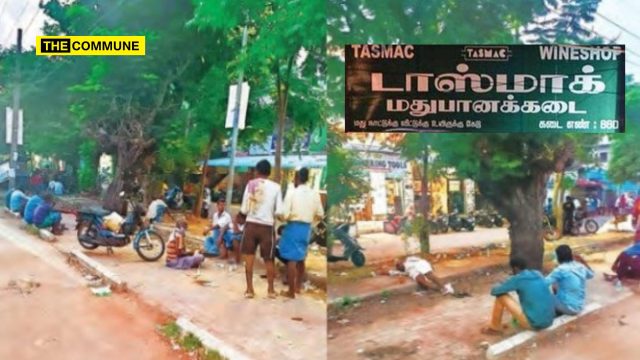
Residents of Maraimalai Nagar have voiced serious concerns over the public nuisance caused by open consumption of alcohol in public spaces. They alleged that the presence of TASMAC liquor shops near residential areas, temples, and schools has created unsafe conditions, especially for women and schoolchildren.

Local residents reported that people were purchasing alcohol from TASMAC outlets in Anna Salai and Pavendar Salai and consuming it openly on pavements, near Ninnakarai Lake, and in parks. They stated that the absence of bar facilities at these outlets was forcing drinkers into public areas, creating an atmosphere of fear and discomfort for passersby.

They further claimed that the shops were located on busy roads frequented by schoolchildren and women commuters. According to residents, despite repeated protests and court orders mandating the removal of liquor shops near sensitive zones, authorities had taken no action to relocate them.

Some residents said that the illegal sale of alcohol was thriving in areas such as Singaperumal Temple and Maraimalai Nagar. They alleged that liquor was being sold 24 hours a day at inflated prices and that it was commonly divided and sold as ‘cutting’ portions for ₹100.

They also expressed concern that intoxicated individuals were often found lying unconscious on the roads and questioned whether law enforcement officials were turning a blind eye to the illicit trade.

Residents urged the district administration to take immediate steps to remove the TASMAC outlets from residential and school zones and to crack down on the illegal liquor trade operating in the area.

(With inputs from Dinamalar)

Subscribe to our channels on Telegram, WhatsApp, and Instagram and get the best stories of the day delivered to you personally.
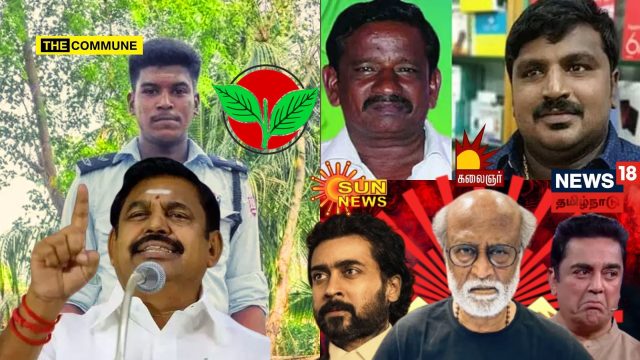
AIADMK Calls Out Kollywood Celebrities’ Stoic Silence On Custodial Death Under DMK Regime After Vocal Activism During EPS Regime

aiadmk custodial death

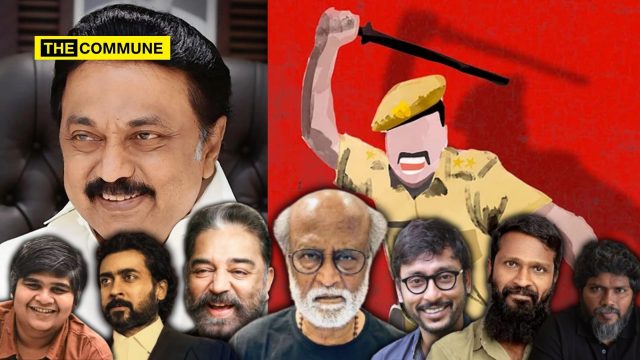
The AIADMK IT wing has taken a direct swipe at pro-Dravidianist DMK-sympathizing Kollywood actors, mocking their selective outrage and performative activism. During the AIADMK regime, several Kollywood celebrities like Rajinikanth, Kamal Haasan, Suriya, Vetrimaaran and others were vocally critical of the government, especially during the tragic custodial death of P. Jeyaraj and his son Bennix in Sathankulam. Even though the then-government was handling the case with caution due to its sensitive nature and COVID-19 restrictions, these stars acted as de facto mouthpieces for the opposition DMK, amplifying its narrative and portraying the administration in a negative light.

Now, under the DMK’s rule, a similar tragedy has occurred yet again with a 27-year-old Ajithkumar, a temple security guard, died in police custody in Sivaganga after allegedly being assaulted during interrogation over a theft case. Initially released after questioning, he was detained again the next day by a special team and reportedly beaten following conflicting statements. His guilt or innocence remains unconfirmed, but what’s clear is the conspicuous silence from the same celebrities who once rallied against state violence.

This glaring double standard hasn’t gone unnoticed. The AIADMK IT wing took to its official X account to call out the hypocrisy with biting sarcasm, posting, “Which celebrity do you miss the most at this time, who only spoke out during the AIADMK rule? Tell us in the comments.”

The post has sparked a wave of online reactions, with many netizens echoing the sentiment that the so-called social justice warriors of Kollywood seem to have lost their voice when the spotlight turned toward a government they ideologically support.

Stoic Silence Of Kollywood Virtue Signallers

‘Superstar’ Rajinikanth, who relased a picture of his ‘angry face’ expressing shock over the incident and calling for all the officials to be severely punished, has gone on mute to shoot for his next film with Sun Pictures.

Director Vetrimaaran who had made a film on custodial torture and had tweeted supporting justice for Jeyaraj and Bennix hasn’t uttered a word on any of the above deaths.

The last tweet of his was in support of Jai Bhim, a controversial film starring and produced by ‘actor’ Suriya on police torture. He went on to say, “This entire incident as a result of an organised crime.”

Many other Kollywood personalities like ‘Jayam’ Ravi, directors Vetrimaaran, Karthik Subbaraj, Pa. Ranjith and others have resorted to looking the other way.

Pa. Ranjith’s is an interesting case where he has played safe by retweeting a tweet from another handle about the recent Thiruvannamalai incident. Just like a soft slap on the cheek. Maybe he is having some trouble in his spine (probably lacks one), to give a hard-hitting statement.

This dead silence now and selective outrage from these celebrities tells a lot about their opportunism and how they stand in mercy at the gates of Gopalapuram.

Subscribe to our channels on TelegramWhatsApp, and Instagram and get the best stories of the day delivered to you personally.

How Leftist Pro-Congress Rag ‘The Wire’ Twisted Indian Defence Attache’s Statements Demeaning Indian Armed Forces Victory Against Pakistan

defence attache jakarta indonesia navy captain the wire propaganda operation sindoor

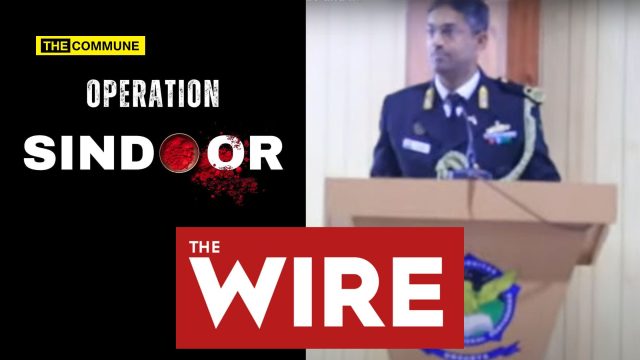
In yet another glaring instance of selective quoting and narrative distortion, The Wire has published a misleading article titled “IAF Lost Fighter Jets to Pak Because of Political Leadership’s Constraints”, falsely attributing a statement to India’s Defence Attache to Indonesia, Captain (IN) Shiv Kumar. The report is not just factually inaccurate—it is a textbook case of twisting a nuanced military briefing into a politically loaded attack on the Indian government and armed forces.

What Was Actually Said

Captain Shiv Kumar, during a 35-minute academic seminar in Jakarta on 10 June 2025, clearly praised the Indian Armed Forces’ calibrated, precise, and non-escalatory response to Pakistani aggression during the May 2025 Operation Sindoor. Far from criticising the political leadership, he highlighted the disciplined restraint shown by India, which targeted only terror infrastructure, in line with India’s doctrine of avoiding unnecessary escalation in a nuclear neighbourhood.

Yes, he did refer to “constraints given by the political leadership”, but in the specific context of the initial targeting directive not to hit enemy military or air defence installations. This decision was framed as a strategic restraint, not a failure. He explicitly stated that once losses were registered, Indian forces swiftly adapted, achieving complete air superiority by May 10 through targeted strikes using BrahMos missiles. His full statement was, “So India’s counter-response was again swift, precise and non-escalatory, there is one point that there was the issue of separation of enemy air defense and destruction of enemy air defense which was not undertaken earlier because the constraints given by the political leadership was to only target the terrorist camp. However still it went on and so what news we know, I may not agree with Tommy when he says that India lost so many aircrafts and all that but we all can agree that whatever losses was mentioned, it only speaks about the 7th of May, but this skirmish went on till 10th of May. So what happened on 8th of May, 9th of May, and 10th of May is, this is what happened. so there was complete air superiority and there was separation of enemy air defense undertaken and then one could hit with impunity.”

What The Wire Did Instead

The Wire, in its typical fashion, cherry-picked fragments and twisted them into a fabricated narrative that India’s jets were lost “because of political leadership’s constraints.” That quote does not exist in the presentation. It is an invention, designed to undermine both the civilian leadership and military operations. Their report overlooks the full timeline, ignores the Defence Attaché’s full speech and praise for India’s professionalism, and strategically omits the shift in tactics that turned the tide in India’s favour. Moreover, it sidelines the fact that India refrained from targeting Pakistani military assets as a matter of deliberate, sovereign policy, not compulsion.

Unlike Pakistan, which escalated indiscriminately, India adhered to its policy of proportionate response. And when the battlefield situation evolved, so did the strategy. By May 10, India had successfully neutralised Pakistani air defences and established clear superiority.

This is not The Wire’s first attempt to distort defence matters. From surgical strikes to Balakote to now Operation Sindoor, their reporting consistently seeks to erode public trust in India’s armed forces by misrepresenting official statements and military achievements.

It is noteworthy that after the controversy created by The Wire’s false reporting, the Indian Embassy in Jakarta released a statement clarifying that, “We have seen media reports regarding a presentation made by the Defence Attache at a Seminar. His remarks have been quoted out of context and the media reports are a misrepresentation of the intention and thrust of the presentation made by the speaker. The presentation conveyed that the Indian Armed Forces serve under civilian political leadership, unlike some other countries in our neighbourhood. It was also explained that the objective of Operation Sindoor was to target terrorist infrastructure and the Indian response was non-escalatory.”

Although The Wire updated this information in its article, it did not make any amends to the title or the content.

Selective quoting, invented headlines, and deliberate omission of context are tools of propaganda that the likes of The Wire employ to set anti-India narratives. Captain Shiv Kumar’s presentation was a clear exposition of India’s doctrine of strategic restraint, effective escalation control, and military professionalism. By turning that into a fabricated indictment of the political leadership, The Wire has misled its readers as well as disrespected the very ethos of our Armed Forces.

Subscribe to our channels on Telegram, WhatsApp, and Instagram and get the best stories of the day delivered to you personally.
Dravidian Stocks In Shock As Traces Of West Eurasian DNA Found In Ancient Keezhadi Population

dravidian stocks west eurasian dna

In a significant blow to the Dravidian narrative that sought to propagate the Aryan-Dravidian racial divide, recent findings have disrupted the foundations of that theory. A UK-based lab, in collaboration with Indian researchers, conducted facial reconstructions of two individuals from the Kondagai burial site. The results revealed that these ancient individuals were of South Indian origin, carrying ancestral links to West Eurasian (Iranian) hunter-gatherers and Austro-Asiatic populations. This discovery directly challenges the divisive Nazi style race-based narrative, as the latest report clearly states, “South Indian with traces of ancestral West Eurasian (Iranian) hunter-gatherers and ancestral Austro-Asiatic people.” With these findings, the attempt to sustain the Aryan-Dravidian binary appears to have hit a dead end.

Excavations at Keezhadi, located about 12 kilometers from Madurai, have revealed evidence of a thriving civilization dating back allegedly to the 6th century BCE. Now, for the first time, researchers have been able to put a human face to these ancient people. The facial reconstructions were carried out by experts at Liverpool John Moores University in collaboration with Madurai Kamaraj University.

Professor Caroline Wilkinson, head of the Face Lab at Liverpool, explained that a computer-assisted 3D technique was used to reconstruct the facial muscles and features of the skulls. While the upper halves of the skulls were largely intact and allowed for more accurate reconstructions, the missing lower jaws required researchers to estimate the shapes based on orthodontic standards and cranial measurements.

Using CT scans of the Kondagai skulls and anatomical data from modern South Indian populations, the team applied forensic and anthropological methods to estimate soft tissue depth and facial characteristics. The reconstructed appearances were finalized using digital modeling, with skin tone, hair texture, and eye color selected from a photographic database.

According to Professor G Kumaresan of Madurai Kamaraj University, the process involves a mix of science and interpretation about 80% based on scientific data and 20% on artistic estimation. These reconstructions, paired with DNA analysis, are expected to provide deeper insights into the ancestry and migratory patterns of people from the Sangam period.

Keezhadi has become a focal point of academic and political debates regarding the region’s historical timeline. Although the Archaeological Survey of India (ASI) recently suggested revising earlier dating of the site to the 3rd century BCE, Tamil Nadu’s state archaeology department maintains that radiocarbon analysis confirms human activity at Keezhadi from the 6th century BCE to the 2nd century CE.

In collaboration with Harvard University’s genetics department, researchers are conducting extensive DNA analysis of the skeletal remains from Kondagai to trace patterns of migration and admixture. Preliminary studies suggest that most individuals buried at Kondagai were around 50 years old at the time of death.

Anthropologist Veena Mushrif Tripathy from Deccan College examined the bones and confirmed that age estimations were based on features such as dental wear, joint conditions, and bone size. Of the remains, 11 skeletons allowed for stature estimates: the average male height was about 170.82 cm (5’7″), and the average female height was 157.74 cm (5’2″). These findings are consistent with data from Kodumanal, another archaeological site.

Sex determination was primarily done by analyzing pelvic and cranial features. Archaeologist K Rajan, who advises the Tamil Nadu archaeology department, noted that this project marks the first facial reconstruction of ancient individuals from South India a significant step forward in understanding the region’s historical identity.

Why Is This A Major Blow For The Dravidian Ecosystem?

Like the Nazis, Dravidianists believe in the racial purity of Dravidian race.

These findings directly challenges the core foundation of the Aryan-Dravidian theory also known as the Aryan migration or invasion theory, which claims that Indo-European (Aryan) groups migrated into India, subjugating or assimilating the native Dravidian-speaking populations. This narrative has long been used to assert that Dravidians were the original inhabitants, dispossessed of power, land, and legacy. Some proponents even went as far as to claim that the Dravidian race was the ancestor of all civilizations, including the Harappans, asserting a singular racial and cultural continuity through history.

With the Keezhadi excavations, there was a concerted effort to shift historical timelines and reinforce this theory through selective peer-reviewed interpretations. However, a single, scientifically grounded facial reconstruction of two skulls from the Kondagai burial site has undercut this narrative. The study revealed that these ancient individuals were South Indian, with genetic influences from ancestral West Eurasian (Iranian) hunter-gatherers and Austro-Asiatic populations effectively dismantling the idea of a racially pure or isolated Dravidian lineage. The evidence speaks for itself and strikes at the heart of an ideological construct that had long evaded scrutiny under hard science.

(With inputs from Times Of India)

Subscribe to our channels on TelegramWhatsApp, and Instagram and get the best stories of the day delivered to you personally.

Perseverance, Resilience, Ayyappan: This Cuddalore Youth Cleared SSB In His 15Th Attempt And Is Set To Join The Indian Navy

indian navy ayyappan

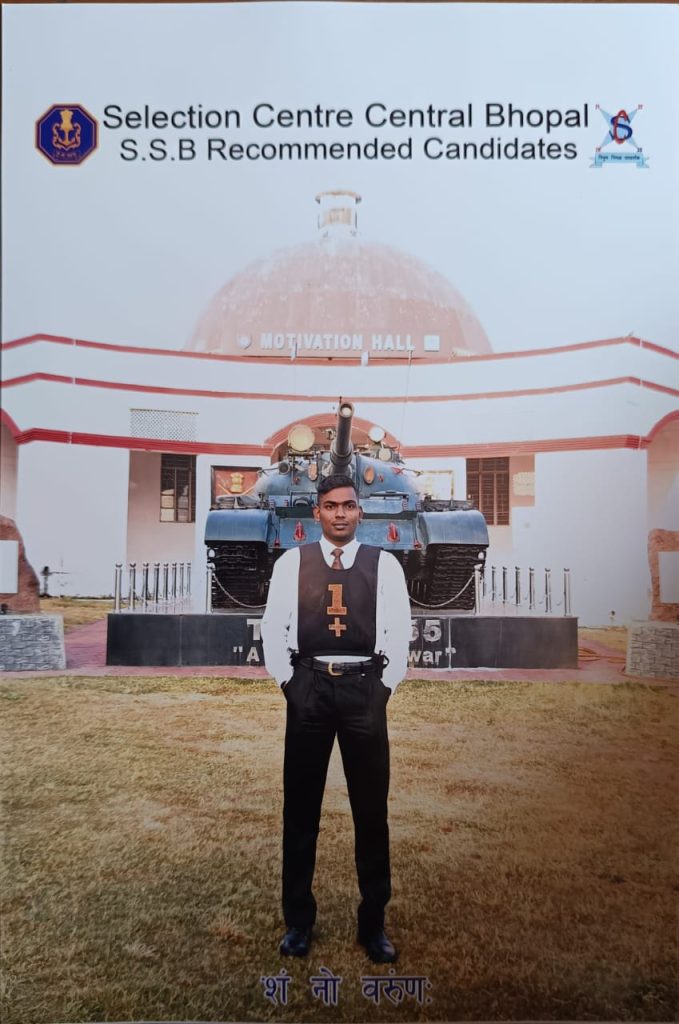
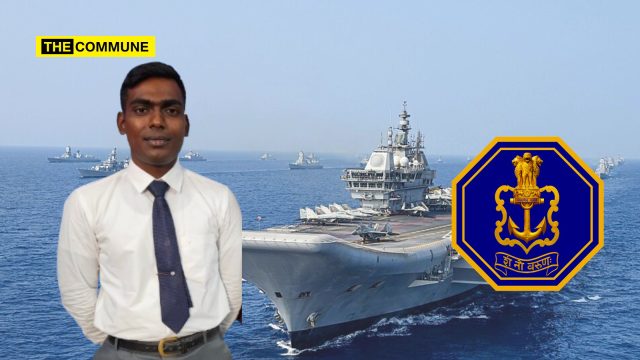
The taste of victory is all the sweeter because of the relentless struggle that preceded it. And this is true in the case of AV Ayyappan. Hailing from a small village in Cuddalore district, Tamil Nadu, Ayyappan has emerged as a shining example of perseverance. After 14 failed attempts, he was finally recommended on his 15th attempt for the Indian Navy. His story is one of self-discovery, discipline, and unshakable determination.

Ayyappan, tell us a little about yourself and how your defence journey began.

Ayyappan: I’m from Cuddalore. My parents were schoolteachers and are now full-time farmers. While in college, I was part of the NCC, which really laid the foundation for my interest in the armed forces. During the COVID-19 pandemic, I helped organize the Swarnim Vijay Run, a marathon commemorating the 50th anniversary of India’s victory in the 1971 war. That event gave me a glimpse into military discipline, leadership, and motivation. After that, I was certain that I wanted to join the armed forces. I attempted the SSB interviews but faced multiple failures: 2 screen outs and then 12 conference outs. Finally, in my 15th attempt at Bhopal, I was recommended for the Indian Navy.

Q: Fourteen missed attempts is no small number. How did you stay motivated through it all?

Ayyappan: It wasn’t easy. Initially, I prepared with friends, we discussed strategies and tried to reflect them in our responses. But I realised I wasn’t showing my true self. I was imitating. After repeated failures, I sat down and created a flowchart of my achievements and experiences. That helped me understand myself better. Once I started projecting my authentic personality in the SSB, I saw results.

Q: What should engineering students keep in mind when applying for defence services?

Ayyappan: Engineering students can apply in their final year via the official portals — joinindianarmy, joinindiannavy, etc. Once shortlisted based on marks, they’re called for the SSB interview, which has two stages:

  • Stage 1:
    • OIR (Officers Intelligence Rating) test
    • PPDT (Picture Perception and Discussion Test) – candidates view a picture, create a story, and then discuss it in a group.

    Out of 200–300 candidates, only 20-30 are usually shortlisted to proceed.

  • Stage 2:
    • Psychological Tests
    • GTO (Group Tasks) to assess leadership and teamwork
    • Personal Interview

Sometimes no one is selected from a batch. Even among those who pass, some get medically unfit or merit out.

Q: You were once declared medically unfit. Can you talk about that?

Ayyappan: Yes, I was declared medically unfit for two reasons: bowlegs and overweight. I worked on my weight and got fit. For the bowlegs, after review, it was found to be muscle build-up from running, not an actual deformity. I appealed and was cleared.

Q: Did you ever feel like giving up?

Ayyappan: Honestly, no. I always believed I would be recommended. My NCC commanding officer and others had faith in me, and I held onto that. I gave myself a time frame – until I completed my ME. Even if I didn’t succeed then, I would have continued to try while taking up a job.

Q: What kind of support did you receive from your friends and family?

Ayyappan: My friends, mostly NCC cadets, knew how tough the process was. They watched me grow. I was weak in English earlier, but by the end, I could speak confidently and dress well. They appreciated that even though I wasn’t getting recommended, I was improving in life.

At home, my parents were extremely supportive. We had never seen even a jawan in uniform in our village, but they never discouraged me. After every failure, they stood by me.

Q: How did your association with Dream of Defence help you?

Ayyappan: Before joining Dream of Defence, I didn’t know what SSB was. The daily online sessions, the feedback from you and Col Swamy, were game changers. You pointed out my weaknesses in communication and soft skills – I worked on those areas, and it helped immensely.

Q: Tell us about Dream of Defence group.

Ayyappan: The Dream of Defence comprises Major Madhan Kumar, Lt Commander Thiagarajan, and Colonel Swamy – retired army officers who have been guiding the defence aspirants for about 5 years now. It was this group and the guidance of the core members – the veterans that helped quite a few of us participants achieve success – realise our dream of entering the armed forces.
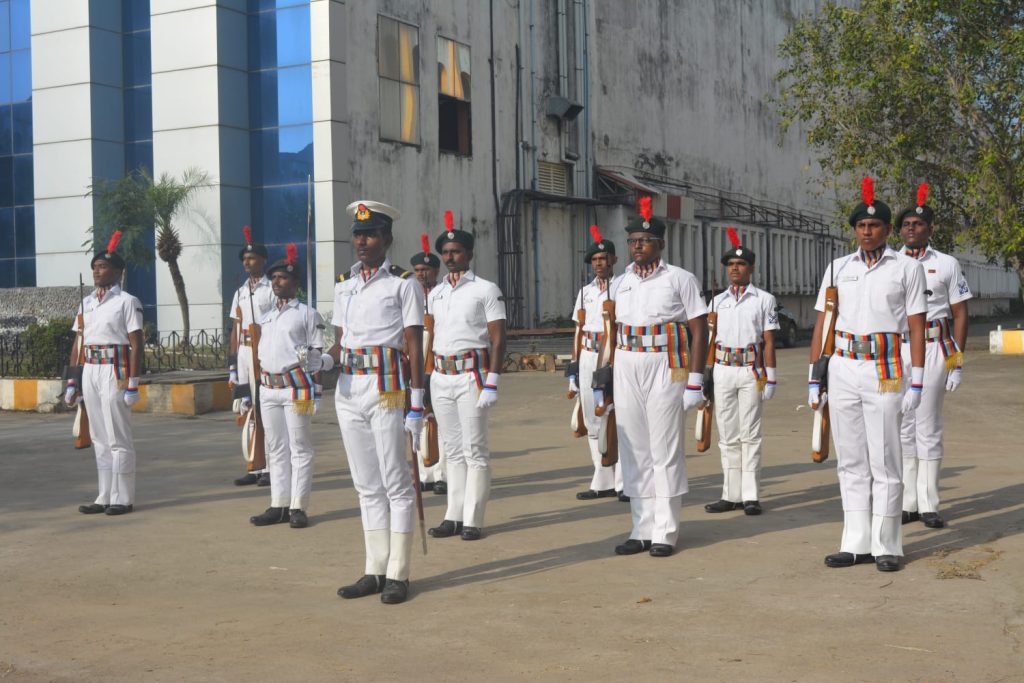
Initially, we were a group of students who began preparing for the exams. Two of them have already become officers (Captain Thirukumaran and Lt Agnivesh) and now me – I am following their footsteps now to become an officer soon. We prepared for the exams together.

Today there are over 100 members in the group comprising of mentors and aspirants.

Q: How did Major Madhan’s guidance impact you?

Ayyappan: I began interacting with Major Madhan after we met while organizing a marathon (as mentioned earlier). I had near-zero idea about the defence related exams and no specific idea about the armed forces to be honest. He helped me with how to begin my preparations and how to go about it. He even helped me analyze my weaknesses – communication was my weak point and guided me to get over it by pointing me to resources and mentors. Every time we discussed my performance, he would analyse everything and tell me how to correct it. He also introduced me to Lt Cdr Thiagarajan, and he conducted many SSB sessions initially. Over time, Col Swamy started guiding us and he is guiding the aspirants now. He is a great mentor.

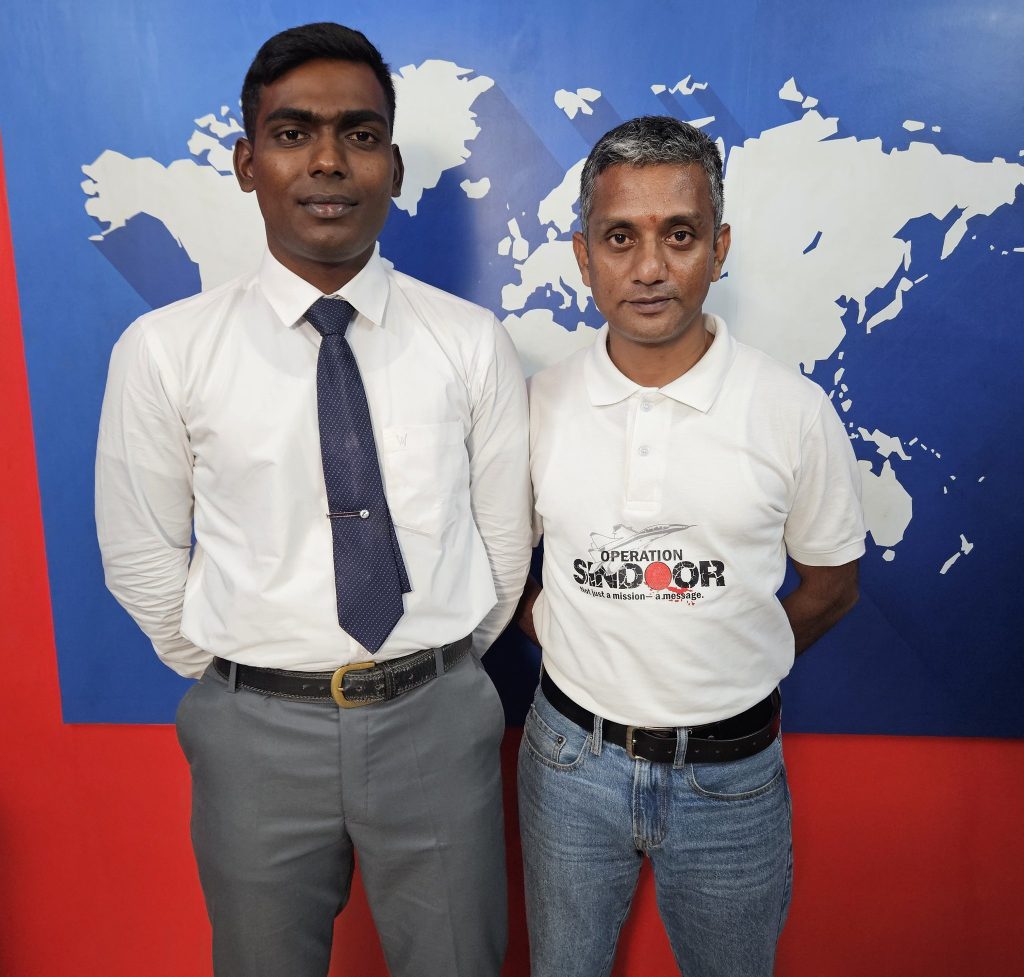
With Major Madhan Kumar

Q: You’ve been selected for the Navy. What is your branch and role?

Ayyappan: I’ve been selected for the Naval Armament Inspection Cadre (NAIC). The role involves quality assurance, safety inspection, and auditing of naval weapons. With the Navy’s focus on indigenization, NAIC also contributes to R&D and weapon warehouse management.

Q: Was the Navy your first choice?

Ayyappan: Actually, my dream was to join the Indian Army, especially the Special Forces. I was drawn to their combat role and leadership. But I’m honoured to serve the nation in the Navy too, and I will give it my all.

Q: You’re coaching others now, many of whom don’t know English or Hindi. What advice do you give them?

Ayyappan:

  1. Confidence is key – Never underestimate yourself.
  2. English is important, especially in a multilingual nation like India.
  3. Stay aware of your environment, yourself, and keep up with current affairs.

Q: How many hours should aspirants study per day for CDS exams?

Ayyappan: The CDS exam is as competitive as the UPSC prelims now. Aspirants should study for at least 4 hours a day, focusing on the syllabus and previous years’ question trends. Coaching isn’t mandatory, but guidance is crucial, past candidates and online resources help a lot.

Q: You’ve come a long way from being shy and hesitant in English. How did you overcome that?

Ayyappan: I practiced speaking to myself. I’d stand in front of the mirror and pretend to be a newsreader. I recorded myself, listened back, and improved slowly. I made grammar mistakes, but the confidence I built was more important than perfection.

Q: How important is physical fitness in SSB? How did you prepare?

Ayyappan: Physical fitness is essential. In the SSB, there are both individual and group obstacle tasks. I didn’t do any special training — just ran 3 km daily, did pushups, pull-ups, sit-ups — the basics. That was enough.

Q: How did your family react to the final recommendation?

Ayyappan: My parents and younger brother were overjoyed. For all of us, it was a long wait and an emotional moment.

Q: What’s your next goal?

Ayyappan: My next goal is to convert my Short Service Commission (SSC) to a Permanent Commission. I want to excel in my training and clear all requirements in the first attempt.

Ayyappan’s journey proves that with clarity, consistency, and courage, no dream is too far. From a village boy unsure of his English to a confident young officer headed to the Navy, his story continues to inspire defence aspirants across the country.

Subscribe to our channels on Telegram, WhatsApp, and Instagram and get the best stories of the day delivered to you personally. 
The Rising Number Of Custodial Deaths In Dravidian Model Tamil Nadu And The Stoic Silence Of DMK Stooge Celebrities

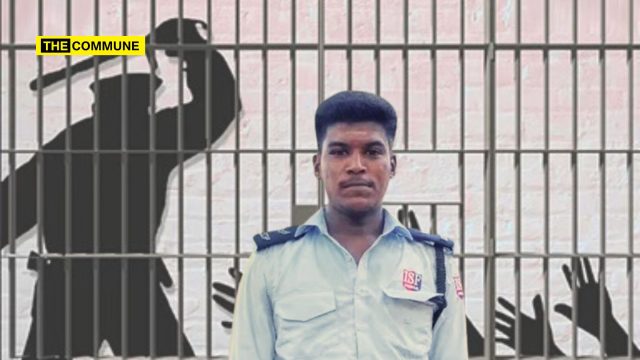
The saga of custodial deaths continues in Tamil Nadu under the Dravidian Model DMK government. The state has been rocked by the news of a 27-year-old temple guard, Ajithkumar, employed under Tamil Nadu’s HR&CE Department, having died in police custody on 28 June 2025. Detained by Thirubhuvanam Police over an alleged theft of 80g of gold jewellery from a disabled devotee’s car at Madapuram Kaliamman temple, Ajith was reportedly tortured for 18 hours without any formal legal procedure. Witnesses claim he was beaten with rods, tied to a tree, and forced to drink chilli-laced water. His brother, Naveen, also alleges being beaten to force a false confession. Ajith died at Thirubhuvanam Government Hospital, but the police allegedly moved the body without informing the family. Protests erupted after news of his death spread, with demands for a CBI probe and FIRs against senior officials. Six policemen have been arrested, but critics call this a cover-up, pointing to political interference and a pattern of custodial deaths in the region.

During the period 2021–22, the National Human Rights Commission of India documented 2152 deaths in judicial custody and 155 deaths in police custody until 28 February 2022 in India. 

In the year 2022 up until March 2025, 24 custodial deaths are said to have taken place as per this report.

In 2024, over 300 accused persons entered Chennai’s Puzhal Prison with broken limbs, as revealed by RTI data. In response, police cited the implausible excuse of “slippery toilets” as the cause of these injuries. The use of extrajudicial methods by Tamil Nadu police has become alarmingly routine, with 21 encounter killings reported since 2021.

Custodial Deaths In Dravidian Model TN

While the Sathankulam custodial deaths rocked the state, when it came to the custodial deaths in the DMK regime, not a whimper was heard from the same activist/celebrity gang.

Here are some of the incidents of death due to police torture that deserve as much traction as that of the Sathankulam case.

Incident 1:

Rajasekar, a 33-year-old resident of Munthiri Thoppu in Tiruvallur district, was brought to the P6 Kodungaiyur police station on 11 June 2022 for an inquiry related to two burglary cases. He was pronounced dead at the Government Stanley Medical College Hospital on 12 June 2022. The autopsy report revealed multiple external injuries, with two injuries occurring approximately 18-24 hours before his death.

Incident 2:

In Nagapattinam district, a 44-year-old man named Siva Subramanian, employed at a cycle repair shop, died in judicial custody. Siva and his brother Ganesh were detained after a brawl with Venkatesh, who owed Ganesh ₹95,000. According to the police, Siva suffered seizures while in jail and was taken to Nagapattinam Government Hospital, where he passed away on the evening of 13 June 2022. The police attributed his death to alcohol withdrawal symptoms, dismissing reports of custodial torture.

Incident 3:

On 18 April 2022, during a routine night check at Kellys in Chennai, police stopped two youths, Vignesh (25) and Suresh (28), in an auto. The duo, found in possession of ganja and liquor, engaged in a verbal duel with the police. Vignesh later developed health complications, vomited, and had seizures. Despite being rushed to the hospital, he was declared dead. Relatives reported seeing injuries on Vignesh’s body, leading to the suspension of a police sub-inspector, a constable, and a home guard personnel.

Incident 4:

In Tiruvannamalai, Thangamani was taken into police custody on 26 April 2022 for an inquiry into illegal liquor sales. Relatives alleged a false case, stating that the police demanded money for their release. The police claimed Thangamani had fits the next day, leading to his hospitalisation and subsequent death during treatment.

Incident 5:

In January 2022, a physically challenged man named Prabhakaran was locked up for allegedly stealing jewellery. Falling ill in jail, he was rushed to Namakkal Government Hospital and later to Salem Government Hospital, where he died on 11 January 2022. Prabhakaran’s relatives alleged police torture as the cause of death, resulting in the suspension of three police officers.

Incident 6:

In June 2021, Murugesan, a fruit stall owner, died after being beaten by police at the Pappanaickenpatti check post. A video circulated on social media showed Special Sub-Inspector Periyasamy thrashing Murugesan with a lathi until he became motionless. Murugesan had engaged in an argument with the police while being penalised for drunk driving. Periyasamy was arrested following a complaint.

Custodial death stands out as one of the gravest offences in a civilised society governed by the Rule of Law, where the state needs to take necessary steps to curb the issue.

The landmark verdict of 18 December 1996, in DK Basu vs State of West Bengal, laid down 11 guidelines by the Supreme Court, addressing arresting procedures and compensation in case of the detainee’s death.

Incident 7:

In December 2022, Gokul Shree, a 17-year-old teen, was arrested on December 28 by the Railway Police in Tambaram on suspicion of stealing a battery from a railway station. He was sent to a children correctional facility because he was a minor. On December 31, he was rushed to Chengalpet Government Hospital with complaints of seizures, where he passed away within hours.

The preliminary autopsy report showed that the child was subjected to a physical attack, had severe contusions on his legs, and several external injuries on his body. The child was beaten severely before being killed, and the majority of his injuries were were ante-mortem. The parents, however, were not given access to the complete autopsy report.

On the basis of the postmortem report, six prison officials of the correctional facility were arrested. S Mohan, 30, superintendent of prisons, P Vidyasagar, 33, assistant superintendent of prisons, J H Raj, 29, barber at the juvenile home, prison wardens D Vijayakumar, 30, M Saranraj, and teacher R Chandrababu, 40, were arrested.

Incident 8:

In June 2023, the death of a 26-year-old Scheduled Caste (Pallar community) youth, Thangasamy, who was in the custody of the Puliyangudi police in Tenkasi district died. According to reports, Thangasamy was remanded in judicial custody, but he complained of uneasiness, prompting authorities to transfer him to Tirunelveli Medical College. However, his condition deteriorated, and he subsequently passed away.

According to Code of Criminal Procedure (CrPc) Section 176 (I) of the CrPC, in the event of a person’s death or disappearance in custody or if a woman is raped in custody, the Judicial Magistrate holds the authority to order an inquiry. Section 54 of the CrPC also empowers the Magistrate to appoint a medical petitioner to examine accused individuals under trial. The Indian Penal Code (IPC) in Sections 330 (a) and (b) allows for sentences of up to 7 years for policemen involved in cases of torture.

Incident 9:

A 58-year-old jeweller and former town secretary of the Communist Party of India (CPI), P Rajasekaran, allegedly died by suicide on Sunday night (June 25). The incident occurred just days after he was taken into police custody for interrogation. The news of his death had prompted widespread condemnation of the police, with allegations of custodial torture emerging.

Incident 10: 

In January 2024, Tamil Nadu witnessed another shocking case of alleged custodial death. M. Balakrishnan, a 36-year-old from Srivaikuntam, Thoothukkudi, travelled to Erode on 26 December 2023. The next day, while at a bar in Palayapalayam with friends, he and five others were detained by Erode police. While four were released, Balakrishnan and his friend Prakash were allegedly held in a private lodge and interrogated over an old case. His family claims he was brutally assaulted by police, leading to his hospitalisation on 28 December and eventual death on 2 January 2024 at Perundurai Government Medical College Hospital. His brother, M. Mariyappan, filed a complaint citing custodial torture. Advocate V. Maharajan, representing the family, highlighted severe injuries and alleged evidence tampering. The Madras High Court ordered a fresh post-mortem in Coimbatore on 9 January. A case under CrPC Section 176(1A) was registered at Chennimalai police station.

Stoic Silence Of Kollywood Virtue Signallers

‘Superstar’ Rajinikanth, who relased a picture of his ‘angry face’ expressing shock over the incident and calling for all the officials to be severely punished, has gone on mute to shoot for his next film with Sun Pictures.

Director Vetrimaaran who had made a film on custodial torture and had tweeted supporting justice for Jeyaraj and Bennix hasn’t uttered a word on any of the above deaths.

Many other Kollywood personalities like ‘Jayam’ Ravi, directors Vetrimaaran, Karthik Subbaraj, Pa. Ranjith and others have resorted to looking the other way.

Pa. Ranjith’s is an interesting case where he has played safe by retweeting a tweet from another handle about the recent Thiruvannamalai incident. Just like a soft slap on the cheek. Maybe he is having some trouble in his spine (probably lacks one), to give a hard-hitting statement.

This dead silence now and selective outrage from these celebrities tells a lot about their opportunism and how they stand in mercy at the gates of Gopalapuram.

Subscribe to our channels on TelegramWhatsApp, and Instagram and get the best stories of the day delivered to you personally.

Sivaganga: Temple Guard Ajithkumar Who Died In Police Custody Was Allegedly Beaten With Rods, Gagged & Given Water Laced With Chilli Powder To Drink

custodial death torture ajithkumar temple guard police postmortem report

A 27-year-old temple guard, Ajithkumar, working at the Madapuram Kaliamman temple in Sivaganga district, Tamil Nadu, has died in police custody, triggering widespread public outrage, allegations of custodial torture, and questions about political interference and institutional accountability.

Ajithkumar, employed under the Hindu Religious and Charitable Endowments (HR&CE) Department, was detained by the Thirubhuvanam Police on Friday, 27 June 2025, following a complaint from a devotee alleging the theft of 80 grams of gold jewellery from her car parked at the temple premises. The complainant, a 42-year-old disabled woman from Madurai named Sivagami, had visited the temple with her daughter, Nikki. Due to her disability, she reportedly handed the car keys to Nikki, who in turn entrusted Ajith with the responsibility of parking the car.

Ajith, who reportedly did not know how to drive, is said to have sought help from someone else. After a delay in returning the keys, Nikki discovered that the jewellery allegedly left in the vehicle was missing. This prompted a complaint to the temple administration and later to the local police.

Alleged Torture And Death In Custody

According to multiple eyewitnesses and statements from Ajith’s family, the situation escalated alarmingly after the theft complaint was filed. Ajith was first assaulted by temple authorities and later, more severely, by police officers who arrived at the temple.

Without any formal inquiry or legal procedure, Ajith and several others were taken into custody. His younger brother, Naveen, was also detained and allegedly tortured in an effort to force Ajith into confessing to the theft. Naveen recounted that five men, including himself and Ajith, were beaten as they were taken in police vehicles from one location to another.

“They beat me for half an hour before they started torturing my brother,” Naveen told reporters. “They were not in uniform. They tied us to a tree behind a temple near Maattukkottai and beat us with rods.”

In another horrifying revelation, witnesses state that Ajith was subjected to extreme forms of torture. After reportedly collapsing from the beating, he allegedly asked for water, which was laced with chilli powder before being given to him. Following this, Ajith reportedly suffered involuntary discharges and was unable to walk.

At approximately 4:00 AM on Saturday, 28 June 2025, the police reportedly searched Ajith’s house, taking him again to the temple and later to a grove where he was beaten further. By noon, he was said to be in an unconscious state and was taken to the Thirubhuvanam Government Hospital. Reportedly, he was beaten up for about 18 hours. Doctors there declared him dead.

Shockingly, instead of reporting the death to medical authorities or the family, the police allegedly took the body from the hospital back to the police station in a tempo van and only later transferred it to the Madurai Government Hospital in an ambulance.

Family And Public React With Protests

Ajith’s family and relatives were not immediately informed of his death. When they arrived at the police station around midnight on Saturday demanding his whereabouts, police reportedly maintained silence until around 1:00 AM when they finally disclosed that Ajith’s body had been moved to Madurai.

A large crowd gathered outside the police station and blocked roads demanding justice. The protestors questioned the legitimacy of the theft complaint and pointed out the lack of basic legal procedures – proof that the jewelry was in the car, why was Ajith detained overnight without remand or legal representation and the police were not in uniform during interrogation. They also questioned why Ajith’s death was not reported immediately.

Ajith’s brother, Naveen, further alleged: “The lady said the jewellery was missing only after the key was returned. We don’t even know if it was there in the first place. They beat us so badly that my brother died confessing something he didn’t do.”

Officials Suspended, But Protesters Demand More

Following intense public pressure, six police officers from the Crime Branch were suspended and later arrested. The officers were identified as Raja, Sankara Manikandan, Ramachandran, Prabhu, Anand (Head Constable), and Kannan.

However, activists, villagers, and opposition political voices have decried this as a cosmetic move, accusing higher-ranking officials of orchestrating the brutal interrogation.

“This is murder, not an investigation,” a protestor declared. “The Superintendent of Police must be named in the FIR. This could not have happened without pressure from senior officials.”

The protestors further claimed that political pressure from the HR&CE Department or other state officials may have played a role. “This is the fourth such death in custody in our area,” one community leader stated. “We are being silenced with compensation offers of ₹5 lakh, ₹10 lakh, even ₹30 lakh.”

Videos circulating online, including coverage by News Tamil and several YouTube citizen journalist channels, show grieving family members and local leaders alleging that DMK party members visited Ajith’s family with offers of compensation and jobs, allegedly coercing them into signing off on the post-mortem procedures.

Several protestors and activists have called for a CBI or CBCID investigation, arguing that the state police cannot be trusted to impartially investigate their own officers. Demands have also been made for the Madras High Court to take suo motu cognizance of the custodial death.

Sivagangai District Superintendent of Police, Ashish Rawat, has confirmed an investigation has been launched, and the Crime Branch team involved has been suspended.

(With inputs from India Today)

Subscribe to our channels on Telegram, WhatsApp, and Instagram and get the best stories of the day delivered to you personally.

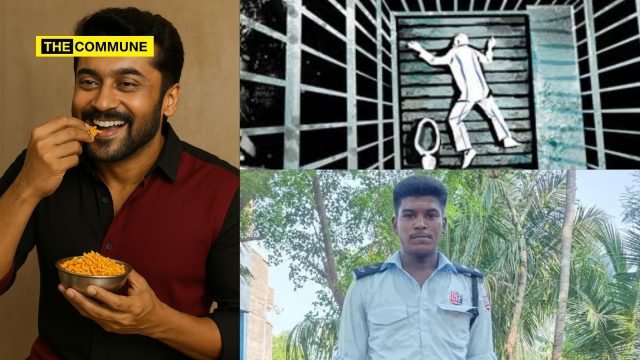
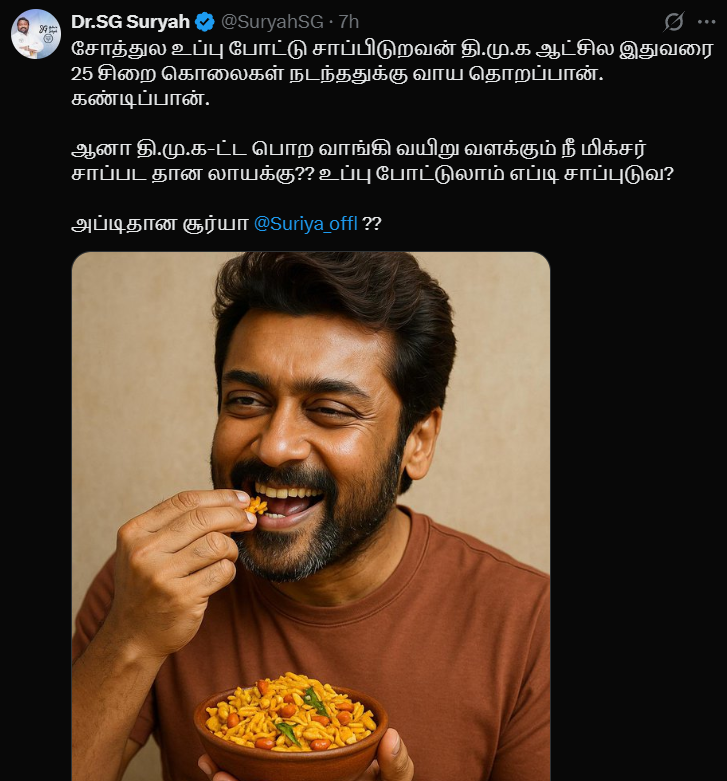
Now You’re The One Eating Mixture: DMK Stooge Suriya Who Virtue-Signalled For Every Issue Under The Sun During EPS Regime Keeps His Mouth Shut For Yet Another Custodial Death Case Under DMK Rule

DMK cheerleader and flop start Suriya, who never missed a chance to pontificate on every issue when Edappadi K. Palaniswami was Tamil Nadu’s Chief Minister, is now basking in the opulent glow of Seychelles’ sunsets, far from the state’s troubles.

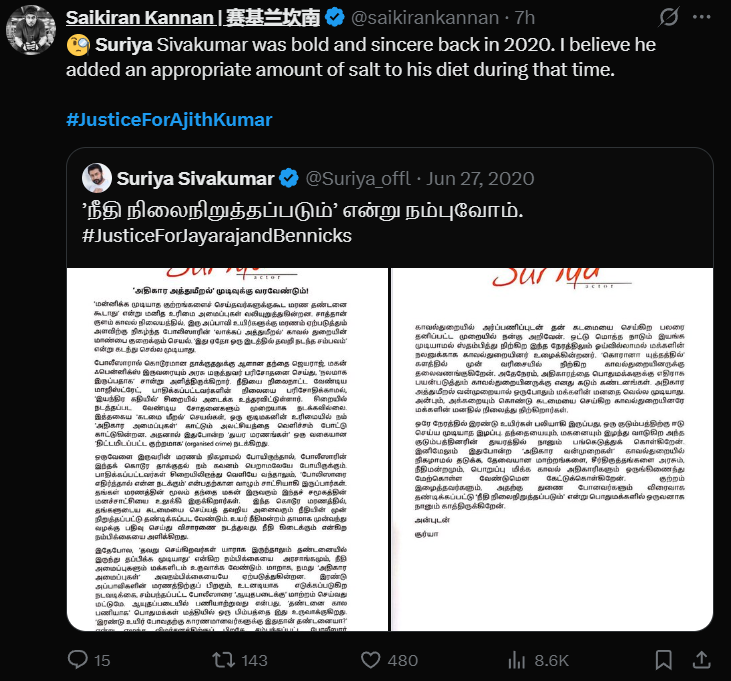
The man who brought custodial brutality into focus with his film Jai Bhim and vocally condemned the custodial deaths of Jayaraj and Bennix in Sathankulam—has remained remarkably silent about the recent custodial death of temple security guard Ajith Kumar in Sivaganga under the DMK government.

A 27-year-old man employed as a security guard at a temple died while in police custody in Sivaganga on Saturday, following his detention by the Thirupuvanam police for questioning in a theft case. Ajithkumar was initially questioned and let go on Friday. However, the following day, a special police team took him in for further interrogation. During the process, he was allegedly assaulted by officers after giving conflicting statements, which reportedly led to his death while in custody. It remains unclear whether Ajithkumar was responsible for the theft, according to police sources.

This is not the first such custodial deaths happening under the police department which comes under the direct control of Chief Minister MK Stalin. Since 2021, there have been more than 9 such cases documented by The Commune.

In January 2024, a 36-year-old resident of Srivaikuntam, Thoothukkudi, who was wanted in multiple criminal cases died days after facing custodial torture.

Custodial deaths must be condemned regardless of which party is in power, and justice must not be selective. But in Tamil Nadu today, it seems silence is the price for ideological loyalty.

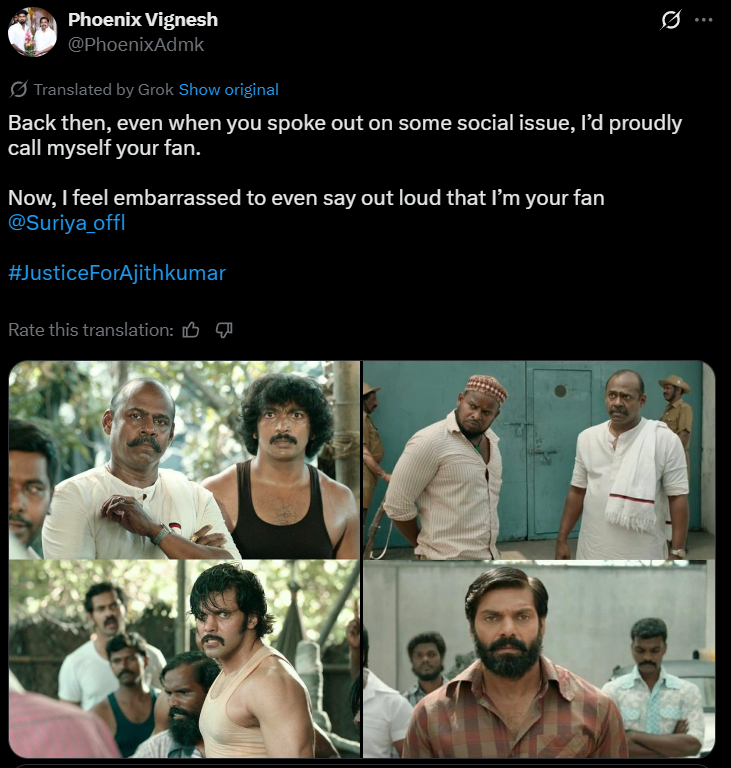
Now netizens are calling out the hypocrisy of Suriya for his shameless silence.

Subscribe to our channels on TelegramWhatsApp, and Instagram and get the best stories of the day delivered to you personally.
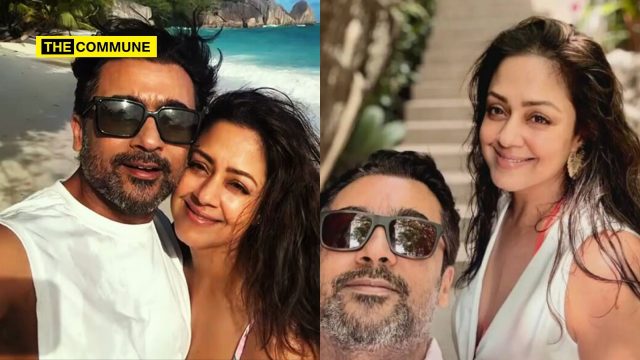
DMK Stooge Suriya And Wife Jyotika Who Criticized Temple Donations Asking People To Give Money To Schools And Hospitals Goes On Expensive Vacation To Seychelles

DMK simp and flop-churning actor Suriya who gave statements after statements for every issue under the sun when Edappadi K. Palaniswami was Tamil Nadu Chief Minister, is now enjoying sunshine and sunsets in the luxury destination of Seychelles.

Videos posted by Jyotika on social media show the celebrity duo strolling along white-sand beaches, indulging in water rides, sipping on fresh coconuts, and posing in high-end tropical attire—all while describing the East African island as “paradise.” In her post, Jyothika wrote, “Another day for you and me in paradise. Thank u Abhishek and Lyn for this beautiful memory at Seychelles.”

This is the same Jyotika who, in 2020, famously criticized temple donations, suggesting the money would be better spent on schools and hospitals—a comment that didn’t sit well with many in the Hindu community.

Her comments were hailed by the DMK’s ecosystem and lapped up by left-leaning media outlets, using it to push the narrative that temple wealth is a misplaced priority.

The couple’s recent luxury vacation—likely costing several lakhs—raises an obvious question: Why is it acceptable to splurge on exotic getaways, but not for devotees to donate to temples they believe in?

Meanwhile, Suriya—who brought custodial brutality into focus with his film Jai Bhim and vocally condemned the custodial deaths of Jayaraj and Bennix in Sathankulam—has remained remarkably silent about the recent custodial death of temple security guard Ajith Kumar in Sivaganga under the DMK government.

When speaking out aligns with their political leanings, they’re loud and visible. But when uncomfortable truths emerge under regimes they support, they retreat into silence—or tropical beaches.

Public memory is not as short as they hope. The internet remembers. And as long as they continue to preach one thing and practice another, their credibility will only keep stooping low further.

Subscribe to our channels on TelegramWhatsApp, and Instagram and get the best stories of the day delivered to you personally.