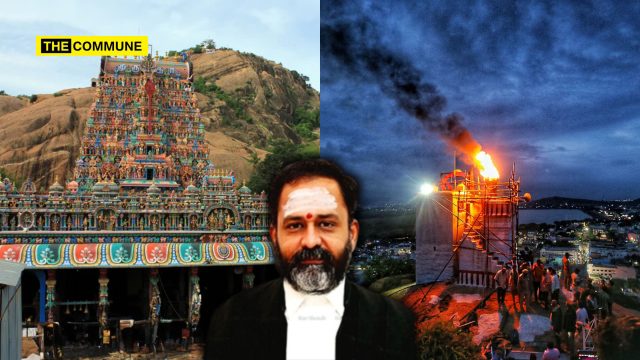
In an unprecedented show of solidarity, 56 former judges, including two former Supreme Court judges, several former Chief Justices, and retired High Court judges from across the country, issued a strongly worded public statement condemning attempts by certain Members of Parliament and senior advocates to seek the impeachment of Justice GR Swaminathan of the Madras High Court.
The signatories described the impeachment push as a “brazen attempt to browbeat judges” who do not align with partisan political expectations, warning that such actions strike at the foundation of judicial independence and constitutional democracy.
They cautioned that permitting political actors to weaponise impeachment would “cut at the very roots of our democracy”, turning a constitutional safeguard into a tool for intimidation. The statement invoked historical precedents from the Emergency including the supersession of Supreme Court judges after Kesavananda Bharati and the sidelining of Justice H.R. Khanna after ADM Jabalpur, as reminders of how political overreach threatens judicial autonomy.
The former judges argued that the current move against Justice Swaminathan fits into a disturbing recent pattern in which political groups attempt to discredit or pressure the higher judiciary whenever judgments do not serve their interests. They cited past campaigns against former Chief Justices Dipak Misra, Ranjan Gogoi, SA Bobde, and D.Y. Chandrachud, as well as attacks on current CJI Justice Surya Kant, as evidence of this trend.
Calling the impeachment attempt “anti-democratic, anti-constitutional, and an anathema to the rule of law”, the statement emphasised that today’s target may be one judge, but tomorrow the entire institution could be at risk.
The judges urged Members of Parliament, the Bar, civil society, and citizens to “unequivocally denounce this move” and prevent the impeachment initiative from proceeding. They stressed that judges are answerable only to their oath and the Constitution, not to ideological intimidation.
“In a Republic governed by the rule of law,” the signatories asserted, “judgments are tested by appeals and legal critique, not by threats of impeachment for political non-conformity.”
The statement was issued with the lead signatory Justice Narsimha Reddy, former Chief Justice of the Patna High Court, followed by a comprehensive list of former judges from the Supreme Court and 15 state High Courts.
56 former judges write against the Impeachment motion against Justice Swaminathan, whose order allowed for lamp to be lit in Madurai pic.twitter.com/QL6mAVlmtK
BJP Tamil Nadu Youth Wing President Dr SG Suryah staged a symbolic protest on Friday, 12 December 2025, by arriving at the party’s youth-wing office-bearers’ meeting in Pollachi on a bullock cart, mocking the DMK government for failing to reduce petrol and diesel prices as promised during the 2021 Assembly election campaign.
Suryah questioned the ruling party’s unkept assurances, asking, “Why hasn’t the DMK reduced petrol and diesel prices as per its election pledge?” The dramatic entry drew attention from locals and party workers, who viewed the act as a pointed critique of the government’s economic governance.
He accused the DMK of betraying voters’ trust and said the protest was intended to highlight how rising fuel prices continue to burden ordinary citizens.
Condemning the DMK government for failing to cut fuel prices as promised, I registered my strong protest in Pollachi today by arriving at the @BJYMinTN office bearers’ meeting on a bullock cart.
The event, held as part of the BJP Youth Wing’s administrative meeting, gained traction online after images of Suryah’s bullock-cart arrival circulated widely on social media.
Subscribe to our channels on WhatsApp, Telegram,Instagram and YouTube to get the best stories of the day delivered to you personally.
A temple festival (Kottikkalasham) in the Tennala panchayat turned controversial yesterday when workers associated with the United Democratic Front (UDF) were seen operating dangerous wood-cutting machinery and tools near children. The incident, captured on video, has raised serious safety concerns, though local police have indicated they are unlikely to file a formal case as those involved are reportedly minors.
The event occurred in Ward 15 of Tennala panchayat during a traditional child’s first haircut ceremony (Kottikkalasham), which is typically marked by music and celebration. However, attendees were alarmed when UDF workers arrived with and operated a petrol-powered wood-cutting machine (saw) and other sharp tools in close proximity to a young child.
According to a local report from Malappuram, UDF workers claimed the machinery was brought solely to create loud celebratory noises, similar to revving motorcycles with removed silencers. They asserted that safety chains were attached and sharp parts were covered, making the tools harmless.
This justification has been met with skepticism. Visuals from the event clearly show the machinery being operated dangerously close to a child. Critics argue that regardless of intent, the use of such industrial equipment at a crowded, family-oriented festival posed an unacceptable risk.
Police have not registered a case, citing the involvement of minors and the absence of a formal complaint. LDF workers initially considered filing one but withdrew, saying they did not want to jeopardise the future of underage boys during an election period.
Police officials said they would review available videos and “take necessary action,” while acknowledging limitations in prosecuting minors. They emphasised that responsibility also lies with party leaders who failed to prevent the act despite prior police instructions regarding permissible items during celebrations.
UDF leaders described the incident as an “error by overexcited youngsters” and denied any pre-planning or leadership involvement. They said the act occurred spontaneously in the heightened atmosphere of kottikkalasham and assured it would not be repeated.
Subscribe to our channels on WhatsApp, Telegram,Instagram and YouTube to get the best stories of the day delivered to you personally.
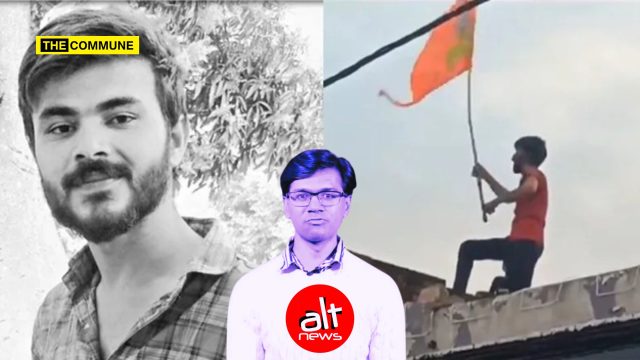
A local court on Thursday sentenced Sarfaraz alias Rinku to death for the murder of 22-year-old Ram Gopal Mishra, who was killed during communal violence at a Durga Puja visarjan/immersion procession in October 2024. Nine others, including Sarfaraz’s father Abdul Hameed and his brothers Faheem and Talib alias Sabloo, received life imprisonment. The court acquitted three others for lack of evidence.
The judicial ruling, delivered Thursday by Additional Sessions Judge Pawan Kumar, brought legal closure to a violent incident that occurred on 13 October 2024, in Rehua Mansoor village. The clash erupted during a Durga Puja visarjan/immersion procession when local Muslims objected to the music being played. During the ensuing violence, Ram Gopal Mishra was shot dead.
Police investigations led to 13 First Information Reports (FIRs) and the application of the National Security Act against several accused.
How Mohammed Zubair Justified The Murder
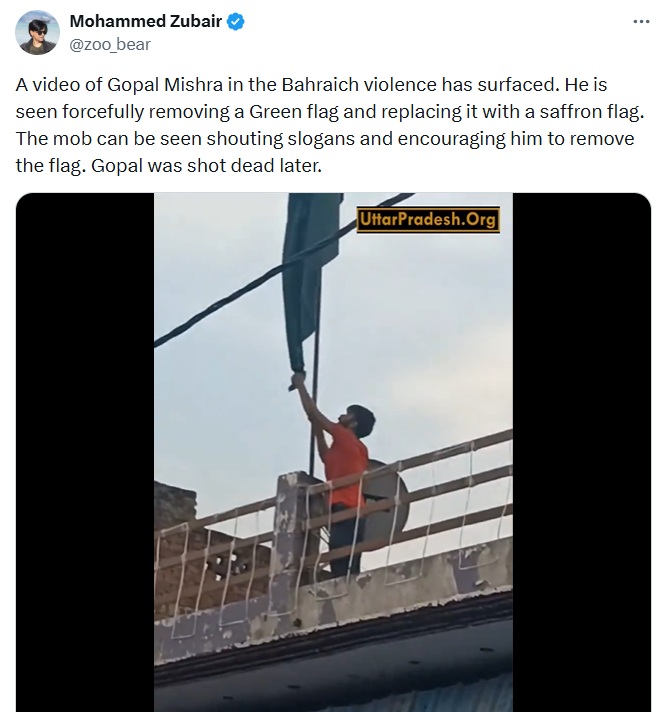
Soon after the murder last year, Alt News co-founder and fake news peddler Mohammed Zubair posted a video on X showing Mishra removing a green flag from a rooftop and replacing it with a saffron one. Zubair captioned the clip saying Mishra was seen “forcefully removing a Green flag… Gopal was shot dead later.”
Critics allege that by sharing the video and highlighting Mishra’s act of flag removal, Zubair was providing context that could be seen as rationalizing or justifying the subsequent murder. They argue the post shifted focus from the fatal shooting to an alleged provocation by the victim.
The critics further contend that such framing is part of a pattern of downplaying violence against Hindus in certain media narratives, especially during religious festivals. They state that the act of sharing this specific video so soon after the murder amounted to an endorsement of a dangerous justification for the crime.
Zubair Targeted OpIndia For Reporting
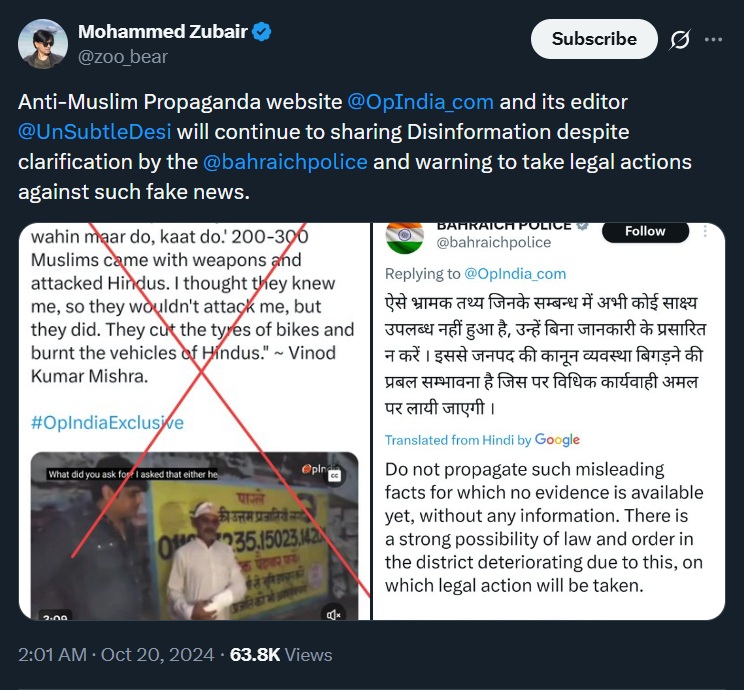
Zubair not only justified the killing but also targeted news portal OpIndia for their reports on how the mosques were making announcements.
The report contained eyewitness accounts but Zubair seemed to claim the eyewitness was lying.
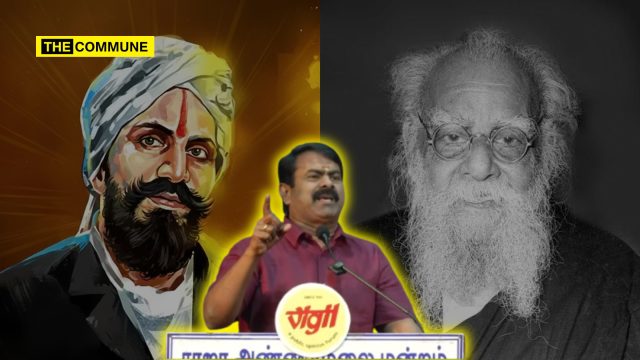
In a fiery, wide-ranging speech delivered on Mahakavi Subramania Bharathi’s birth anniversary, Naam Tamilar Katchi (NTK) chief Seeman launched a profound ideological offensive. Positioning himself as the sole true inheritor of Bharathi’s vision, he systematically sought to dismantle the intellectual foundations of the Dravidian movement, attack its icon EV Ramasamy Naicker (Periyar) and redefine Tamil nationalism within a framework of Indian unity.
‘Bharathi Praised Tamil While EVR Denigrated The Language’
Seeman framed his entire speech as a corrective to historical betrayal, painting a picture of a society that neglected its greatest poet while elevating a figure he portrays as contemptuous of Tamil itself.
He began with a raw emotional charge: “This is indeed a cruel country. That Bharatham starved Bharathi… and the children of the beautiful Tamil race should not forget this.” He directly addressed the ridicule he faces for claiming Bharathi as an ancestor: “When I said Bharathi was my ancestor, they criticized it… ‘Bharathi has become Seeman’s ancestor, hasn’t he?’ everyone questioned.”
His counter-argument was pointed: “When someone who called Tamil ‘misfortune’ (saniyan) is considered my father, why shouldn’t Bharathi, who sang about the sweetness of Tamil, be considered an ancestor?”
This contrast became the core of his attack. He juxtaposed Bharathi’s verse – “‘Among the languages we know, the Tamil language is the sweetest, nowhere to be seen’… ‘Long live the powerful language that measured all that the sky measured’” – with EVR’s statement that “Tamil is a barbarian language (kāttumirāndi mozhi).” Seeman turned this into a searing question for the audience: “If Tamil is a barbarian language, who spoke Tamil?… Who is the barbarian? Is he (EVR) the barbarian? Am I the barbarian? Are you all barbarians?”
Seeman also contrasted Bharathi’s patriotism with what he characterised as anti-Tamil statements by others, asking rhetorically: “If Tamil is a barbarian language, who spoke Tamil? Who is the barbarian?” and rebutting that the poet’s vision of Tamil was universal: “Bharathi sings, ‘Worship the auspicious Tamil country as our mother… It is the land of our wise ancestors.’”
He extended this critique to social reform, arguing Bharathi preceded and surpassed the Dravidian movement. “They say that feminism (penniyam) was spoken about only after the respected Ayya EVR started… But look at Bharathi – he finished singing long before they came to speak.” He quoted extensively: Bharathi’s call to “set fire to the foolishness that degrades women (maadharathamai),” his demand for equality in chastity (“If chastity… is what they want to talk about, let us place it common to both parties”), and his declaration that “Woman is not inferior to man in intellect.”
Seeman then presented a powerful visual argument for Bharathi’s lived feminism, referencing a famous photograph. “Go and look at the picture of our grandfather. Our grandfather will be sitting like this. Our grandmother will be standing behind like this. But in Tamil Nadu, there is only one photograph… Go and look at Bharathi’s house. Chellamma is sitting. Bharathi is standing. Only one picture. Hey, he made Chellamma sit in the chair, and he stood. Feminism stood up.”
He elaborated on this act as a revolutionary, public statement: “In public, they shouldn’t put their hand on a woman’s shoulder. ‘Come, Chellamma,’ he calls, and walks with his hand on Chellamma’s shoulder, majestically.” For Seeman, this was not just poetry but practiced philosophy. “If you want to break an existing principle… and build a new one. The courage to establish that principle… requires more bravery and nerve than a warrior… Our ancestor Bharathi is the great man who shattered the existing tradition and established a new principle.” He concluded this point with a defining praise: “Bharathi is the great man whose writing and life had no gap.”
Redefining “Paarpaan,” Exposing “Brahmin Antagonism” as Political Tool
Perhaps the most provocative segment was Seeman’s address of caste and his redefinition of the term “Brahmin.” He focused on Bharathi’s radical egalitarian line: “There are no castes, Paapa. To speak of high or low birth is a sin.”
He then identified what he called a “great betrayal”: “They taught us that the one who sang ‘There are no castes, Paapa’ was a Brahmin (paarppan).” Seeman offered a stunning reinterpretation: “Bharathi is a Brahmin (paarpaan) because he did not differentiate between high and low birth and treated everyone equally. Now, will anyone call Bharathi a Brahmin?”
He argued that the Dravidian movement’s politics relied on a manufactured enemy. “The same Brahmin antagonism (Brahmana Ethirppu) you used to establish Dravidian presence. I am using that Brahmin crowbar to break down this dilapidated building, ancestor.” He claimed this political need required suppressing Tamil giants like Bharathi: “There should be no identity or greatness for Tamils in history. What is the problem if you praise Bharathi?… Tamil is the problem. His Tamil is the problem.”
Seeman also listed non-Brahmin Tamil scholars and Vaidyanatha Iyer social reformers who championed Tamil and temple entry, questioning EVR’s unique claim as a social revolutionary.
“Not Hindi Ozhiga, But Tamil Vaazhga” – A New Tamil-Indian Nationalism
Moving to linguistic politics, Seeman articulated a principle meant to transcend the traditional anti-Hindi agitations of Dravidian politics. “Our principle is not ‘Let Hindi perish’ (Hindi Ozhiga). It is ‘Let Tamil live long, flourish, and win’ (Tamil Vaazhga).”
He elaborated a vision of mutually respectful linguistic federalism: “I don’t have the right to destroy another person’s mother tongue. I praise, love, and respect his mother tongue. Likewise, I praise, respect, and love my mother tongue. I should be a Tamilian on this land. He should be a Telugu on that land… If everyone is well, India will be well.”
He grounded this inclusive patriotism firmly in Bharathi’s own verses, quoting him at length: “‘Sing praises daily of Hindustan, filled with wealth, Paapa’… ‘We will say Vande Mataram, we will worship our State Mother’… ‘This is the country where my father and mother lived and played happily… Shall I not worship it, saying Vande Mataram, Vande Mataram?’”
Seeman concluded by elevating Bharathi to a divine, timeless figure: “He is the poet who created time. The time-seer (kālagnāni). The seer. The avatar. He is the one man in the world… Tell me something he didn’t sing about.” By declaring himself the “ideological heir” to this comprehensive legacy encompassing Tamil pride, social justice, rationalism, and Indian nationalism, Seeman’s speech was not merely a tribute, but a bold manifesto aimed at supplanting Dravidianism as the dominant political ideology of Tamil Nadu.
Subscribe to our channels on WhatsApp, Telegram,Instagram and YouTube to get the best stories of the day delivered to you personally.
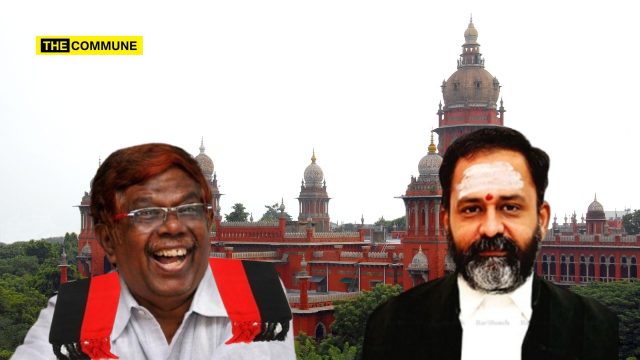
Former Madras High Court judge K Chandru, long known for his ideological activism and open alignment with Left/Dravidianist politics, has again inserted himself into public controversy; this time by attacking sitting Madras High Court judge Justice GR Swaminathan for the “crime” of believing in the Vedas and speaking at events organised by the Rashtriya Swayamsevak Sangh (RSS).
Chandru’s intervention came after over 100 I.N.D.I. bloc MPs, led by the DMK, moved a motion seeking Justice Swaminathan’s impeachment. Even as the political machinery of the ruling Tamil Nadu establishment went into overdrive, Chandru enthusiastically amplified their narrative, delivering a series of allegations that mirror DMK talking points.
Speaking at a legal event organized by the advocates’ wing of the Viduthalai Chiruthaigal Katchi (VCK) in October 2025, Chandru says Justice Swaminathan had “betrayed his oath to the Constitution” – a claim Chandru justified solely on the grounds that the judge had publicly stated his reverence for Hindu scriptures and spoken about the historical evolution of the Constitution. The former judge even went so far as to call Swaminathan a “strange person,” declaring that remarks about the Constitution being influenced by the Government of India Act “strike at the heart of the constitutional order.”
Chandru framed Swaminathan’s attendance at RSS-linked events as evidence of misconduct, asserting that the sitting judge behaves “as if he is the propaganda secretary of the RSS.” He further complained that Swaminathan’s belief in the Vedas is “the least expected of a sitting judge,” revealing more about Chandru’s own ideological prejudice than any breach of judicial ethics.
In line with his long-standing hostility toward Hindu cultural expression, Chandru condemned Swaminathan’s speeches praising the Vedic tradition and accused him of “denigrating the Constitution” – an inversion of reality given that Chandru himself has a decades-long record of politicising the judiciary through Marxist activism.
Speaking to The Print, Chandru defended the impeachment attempt initiated by DMK MPs, insisting that removal is the only remedy for what he labelled “misbehaviour.” He claimed that Swaminathan’s conduct, and not merely his judicial orders, was “unbecoming,” and concluded that a judge who believes in the Vedas or speaks at RSS events is unfit for the judiciary.
Screenshot of ThePrint article
This attack is rich with irony, coming from a figure like Chandru, whose own career has been marked by open allegiance to communist and DMK-aligned causes. His past reveals a consistent pattern of political advocacy, now repackaged as a defense of judicial secularism. For Chandru and his political masters in the DMK, “secularism” appears to be a one-way street, hostile to any public affirmation of Hindu faith while being conspicuously silent on other forms of identity politics.
Chandru’s sudden constitutional purism is belied by his own history as a fellow traveler of communist propaganda, an ideology historically antagonistic to the very constitutional framework he now claims to protect. His transformation into the chief accuser in this impeachment drama exposes the move for what it is: not a principled stand for judicial integrity, but a politically motivated witch-hunt against a judge whose cultural worldview does not conform to the anti-Hindu secularism of the I.N.D.I. bloc and its fellow travelers.
Who Is ‘Justice’ Chandru?
Former Justice of Madras High Court, Chandru, who has been at the center of controversy following his involvement in the Dravidianist propaganda movie ‘Jai Bhim’, known for his vocal opposition to the central government and his strong alignment with the DMK. His political views and support for Dravidian ideologies have often led to criticisms, particularly his proposals aimed at eradicating caste distinctions in schools. Under the guise of his role in the ‘One Man Commission,’ Chandru controversially recommended measures that appeared to specifically target Hindu practices among students, such as the removal of spiritual symbols like the sacred ropes tied around their wrists, wearing Vibuthi among others.
He has made casteist and sexist remarks about Union Finance Minister Nirmala Sitharaman in his social media posts.
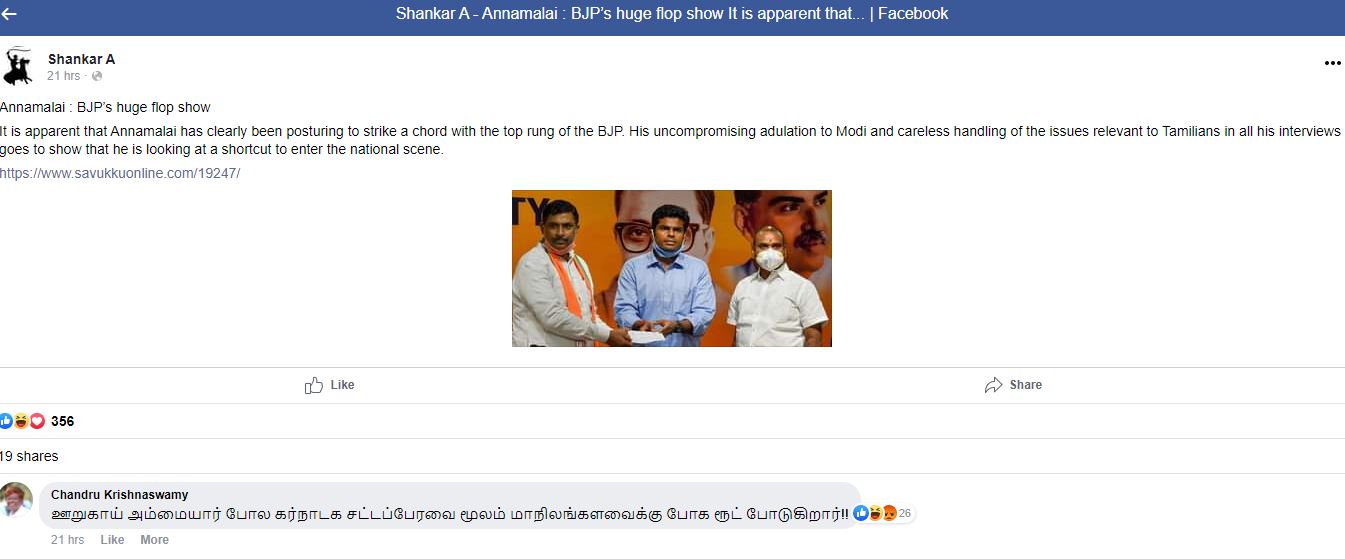
In a Facebook post, former Judge of the Madras High Court had commented that Annamalai is making a route for a Rajya Sabha seat through Karnataka just like “Oorugaai Ammaiyaar” – a casteist and a sexist reference to Finance Minister Nirmala Sitharaman’s Brahmin and woman identity.
Oorugaai Ammaiyaar in Tamil means “a woman who makes pickles”. This reference is used because it is said that women from Tamil Brahmin community make good pickles.
It is not just a casteist reference but is also sexist and highly misogynistic that indirectly implies that women from Brahmin commmunity are good for only making pickles.
Following this, many on social media called out the casteist and sexist mindset who had once wielded the pen of justice.
Jai Bhim
Remember the film Jai Bhim, made by Dravidianist stooge actor Sooriya and his character was based on the same Justice Chandru. In the film Advocate K Chandru, portrayed as an uncompromising crusader, was accused in 2021 of doing the opposite in the real case. According to a leaked audio clip from Anthony Samy’s nephew, Chandru and certain Communist Party members allegedly demanded ₹5 lakh from the accused Sub-Inspector to avoid implicating him in Rajakannu’s custodial-death case. When Anthony Samy supposedly could offer only ₹2 lakh, the group is accused of deciding to “trap him fully” instead. These allegations starkly contradict the film’s claim that Chandru fought the case without taking a single rupee.
In June 2024, Justice Chandru’s one-man committee report drew sharp criticism for recommendations seen as targeting only Hindus under the guise of preventing caste violence. The report began with an Ambedkar quote on Hindus “revising old values,” framing the entire exercise as Hindu-specific. Key proposals such as removing caste names from Hindu institutions, restricting donor names, monitoring teachers, banning sacred threads and forehead marks, regulating bicycle colours, and creating a “Social Justice Student Force” were viewed as impractical, discriminatory, and unconstitutional. Critics argued the report ignored similar practices in other religions and ultimately attacks Hindu identity rather than addressing caste discrimination.
In July 2025, Justice Chandru intervened in the contempt case involving Advocate S. Vanchinathan by issuing a letter, claiming support from seven other retired judges, urging the Madras High Court not to pursue contempt action. This prompted sharp criticism from the Bench, which called the intervention “gratuitous” and “unfortunate.” One retired judge, KK Sasidharan, publicly denied giving Chandru any authorization, contradicting Chandru’s claim. The Court held that such interference, while proceedings were pending, amounted to contempt, and Justice Swaminathan rebuked the attempt as part of an “ecosystem” trying to intimidate the judiciary.
In February 2025, he sparked controversy again with an inappropriate Facebook comment. Responding to a DMK functionary’s sensual “Kiss Day” post, Chandru wrote, “We now have the metric system… now write poetry in metric measurements!!” – a remark widely seen as snide and unnecessary. The Dravidianist actor-anchor replied in surprise, saying he thought Chandru was “only a judge,” not “Ramanujan,” and did not expect him on such a page. Critics argued this was yet another instance of Chandru, who presented himself as a social-justice crusader, making improper or intrusive comments on social media.
Subscribe to our channels on WhatsApp, Telegram,Instagram and YouTube to get the best stories of the day delivered to you personally.
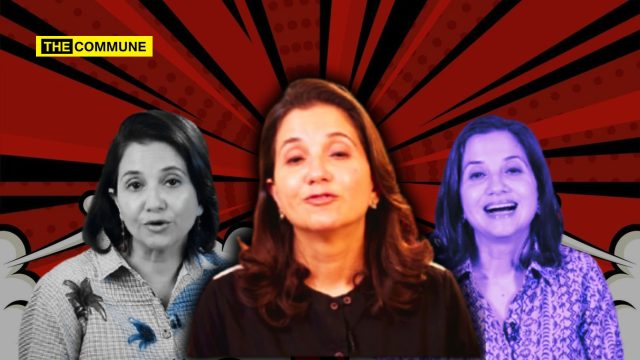
Film critic Anupama Chopra, long seen as part of the rarefied Lutyens-Bollywood cultural circuit, has once again become the centre of a national debate after abruptly taking down her Dhurandhar review following intense backlash. But this incident is not an outlier. Rather, it is part of a consistent ideological pattern in Chopra’s criticism over the past decade: an elitist, selectively moralising viewpoint that rewards films aligned with her worldview while punishing those that portray Indian nationalism, Hindu identity, or grounded geopolitical realities.
Her treatment of Dhurandhar exposed this pattern more starkly than ever.
The Dhurandhar Backlash: A Critic Who Couldn’t Take Criticism
Chopra’s now-removed review called Dhurandhar, “exhausting, relentless, frenzied”, filled with “too much testosterone”, steeped in “shrill nationalism”, containing an “inflammatory anti-Pakistan narrative”.
Anupama Chopra was trying to criticize Dhurandhar.
Instead she ended up giving one of the best review of Dhurandhar:
– Relentless espionage thriller
– Too much testosterone
– Shrill nationalism
– Inflammatory Anti Pakistan narrative pic.twitter.com/MF6WXcM755
The irony? These descriptions actually matched audience praise – because Dhurandhar is a muscular espionage thriller about ISI networks, terror cells, and undercover operations. Yet Chopra dismissed its tone as a flaw rather than a feature.
When viewers pushed back, pointing out that a spy thriller is not expected to resemble a perfume commercial or a tourist music video, Chopra restricted/removed the review entirely.
For a critic who lectures the industry about “robust artistic discourse,” deleting a review after public disagreement reveals the fragile foundation beneath her “bold criticism.”
She then went on to hide behind her Film Critics Guild criticizing those who are criticizing her review of the film.
The Ideological Divide In Her Ratings: A Pattern Too Clear To Ignore
A quick glance at her ratings paints a revealing picture.
Films with patriotic themes or realistic depictions of Pakistan/Islamist-based terrorism such as The Kashmir Files, Shershaah, were classified as bad films; Uri: The Surgical Strike was labelled “emotionally manipulative,” “desh-bhakti button pushing”, Dhurandhar – testosterone filled shrill nationalism with anti-Pakistan narrative – before she removed it.
Films with Pakistan-positive tones, anti-establishment heroes, or “apolitical” violence were praised. For example, Pathaan where Pakistan is shown as cooperative, a rogue Indian agent as villain and Chopra calls SRK’s return “a thing of beauty”, says “the emperor gets his groove back”, praises his “electrifying introduction”. Across the same review, she highlights Deepika Padukone as a bona fide action star and lauds the film’s scale and stardom, effectively giving it a broadly positive, celebratory notice rather than treating it as shallow mass cinema.
Veere Di Wedding – a forgettable film was praised and celebrated for “female agency” despite messy writing.
Kalank – again another forgettable film that was panned by audiences, was worshipped in her review.
When Janhvi Kapoor underperformed in Dhadak, Anupama Chopra gushed that the actress was “endearing, assured, the nepotism debate be damned.” Yet in her review of Raabta, she dismissed Sushant Singh Rajput as “not natural.”
And in her review of Param Sundari, she summed it up with: “pretty leads, limp writing.”
In three lines across three films, she perfectly captures what ails Bollywood today, nepotism defended, genuine talent dismissed, and beauty used as a substitute for substance.
The only major differentiating factor between the low-rated films and high-rated films is not cinematography, not screenplay, not acting, not scale but ideological comfort.
In her review of Chhaava, Anupama Chopra calls Laxman Utekar’s film ambitious and singles out the final act as its strongest stretch. But Chopra notes that the first half feels flat and sluggish, weighed down by dialogue that often reads like speeches. The characters, she argues, are underwritten and the film tends to slip into reverence rather than dramatic vitality. Even great true stories, she says, require nuance and sharper writing to land with full emotional force.
Film Companion’s Reviews
Anupama Chopra’s flagship Film Companion also published film reviews by other “reviewers. Let us take a look at how the team reviewed the films from the ‘non-left’ part of the spectrum.
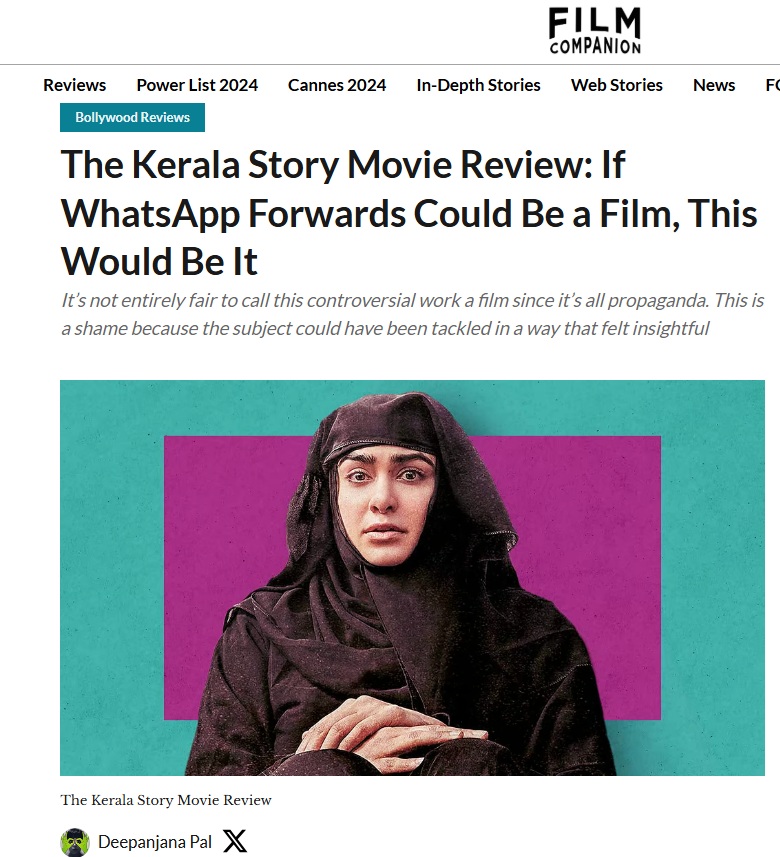
#1 The Kerala Story = WhatsApp Forward
The review of this film bends over backwards to pretend The Kerala Story, the film which allegedly is based on ‘WhatsApp forwards’, is the problem, and not the extremist networks it portrays. The reviewer fixates on prop placement, background music and Communist wall art, while treating actual cases of grooming, conversions and trafficking as inconvenient “Whatsapp forwards.” The film is accused of “demonising Muslims,” but the review has no issue demonising the filmmakers for showing documented patterns. Nuance is demanded only when jihadist recruitment is depicted; outrage is effortless when a film doesn’t fit the reviewer’s politics. In the end, the review exposes more ideological panic than cinematic analysis.
#2 The Kashmir Files = Fantasy
This review spends more time diagnosing Vivek Agnihotri’s motives than discussing the genocide that actually happened. The critic dismisses documented horrors as “torture porn” but melts into lyrical admiration when the same violence appears in Hollywood war films. Apparently, showing Hindu victims is “propaganda,” but showing Hindu perpetrators is “brave cinema.” The reviewer’s real problem isn’t the craft, it’s that The Kashmir Files refuses to sanitise Islamist terror or flatter the reviewer’s ideological comfort zone. Calling a film “dishonest” while trivialising the ethnic cleansing of Kashmiri Pandits is peak Film Companion: moral outrage outsourced, historical memory optional.
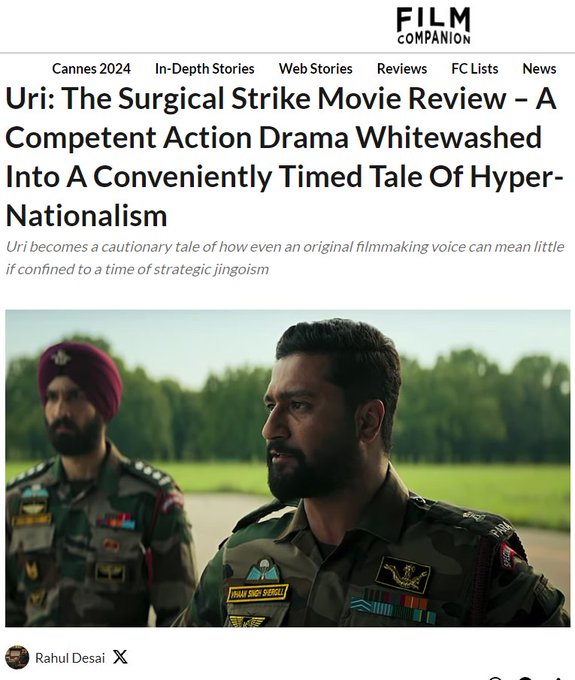
#3 Uri – The Surgical Strike = Hypernationalism, Jingoism
Image Source: Labs Tamil X handle
Film Companion dismissed the film as an action drama conveniently repackaged into a burst of hyper-nationalism and strategic jingoism, framing it as technically polished but ideologically loud – full of chest-thumping patriotism, “shrill” nationalism, and an unapologetically anti-Pakistan stance. To them, its high-octane, hyper-masculine energy and use of real terror attacks amounted not to legitimate wartime storytelling but to jingoism. Unsurprisingly, Anupama Chopra and Film Companion delivered a lukewarm, low-star review, entirely consistent with their long-standing discomfort toward any cinema that presents unapologetic Indian resolve.
The review is now deleted.
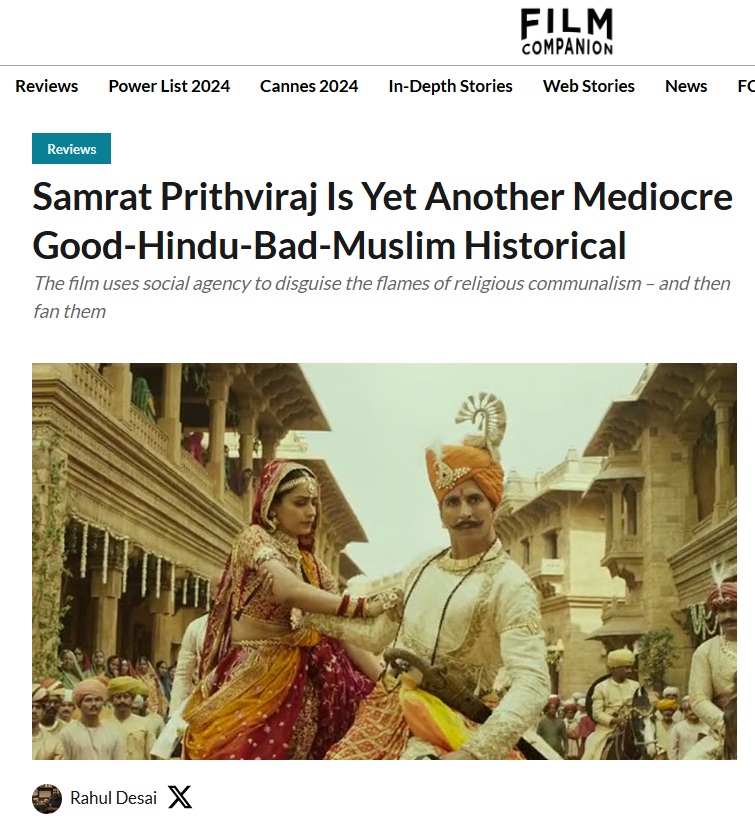
#4 Samrat Prithviraj = Nadir Of Saffronisation Of Hindi Cinema
Film Companion’s review of Samrat Prithviraj reads less like film criticism and more like a triggered manifesto against anything remotely Hindu. The reviewer’s biggest gripe isn’t the craft — it’s that the film refuses to portray 12th-century Islamic invaders as misunderstood, poetry-loving soft boys. Apparently, acknowledging well-documented invasions is “Islamophobic,” but endlessly romanticising Mughals is “nuance.” The review rants more about “saffronisation” than the actual movie, revealing its real discomfort: a Hindu king portrayed without apology. FC wants historical epics to tiptoe around facts, so their ideology stays undisturbed. Sorry, but not every film is required to flatter your politics.
Tamil Films Reviewed By Film Companion
Yes, Film Companion has reviewed Tamil films too. But you know the routine – if it is by a director who is ‘right’ leaning, it is boring and if it is from the other end, it is praiseworthy.
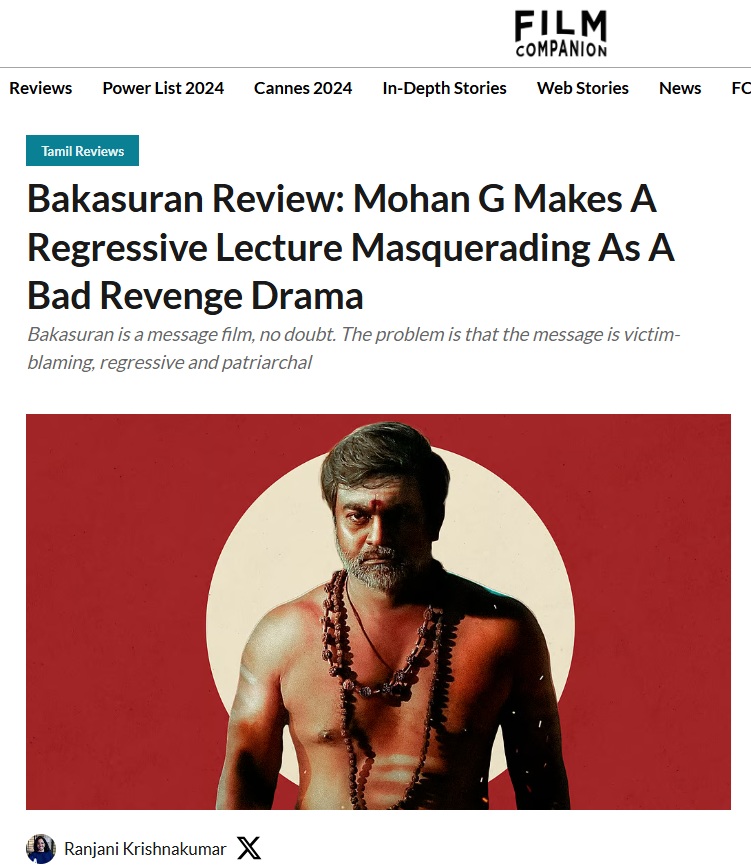
#1 Bakasuran = Regressive Lecture
For the Film Companion, Bakasuran is yet another parade of predictable outrage disguised as critique. The reviewer is offended that Mohan G doesn’t turn a sexual-exploitation racket into a TED Talk on “lived experiences” and instead chooses, gasp, male protagonists who actually fight the criminals. The review mourns the lack of “agency” for women but is strangely unbothered by the predators they fall victim to. And of course, the reviewer’s favourite bogeyman appears: saffron, rudraksha, and any Hindu symbolism automatically equals “regressive.” FC complains about “message padams,” yet this review reads like a sermon scolding the film for not matching their politics.
#2 Blue Star = Love Letter To Pa Ranjith
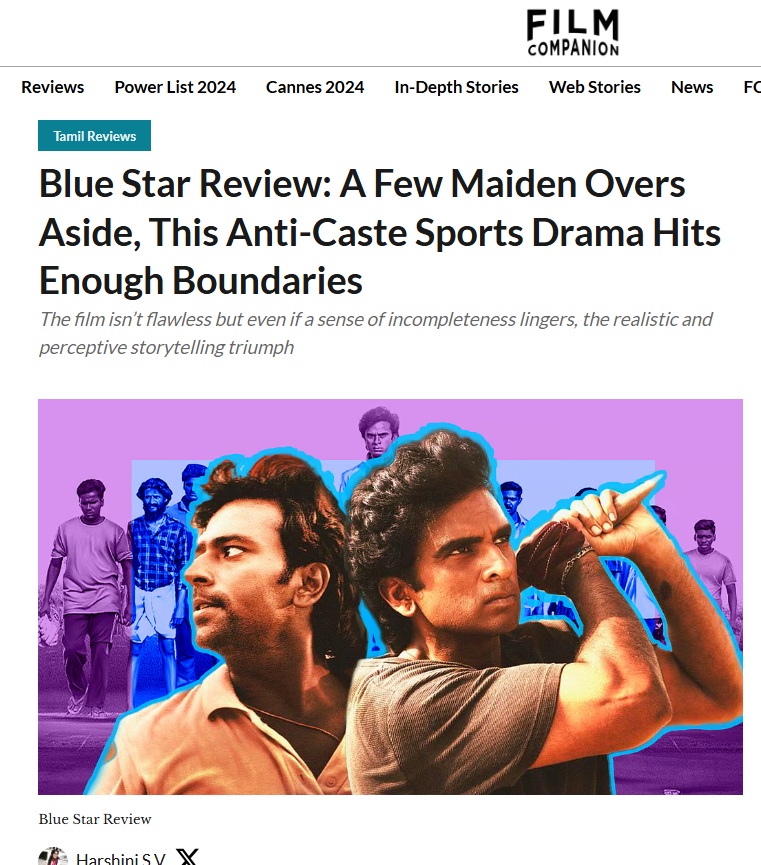
A mediocre film like Blue Star is hailed by Film Companion. Their review of Blue Star reads like a love letter to Pa. Ranjith-style caste discourse first and a film review a distant second. Every frame is analysed not for craft or storytelling but for how loudly it screams “anti-caste politics.” The reviewer treats ordinary cricket scenes as profound social uprisings and neighbourhood dynamics as revolutionary manifestos. Any flaw in the film is forgiven because the ideology aligns perfectly with FC’s worldview. The piece gushes over Ambedkar posters and “perspective storytelling” while brushing past basic narrative gaps. It’s less a critique and more an ideological certificate of approval.
#3 Natchathiram Nagargiradhu = Spiritual Bliss
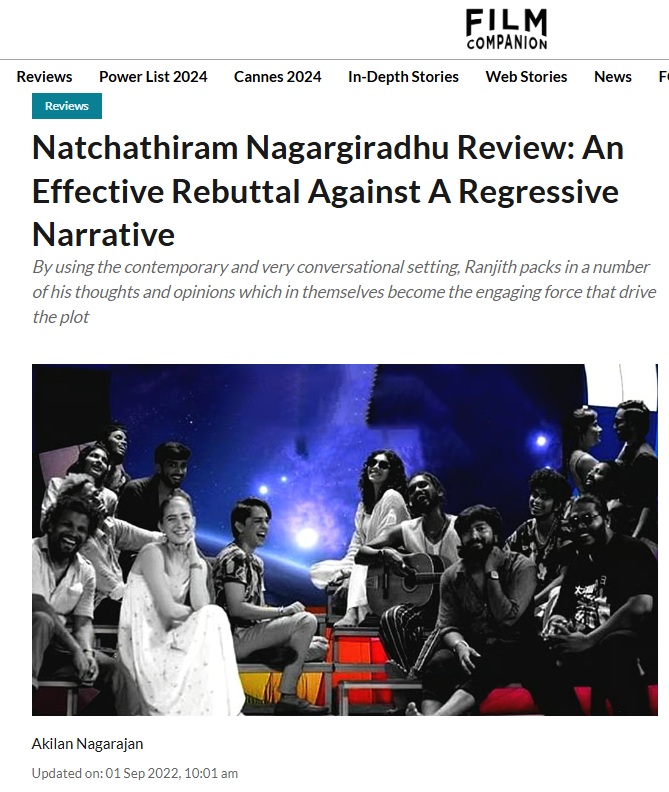
This Natchathiram Nagargiradhu review reads less like film criticism and more like a spiritual sermon for the Church of Pa. Ranjith, where every frame must be decoded for caste allegory and every character exists to educate the “regressive masses.” The reviewer gushes over microaggressions, “collectives,” and Buddha-door symbolism with the zeal of someone discovering oppression for the first time on Twitter. Cinema, performances, pacing, coherence? Mere distractions from the real task – applauding Ranjith’s ideological TED Talk. By the end, you’re left wondering whether they watched a film or attended a compulsory political workshop disguised as a love story.
Pa Ranjith – FC Loves You
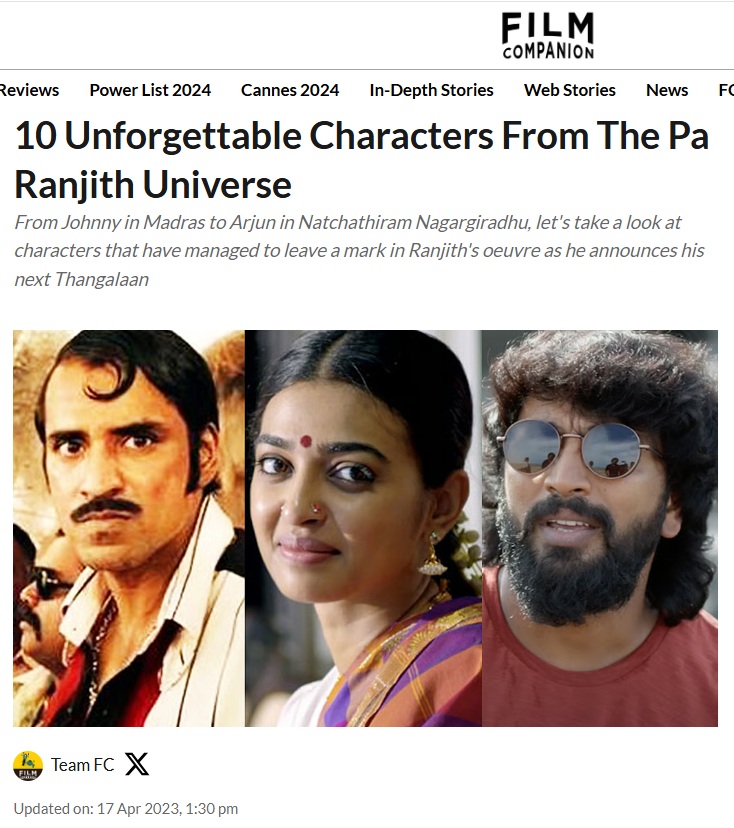
Film Companion’s “10 Unforgettable Characters From the Pa Ranjith Universe” reads less like a feature and more like a required reading list for an Intro to Identity Politics class. Every character is described not for writing, craft, or performance, but for how effectively they serve The Message™. Caste angle? Check. Oppression checklist? Check. Buddha statue symbolism? Of course. Even minor characters are elevated to mythic status as long as they align with the ideological syllabus. It’s less a celebration of cinema and more a devotional essay to Ranjith’s politics — film criticism replaced by activist fan service dressed up as analysis.
Thinks Actors Should Not Work In Films With ‘Bad Politics’
Anupama Chopra solemnly nodding along with Kabir Khan’s philosophy that “bad acting is fine, bad scripts are fine, but bad politics is unforgivable” – is already comedy gold, but the real show begins when she gently scolds Saif Ali Khan for starring in the “saffron” Tanhaji. Saif, ever the historian of WhatsApp University, responds with the iconic revelation that “There was no concept of India till the British gave it one,” a claim so intellectually barren yet so beloved in left wing kitty party circles that it practically earns him a standing ovation. And then, with breathtaking seriousness, the two lament how “tough” India is for them.
Anupama Chopra agrees with Kabir Khan who can forgive bad acting and sloppy scripts, but can’t forgive “bad politics”.
She then proceeds to ask Saif who acted in the historical film Tanhaji that had “questionable politics” – basically she wants to know why Saif is acting in… pic.twitter.com/arum0MwN0k
Selective Outrage: Why Some Violence Disturbs Her And Some Doesn’t
Chopra’s critique often focuses on “toxic masculinity,” “hyper-masculine rage,” and “patriotic bravado” but only when the protagonist is an Indian soldier or spy. But when the male lead is a Bollywood superstar who beats up 50 men in designer wear? She gushes.
In War 2, she swoons over “towering star power” and “glossy spectacle.”
In Tiger Zinda Hai, she writes, “stardom trumps storytelling,” and means that as a compliment.
But when an Indian agent infiltrates a Pakistani mafia and they fight among themselves, suddenly the testosterone is “too much.”
This asymmetry is ideological, not artistic.
A Track Record Of Condescension Toward “Middle-Class” Actors
Chopra’s elitism becomes most visible when she writes about actors outside the “Bollywood royal club.”
The Yami Gautam Episode
In her Dasvi review, Film Companion (Chopra’s platform) dismissed Yami Gautam with a line suggesting her expressions were becoming “repetitive.” Yami publicly slammed the review as “extremely disrespectful”, “mocking” her efforts.
Under Anupama’ s Film Companion, they brutally tr0lled a self made actress like Yami Gautam Dhar, who openly called out their biased and disrespectful takes.
And now these snowflakes who can’t take any criticism are weeping with victim cards. Get off your high horse cl0wns. pic.twitter.com/Il8KnuDK9b
Yami Gautam’s film Dasvi’s review described her as “no longer the dead girlfriend in Hindi films, but the combative smile is starting to get repetitive”, which is exactly the phrasing Yami publicly objected to on social media.
Fans contrasted this with Chopra’s glowing, almost worshipful interviews of the same actors when promoting films. The perception of two-faced elitist criticism gained traction.
The “Elite Insider” Question
Like Twinkle Khanna, Anupama Chopra’s career has long benefitted from proximity to industry dynasties, access to exclusive circles, leadership of Film Companion, a platform often accused of favouring certain producers, banners, and PR ecosystems.
Her patterns reinforce criticism that many mainstream critics review movies not purely on merit, but on how well they fit into the ideological and aesthetic preferences of a cultural elite centered in Mumbai and Delhi.
The Kashmir Files, The Tashkent Files, And The Selective Silence
Vivek Agnihotri has repeatedly accused Chopra and Film Companion of ignoring his trailers, delaying or burying reviews, launching negative “campaign-style” criticism.
Whether or not one agrees with Agnihotri’s films, the inconsistency is hard to miss:
The Kashmir Files received universal public acclaim → Film Companion called it “distasteful.”
Pathaan, a film Chopra herself admits is messy → “5 stars, a thing of beauty.”
This is not film analysis. This is ideological curation masquerading as criticism.
Her Dhurandhar Meltdown Seals The Pattern
Chopra’s problems with Dhurandhar mirror her long-running biases. She has a discomfort with grounded depictions of cross-border terrorism, she has a reflexive suspicion of Indian intelligence narratives, an instinctive recoil from nationalism unless wrapped in glamour, has a soft spot for films that sanitise Pakistan, a deep admiration for star vehicles starring Bollywood’s elite, and a tendency to frame strong male-led action as a moral problem, but only in certain contexts.
When this worldview clashed directly with a film embraced by audiences, Chopra did not debate, defend, or clarify. She removed the review.
The audience had pierced the bubble. And she chose the bubble.
The Divide Between Critics And Viewers Has Never Been Sharper
Anupama Chopra represents a class of critics who see patriotism as propaganda, realism as problematic, glamour as quality, “electrifying” star power where viewers see hollow spectacle, “shrill nationalism” where audiences see justified emotion, and see themselves as cultural guardians correcting the audience rather than reflecting them.
Her Dhurandhar takedown isn’t just a review gone wrong.
It exposes a deeper truth – Bollywood criticism today is less about cinema and more about ideology. And increasingly, audiences are refusing to play along.
Subscribe to our channels on WhatsApp, Telegram,Instagram and YouTube to get the best stories of the day delivered to you personally.
In a 5 December 2025 interview with Bloomberg, acclaimed author Salman Rushdie expressed being “very worried” about rising Hindu nationalism and threats to free expression in India. However, this statement stands in stark contrast to the 33 years of violent extremism he himself endured following the publication of his novel The Satanic Verses, a campaign of terror that included riots, arson, bombings, murders of translators, assassination attempts, and ultimately the 2022 stabbing that cost him his right eye.
The worldwide impact of The Satanic Verses has been devastating, approximately 57-62 deaths, three murders or targeted killings, protests in more than 20 countries, and book bans in over 15 nations.
In this report, we take a look at Salman Rushdie.
Early Life and Background
Ahmed Salman Rushdie was born on 19 June 1947, in Bombay, into a prosperous Kashmiri Muslim family in post-independence India. His father, Anis Ahmed Rushdie, was a Cambridge-educated lawyer who became a businessman after being dismissed from the Indian Civil Services for age falsification on his application. The family surname was adopted in honor of the medieval Muslim philosopher Ibn Rushd.
His mother, Negin Bhatt, worked as a teacher, and the family lived in affluent areas such as Windsor Villa in Bombay. Rushdie has ancestral roots in Delhi’s Ballimaran neighborhood through his grandfather, a textile magnate.
Rushdie attended Cathedral and John Connon School in Bombay before moving to England in 1961. He attended Rugby School and later King’s College, Cambridge, where he earned a BA in history in 1968.
The Satanic Verses Crisis: A Timeline of Violence
The 1989 Fatwa
On 14 February 1989, Iran’s Ayatollah Ruhollah Khomeini broadcast a fatwa on Tehran radio, declaring The Satanic Verses blasphemous for insulting Prophet Muhammad. Khomeini called Rushdie an “apostate” deserving death and urged Muslims worldwide to execute him and his publishers. The Iranian bounty initially stood at one million dollars, rising to 2.8 million dollars or more by the 1990s. Fifteen Iranian Khomeini followers offered an additional three million dollars.
The Satanic Verses, published in 1988, mixed London and Mecca in a magic-realist narrative that many Muslims viewed as blasphemous. India banned the book, copies were burned in the UK, riots occurred in Pakistan, and several translators were attacked or killed.
For almost 13 years, Rushdie lived in hiding under the pseudonym Joseph Anton, moving between safe houses and changing base 56 times in the first six months. His solitude was worsened by his split with his wife, American novelist Marianne Wiggins, to whom The Satanic Verses is dedicated.
Deadly Protests Around the World
Islamabad, Pakistan (12 February 1989)
More than 10,000 Jamiat Ulema-e-Islam supporters marched after Friday prayers and attacked the US Cultural Center, American Express office, and US Embassy annex in protest against the US publication of The Satanic Verses. Police opened fire when the crowd broke barricades, killing six people (some reports say five) and injuring over 100. The unrest later spread to Rawalpindi.
The Cultural Center, home to an American library and cultural programs, suffered heavy damage worth thousands of dollars as demonstrators forced their way in, vandalized the premises, and set two small fires while shouting anti-American slogans including “American dogs!” and “God is great!”
Bombay, India (24 February 1989)
Over 2,000 protesters gathered at Mastan Talao after Friday prayers to denounce Britain’s protection of Salman Rushdie following the Khomeini fatwa. Defying a ban, the crowd marched toward the British High Commission, set a bookstore near Crawford Market on fire, and clashed with police. Officers opened fire, killing 12 people (some reports say 10) and injuring more than 40, while around 500 people were arrested.
Bolton, London (2 December 1988)
Bolton witnessed one of the earliest and most dramatic public protests against The Satanic Verses. An estimated 7,000 Muslims marched from the Zakariyya Jame Masjid to the town center, where they burned copies of Rushdie’s novel in a mass demonstration.
Parliament Square, London (27 May 1989)
A massive demonstration took place in Parliament Square, where an estimated 15,000 to 20,000 protesters gathered. Demonstrators marched through central London and burned effigies of Salman Rushdie, symbolizing the peak of UK-based outrage during the Rushdie affair. Police said 84 people were arrested and six police officers were injured during the march, which erupted in a scuffle before the Parliament building.
Bombings and Attacks in the UK
London Bookstore Bombings (9 April 1989)
Two bombs exploded at the Collets and Dillons bookstores on Charing Cross Road in London, both of which were stocking The Satanic Verses. The blasts caused significant property damage, but no injuries were reported, marking one of the earliest violent attacks in the UK linked to the Rushdie controversy.
Penguin Bookshop Bombings (June 1989)
A bomb exploded outside a Penguin bookshop in York just before an army disposal unit could defuse it. Two hours earlier, a caller with an Indian accent warned ITV that four bombs had been placed in York, Peterborough, Nottingham, and Guildford, all outside Penguin outlets. Police found the remaining devices: one was defused in Guildford, one was destroyed by controlled blast in Nottingham, and one was safely removed in Peterborough.
Authorities linked the attacks to The Satanic Verses, published by Viking Penguin. A separate pipe-bomb attack on Liberty’s, London, earlier that month had also included a warning referencing the novel.
The Sivas Massacre in Turkey (2 July 1993)
In Sivas, Turkey, more than 20,000 people, stirred after Friday prayers over writer Aziz Nesin’s plan to publish The Satanic Verses in Turkish, surrounded the Madımak Hotel during an Alevi cultural festival. The mob set the building on fire, killing 37 Alevi intellectuals, poets, and musicians trapped inside. Nesin survived after being evacuated in a police armored vehicle.
Jaipur Literature Festival Cancellation (January 2012)
Salman Rushdie was scheduled to attend the January 2012 Jaipur Literature Festival, but Darul Uloom Deoband demanded that he be prevented from coming, citing anger over The Satanic Verses. Although Rushdie did not require a visa, protests mounted and police warned of possible underworld assassins targeting him. Rushdie then cancelled his visit, saying intelligence inputs indicated hired killers had been sent to attack him. The episode revived memories of the 1989 fatwa and the wave of violence that followed globally.
Targeted Killings and Attacks on Translators
Murder of Hitoshi Igarashi (11 July 1991)
At Tsukuba University, Japan, Hitoshi Igarashi, a 44-year-old assistant professor of comparative Islamic culture and the Japanese translator of The Satanic Verses, was brutally stabbed in the face, neck, and arms sometime between 10 PM on July 11 and 2 AM on July 12. A cleaning staff member discovered his body in the hallway outside his office. The case remains unsolved, and the statute of limitations expired in 2006. The killing occurred months after Ayatollah Khamenei renewed the bounty on Rushdie and those involved with the book in March 1991.
Attack on Ettore Capriolo (4 July 1991)
In Milan, Italy, Ettore Capriolo, the 61-year-old Italian translator of The Satanic Verses, was stabbed 11 times in the neck, chest, and hands inside his apartment by a bearded man posing as an Iranian postal worker who claimed he needed help translating a Muslim pamphlet. The attacker asked for Salman Rushdie’s address before assaulting him and fled the scene. Capriolo survived after hospitalization, but no arrests were ever made.
Shooting of William Nygaard (11 October 1993)
In Oslo, Norway, William Nygaard, the Aschehoug publisher of the Norwegian edition of The Satanic Verses, was shot three times in the back and thigh outside his home on Dagaliveien at around 7:30 AM while walking to his car. He was critically injured but survived after surgery at Sunnaas Hospital.
The 2022 Stabbing Attack (August 12, 2022)
Salman Rushdie was violently attacked onstage at the Chautauqua Institution in New York. A 24-year-old Lebanese-American Shia Muslim, Hadi Matar, suddenly rushed the stage and stabbed Rushdie more than 27 times, causing severe injuries including a punctured liver, the loss of sight in Rushdie’s right eye, and severed nerves in his hand.
The moderator was also injured while trying to prevent the attack. Matar carried a copy of Rushdie’s controversial novel The Satanic Verses and later admitted he was inspired by the 1989 fatwa issued by Iran’s Ayatollah Khomeini, identifying himself as a “soldier of Imam Khomeini.”
Following the attack, Rushdie underwent multiple surgeries and faced a long recovery, which he detailed in his 2024 memoir Knife.
Controversial Statements on India and Hindu Nationalism
Comments on Hindu Nationalism (5 December 2025)
In a Bloomberg interview with Mishal Husain, Rushdie expressed being “very worried” about growing Hindu nationalism and restrictions on free expression in Modi’s India. He stated: “I feel very worried about it. I have lots of friends in India. Everybody is extremely concerned with the attack on freedoms of journalists, writers, intellectuals, professors, et cetera.”
He further added: “There seems to be a desire to rewrite the history of the country; essentially to say Hindus good, Muslims bad—the thing VS Naipaul once called a ‘wounded civilisation,’ the idea that India is a Hindu civilization wounded by the arrival of Muslims.”
On India’s Democratic Decline (December 2021)
Rushdie stated that Pakistan remains unchanged in its old problems, but India has clearly declined. He noted that India’s status as a democracy has been downgraded by various international bodies, which he called tragic. He observed that India used to take enormous pride in being the world’s largest democracy, pointing out that it is much easier for rich countries to be democratic and very hard for poor countries to maintain democratic freedoms. He described it as truly tragic that Prime Minister Modi has managed to sell to many Indians the idea of Hindu majoritarian rule, which he characterized as anti-democratic.
Kashmir and Article 370 (15 August 2019)
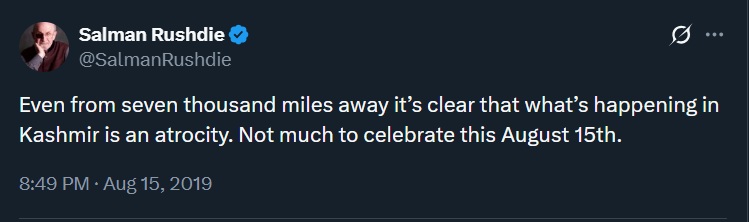
On India’s 73rd Independence Day, Rushdie tweeted: “Even from seven thousand miles away it’s clear that what’s happening in Kashmir is an atrocity. Not much to celebrate this August 15th.”
The move triggered sharp reactions: Pakistan marked the day as “Black Day,” and China pushed for UN consultations.
Award Wapasi Controversy (13 October 2015)
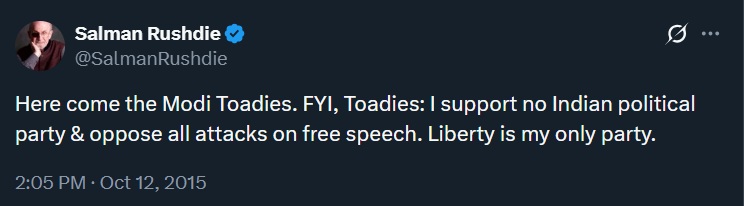
After Salman Rushdie supported writers returning their Sahitya Akademi awards over what they called rising intolerance including rationalist murders, beef-lynching incidents, and ink attacks, he was heavily trolled by political supporters online. He tweeted: “Here come the Modi Toadies. FYI, Toadies: I support no Indian political party & oppose all attacks on free speech. Liberty is my only party.”
Open Letter Against Modi’s Candidacy (April 2014)
Prominent Indian artists and academics, including Salman Rushdie and Anish Kapoor, wrote an open letter warning against Narendra Modi becoming Prime Minister. Regarding the possibility of Modi becoming India’s next PM, the letter stated: “Were he to be elected prime minister, it would bode ill for India’s future as a country that cherishes the ideals of inclusion and protection for all its peoples and communities.”
They criticized his handling of the 2002 Gujarat riots, calling it a moral failure that threatens India’s secular values. The BJP dismissed the letter as baseless, saying courts found no evidence against Modi.
BJP-RSS as “Crypto-Fascist” (February 2014)
In a discussion on Indian politics, Rushdie described the BJP-RSS-type Hindu nationalist project as “actually a crypto-fascist movement.” He criticized it for attempting to create “Nuremberg-style rallies,” likening the mass mobilizations to those used by fascist regimes. He also pointed out that this project invents a collective, quasi-church-like Hindu worship, which he argued is alien to traditional Hinduism’s diverse and decentralized nature. This view was elaborated in his later essay for PEN America’s “India at 75” project, underscoring his concern that the movement distorts Hinduism into a fascist political ideology.
Literary Works
Rushdie’s extensive body of work includes novels such as Grimus (1975), Midnight’s Children (1981), Shame (1983), The Satanic Verses (1988), Haroun and the Sea of Stories (1990), The Moor’s Last Sigh (1995), The Ground Beneath Her Feet (1999), Fury (2001), Shalimar the Clown (2005), The Enchantress of Florence (2008), Luka and the Fire of Life (2010), Two Years Eight Months and Twenty-Eight Nights (2015), The Golden House (2017), Quichotte (2019), and Victory City (2023). His nonfiction works include Joseph Anton (2012), Languages of Truth (2021), Knife (2024), and The Eleventh Hour (2025).
Subscribe to our channels on WhatsApp, Telegram,Instagram and YouTube to get the best stories of the day delivered to you personally.
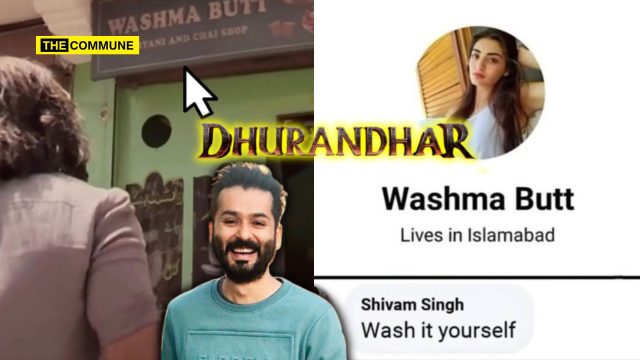
Ranveer Singh–starrer Dhurandhar continues to dominate headlines following its 5 December 2025 release, with a brief scene from the film now becoming the latest subject of social-media chatter. Viewers have spotted a moment set in Pakistan that features a biryani and chai shop named “Washma Butt” – a reference that quickly triggered a wave of memes and amused reactions online.
The name mirrors that of an Islamabad resident who became the focus of widespread internet trolling and meme culture. Though the shop appears only for a few seconds in the film, users across platforms have expressed surprise, humour and curiosity about the filmmakers’ decision to include the reference.
Netizens React
Let us take a look at some of the netizen reactions.
Dhurandhar has been performing strongly at the box office, crossing ₹150 crore by 9 December 2025, and is projected to become Singh’s highest-grossing film in six years, surpassing Rocky Aur Rani Ki Prem Kahani.
Directed by Aditya Dhar, the espionage drama is inspired by real events connected to Karachi’s Lyari gang network. Set in Pakistan in the early 2000s, the film follows an Indian operative who infiltrates criminal syndicates as part of a covert mission.
The ensemble cast includes Akshaye Khanna, Arjun Rampal, Sanjay Dutt, Rakesh Bedi, Gaurav Gera, R. Madhavan, Sara Arjun and Saumya Tandon, alongside Singh in the lead role. With themes of betrayal, patriotism, covert intelligence work and organised crime, Dhurandhar continues to generate conversation—both for its storyline and its unexpectedly meme-worthy details.
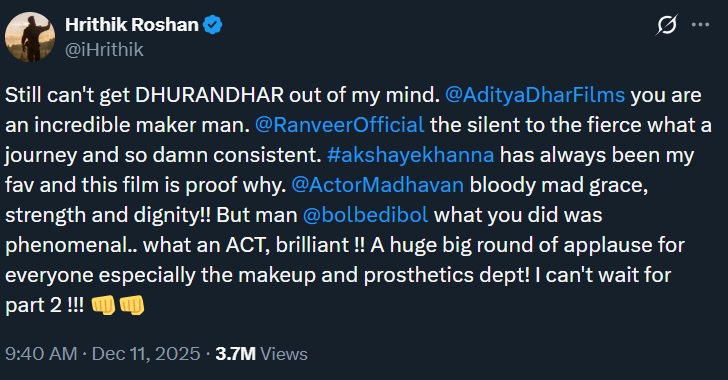
Actor Hrithik Roshan has stirred online debate after posting two separate, seemingly contradictory reviews of the recently released film Dhurandhar within a span of hours. The actor’s initial critique, which lauded the filmmaking but questioned the movie’s “politics,” was followed by a second, unrestrainedly enthusiastic post with no mention of any disagreement.
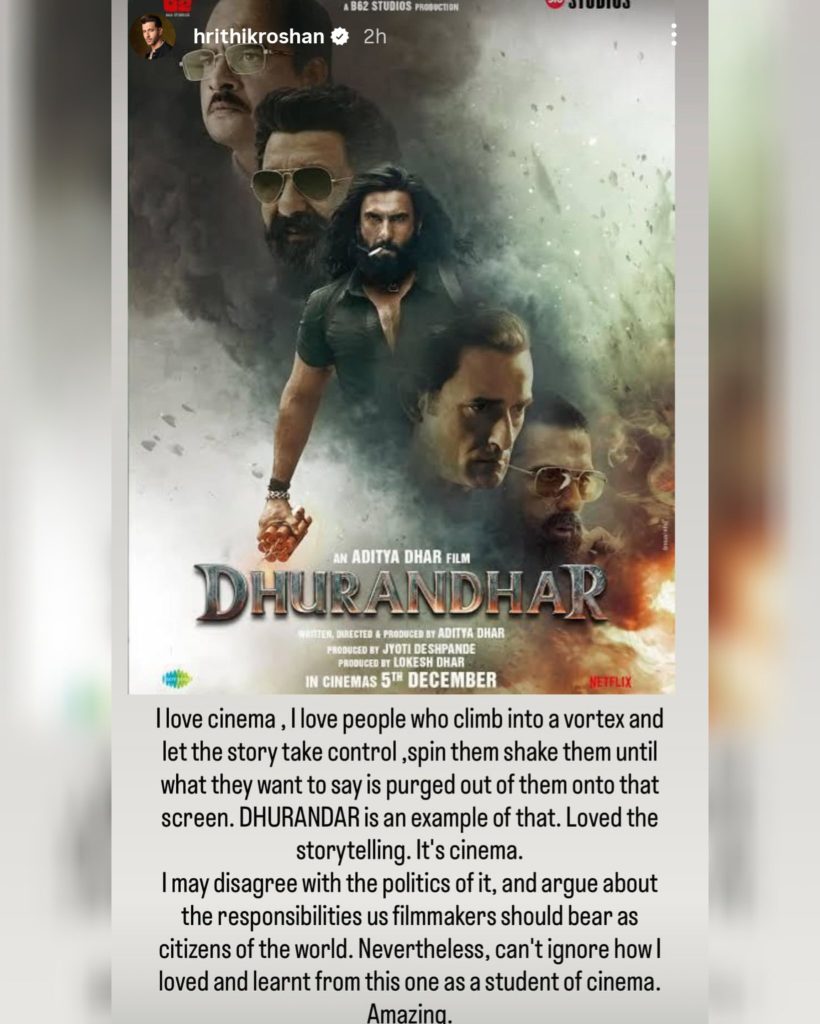
On Wednesday (10 December 2025) evening, the actor posted a detailed note on his Instagram story praising the film’s craft while stating that he did not agree with its “politics.” He described Dhar’s direction as immersive and applauded the storytelling, adding that filmmakers carry certain responsibilities when dealing with political themes. The post, in which he admired the film as a student of cinema despite ideological differences, quickly circulated across platforms.
Hrithik Roshan Instagram Story
By Thursday (11 December 2025) morning, however, Roshan shared a second review, this time on X, without any reference to political disagreements. Instead, he focused entirely on the performances and technical aspects, calling Dhar “an incredible maker” and applauding actors Ranveer Singh, Akshaye Khanna, R. Madhavan, and Rakesh Bedi. He also highlighted the makeup and prosthetics department and said he was eagerly awaiting part two, slated for release on 19 March 2026.
Hrithik Roshan X post
The drastic shift prompted users online to question which opinion represented his actual view. Comments ranged from humorous speculation about separate admins handling his accounts to suggestions that he was walking back his earlier remarks. Several users also asked why the political concerns raised in his first review were missing in the second.