Home Blog Page 1899

MP Shobha Karandlaje helps TN fishermen stranded in Udupi to return home

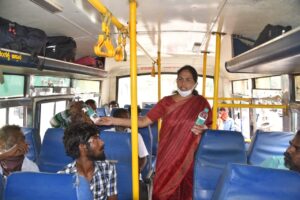
82 fishermen from Ramanathapuram in Tamil Nadu, who had gone to Udupi and got stranded due to the nation-wide lockdown, are set to return home.

3 buses have been arranged by the Karnataka government that will transport them to Ramanathapuram.

BJP MP Shobha Karandlaje, who represents the Udupi Chikmaglur Lok Sabha constituency, oversaw the efforts and sponsored food, water bottles, and other supplies for the journey. She thanked the fishermen for their cooperation.

Member from BJP Tamil Nadu Unit thanked the MP for going out of her way in helping the stranded people from Tamil Nadu.

Along with them, fishermen from Srikakulam, Nellur and other parts of Andhra Pradesh left in 6 busses from Udupi to their respective districts.

Wrestling the Virus by Wrestling with Technology

Looking back at Black Death, the pandemic that struck Italy between 1347-1351 CE and killed nearly 60% of European population, one wonders how people would have managed back then when technology was not so evolved. Digital evolution was alien to the global population of those times. Today, with all the technological advancements ushered in with the digital age, information is now everywhere. The state of being aware of what is happening around the globe is unprecedented. Like it or not, technological evolution and its associated globalization is what has brought the pandemic and is also helping us in fighting against it.

This pandemic has triggered an unprecedented demand for digital health technology solutions that is helping in population screening, tracking the infection, prioritizing the use and allocation of resources, and designing targeted responses. The possibilities that digital technology is offering could lead to a situation where the debates and deliberations among the youths in schools and colleges on topics such as “whether technology is a boon or bane” would soon become obsolete.

The thought of digital technology becoming a bane would soon be away from our mind in light of this pandemic, as the digital technology usage becomes inevitable and unavoidable. If a miniscule portion of the economy is being saved right now, we have to extend our gratitude to the technology that has provided platform to address some of supply-chain issues in the economy.

Modi’s push towards digitization comes in handy

When our Hon’ble Prime Minister Shri Narendra Modi urged the population to embrace digitization, only a few realized its importance and a section of our friends kept criticizing the move unable to take his words of wisdom in letter and spirit. Demonetization and GST were seen as moves of failure.

However, given the fear that COVID-19 might even spread through currency notes, India’s move towards digitization has turned out to be a visionary move. Now, there is a sudden surge towards usage of Google Pay and PayTm. The other money transfer portals like Phonepay and Freecharge have seen a rapid increase and a paradigm shift in their businesses. From super markets to grocery stores and tea stalls, everybody has put a QR code right outside their businesses. Shopkeepers are now happy if someone makes a digital payment. Those who have remained technologically challenged are now showing their involvement and wanting to get accustomed.

However, a robust identification system, widespread and consistent internet access, and trustworthy ways to get money into digital formats would prove to be important for digital payments to thrive. Digital payments may definitely be a back bone and a success story behind India’s vibrant digital economy. COVID-19 would go in history as the factor that pushed people towards use of digital technology.

The COVID-19 crisis has resulted in an immense need for technological support. This in addition might pave way for an effective governmental policy in which the government actively builds partnerships with private technology companies, the digital entrepreneurs of the day, and other international organizations to make use to existing technologies to meet the needs of people and soften the impact of crisis in their lives.

What We Can Learn From China

In China, BeiDou, the country’s own GNSS (Global Navigation Satellite System) constellation, helped track patients and affected places, thus containing the virus, apart from analyzing the pattern of the outbreak. BeiDoU is a satellite-based radio navigation system developed by the China Space Science and Technology Group. With the help of reliable data and precise mapping and imagery, China could build thousands of new makeshift hospitals across the country. Using drones technology, BeiDoU has enabled the use of drones for monitoring crowded public places. Usage of robots to perform thermal monitoring and performing diagnosis in hospitals are also being built at a rapid pace by the Chinese.

Wuchang Hospital in China and Cloud Minds, a manufacturer of Cloud-based robotics systems, are working in collaboration for at making the hospital facility completely smart and digital. The devices in the hospital services are being carried out robots. The initial screening of the patients is done by 5G-enabled thermometers that send instant updates. Also, there are rings and bracelets that are connected to the Cloud Minds platform so that it can monitor all changes in the body.

India too saw such innovations come through individual altruistic efforts. It was heartening to see young talents in our country coming up with innovations to limit contact spreading. States like Tamil Nadu have commissioned digital robots that limit the exposure of doctors and nurses to COVID-19 patients. However, these are efforts of individuals and organization helping the government in its fight against the pandemic. Government of India should build on its PPP (Public Private Partnership) model that provides a platform to nurture such talents and potential.

For now, India can take a leaf out of the Chinese’s book, by adopting technologies that the Chinese have managed to come up with. While apps like Arogya Setu is definitely helping in identifying and tracing the spread, keeping in check the containment zones and creating awareness among the citizens, its usage is restricted to those who have smart phones. We need to bridge the digital divide as technology plays a pivotal role in the present situation. Pragmatic use of satellite navigation system would allow India to overcome its digital divide barrier. Putting to use such a technology will definitely be a path breaking achievement for India.

Going forward, the underlying theme of the technological transformation in post-COVID world will revolve around creating business models that will help us survive in a society with ‘less contact’, a concept that will be etched in the collective memory of our society and would see prominence in the years to come. The continuous use of technology and getting accustomed to its usage would ensure that in the event of another health pandemic, the  “business-as-usual” will become a norm and will never remain disturbed. Artificial Intelligence and Machine Learning will help us move into a “less contact” world.

Aurangabad: Freight train runs over people sleeping on tracks, at least 16 dead

In the early hours of the morning, a freight train mowed down several people who were sleeping on the rail tracks. The accident is known to have occurred at Gadhejalgaon village between Badnapur and Karmad railway stations in Maharashtra’s Aurangabad district. At least 16 people died in the accident and five are believed to have been injured. Three others sleeping away from the tracks escaped unhurt.

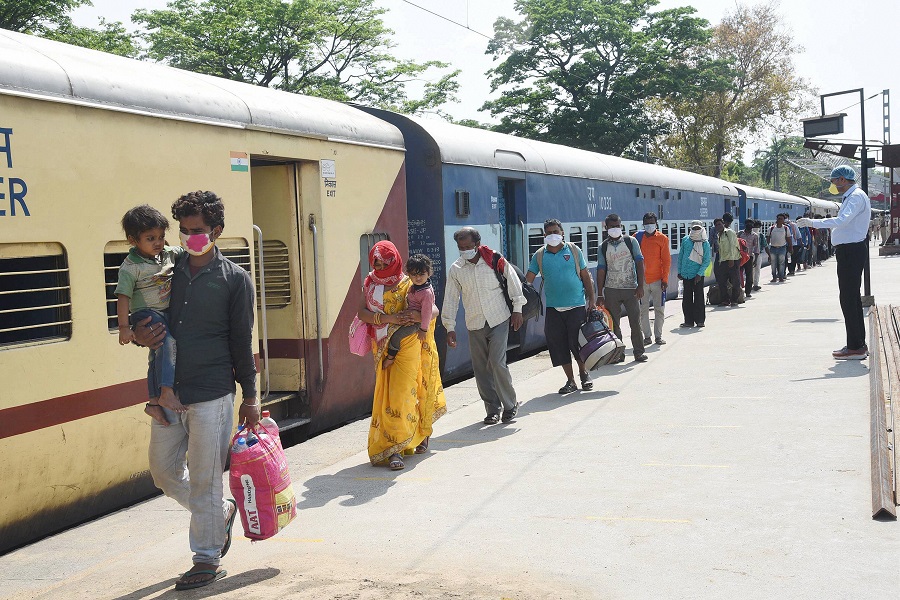
The deceased and the injured were migrant workers employed at a major steel plant in the neighbouring district of Jalna. They were walking from Jalna to Bhusawal to board a Shramik train to Madhya Pradesh.

An inquiry has been ordered under the aegis of the Commissioner of Railway Safety. Madhya Pradesh CM Shivraj Singh Chouhan has announced a compensation of Rs 5 lakh each to the deceased’s kin. The Maharashtra government has announced a similar relief to the families of the deceased.

President Ram Nath Kovind tweeted that he was “saddened beyond words” to learn about the accident and wished the injured a “speedy recovery”. PM Narendra Modi too expressed sorrow over the incident in a tweet and said that Railways Minister Piyush Goyal is monitoring the situation.

A day after Shramik trains were stopped, Karnataka restarts train for stranded migrants

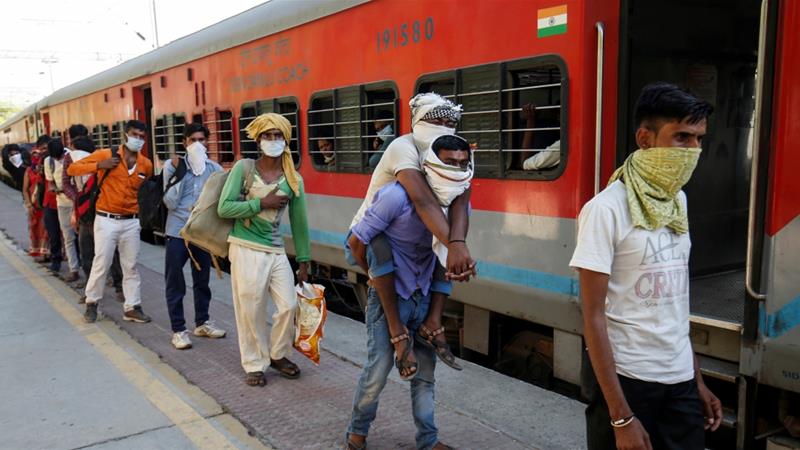
Patna: Migrants from Jaipur arrive by 'Shramik Special' train at Danapur junction, during the nationwide lockdown to curb the spread of coronavirus, in Patna, Saturday, May 02, 2020. (PTI Photo)(PTI02-05-2020_000082A)

After criticisms mounted over its decision to cancel inter-state trains to transport migrant workers, the Karnataka Government on Thursday announced that trains to 9 north Indian states would start from Friday.

The government has written to 9 states that include Bihar, Uttar Pradesh, Jharkhand, Manipur, Tripura, West Bengal, Madhya Pradesh, Rajasthan and Odisha. So far, it has received the consent to receive migrants from only Bihar and Madhya Pradesh. The first train to Bihar will start on leave on Friday. One train a day will be sent to Manipur and Tripura.

It was alleged that the move to cancel trains following the CM’s meeting with builders. Mr. Yediyurappa had tweeted that labourers were being provided with all essential facilities and that construction activity had already started. He mentioned that directions were given to convince the workers to refrain from travelling unnecessarily.

However, Mr. Manivannan, the IAS officer in the labour department, tweeted on May 6 that the decision to cancel the trains for the time being was taken after seeing the migrant labourers rushing railway stations in huge numbers. He said that while the off-take was around 6000 per day, the inflow to stations was 25000, thereby triggering the fear of COVID. He categorically stated that it had nothing to do with builders lobby. He mentioned that the builders association is taking care of around 38000 people on record and action is being taken on small builders who have left them to lurch. He also said that the migrant workers are in no mood to wait for their turn and that it is impossible to shift lakhs on the same day. Most of them camp at the stations and such a gathering could become a COVID-19 red zone, he said.

Fresh protests erupt in Hong Kong, China says it will not sit idly and watch

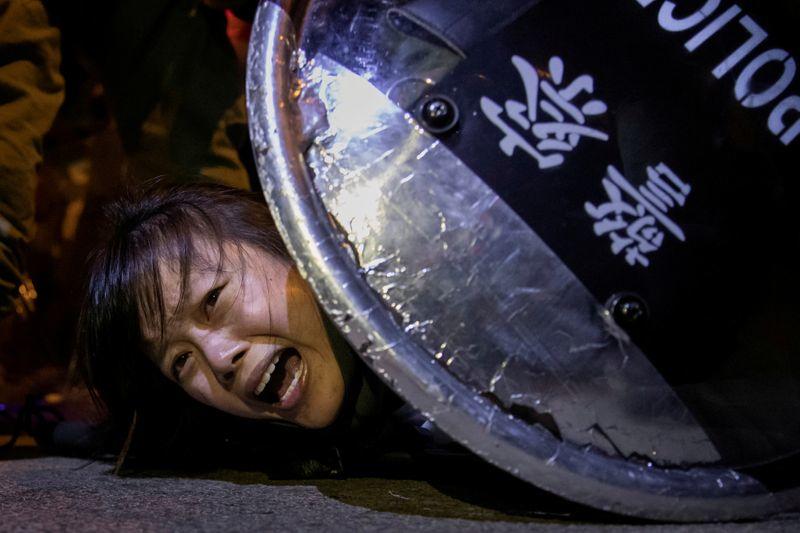
After a largely peaceful public holiday on last Friday, protestors in Hong Kong held demonstrations against China in which the Hong Kong police resorted to using pepper spray to disperse the crowd. As the fear of pandemic wanes away, Hong Kong has started witnessing small demonstrations in recent weeks.

On Wednesday, China warned Hong Kong that it would not tolerate them “stirring up trouble again”.

“We noticed that the black violent forces slowed down a little when faced with the Hong Kong epidemic, but now they are stirring up trouble again.” State Council’s Hong Kong and Macau Affairs, China’s top body overseeing Hong Kong said in a statement.

While China has been upset with the usage of the term “Wuhan Virus” or “Chinese Virus”, the statement referred the made-in-China virus and its ensuing epidemic as “Hong Kong epidemic”.

The body also said that “the central government will not sit idly and watch these insane and wantonly destructive forces” and added that the protestors wanted to “drag Hong Kong off a cliff”.

The semi-autonomous region of Hong Kong saw violent protests that began in June 2019 in response to a bill that allowed extraditions to mainland China. The courts in mainland China are controlled by the Communist Party. The bill was then withdrawn by Hong Kong’s Chief Executive Carrie Lam. However, the protests have gradually gone on to include demands for democracy.

RSS calls for Swadeshi model of development based on self-reliance

RSS Sah-Sarakaryavaah (joint general secretary) Dattatreya Hosabele on Wednesday, in a video conference with members of the foreign press that included Wall Street Journal, Bloomber, Agence France-Pressem Deutsche Presse-Agentur and ARD (German television), said that India would do well by evolving a swadeshi development model that is based on self-reliance while still maintaining the concept of Vasudhaiva Kutumbakam (the world is one).

“In this indigenous model, local resources, workforce and needs should be integrated to revive the economy by also taking into account environmental consideration.”, he said.

He added that the COVID-19 pandemic had exposed the limits of both global capitalism an global communism development models.

He also said that it was time to write “bright new chapters of the new world as one without any discrimination” and “without creating any ‘otherisation’ or ‘exclusion’.”

He mentioned that a detailed investigation into the origins of COVID-19 should take place and asked the world to come together to avoid such emergencies in the future. He called for new regimes to deal with them by involving responsible individuals, organizations and countries.

Tribal woman from Kerala is first ever rank holder from ST community in civil services

Sreedhanya Suresh, belonging to the Kurichia community in Kerala has become the first ever person belonging to the Scheduled Tribe community to emerge as a rank holder in the civil services. She will be taking charge as Assistant Collector (in training) in Kozhikode. News of her achievement sent waves of joy and pride not just among the city’s residents but the entire state.

Sreedhanya secured 410th rank in the UPSC Civil Services Examination held in 2018. She cleared the exam in her third attempt.

Second of the 3 children born to Suresh and Kamala both of whom are daily wage workers, she studied in a local school in Wayanad district. She graduated from St. Joseph College in Devagiri, Kozhikode acquiring a degree in zoology. She completed her post-graduation in Applied Zoology from Calicut University.

Interestingly, she will be working under Mr. S. Sambasiva Rao who was her inspiration to become a civil service officer. Currently, she is undergoing training at Lal Bahadur Shastri National Academy in Mussoorie and will take charge once the lockdown gets lifted and after completing her 14-day mandatory quarantine period.

Low wage migrant labourers in Qatar forced to beg for food

The Guardian on May 7 reported that low wage migrant workers in Qatar have been forced to beg for food amidst the threat of a pandemic. Most of them have become unemployed and have no means of sustenance. As a result, they are being pushed to beg for food and charity from their employers.

A worker from India had told the newspaper that the company in which he works for had informed him that they won’t pay for the month of April and that only money for food would be given. He added that they weren’t getting that too. “They gave us a tray of eggs and some oil a few days ago. That was all”, he had said.

Another worker from Bangladesh who had lost his job in March said that “I don’t have much food left. Just some rice and lentils. It will last only a few days. What happens when this food finishes?”

A worker from Philippines mentioned that her boss was not even giving her food.

The situation across Gulf countries is the same. Countries like Saudi Arabia are also struggling to contain the pandemic among the migrant population and have left the workers in limbo.

Qatar has one of the highest rates of per capita infection in the world and over 25% of those tested have been found to be infected in the past week, the vast majority of which were migrant workers.

Cultural Terrorism and NGOs in Tamil Nadu, Keezhadi is a Warning

Cultural terrorism can be termed a policy of attacking or suppressing cultural values or of destroying cultural treasures, an offensive against dominant systems of meaning within the realms of propaganda and disinformation. It is not just an aggressive act of violence destroying cultural remains, but conspiring to expunge the past using money, organizations, hoax claims and bogus propaganda using radical racial, linguistic and political machinery. Kathleen Nader DSW and Yael Danieli in 2008, argue that trauma and the destruction of culture may create fertile ground for violent cultures and future terrorists. At the Second 21st Century Academic Forum Conference at Harvard in 2015, Saba Gheni while speaking about a culture of terrorism in Middle East highlighted two important factors that fuel culture based terrorism. They are demonization of the enemy and conspiracies. That is precisely what is happening with Keezhadi.

Keezhadi located in the Sivaganga district of Tamil Nadu was excavated by Archaeological Survey of India. On October 2019, Tamil Nadu State Minister for Tamil Language and Culture, K Pandiarajan, termed the Keezhadi’s heritage “Bharatham’s civilization”. It was opposed by Madurai Central DMK MLA PTR Palanivel Thiagarajan who asked how the findings dating back 2600 years could be representative of nationhood formed just 70 years ago. Thiagarajan further contended that “The notion of the Dravidian is also proven as something non-Aryan and so there is nothing wrong in calling Keezhadi a Dravidian civilization”.

Thiagarajan was giving a clear indication that the Keezhadi excavators shall accept only cultural remains that fit into their ideological frame and reject or destroy any evidence that challenge their concept of Dravidian racial/linguistic claims. Their outlook is one that divides the world simplistically into “them” and “us.” Demonization of a mythical enemy is an essential factor in cultural terrorism.

By a call for racial and linguistic bifurcation of people, such statements not only negatively impacts the right to take part in cultural life, but it nourishes extremist groups both materially and immaterially, thereby indirectly promoting terrorism and its associated violations. It is analogous to the statement from the one-eyed cleric Mullah Omar “The real God is only Allah, and all other false gods should be removed”, following an edict issued by Afghanistan’s Taliban regime announcing that all pre-Islamic statues in the country were to be destroyed.

CPI leader and Madurai MP, Su Venkatesan, claimed Keezhadi evidences shows a Tamil Civilization debunking ASI lies. Venkatesan said “The findings have again proved that Tamil is the oldest language and the similarities in the markings discovered in Keezhadi and Indus Valley are new keys to rewrite Tamil history.

The left-church alliance is a major factor in Dravidian secessionism.  Mathias Samuel Soundra Pandian, popularly known as M.S.S. Pandian was JNU historian and ideologue of Dravidian theory launched by Bishop Robert Caldwell .The recent work authored by Y. Vincent Kumaradoss titled Robert Caldwell Scholar Missionary Colonial South India was published by Indian Society for Promoting Christian Knowledge (ISPCK). This new study on Robert Caldwell’s was commissioned by his missionary society in London, United Society for the Propagation of the Gospel (USPG). M.S.S. Pandian commented that Robert Caldwell’s “contribution to both Christianity in South India and the cultural awakening of the region is unmatched during the last two hundred years”. Pandian has helped edit the book in conjunction with the Rev. Dr. Daniel O’Connor, a Vice-President of the USPG and a former teacher and chaplain at St. Stephen’s College, Delhi.

But what the Dravidian and left lobbies suppressed was a conspiracy, an essential factor in cultural terrorism. They suppressed the major involvement of Father Gasper Raj, Catholic priest and his NGO, Tamil Maiyyam at Keezhadi, thus preventing examination of unearthed antiquities by ASI through PIL filed in the Madurai Bench of the Madras High Court. Fr. Gaspar Raj is officially referred in US crime records as ‘Gaspar Raj Maria Paulian’ according to senior national security strategist, Douglas C. Lovelace Jr. and Domestic Security and Intelligence analyst, Siobhan O’ Neil. They charge Gasper Raj for “involving in multiple criminal activities in support of LTTE, a Sri Lankan group designated by the US state department as a Foreign Terrorist Organization”.

In 2010, the CBI raided senior DMK politicians in connection with the 2G scam. The media reported that, “the biggest, most prominent raid in Chennai could very well be that of Father Jegath Gaspar Raj, a Catholic priest and the head of the NGO, Tamil Maiyam. A source said, the CBI questioned Gaspar Raj on the source of the NGO’s funding and its income”.

The home ministry’s website shows that there has been an overall increase in foreign funding to NGOs in Tamil Nadu, mostly Christian organizations. The Intelligence Bureau revealed that Tamil Nadu has the second highest foreign aid receipts by NGOs, next only to Delhi.

The non-governmental organisations (NGOs) operating out of Tamil Nadu received the maximum foreign funding of about ₹547 crores in 2013-14, according to the Ministry of Home Affairs (MHA) which also informed the Lok Sabha that on the basis of complaints, 24 cases had been referred to the CBI and nine to the State police for investigation.

Academicians who hold top posts on foreign funded NGOs have entered the Advisory Board of Archaeology, Archaeological Survey of India, to help their NGOs secure license and other concessions for excavations. Prof. K. Rajan of Pondicherry University, who patronises Pattanam and Keezhadi,  is Member, Sub-Committee of the Central Advisory Board of Archaeology, Archaeological Survey of India. He is in the executive council of Kerala Council for Historical Research (KCHR). Union Ministry of Home Affairs (MHA) has cancelled the licence of over 20 NGOs in Kerala in 2016, under the Foreign Contribution Regulation Act (FCRA), 2010 which includes  the KCHR. Currently PAMA, an NGO run by P.J. Cherian who earlier excavated Pattanam under Muziris Heritage Project, has managed to secure license to re excavate Pattanam and Mathilakam in Kerala under the Ancient Tamilakam Project. This Tamilakam project claims its brotherhood ties with Keezhadi excavations.

On November 2007, the U.S. Department of the Treasury announced that it would freeze the U.S.-held assets of the Tamils Rehabilitation Organization (TRO) that acts as a front to facilitate fundraising and procurement for the Liberation Tigers of Tamil Eelam (LTTE). TRO was established in 1985 in Tamil Nadu with current headquarters at Jaffna in Sri Lanka.  The LTTE has been designated by the United States as a Specially Designated Global Terrorist Organization since 2001 and a Foreign Terrorist Organization since 1997. The Tamils Rehabilitation Organization (TRO) is designated today under Executive Order 13224, which is aimed at financially isolating terrorist groups and their support networks. E.O. 13224 freezes any assets held by designees under U.S. jurisdiction and prohibits U.S. persons from transacting with designees.

According to press release issued by the U.S. Embassy in Sri Lanka, on 15 November 2007 titled U.S. freezes TRO funds, the LTTE has ordered international NGOs operating in its territory to provide all projects funding through local NGOs, which are managed collectively by the TRO. This arrangement allows TRO to withdraw money from the local NGO accounts and to provide a portion of the relief funds to the LTTE. Robert Blake, the U.S. Ambassador for Sri Lanka, addressed media in Colombo on the funds freeze of the TRO by the United States Department of the Treasury.

In an interview given to Praveen Suresh on November 7, 2019,  titled ‘Meet Fr. Jegath Gasper Raj, Founder of ‘The Rise’ Global Summit for Tamil Entrepreneurs & Professionals’,  Father Gasper Raj  asserts his association with the TRO.

The tenth World Tamil Conference, mainly sponsored by FeTNA, was held in July 2019 at Chicago. Its central theme was “Keezhadi nam Thai madi” (On our Tamil mother’s lap – Keezhadi excavation), dedicated to Tamil scholar Rev. G.U. Pope on his 200th birth anniversary.

M.Nageswara Rao, senior IPS Officer has currently disclosed that a humongous amount of Rs. 2,08,096 Crores of foreign ‘donations’ has been pumped into the country, in the last two decades, by foreign sources through official open channels by remitting to FCRA-NGOs. He cautioned that, foreign funds have been the prime mover for changing the religious demography, interference in our indigenous religious traditions and practices, creating hurdles in our socio-economic progress, creating and aggravating various faultlines and the consequent unrest, colonising our minds and subverting our national discourse to suit certain sinister purposes.

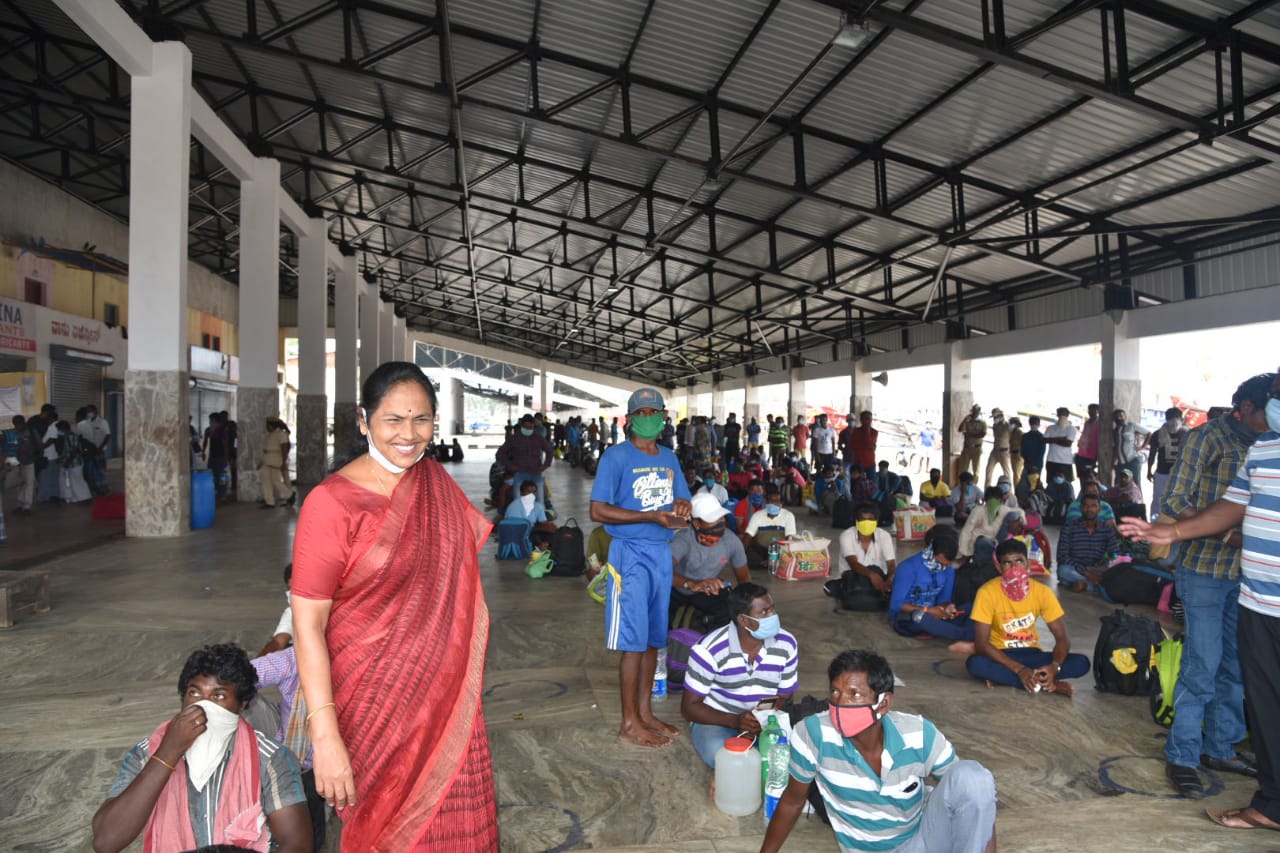
Work From Hospital: US Supreme Court Justice resumes work from hospital bed

US Supreme Court Justice Ruth Bader Ginsburg (87), resumes her participation in legal arguments days after her admission in the hospital due to a gall bladder infection. She took part in two cases shortly only after a day at Baltimore’s John Hopkins hospital.

The Court’s spokeswoman Kathy Arberg reported that she was ‘comfortably resting and was glad to be home’ in her statement to the press.

Ms. Ginsburg is the senior most liberal justice of the court and her health is being monitored continuously. Although she had been admitted a few times in the past few years, she has always returned back to work on every single instance. In August 2019, she was treated for a cancerous tumour on her pancreas. She received treatment for colon cancer in 1999, and pancreatic cancer in 2009.

In December 2018, she had a surgery to remove two cancerous nodules from her lung. She has also suffered fractured ribs from falls.

She was the second woman to have ever joined the Supreme Court of the United States, after having been nominated by President Bill Clinton in 1993.

Since Supreme Court Justices serve for life or until they choose to retire, Ms. Ginsburg was reported saying  “As long as I can do the job full steam, I will be here”, after there were concerns from her supporters of her being replaced by a more conservative judge.