
Home Blog Page 188

Uttarakhand Cloudburst: 150 Army Personnel Deployed In Dharali Rescue
dharali uttarkashi cloudburst rescue

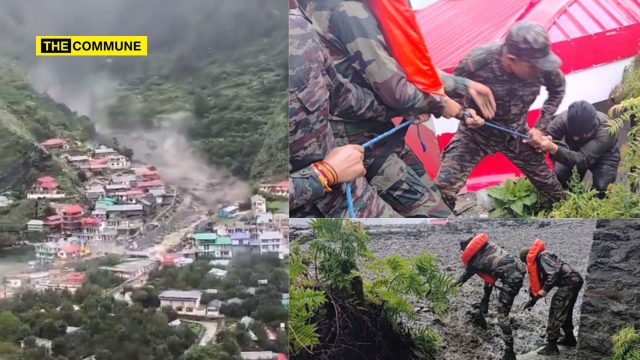
A devastating cloudburst struck the Dharali area near Harsil in Uttarakhand’s Uttarkashi district on Tuesday afternoon, triggering flash floods and landslides that caused widespread destruction in the region.

Following the calamity, the Indian Army mounted a prompt and large-scale rescue operation to assist the affected civilians. The landslide occurred around 1:45 PM near Dharali village, just 4 km from the Indian Army camp at Harshil.

Within ten minutes of the incident, the Army mobilised 150 personnel to the disaster site. Rescue teams immediately began evacuating trapped villagers and providing critical assistance on the ground. So far, between 15 and 20 individuals have been rescued and evacuated safely.

The injured were promptly transported to the Army’s medical facility in Harshil for urgent treatment. Army officials confirmed that search and rescue efforts are still underway, with all available resources being deployed to locate and assist any remaining stranded civilians.

In a statement, the Indian Army said, “The situation is under continuous monitoring, and the Indian Army remains fully committed to providing all possible assistance to the affected civilians.” Union Home Minister Amit Shah also took to the social media platform X to express his concern and share updates.

“I spoke with the Uttarakhand Chief Minister regarding the flash flood in Dharali, Uttarkashi. Three nearby ITBP teams have been dispatched, and four NDRF teams are also en route to begin rescue operations.” Uttarakhand Police stated in a public advisory, said that due to the rising water levels in Kheer Gadh in Dharali, Uttarkashi, reports of damage have been received in the Dharali market area.

“Police, Fire department, SDRF and Army, along with other disaster relief and rescue teams, are engaged in relief and rescue operations at the scene,” the police said. Authorities have urged locals to maintain a safe distance from the riverbanks and ensure the safety of children and livestock.

Uttarakhand Chief Minister Pushkar Singh Dhami called the situation “extremely sad and distressing” and said relief operations are underway on a war footing.

“The news of heavy damage caused by a cloudburst in the Dharali (Uttarkashi) region is extremely sad and distressing. SDRF, NDRF, district administration, and other related teams are engaged in relief and rescue operations on a war footing,” CM Dhami said in a post on X.

“I am in constant contact with senior officials, and the situation is being closely monitored. I pray to God for everyone’s safety,” he added. While official confirmation on casualties remains awaited, the search for the missing is ongoing.

-IANS

Subscribe to our TelegramWhatsApp, and Instagram channels and get the best stories of the day delivered to you personally.
MSME Boost, Women Empowerment & Skilling At Heart Of India’s Growth Plan

india growth plan domestic

India has remained the fastest-growing major economy, averaging over 7 per cent GDP growth between 2014 and 2025 (excluding the Covid years) and in a global environment marked by protectionism, sustaining 7–8 per cent growth requires a sharp focus on domestic growth drivers, the Parliament was informed on Tuesday.

“To this end, the Government remains committed to a strategy centred on deregulation, infrastructure investment and MSME development; enhancing female labour force participation; skilling the workforce to harness the demographic dividend; and accelerating digitalisation to boost financial inclusion and formalisation,” Minister of State for Statistics & Programme Implementation, Rao Inderjit Singh, said in the Rajya Sabha.

These efforts — reinforced by Centre–State coordination and institutional strengthening — are designed to unlock productivity, attract private investment, and drive inclusive, innovation-led, and resilient growth, he said.

The government has adopted a range of strategies to mitigate potential risks and leverage emerging opportunities, with a focus on strengthening domestic capacities, promoting exports, diversifying supply chains, exploring alternative import sources, and enhancing overall economic resilience, he explained. The minister pointed out that India’s demographic dividend, driven by a growing working-age population, presents a crucial opportunity to boost GDP growth.

The working age population is projected to rise from 735 million in 2011 to 988.5 million in 2036. The current working age population is 64.2 per cent, and for the next 10 years, the favourable demographics will remain approximately at 65 per cent.

To harness its demographic dividend, the government is strengthening education, healthcare and skill development, while prioritising employment generation in labour-intensive sectors and increasing women’s workforce participation. Programmes like Mission Shakti, Namo Drone Didi, and Lakhpati Didi aim to enhance women’s economic empowerment.

Complementing these efforts, the Make in India initiative seeks to revitalise manufacturing, generate large-scale employment, especially for semi-skilled and unskilled workers, the minister said. These key initiatives and policy measures include the Foreign Trade Policy, effective from April 1, 2023, and are designed to integrate India more effectively into the global market, improve trade competitiveness, and establish the country as a reliable and trusted trade partner.

Various tax incentives to promote labour-intensive exports, such as textiles, have also been undertaken. For the Remission of Duties and Taxes on Exported Products, there is a budget allocation of Rs 18,232.50 crore for FY 2025-26, the minister pointed out.

The District Export Hubs initiative had also been launched by identifying products with export potential in each district, addressing bottlenecks for exporting these products and supporting local exporters/manufacturers to generate employment in the district, the minister added.

-IANS

Subscribe to our TelegramWhatsApp, and Instagram channels and get the best stories of the day delivered to you personally.
“Sovereign Nations Must Have The Right To Choose Their Trading Partners,” Russia Defends India’s Oil Imports Amid Trump’s Tariff Threat

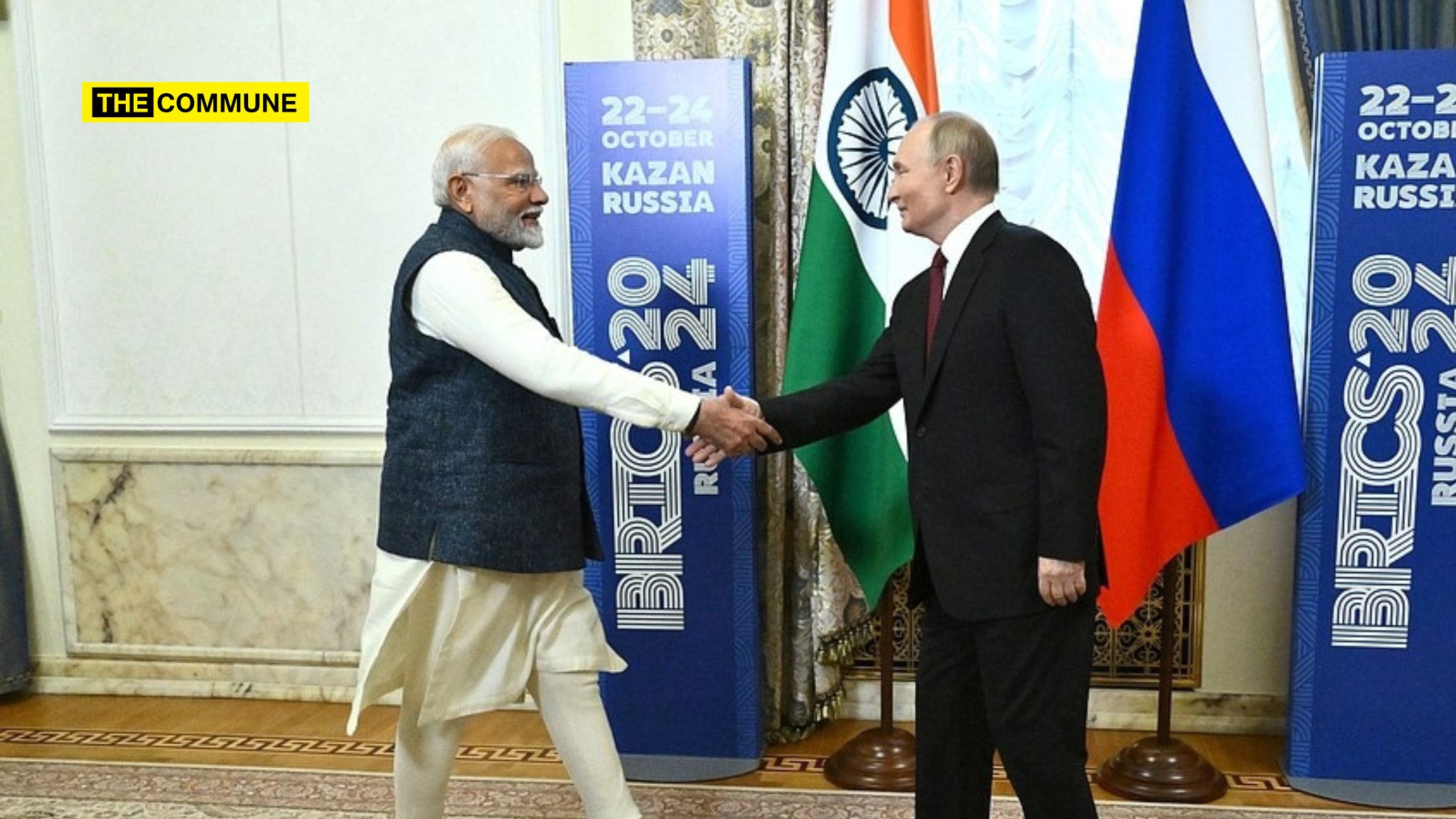
India-Russia Ties So Strong That PM Modi Would Understand Me Without Translation: Putin

Russia on Tuesday backed India and while criticising US President Donald Trump over his threats to increase tariffs on New Delhi for buying oil from Moscow, saying that “sovereign nations must have the right to choose their trading partners.”

Speaking at a regular press briefing on Tuesday, Russian President’s Press Secretary Dmitry Peskov stated that Russia has noted the US threats against India and does not consider them to be legitimate. He emphasised that nations should have the right to choose the trading partners based on their own interests.

“Russia notes US threats against India but does not consider such statements to be legitimate. Sovereign countries must have and have the right to choose their own trading partners, partners in trade and economic cooperation, and to choose those trade and economic cooperation regimes that are in the interests of a particular country,” Peskov was quoted as saying by Russia’s state-owned news agency TASS.

The Kremlin’s reaction came after Trump threatened to substantially raise tariffs on India for purchasing oil from Russia. “India is not only buying massive amounts of Russian Oil, they are then, for much of the Oil purchased, selling it on the Open Market for big profits. They don’t care how many people in Ukraine are being killed by the Russian War Machine,” Trump wrote in a social media post. “Because of this, I will be substantially raising the Tariff paid by India to the USA,” he added.

After Trump threatened to impose hefty tariffs on New Delhi, the Indian government on Monday said that the targeting of the country by the US over Russian oil purchase is unjustified and unreasonable.

A statement released by the Ministry of External Affairs (MEA) spokesperson said that like any major economy, “India will take all necessary measures to safeguard its national interests and economic security”.

According to the government, India has been targetted by the United States and the European Union for importing oil from Russia after the commencement of the Ukraine conflict.

“In fact, India began importing from Russia because traditional supplies were diverted to Europe after the outbreak of the conflict. The United States at that time actively encouraged such imports by India for strengthening global energy markets stability,” the Centre emphasised.

“India’s imports are meant to ensure predictable and affordable energy costs to the Indian consumer. They are a necessity compelled by global market situation. However, it is revealing that the very nations criticizing India are themselves indulging in trade with Russia. Unlike our case, such trade is not even a vital national compulsion,” the government highlighted.

According to the Indian government, the European Union in 2024 had a bilateral trade of Euro 67.5 billion in goods with Russia. In addition, it had trade in services estimated at Euro 17.2 billion in 2023.

“This is significantly more than India’s total trade with Russia that year or subsequently. European imports of LNG in 2024, in fact, reached a record 16.5 million tonnes, surpassing the last record of 15.21 million tonnes in 2022. Europe-Russia trade includes not just energy, but also fertilizers, mining products, chemicals, iron and steel and machinery and transport equipment,” said the official statement.

The government further stated that as far as the United States is concerned, it continues to import from Russia uranium hexafluoride for its nuclear industry, palladium for its EV industry, fertilizers as well as chemicals.

“In this background, the targetting of India is unjustified and unreasonable. Like any major economy, India will take all necessary measures to safeguard its national interests and economic security,” the MEA statement stressed.

-IANS

Subscribe to our TelegramWhatsApp, and Instagram channels and get the best stories of the day delivered to you personally.
China Supplied Missile Battery Components To Iran In Exchange for Oil During Israel Conflict Says Report

china iran oil israel conflict

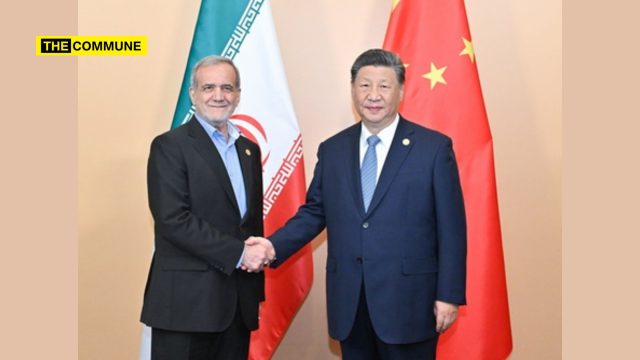
China, which has for long claimed of having a “noninterference” foreign policy and not providing direct military assistance to nations engaged in conflict, reportedly supplied batteries for surface-to-air missiles to Iran in exchange for oil during the recent conflict with Israel, a new report has cited.

This comes after Beijing is already facing heat for its alleged involvement in Russia’s ongoing war against Ukraine and backing Pakistan in its conflict with India in May following the heinous April 22 Pahalgam terror attack.

“As an expert specializing in China’s grand strategy, I think it is highly possible that China would offer Iran military support while denying it publicly. Such plausible deniability would allow Beijing to assert military influence and showcase some of its hardware, while deflecting international criticism and preserving diplomatic flexibility,” Linggong Kong, a leading researcher on international relations and China’s grand strategy, wrote in ‘One World Outlook’.

“But the tactic works only so far. As indirect evidence accumulates, as many suggest it is, such covert action may gradually develop into an open secret – leading to what scholars term ‘implausible deniability’, where denial is no longer credible even if it is still officially maintained,” he added.

Shattering Beijing’s claims of not providing arms to any party involved in a war, the writer emphasised that while the Chinese Embassy in Israel has denied the reports of military connection with Tehran stating that China opposes the proliferation of weapons of mass destruction and does not export arms to countries at war, the country’s Ministry of Foreign Affairs is yet to issue an official statement on the alleged transfer.

The report highlighted that China has quietly supported Russia during its ongoing war with Ukraine even though it claims of being neutral since the conflict began in 2022. The ‘One World Outlook’ report detailed that China has reportedly provided large quantities of dual-use goods – goods that can be used for civilian and military purposes to Russia to enhance its offensive and defensive capabilities and boost China’s military-industrial production.

China has also allegedly supplied satellite imagery to assist Russia amid the ongoing war with Ukraine. Beijing, the report mentioned, presented itself as a neutral party in the India-Pakistan conflict too and called for restraint on both sides. “But in practice, China is allied with Pakistan. And the direct military support it has provided to Lahore appears driven by China’s desire to curb India’s regional influence, counterbalance the growing US–India strategic partnership and protect the China–Pakistan Economic Corridor, a massive bilateral infrastructure project,” it said.

Similarly, China and Iran signed a 25-year comprehensive cooperation agreement that covered trade, energy and security, showcasing the strategic value that Beijing places on Tehran.

“From Beijing’s perspective, Tehran presents a counterbalance to the influence of the US and its allies – especially Israel and Saudi Arabia – in the region and helps divert Western resources and attention away from China,” the report mentioned.

-IANS

Subscribe to our TelegramWhatsApp, and Instagram channels and get the best stories of the day delivered to you personally.
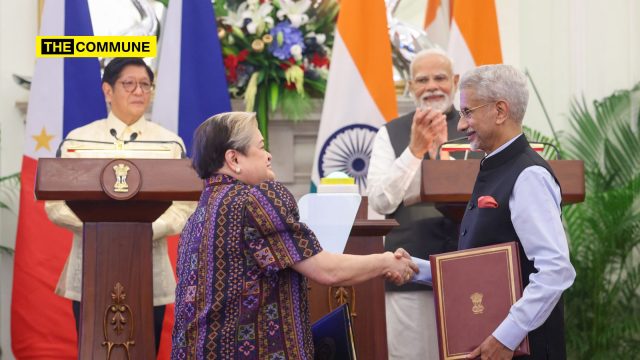
‘Friends By Choice, Partners By Destiny’ Prime Minister Narendra Modi Hails India – Philippines Strategic Partnership

Lauding ties between India and the Philippines, Prime Minister Narendra Modi on 5 August said that the two nations are “friends by choice and partners by destiny.” He emphasised that while the diplomatic ties might be new, the cultural bond between the two nations exists from the ancient times and termed the Philippines’ Ramayana Maharadia Lawana as a “living proof” of the centuries-old cultural ties.

While making a joint press statement with the Philippines President Ferdinand R Marcos Jr at the Hyderabad House in New Delhi on Tuesday following their bilateral discussions, PM Modi extended a warm welcome to the visiting leader and noted that the two nations are celebrating 75th anniversary of diplomatic ties in 2025. “India and the Philippines are friends by choice and partners by destiny. From the Indian Ocean to the Pacific, we are united by shared values. Ours is not just a friendship of the past, it is a promise for the future,” said PM Modi.

PM Modi also expressed gratitude to the Philippines President and his government for strongly condemning the 22 April Pahalgam attack, which claimed 26 lives and injured several others. He welcomed Manila’s decision to give a visa-free entry to Indian tourists. “We express gratitude to the Philippines Government and the President for strongly condemning Pahalgam attack and standing with us in our fight against terrorism. The agreements signed today on mutual legal assistance and the transfer of sentenced persons will further strengthen our security partnership. We welcome Philippines decision to give visa-free entry to the Indian tourists. India has also decided to give free e-visa facility to tourists from the Philippines. This year, we will work to start direct flights between Delhi and Manila,” stated PM Modi.

Extending India’s support to the Philippines for its chairmanship of ASEAN that is set to begin next year, PM Modi expressed India’s commitment to peace, security, prosperity, and a rules-based order in the Indo-Pacific region. “The Philippines is an important partner in our Act East Policy and Mahasagar Vision. We are committed to peace, security, prosperity, and a rules-based order in the Indo-Pacific region. India strongly supports freedom of navigation in accordance with international law,” he said. Prime Minister Modi mentioned that the growing defence ties between India and Philippines are a “symbol of deep mutual trust.” He announced India’s decision to increase the number of Quick Impact Projects (QIPs) in the Philippines. “Our companies are actively working in every sector — information and digital technology, health, automobiles, infrastructure, and minerals. In the field of science and technology, from virology to AI and additive manufacturing (ADQ), joint research is ongoing. The Science and Technology Cooperation Plan finalised today will further accelerate this…I am pleased to say that under the Development Partnership, we will increase the number of Quick Impact Projects in the Philippines and will cooperate on developing sovereign data cloud infrastructure in Philippines.”

He announced that India and the Philippines will also cooperate in the space sector. “Our partnership on Earth is already strong and we have also begun preparations for space sector. In this regard, an agreement has also been signed today. Our growing defense ties are a symbol of deep mutual trust. As maritime nations, maritime cooperation between our two countries is both natural and necessary.” PM Modi said that India and Philippines have decided to work towards a Bilateral Preferential Trade Agreement. He mentioned that during their meeting, both leaders also discussed other areas of mutual cooperation, regional issues and international situations.

“Dialogues at every level and cooperation in every sector have been the identity of our relations for a long time now. Today, the President and I held a detailed discussion on mutual cooperation, regional issues and international situations. This is a matter of joy that today we have decided to elevate our relations to strategic partnership. To convey the potential of this partnership into results, an extensive action plan has been formed. Our bilateral trade is increasing continuously and has crossed the figure of three billion dollars. To further strengthen this, it will be our priority to complete the review of India-ASEAN Free Trade Agreement at the earliest. We have also decided to work towards Bilateral Preferential Trade Agreement,” said PM Modi. Earlier in the day, Philippines President Ferdinand R Marcos Jr was accorded a ceremonial welcome at the forecourt of the Rashtrapati Bhavan.

-IANS

Subscribe to our TelegramWhatsApp, and Instagram channels and get the best stories of the day delivered to you personally.

Fake ID, Flat Purchase, And False Complaints: Kolkata Police Bust Bangladeshi Model Santa Paul’s Cover-Up As Indian Citizen

Santa Paul, the recently arrested Bangladeshi model, tried multiple means to camouflage as an Indian citizen, even trying to engage with the local administration and police on various pretexts, investigating officers in the case revealed on 5 August 2025.

Investigating officials said that Paul was desperate to keep her image clean as a purported Indian citizen. She did not hesitate to approach the police with a fictitious complaint, posing as an Indian citizen and as a resident and seeking justice.

A police officer said on 5 August that Paul, during her stay in Kolkata after expiry of her visa, registered a fictitious complaint with the police, accusing an interior designer company, whom she appointed for decoration of her flat at Gold Green in South Kolkata, of cheating her out of lakhs of rupees.

“She had filed the written complaint against the interior designer company at Thakurpukur Police Station in south Kolkata’s Behala area. Santa Paul had bought a flat in Golf Green in South Kolkata. She was given a quote of several lakhs of rupees by an interior decoration company which she had hired to design her flat,” a city police official said. In her complaint, the city police official said Paul alleged that she had given several lakhs of rupees to the company concerned in the first phase.

“However, as per her complaint, no work started even after making the payment. Therefore, she registered a complaint with the police,” the city police cops added. According to him, generally, a foreign national residing in any other country illegally without proper documents maintains a low profile and avoids approaching the police even if they become victims of minor crimes like forgery out of fear of his or her real identity being revealed.

“But this Bangladeshi model tried to be too smart and over-confident, and that is why she did not hesitate to approach the police with the complaint,” the cop added. According to him, any individual could file a police complaint, and prima facie, it is not always possible to know whether that person is a citizen of India or an illegal foreign infiltrator.

Following her arrest, several questions have been raised about how she bought the flat in Golf Green and got it registered. On Tuesday morning, the Anti-Rowdy Squad (ARS) of the Kolkata Police nabbed one individual, Soumik Dutta, from Naihati in North 24 Parganas district, on charges of arranging fake Indian documents for Paul.

-IANS

Subscribe to our TelegramWhatsApp, and Instagram channels and get the best stories of the day delivered to you personally.
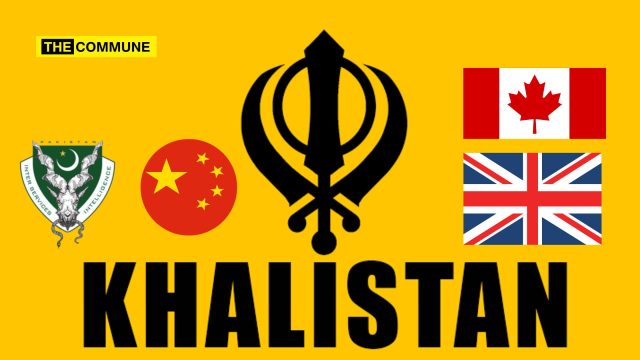
Khalistan Terror Goes Global: India Warns Canada & UK Of ISI-China-Drug Cartel Convergence

India has repeatedly warned countries such as Canada and the United Kingdom about the Khalistan terror menace. Both countries have been complicit when it comes to taking action against the Khalistani terrorists operating on their soil.

The problem is also persistent in the United States, and these elements have managed to get away under the garb of free speech. While they state that their demand is the creation of a separate Khalistan nation carved out of India, in reality, these elements are notorious gangsters, terrorists, arms smugglers, and drug lords. Earlier, they would operate by using their own networks in these foreign nations.

The Khalistani terrorists also have a wide network of gangsters operating in India. These persons indulge in hit jobs, terror acts, and narcotic smuggling. However, in recent times, the Khalistani elements have teamed up with Latin-American drug cartels and the Chinese network as well. These connections were exposed after the US Drug Enforcement Agency (DEA) revealed that there was a Khalistan connection to the Chinese and Latin-American cartels. The busting of these networks, which also have an ISI link, led to the arrest of an Indian-Canadian gangster, Opinder Singh. There has not been any link with the Chinese elements and Khalistani terrorists. However, the security agencies suspect that China may have started to promote these elements following a request by the ISI.

In a bid to gain the support of the Chinese, the ISI roped in Gurpatwant Singh Pannun, the head of the proscribed group, Sikhs for Justice (SFJ). Intelligence agencies say that the proximity between the Chinese and Khalistani elements may have begun when India and China were locked in a tense standoff along the Line of Actual Control (LAC). It was at that time that Pannun had written to Chinese President Xi Jinping, in which he justified China’s stand against India. “We consider China’s counter-military action against India as legitimate and justified to protect its territorial integrity under international laws,” he had written.

He urged the Chinese President to take up the issue of Sikhs’ rights of self-determination in the UN Security Council. He had also written a letter in 2019 to the Chinese ambassador to Pakistan stating that the Indian agencies are planning to attack the Chinese consulate in Pakistan. China also appeared to be supportive of Pannun when the US agencies arrested one Nikhil Gupta, who had claimed that he had been paid by the Indian agencies to assassinate the SFJ chief. India had rejected the claim and even snubbed China. These developments are worrying since the ISI has been pooling several resources to ensure that the Khalistan movement is taken forward.

To take the movement forward, the ISI brought together gangsters and narcotic smugglers. The mingling with the international cartels is aimed at earning more money so that the movement can be funded in a major way. While the Indian agencies are on high alert and have not allowed the movement to raise its ugly head in the country, the worry is the associations abroad. The Punjab police also held a detailed meeting with the field officers, during which presentations were given about the issue. The Punjab police took note of the rise in activity in the border areas of Amritsar and Jalandhar. This was an indication that the ISI was pushing the Khalistan agenda harder.

-IANS

Subscribe to our TelegramWhatsApp, and Instagram channels and get the best stories of the day delivered to you personally.
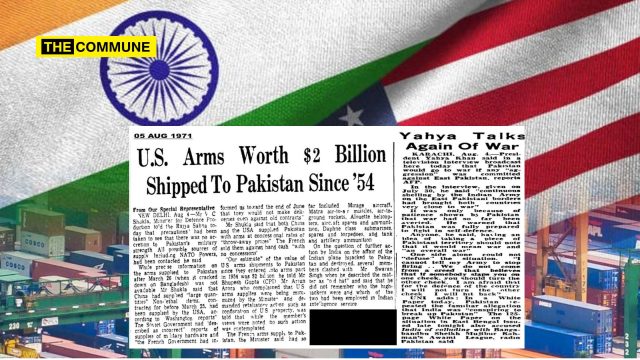
Indian Army Takes A Dig At U.S. Sharing How It Armed Pakistan In 1971 Amidst Trump’s Trade Threats

Amid growing strain between the US and India over trade ties, the Indian Army on 5 August 2025, shared details of how Pakistan, the safe haven for global terrorists, was receiving an ‘uninterrupted‘ supply of weapons from America since 1954.

The Eastern Command of the Indian Army shared a throwback newspaper clipping from 1971 archives, and shared it on its social media handle and wrote, “This Day That Year Build Up of War 05 Aug 1971″. “US Arms worth $2billion shipped to Pakistan since 1954”, the newspaper heading reads, with details of US shipments to Pakistan elaborately explained in the news report.

The report highlights how the United States remained one of the key suppliers of arms to Pakistan till 1971, the year when war broke out between India and Pakistan, resulting in the formation of Bangladesh. Indian Army’s digging out old news report on US arms supply to Pakistan assumes importance in light of the American President, Donald Trump’s recent tirade at India and also his threats of imposing ‘penalty’, besides the recently unveiled 25 per cent tariff. Trump recently threatened to impose additional tariffs on Indian goods, objecting to the latter’s purchase of subsidised oil from Russia. This prompted a strong counter from India as well as the Ministry of External Affairs (MEA), which pointed to ‘unfair‘ treatment and targeting by the US.

“They don’t care how many people in Ukraine are being killed by the Russian War Machine. Because of this, I will be substantially raising the Tariff paid by India to the USA,” Trump posted on Truth Social. Subsequently, India hit back at the United States, reminding it that when it began importing from Russia after the Ukraine conflict, the former ‘actively encouraged such imports’.

In a riposte to Trump’s threats to India over the purchase of Russian oil, the MEA said that the US objections were “unjustified and unreasonable”. The MEA also rebuked the European Union for singling out Indian refiners over their trade with Russia. It also called out the double standards of the US as well as the European Union and underscored the fact that America continues to import uranium hexafluoride from Russia for its nuclear installations.

-IANS

Subscribe to our TelegramWhatsApp, and Instagram channels and get the best stories of the day delivered to you personally.
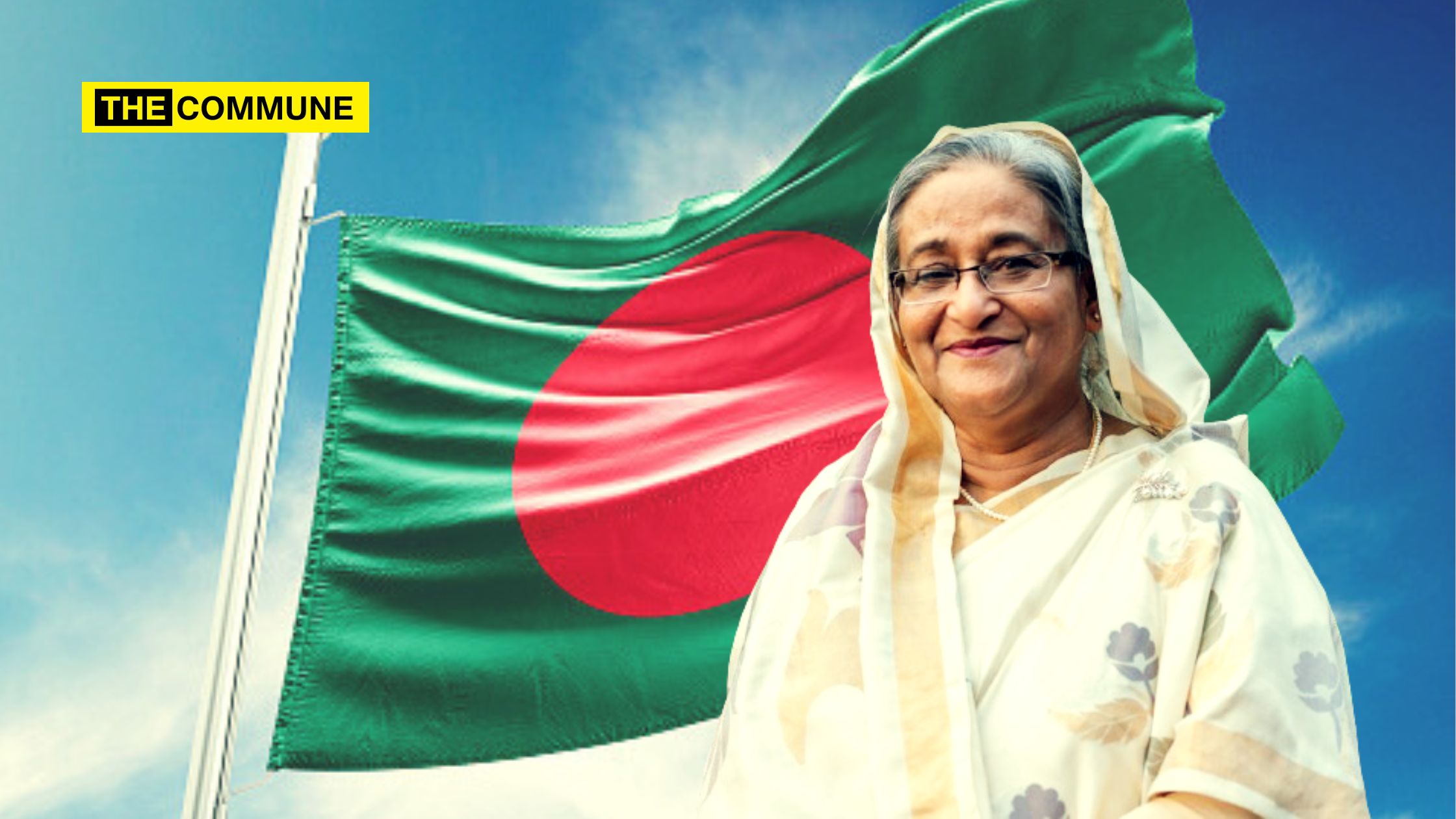
‘Power Belongs To The People’ Sheikh Hasina Reaffirms Faith In Democracy As Bangladesh Marks Year Of Political Upheaval

Sheikh Hasina achievements in Bangladesh

As Bangladesh marked one year since the fall of the democratically elected Awami League government on 5 August 2025, former Prime Minister Sheikh Hasina slammed the current interim regime and hailed the people for standing up in the face of “injustice and repression.”

In an open letter, the people of the country, Hasina wrote, “One year ago today, our nation witnessed the violent interruption of our hard-fought democracy, as an unelected regime seized power through unconstitutional means. It was a dark moment in our history, an affront to the will of the people, and a betrayal of the trust between citizens and the state.” Slamming the Muhammad Yunus-led interim government, Hasina stated, “While they may have taken power, they will never take away our spirit, our resolve, or our destiny. I can assure you of that.”

She praised the extraordinary courage of the people of Bangladesh who have refused to be silenced in the face of “injustice and repression.” “You have stood up for democracy, for freedom, and for the future we all deserve. I am constantly inspired by your courage and your love for our country. Though this past year has tested us, it has also revealed the unbreakable bond between our people and the values of democracy. We have endured hardship, but in that hardship, we have found unity and purpose,” the letter detailed. Emphasising that “power belongs to the people”, Hasina stated no regime can suppress the will of a nation forever, adding that their struggle for the just cause continues.

The former Prime Minister urged the people to continue “to stand for justice, for economic opportunity, for education, for peace, and for a nation where no one lives in fear.” “Together, we will rebuild what has been broken. Together, we will reclaim the institutions that were taken from us. And together, we will write a new chapter, one defined not by oppression, but by hope, progress, and freedom,” she said. Hasina expressed hope for the future and called on the people to remember it as “a rallying cry for a brighter tomorrow.” “Bangladesh has overcome adversity before, and we will rise again, stronger, more united, and more determined to build a democracy that truly serves its people. I believe in you. I believe in Bangladesh. And I believe that our best days are yet to come,” she added.

-IANS

Subscribe to our TelegramWhatsApp, and Instagram channels and get the best stories of the day delivered to you personally.
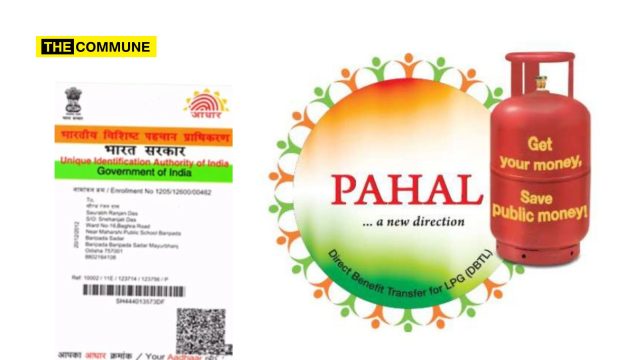
Over 4 Crore Fake And Duplicate LPG Connections Blocked Under Aadhaar-Linked PAHAL Scheme: Govt Tells Parliament

The Aadhaar-based authentication under the PAHAL scheme for the direct benefit transfer of LPG subsidy has played a crucial role in identifying and blocking ghost accounts, multiple accounts, and inactive connections, thereby curbing the diversion of subsidised LPG for commercial use, Minister of Petroleum and Natural Gas Hardeep Singh Puri informed Parliament on 5 August 2025.

As of 1 July this year, as many as 4.08 crore duplicate, fake, and inactive LPG connections have been blocked, suspended, or deactivated, the minister said in a written reply to a question in the Rajya Sabha. The minister said that Aadhaar-based authentication for DBT schemes enables accurate, real-time, and cost-effective identification, authentication, and de-duplication of beneficiaries, ensuring targeted delivery of benefits.

The government had directed public sector oil marketing companies to undertake and complete biometric Aadhaar authentication of PMUY and PAHAL beneficiaries. He said that focused efforts have been made to ensure that all consumers become Aadhaar Transfer Compliant. As of 1 July, 92.44 per cent of active LPG consumers out of a total 33.05 crore have their Aadhaar seeded in the database of the oil companies. Around 86.78 per cent of the total 30.63 crore DBTL consumers are Aadhaar Transfer Compliant.

As of 1  July this year, biometric Aadhaar authentication has also been completed for 67 per cent of the existing PMUY beneficiaries. Further, all new PMUY consumers undergo biometric authentication before the release of connections, the minister said. Puri further stated that the government has introduced the Common LPG Database Platform through which duplicate connections are identified and removed from the LPG database. Deduplication is carried out using Aadhaar number, bank account details, AHL TIN, ration card details, name, and address as key parameters. He pointed out that PAHAL enables the disbursement of targeted subsidy benefits to PMUY consumers.

Multiple steps have been taken to ensure that these benefits reach the eligible and targeted beneficiaries efficiently and in a timely manner. Since inception, as a result of comprehensive deduplication exercises, 8.49 lakh PMUY connections have been terminated. He added that, in January 2025, a Standard Operating Procedure (SOP) was issued for the removal of PMUY consumers who had not taken any refills after installation of their connection. Under this SOP, around 12,000 inactive PMUY connections have been terminated, the minister said. The Minister further stated that several studies have been conducted to assess the impact of the DBTL–PAHAL scheme.

A comprehensive third-party evaluation by the Research and Development Initiative (RDI) found that more than 90 per cent of respondents were satisfied with the subsidy reimbursement mechanism. The report recommends strengthening the subsidy payment infrastructure and grievance redressal systems, and improving targeting by limiting subsidies to economically weaker sections.

-IANS

Subscribe to our TelegramWhatsApp, and Instagram channels and get the best stories of the day delivered to you personally.