Home Blog Page 168

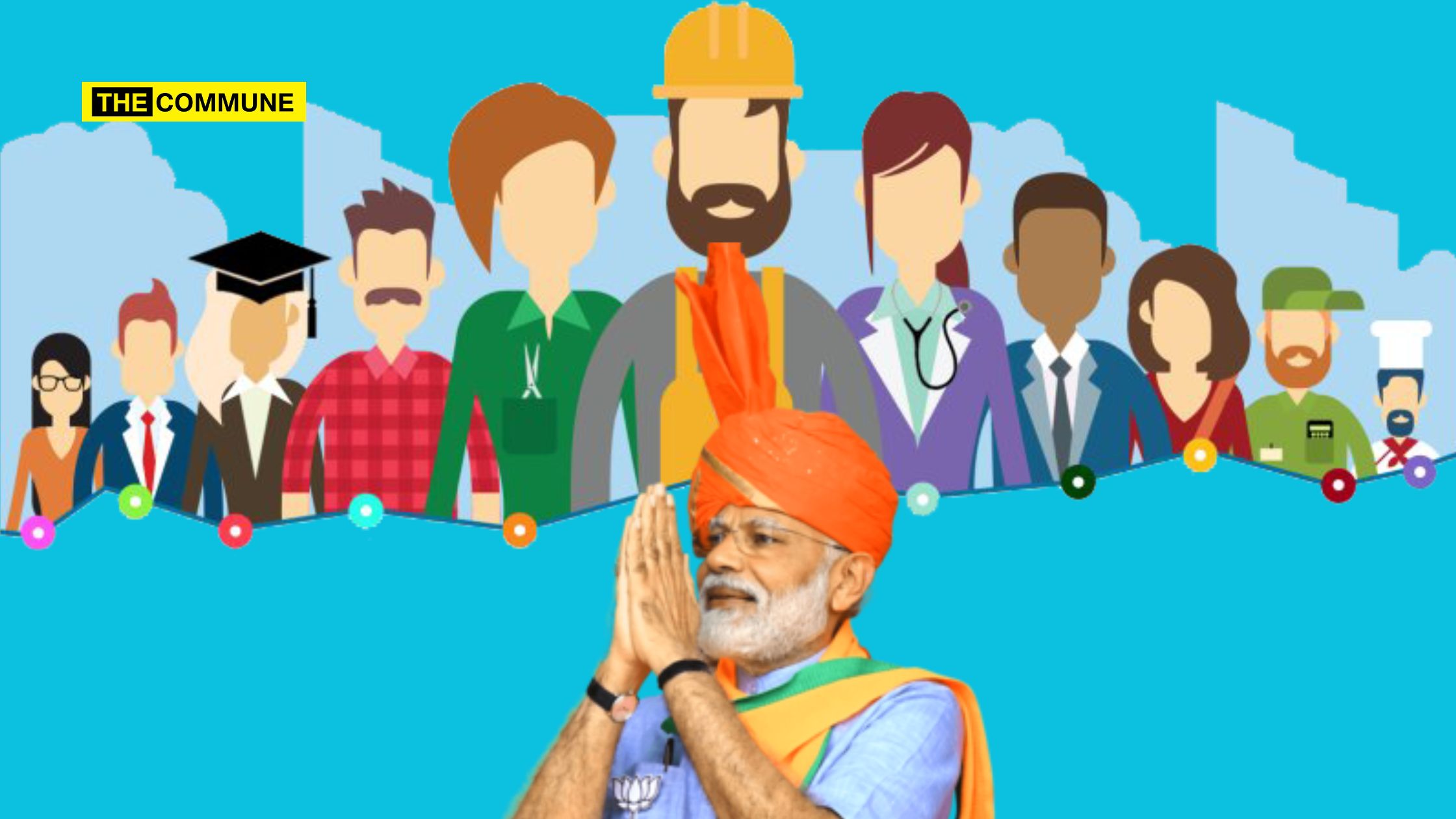
India’s Employment Rate Rises In July, Unemployment Falls To 5.2%

India's Job Crisis: Balancing Growth with Employment

The labour force participation rate (LFPR) in India, which is the indicator of employment, rose to 54.9 per cent among persons of age 15 years and above in July as compared to 54.2 per cent during June, according to data released by the Ministry of Statistics on Monday.

The worker participation rate (WPR), another indicator of employment, among persons of age 15 years and above increased to 54.4 per cent in rural areas during July this year from the corresponding figure of 53.3 per cent observed in June 2025. WPR in urban areas also registered a marginal increase to 47.0 per cent in July 2025 from 46.8 per cent in June 2025 for persons of the same age group, the data showed.

This supports the LFPR figures of an increase in employment. WPR for rural female of age 15 years and above was 35.5 per cent in July 2025 as compared to 23.5 per cent observed for urban female.

The overall female WPR of the same age group at the country level was 31.6 per cent during the month. The unemployment rate among persons of age 15 years and above declined to 5.2 per cent in July 2025 from 5.6 per cent in June 2025.

During July 2025, LFPR in rural areas and urban areas was 56.9 per cent and 50.7 per cent, respectively for persons of the same age group. LFPR in CWS for rural male of age 15 years and above was 78.1 per cent whereas the LFPR for urban male of the same age group was 75.1 per cent during July, 2025.

LFPR among rural female of the same age group increased to 36.9 per cent during July 2025, up from to 35.2 per cent reported during June 2025, the figures showed. The sampling methodology of the Periodic Labour Force Survey (PLFS) was revamped from January 2025, considering the need to generate high-frequency labour force indicators with wider coverage.

The redesigned PLFS aims to generate key employment and unemployment indicators – namely Labour Force Participation Rate (LFPR), Worker Population Ratio (WPR) and Unemployment Rate (UR) – every month for both rural and urban areas at the all-India level under the Current Weekly Status (CWS). It also aims to extend the Quarterly PLFS results to rural areas, thereby producing quarterly estimates of labour market indicators for both rural and urban India under the CWS framework.

Besides, it provides annual estimates of key employment and unemployment indicators in both usual status and Current Weekly Status (CWS) for rural as well as urban areas. Unemployment Rate (UR) for both males and females of age 15 years and above was recorded as 5.4 per cent during the quarter April-June quarter of 2025.

The overall rural UR was lower at 4.8 per cent compared to the UR of 6.8 per cent observed for the urban areas in April– June 2025 quarter. By industry of work, the agriculture sector engaged the majority of rural workers (44.6 per cent of men and 70.9 per cent of women), while the tertiary sector was the largest source of employment in urban areas (60.6 per cent of men and 64.9 per cent of women).

On average, 56.4 crore persons (aged 15 years and above) were employed in the country during this quarter, of which 39.7 crore were men and 16.7 crore were women, according to the ministry data.

-IANS

Subscribe to our channels on TelegramWhatsApp, and Instagram and get the best stories of the day delivered to you personally.

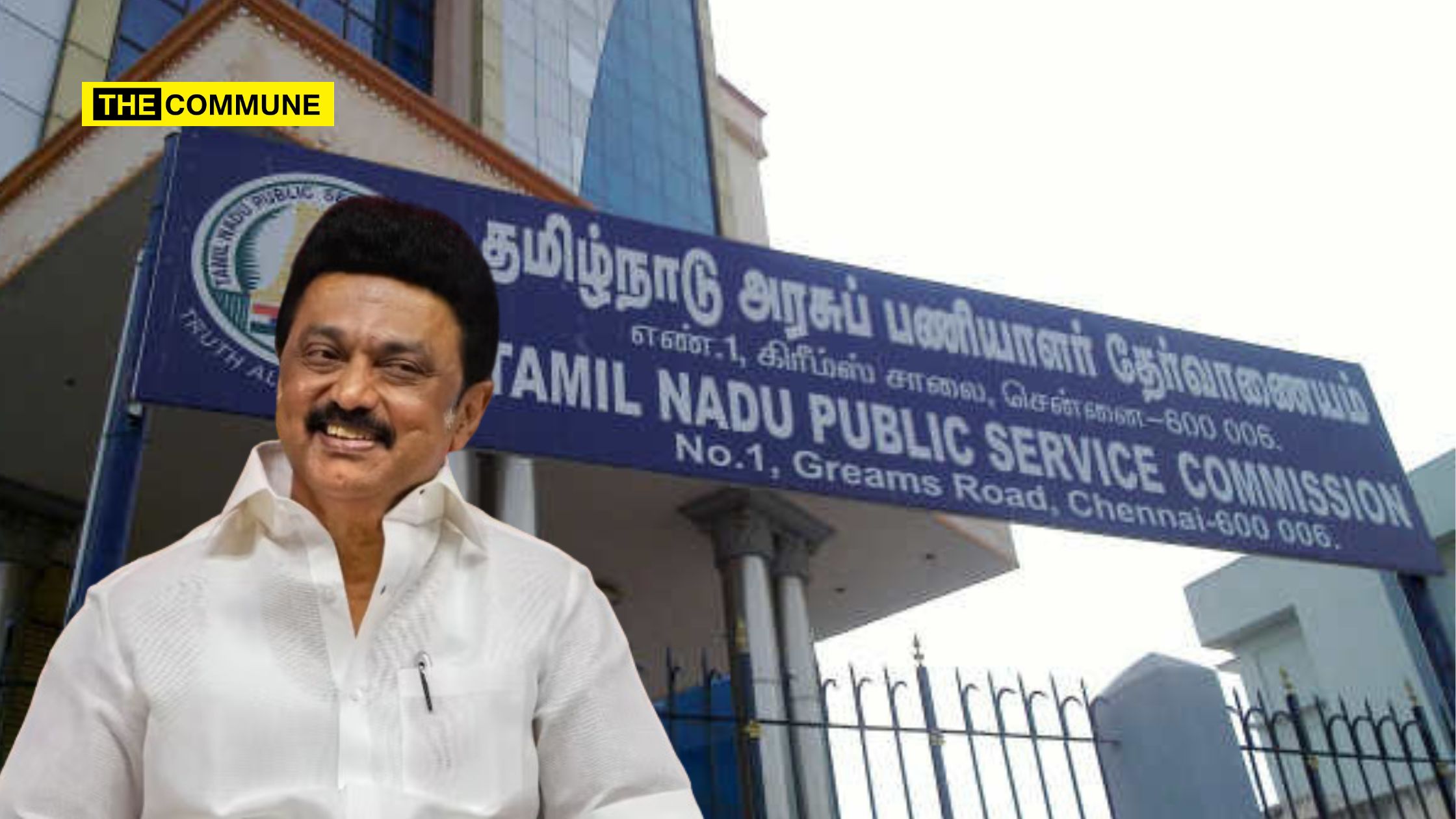
TNPSC Or DMKSC? Technical Services Exam Question Paper Mirrors Ruling Party’s Political Agenda

tnpsc group 1 exam dmk propaganda

The Tamil Nadu Public Service Commission (TNPSC), an autonomous body responsible for recruiting civil servants, is facing severe backlash over allegations of politicization under the DMK government. The latest controversy stems from a question in the Technical Services Examination (Non-Interview Post) held on 17 August 2025, which directly blamed the Union Government for withholding funds from Tamil Nadu under the Samagra Shiksha Scheme (SSS), a politically charged framing that aligns with the DMK’s rhetoric against the Centre.

TNPSC Exam Paper Mirrors DMK’s Political Narrative

The question in the Reason and Assertion section read:

Assertion [A]: Tamil Nadu has long resisted the imposition of Hindi in government schools and hence refused to join the Prime Minister Schools for Rising India (PMSRI). Therefore, the Union Government has withheld funds under the Samagra Shiksha Scheme (SSS).

Reason [R]: Though the Union government acknowledged Tamil Nadu’s two-language policy, it seeks to influence subjects in the Concurrent List through the New Education Policy (NEP) 2020, which the Tamil Nadu government opposes as an attack on federalism.

Critics argue that the question frames the Centre as the villain while uncritically endorsing the DMK’s stance, raising concerns over whether TNPSC is functioning as an extension of the ruling party’s propaganda machinery.

A Pattern of Politicization

This is not an isolated incident. Over the past year, TNPSC exams have repeatedly included politically loaded questions that critics say promote DMK’s agenda:

“Thayumanavar” Controversy (Group 2A Exam, 2025)

A question asked which scheme made people call the Chief Minister “Thayumanavar“, with options listing DMK welfare schemes like Makkaludan Mudhalvar and School Breakfast Program.

Critics slammed it as sycophantic, arguing that exams should test governance knowledge, not propaganda.

Freedom Fighter Vilified (Group 1 Exam, July 2024)

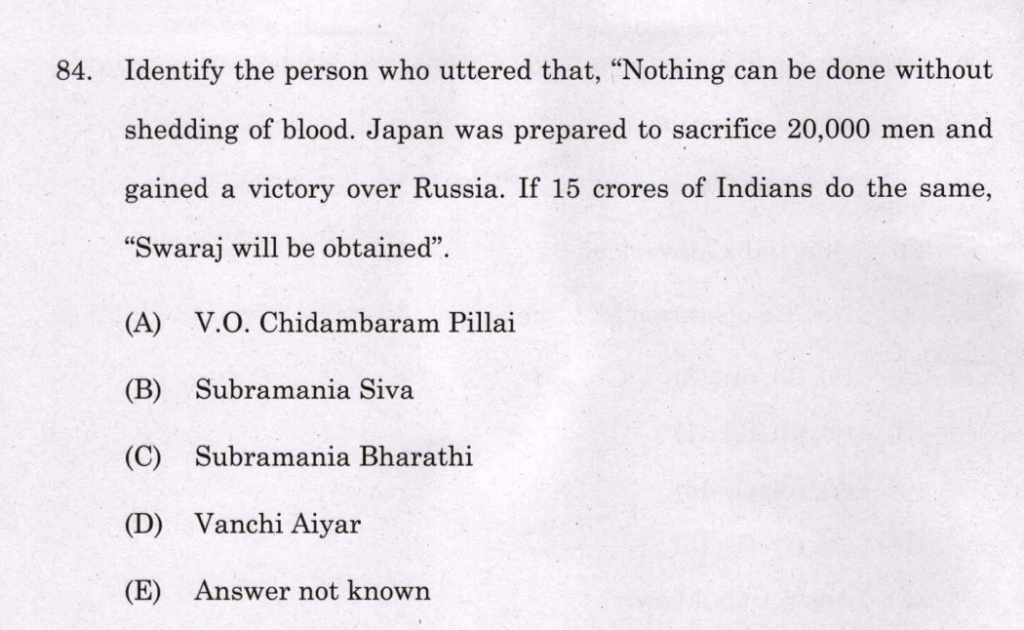
A question labeled Vanchinathan, a Tamil freedom fighter who assassinated British official Robert Ashe, as a “first accused” in a murder case, echoing colonial-era rhetoric rather than honoring his role in the independence struggle.

UNESCO’s “Socrates of South Asia” Myth (Group 1 Exam, 2024)

A question falsely claimed E.V. Ramasamy (Periyar) was certified by UNESCO as the “Socrates of South Asia”, despite UNESCO denying ever giving such a title.

The DMK has long pushed this debunked claim, and TNPSC’s inclusion of it raised eyebrows.

Selective Erasure of Caste Surnames (Group 1 Exam, 2025)

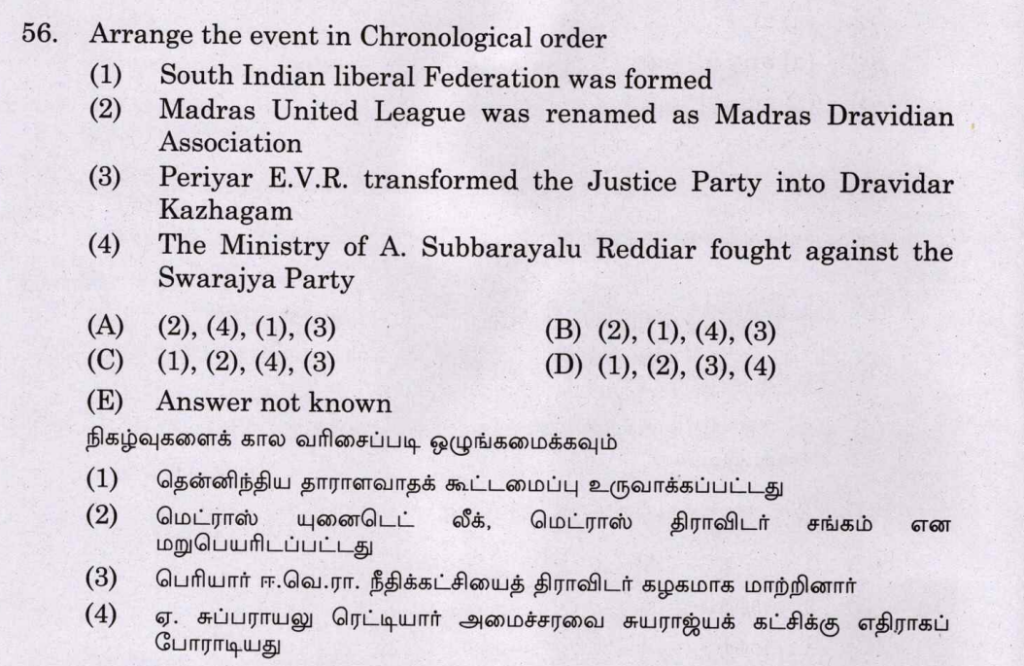
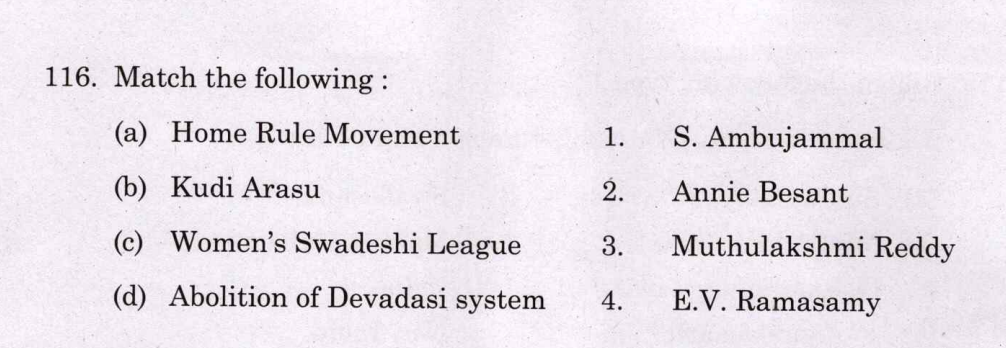
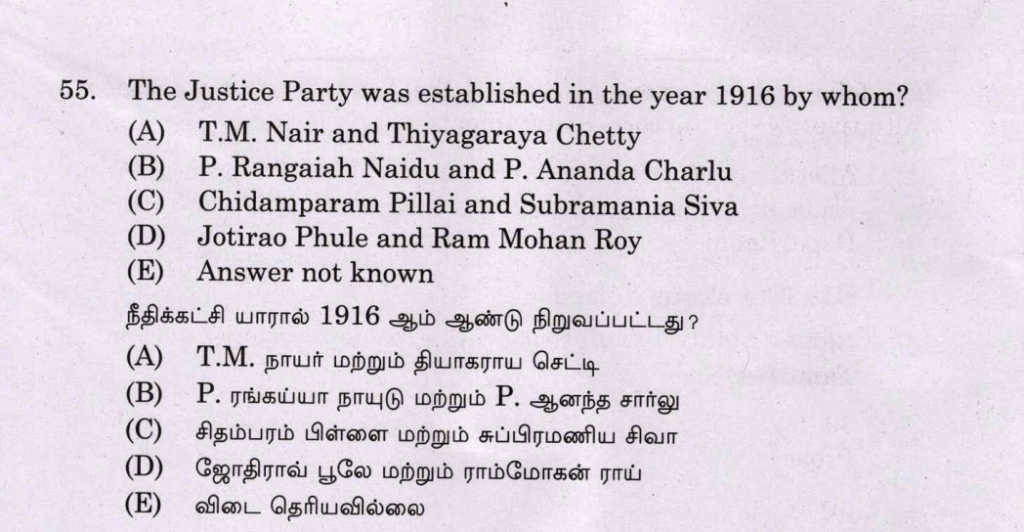
While DMK leaders like Annadurai and Periyar were mentioned without caste surnames, others including Subbarayalu Reddiar, V.O. Chidambaram Pillai, and Dr. Muthulakshmi Reddy were explicitly identified by caste.

This hypocrisy contradicts the DMK’s claim of abolishing caste identities, exposing its political opportunism.

The present controversy has reignited debates over the DMK’s influence on autonomous bodies, with many questioning whether Tamil Nadu’s administrative institutions are now extensions of the ruling party.

Subscribe to our channels on TelegramWhatsApp, and Instagram and get the best stories of the day delivered to you personally.

“Trump Is Empowering A Terrorist State”: Baloch Activist Slams US-Pakistan Mineral Deal

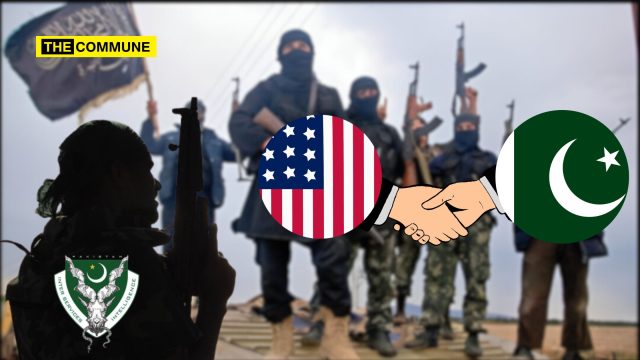
Leading Baloch human rights defender Mir Yar Baloch asserted that United States President Donald Trump gambled with peace by considering entrusting trillions of dollars’ worth of Balochistan’s mineral wealth to Pakistan, thereby empowering the terrorist country.

Mir stressed that if Pakistan gains unchecked control over Balochistan’s trillion-dollar worth of critical minerals and rare earth resources, it would only accelerate its extremist ambitions. Very soon, its religious radicals, he added, would attempt to “impose their brand of ‘Sharia’ even within the US itself.” He highlighted that the warning signs are already visible across Europe and other parts of the world, where every trail of extremism and terrorism consistently traces back to Pakistan’s Inter-Services Intelligence (ISI).

The remarks came after Pakistan’s Field Marshal Asim Munir, in an interview with local media outlet Jung News, said, “Pakistan has a rare earth treasure, with this treasure, Pakistan’s debt will also be reduced and Pakistan will soon be counted among the most prosperous societies.” “The sixty million people of Balochistan once again wish to remind Pakistan and the international community that the mineral wealth found in Republic of Balochistan does not belong to an artificial state of Pakistan that has existed for merely seventy-seven years, but to the Baloch nation, whose history and presence span over ten thousand years on the world map,” Mir posted on X.

Slamming Munir, the human rights activist claimed that these resources are the legitimate inheritance of the Baloch people and not of the Pakistani government or army, which has forcibly annexed the region. Emphasising that Balochistan is a “free nation,” Mir said that any attempt to “unlawfully seize” another country’s natural wealth constitutes a grave violation of international law.

He accused Pakistan’s corrupt establishment of repeatedly mortgaging Balochistan’s resources while securing loans from the IMF, World Bank, and other international financial institutions, deliberately misrepresenting ownership of these assets. The Baloch people, he said, have repeatedly warned these international institutions to refrain from extending financial support to the bankrupt Pakistan based on resources that do not belong to it.

Mir stressed that Munir, who, he said, draws inspiration from global terrorists like Osama Bin Laden, has claimed that Pakistan took the initiative in recommending Trump for the Nobel Peace Prize. The human rights activist said that a true Nobel Peace Prize for any American President would only be deserved if the US formally recognised Pakistan as a terrorist state and held its military generals accountable before the International Court of Justice for the deaths of 5000 American soldiers in Afghanistan after 9/11, orchestrated by ISI generals. Mir stressed that the ISI had harboured Osama bin Laden for nearly a decade, despite his involvement in global terrorism, including the September 11 attacks.

He also accused ISI of being involved in the genocide of 30 million Bengalis in 1971 in Dhaka, the killing of Palestinians in Jordan in 1971, and the genocide of the Afghans in Afghanistan and the Baloch people in Balochistan. He noted that if Trump is ever to be awarded a Nobel Peace Prize, that recognition will not come from Pakistan’s rogue military establishment, but from the people of Balochistan, Afghanistan, Bangladesh, and India, nations that have borne the brunt of Pakistan’s state-sponsored terrorism, cross-border aggression, ethnic cleansing, and military occupation. “To receive a Nobel Peace Prize from a terrorist, or at the behest of a terrorist state, would be no different than being rewarded by a terrorist itself. True peace cannot be validated by those who nurture violence,” Mir stated.

-IANS

Subscribe to our channels on TelegramWhatsApp, and Instagram and get the best stories of the day delivered to you personally.

Arak And Sheetal’s Deaths Are Not Isolated — They Are The Norm In Pakistan’s Gender Apartheid

teen girl stabbed to death ranipet palakkad

The recent brutal murders of Arak and Sheetal are not isolated tragedies but the latest entries in Pakistan’s long catalogue of bloodletting conducted in the name of honour. While Pakistan’s government speaks about morality and sovereignty, the reality is that Pakistan has become a slaughterhouse for women, where patriarchal violence is not only tolerated but placed in the fabric of society and backed by state institutions.

Each year, 300-1000 women are killed by their own families under the pretext of honour. Tehmeena Rizvi, a policy analyst, in First Post, wrote that these are not crimes of passion but a premeditated execution and happen with such frequency, brazenness that they expose Pakistan for being a nation incapable of protecting half of its population and not ready to confront the barbarity it shelters.

The report stated, “The killings of Arak and Sheetal are horrifying, but they are also predictable. They happened in a country where misogyny is weaponised, where women who dare to love, marry, or simply make choices of their own are punished with death. Pakistan has normalised this slaughter to such an extent that it barely registers as shocking anymore inside its borders. Instead, honour killings are treated as ‘family matters,’ excused by police, and whitewashed by local media using euphemisms like “tragedy” or “dispute.” Murder is softened into culture. Violence is disguised as tradition.”

The much-welcomed 2016 legal reforms supposedly “closed loopholes” that enabled killers to escape punishment. Years later, families still protect perpetrators of the crime, and the jirga and tribal council back honour killings as acceptable justice. Political leaders still play to the misogynistic gallery as they are scared to raise objections to the same patriarchal structures that keep them in power.

Laws in Pakistan are theatre; the stage props look modern, but the blood on the floor is real. The deaths of Arak and Sheetal make clear what Pakistan’s rulers refuse to admit: women in this country live in a permanent state of siege. Their bodies are not their own. Their choices are treated as threats. Their existence is conditional upon obedience to a code that sees them as property. To step outside that line is to sign one’s own death warrant. And when that death comes, the killers are rarely punished. Pakistan’s honour killing crisis is not a side issue or a cultural quirk. It is central to how the state operates—through fear, violence, and the crushing of dissent, whether political or personal,” Tehmeena Rizvi wrote in First Post.

Women in Pakistan are murdered to enforce obedience, just like Baloch voices are silenced by enforced disappearances and journalists are intimidated into submission. As per the report, honour killings are not a random crime but an instrument of control. Despite this, Pakistan calls itself a democracy, a land of values, a country of pride. The report stated, “Where is the pride in the corpses of women dumped in shallow graves? Where is the honour in strangling daughters because they chose whom to love? Where is the morality in a state that passes laws it never enforces, that pretends progress while presiding over medieval brutality?” Pakistan is not only failing its women but destroying them. A nation where hundreds of women are killed each year with impunity cannot be a civilised state but a patriarchal fortress built on blood and silence. Despite this, Pakistan’s leadership tries to deceive the world by mentioning reforms, quoting statistics selectively, and telling the international community that things are improving in their country.

According to the First Post report, Arak and Sheetal will soon be replaced by other women, and the killings will continue in Pakistan. The report stated, “The police will shrug. The politicians will preen. The mullahs will remain silent. And Pakistan will continue to bleed its daughters, one by one, while claiming to defend honour. But there is no honour in murder. There is only shame, and it belongs entirely to Pakistan. Pakistan has reached its lowest depths.” A nation which cannot protect its women in their own homes provides them no safety anywhere. The report stated, “For countless women, Pakistan is no longer a country to live in, but a graveyard that buries their voices, their dignity, and their very existence.” 

-IANS

Subscribe to our channels on TelegramWhatsApp, and Instagram and get the best stories of the day delivered to you personally.

Andhra Police Nab Kotwal Noor Mohammad For Links To 30 Pakistan-Based Jihadist Groups; Booked Under UAPA, BNS

A 42-year-old man arrested in Andhra Pradesh’s Sri Sathya Sai district was found to be actively connected to the Pakistan-backed social media groups, circulating jihadi propaganda, police said on 17 August 2025. Kotwal Noor Mohammad was arrested in Dharmavaram town on 16 August. Superintendent of Police (SP) V. Ratna confirmed the arrest at a news conference on 17 August.

A case has been filed under the stringent sections of the Bharatiya Nyaya Sanhita (BNS) and the Unlawful Activities (Prevention) Act (UAPA). The SP said that the accused has been booked for promoting enmity between different groups and indulging in activities prejudicial to the sovereignty and integrity of India.

According to the SP, he was found to be a member in six WhatsApp groups of banned organisations and was also active in 30 other social media groups of Pakistan. Police also detained another person who was in touch with Noor Mohammad. The police were questioning him. Noor Mohammad was presented before a magistrate, who remanded him to judicial custody. He was sent to Kadapa Jail. Noor Mohammad was working at a hotel in the town, making chicken biryani. He has been staying in the town for the last 15 years.

Police initially suspected him of being a passive member, but the preliminary investigation revealed that he was an active participant in discussions intended to glorify extremist ideology. The police seized the accused’s mobile phone and a book in which he had allegedly written the messages and information received on WhatsApp groups.

The SP said the seized mobile had been sent to forensic laboratories to unravel his “digital footprint” to map his network. She did not rule out the possibility that the accused might have acted as a recruiter or sympathiser beyond the Sri Sathya Sai district. The arrest was made on the information provided by counter-intelligence.

The questioning also revealed that he was ready to go for training with the terrorist groups. The SP stated that the incident proves how social media platforms are being mishandled and misused to negatively impact youth and gullible minds at the local level by terrorist groups.

-IANS

Subscribe to our channels on TelegramWhatsApp, and Instagram and get the best stories of the day delivered to you personally.

US Firm Jefferies Says ‘Buy India’, Predicts Trump’s Tariff Reversal

US broking firm Jefferies has recommended its clients to purchase Indian stocks rather than sell them, as US President Donald Trump’s tariff policies are bound to take a U-turn, a report said on 18 August.

In the report by Jefferies, Christopher Wood, a leading analyst at the US broking firm, suggested that its clients consider investing in India owing to the current global market environment and the possibility that Trump will eventually change his stance, which is not in America’s interest. “It is only a matter of time before Trump backs off the stance, which is not in America’s interest… On this point, it is worth noting that the track record makes it clear that it pays to stand up to the Donald,” Wood said.

Wood stated that Trump’s actions against major economies could drive the BRICS nations — Brazil, Russia, India, China, and South Africa — toward de-dollarisation. De-dollarisation is a situation where countries use a non-dollar currency for transactions instead of the US dollar. The analyst said that Jefferies has consistently maintained a bullish stance on India, especially in its Asia ex-Japan long-only portfolio.

The report noted that the country has experienced its largest period of underperformance in the past 12 months compared to global emerging markets in the last 15 years. The broking firm also kept a “marginal Overweight” stance on India in its Asia ex-Japan relative-return book. “India represents the best long-term structural story in Asia,” though the market is “facing high valuations and massive equity supply”, said Wood. Indian equities are trading at 20.2 times one-year forward earnings, down from 22.4 times at the peak in October 2021.

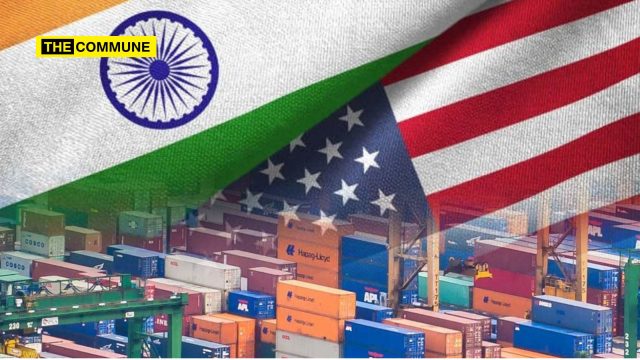
The Jefferies strategist noted that BRICS countries are reuniting primarily due to the lack of a conceptual framework in the US administration’s foreign policy. Meanwhile, several media reports claimed that the visit scheduled by US trade representatives to New Delhi between 25 and 29 August will likely be rescheduled. Trade relations between the two countries have soured after the US imposed a 25 per cent tariff on Indian exports, with threats of an additional 25 per cent duty scheduled to be in effect from 27 August.

-IANS

Subscribe to our channels on TelegramWhatsApp, and Instagram and get the best stories of the day delivered to you personally.

ECI Issues Ultimatum: Demands Proof Or Public Apology From Rahul Gandhi Over ‘Vote Chori’ Claim

rahul gandhi eci vote chori

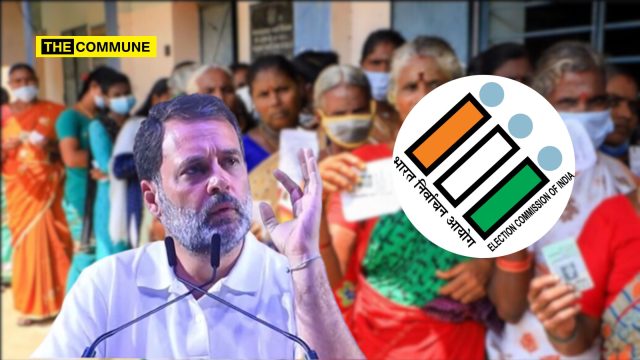
The political temperature in the country rose sharply on 17 August after the Election Commission of India (ECI) issued an ultimatum to the Leader of Opposition (LoP) in the Lok Sabha, Rahul Gandhi, over his “vote chori” remarks. The ECI directed LoP Gandhi to either submit an affidavit with evidence supporting his allegations within seven days or issue a public apology.

The Commission said that in the absence of an affidavit, all such accusations would be treated as false. The ruling BJP welcomed the ECI’s move, pressing LoP Gandhi to comply, while the INDIA Bloc accused the poll body of acting as a “political weapon” to silence dissent.

Union Minister Giriraj Singh lashed out at the Congress MP, saying, “The Election Commission had clearly said they must file an affidavit within seven days, otherwise he (LoP Gandhi) should apologise to the people. I want to ask, today is 18 August, till now, how many names has he found to be wrong and submitted to the Election Commission? Spreading confusion will not help.”

Speaking to IANS, Uttar Pradesh Deputy Chief Minister Keshav Prasad Maurya professed, “Rahul Gandhi has been spreading chaos and questioning constitutional institutions. Every process has a proper procedure; if a political party has objections to the voter list publication and revision, it can raise them officially.” “However, Rahul Gandhi is firing blindly, spreading rumours in the country,” he claimed and added, “His conduct is neither democratic nor constitutional and is completely irresponsible. For someone in the responsible position of Leader of the Opposition, such actions are disgraceful.”

Madhya Pradesh Minister Vishvas Sarang also slammed the LoP, telling IANS, “Rahul Gandhi, without any factual basis, makes such baseless statements for media and photo opportunities to mislead the public. When allegations are made against institutions like the Election Commission, one must provide facts and an affidavit; this is the rule.”

Backing the ECI, Uttar Pradesh Minister Anil Rajbhar said the poll body had already clarified all the questions raised by the Opposition. “I think the Election Commission held an exceptionally long press conference yesterday, something that has never happened before. They answered every question and clarified every issue,” he said. JD(U) MP Dileshwar Kamait also criticised LoP Gandhi for targeting the Commission, saying, “The poll body has answered to the confusion, now it’s time for Rahul Gandhi to do the same. The people of the country know the Commission aims to conduct free and fair elections. An affidavit is essential for ensuring impartiality.”

However, the Opposition made it clear that LoP Gandhi would not apologise, arguing that he had spoken the truth and had not committed any wrongdoing. Congress MP Pramod Tiwari strongly defended LoP Gandhi, saying, “I would like to tell Gyanesh Kumar that, as the respected Chief Election Commissioner holding a constitutional position, he should maintain the dignity of his office. The way he conducted the press conference, the term ‘vote theft’ seems too mild. If citizens are unable to exercise their rights, who else will safeguard them? I urge him to act responsibly and ensure nothing happens that would make people lose faith in him.” Congress MP Imran Masood also stood firm, declaring, “Apology from LoP Rahul Gandhi? Why should he apologise? Rahul Gandhi will not apologise. Whatever he has said, he has said it boldly and with conviction.”

He added that the ECI had failed to address the core issues raised by the Opposition and said, “They didn’t even touch upon the very question that has created an uproar across the entire country. They didn’t mention that at all. They didn’t even bring up the Lok Sabha, where so many fake voters were caught and identified. There was no mention of that either.”

Shiv Sena (UBT) MP Priyanka Chaturvedi also hit out at the Commission, telling IANS, “We did not get any concrete answers to our questions. It was merely a script being read out, seemingly drafted from the BJP office and aimed at targeting the Opposition. Today, it has become clear that the Election Commission is misusing its authority, while the BJP is using it as a tool to attack the Opposition.” Samajwadi Party MP Ram Gopal Yadav expressed similar concerns about the poll body.

Speaking to IANS, he said, “If the Election Commission swears before the country that its voter list is completely accurate, then it has the right to demand an affidavit… If the Election Commission makes a mistake, it says to file an application for correction, but if someone points it out, they demand an affidavit. This is not right.”

NCP (SP) MLA Rohit Pawar also accused the poll body of partisanship, saying, “We want to tell the Election Commission that you are a constitutional body. You should act in the manner you are supposed to, but you are not doing so. You are acting like an extended department of the BJP. Here, you are only misleading through words or language without taking real action.”

-IANS

Subscribe to our channels on TelegramWhatsApp, and Instagram and get the best stories of the day delivered to you personally.

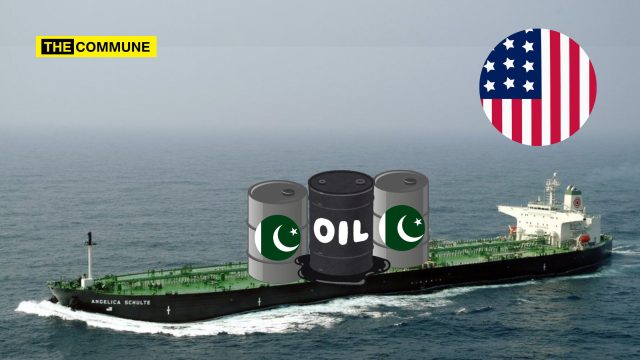
Trump’s Oil Deal With Pakistan Disrupts South Asian Equilibrium, Poses Risk For U.S. Firm

President Donald Trump’s announcement of a new US-Pakistan deal to jointly develop Pakistan’s oil reserves has added more complexity into South Asian geopolitics as the deal carries implications far beyond its stated aim of energy development.

Despite Trump’s reference to “massive oil reserves,” Pakistan’s conventional crude output remains modest by global standards. The country’s proven reserves stand at roughly 238 million barrels, a sliver compared to Middle Eastern producers. Where Pakistan’s real promise lies is in its natural gas wealth (an estimated 18 trillion cubic feet) and technically recoverable shale oil deposits, pegged at about 9 billion barrels, concentrated largely in Balochistan’s under-explored basins.

Balochistan, however, is both an energy frontier and a political tinderbox. The province hosts vast mineral deposits — copper, gold, and chromite among them — and is crisscrossed by energy infrastructure linked to the China-Pakistan Economic Corridor (CPEC). It is also home to a decades-long insurgency, with groups like the Baloch Liberation Army targeting pipelines, mines, and foreign contractors. Any US-led oil and gas project here would, therefore, be as much a test of Islamabad’s internal security capacity as it would be of its resource potential, according to an article by retired IAS officer KBS Sidhu.

The article highlights the risks involved in strife-torn Balochistan, if US energy majors move into the province. The region already hosts Chinese-backed projects under CPEC and is strategically linked to Gwadar Port, China’s Arabian Sea outlet. However, insurgent activity has repeatedly disrupted projects, targeting foreign workers and energy installations alike. For the Baloch nationalist movement, U.S.-led resource development could become another rallying point against what they perceive as external exploitation. Washington’s involvement will thus carry not only commercial risks but also broader geopolitical reverberations, potentially complicating both China’s and Pakistan’s plans for the province.

This new US-Pakistan energy partnership signals that Washington is ready to engage Islamabad in ways that bypass traditional military aid frameworks, using commerce and investment as entry points, the author observes. The article further states that going forward, India’s foreign policy will need to account for this evolving triangle. Maintaining momentum in Indo-US defence and technology ties, hedging on energy diversification, and using its negotiating leverage to neutralise tariffs will be essential.

The broader trajectory of US-India relations may now hinge on how deftly New Delhi can both manage Trump’s transactionalism and ensure that any new American footprint in Pakistan is shaped in ways that ultimately reinforce, rather than undercut, India’s strategic standing in the region. In sum, Trump’s oil deal is more than a headline — it is a stress test for India’s ability to blend hard-nosed trade bargaining with big-picture diplomacy in a rapidly shifting regional order, the article added.

-IANS

Subscribe to our channels on TelegramWhatsApp, and Instagram and get the best stories of the day delivered to you personally.

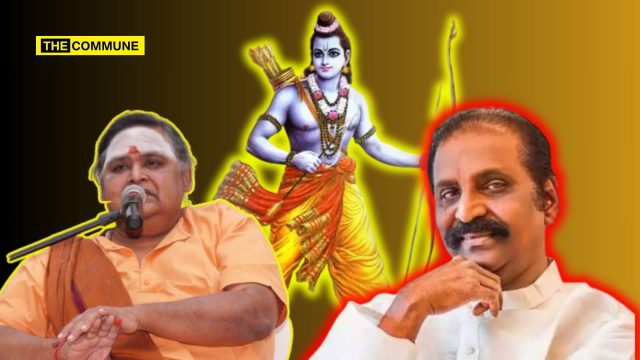
Tamil scholar Kambavarithi Ilangai Jeyaraj Issues Scathing Response To DMK-Supporting Sexual Harassment-Accused Vairamuthu For Derogating Lord Ram

ilangai jeyaraj vairamuthu lord rama
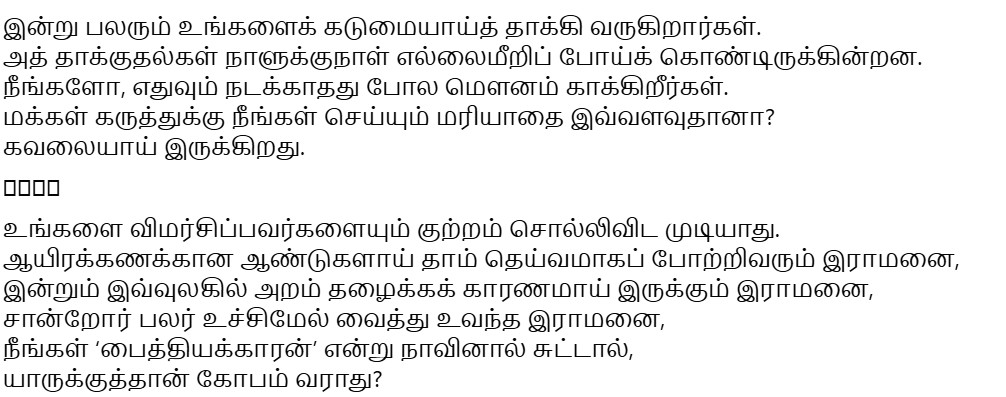
Renowned Tamil scholar and spiritual orator Kambavarithi Ilangai Jeyaraj issued a pointed and intellectually rigorous rebuke of #MeToo-accused Tamil lyricist Vairamuthu, following the latter’s controversial comments about Lord Ram at a recent event in Mylapore. Vairamuthu, while speaking on poet Kamban’s Tamil epic Kambaramayanam, claimed that Kamban “saved” Lord Ram by depicting him as having was mentally unsound after being separated from Sita, a state Vairamuthu likened to legal insanity under the Indian Penal Code, which exempts individuals of unsound mind from criminal liability.

Ilangai Jeyaraj, who was present at the event, initially addressed the comment with restraint. However, he later followed up with a more thorough and unmistakably scathing response, published for a wider audience to make his position clear. His intent was not only to defend Hindu tradition but to call out a recurring pattern of disrespect toward Hindu deities by certain intellectuals and ideologues associated with the Dravidianist narrative.

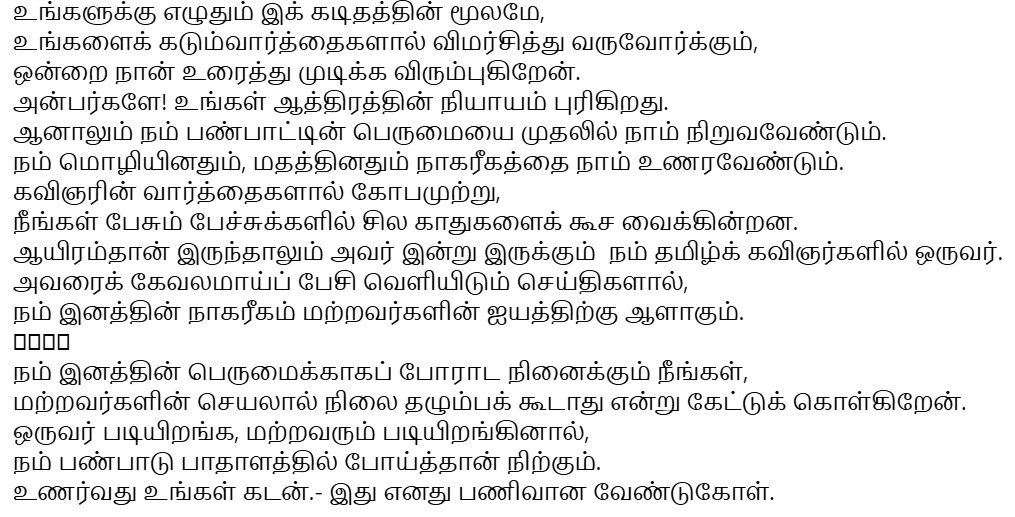
In a social media post that balanced rhetorical civility with sharp criticism, Ilangai Jeyaraj began with the words, “Greetings to my beloved Kaviperarasu Vairamuthu! I pray for your well-being. You are once again embroiled in controversy. Before I get to the matter at hand, I must express my gratitude to you. At the Chennai Kamban Festival, you spoke very highly of me, and I am thankful for that affection. Beyond that sense of gratitude, I regret that I must say a few things. You, too, accept the teachings of Valluvan, and you know well the purpose behind placing the chapter on ‘Impartiality’ after the chapter on ‘Gratitude.’ It is in the spirit of that Valluvan’s wisdom that I attempt to write this letter.” 
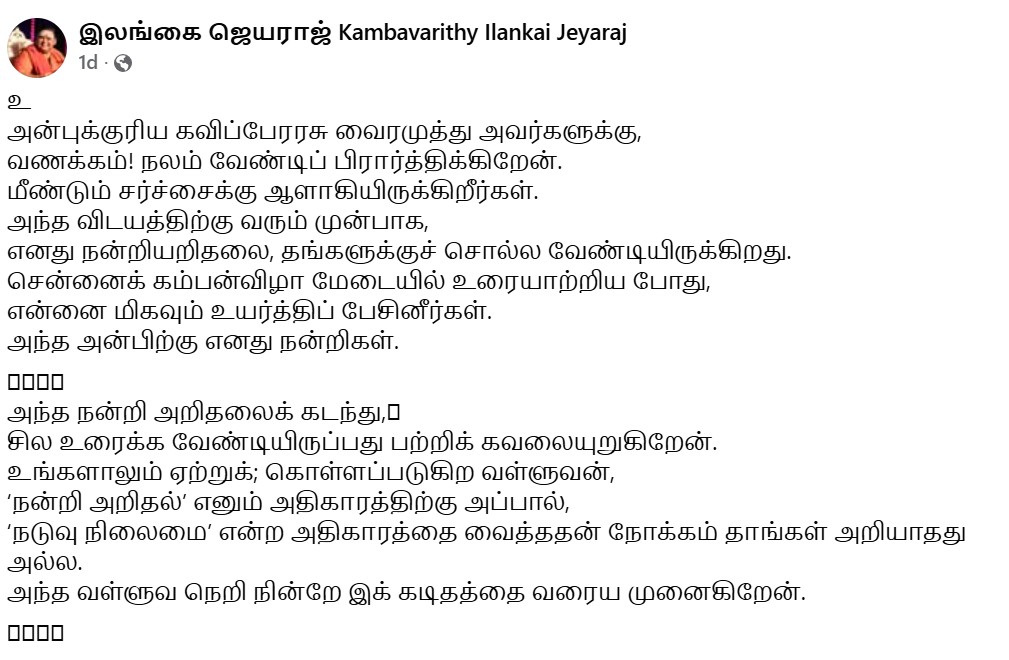
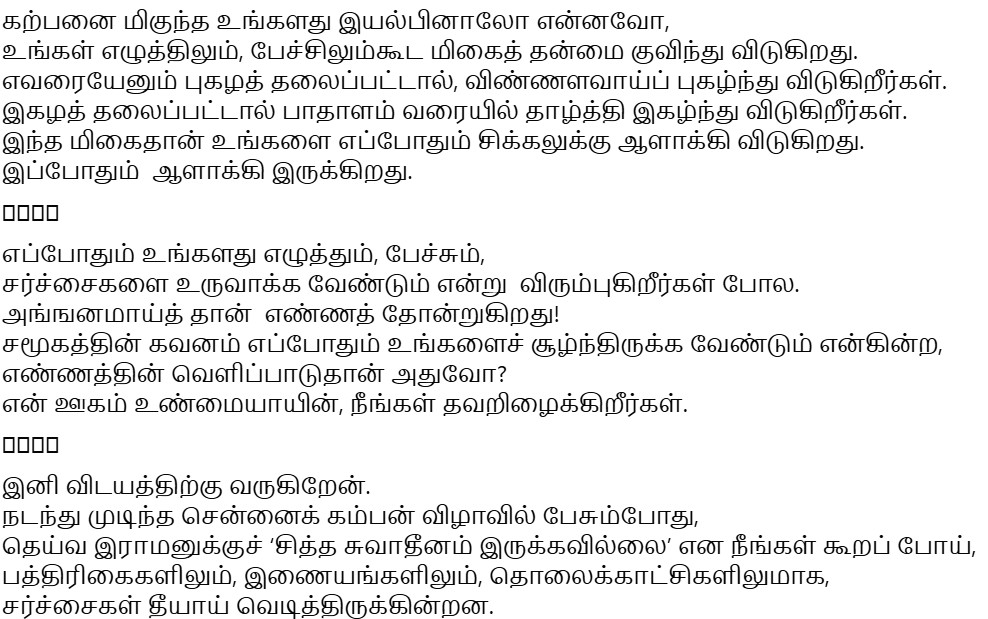
Jeyaraj’s tone, though outwardly courteous, carried the weight of deep moral indignation. He criticized Vairamuthu’s long-standing habit of intellectual provocation disguised as poetry, accusing him of repeatedly using religious or cultural symbols to generate controversy for personal relevance or ideological signaling. He said, “Perhaps due to your highly imaginative nature, your writing and speeches are often filled with exaggeration. When you praise someone, you elevate them to the heavens, and when you disparage them, you drag them down to the depths. This exaggeration is what constantly lands you in trouble. It has happened again now. It seems as though you always want your writing and speeches to create controversy. That is what it feels like! Is this a manifestation of a desire for society’s attention to always be on you? If my guess is correct, you are making a mistake. Now, I will come to the point. During your speech at the recently concluded Chennai Kamban Festival, your statement that the divine Rama ‘lacked mental stability’ has ignited a firestorm of controversy in newspapers, on the internet, and on television.

Many are severely criticizing you now. These criticisms are escalating day by day. Yet you remain silent, as if nothing has happened. Is this all the respect you have for public opinion? It is a matter of concern. You cannot fault those who criticize you. Rama, whom they have revered as a deity for thousands of years, Rama, who is the reason for righteousness prevailing in this world, Rama, whom many learned scholars have held in high esteem – if you brand him a ‘madman’ with your tongue, who would not get angry?” 
He reminded the lyricist that Lord Ram is not merely a literary figure, but a central deity for millions, a moral exemplar, and a symbol of righteousness and dharma.

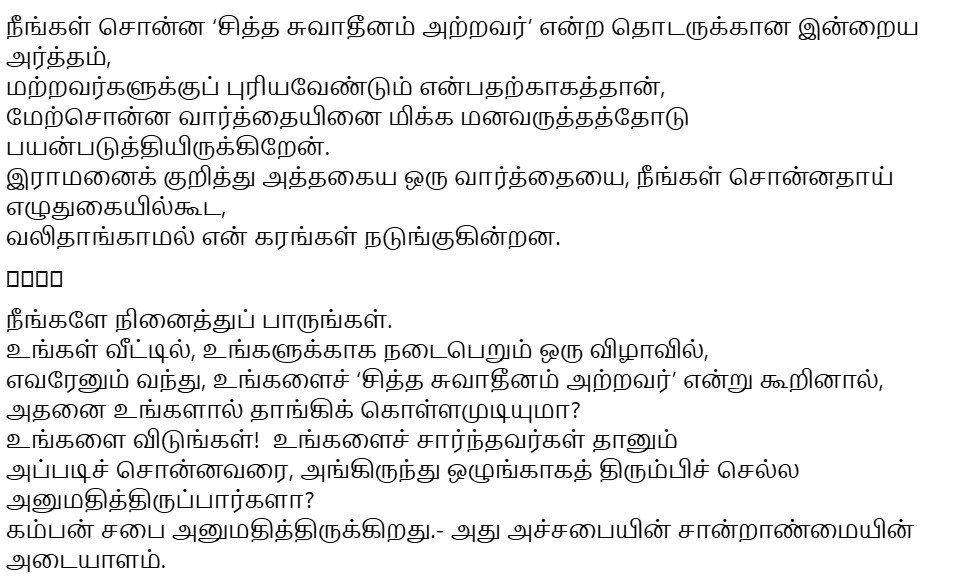
Ilangai Jeyaraj minced no words when addressing the implications of calling Rama ‘mentally unstable’, “I used the word ‘madman’ with great pain to make others understand the current meaning of the phrase ‘lacked mental stability’ that you used. Even as I write about you saying such a word about Rama, my hands tremble with unbearable pain. Think about it yourself. In a celebration held at your home for you, if someone were to come and call you ‘lacked mental stability,’ could you bear it? Leave aside you, would your family members have allowed that person to leave properly? The Kamban society allowed it – that is a sign of its greatness.”
He pointed out the deep irony of Vairamuthu speaking in such terms at a Kamban festival, a stage meant to honor one of Tamil’s greatest spiritual poets. By doing so, Jeyaraj argued, the lyricist did not merely misinterpret Kamban but he insulted the very spirit of the event, and worse, did so in a manner designed to avoid immediate confrontation while maximizing public outrage afterward.

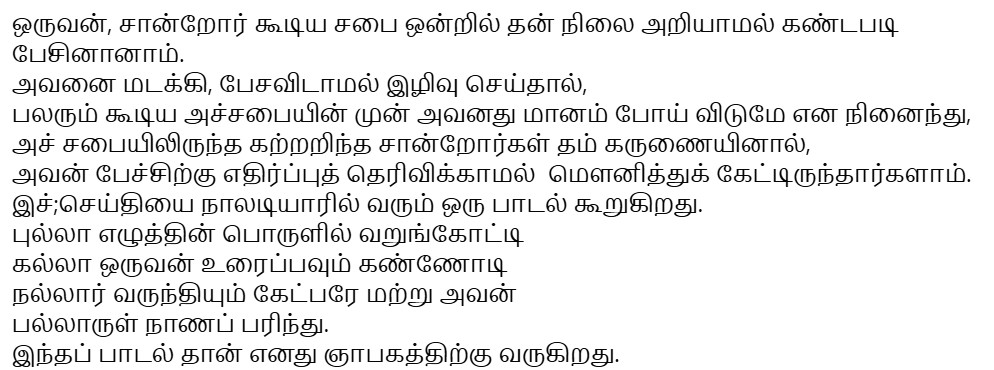
He said, “There is a song in Naladiyar that says: ‘When an unlettered person with empty words speaks in a gathering of scholars, the kind-hearted scholars, feeling pity for him, listen to his words in silence so that he may not be embarrassed in front of many.’ This poem comes to my mind. You thought the Kamban festival gathering was an ordinary one. It has been almost a hundred years since the Kamban societies were started. A great man named ‘Kambanadippodi,’ who loved Kamban as his God, first started the Kamban society in Karaikudi. Later, he paved the way for many Kamban societies to be started in various towns. That seed sown by that great man has now grown into a vast tree, extending beyond Tamil Nadu, beyond India, and into many countries around the world. These are not unknown facts to you. I shudder to think what would have happened if the short-tempered Kambanadippodi had been in that gathering where you spoke.

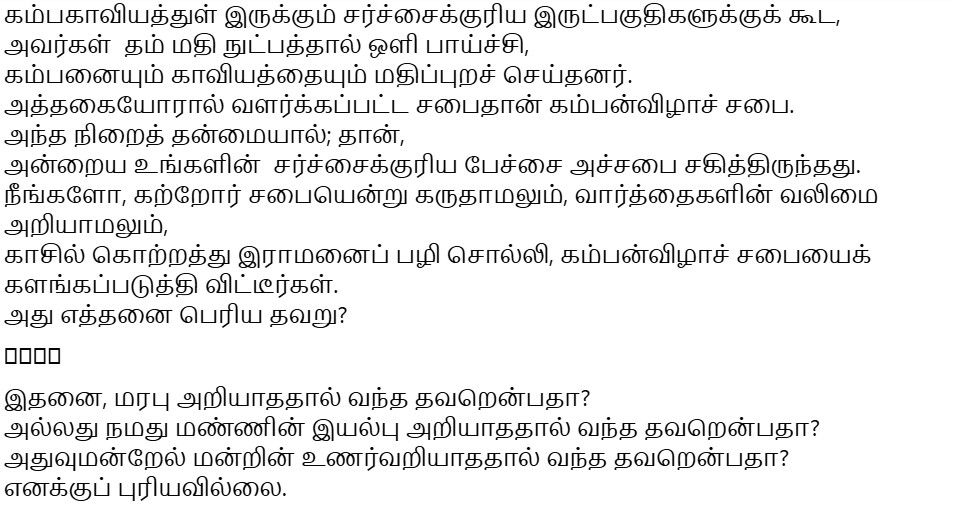
Following the path laid by Kambanadippodi, countless Kamban festivals have been successfully held. In those festivals, many full-fledged scholars participated and polished the diamond that is Kamban’s epic with their intellect, making it shine. They are still doing so. Even the controversial dark passages within Kamban’s epic were illuminated by their wit, bringing respect to both Kamban and his work. That is the kind of gathering the Kamban festival is. It was due to that integrity that the gathering tolerated your controversial speech. However, without considering it a gathering of scholars, and without understanding the power of your words, you have defiled the Kamban festival gathering by insulting Rama, the ‘flawless hero.’ How great a mistake is that? Should we call this a mistake born of ignorance of tradition? Or a mistake born of ignorance of our land’s nature? Or a mistake born of ignorance of the feelings of the gathering? I do not understand. We have to find an excuse for your action, just as Vali told Rama, ‘You seem confused.’ I want to confirm here that I am not using the word ‘confused’ in the same sense as you did.”
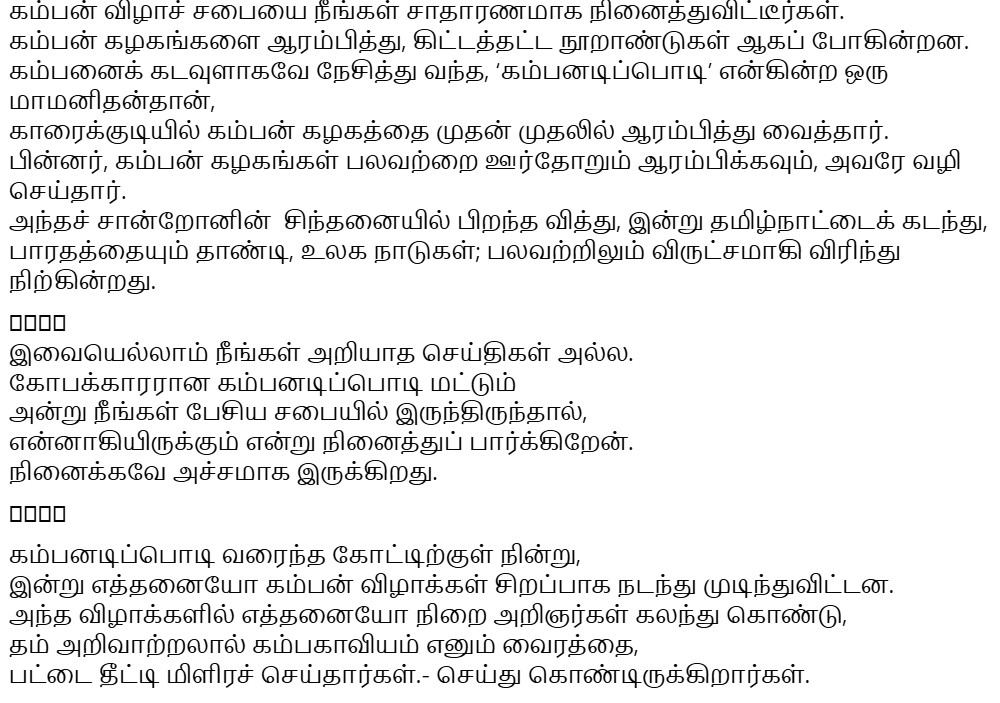
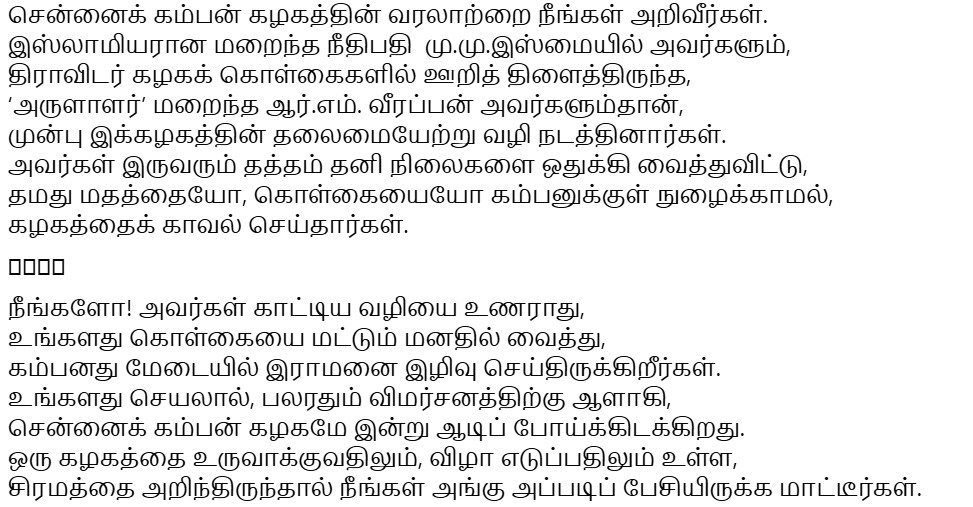
By invoking the legacy of scholars and leaders across religious lines who had shown restraint and reverence at past Kamban events including Muslim judge M.M. Ismail and Dravidian leader R.M. Veerappan, Jeyaraj underscored just how far Vairamuthu had strayed from that legacy of respectful discourse. Instead, he alleged, Vairamuthu had reduced a sacred cultural platform to an ideological stage.

He continued, “You are aware of the history of the Chennai Kamban Society. The late Justice M.M. Ismail, a Muslim, and the late R.M. Veerappan, a ‘blessed man’ deeply immersed in Dravidian movement ideologies, once led this society. They both set aside their personal beliefs, not bringing their religion or ideology into Kamban, and protected the society. You, on the other hand, without understanding the path they showed, and keeping only your ideology in mind, have insulted Rama on Kamban’s stage. Due to your actions, the Chennai Kamban Society itself is now shaken, facing criticism from many. If you had known the difficulty of creating and organizing a society and a festival, you would not have spoken like that.

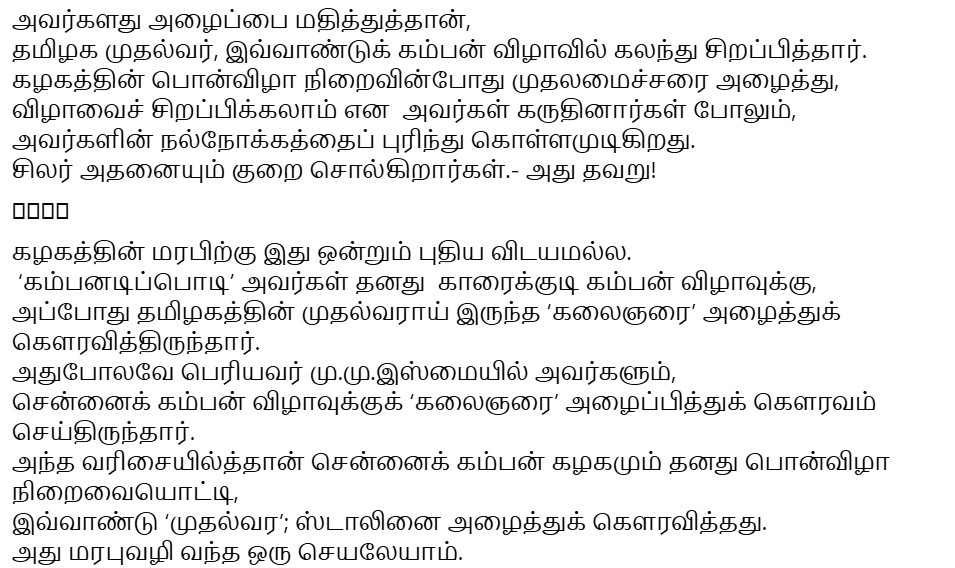
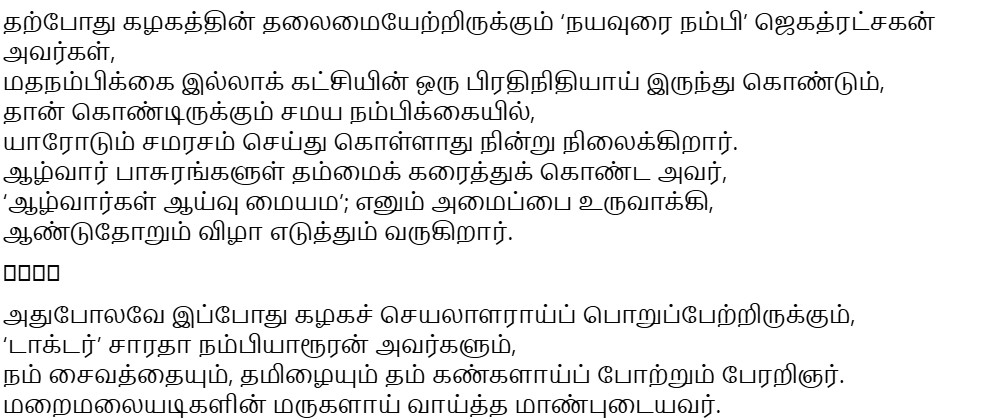
The current head of the society, ‘Nayavurai Nambi’ Jagathrakshakan, despite being a representative of a non-religious party, stands firm in his own religious beliefs without compromising with anyone. He has immersed himself in the hymns of the Alvars and has even established an organization called ‘Alvars Research Center,’ which holds annual festivals. Similarly, the current secretary of the society, ‘Doctor’ Sarada Nambiyaruran, is a great scholar who cherishes our Saivism and Tamil as her two eyes. She is a woman of dignity who is the daughter-in-law of Maraimalai Adigal. It was in deference to their invitation that the Chief Minister of Tamil Nadu graced this year’s Kamban festival. They must have thought of inviting the Chief Minister to grace the festival on the occasion of the society’s golden jubilee, and their good intention is understandable. Some criticize even that, but it is wrong! This is not a new issue for the society’s tradition. ‘Kambanadippodi’ honored the then Chief Minister of Tamil Nadu, ‘Kalaignar,’ by inviting him to the Karaikudi Kamban festival. Similarly, the elder M.M. Ismail also honored ‘Kalaignar’ by inviting him to the Chennai Kamban festival. It is in this line that the Chennai Kamban Society, on the occasion of its golden jubilee, honored ‘Chief Minister’ Stalin this year. It is an act that follows tradition.

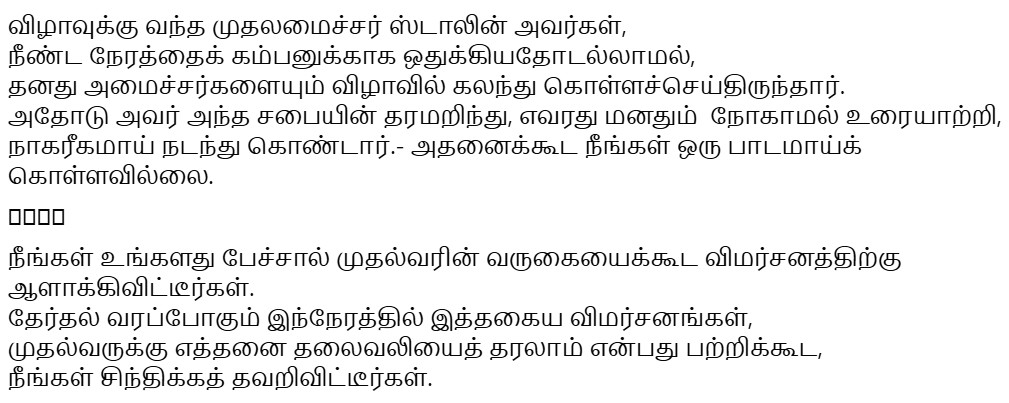
Chief Minister Stalin, who attended the festival, not only spent a long time for Kamban but also had his ministers attend the festival. Furthermore, understanding the dignity of the gathering, he spoke in a civilized manner without hurting anyone’s feelings – you did not even take that as a lesson. With your speech, you have even subjected the Chief Minister’s visit to criticism. You have failed to even consider the headache such criticisms can cause the Chief Minister at a time when an election is approaching.

Despite being aware of the previous controversy regarding Andal caused by you, Jagathrakshakan, who reveres the Alvars as deities, out of his love for poetry, Tamil, and you, decided to award you the ‘Kamban Award,’ which the Alvars Research Center gives annually. How many people must have opposed this decision when they made it? How many must have disagreed? The society must have gone beyond all of them to decide to give you that award. They must have thought that through this award, they could bring you, a person of great ability, into a realm of spiritual service. However, without understanding their noble intention, you spoke in a way that has now made them appear as culprits in front of society. After all this, you are not an ordinary person you are Kaviperarasu! Is this title an ordinary one? You have received many high awards for your poetry. As such, I feel compelled to ask you something. If someone were to wrongly interpret a poem you wrote, contrary to your intent, how much would your heart hurt? Think about it. One could forgive a person who does not know poetic tradition for speaking this way. But it is because you, Kaviperarasu, spoke like this that everyone is seething with anger. It has become your job to drag the chariot out into the street. Why this negative tendency?

Kamban was not a poet who wrote for cinema like you. He was a great poet who sang for the establishment of righteousness. That is why our people cherish Kamban’s epic as a source of righteousness, love, culture, devotion, truth, and nobility. If you lay hands on that high treasure, how could they tolerate it? The great poet Kamban describes Rama as the ‘flawless hero’ at the very beginning of the epic. Rama is not just a hero of an epic; he is a hero of righteousness. He is also a divine hero worshipped by a specific religious group. Don’t you know how many temples there are for him in this land? How many hymns are there for him? How many devotees are there for him? Even though you knew all this, how could you say that he lacked mental stability?”
Throughout the post, Jeyaraj exposed Vairamuthu’s ideological opportunism, where Hinduism is regularly used as a soft target, while other faiths are treated with either caution or reverence not out of respect, but out of fear of reprisal. Jeyaraj gave a broader warning, that Hinduism’s tolerance is being mistaken for passivity, and that cultural provocation cloaked in artistry will no longer go unchallenged.

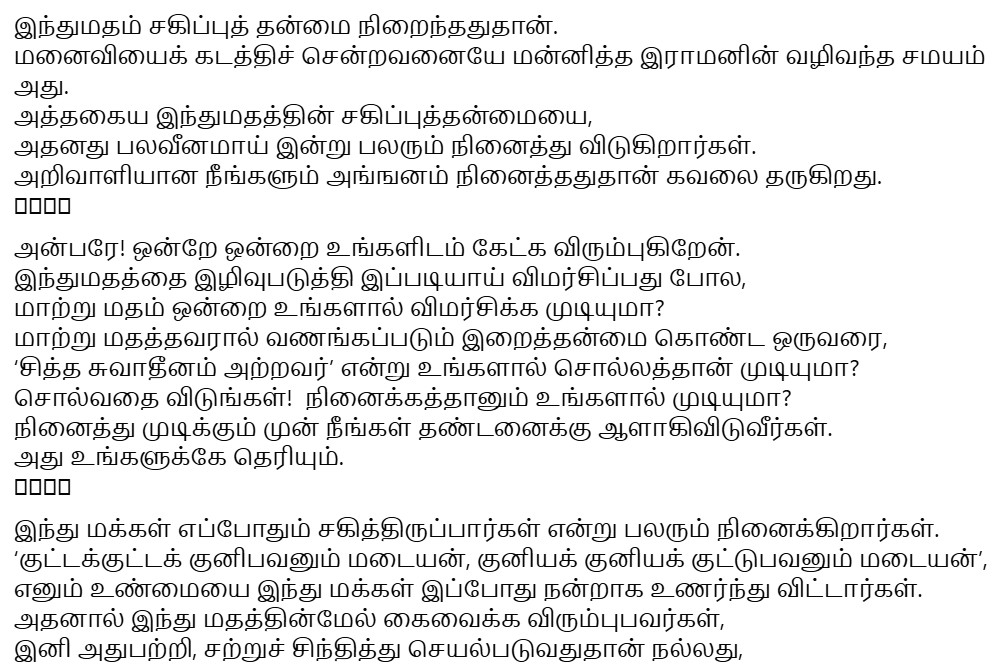
He wrote, “Hinduism is full of tolerance. It is a religion descended from Rama, who even forgave the one who abducted his wife. Many people today mistake the tolerance of such Hinduism for its weakness. It is worrying that even an intellectual like you thought that way. Dear friend! I want to ask you one thing. Can you criticize another religion and its divine figure in such an insulting way as you did with Hinduism? Could you say that a divine figure worshipped by people of another religion lacked mental stability? Forget saying it! Could you even think it? Before you could even think it, you would be punished. You know that yourself. Many people think that Hindus will always tolerate everything. Hindus have now well and truly understood the truth that, ‘a person who bows down every time when he is being hit is a fool, and a person who hits every time someone bows down is also a fool.’ Therefore, it is better for those who want to lay hands on the Hindu religion to think carefully before they act.” 
In closing, Jeyaraj urged both restraint and accountability. To the Hindu community, he appealed for dignity in the face of provocation. To Vairamuthu, he extended an olive branch urging him to issue a public clarification and acknowledge the hurt caused.

With this powerful statement, Ilangai Jeyaraj not only defended the honor of Lord Ram and the literary sanctity of Kamban’s work but also drew a sharp line against the cultural relativism and ideological excesses that continue to target Hindu faith under the banner of artistic freedom.

He said, “Through this letter, which I am writing to you, I want to say one thing to those who are criticizing you with harsh words. Friends! I understand the justice of your anger. However, we must first establish the greatness of our culture. We must realize the civilized nature of our language and religion. Some of the words you are using in anger over the poet’s words are grating to the ears. No matter what, he is one of our Tamil poets today. By releasing messages that speak ill of him, the civilized nature of our race will be questioned by others. I ask that you, who wish to fight for the greatness of our race, do not let your stand falter due to the actions of others. If one person steps down, and another also steps down, our culture will end up in the depths. It is your duty to understand this. This is my humble request. “

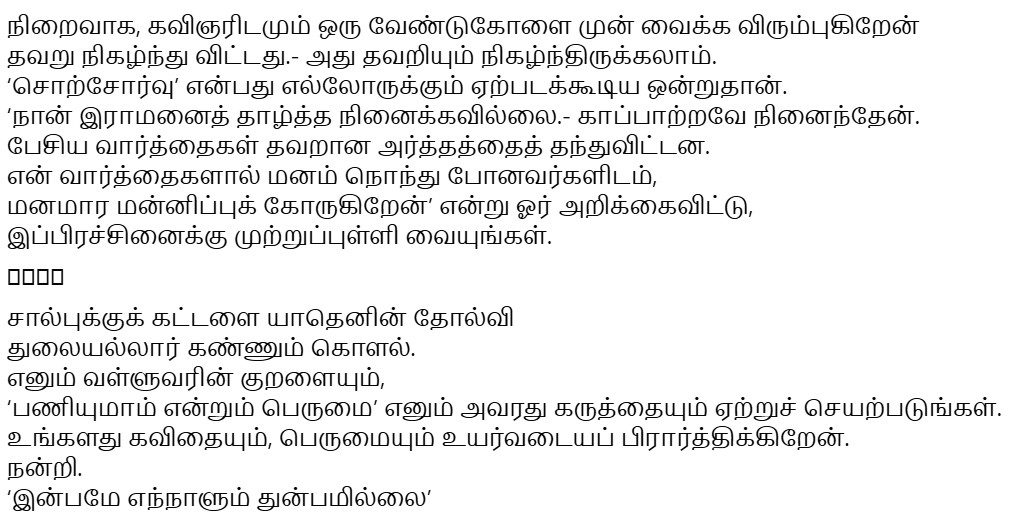
He added, “Finally, I would like to make one request to the poet as well. A mistake has happened, and it might have happened by accident. A “slip of the tongue” can happen to anyone. Please put an end to this problem by issuing a statement: “I did not intend to demean Rama. I intended to save him. The words I spoke have given a wrong meaning. I sincerely apologize to those whose hearts were hurt by my words.” Accept and act upon Valluvan’s couplet: ‘The mark of greatness is to take a loss even from those who are not worthy of it’ and his idea that ‘greatness always bows down.’ I pray that your poetry and greatness may rise. Thank you. Always happiness, no sorrow”
Subscribe to our channels on TelegramWhatsApp, and Instagram and get the best stories of the day delivered to you personally.

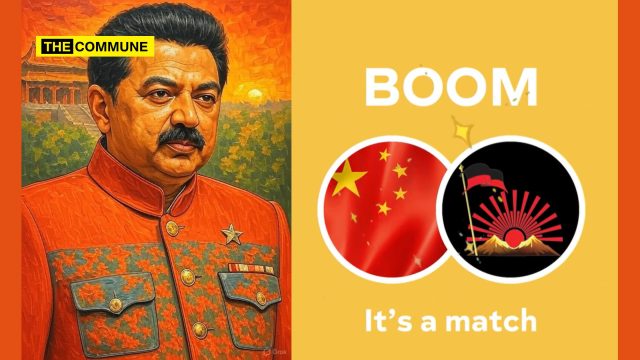
Nothing Original, Just Copied: How Dravidian Model Mirrors The Chinese Propaganda Playbook

Nothing Original, Just Copied: How Dravidian Model Mirrors The Chinese Propaganda Playbook

In 2017, a paper on “How the Chinese government fabricates social media posts for strategic distraction not engaged argument” was published. A closer look at this study reminds of something closer to home, the Dravidian model. First, let us take a finer look at the published study on Chinese propaganda.

The study, which analysed millions of posts linked to China’s infamous “50 Cent Party” (wumao), highlighted several key features of Beijing’s social media disinformation tactics.

Modus Operandi of Chinese Government Propaganda on Social Media

Nature of Propaganda Contrary to the myth of paid trolls arguing with critics, most Chinese government-directed posts avoided confrontation. Instead, they sought to cheerlead, distract, and flood platforms with pro-government messaging.

Scale of Operations – Researchers estimated 448 million fabricated posts annually, strategically timed around protests, anniversaries, and politically sensitive events to drown out dissent.

Goal of Propaganda – The central aim was not persuasion but “strategic distraction”—filling feeds with positivity and irrelevant chatter to sideline genuine criticism.

Coordination & Secrecy – Operations were centrally directed yet covert. Local governments and Party offices quietly mobilised state employees and agencies to generate content, without admitting it was propaganda. Instructions and credit for posts were managed through propaganda offices at multiple government levels (district, township, bureau, etc.).

Style of Posting – Posts avoided negativity or direct rebuttals, instead relying on banal slogans such as “China is great,” “Support the Party,” and appeals to unity. Many were deliberately cheerful to mask their orchestrated nature.

Was 50-Cent A Myth? – Contrary to belief, most propaganda workers were regular government employees, not freelancers earning 0.5 yuan per post. Participation in online propaganda was often part of their official duties.

Propaganda Warfare Logic – The deeper strategy was agenda control, using mass posting to drown out critics rather than to convince them.

Volume spikes in posting were the result of top-down directions, often after internal meetings or government initiatives.

Selective Targeting – The regime increased posting during periods of potential social unrest, emergencies, or politically sensitive anniversaries.

Posts appeared on both government platforms and popular commercial sites like Sina Weibo, Tencent, etc., mixing with genuine citizen content.

Surveys and Validation – The researchers used leaked emails, direct surveys, and statistical validation to confirm the identity and behavior of government propagandists.

Chinese social media propaganda relied on coordinated, non-confrontational, government-authored posts to flood digital spaces with cheerleading distraction, carefully timed to influence collective perception and quell dissent without engaging in open debate.

Dravidian Model Propaganda – Mirrors Chinese MO

Observers now note that these tactics used by the Chinese echoed the DMK’s “Udan Pirappus”, where party-aligned web warriors are allegedly paid around ₹200 per day to amplify pro-government narratives and stifle criticism. Like the Chinese wumao, these cadres reportedly avoid logical debate, instead relying on volume, positivity, and coordinated flooding of social media feeds. Well, akin to the Chinese machinery, the taxpayer funded “fact checking unit” has also been disseminating fake news over and over again.

Critics argue that this exposes the so-called Dravidian Model as a derivative copy of the Chinese Communist Party’s online propaganda playbook, not a unique or indigenous innovation.

By borrowing wholesale from Beijing’s disinformation strategy, the DMK’s digital apparatus, they say, has less to do with grassroots democracy and more to do with agenda manipulation and narrative control.

Subscribe to our channels on Telegram, WhatsApp, and Instagram and get the best stories of the day delivered to you personally.