Home Blog Page 164

Supreme Court Says It Can’t Fix Timelines For Governor And President To Grant Assent To Bills

Supreme Court Rules Against Fixed Timelines Or 'Deemed Assent' For Governor And President On Bills

In a landmark opinion on a Presidential Reference, the Supreme Court of India has unanimously held that it cannot impose fixed timelines on Governors or the President for granting assent to Bills under Articles 200 and 201 of the Constitution. The court also decisively rejected the concept of “deemed assent,” calling it a judicial takeover of executive functions and “antithetical to the spirit of the Constitution.”

The ruling was delivered by a five-judge Constitution Bench comprising Chief Justice of India BR Gavai and Justices Surya Kant, Vikram Nath, PS Narasimha, and AS Chandurkar. The bench was answering a reference made by President Droupadi Murmu under Article 143 of the Constitution, seeking the court’s opinion on key questions regarding the assent process for Bills.

Core Ruling: No Timelines, No Deemed Assent

The court firmly stated that prescribing fixed timelines for constitutional authorities like the Governor and President would violate the “elasticity” deliberately built into the Constitution.

“We have no hesitation in concluding that deemed consent of the Governor, or President, under Article 200 or 201 at the expiry of a judicially set timeline, is virtually a takeover, and substitution, of the executive functions by the Judiciary, through judicial pronouncement, which is impermissible within the contours of our written Constitution,” the Court held.

The court clarified that the powers under Article 142 cannot be used to create a concept of “deemed assent” or to substitute the decisions of the President or Governor.

Limited Judicial Power in Cases of “Prolonged Delay”

While rejecting fixed timelines, the court carved out a crucial exception. It held that in cases of “prolonged or unexplained delay” by a Governor that “frustrates the legislative process,” the judiciary can intervene.

The Court can issue a “limited mandamus” to direct the Governor to decide on the Bill within a reasonable time. However, the court explicitly stated it cannot comment on the merits of the Bill or how the discretion should be exercised.

Key Questions Answered by the Supreme Court

The court provided definitive answers to the 14 questions posed in the Presidential Reference.

The Court clarified that when a Bill is presented under Article 200, the Governor has three constitutional options: to assent to the Bill, to withhold assent, or to reserve it for the consideration of the President. Crucially, the Court held that the power to withhold assent is not a standalone option but must necessarily be accompanied by the Governor returning the Bill to the State Legislative Assembly for reconsideration, as mandated by the first proviso to Article 200. Permitting the Governor to withhold a Bill without returning it, the Court reasoned, would undermine the principles of federalism.

On the critical question of whether the Governor is bound by the aid and advice of the Council of Ministers, the Court ruled that while the Governor typically acts on such advice, they exercise personal discretion under Article 200. This discretion is evident from the use of the phrase “in his opinion” in the second proviso, which grants the Governor the power to return a Bill or reserve it for the President’s consideration independently.

Regarding the justiciability of the Governor’s actions, the Court established that the merits of the Governor’s decision under Article 200 are not subject to judicial review. However, in cases of “prolonged, unexplained and indefinite” inaction that frustrates the legislative process, the judiciary can intervene by issuing a limited mandamus. This directive would compel the Governor to discharge their constitutional functions within a reasonable time, without, however, commenting on the merits of the decision itself.

Addressing the immunity granted to the Governor under Article 361, the Court stated that while this provision is an absolute bar on legal proceedings against the Governor personally, it cannot be used to shield the office of the Governor from the Court’s jurisdiction in cases of prolonged inaction. Thus, the Court retains the power to issue writs to the office of the Governor to enforce constitutional duties.

On the contentious issue of imposing timelines, the Court decisively ruled that neither the Governor under Article 200 nor the President under Article 201 can be bound by judicially prescribed deadlines. The Court reasoned that the constitutional text was deliberately framed with a “sense of elasticity” to allow these authorities to perform their functions in diverse contexts. Imposing fixed timelines would be contrary to this constitutional design. Consequently, the President’s decision on a Bill reserved for their consideration is also non-justiciable.

The Court further opined that the President is not required to seek the Supreme Court’s advice under Article 143 whenever a Bill is reserved by a Governor. The President’s subjective satisfaction is sufficient, though a reference may be made in cases lacking clarity.

Emphatically rejecting the concept of “deemed assent,” the Court stated that the exercise of constitutional powers by the President or Governor cannot be substituted by the judiciary under Article 142 of the Constitution. There is no scenario, the Court clarified, where a Bill passed by a State Legislature can become law without the Governor’s assent under Article 200, as the Governor’s role in the legislative process cannot be supplanted.

Finally, the Court affirmed that the decisions of the Governor and President on Bills are not justiciable before a law comes into force, and courts cannot adjudicate the contents of a Bill prior to its enactment.

Background and Context

The Presidential Reference was made in May 2025, shortly after a two-judge bench of the Supreme Court, in the Tamil Nadu Governor case, had laid down timelines for Governors to act on Bills. The reference sought to clarify the constitutional position, raising 14 specific queries.

During the extensive hearings, the Union Government, represented by Attorney General R. Venkataramani and Solicitor General Tushar Mehta, argued against judicially imposed timelines. SG Mehta contended that while Governors cannot “indefinitely sit on bills,” courts cannot lay down a “straitjacket timeline,” as it would violate the separation of powers.

Several states, including Tamil Nadu, Kerala, West Bengal, and Punjab, argued in favor of timelines and judicial intervention to prevent gubernatorial obstruction. Senior advocates Kapil Sibal, Dr. A.M. Singhvi, K.K. Venugopal, Gopal Subramanium, and Arvind P. Datar presented these arguments. Conversely, states like Maharashtra and Chhattisgarh, represented by Senior Advocates Harish Salve and Mahesh Jethmalani, supported the Union’s position.

The Supreme Court’s opinion now provides an authoritative interpretation, balancing the discretion of constitutional authorities with the judiciary’s role as a guardian against arbitrary inaction, thereby settling a significant federal debate in the Indian polity.

(Source: LiveLaw)

Subscribe to our channels on WhatsAppTelegram, Instagram and YouTube to get the best stories of the day delivered to you personally.

“All Credit Goes To PM Modi”: Farmers Association Chief PR Pandian Hails Centre’s Role In Kaveri River Dispute, Jallikattu, And Natural Farming

Prime Minister Narendra Modi on Wednesday, 19 November 2025, inaugurated the three-day South India Natural Farming Summit 2025 at Codissia Hall in Coimbatore, reinforcing India’s commitment to becoming a global hub for natural farming. The event witnessed enthusiastic participation from farming communities across the southern states, with a strong show of support from Tamil Nadu’s agricultural leadership.

Addressing the summit, All Farmers’ Association Coordination Committee President PR Pandian praised the Prime Minister for his role in resolving several long-standing issues affecting Tamil Nadu’s farmers.

“All credit goes to the Prime Minister,” Pandian said, as he highlighted Modi’s contribution in settling the Kaveri river dispute and overturning the Supreme Court’s ban on Jallikattu.

“The long-standing Cauvery issue has been resolved by setting up the Cauvery Management Commission. The Supreme Court banned the Jallikattu competition. A permanent solution was found by bringing an emergency law. All that credit goes to Prime Minister Modi,” Pandian said.

Showcasing Natural Farming and Farmer Recognition

The Prime Minister’s presence at the summit was seen as a major morale booster for farmers, particularly those practicing traditional and natural methods of cultivation.

“The summit officially started with the Prime Minister of India, and he inaugurated the 21st PM-Kisan scheme on this stage among farmers. This made the summit grand and, more importantly, instilled confidence among all South Indian farmers by the Prime Minister’s presence during difficult times. We are grateful for the Prime Minister’s visit and the faith he’s given to the farmers,” Pandian said.

He also extended gratitude to other dignitaries present, including Tamil Nadu Governor RN Ravi, BJP State President Nainar Nagendran, and former Vice Chancellor of the Tamil Nadu Agricultural University, Dr. K. Ramasamy.

Praising PM Modi for Cultural and Agricultural Interventions

Recalling the cultural significance of Jallikattu, Pandian noted the central government’s legal intervention to preserve the tradition.

“Jallikattu is part of Tamil Nadu’s culture – a brave sport not just for youth, but to raise awareness about livestock. The Supreme Court imposed a permanent ban on Jallikattu, but respecting the emotions of youth and farmers, an emergency law was introduced and, through this law, the SC’s order was overridden and special permission was obtained for Jallikattu in TN by the Hon. Prime Minister. I express my gratitude for that here.”

Calling for Broader Policy Interventions

Pandian also appealed to the Prime Minister for new national policies focused on soil regeneration, wildlife-farmer conflict mitigation, and protection of ecologically sensitive zones like the Western Ghats.

“We urge the PM to create a national policy to protect soil, people, and farmers. The Western Ghats start in Kerala and run through several states. Changes in this range drive climate change. We need policies to protect the Western Ghats, which are crucial. Wildlife is destroying farmlands and even attacking farmers. Forests and farmers both need protection. Only the PM can bring comprehensive law for this.”

He also criticized the Tamil Nadu Land Integration Act 2023, warning of its consequences for agricultural and water ecosystems.

“The TN Land Integration Act 2023 has risked not only lands but also wetlands, lakes, ponds, and water pathways by reclassification, benefiting developers. We need unified law to stop this crisis. Farmers are not opposed to industry but want growth that does not come at the cost of agriculture and food security.”

Appeal to Honor Nammazhwar

Pandian concluded his address with an emotional plea for national recognition of Nammazhwar, the late eco-farming pioneer of Tamil Nadu.

“We request, in memory of Nammazhwar, that during your tenure, you award him the Bharat Ratna. The BJP has already supported this resolution. Please make this summit’s resolution a reality. You declared publicly, even during COVID, that small farmers revived the Indian economy.”

“During the global food shortages in COVID, Indian farmers supplied food to many countries, as you acknowledged. Farmers need adequate crop insurance coverage, and the PM-Kisan scheme must benefit all farming families, especially those practicing natural farming on 60% of TN lands.”

Subscribe to our channels on WhatsAppTelegram, Instagram and YouTube to get the best stories of the day delivered to you personally.
Bangladesh’s Political Purge: Sheikh Hasina’s ‘Death Sentence’ Is A Warning To The Subcontinent

Bangladesh’s Political Purge: Hasina’s Death Verdict Is a Warning to the Subcontinent

The death sentence handed down to former Bangladesh Prime Minister Sheikh Hasina by the reconstituted International Crimes Tribunal is more than a legal verdict; it is a political earthquake. And like all political earthquakes in the subcontinent, its rumblings carry the unmistakable resonance of history.

The comparison many analysts have drawn between Hasina’s trial in 2025 and Zulfikar Ali Bhutto’s trial in Pakistan in 1978 is not an exaggeration; it is a warning. A warning that when courts become theaters and justice becomes a prop for political vendettas, the nation drifts into dangerous waters.

The tribunal that delivered Hasina’s sentence was created to prosecute the atrocities committed during the 1971 Liberation War. Its purpose was to close old wounds, bring justice to victims, and honor the foundational values of Bangladesh. But the Yunus-led interim government’s decision to expand the tribunal’s jurisdiction in 2024, giving it the authority to try contemporary political actors, weaponized the institution.

Instead of healing historical traumas, it has now become an instrument to manufacture new ones. Hasina was tried in absentia, denied the opportunity to testify directly, barred from cross-examining witnesses, and subjected to a hastily conducted judicial process that resembled a political purge rather than a legitimate trial.

Supporters of the verdict might argue that Hasina must be held accountable for alleged abuses committed during her tenure. But accountability must arise from a process that upholds the basic tenets of justice. What transpired instead was a judicial spectacle: rushed proceedings, opaque evidence, and a tribunal whose neutrality had evaporated long before the verdict was announced.

In politics, optics matter, and the optics here are unmistakable: a regime intent on erasing its predecessors, using the legal system as a sword rather than a scale.

This is where the shadow of Bhutto looms large. Bhutto’s trial in 1978 under Pakistan’s General Zia-ul-Haq is now universally recognized as a travesty. Conducted under pressure, presided over by a judiciary molded by the military regime, and fueled by political animosity, Bhutto’s hanging remains one of the darkest chapters in South Asian judicial history.

Decades later, even Pakistan’s Supreme Court conceded that Bhutto had not been granted a fair trial. The parallels to Hasina are too strong to dismiss: a toppled leader, a new regime desperate to consolidate power, a judiciary re-engineered to comply, and a verdict that seems designed to eliminate political opposition rather than deliver justice.

Bangladesh, unlike Pakistan, was born out of a struggle for secular democracy. The Awami League under Sheikh Mujibur Rahman built its identity on linguistic nationalism and liberation from Pakistani militarism. But in recent years, the drift in Dhaka has been troubling.

The interim government’s accommodation of Islamist groups previously barred from politics, its shrinking tolerance for dissent, and its aggressive dismantling of the Awami League’s organizational structures all indicate an ideological shift, a shift that eerily resembles Pakistan under Zia. This is not merely about punishing Hasina; it is about rewriting the ideological DNA of the republic.

By sentencing Hasina to death, the interim regime has sent a message to its domestic rivals: political displacement will not stop at exile; it may end at the gallows. For a nation that prides itself on emerging from the ashes of genocide and dictatorship, this is an alarming regression.

Bangladesh’s political system has always been turbulent, but this verdict threatens to push it into a new phase: one where political competition is no longer mediated through elections or parliamentary processes but through courts and punitive tribunals acting under executive influence.

For India, the developments in Bangladesh carry profound strategic implications. New Delhi has long regarded Dhaka as a key ally in maintaining stability in the Northeast, combating cross-border terror networks, and managing migration flows. Sheikh Hasina’s government played an instrumental role in neutralizing extremist groups and strengthening bilateral cooperation.

Her ouster, followed by a death sentence delivered under dubious legal circumstances, destabilizes the regional balance. Bangladesh drifting toward Islamist politics even moderately threatens to reopen security challenges that India spent years combating. The Northeast, already sensitive, cannot afford a Bangladesh where anti-India political currents regain strength.

Moreover, the verdict raises questions about the future of Bangladesh’s democratic institutions. If courts can be repurposed to eliminate political opponents, then elections cease to be meaningful. The interim regime may claim to be restoring democracy, but a democracy built on judicial intimidation is hollow.

Even critics of Hasina’s governance and she had many recognized that justice cannot be selective. Her trial sets a precedent that any future government could exploit, trapping Bangladesh in a cycle of judicial vengeance with no exit.

The human rights dimension cannot be ignored either. Trials in absentia belong to authoritarian playbooks, not democratic ones. Executing a former prime minister under such circumstances violates international norms and invites scrutiny from global bodies. It signals to the world that Bangladesh is turning inward, away from democratic accountability and toward ideological consolidation. Nations that rely on international legitimacy do not pass death sentences in politically charged trials without expecting consequences.

This is why the comparison to Bhutto is so powerful. Bhutto’s execution did not strengthen Pakistan. It delegitimized its judiciary, deepened political polarization, emboldened authoritarian forces, and created a martyr whose shadow haunted Pakistani politics for generations. Bangladesh now stands at a similar crossroads.

Hasina’s sentence risks creating a political vacuum filled not by democratic forces but by opportunistic alliances of Islamist groups, disillusioned power centers, and authoritarian actors seeking permanence.

The tragedy of South Asian politics is that its leaders seldom learn from history. Institutions are reshaped to serve immediate goals, only to later become instruments of oppression for those who once controlled them. The tribunal that now convicts Hasina with sweeping authority may one day be turned against the very people who empowered it. That is the nature of political tools; they rarely remain in one set of hands for long.

Bangladesh’s soul was forged in the fires of 1971. Its promise was democracy, secularism, and justice. By sentencing Sheikh Hasina to death in a trial that carries the unmistakable scent of political revenge, the country risks abandoning that promise. The world, and especially India, must watch with vigilance.

Not because Hasina must be defended uncritically, but because democracy must be defended vigorously. When justice becomes indistinguishable from politics, nations lose their moral compass. And when nations lose their moral compass, history often the darkest parts of it has a way of repeating itself.

Dr. Prosenjit Nath is a techie, political analyst, and author.

Subscribe to our channels on WhatsAppTelegram, Instagram and YouTube to get the best stories of the day delivered to you personally.
Was Rahul Gandhi And Congress Part Of Chinese Disinformation Campaign Against Rafale Jets During Operation Sindoor?

A shocking report by a top US government commission has exposed a covert Chinese disinformation campaign designed to sabotage the French Rafale fighter jet’s global reputation, raising serious questions about whether Congress leader Rahul Gandhi inadvertently became a vocal asset in this foreign propaganda effort.

The US-China Economic and Security Review Commission’s report details that following the May 2025 India-Pakistan border crisis, China initiated a coordinated drive to undermine sales of the French Rafale in favour of its own J-35 fighter jets. The campaign allegedly used fake social media accounts to propagate AI-generated images of supposed Rafale debris, falsely claiming the jets had been destroyed by Chinese-made weaponry.

This revelation places a glaring spotlight on Rahul Gandhi’s persistent demands for the Modi government to disclose the “number of jets lost” during Operation Sindoor, echoing the very narrative pushed by Chinese and Pakistani sources.

The Chinese Playbook And The Echo In India

According to the US report, the Chinese strategy was clear: exploit the India-Pakistan conflict to create a global perception that the Rafale jet was vulnerable, thereby hindering its exports and creating an opening for China’s own arms sales. Indonesia was reportedly convinced to pause a Rafale deal following this campaign.

Simultaneously, in India, a political narrative was being built. Despite the Indian Air Force’s clear statements that all assets were intact and that sharing operational details mid-conflict would jeopardise national security, Rahul Gandhi led a chorus of opposition leaders demanding specifics on aircraft losses.

His repeated questioning, “How many jets were lost?” and his recent tweet demanding PM Modi reveal “the truth about the five jets” after former US President Donald Trump’s unsubstantiated claims, aligned suspiciously with the objectives of the Chinese disinformation campaign.

Amplifying A Hostile Narrative

The timeline of events is telling:

Chinese Campaign Begins: Post-May 2025 conflict, Chinese fake accounts push the “Rafale shot down” narrative.

Pakistani Claims: Pakistan, a close ally of China, claims it shot down three Rafales, a claim dismissed by the Indian Chief of Defence Staff and Dassault Aviation as “absolutely incorrect” and “inaccurate.”

Opposition Demands in India: Rahul Gandhi and the Congress party persistently question the government on the same lines, keeping the debunked narrative alive in the public discourse.

Many Congress MPs made claims about Rafale jets being show down in the Parliament.

Congress MP Amrinder Singh Raja Warring has claimed that a Rafale fighter jet crashed near Bhisiana Air Force Station in Punjab, presenting photos as evidence and stating that the tail section with the code “BS-001” was found at the site.

Congress MP Gurjeet Singh Aujla has publicly demanded that Prime Minister Narendra Modi parade all 35 Rafale jets to prove that none were shot down during Operation Sindoor.


Kerala Congress MP K. Francis George claimed that India lost three Rafale jets, one Sukhoi-30 MKI, and one MiG-29, all shot down within Indian territory.

A Question of National Security

In August 2008, the Sonia Gandhi-led Congress and the Communist Party of China signed a Memorandum of Understanding (MoU) “for exchanging high level information and cooperation between them”. The MoU also said that the two parties would “consult each other on bilateral, regional and international developments”. The deal was signed by none other than the then Congress General Secretary Rahul Gandhi on the Indian side.

The convergence between a hostile foreign power’s propaganda and the political opposition’s line of questioning has raised serious concerns about its impact on national security and India’s defence preparedness. By continuously seeking to validate a false narrative that undermines a key component of India’s air power, the opposition’s actions, whether intentional or not, served to amplify a disinformation campaign aimed at weakening India’s strategic position.

While there is no evidence to suggest a direct link between the Congress party and the Chinese state, the net effect of their demands has been to erode public confidence in a critical defence asset and parrot a talking point that originates from a campaign designed to harm India’s strategic and economic interests.

The central question remains: Did Rahul Gandhi, in his pursuit to corner the government, become an unwitting participant in a larger, malicious game orchestrated by Beijing against the Indian military and the Rafale jet?

(Source: Hindustan Times)

Subscribe to our channels on WhatsAppTelegram, Instagram and YouTube to get the best stories of the day delivered to you personally.
Congress Honours India’s Vocal Critic: Sonia Gandhi Presents Indira Gandhi Peace Prize To Far-Left, Anti-India UN Official Michelle Bachelet Who Is Also Part Of Soros-Funded Progressive Alliance

In a move that has ignited fierce political and public backlash, the Congress party, through the Indira Gandhi Memorial Trust, has conferred its prestigious Indira Gandhi Prize for Peace, Disarmament and Development upon former Chilean President Michelle Bachelet, a figure internationally known for her far-left ideology and a consistent record of making statements perceived as rabidly anti-India and sympathetic to separatist narratives in Kashmir.

The award was presented on Wednesday, 19 November 2025, by Congress Parliamentary Party Chairperson Sonia Gandhi, who also chairs the Trust, in a ceremony attended by top Congress leadership including party president Mallikarjun Kharge.

A “Perfect” Pick For Congress: An Ideological Ally Against The Indian State

The selection of Michelle Bachelet is being viewed by political observers not as a mere coincidence, but as a deliberate ideological statement by the Congress party. Bachelet’s profile aligns perfectly with a political narrative that often positions itself in opposition to the current Indian government, even on matters of national security and sovereignty.

#1 A Far-Left Politician

Michelle Bachelet is a lifelong member of the Socialist Party of Chile, a party with a documented history of Marxist ideology and a stated goal of revolutionary transformation. Her political career is rooted in this far-left framework, which she has carried into her international roles. The decision to honour a politician from this specific ideological strand makes one wonder about the Congress’s own political compass and its choice of international allies.

#2 Rabidly Anti-India And Separatist Sympathiser In Kashmir

As the United Nations High Commissioner for Human Rights, Bachelet moved beyond diplomatic language to become one of the most vocal international critics of India’s sovereign decisions. Her tenure was marked by:

Interference in Kashmir: Following the abrogation of Article 370, Bachelet used her UN platform in 2019 to express “deep concern” about the situation in Kashmir, echoing the talking points of separatist lobbies. She explicitly called for the “people of Kashmir” to be “consulted and engaged in any decision-making processes,” a demand that directly dovetails with the rhetoric of those seeking to challenge India’s constitutional integrity.

Baseless Allegations: Under her leadership, the Office of the UN High Commissioner for Human Rights (OHCHR) released reports on Kashmir that were officially rejected by the Government of India as “false, motivated,” and displaying a “clear bias.” These reports heavily criticized India’s security measures and legal frameworks, ignoring the threat of cross-border terrorism.

Criticism of Domestic Policies: She also repeatedly targeted India on the National Register of Citizens (NRC) process, issuing statements that the Indian government termed “unwarranted” and “not reflective of the ground reality.”

#3 The Pro-Islamist

Bachelet’s focus consistently singled out India, often framing its internal security and legal measures as an assault on Muslim communities. Her statements frequently highlighted the ‘concerns of Muslim minorities’ in the context of Kashmir and the NRC, while largely ignoring the complex security and demographic challenges faced by the Indian state. This pattern of criticism, which aligns with the propaganda of Pakistan-based elements, has led many to label her stance as de facto pro-Islamist in its selective outrage.

Furthermore, she established herself as a global “dissent evangelist,” using her UN position to routinely chastise India over its internal governance. She repeatedly criticized India’s legal instruments like the UAPA and raised alarms about the state of civic space and freedom of expression, often siding with narratives that oppose the Indian government’s policy decisions.

Congress And Bachelet: A Shared Narrative?

In her award ceremony speech, Sonia Gandhi praised Bachelet for her work on gender equality and social reforms in Chile, notably avoiding any mention of her controversial tenure at the UN and her direct confrontations with the Indian government. This selective celebration, critics argue, reveals a tacit endorsement of Bachelet’s anti-India stance.

By bestowing one of India’s most famous peace prizes upon a foreign official who has consistently undermined India’s position on the global stage, the Congress party has sent a clear message. The move is seen as a political gambit that prioritizes international left-liberal approval and domestic opposition politics over unambiguous national solidarity.

The award has solidified the perception that for the Congress leadership, a “perfect” laureate is one whose international influence has been deployed to question the actions and legitimacy of the Indian nation-state itself.

Both INC And SPC Part Of Soros-Funded Group

The Indian National Congress is a prominent member of the Progressive Alliance, an international coalition of social democratic and progressive parties. Michelle Bachelet, former President of Chile, is associated with the Socialist Party of Chile, which is also a member of the Progressive Alliance. Rahul Gandhi had recently visited Chile as part of his South America tour in early October 2025.

The Progressive Alliance funded by George Soros is a global cartel of left-liberal elites, repackaging their ideological failures as “progress” while pushing the same cookie-cutter agenda across continents. Behind its polished rhetoric of human rights and cooperation, the PA routinely meddles in domestic politics, undermining national sovereignty through coordinated narratives dressed up as international solidarity. Far from being a grassroots movement, it survives on billionaire-funded activism, relying more on donor money than public mandate. In practice, the alliance promotes agenda-driven politics that destabilise societies, making it a club of wealthy backers and disconnected ideologues rather than a genuine force for democratic progress.

Subscribe to our channels on WhatsAppTelegram, Instagram and YouTube to get the best stories of the day delivered to you personally.
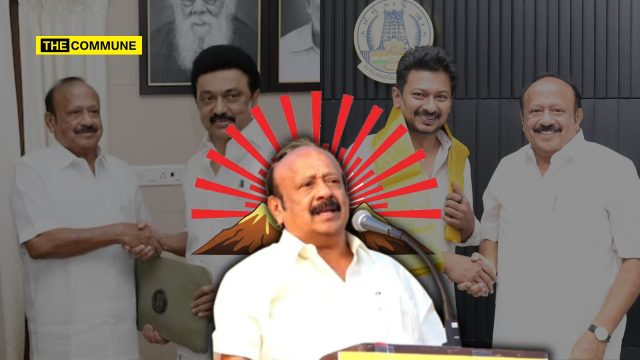
“Rising Atrocities Against Dalits In Tamil Nadu”, DMK-Ally VCK MP Ravikumar Cites NCRB Data

"Rising Atrocities Against Dalits In Tamil Nadu", DMK Ally VCK MP Ravikumar Cites NCRB Data

Villupuram VCK MP Ravikumar on Wednesday, 19 November 2025, published a detailed post on X expressing alarm over the rise in atrocities against Dalits in Tamil Nadu, calling the newly released National Crime Records Bureau (NCRB) 2023 report “shocking” for the State. In his statement, he compared year-on-year data and said Tamil Nadu’s numbers stand out negatively even as neighbouring states have shown declines.

In his post, Ravikumar pointed out that Tamil Nadu recorded 1,921 crimes against Scheduled Caste (SC) persons in 2023, up from 1,377 cases in 2021 and 1,761 cases in 2022. He wrote that this continuous increase contrasts with Andhra Pradesh, Telangana, and Karnataka, all of which reported fewer such crimes in 2023 compared to the previous year.

According to the MP, the most disturbing figures relate to murder and sexual violence. He wrote that 74 Dalits were murdered in Tamil Nadu in 2023, and 135 Dalit women were raped, including 100 minor girls below 18 years of age. He added that Tamil Nadu is among only six states with such high numbers of sexual crimes against minor SC girls.

Ravikumar’s post also noted that 66 caste-related riots occurred in Tamil Nadu in 2023, placing the State among the top four nationally for such incidents.

The MP further criticised what he described as Tamil Nadu’s “high tendency” to dismiss SC/ST (Prevention of Atrocities) Act cases as false. According to him, only four states show this pattern, and Tamil Nadu is among them.

He highlighted delays in the judicial process, writing that while charge sheet rates in Atrocities Act cases match national levels, pendency before courts in Tamil Nadu is 37.7%, nearly double the national average of 21.2%. Ravikumar said that the State had 7,912 cases awaiting trial in 2023, including older and newly filed cases.

Citing NCRB numbers, he said courts dismissed 21 cases without investigation, convicted accused persons in only 115 cases, and acquitted 830 individuals in the same period. He emphasised that Tamil Nadu’s conviction rate in SC/ST atrocity cases is 12.2%, far below the national average of 31.9%, and significantly lower than states such as Uttar Pradesh (65.6%), Rajasthan (61.4%), and Bihar (30.1%).

Ravikumar wrote that 172 people were convicted in 2023, while 1,475 were acquitted, and claimed that accused persons in such cases receive bail “very quickly”. NCRB data shows 4,343 people were released on bail last year, while charge sheets were filed against 326 individuals.

Concluding his post, the MP stated that the data demonstrates the Tamil Nadu government has not taken adequate measures to prevent caste atrocities or ensure effective prosecution. He questioned whether the State would now take steps to address what he described as a “dire situation” reflected in national crime statistics.

Subscribe to our channels on WhatsAppTelegram, Instagram and YouTube to get the best stories of the day delivered to you personally.
Talaq-E-Hasan: Islamists Resort To New Way To Divorce Wife

Talaq-E-Hasan: Islamists Resort To New Way To Divorce Wife

The Supreme Court on Wednesday raised serious concerns over the validity and procedure of talaq-e-hasan, a form of triple talaq under which a Muslim man can divorce his wife by pronouncing “talaq” once every month for three months. A Bench of Justices Surya Kant, Ujjal Bhuyan, and NK Singh made the observations while hearing multiple petitions challenging the practice.

The court, which had declared instant triple talaq (talaq-e-biddat) “bad in law” eight years ago, revisited the broader issue of divorce among Muslims and questioned whether talaq-e-hasan could withstand constitutional scrutiny today.

“How is this allowed in modern society?” the Bench asked, seeking detailed submissions on all existing forms of divorce in Muslim personal law.

Case of Woman Denied Child’s School Admission

During the hearing, the court also took up the case of petitioner Benazir Heena, whose child’s school admission was delayed because her former husband did not sign the divorce documents. Her counsel told the court that her husband, Ghulam Akhtar, had divorced her through his advocate and subsequently remarried.

“She will indulge herself in polyandry because of her husband. In the 11-page talaq notice, the sign of the husband is missing. Talaq was pronounced by the husband’s advocate,” her counsel said.

Her husband’s lawyer argued that this was a common practice in Islam. In response, Justice Kant asked, “Can this be a practice? How are these new innovative ideas being invented?”

The Bench further criticised the practice of issuing divorce notices through lawyers instead of direct communication.

“What prevents the husband from directly communicating with her? He has such an ego that even for divorce, he cannot speak to her. How can you promote this in a modern society? It is the dignity of a woman,” the court remarked.

The judges added that if talaq is invoked under religious practice, procedures must be “followed as it is prescribed.”

Court Summons Husband, Seeks Details on School

The Bench also sought details of the school that denied admission to the child and expressed concern about the broader implications of such practices on Muslim women across the country.

“We salute this woman who has chosen to fight for her rights. But there may be a poor woman who does not have resources. If she remarries, her earlier husband comes and says she is indulging in (polyandry)? Should a civilised society allow this kind of practice?” the court observed.

The Supreme Court directed that the husband be present at the next hearing, stating, “Let him come here and unconditionally provide what she wants.”

The matter has been posted for further hearing, with the court seeking complete information on the various forms of divorce recognised in Muslim personal law.

(Source: NDTV)

Subscribe to our channels on WhatsAppTelegram, Instagram and YouTube to get the best stories of the day delivered to you personally.
The DMK’s Manufactured Metro “Rejection” Lie – How A Shoddy Dravidian Model DPR Forced Centre To Seek Clarifications

A political firestorm erupted in Tamil Nadu after reports claimed the Union Government had “rejected” the metro rail proposals for Coimbatore and Madurai. In what seems like it was spearheaded by Chief Minister MK Stalin and amplified by a coordinated media and social media blitz, the narrative became clear: the BJP-led Centre was “punishing” Tamil Nadu for its democratic choice and “denying” development to its cities.

However, a thorough investigation and access to the full three-page letter sent by the Union Ministry of Housing and Urban Affairs to the Tamil Nadu government reveals a starkly different truth. The projects were not rejected; they were returned for revision due to a Detailed Project Report (DPR) filled with unrealistic data, unfeasible route alignments, and projections that defy logical and empirical evidence.

The Genesis Of The Disinformation Campaign

The sequence of events paints a picture of a pre-meditated political operation. The Central Government returned the metro approval applications for Coimbatore and Madurai, seeking further clarifications on specific, technical grounds. Within hours, mainstream media outlets citing unnamed “sources,” erroneously reported the projects as being “rejected.” This was immediately picked up by Dravidianist mouthpieces in the state – channels like Sun TV, which ran multiple infographics amplifying the false narrative.

Almost instantaneously, the DMK’s IT wing and its vast social media ecosystem of Dravidianists launched a full-scale anti-Centre propaganda campaign, with hashtags and posts accusing the BJP of being “anti-Tamil” and withholding Tamil Nadu’s tax money.

Crucially, this campaign was launched before the competent authority, the Chennai Metro Rail Limited (CMRL), could issue a clarification, which it did 90 minutes later. By then, the false narrative had already been cemented in the public discourse.

Deconstructing The Flawed DPR: The Centre’s Valid Queries

The central government’s letter highlights several critical flaws in the Coimbatore Metro DPR that make the project, as currently proposed, unviable.

#1 The Ridership Mirage: 6 Lakh Riders In Coimbatore?

The Claim: The TN government’s DPR projects a daily ridership of 6 lakh (600,000) passengers for the Coimbatore Metro.

The Reality Check: The Greater Chennai region, with a population of nearly 1 crore (10 million) people, has a current daily metro ridership of only 4 lakh (400,000) passengers after years of operation.

The Question: How can Coimbatore, with an estimated population of 20-25 lakh (2-2.5 million), possibly generate a daily ridership 50% higher than that of Chennai? The Centre has rightly questioned the methodology behind this inflated projection, which appears designed to artificially boost the project’s benefit-cost ratio.

#2 The “Right of Way” Roadblock: A Physically Impossible Plan

This is the most damning technical failure of the DPR. For an elevated metro, a minimum Right of Way (RoW) of 20-22 meters is essential for the construction of pillars and ensuring public safety.

The Shocking Revelation: The DPR submitted by the TN government proposes routes where, for 79% of the alignment, the RoW is less than the mandatory 20 meters.

Specific Examples: The central government’s letter points to specific corridors where construction is physically implausible:

  • On the Old Post Office Road (Coimbatore Junction to Ramakrishna Mills), the RoW is a mere 7 meters.
  • On Nawab Hakim Road, the RoW is between 10-12 meters.
  • On Big Bazaar Street and Oppanakara Street, the RoW varies from 12 to 22 meters.

The Implication: The state government has proposed a metro line through streets that are too narrow to build it. The Centre has essentially asked, “How do you plan to construct an elevated metro in a space where there is physically no room for it?”

#3 The Unrealistic Timeline: A Three-Year Fantasy

The Claim: The TN government claims it will complete the entire 34 km Coimbatore Metro project in just three years.

The Reality: Given that 79% of the route requires massive land acquisition from private and public entities, the process of acquisition alone would likely take longer than three years. The ongoing delays in land acquisition for projects like the Parandur Airport stand as a testament to this reality. The Centre has flagged this timeline as wholly unrealistic.

Countering the DMK’s Political Narrative

Let’s bust the lies one by one.

Lie #1: “Centre rejected metros because of low population.”

Truth: The population criterion was one of several points in a three-page letter dominated by more serious technical flaws. The primary reasons for returning the DPR were the inflated ridership figures and the unfeasible RoW.

Lie #2: “This is discrimination against non-BJP states.”

Truth: This is a standard procedure applied to all states, regardless of the ruling party. The Agra Metro project in BJP-ruled Uttar Pradesh was initially returned by the Centre in 2017 citing similar population concerns. The UP government revised and resubmitted the DPR, which was subsequently approved in 2019. Similarly, the Bengaluru Metro’s Phase 3A is currently under cost reassessment by the same Union Ministry. This is not discrimination; it is due diligence.

Lie #3: “The Centre is cheating Tamil Nadu.”

Truth: The Centre is asking legitimate questions to safeguard public funds. Approving a project with a wildly inflated ridership projection and an unbuildable route would be a colossal waste of taxpayer money. By demanding a realistic DPR, the Centre is acting as a responsible auditor, ensuring that the people of Coimbatore eventually get a metro that is practically feasible and financially viable.

A Failure Of Governance, Not A Conspiracy

The entire episode exposes a troubling lack of professionalism within the Tamil Nadu administration. Instead of preparing a thorough and realistic project report, the DMK government submitted a shoddy DPR that failed basic technical scrutiny. When caught out, their response was not to acknowledge the lapses and commit to revisions, but to launch a blistering disinformation campaign to hide their own incompetence and blame the Centre.

Subscribe to our channels on WhatsApp, Telegram, Instagram and YouTube to get the best stories of the day delivered to you personally.
“There Are Security Issues. How Can We Allow That?” Supreme Court Rules In Favour Of Army, Rejects Plea For Civilian Access To Chennai Cantonment Mosque

"There Are Security Issues. How Can We Allow That?” Supreme Court Rejects Plea For Civilian Access to Masjid Inside Army Quarters

The Supreme Court on Monday, 17 November 2025, dismissed a petition seeking restoration of civilian access to the Masjid-E-Aalishaan, a mosque located within the military quarters in Chennai, ruling that security considerations outweigh the demand for public entry.

A Bench of Justices Vikram Nath and Sandeep Mehta refused to interfere with the April 2025 decision of a Madras High Court division bench, which had upheld the Army’s administrative order restricting civilians from entering the mosque.

“How can we allow that?” Supreme Court declines plea

During the hearing, counsel for the petitioner argued that civilians had been permitted to offer prayers at the mosque since 1877 and that restrictions were imposed only during the COVID-19 pandemic. The Supreme Court was, however, unconvinced.

The Bench remarked, “There are security issues and so many things. How can we allow that?” while rejecting the special leave petition.

Army’s decision upheld by High Court earlier

Before the High Court, the petitioner had contended that the Army abruptly discontinued civilian access without valid justification. The division bench, however, pointed to the Station Commander’s communication in June 2021, where the request for entry was verbally declined and it was clarified that:

  • The mosque is primarily meant for Army personnel
  • Outsiders cannot be allowed inside under the Cantonment Land Administration Rules, 1937

The High Court held that decisions concerning access to a sensitive Defence installation fall squarely within the Army administration’s discretion and refused to intervene.

Supreme Court affirms the High Court’s reasoning

Agreeing with this view, the Supreme Court dismissed the plea and reaffirmed that security concerns govern entry into cantonment spaces.

The ruling effectively maintains the Army’s restrictions on civilian entry to Masjid-E-Aalishaan, bringing an end to the petitioner’s challenge.

(Source: LawBeat)

Subscribe to our channels on WhatsAppTelegram, Instagram and YouTube to get the best stories of the day delivered to you personally.
Texas Governor Greg Abbott Designates CAIR, Muslim Brotherhood As Terrorist And Criminal Organizations

Texas Governor Greg Abbott Designates CAIR, Muslim Brotherhood As Terrorist And Criminal Organizations

Texas Governor Greg Abbott on Tuesday, 18 November 2025, formally designated the Council on American-Islamic Relations (CAIR) and the Muslim Brotherhood as foreign terrorist and transnational criminal organizations, a move that immediately drew strong pushback from Muslim civil rights groups and raised questions about enforcement authority.

Under the declaration, the two groups are prohibited from purchasing or acquiring land in Texas, and state agencies have been instructed to apply “increased enforcement” measures against them. The governor described the action as a response to what he called threats to public safety and national security.

“The Muslim Brotherhood and CAIR have long made their goals clear: to forcibly impose Sharia law and establish Islam’s ‘mastership of the world’,” Abbott said in the proclamation letter. He accused the Muslim Brotherhood of supporting terrorism globally and alleged that CAIR has worked to “subvert our laws through violence, intimidation, and harassment.”

The Muslim Brotherhood is an international Islamist movement that has advocated for Sharia-based governance in Muslim-majority countries. U.S. intelligence assessments over the years have found no evidence of an organized Brotherhood presence inside the United States, though the group has remained the subject of political controversy.

Abbott Cites Claims Linking CAIR to Hamas

In the declaration, Abbott referred to longstanding allegations that CAIR was founded as a “front group” for Hamas, along with claims that the organization had “employed, affiliated with, and supported individuals promoting terrorism-related activities.”

CAIR, founded in 1994, maintains that its mission is to defend civil rights and combat anti-Muslim discrimination. The organization has consistently denied any connection to Hamas.

Responding to Abbott’s announcement, CAIR dismissed the proclamation as politically motivated.

“Although we are flattered by Greg Abbott’s obsession with our civil rights organization, his publicity stunt masquerading as a proclamation has no basis in fact or law,” a CAIR spokesperson said, adding that the governor was promoting “debunked conspiracy theories and made-up quotes.”

CAIR also said it was prepared to file a legal challenge. “We have successfully sued Greg Abbott three different times for shredding the First Amendment for the benefit of the Israeli government, and we are ready to do so again if he attempts to turn this publicity stunt into actual policy.”

Questions Over Legal Authority

Designating a foreign terrorist organization is a power held exclusively by the U.S. Secretary of State, raising questions about how Abbott’s proclamation could be implemented. The governor did not specify how Texas would enforce the designations or what penalties might apply.

The announcement comes months after U.S. Senator Ted Cruz introduced the “Muslim Brotherhood Terrorist Designation Act of 2025,” the latest in a series of attempts since 2015 to formally label the organization as a terrorist group at the federal level.

Context of Rising Tensions in Texas

CAIR-Texas chapters have been actively involved in reporting suspected anti-Muslim hate incidents in recent months. The group recently urged investigations into the alleged assault of Muslim teenagers and an incident at the University of Houston in which a man reportedly shouted anti-Muslim slogans and burned a Quran.

“Mr. Abbott is defaming us and other American Muslims because we are effective advocates for justice here and abroad,” CAIR-Texas said, adding that it would continue advocating on issues of civil rights, free speech, and religious freedom.

EPIC City Dispute and Religious Discrimination Claims

Abbott’s declaration also referenced House Bill 4211, passed earlier this year to restrict certain property developments by religious organizations. During its signing, the governor specifically mentioned “EPIC City” (now renamed The Meadow), a 402-acre residential and institutional project planned by the East Plano Islamic Center.

The governor has accused the developers of attempting to impose Sharia law through the project. He has also initiated four state investigations, alleging discrimination against non-Muslims, potential financial harm to investors, violations of consumer protection laws, and illegal funeral services.

Federal authorities previously opened a criminal investigation into the project over alleged religious discrimination but closed the case in June. The Texas Workforce Commission also dismissed all fair housing allegations in September.

Multiple religious groups including CAIR-DFW have criticized the investigations as politically motivated and an abuse of power.

EPIC later filed a lawsuit of its own after the Texas Funeral Service Commission ordered the mosque to stop performing burial rites, arguing the directive violated religious freedom.

(Source: KERA News)

Subscribe to our channels on WhatsAppTelegram, Instagram and YouTube to get the best stories of the day delivered to you personally.