Home Blog Page 124

Health Warnings For Deepavali, Indulgence For Christmas: Exposing The ‘Secular’ Bias Of India’s Media, Corporates And Politicians

Deepavali is repeatedly framed through health warnings, pollution concerns, guilt, restrictions, and narratives of public harm, with media coverage frequently highlighting the risks associated with sweets, firecrackers, air quality, and calls for moderation. In contrast, Christmas coverage remains largely celebratory and uncritical, focusing on food, joy, spirituality, lifestyle features, and festive greetings, without comparable scrutiny of health effects, environmental impact, or excessive spending.

An article published by the Times of India on 24 December 2025, described plum cake and Black Forest pastry as “healthier” Christmas treats, while portraying Deepavali sweets as unhealthy and adulterated.

In this report, we document 18 such instances between 2015 and 2025, pointing to a consistent pattern in which media organisations, corporate entities, and political leaders are said to apply different standards when portraying Deepavali and Christmas.

Media Portrayal

Instance 1

In December 2025, the Times of India published an article portraying plum cake and Black Forest pastry as comparatively “healthier” Christmas treats.

The same outlet, during Deepavali, ran articles warning readers about adulterated sweets and health risks associated with traditional festive food.

While Deepavali sweets were framed as unsafe and harmful, Christmas desserts were discussed in a positive nutritional comparison format, without similar cautionary language.

Instance 2

Mint’s coverage during 2025 presented Christmas primarily through greetings, images, social media messages, and celebratory content designed for sharing.

In contrast, its Deepavali-related reporting focused on air pollution, fireworks data, and environmental impact, often using charts and alarming statistics.

Deepavali was framed largely as an environmental problem, while Christmas was treated as a festive and cultural occasion without parallel scrutiny of environmental or public health aspects.

Instance 3

The New Indian Express published Christmas-related articles in December 2025 that described sweets and baked goods as enjoyable seasonal indulgences.

However, Deepavali coverage from the same outlet focused on expert warnings about excessive sugar consumption and associated health risks. Headlines during Deepavali emphasised alarm and medical concern, whereas Christmas food was framed as part of festive enjoyment.

Instance 4

The Indian Express portrayed Christmas baking as easy, fun, and desirable through lifestyle-focused articles published in December.

In contrast, Deepavali-related articles from earlier years associated sweet consumption with guilt, high calorie intake, and the need for detox or corrective measures.

Deepavali was framed as nutritionally problematic, while Christmas baking was positioned as a wholesome seasonal activity without comparable warnings.

Instance 5

ABP Live’s Deepavali coverage in 2025 included articles cautioning readers about the health risks of consuming sweets, particularly linking them to diabetes and excessive sugar intake.

During Christmas, however, ABP Live published articles celebrating plum cake, panettone, and other traditional cakes as cultural and global festive foods.

One can see how there is a start absence of health warnings in Christmas coverage, despite similar sugar and calorie content.

Instance 6

NewsMeter’s lifestyle framing differed sharply between the two festivals. Deepavali-related posts in 2024 focused on guilt-free eating, restraint, and avoidance of excess, presenting the festival in a corrective tone.

Christmas content from the same outlet promoted gifting ideas, celebration, and inspiration without cautionary messaging.

Instance 7

The Economic Times described Deepavali as a festival centred on oil, fat, and fried foods in its 2025 coverage, emphasising unhealthy overeating.

In contrast, its Christmas articles highlighted rich desserts and drinks as “mouth-watering delicacies” enjoyed across regions.

While both festivals involve indulgent food, only Deepavali was framed negatively, while Christmas indulgence was presented positively and aesthetically.

Instance 8

Times Now published social media content in 2018 advising audiences to avoid or limit Deepavali sweets due to high calories and the risk of weight gain.

Around the same time, Christmas-related posts from the channel promoted plum cake as an essential festive item and even described it in positive nutritional terms.

This is a direct contrast in health messaging applied within the same media platform.

Instance 9

The Times of India’s Deepavali coverage in 2017 and 2021 focused on firecracker bans, animal suffering, and restrictions, framing the festival through loss and limitation.

Its Christmas coverage during the same period promoted recipes, brunch ideas, and festive cheer.

Instance 10

The Quint’s Deepavali coverage from 2015 used emotional appeals to discourage firecracker use, featuring animal suffering and ethical responsibility narratives.

In contrast, its Christmas coverage in 2021 focused on recipes, festive joy, and lifestyle content.

Christmas articles avoided environmental or ethical scrutiny that was central to Deepavali reporting.

Instance 11

The Wire presented Christmas in spiritual and reflective terms in 2019, emphasising inclusivity and religious sentiment.

Deepavali coverage from the same outlet focused on air pollution, noise, and civic inconvenience, portraying the festival as a public problem.

This is an example of philosophical framing for Christmas versus regulatory framing for Deepavali.

Instance 12

Scroll.in published Deepavali-related articles linking the festival to smog, health damage, and legal restrictions, often using strong medical warnings.

Christmas coverage, however, focused on cultural history and lifestyle aspects, such as the origins of the Christmas tree.

Instance 13

Dainik Bhaskar’s Christmas articles in 2022 described cakes as immunity-boosting and highlighted increased demand and nutritional benefits.

Deepavali articles from 2024, however, focused on health risks of sweets, especially for diabetic patients, and stressed medical precautions.

This is yet another example of positive health framing for Christmas and cautionary framing for Deepavali.

Corporate Messaging

Instance 14

Corporate messaging by Airtel showed a similar contrast. In 2017, Airtel’s Deepavali posts urged people to reduce pollution and noise and take environmental pledges.

Its Christmas messages in 2019 offered unconditional festive greetings focused on celebration and goodwill.

The cautionary themes were applied only to Deepavali.

How Politicians Greeted During Deepavali & Christmas

Instance 15

Let’s take a look at Rahul Gandhi’s festival greetings. His Christmas message in 2025 conveyed joy, compassion, and goodwill without political commentary.

His Deepavali post in 2021, however, criticised the central government over inflation and governance, rather than offering neutral festive wishes.

Instance 16

Indian National Congress social media posts are also examined. Christmas messages consistently emphasised peace, happiness, unity, and prosperity.

Deepavali posts, particularly in 2021, highlighted crime, safety risks, and suggested there was “nothing to celebrate.”

Deepavali was framed negatively, while Christmas messaging remained uniformly positive.

Instance 17

Journalist Sagarika Ghose’s social media posts are yet another example. Her Christmas posts were limited to simple festive greetings.

In contrast, her Deepavali posts focused on pollution, firecrackers, and breathing difficulties, advocating for a “green Deepavali.”

Instance 18

Let us compare the statements/greetings by Samajwadi Party chief Akhilesh Yadav. He advised against spending on lamps during Deepavali while praising Christmas lighting practices globally as an example to learn from.

This is yet another instance where Deepavali was discouraged while Christmas was upheld as an ideal celebration.

Subscribe to our channels on TelegramWhatsApp, and Instagram and get the best stories of the day delivered to you personally.

2026 Tamil Nadu Assembly Election: Poll Matrix Survey Shows DMK Is Weak, NDA Well-Placed To Gain

A detailed discussion aired on Tamil Janam 360, drawing on a large-scale opinion survey conducted by Poll Matrix India, offered a rare, layered look into voter sentiment ahead of the 2026 Tamil Nadu Assembly elections. Based on a reported sample of approximately 7,400 respondents surveyed from late October 2025 onwards, the survey and subsequent discussion moved beyond headline seat projections to expose deeper contradictions in governance perception, media narratives, alliance mathematics, and the growing role of cinema-driven political identity.

Rather than presenting a simple forecast, the findings revealed fault lines that may ultimately determine the election’s outcome: recall versus reality, perception versus performance, and arithmetic versus ideology.

The DMK Government’s “Report Card”: Recall Over Governance

The survey assigns the ruling Dravida Munnetra Kazhagam government an overall administrative score of approximately 6.37, indicating above-average performance but falling short of strong approval. Crucially, it was clarified that this score was not derived from direct evaluation of governance but from indirect perception-based responses.

A major contradiction emerged in public recall. When respondents were asked to identify key government achievements, memory overwhelmingly converged on just two welfare schemes – Free bus travel for women and the ₹1,000 monthly cash assistance scheme.

More than 500 electoral promises including those made to government employees, teachers, nurses, sanitation workers, and other frontline staff barely registered in public memory.

The survey emphasised that this gap does not necessarily indicate effective governance but rather media-driven recall bias. Schemes that receive sustained publicity are remembered; those quietly stalled, diluted, or delayed fade from collective consciousness. Areas such as law and order, drug trafficking, flood management, sanitation, and treatment of frontline workers are core governance indicators but were not foregrounded in the survey’s design.

Anti-Incumbency: Suppressed, Not Absent

While the overall score suggests surface-level stability, analysts converged on a key assessment: anti-incumbency exists, but remains delayed.

The findings seem to identify a “silent anger” that has not yet translated into visible political expression. This suppression is attributed to:

  • Continuous welfare distributions
  • Controlled media narratives
  • Limited scrutiny of governance failures

It is possible that this latent dissatisfaction could surface after Pongal, when:

  • Free distributions slow down
  • New policy announcements taper off
  • Price pressures related to power tariffs, milk prices, education fees, and services become unavoidable

The absence of visible protest, they argued, reflects weakened media scrutiny rather than public contentment.

Leadership Ratings: Visibility As A Proxy For Performance
Chief Minister – M. K. Stalin

Stalin’s leadership scores clustered high across perception-based metrics:

  • Administration: 7.2
  • Public image: 7.0
  • People connect: 8.0
  • Infrastructure: 6.8

It is possible that these scores align closely with visibility rather than outcomes. Carefully curated walkabouts, controlled public interactions, and selective media amplification can be factors inflating the “people connect” metric, that could have been modelled on high-visibility national political campaigns.

Opposition Leader – Edappadi K. Palaniswami

Palaniswami scored higher in administration and infrastructure, reflecting retrospective reassessment of his tenure. Despite years of hostile media coverage while in office, his governance record particularly in organisational stability and infrastructure execution has gained renewed recognition.

His lower visibility score can be attributed to weaker media amplification rather than organisational weakness. The findings seem to highlight his continued grip over party machinery, especially in western Tamil Nadu, as a critical electoral asset.

The Vijay Factor: Media-Manufactured Momentum

The entry of Vijay and his party TVK emerged as one of the most revealing aspects of the analysis.

Vijay’s administrative score of around 5 may be openly acknowledged as entirely fictional, shaped not by political experience but by cinematic roles in films such as Sarkar, Kaththi, and Thalaivaa. Despite this, his “people connect” score soared driven by relentless television and digital exposure.

A striking finding was that many respondents rated Vijay on governance metrics despite being unable to define governance itself.

Most crucially, one can conclude that Vijay’s vote base may not be neutral. His support draws disproportionately from DMK’s traditional ally vote banks, particularly in urban and coastal pockets such as Chennai and Kanyakumari, rather than from AIADMK or BJP voters. In effect, TVK functions as a DMK vote-splitter, not a third force equally damaging to both sides.

Seeman And NTK: Visibility Without Conversion

Seeman and NTK can be described as highly visible but electorally inefficient. While Seeman scores strongly on rhetoric and digital presence, this visibility has not translated into seat-level success.

The survey points to weak booth-level machinery, limited alliance expansion, and vote share stagnation.

NTK’s realistic electoral footprint remains limited to one or two seats at best, with its influence largely confined to digital and protest spaces.

Alliance Arithmetic: Where Elections Are Won

A central theme of the survey was vote transfer efficiency, identified as more decisive than ideology.

  • DMK–Congress: ~92%
  • DMK–VCK: ~94%
  • AIADMK–BJP: historically ~65%, projected to rise to 70–75%

It is an open secret that AIADMK and BJP need each other structurally. Ideological discomfort is secondary to arithmetic necessity.

Regional Breakdown

Western Tamil Nadu (Kongu belt): Strong NDA advantage due to caste consolidation and organisational depth

Northern Tamil Nadu: NDA leads, aided by PMK influence, though internal frictions remain

Delta region: DMK dominance driven by SC and minority consolidation

Southern Tamil Nadu: Highly fragmented, with religion and caste acting as decisive variables

Chennai: DMK stronghold, but erosion visible due to TVK’s urban appeal

Media As The Central Variable

The most consequential argument that can be identified from the survey was that media behaviour, not opposition strength, is DMK’s biggest vulnerability.

It is noteworthy that EPS faced sustained media hostility during his tenure, Stalin has benefited from consistent media shielding and the Dravidianist media selectively underreported protests, violence, and governance failures.

This imbalance has triggered a credibility collapse, pushing politically engaged audiences toward alternative platforms such as Tamil Janam.

Final Projection: Toward A Hung Assembly

Poll Matrix’s own projections suggest:

  • No party is likely to cross the 117-seat majority mark independently
  • A coalition government is the most probable outcome
  • The NDA has a marginally higher probability of forming government than the DMK alliance, but without certainty

A hung assembly with post-poll negotiations emerged as the most realistic scenario.

Conclusion

The Poll Matrix survey inadvertently revealed a deeper transformation in Tamil Nadu politics. Electoral outcomes are no longer driven primarily by governance performance, but by perception engineering, media mediation, and vote fragmentation.

The 2026 Assembly election is shaping up not as a referendum on administration alone, but as a test of credibility of leaders, alliances, and the media itself. Whether the currently muted discontent translates into votes once welfare optics recede remains the unanswered question that will define the state’s political future.

Subscribe to our channels on TelegramWhatsApp, and Instagram and get the best stories of the day delivered to you personally.
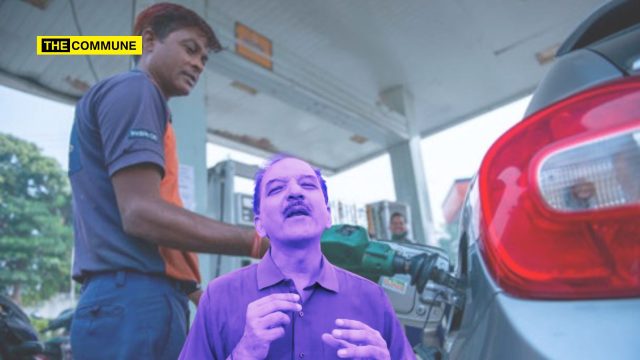
Derogatory Book Targeting Justice GR Swaminathan As ‘RSS Rowdy’ To Be Sold At Upcoming Chennai Book Fair

Even as preparations are underway for the 49th Chennai Book Fair, a controversy has emerged over the inclusion of a book that is derogatory and defamatory in nature. The book, whose cover caricatures sitting Madras High Court Justice GR Swaminathan, is scheduled to be sold at the upcoming fair, raising serious questions about the extent to which the Dravidianists will go to derogate a sitting judge who has been delivering fair judgements all through his career so far, especially surrounding the Thirupparankundram Karthigai Deepam row.

The book titled “Thirupparankundram Issue: GR Swaminathan – Judge or RSS rowdy?”, priced at ₹30, portrays Justice Swaminathan in a highly derogatory manner. The depiction goes beyond critique and amounts to personal vilification of a constitutional authority, undermining the dignity of the judiciary.

The controversy has surfaced just days after office-bearers of the Booksellers and Publishers Association of South India (BAPASI) announced details of the book fair at a press conference held at the Chennai Press Club. BAPASI president Shanmugam and secretary Vairavan had outlined the scale of the event, which is set to be held at the Nandanam YMCA Grounds from 8 January to 21 January 2026, with Chief Minister MK Stalin scheduled to inaugurate it.

While organisers highlighted plans for over 1,000 stalls, participation by leading Indian and international publishers, and expectations of attracting up to 25 lakh visitors, the presence of the derogatory book has shifted focus from literary celebration to propaganda peddling. Allowing such material to be sold at a major public book fair lends legitimacy to personal attacks on judges and risks normalising defamatory content under the guise of publishing freedom.

While book fairs traditionally provide space for diverse and even dissenting views, direct targeting of serving judges through insinuation and mockery raises ethical and possibly legal issues.

Subscribe to our channels on TelegramWhatsApp, and Instagram and get the best stories of the day delivered to you personally.
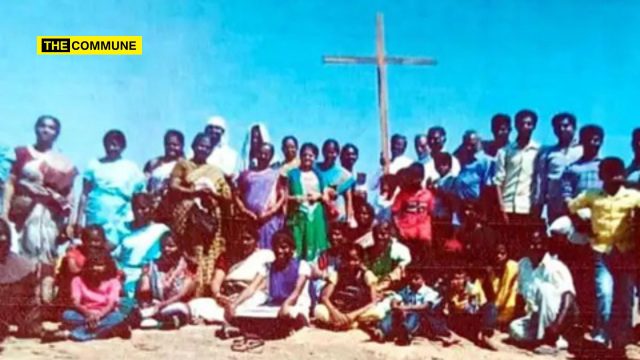
As 5 Lakh Devotees Assemble For Chidambaram Nataraja Temple Car Festival, Pariavaran Sanrakshan Leads Cleanliness Drive

Pariavaran Sanrakshan chidambaram car festival

On the occasion of the car festival at the Chidambaram Nataraja Temple on 2 January 2026, which witnessed the participation of more than five lakh devotees, a large-scale cleanliness drive was organised by Parivaran Sanrakshan.

Amid the heavy footfall and continuous religious activities, Parivaran Sanrakshan undertook a cleanliness initiative aimed at maintaining hygiene in and around the temple town.

More than 500 volunteers participated in the drive, clearing waste from roads, public spaces, and areas surrounding food distribution points. The volunteers focused on proper disposal of waste and general cleanliness to ensure a safer and cleaner environment for devotees during the high-profile religious event.

Organisers said the initiative was intended to complement the spiritual significance of the festival by promoting environmental responsibility and public cleanliness, especially during large congregations where waste generation is high.

Subscribe to our channels on TelegramWhatsApp, and Instagram and get the best stories of the day delivered to you personally.
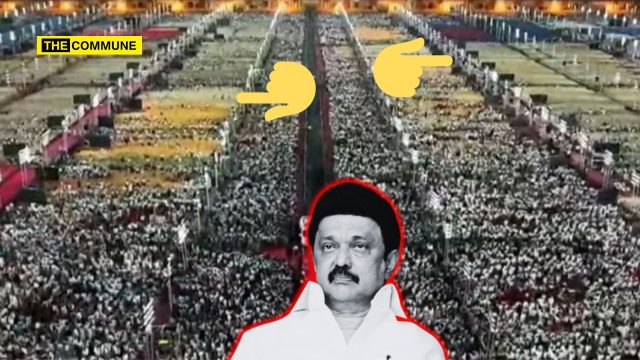
The Forgotten 1755 Natham Kanavai Battle Victory Where Tamil Warriors Routed The British

A little-known 18th-century guerrilla battle, in which Kallar warriors inflicted a devastating defeat on East India Company forces to reclaim looted temple idols, has been thrust into contemporary spotlight by a recent Madras High Court ruling. The judgment has cleared the legal way for a memorial stupa on private land to honour what is considered one of the earliest major anti-colonial resistances on Tamil soil.

The conflict, known as the Natham Kanavai War, unfolded over February to May 1755. Colonel Alexander Heron, leading a column of roughly 1,000 Company troops, was marching through the narrow Natham pass (Natham Kanavai) between Madurai and Tiruchirappalli. The column carried brass idols plundered from the Thirumogur (Koilkudi) temple, an act that had ignited local fury.

The looting was the culmination of a tax-collection expedition led by Heron and his military subordinate, Yusuf Khan (also known as Marudu Nayagam). When the local polygar (chieftain) Lakshmi Nayak refused to pay, British forces attacked. The regional governor, Mayana, fled to the Thirumogur temple for sanctuary.

Though Mayana escaped upon Yusuf Khan’s approach, Colonel Heron proceeded to assault the temple itself, burning its gates and seizing its idols. The Kallar community, traditional worshippers and protectors of the temple, were outraged. Their demand for the idols’ return was met with a ransom demand of 5,000 rupees, an exorbitant sum they could not pay.

Determined to retaliate, the Kallars of Melur planned an ambush. As Colonel Heron’s garrison later retreated through the strategic Natham pass, the warriors executed a meticulously planned attack.

They felled trees to block the winding gorge and positioned themselves on both flanks. When the elongated British column entered the constricted stretch, the Kallars attacked with traditional weapons, surgically segmenting and assaulting the trapped troops who struggled to deploy muskets and light artillery effectively.

Historical reconstructions and court records describe the encounter as a massacre. Of the approximately 1,000 Company soldiers, only Colonel Heron and about 30 sepoys reportedly survived to reach Tiruchirappalli. The Kallars triumphed, recovering all the stolen idols and reinstalling them in the Thirumogur temple – a victory seen not merely as a military success but as the restoration of Dharma and community honour.

For the Porkudi (war-clan) Kallars and local communities, Natham Kanavai holds profound significance as arguably the first instance on Tamil land where British forces suffered catastrophic casualties, predating the 1857 rebellion by a century. The memory is kept alive through annual victory-day commemorations near Melur, featuring bullock-cart races and gatherings.

The battle’s legacy entered the legal arena when a Melur-based lawyer, Siva Kalaimani Ambalam, petitioned the Madras High Court after local officials denied permission for a memorial stupa on private land dedicated to the fallen warriors.

In a significant ruling, Justice GR Swaminathan held that no prior government consent was required for such a commemorative structure on private property. Drawing parallels to other memorials like the memorial for Stan Swamy, the justice affirmed a community’s fundamental right to preserve its historical memory. This decision has formally paved the way for the construction of the Natham Kanavai War Memorial Stupa.

The judgment has also ignited fresh public discourse on the recognition of localised, pre-1857 anti-colonial struggles often omitted from mainstream historical narratives, reaffirming the right of communities to honour their resistance heritage outside the textbook canon.

Subscribe to our channels on TelegramWhatsApp, and Instagram and get the best stories of the day delivered to you personally.
“If Stan Swamy Can Have A Memorial, Why Not Them?” – Madras High Court Allows Memorial For 1755 Natham Kanavai Battle Heroes

The Madras High Court has permitted the installation of a memorial stupa to commemorate the warriors who fought and won the 1755 Natham Kanavai battle against British forces, observing that remembering such victories was a constitutional and civilisational duty.

Justice GR Swaminathan made the observation while allowing a writ petition filed by Siva Kalaimani Ambalam, a practising lawyer, whose request to install the stupa had earlier been rejected by the Tahsildar of Natham. The petition sought permission to erect a memorial in memory of the Natham Kanavai War, fought in 1755.

During the hearing, the court expressed concern that large sections of the present generation remain unaware of the resistance and sacrifices made by Indian society during the colonial period. Drawing a comparison with other memorials, the court remarked, “If for erecting a stone pillar in memory of Stan Swamy, permission is not required, certainly, no permission is required for erecting a stupa in memory of the Natham Kanavai battle.”

It was placed before the court that Natham Kanavai witnessed a “bloody confrontation” between the Melur Kallars and British troops in 1755, in which the Kallar community emerged victorious. The petitioner submitted that the British forces, led by Colonel Alexander Heron, had looted brass idols from the Thirumogur (Koilkudi) Temple, which were later recovered by the Kallar community after defeating the colonial troops.

In its order dated 26 November 2025, the High Court outlined several reasons for permitting the memorial. Referring to India’s civilisational diversity, the court observed that while the United States is described as a “melting pot,” India is better understood as a “salad bowl,” consisting of numerous communities and sub-communities with distinct histories. The court noted that such historical memories could be harnessed for higher national purposes.

Justice Swaminathan also highlighted the martial background of the Kallar community, comparing it with groups such as the Gurkhas and Rajputs. He noted that the community had been branded as a “criminal tribe” by the British and had suffered for decades until it was redeemed by leaders such as Shri Pon Muthuramalinga Thevar.

Observing that resistance to British rule began much before the 1857 uprising, the court said some scholars hold the view that the first war of Indian independence was waged from Tamil soil. Taking judicial notice of this perspective, the court remarked that the British “met their match” in the Madurai region, recalling historical figures such as Velu Nachiyar, the Marudu brothers, Puli Thevar, Veerapandiya Kattabomman, and Oomaithurai.

The court further reflected on the importance of celebrating success, stating that there is a converse to the maxim “success has many fathers but failure is an orphan,” namely that “success will beget many more successes.” It said victories against colonial forces, achieved at great cost and against impossible odds, deserved to be “relished” and the memory of martyrs “honoured.”

Drawing an analogy from sports, Justice Swaminathan referred to Chennai as the Chess Capital of India and noted that celebrating success could “motivate, instil inspiration and trigger transformation.” He cited the achievements of leading chess players, including world champion Gukesh Dommaraju, as examples of how success stories inspire future generations.

The court also referred to Article 51A of the Constitution, noting that it is the duty of every citizen to cherish and follow the noble ideals that inspired India’s freedom struggle and to defend the nation when called upon.

Concluding the matter, the High Court held that the petitioner was at liberty to erect the memorial stupa for the “Natham Kanavai War” on the land mentioned in the petition, thereby clearing the way for honouring the 1755 war heroes.

Source: Indian Express

Subscribe to our channels on TelegramWhatsApp, and Instagram and get the best stories of the day delivered to you personally.
“What Is Happening In Tamil Nadu Congress Is Deeply Distressing”, Says Congress MP Jothimani; Criticizes Leadership For Unchecked Internal Party Problems

jothimani congress

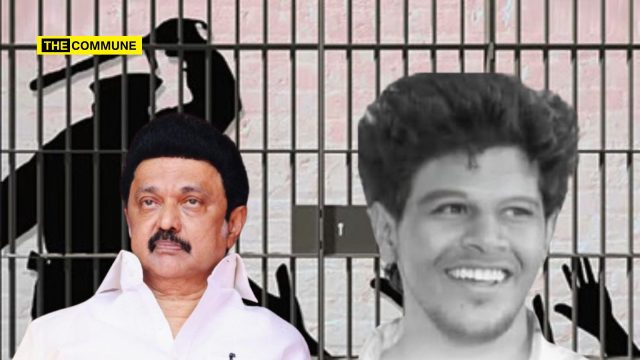
Congress Member of Parliament S Jothimani has publicly flagged serious internal problems within the Tamil Nadu Congress, stating that recent developments in the party are “deeply worrying.” In a Facebook post, she wrote that “no political party would ever think of blocking its own Member of Parliament from submitting the polling booth agent list to the Election Commission during elections,” but added that “this is exactly what is happening in the Congress party.”

Expressing anguish over the direction of the State unit, Jothimani said, “What is happening in the Tamil Nadu Congress is extremely distressing,” and accused certain sections of attempting to dilute the party’s ideological positions and political functioning. She noted that the party was increasingly appearing in the news “for wrong and irrelevant reasons, instead of people’s issues.”

Referring to the broader political climate, the MP warned that Tamil Nadu was facing “a grave danger from divisive, communal, and violent forces,” and cautioned that some groups were waiting to “provoke public emotions, capture power, and bury the social justice, self-respect, people-centric politics, and development safeguarded by leaders like Perunthalaivar Kamaraj and Periyar.”

Jothimani stressed that in such circumstances, “all political parties have a responsibility to handle the forthcoming elections with extreme care,” but questioned whether the Congress had truly understood the seriousness of this duty. She urged the party not to abandon its cadre, stating that “Congress workers who have proudly carried the party flag in every village despite not being in power for 60 years must not be betrayed.”

Highlighting organisational decay, she wrote that “unchecked internal party problems in the Tamil Nadu Congress are causing deep demoralisation,” and criticised the leadership for indulging in “mere arithmetic and power calculations instead of ideological politics and people’s issues,” warning that such conduct was pushing the party “slowly towards destruction for the selfish interests of a few.”

Invoking the leadership of Rahul Gandhi, Jothimani said the current path of the Tamil Nadu Congress was “completely opposite to his selfless, principled, and fearless politics,” and added that “we cannot betray his hard work and unmatched sacrifices.”

She concluded by reminding party members that the Congress’ standing in the State came from “the legacy protected by Perunthalaivar Kamaraj and the sacrifices of the Nehru–Gandhi family,” and said this legacy represented “the love and respect shown by the people of Tamil Nadu,” which, she cautioned, should not be taken lightly.

Subscribe to our channels on TelegramWhatsApp, and Instagram and get the best stories of the day delivered to you personally.
Kudali Sringeri Mahasamasthan Shankaracharya Sri Sri Abhinava Shankara Bharathi Mahaswami Visits Draupadi Amman Temple At Village Near Mahabalipuram During Vijay Yatra

Kudali Sringeri Mahasamasthan Shankaracharya Sri Sri Abhinava Shankara Bharathi Mahaswami Visits Draupadi Amman Temple At Village Near Mahabalipuram During Vijay Yatra

Sri Sri Abhinava Shankara Bharathi Mahaswami, the 72nd Peethadhipati of the Kudali Sringeri Mahasamasthan, visited Nallanpillaipetral village near Mahabalipuram in Chengalpattu district on Sunday as part of his ongoing Vijaya Yatra to Chennai and Puducherry.

The seer was accorded a traditional welcome by village elders and devotees at the Arulmigu Draupadi Amman Temple.

During his visit, the Mahaswami interacted with villagers at the temple premises and spoke about the role of temples in community life. He stressed that temples should serve not only as centres of worship but also as hubs for education and other socially beneficial activities.

The Kudali Sringeri Mahasamasthan, founded by Adi Shankaracharya nearly 2,500 years ago, is situated at the confluence of the Tunga and Bhadra rivers in present-day Karnataka.

According to local residents, this marks the first time that the Peethadhipati of the ancient Kudali Sringeri tradition has visited Nallanpillaipetral village, making the occasion a significant and memorable event for the community.

Subscribe to our channels on TelegramWhatsApp, and Instagram and get the best stories of the day delivered to you personally.
“Are You Eating Food Or Sh*t?”: DMK HR&CE Minister Loses Cool And Abuses Devotees At Suchindram Temple Festival

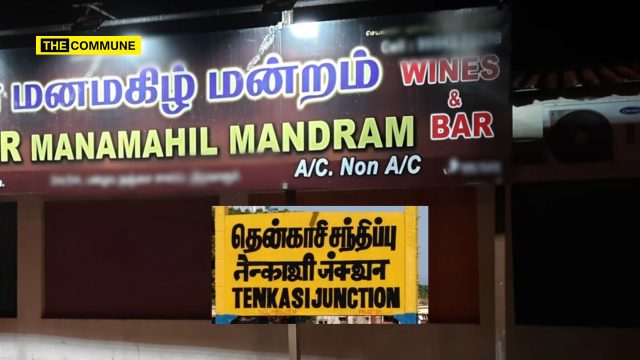
DMK HR&CE Minister Sekar Babu Reportedly Seen Scolding Devotees At Suchindram Temple Festival

A controversy has erupted following an incident involving DMK’s Hindu Religious and Charitable Endowments (HR&CE) Minister PK Sekar Babu, who was seen scolding and abusing devotees during the annual festival at Suchindram Temple.

The incident occurred when the minister visited the temple during the festival taking place. According to videos circulating on the internet, Sekar Babu is seen abusing devotees. In the video, he is seen yelling at the devotees asking, “Are you eating food or sh*t?”


View this post on Instagram


A post shared by Tamil Janam (@tamiljanam)

This is not the first time that Sekar Babu has behaved in this manner with devotees. In January 2025, he was seen making insensitive comments at devotees standing in the queue at Tiruchendur Murugan temple. He was reportedly seen saying, “He goes to Tirupati and waits 24 hours in queue, but that won’t count,” disregarding the long wait and hardships of the devotees, including women, children, and the elderly, who were struggling in a long queue with inadequate facilities.

The current episode has triggered criticism from various quarters, with devotees and observers questioning the conduct of a minister overseeing temple administration. Critics argue that such behaviour at a religious event undermines the dignity of devotees and raises concerns about the DMK government’s approach to temple management and public engagement during religious festivals.

Subscribe to our channels on TelegramWhatsApp, and Instagram and get the best stories of the day delivered to you personally.
100 Years Of Communism In India: An Imported Ideology With Foreign Loyalties And Bloodstained Outcomes

As the Communist Party of India (CPI) completes 100 years, its leaders, fellow travellers, and intellectual sympathisers are marking the occasion with celebration, nostalgia, and selective memory. Conferences are being organised, commemorative volumes released, and speeches delivered extolling the “historic contribution” of Indian Communism to workers, peasants, and democracy. Yet centenaries are not meant merely for remembrance; they are moments for serious evaluation. Political movements do not earn relevance by age alone. They earn it by outcomes, conduct, and contribution to the nation.

Over the past century, Indian Communism has consistently projected itself as the moral conscience of Indian politics the voice of the oppressed, the champion of the underprivileged, and the ideological alternative to what it dismisses as “bourgeois democracy.” It has claimed historical inevitability and moral superiority over other political traditions. And yet, after a hundred years, the communist movement today stands electorally marginal, ideologically rigid, socially disconnected, and increasingly irrelevant to India’s aspirations.

This raises an unavoidable question that cannot be brushed aside with slogans or romantic recollections of a vanished past: did Indian Communism actually serve India, or did it ultimately damage the nation’s political, economic, and social fabric?

Answering this question requires neither rhetorical hostility nor ideological prejudice. It requires an honest audit based on historical record, political conduct, and measurable outcomes. After 100 years, an ideology deserves neither automatic reverence nor automatic rejection. It deserves truth.

Not Indian in Origin, Never Indigenous in Spirit

Communism did not emerge from Indian social, cultural, or economic realities. It was a European ideological product, born in the specific historical conditions of 19th-century Europe. Its intellectual foundations were laid by Karl Marx, who analysed the dynamics of industrial capitalism in Europe factory labour, wage exploitation, and the sharp divide between capital owners and industrial workers. Vladimir Lenin later adapted this theory into a model of violent revolution led by a tightly controlled vanguard party seizing state power.

Both thinkers operated within relatively homogeneous, industrial societies where economic class was assumed to be the primary identity. Their framework rested on rigid assumptions: a clear oppressor–oppressed binary, violent rupture as the path to justice, and centralised control as the solution to inequality.

India, however, was never structured this way. Indian society is civilisational, plural, and layered. It is shaped by community, region, faith, language, and tradition not by economic class alone. Historically, Indian social change has occurred through reform, accommodation, synthesis, and gradual evolution rather than the annihilation of existing structures. From Bhakti and Sufi movements to social reformers and national renaissance, India’s civilisational method has always favoured continuity over destruction.

This fundamental mismatch explains why Communism never achieved deep societal acceptance in India. An ideology built on rigid binaries could not sustain itself in a civilisation that thrives on plurality, negotiation, and organic balance. Indian society is complex and adaptive; Communism is doctrinaire and inflexible. This contradiction lies at the heart of Communism’s long-term irrelevance in India.

Ideology Above Nation: The Quit India Betrayal

Beyond its theoretical incompatibility, Indian Communism is burdened by a far more serious charge: the repeated prioritisation of ideology over national interest. The most glaring example remains its conduct during the Quit India Movement of 1942.

In August 1942, India witnessed one of the most decisive mass uprisings against British rule. The Quit India Movement, led by Mahatma Gandhi, cut across regions, castes, and ideologies. It was a moment of national unity and moral clarity. And yet, the Communist Party of India chose to stand apart from the nation.

The CPI opposed the Quit India Movement not due to any strategic assessment of India’s readiness for freedom, but because of ideological alignment with Moscow. When Nazi Germany invaded the Soviet Union in 1941, Britain became an ally of the USSR. Overnight, the CPI reclassified the Second World War as a “people’s war” against fascism and instructed its cadres not to disrupt the British war effort. Strikes were discouraged. Protests were opposed. In several instances, Communist functionaries cooperated with colonial authorities.

While millions of Indians faced arrests, firing, and imprisonment, the CPI stood aside not because India’s freedom could wait, but because Soviet interests demanded restraint. Few episodes so clearly illustrate how Indian Communism subordinated national aspirations to foreign ideological centres.

The China War: Ambiguity in the Face of Aggression

A similar pattern re-emerged during the 1962 Sino-Indian War. When Chinese forces crossed India’s borders in Ladakh and Arunachal Pradesh, the nation expected unity and moral clarity from its political leadership. What it received instead from large sections of the Communist movement was silence, confusion, and ideological sympathy for the aggressor.

The crisis exposed the deep ideological dislocation within Indian Communism. Instead of unequivocal support for India’s sovereignty, sections of the Left attempted to rationalise Chinese actions through Marxist jargon. This culminated in a split within the CPI, leading to the formation of the CPI(M), with its pro-China orientation.

Once again, when ideology clashed with national interest, Indian Communism faltered.

From Ballot to Bullet: The Descent into Armed Insurgency

Ideological confusion was damaging enough. What proved catastrophic was the gradual abandonment of democratic politics by sections of the Communist movement. From the late 1960s onwards, large segments embraced armed insurgency as a legitimate political tool. This was no longer opposition to the state it was war against the Indian Republic.

What followed was not a struggle for workers’ rights, but a prolonged campaign of violence: assassinations, massacres, landmine blasts, destruction of infrastructure, and systematic intimidation of civilians. The victims were not colonial rulers or capitalist elites, but ordinary Indians tribals, farmers, elected representatives, policemen, and daily-wage workers.

From Senari and Bara in Bihar to Dantewada, Sukma, and Jeeram Ghati in Chhattisgarh, the trail of blood is undeniable. The Dantewada massacre of 2010 alone claimed the lives of 76 CRPF personnel. The Jeeram Ghati attack targeted elected leaders. Landmines have blown up civilian vehicles in Giridih and Latehar. Entire regions have been held hostage to fear and stagnation in the name of “class struggle.”

This violence did not liberate the poor. It devastated them. It destroyed schools, roads, healthcare access, and livelihoods. It delayed development in tribal regions by decades, ensuring continued misery while insurgent leadership thrived in underground privilege.

Electoral Collapse and Ideological Exhaustion

While armed extremism represents one face of Communism’s failure, its parliamentary wing tells another story. Once dominant in West Bengal, Tripura, and Kerala, Communist parties have been decisively rejected by voters in most of India. Where they governed, their record is marked by industrial stagnation, flight of capital, politicisation of institutions, and cadre-driven intimidation.

The collapse of Left Front rule in West Bengal was not accidental—it was the result of decades of economic mismanagement, ideological rigidity, and suppression of dissent. Even today, the Left’s vocabulary remains frozen in the 20th century, unable to engage with India’s entrepreneurial, aspirational youth.

Conclusion: A Hundred Years, No Redemption

After a century, Indian Communism cannot be judged by intent, theory, or self-image. It must be judged by record. That record reveals an ideology imported from outside India, fundamentally misaligned with Indian civilisation, repeatedly subordinating national interest to foreign ideological loyalties, and turning to violence when democratic relevance declined.

This is not the story of an ideology betrayed by circumstances. It is the story of an ideology that failed because it could not adapt to India’s pluralism, its civilisational continuity, or its democratic ethos. The centenary of the Communist Party of India is therefore not a moment for celebration, but for reckoning.

After 100 years, Indian Communism has neither liberated the poor nor strengthened democracy nor safeguarded national sovereignty. It has only demonstrated one enduring truth: an ideology that places itself above the nation will ultimately damage both the nation and itself.

Dr. Prosenjit Nath is a techie, political analyst, and author.

Subscribe to our channels on TelegramWhatsApp, and Instagram and get the best stories of the day delivered to you personally.