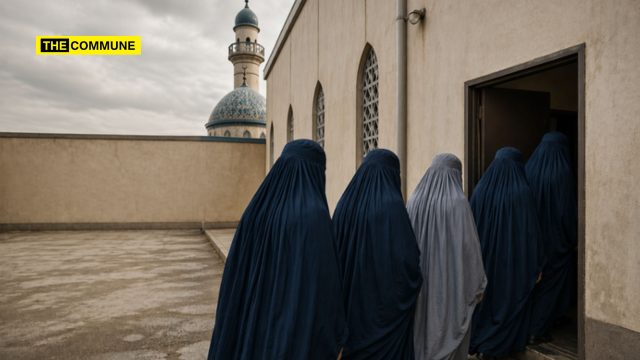
The petition filed by the Peerzade family before the Supreme Court of India seeking equal worship rights for Muslim women in mosques has reopened a long-suppressed debate within the Indian Muslim community. The response of the All India Muslim Personal Law Board—while acknowledging that Islam does not prohibit women from entering mosques—continues to defend restrictions through arguments such as “non-mandatory worship” and enforced segregation. As a nationalist Muslim and a member of the Rashtriya Muslim Manch, I argue that this position is Islamically weak, constitutionally unsustainable, and culturally alien to India.
The Indian Constitution remains the highest social and moral contract for all citizens, including Muslims, and religious freedom under it cannot be used to justify gender-based exclusion. Articles 14 and 15 guarantee equality before the law and prohibit discrimination on the grounds of sex, while Article 21 protects dignity and the right to a meaningful life. Article 25 safeguards freedom of conscience and religious practice, but makes it clear that such freedom operates within the framework of constitutional equality. Denying Muslim women access to mosques undermines their equality, restricts their religious conscience, and compromises their dignity as believers.
The claim that mosque attendance is “not compulsory” is constitutionally irrelevant. Fundamental rights protect voluntary religious practices, not merely obligatory rituals. Many Islamic practices—such as nafl prayers, religious gatherings, i‘tikaf, and learning circles—are non-mandatory, yet access to them is never denied. Non-obligation does not amount to prohibition. The AIMPLB’s argument therefore collapses both legally and logically, as denying access to mosques clearly violates Article 25 read with Articles 14 and 21.
The strongest counter to this position arises not from modern constitutional law but from Islam itself. Prophet Muhammad categorically declared, “Do not prevent the female servants of Allah from the mosques of Allah.” This clear and authentic command leaves no room for institutional practices that seek to restrict or deny women’s access. It is explicit, unconditional, and unambiguous. There is no evidence that the Prophet ordered a permanent ban, mandated barriers as a condition of entry, or restricted mosque access on the basis of social concerns. No religious body, regardless of its stature, can override a direct Prophetic instruction.
The AIMPLB’s attempt to present segregation as an essential Islamic requirement is historically inaccurate. In the Prophet’s mosque, men and women prayed in the same space. Rows were arranged, but there was no architectural exclusion. Physical barriers emerged later, shaped by changing social conditions rather than divine command. Islamic jurisprudence recognises context and evolution; it does not freeze historically contingent practices into eternal religious obligations.
The frequently cited claim that Caliph ʿUmar restricted women from mosques also requires careful clarification. There was no formal or universal ban imposed during his time. Any caution that may have been exercised was linked to concerns of public decorum and safety, not theological prohibition. Crucially, the Prophetic instruction permitting women’s mosque access was never annulled. Invoking early contextual caution to justify permanent exclusion today is therefore historically inaccurate and juristically unsound.
India’s civilizational tradition is inherently collective and participatory, where shared worship remains the norm. Across traditions, places of worship are accessible to both men and women. Islam in India historically coexisted within this inclusive cultural framework. By insisting on exclusionary practices, the AIMPLB risks socially isolating Muslims, alienating Muslim women, and weakening mosque-centered community life. A religion that withdraws from society risks stagnation, while one that engages with its social environment continues to thrive.
From a nationalist Muslim perspective, Indian Muslims must think in terms of Indian constitutional values, not imported rigidity. Our rights, dignity, and security are safeguarded by the Constitution, not by external clerical authority. Within this framework, Islam can flourish alongside Indian nationalism. Upholding women’s dignity strengthens the community, while defensiveness and exclusion only weaken it.
The Peerzade petition does not seek to alter Islamic theology or impose social disruption. It does not call for mixed-gender prayers or the abandonment of modesty. It simply seeks to ensure that Muslim women are not arbitrarily excluded from mosques. At its core, it demands access, dignity, and equal participation as believers and citizens. It is a restorative demand, aligned with the Qur’an, supported by Prophetic tradition, and grounded in constitutional morality.
In conclusion, the AIMPLB must reconsider its position in the larger interest of Indian Islam. Its current stance is Islamically weak, as it contradicts clear Prophetic guidance; constitutionally indefensible, as it violates equality and dignity; and culturally disconnected from India’s inclusive ethos. Excluding women from mosques has no Qur’anic basis and runs contrary to the Sunnah. The strength of Indian Islam lies in confidence, inclusion, and alignment with constitutional morality—not in fear-driven exclusion. A mosque that welcomes women is not less Islamic, but more faithful to the Prophet’s teachings, the Constitution, and the nation itself.
Imran has a degree from TISS Mumbai and is part of Rashtriya Muslim Manch.