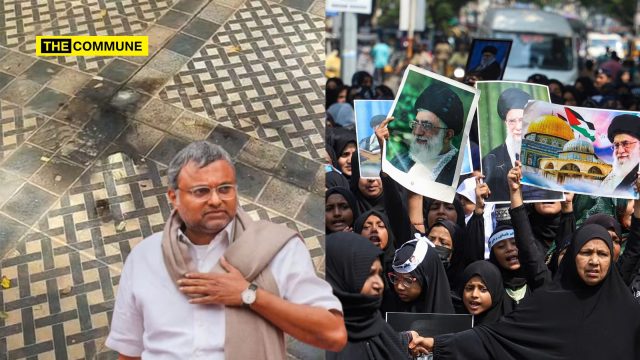
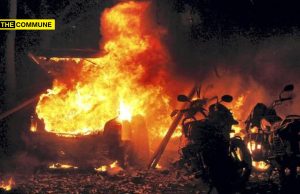
Molotov cocktails (petrol bombs) were hurled at the office of Sivaganga MP Karti P. Chidambaram in Subramaniyapuram, Karaikudi, in the early hours of Wednesday (11 March 2026), police said.
The incident came to light on Wednesday morning when the damage was noticed at the premises. The office was locked at the time of the attack and no one was present inside. As a result, no injuries were reported.
As reported in The New Indian Express, police officials said the exact time of the incident remains unclear as the office does not have CCTV surveillance. Investigators are attempting to determine the timing through other means. Two Molotov cocktails were believed to have been thrown at the building, and their impact marks were visible on the premises. However, the attack did not cause significant structural damage.
Following the incident, Karaikudi Congress MLA S. Mangudi visited the site as the MP was not in the locality. Sivaganga Superintendent of Police R. Shiva Prasad also inspected the venue and announced that special teams had been formed to identify and apprehend those responsible.
The attack comes in the backdrop of his remarks made earlier this month about developments in Iran.
On 2 March 2026, shortly after the assassination of Ayatollah Ali Khamenei, Karti Chidambaram spoke about the political situation in Iran.
Addressing the issue, he said that he was not defending the Ayatollah regime and described it as oppressive toward its own people. He said, “Khamenei’s regime was a cruel/brutal regime (கொடூர ஆட்சி) – I will not defend it”
The backlash was immediate and escalated quickly on the ground. As reported in Dinamalar and Getlokalapp, his remarks drew criticism from some Muslim organisations, which accused him of making offensive comments. Protests were subsequently held near the Sivaganga Palace area, where demonstrators raised slogans against the Congress MP.
In Karaikudi and surrounding areas, several Islamic organisations also condemned the remarks through social media posts and posters. Some of these posters were reported to contain controversial messages targeting the MP.
Speaking to the press about the backlash, he said, “I condemn the Taliban and Ayatollahs. That does not mean I am against Muslims. Those who oppose my views must read and understand the atrocities committed by the Ayatollahs in Iran.”
Reiterating his comments, at another press conference he said, “Those criticising my comments should read about Iran. Let me say it again: if I condemn the Taliban, does it mean I am condemning Muslims? I condemn the Ayatollahs. People must read about the atrocities committed by the Ayatollahs in Iran.”
Subscribe to our channels on WhatsApp, Telegram,Instagram and YouTube to get the best stories of the day delivered to you personally.
Incidents of banner collapses causing injuries and fatalities have continued to be reported across Tamil Nadu, despite repeated warnings and directives from courts against the practice. Courts have issued guidelines, strengthened regulations and cautioned authorities about the dangers posed by banners and flagpoles placed in public spaces. However, political parties across the spectrum, whether ruling, opposition or smaller outfits have continued to install banners in unsafe locations, often placing large hoardings in public areas and digging pits in the middle of roads to erect flagpoles.
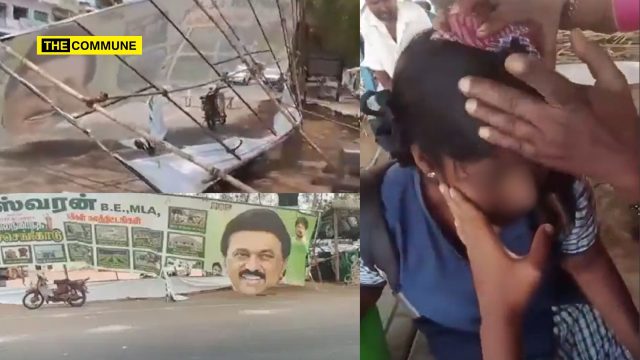
In the latest such incident, a Plus One student was injured after a banner installed to highlight the achievements of Tiruchengode MLA Eeswaran collapsed in Namakkal district on Tuesday (10 March 2026) evening.
The incident occurred in Kalippatti when strong winds swept through the area. The large banner, which had been erected to publicise the achievements of Eeswaran, who represents the Tiruchengode Assembly constituency and serves as the general secretary of the Kongunadu Makkal Desiya Katchi, reportedly could not withstand the force of the wind and suddenly collapsed.
The banner fell on Dharani, a 16-year-old Class XI student from Konangipatti near Tiruchengode. She had arrived at the Kalippatti bus stop after attending a special class at school earlier in the evening.
As reported in Dinamaalai, Dharani was standing at the bus stop when strong gusts of wind hit the area, causing the banner to fall directly onto her head. She sustained head injuries and collapsed at the spot, bleeding profusely.
Local residents rushed to her aid and administered first aid before informing her family. Upon receiving the information, the girl’s father rushed to the location. He reportedly stated that his priority was his daughter’s health and requested that no complaint or publicity be pursued regarding the incident. He then took her to a private hospital for further treatment.
A banner highlighting achievements, featuring the photograph of CM #MKStalin and put up by Tiruchengode MLA and Kongunadu Makkal Desiya Katchi leader E.R Eeswaran in the Kalipatti area of #Namakkal district, collapsed and fell on a school student named Dharani. The student… pic.twitter.com/6y6GK72KwW
Police from the Mallasamudram police station registered a case and have begun an investigation into the incident.
The episode has once again triggered concerns in the Kalippatti area about the continued installation of large political banners in public spaces, despite repeated court warnings that such displays can pose serious risks and inconvenience to the public.
Subscribe to our channels on WhatsApp, Telegram,Instagram and YouTube to get the best stories of the day delivered to you personally.
In a horrifying incident that has sent shockwaves through the region, a 14-year-old girl was chased, kidnapped, and gang-raped by two men after she was left behind by her companions following a motorcycle accident late Monday (9 March 2026) evening. The survivor displayed incredible courage, walking approximately 12 to 16 kilometers through the night to reach a government hospital and report the crime.
Police have arrested one suspect, identified as ‘Kakka’ Balaji, while a massive manhunt is underway for his accomplice.
As reported in Times of India, according to police officials, the ordeal began around dusk on Monday when the victim was riding pillion on a motorcycle with a 17-year-old boy and another 16-year-old girl. The trio was traveling from Tambaram towards Keelakandai. As they reached the Devathur area near Madurantakam, they noticed two men on a motorcycle following them. The suspects, who were reportedly intoxicated, attempted to confront the teenagers.
Panicking, the boy driving the two-wheeler accelerated in an attempt to flee but lost control of the vehicle, causing all three to fall off. As the two assailants closed in, the boy and the 16-year-old girl quickly got back on the motorcycle and sped away, leaving the injured 14-year-old girl alone at the scene.
The two men then captured the minor and dragged her to a secluded area near the Athivakkam lake. They proceeded to gang-rape her before fleeing, abandoning her at the spot. Despite the trauma and her injuries, the girl managed to get up and walk through the night to the Chengalpet Government Hospital, where she arrived at dawn and narrated her ordeal to the medical staff.
Hospital authorities immediately alerted the police. The survivor is currently undergoing treatment at the hospital, where her condition is reported to be stable.
The Melmaruvathur All-Women Police Station has registered a case, and four special teams have been formed to track down the remaining accused.
A senior police official confirmed that the arrested suspect, ‘Kakka’ Balaji, a resident of Thiruverkadu, has a prior criminal record and is involved in several cases registered at the Guduvanchery police station.
Subscribe to our channels on WhatsApp, Telegram,Instagram and YouTube to get the best stories of the day delivered to you personally.
A few months ago, short video clips of an emcee ‘relishing’ the sambar served at government schools as part of the midday meal and breakfast scheme in Tamil Nadu circulated widely on social media.
— Saikiran Kannan | 赛基兰坎南 (@saikirankannan) March 10, 2026
A few days ago, we reported that 33 students fell ill due to suspected food poisoning at a government model school hostel near Cuddalore.
On Tuesday, 10 March 2026, yet another similar incident surfaced, this time from Coimbatore.
As reported in Times of India, as many as 44 students suffered suspected food poisoning after consuming lunch at a Coimbatore Corporation Middle School in Kavundampalayam on Tuesday afternoon. It was alleged that a lizard had fallen into the food served to the students.
#WATCH | Coimbatore, Tamil Nadu: 43 students of a government school in Coimbatore were rushed to the Government Hospital following a suspected case of food poisoning linked to their Noon meal. pic.twitter.com/JIgn0alDzA
According to officials, most of the affected children were studying in Class IV. Shortly after lunch, several students began experiencing continuous vomiting, while some reportedly fainted. The affected group included 30 boys and 14 girls.
VIDEO | Coimbatore, Tamil Nadu: Several students of a school hospitalised after a lizard was allegedly found in their Mid Day meals.
Forty-three of the students were rushed to the Coimbatore Medical College Hospital (CMCH) for treatment, while the parents of one student took the child home. A team of five doctors at CMCH attended to the children and provided medical care.
Coimbatore District Collector Pavankumar G Giriyappanavar, Corporation Commissioner M Sivaguru Prabakaran and Mayor R Ranganayaki visited the hospital to review the situation and check on the students.
Officials stated that the condition of all the affected children was stable. All 44 students were discharged later on Tuesday night after receiving treatment.
Corporation Commissioner M Sivaguru Prabakaran stated that a special team had been constituted to investigate the allegation that a lizard had fallen into the food served to the students. He reported that a detailed inspection would be carried out at the school kitchen and that only the investigation would determine whether negligence on the part of the staff had caused the incident. He also stated that a circular would be issued to all schools following the inquiry.
Meanwhile, parents gathered at the school entrance after learning about the incident. According to reports, they were initially denied entry into the premises, which led to an argument between the parents, school authorities and police personnel present at the spot.
Subscribe to our channels on WhatsApp, Telegram,Instagram and YouTube to get the best stories of the day delivered to you personally.
In January 2008, as Pakistan was secretly planning a wave of terrorist attacks that would strike Jaipur, Bangalore, Ahmedabad, Delhi, and culminate in the Mumbai massacre of November that year, India’s Petroleum Minister Murli Deora was meeting his Pakistani counterpart at the Crowne Plaza Hotel in London – to finalise a multi-billion dollar gas pipeline running from Iran, through Pakistan, into India.
It was called the Iran-Pakistan-India Pipeline. Its backers called it the Peace Pipeline. In hindsight, it may have been the most dangerous energy gamble India never took.
What Was the IPI Pipeline?
First proposed in the early 1990s, the IPI pipeline would carry natural gas from Iran’s South Pars field, one of the largest in the world, through 1,035 km of Pakistani territory before entering India near Barmer, Rajasthan. Total length: 2,135 km. Estimated cost: over $7 billion. Designed capacity: 60 million standard cubic metres per day, split equally between India and Pakistan.
For an energy-hungry India growing at 8–9% annually, the appeal was obvious. The UPA government under Dr. Manmohan Singh pursued it earnestly through 2005, 2006, 2007, and into 2008.
Dear young people,
You have no idea how crazy UPA was
Here was Dr. Singh’s worst idea … to build an oil pipeline from Iran through Pakistan to India!
Imagine putting our oil supply in hands of Pakistan…
There was one fundamental flaw: Pakistan would control the tap.
Every cubic metre of gas entering India would first pass through over a thousand kilometres of Balochistan and Sindh – regions marked by insurgency and chronic instability. India proposed paying only upon delivery at the Indian border, so it would not pay if Pakistan disrupted supply. Iran refused, insisting India pay regardless of Pakistani interference. In plain terms, Pakistan could cut off India’s gas during any border standoff or diplomatic crisis, and India would still owe Iran the money.
The Year Pakistan Was Planning Terror
The January 2008 London handshake happened while Pakistan’s security establishment was running operational planning for the deadliest terror campaign India had ever seen. Jaipur was bombed in May, Bangalore and Ahmedabad in July, Delhi in September, and Mumbai in November – 166 killed in 26/11 alone. India was negotiating energy dependency with the very state whose proxies were simultaneously planting bombs in its cities.
Why India Walked Away
India distanced itself from 2007 onwards, citing security concerns and pricing disputes. The final push came from the India-US civil nuclear deal of 2008, which carried an unspoken expectation that India would not deepen ties with Tehran. US sanctions on Iran sealed the decision. Pakistan’s Foreign Minister Shah Mahmood Qureshi later acknowledged India “pulled out for obvious reasons.”
The Lucky Near-Miss
Had the pipeline been built, US sanctions reimposed after 2018 would have rendered it legally unusable. Every India-Pakistan crisis, Pulwama, Balakot, would have unfolded with Islamabad’s hand on an energy switch. The IPI was dressed up as a peace project. In reality, it would have been a permanent structural vulnerability. Its cancellation, even if driven largely by American pressure, may be one of the luckiest near-misses in India’s post-liberalisation history.
Subscribe to our channels on WhatsApp, Telegram,Instagram and YouTube to get the best stories of the day delivered to you personally.
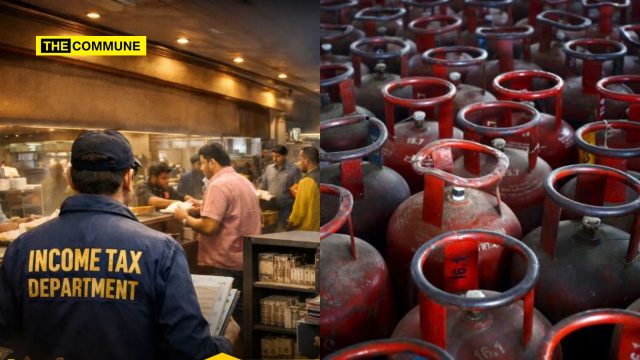
On the morning of 9 March 2026, the Central Board of Direct Taxes issued a press release that should have dominated news cycles for days. The Income Tax Department had conducted a nationwide survey of 62 restaurants across 46 cities in 22 states, deploying AI-enabled analytics on transactional data from 1.77 lakh food and beverage establishments and found suppressed sales worth Rs 408 crore. Restaurants had been deleting bulk bills, modifying records, and excluding transactions from reported sales to evade tax.
The department announced that 63,000 restaurants would be nudged to file updated returns before 31 March 2026, and that full investigations were underway.
So the LPG shortage was to mask this illegal system they were doing all these years. pic.twitter.com/SMgT42jLn8
— Indu Makkal Katchi (off) (@Indumakalktchi) March 10, 2026
But by evening, that story had been almost completely buried. In its place, television screens across India were filled with visuals of a handful of restaurant owners standing outside their establishments, claiming they could not get LPG cylinders. The “gas crisis” had arrived – loud, dramatic, and perfectly timed.
The Shortage That Wasn’t – And the One That Is
To be clear: a disruption in commercial LPG supply is real. The Iran-Israel war has created turbulence in West Asian shipping lanes, and the government of India has itself invoked the Essential Commodities Act on March 5 and issued the Natural Gas Supply Regulation Order on March 10 to manage the situation. These are genuine policy responses to a genuine global disruption.
But genuine disruption and manufactured panic are different things and what played out on news channels was unmistakably the latter.
The Timeline That Raises Questions
The sequence of events is striking.
The CBDT press release exposing ₹408 crore in suppressed restaurant sales was issued on the morning of March 9. Within hours, hospitality associations in major cities such as Mumbai, Bengaluru, and Chennai began issuing warnings of possible shutdowns due to LPG shortages. By the evening of the same day, television coverage had shifted almost entirely from the Income Tax Department’s nationwide survey to the alleged gas supply crisis.
What should have been a story about systematic tax evasion across tens of thousands of restaurants had suddenly become a story about restaurants as victims of a supply disruption.
What the Cameras Chose to Show
Yet morning news channels chose to zoom in, repeatedly and needlessly, on a handful of outlets claiming no cylinder supply, presenting isolated, unverified anecdotes as a national emergency. The coverage was disproportionate, emotionally charged, and conspicuously timed.
The question that must be asked is straightforward: who benefits from this noise?
The restaurant and hotel industry, the very sector that the Income Tax Department had just put under a nationwide scanner for systematic tax evasion, suddenly became the loudest voice in the national conversation, not as tax evaders under scrutiny, but as victims of a government supply failure. The framing could not have been more convenient. Industry associations in Mumbai, Bengaluru, and Chennai issued coordinated shutdown warnings within hours of the IT survey becoming public, generating wall-to-wall media coverage that effectively pushed Rs 408 crore worth of documented fraud off the front page.
We had DMK mouthpiece Sun News blowing things out of proportion. Polimer News too played second fiddle.
Very interestingly, one restaurant chain in Chennai – Adayar Ananda Bhavan and one in Coimbatore, Annapoorna, seemed to be highlighted by news channels.
Looks like the LPG shortage has affected only one restaurant in Bengaluru and one in Chennai.
Most renowned Annapoorna restaurant chain in Coimbatore has placed a notice in front of its branches stating that because of LPG cylinder shortage they are minimizing their menu to only provide essential food varieties pic.twitter.com/nY7b06eM13
To top it all, DMK leaders like Kanimozhi too voiced her ‘concern’.
The suspension of commercial LPG cylinder distribution in South Indian states, including Tamil Nadu, has triggered widespread concern among the public. Reports indicating a possible shortage of fuels such as petrol have further deepened these anxieties.
Since rumours of a fuel shortage began circulating on social media, they ballooned rapidly, despite government sources clearly stating there is no cause for concern regarding fuel availability in India. On petrol and diesel, officials confirmed that retail prices will remain stable unless global crude oil prices cross approximately USD 130 per barrel and crude is currently expected to remain around the USD 100 per barrel range. There is no shortage of petrol or diesel at fuel stations across the country. India has accelerated crude oil sourcing from routes outside the Strait of Hormuz to proactively mitigate any potential disruption.
On Aviation Turbine Fuel, the government was even more emphatic: India is not merely self-sufficient – it is an exporter of ATF. Officials noted that several nations have approached India to assess supply availability, positioning India as relatively better placed than most countries facing the West Asia crisis. There is, in the government’s own words, no reason for panic.
Govt Sources say –
* Petrol and Diesel prices are unlikely to increase as we have enough stock. Unless crude oil prices breach USD 130, petrol-diesel prices are unlikely to increase. We expect crude oil prices to be around $100 per barrel.
On the very day the Income Tax Department exposed widespread tax suppression across tens of thousands of restaurants, the national conversation abruptly shifted to an alleged LPG crisis. While logistical disruptions in global energy supply are real, the scale of panic projected on television screens appeared far removed from the government’s own assessment of the situation.
What quietly slipped out of focus was a far more consequential development: a nationwide, AI-driven investigation into systematic tax evasion across the hospitality sector.
When a ₹408 crore tax suppression story disappears from headlines within hours, the question is no longer about LPG cylinders. It is about how quickly narratives can be redirected and which stories are allowed to dominate the public conversation.
Subscribe to our channels on WhatsApp, Telegram,Instagram and YouTube to get the best stories of the day delivered to you personally.
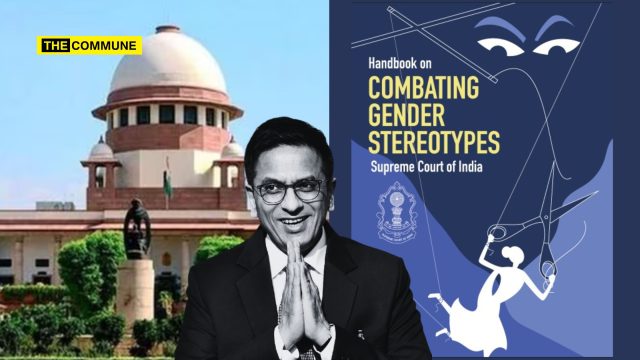
The Supreme Court of India has ordered a comprehensive relook at the controversial “Handbook on Combating Gender Stereotypes” introduced in 2023 under former Chief Justice D Y Chandrachud. It has ordered the drafting of fresh judicial sensitivity guidelines after several sitting judges expressed deep discomfort – both with the process through which the handbook was adopted and with portions of its content that they believe reinforce, rather than remove, prejudice.
As reported in The Indian Express, the move, formalised through a February 10 order by a three-judge bench of Chief Justice Surya Kant, Justice Joymalya Bagchi, and Justice N V Anjaria, asks former Supreme Court judge Justice Aniruddha Bose, now Director of the National Judicial Academy in Bhopal, to constitute a committee of domain experts drawn from practitioners, academicians, and social workers to prepare a comprehensive report and draft new guidelines. The committee has been given three months to submit its findings.
What Triggered the Order
As reported in OpIndia, the immediate occasion was a suo motu case the Supreme Court had initiated against an Allahabad High Court ruling in a POCSO matter, where the High Court drew a distinction between “preparation” and “attempt” to commit rape and consequently diluted the charges against the accused. The Supreme Court disagreed sharply. It held that the accused had clearly moved beyond preparation into active execution of intent, restored the original charges, and set aside the High Court’s judgment.
In that context, concerns raised by counsel about the persistence of judicial insensitivity in sexual offence cases, particularly those involving minors and vulnerable victims, found a receptive bench. CJI Kant acknowledged that empathy and compassion must accompany legal reasoning in such cases. The broader order that followed was, however, about something more systemic.
The Handbook That Divided the Court
The 2023 handbook, produced under CJI Chandrachud’s initiative and described in its foreword as having been “conceptualised during the COVID-19 pandemic” as part of the e-Committee of the Supreme Court, was framed as a tool to help judges and legal professionals identify and avoid gender stereotypes. Its glossary offered alternative language to replace what it termed “gender-unjust” terms in pleadings, orders, and judgments.
But behind the scenes, the handbook had been quietly generating friction within the institution. Highly placed sources told The Indian Express that judges were unhappy on two counts – process and substance.
On process, the grievance was direct: a document intended to guide the judiciary’s conduct in courtrooms was adopted without being placed before the full court. “It was necessary to take all judges into confidence before deciding to publish the handbook, which they were supposed to follow… It should ideally have been placed before the full court for a broader discussion, but this was not done,” sources said.
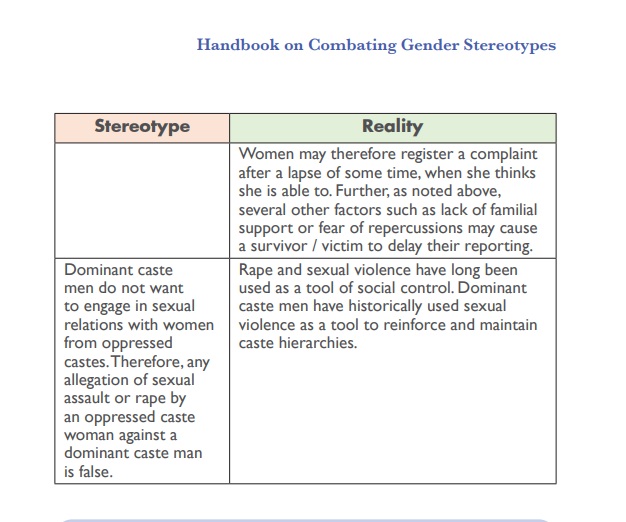
On substance, judges took specific exception to a section listing stereotypes commonly applied to men and women in the context of sexual violence. One entry in the handbook states that a prevailing stereotype holds that “dominant caste men do not want to engage in sexual relations with women from oppressed castes” and therefore any allegation of sexual assault by an oppressed caste woman against a dominant caste man is presumptively false. The handbook then offers its counter-narrative: that rape and sexual violence have historically been “used as a tool of social control” and that “dominant caste men have historically used sexual violence as a tool to reinforce and maintain caste hierarchies.”
Source: DYC Gender Handbook
For a section of the judiciary, this was not sensitivity training – it was institutional overreach. Sources told the Indian Express that judges felt “the Supreme Court should not be making such generalised and sweeping statements, which have the effect of painting targets on entire communities.” That an official Supreme Court publication was making categorical sociological assertions about entire caste groups, rather than adjudicating specific disputes between individuals, was seen as a category error that carried serious institutional risk.
“Too Harvard Oriented”
The February 10 bench was also unsparing about the handbook’s language. CJI Kant pointedly described it as “too Harvard oriented” – academic, inaccessible, and remote from the lived reality of the litigants it was nominally designed to serve. The court’s order mandated that any new guidelines must be written in “simple language comprehensible to laypersons” and must not be “loaded with heavy, complicated expressions borne from foreign languages and jurisdictions.”
In a pointed formulation, the bench stated that the guidelines “must be contextualised in the real and lived experience of the stakeholders in the Indian judicial process, with direct reference to the ethos, values, and social fabric of our country.” The committee has also been specifically asked to identify offensive and insensitive expressions used across regional contexts so that victims from diverse linguistic backgrounds can better articulate their experiences before courts.
The order also acknowledged frankly that “the efforts thus far have not borne the fruit that was expected” – a measured but unmistakable institutional admission that Chandrachud’s handbook had failed its stated purpose.
A Pattern Worth Noting
This is not the first time that an institutional document addressing sensitive social questions has generated a sharp backlash for making sweeping generalisations. The UGC’s Promotion of Equity in Higher Education Institutions Regulations, 2026, stayed by the Supreme Court itself in late January, ran into similar turbulence for structurally presuming that General Category students and faculty are perpetrators in matters of caste discrimination. The court has now, in effect, flagged the same problem with a document it had itself published.
When contacted by The Indian Express, ex-CJI Chandrachud declined to comment.
What Comes Next
The new committee will study all previous attempts, including the 2023 handbook, before proposing fresh draft guidelines. Crucially, sources confirmed that the final guidelines will be placed before the full court for discussion and adoption – the consultative step that was conspicuously skipped the last time around.
What the February 10 order signals is an institution quietly pressing the reset button. The judiciary understands that sensitivity toward victims of sexual violence is not optional, it is a constitutional imperative. But the court has also signalled, without ambiguity, that the instruments used to build that sensitivity must themselves be constitutionally sound: carefully deliberated, linguistically accessible, institutionally credible, and free of the kind of sweeping sociological generalisations that convert judicial guidance into political controversy.
Chandrachud’s handbook arrived with considerable fanfare. It is leaving through the back door.
Subscribe to our channels on WhatsApp, Telegram,Instagram and YouTube to get the best stories of the day delivered to you personally.
As tensions escalate in West Asia, social media has seen a surge of posts warning of potential shortages of LPG and fuel supplies. Several of these claims have been amplified by Congress sympathisers.
Foremost among those is Sumanth Raman – the all-in-all commentator who is an arm-chair expert on everything under the sun.
On 9 March 2026, news of hotels and restaurants across Mumbai, Bengaluru, and Chennai reportedly staring down forced shutdowns as a severe commercial LPG shortage (triggered by the ongoing Iran-Israel war disrupting Middle Eastern shipping routes) started circulating in media. They stated that the situation had choked supply chains across India’s major cities. Distributors reported near-total supply failures, with Bengaluru hotels receiving as little as 10% of their usual cylinders before deliveries stopped altogether, while Mumbai’s hospitality associations warning that every restaurant in the city could be dark within 48 hours if the crisis is not resolved.
Chennai’s hoteliers, representing over 10,000 establishments, have written directly to the Prime Minister flagging cascading consequences for hospitals, college hostels, and railway catering.
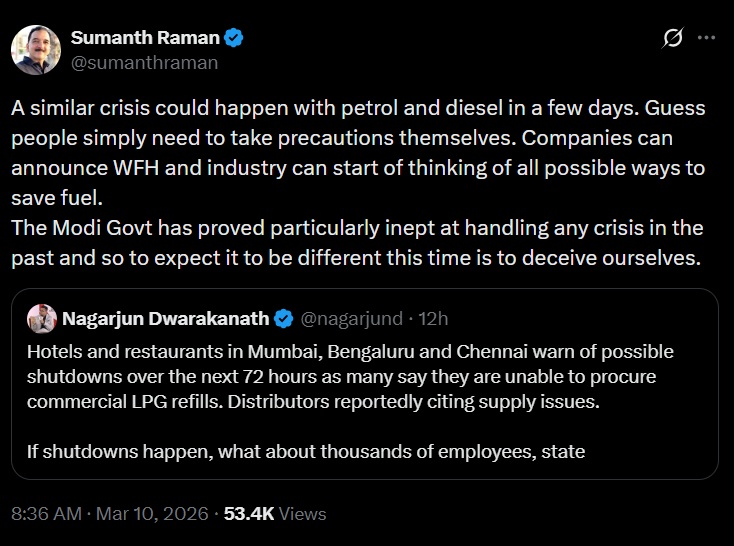
Hotels and restaurants in Mumbai, Bengaluru and Chennai warn of possible shutdowns over the next 72 hours as many say they are unable to procure commercial LPG refills. Distributors reportedly citing supply issues.
If shutdowns happen, what about thousands of employees, state…
Taking this as an opportunity to deride the central government, Sumanth Raman began fear mongering. On his X handle, he wrote, “A similar crisis could happen with petrol and diesel in a few days. Guess people simply need to take precautions themselves. Companies can announce WFH and industry can start of thinking of all possible ways to save fuel. The Modi Govt has proved particularly inept at handling any crisis in the past and so to expect it to be different this time is to deceive ourselves.”
Looks like he had not read the news when he woke up on the morning of 10 March 2026.
The central government had announced on 9 March 2026 by late evening that there was no shortage as of that day and prices would not be hiked.
Government sources told ANI that there is currently no cause for concern regarding fuel availability in India despite rising tensions in West Asia. According to the sources, petrol and diesel prices are unlikely to increase in the near term as the country has adequate fuel stocks. They indicated that retail prices would remain stable unless global crude oil prices cross approximately USD 130 per barrel, adding that crude is currently expected to remain around the USD 100 per barrel range.
Officials also said there is no shortage of petrol or diesel at fuel stations across the country. Sources further noted that India has accelerated crude oil sourcing from routes outside the Strait of Hormuz to mitigate potential disruptions.
On aviation fuel, government sources stated that the country has sufficient stocks of Aviation Turbine Fuel (ATF). They added that India is not only a producer but also an exporter of ATF, and therefore there is no need for panic regarding aviation fuel availability. Officials also indicated that India is relatively better positioned compared to several other countries and that some nations have approached India to assess the supply situation.
Govt Sources say –
* Petrol and Diesel prices are unlikely to increase as we have enough stock. Unless crude oil prices breach USD 130, petrol-diesel prices are unlikely to increase. We expect crude oil prices to be around $100 per barrel.
It is noteworthy to remember that even in a crisis like COVID-19, India fared really well compared to its Western counterparts and people across the globe praised our country for handling the pandemic efficiently despite our massive population.
For the likes of Sumanth Raman who wanted Jacinda Ardern to rule over India during COVID-19, the instinct appears to remain the same: when uncertainty emerges, assume the worst about the Indian state and amplify panic before facts have even settled.
In moments that require restraint and responsible commentary, such alarmism risks doing little more than fuel anxiety among the public. When government data, supply figures and official statements clearly indicate that fuel stocks are stable and contingency planning is underway, turning speculation into certainty becomes less analysis and more theatrics.
In the end, the pattern is familiar. A rumour appears, a crisis narrative is constructed, and the government is declared incompetent before the situation is even verified. When the facts arrive later, the panic rarely receives the same amplification as the prediction.
Subscribe to our channels on WhatsApp, Telegram,Instagram and YouTube to get the best stories of the day delivered to you personally.
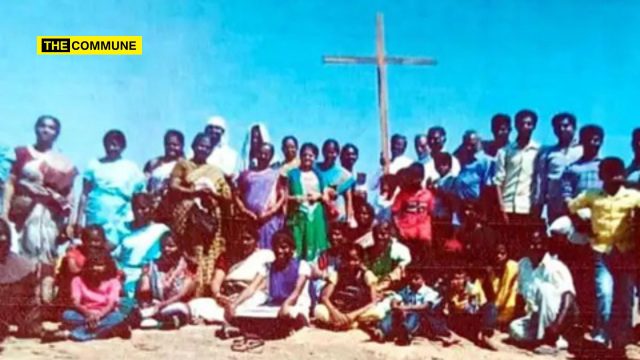
An incident involving the alleged installation of a cross and conduct of Christian prayers on Yanai Malai near Othakadai in Madurai has triggered controversy, with Hindu organisations raising objections and calling for action.
As reported in Dinamalar, a group of individuals recently climbed Yanai Malai and conducted prayers after placing a cross on the hill. Photographs of the event were later shared online, drawing criticism from several Hindu groups.
Yanai Malai is regarded as sacred by many Hindus in the surrounding villages, who worship the hill as a deity. The site is also historically significant as it contains Jain beds and comes under the control of the Archaeological Department.
Following the incident, the Bharatiya Janata Party (BJP) filed a complaint with the Othakadai police seeking legal action. Harihara Puthiran, State Secretary of the BJP’s Tamil Literature and Tamil Development Wing, stated in his complaint that some members of a Christian organisation had climbed the hill, placed a cross there, and conducted prayers.
He alleged that the act amounted to an attempt to encroach upon a site revered by local Hindus and could potentially create religious tensions in the area. He urged the police to take appropriate legal action against those responsible.
Hindu organisations also expressed concern over the development. Representatives of the groups alleged that similar attempts had previously been made at Thirupparankundram hill and warned that regular prayer gatherings at Yanai Malai could eventually lead to attempts to establish religious claims over the site.
They called upon both the police and the Archaeological Department to monitor the situation and prevent any encroachment.
Madurai Superintendent of Police Aravind stated that although Yanai Malai is maintained by the Archaeological Department, it remains a public place. He added that the police were conducting an inquiry to ascertain whether cross worship had taken place at the site.
Subscribe to our channels on WhatsApp, Telegram,Instagram and YouTube to get the best stories of the day delivered to you personally.
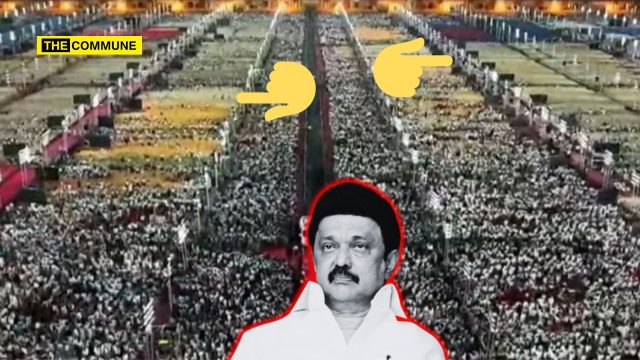
The DMK’s much-hyped 12th State-level Maanadu at Siruganur, Trichy, on 9 March 2026 was projected as a show of force – a grand political statement ahead of the 2026 Assembly elections. Party functionaries had spent weeks publicising a target of 10 lakh attendees, with 3 lakh chairs spread across a staggering 20 lakh square foot venue. What unfolded, however, told a different story.
Live visuals from the venue, widely circulated on social media, showed vast stretches of empty chairs when Chief Minister MK Stalin arrived at the ramp area with estimates suggesting nearly three-fourths of the seating capacity remained unoccupied at key moments during the event. For a party that positioned this conference as proof of its organisational strength and public goodwill, the optics were far from flattering.
10 லட்சம் பேர் என்பது பொய்…😎💥
20 லட்சம் பேருக்கு மேல் உறுதியாக திரண்டிருக்கிறார்கள் 🖤❤️
The timing makes the optics worse. The Maanadu/conference was originally scheduled for 8 March 2026 but was quietly postponed by a day, officially attributed to the Samayapuram Mariamman Poochorithal festival. Critics read it as last-minute fumbling by a party that could not synchronise its mega-event with ground realities.
The DMK had marketed the Trichy conference with a clear electoral pitch: “Stalin Should Continue; Let Tamil Nadu Win”, framing it as a pre-election confidence vote. But when a ruling party that controls the full machinery of the state government struggles to fill its own chairs, the confidence vote reads differently from the ground.
DMK looks shell-shocked. Live visuals from the maanadu venue show that when M. K.Stalin reached the ramp area, more than 60% of the chairs were empty.
That’s a loud signal from the ground.
People seem to be rejecting the government and the worry bells could be ringing inside the… pic.twitter.com/aM63gGKIet
To be sure, the DMK will claim massive mobilisation and point to the sheer size of the venue as context. But optics in politics are rarely about what you explain later – they are about what the camera captures in the moment. And on 9 March 2026 in Trichy, the cameras captured a lot of empty chairs.
As Tamil Nadu inches toward what promises to be a fiercely contested 2026 election, the question DMK insiders must now quietly ask themselves is whether this was simply a logistical miscalculation or an early signal from a public growing tired of business as usual.
Subscribe to our channels on WhatsApp, Telegram,Instagram and YouTube to get the best stories of the day delivered to you personally.