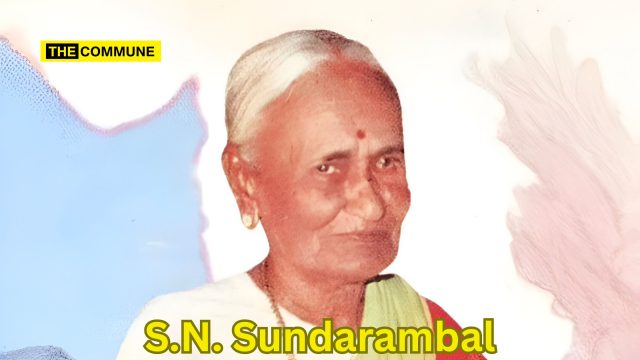
S. N. Sundarambal, born on 7 October 1913, in Veerapandi, Tiruppur, was a fearless freedom fighter and tireless social worker whose life was dedicated to the causes of India’s independence and rural welfare. Coming from a well-off family her father, Natchimuthu Goundar, was a respected maniyakkar (local chieftain) Sundarambal could have led a life of comfort. Instead, she chose the path of activism and service, becoming a prominent figure in the freedom movement and later in the field of social reform.
Her journey into the national struggle began at a young age. At just 15, during a Congress gathering in Tiruppur in 1928, she was inspired by Mahatma Gandhi, who urged the crowd to support the freedom movement. In a moment that would mark the beginning of her lifelong commitment, young Sundarambal climbed onto the stage and offered her gold bangles to Gandhi. Impressed but wanting more than just symbolic support, Gandhi encouraged her to take a deeper role in the fight for independence and to adopt khadi, rejecting foreign-made clothes. From that day forward, she wore only khadi garments, symbolizing her devotion to the Swadeshi movement.
Sundarambal’s active role in the freedom struggle saw her participate in numerous protests and Satyagraha campaigns. In 1941, during one such protest, she was arrested along with her infant son and imprisoned in Vellore Central Prison for three months. The following year, when the Quit India Movement was launched in 1942, she once again took to the streets in non-violent resistance, which led to another arrest and a seven-month jail term. Her courage never wavered. In 1943, she spearheaded a major protest in Tiruppur against British rule, resulting in yet another arrest and three more months in prison.
Even after India gained independence in 1947, Sundarambal’s spirit of activism did not diminish. She turned her attention to agricultural and rural issues, especially the welfare of farmers in Tiruppur district. Her commitment to grassroots causes led her to organize several demonstrations for farmers’ rights, and even in the 1970s, she continued to be arrested for leading protests.
A turning point in her post-independence life came after meeting Vinoba Bhave, the noted Gandhian and social reformer. Inspired by his ideology, she established an orphanage in Angeripalayam, Tiruppur, which reflected her enduring dedication to community welfare.
S. N. Sundarambal passed away on 20 August 2007, in Tiruppur, leaving behind a legacy of courage, humility, and unwavering service to society. Though she had two sons, both had predeceased her. Today, she is remembered not only for her contributions to India’s freedom but also for her relentless efforts to uplift the underprivileged and marginalized long after the nation had won its independence.
Subscribe to our channels on Telegram, WhatsApp, and Instagram and get the best stories of the day delivered to you personally
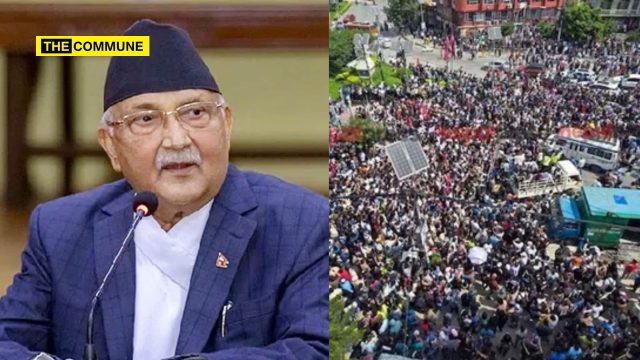
Between September 8 and 9, 2025, Nepal was rocked by unprecedented unrest as youth-driven protests spiraled into violent attacks on leaders, political parties, and government buildings. Sparked by anger over corruption, nepotism, and a controversial social media ban, demonstrators directly targeted symbols of state power. Homes of prime ministers past and present, party offices, and ministries were torched, vandalised, or besieged. The chaos culminated in multiple resignations, the collapse of the Oli government, and tragic casualties. Below is a detailed account of 18 major incidents that defined this turbulent two-day uprising.
#1 PM Oli’s Residence Set Ablaze
On 9 September 2025, protesters stormed and set fire to Prime Minister K.P. Sharma Oli’s private residence in Kathmandu. The attack marked a dramatic escalation of anti-government demonstrations that had gripped Nepal for days. Reports said several ministers had to be airlifted to safety as crowds turned violent around the premises.
The assault on Oli’s home was seen as symbolic of growing rage against the Communist Party of Nepal (UML) leadership. Images of flames engulfing the property quickly spread across social media, fueling further anger and calls for his resignation.
#2 Parliament Building Gutted
On the same day, thousands of enraged youth stormed and gutted Nepal’s Parliament in Kathmandu. Demonstrators, frustrated over corruption and censorship, breached security barriers and set the iconic building ablaze. The destruction of the legislature was a shocking moment, symbolising the collapse of trust in democratic institutions.
Eyewitness accounts described scenes of smoke and chaos as protesters danced and cheered outside. For many, the burning of Parliament highlighted the scale of generational anger against a political elite accused of betraying public trust. The event underscored the protest movement’s determination to dismantle symbols of entrenched authority in Nepalese politics.
#3 Law Minister Ajay Kumar Chaurasia’s Residence Burned
In Birgunj, the residence of Nepal’s Law Minister Ajay Kumar Chaurasia was set on fire on 9 September 2025. Reports suggested the minister narrowly escaped harm as demonstrators unleashed their fury against government officials. Chaurasia, a UML leader, had been a visible face of the controversial policies that triggered mass unrest. Local media reported that mobs ransacked the property before torching it, while neighbouring houses were also threatened. The attack reflected public resentment against those perceived as enforcers of an oppressive state. By targeting Chaurasia, protesters signaled their rejection of the legal and political machinery backing the Oli government.
#4 Former PM Sher Bahadur Deuba’s House Attacked
Protesters in Kathmandu vandalised and set fire to the home of former Prime Minister Sher Bahadur Deuba on 9 September 2025. Reports stated that Deuba was left bleeding as mobs ransacked his residence, looting and destroying property.
SHOCKING. In #Nepal, ex-PM Sher Bahadur Deuba left BLEEDING as his house was ransacked, ex-Peace Minister dragged like garbage, Street rule > Law 🤯
~ Don’t miss the subtext: this COLLAPSE is fuel for the same Regime-change cartels eyeing India nextpic.twitter.com/PSnLF2EQXf
— The Analyzer (News Updates🗞️) (@Indian_Analyzer) September 9, 2025
The attack stunned many, as Deuba had been a long-standing figure of the Nepali Congress and an opposition leader, not a ruling UML politician. Demonstrators, however, appeared intent on punishing all members of the political class, regardless of party affiliation. This assault illustrated how the protests had morphed from targeted dissent against the Oli government into a wholesale rejection of Nepal’s political establishment.
#5 Finance Minister Bishnu Paudel Chased and Beaten
On 9 September 2025, Nepal’s Finance Minister Bishnu Prasad Paudel was chased through Kathmandu streets and thrashed by angry demonstrators. Video footage showed mobs pursuing Paudel, cornering him, and attacking before security forces intervened. The shocking scenes highlighted the personal danger faced by political leaders amid the collapse of law and order.
Nepal's finance minister chased on street, thrashed by protesters as Oli govt collapses
A video, which surfaced today (Sept 9), shows Finance Minister Bishnu Prasad Paudel being chased on a road and thrashed by demonstrators.
Paudel, long criticised for his handling of Nepal’s fragile economy, became a visible scapegoat for public rage. The incident sent shockwaves across the country, signalling that no minister was safe from the fury of Gen Z-led protests. It further deepened the Oli government’s political and moral crisis.
#6 PM Oli Resigns Amid Chaos
Facing relentless protests, Prime Minister K.P. Sharma Oli resigned on September 9. His departure came after days of escalating violence, including the burning of his residence and Parliament. Oli’s resignation marked the collapse of his UML government and left Nepal in political uncertainty.
#BREAKING | Nepal Prime Minister K.P. Sharma Oli resigned on Tuesday, his aide Prakash Silwal said.
Anti-corruption demonstrators in Nepal defied an indefinite curfew today (Sept 9), clashing with police and shouting slogans against Prime Minister K.P. Sharma Oli, a day after 19… pic.twitter.com/UdXWIZXSH0
His critics argued that the social media ban and entrenched corruption had alienated youth beyond repair. Supporters of the protests celebrated his fall as a generational victory, while others warned of instability in the absence of a clear successor. The resignation was the most dramatic outcome of the uprising, reshaping Nepal’s political landscape overnight.
#7 Home Minister Ramesh Lekhak Steps Down
On 8 September 2025, Nepal’s Home Minister Ramesh Lekhak announced his resignation amid violent demonstrations. His decision came after mounting criticism over the police crackdown that left several protesters dead. Lekhak’s exit was one of the earliest high-profile casualties of the unrest, signalling fractures within the government even before Oli stepped down.
Observers said his resignation was an attempt to defuse public anger, but it failed to calm demonstrators. Protesters accused him of authorising brutal repression and demanded accountability for lives lost. Lekhak’s fall showed how quickly the protests destabilised key figures in the Oli administration.
#8 Protesters Celebrate as Oli’s Bhaktapur Residence Burns
In Bhaktapur on 9 September 2025, jubilant protesters danced and celebrated as flames engulfed another residence of former Prime Minister Oli. The sight of young demonstrators rejoicing in front of a burning house captured the raw anger and symbolism of the uprising. Oli, once a dominant figure in Nepali politics, had become a hated symbol of corruption and authoritarianism for many youths.
Protesters dance and celebrate as the private residence of former Nepalese PM KP Sharma Oli, in Bhaktapur, burns . . . . Video: TV Today Nepal/ANI pic.twitter.com/S5tfy69Ovw
Videos from the scene circulated widely, further galvanising protesters elsewhere. The celebrations, though shocking, reflected the protesters’ belief that the destruction of elite property was a necessary act of resistance against decades of failed governance.
#9 Nepali Congress Party Office Torched
On 9 September 2025, protesters set fire to the Nepali Congress Party’s office in Kathmandu. The attack showed that the fury was not confined to the ruling UML but extended to the broader political class. Demonstrators accused all major parties of perpetuating corruption, nepotism, and betrayal of democratic ideals.
The destruction of the Congress office symbolised generational disillusionment with both ruling and opposition parties. Videos shared online showed crowds surrounding the burning office, chanting slogans for justice. The attack underscored the depth of mistrust between Nepal’s youth and the political elite, threatening the survival of established party structures.
#10 Foreign Minister Arzu Rana Deuba’s Residence Attacked
On 9 September 2025, protesters attacked the residence of Foreign Minister Arzu Rana Deuba, wife of former PM Sher Bahadur Deuba. Demonstrators damaged the property amid escalating anger against political leaders of all stripes. The assault was part of a broader pattern where both ruling and opposition figures faced direct retaliation from the streets.
Protesters attack the residence of Nepal’s Foreign Minister, Arzu Rana Deuba. pic.twitter.com/ft1iNRJ0rf
Arzu Rana, a prominent Congress politician, had been a vocal critic of Oli but was nevertheless targeted. The attack demonstrated that protesters viewed the entire political class as complicit in corruption and misrule. It highlighted how the uprising blurred partisan lines in its fury.
#11 President Ram Chandra Paudel’s House Attacked
On 9 September 2025, demonstrators attacked the residence of Nepal’s President Ram Chandra Paudel. The assault followed earlier attacks on ministers’ homes, including those of the communications and finance ministers. Protesters pelted stones, set fires, and damaged property, escalating the sense of crisis.
Gen Z protesters have attacked house of Nepal's President Ram Chandra Poudel.
Earlier, protesters also set fire to the house of Communication Minister Prithvi Subba Gurung and pelted stones at Finance Minister Bishnu Paudel’s residence.
As head of state, Paudel was seen as part of the same establishment that had imposed the social media ban and failed to address corruption. The attack on the president’s house shocked observers but illustrated how no office was beyond the protesters’ reach.
#12 Communications Minister Prithvi Subba Gurung’s House Torched
The home of Communications Minister Prithvi Subba Gurung was torched on 9 September 2025 by furious Gen Z protesters. As the minister linked to the social media ban that ignited the unrest, Gurung was a prime target of demonstrators. His house was set ablaze alongside those of other political elites.
🇳🇵 GEN Z PROTESTERS ATTACK HOMES OF NEPAL’S TOP LEADERS
Homes of ministers and political elites across Nepal were stoned and torched as angry Gen Z demonstrators took their rage straight to the front doors of power.
Eyewitnesses described angry mobs hurling stones and chanting slogans against censorship and corruption. The attack highlighted the central role Gurung’s policies played in sparking the crisis. Protesters framed the burning of his residence as a symbolic rejection of repression and state-imposed curbs on digital freedoms.
#13 Former PM Pushpa Kamal Dahal’s Residence Vandalised
On 9 September 2025, protesters vandalised the residence of former Prime Minister Pushpa Kamal Dahal, also known as Prachanda. Demonstrators pelted stones, clashed with police, and faced tear gas near his home in Kathmandu. Dahal, a key UML figure, was accused by protesters of enabling decades of corruption and misrule. His house became another casualty of the movement’s anti-elite rage.
The incident reflected how protesters saw no distinction between current and former leaders, holding the entire establishment accountable. Police use of tear gas underscored the volatility of the situation, with violence spilling into neighbourhoods around Dahal’s residence.
#14 Army Evacuates Ministers
On 9 September 2025, as protests escalated, the Nepalese Army intervened to evacuate several government ministers from their residences. Demonstrators had already set fire to the homes of Prime Minister Oli, the president, and multiple cabinet members. The military’s deployment reflected the state’s loss of control over security forces and the urgency to protect officials from mob attacks.
🇳🇵 Nepal’s army is evacuating government ministers from their residences amid mass protests across the country.
Reports say the evacuation is being carried out by helicopter. Kathmandu’s international airport has been shut down due to the unrest, with all flights canceled.… pic.twitter.com/nnVFAOHHAg
Helicopters were reportedly used to airlift ministers to safety. The dramatic scenes of ministers fleeing highlighted the collapse of civilian authority and the severity of the crisis. It was a turning point, marking the army’s central role in containing the unrest.
#15 Government Buildings Set on Fire
On 9 September 2025, protesters turned their fury toward government buildings across Nepal, setting several ablaze. Offices linked to the state apparatus were ransacked and torched as demonstrators sought to dismantle symbols of state power. Videos circulating online showed flames consuming administrative blocks while crowds chanted slogans.
The attacks disrupted government functioning and paralysed services. For protesters, burning government property was a symbolic act of resistance against decades of corruption and mismanagement. For officials, it represented an unprecedented collapse of law and order.
#16 Energy Minister’s Office Burned, Cash Scattered
In one of the most dramatic incidents on September 9, protesters set fire to the office of Nepal’s Energy Minister Deepak Khadka. Reports said demonstrators looted money from the building and threw it into the air as crowds cheered. The act, caught on video, became a striking symbol of public resentment against corrupt officials.
Nepal Enerji Bakanı’nın binası yakılıyor.
Binanın içindeki paralar protestocular tarafından toplanarak havaya saçılıyor.pic.twitter.com/0p5ZSC5SAR
Khadka, a UML minister, was accused of profiting while ordinary citizens suffered. The burning of his office and the symbolic scattering of cash resonated widely, reflecting anger at elite enrichment. It further deepened the narrative of corruption and betrayal fueling the uprising.
#17 Wife Of Former PM Burnt Alive
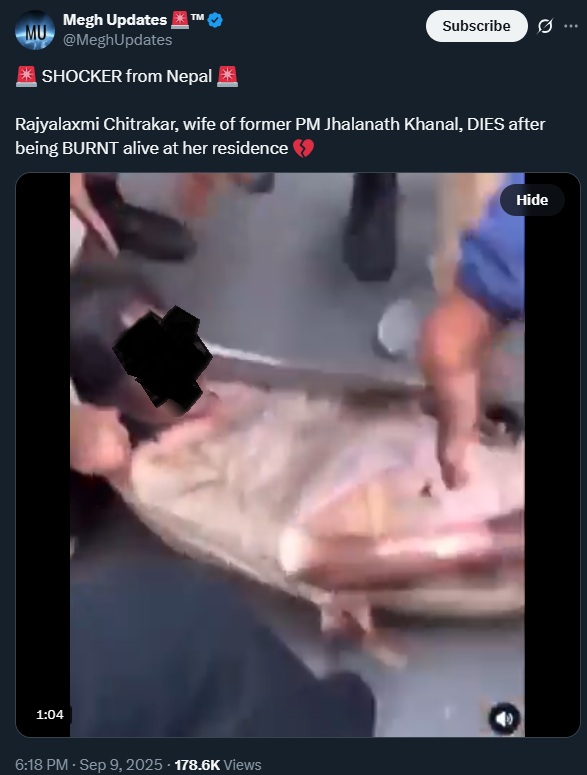
Tragedy struck on 9 September 2025 when Rajyalaxmi Chitrakar, wife of former Prime Minister Jhalanath Khanal, died after being burnt alive at her residence. Reports said protesters set her home on fire, and she was unable to escape.
The incident shocked the nation and raised questions about the movement’s violence spiraling beyond control. While protesters claimed to be targeting corrupt leaders, the death of a family member of a political figure added a grim dimension to the unrest.
#18 Protesters Storm Communist Party Headquarters
On 9 September 2025, protesters stormed the headquarters of Nepal’s Communist Party (UML), tearing down its iconic hammer-and-sickle flag. The assault marked the symbolic dismantling of the ruling party’s authority. Demonstrators accused the UML of betraying democratic ideals and fostering corruption.
⚠️THE FALL OF COMMUNISM IN NEPAL!?
Nepalese protesters storm the Communist Party headquarters and tear down the Hammer and Sickle flag pic.twitter.com/zKf1g0wc14
By toppling the flag, protesters sent a message that they were rejecting not only individual leaders but the party’s entire ideological and organisational apparatus. The incident underscored the depth of disillusionment with communist politics in Nepal, once hailed as revolutionary but now derided as corrupt and oppressive by the new generation leading the protests.
Subscribe to our channels on Telegram, WhatsApp, and Instagram and get the best stories of the day delivered to you personally.
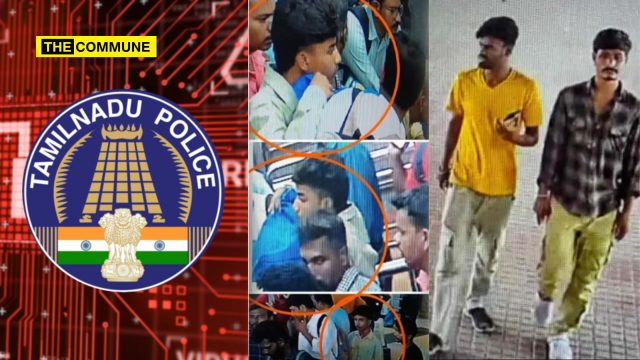
The Chennai City Police have issued a strong advisory to the public following verified intelligence inputs indicating the entry of the notorious Navonia gang into the city. Known for executing high-level thefts in densely populated areas, the gang is reportedly operating in major transit zones like Chennai Central and Egmore railway stations locations where they have previously targeted unsuspecting individuals.
The recent arrest of four suspected members in separate incidents has intensified concerns. These developments point to the gang’s active presence and the risk they pose, prompting authorities to ramp up surveillance and security measures across the city.
Originating from states such as Jharkhand and West Bengal, the Navonia gang is infamous for orchestrating coordinated thefts involving valuables like jewellery, mobile phones, and cash. Their strategy typically involves dividing into small groups to blend into crowded public spaces including railway stations, bus terminals, shopping malls, and tourist locations like Marina Beach where they identify and target individuals, particularly solo travellers. Police sources noted that these gangs often stay in the city for a limited duration from a few days to a month before fleeing with the stolen goods.
Arrests Reveal Pattern; Citizens Urged to Stay Alert
The arrests have shed light on the gang’s operational tactics. In one notable case, Marina Beach police registered a complaint after a robbery on 31 July 2025, leading to the arrest of three suspects by 6 September 2025. Investigations revealed that all three had previous criminal records, including cases registered with the Railway Police.
In another incident, a member of the gang was caught red-handed trying to steal a mobile phone from a passenger at Mambalam Railway Station near the ticket counter. These incidents have prompted the police to issue a high alert across all major railway stations in Tamil Nadu.
Authorities are urging the public to remain vigilant, especially in high-traffic areas. The gang is known to exploit the distraction of crowds to commit swift and silent thefts, often disposing of the stolen items quickly to avoid detection. People are advised to keep personal belongings secure, avoid carrying excessive valuables, and report any suspicious behaviour to law enforcement without delay.
The police continue to pursue leads in an effort to dismantle the remaining network of gang operatives active in the city.
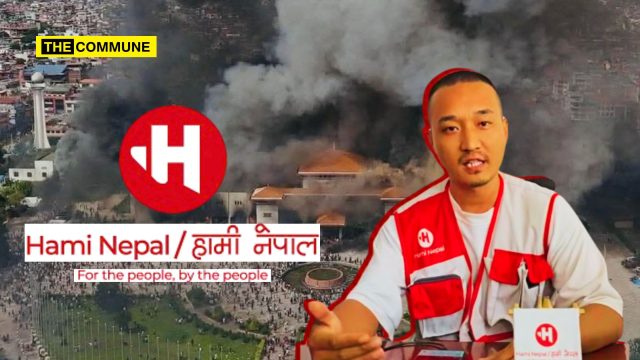
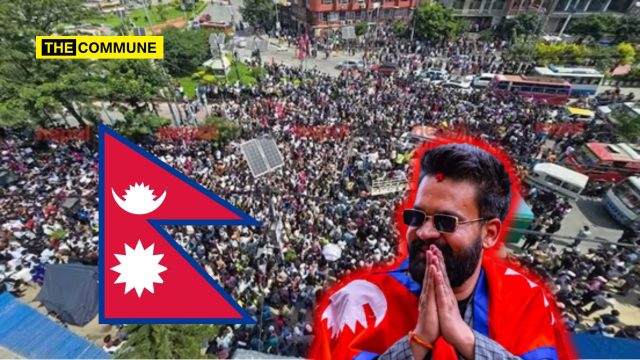
While much of the world views the recent Gen Z-led protests in Nepal as a response to government censorship and corruption, the movement runs deeper than it first appears. At the heart of this youth uprising stands one figure who has become its most recognizable face Sudan Gurung, a 36-year-old activist and president of Hami Nepal, a youth-centric NGO that has gradually evolved into a significant civic force. For many, Gurung represents a new generation determined to demand accountability and resist silence.
Who is Sudan Gurung?
Gurung’s background is rooted in personal tragedy and transformation. Formerly an event organizer, his life took a dramatic turn after Nepal’s devastating 2015 earthquake, during which he lost a child. In an emotional account shared with The Annapurna Express, he recalled how a desperate SOS message he posted online in the aftermath led to the mobilization of 200 volunteers. That moment marked the beginning of his journey into humanitarian and civic activism. Since then, Gurung has overseen relief operations across the country during natural disasters, coordinating emergency aid and donations, and distributing supplies to affected communities.
Under his leadership, Hami Nepal has grown rapidly. The organization describes Gurung as a committed philanthropist with over a decade of experience in disaster response. Using platforms like Instagram and Discord, Hami Nepal has been actively rallying youth participation. For instance, in the lead-up to Nepal’s recent internet blackout, the NGO circulated protest guides online, calling on students to show up in school uniforms carrying their books a symbolic, non-violent show of defiance.
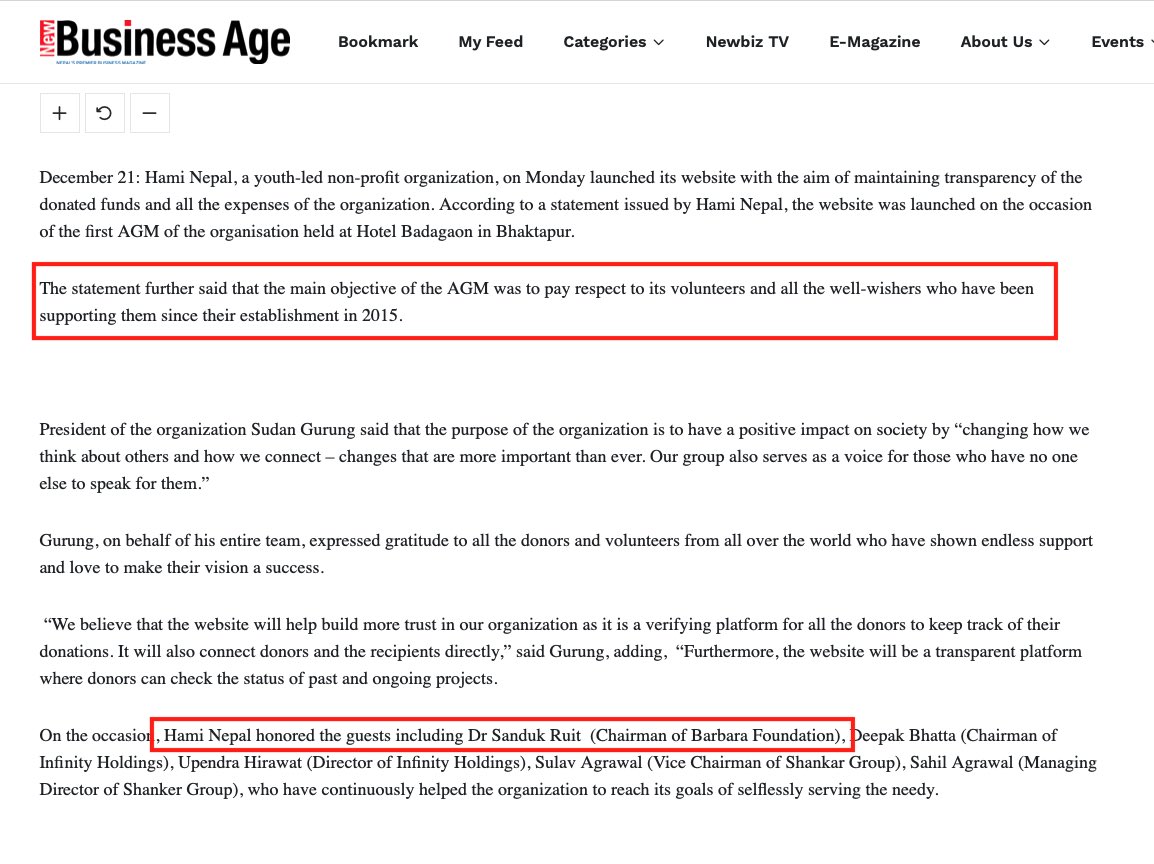
The NGO boasts a growing support base, including prominent figures such as ophthalmologist Dr. Sanduk Ruit, who serves as a mentor, and Miss Universe Nepal 2018, Manita Devkota, who acts as its goodwill ambassador. Nepalese celebrities like Priyanka Karki, Swastima Khadka, and Abhaya Subba have also lent their support during various crises, from setting up a COVID-19 plasma bank to distributing food aid.
Publicly, Hami Nepal maintains that it is politically neutral, often repeating the motto “For the People, By the People.” With over 1,600 active members and partnerships with recognizable names like Al Jazeera, Coca-Cola, Viber, and Goldstar, the NGO projects itself as a grassroots movement for the people of Nepal. Gurung, as its public face, has become a rallying point for Gen Z’s demands for accountability, transparency, and reform.
Who Funds Hami Nepal?
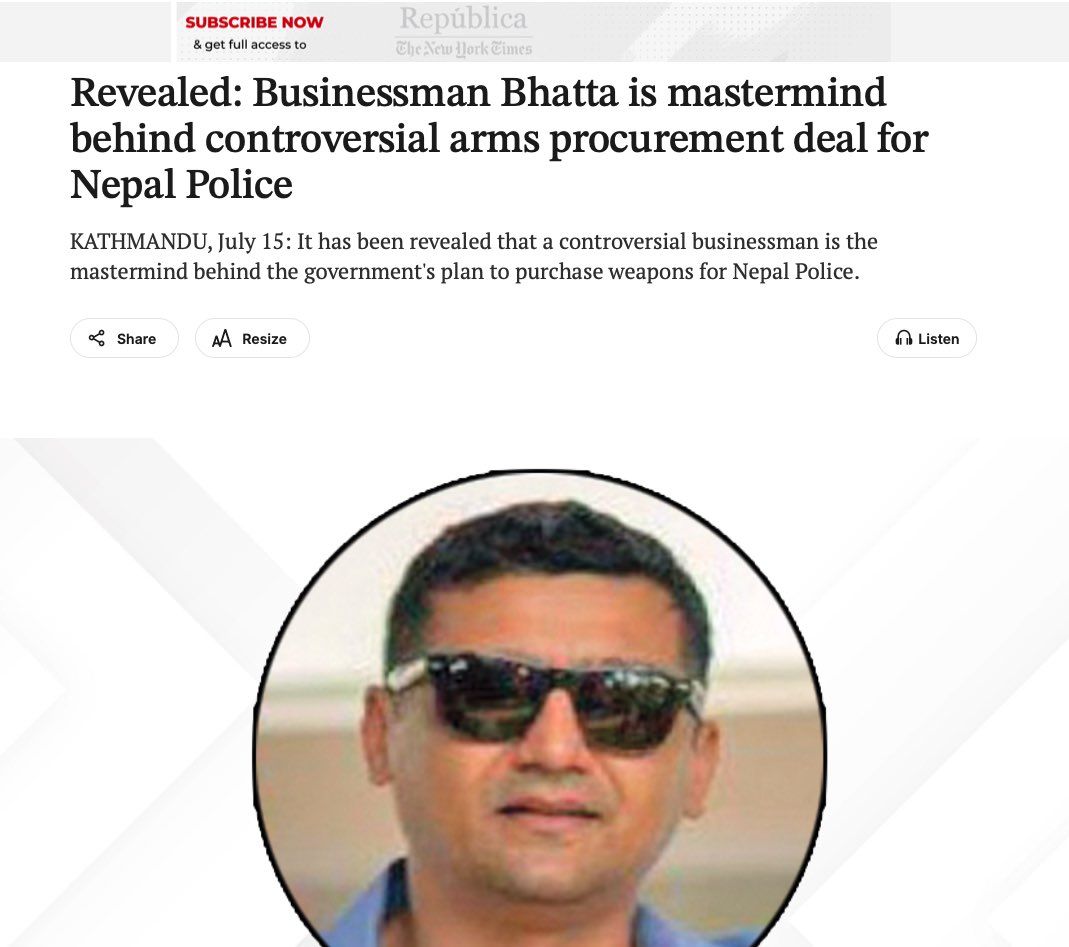
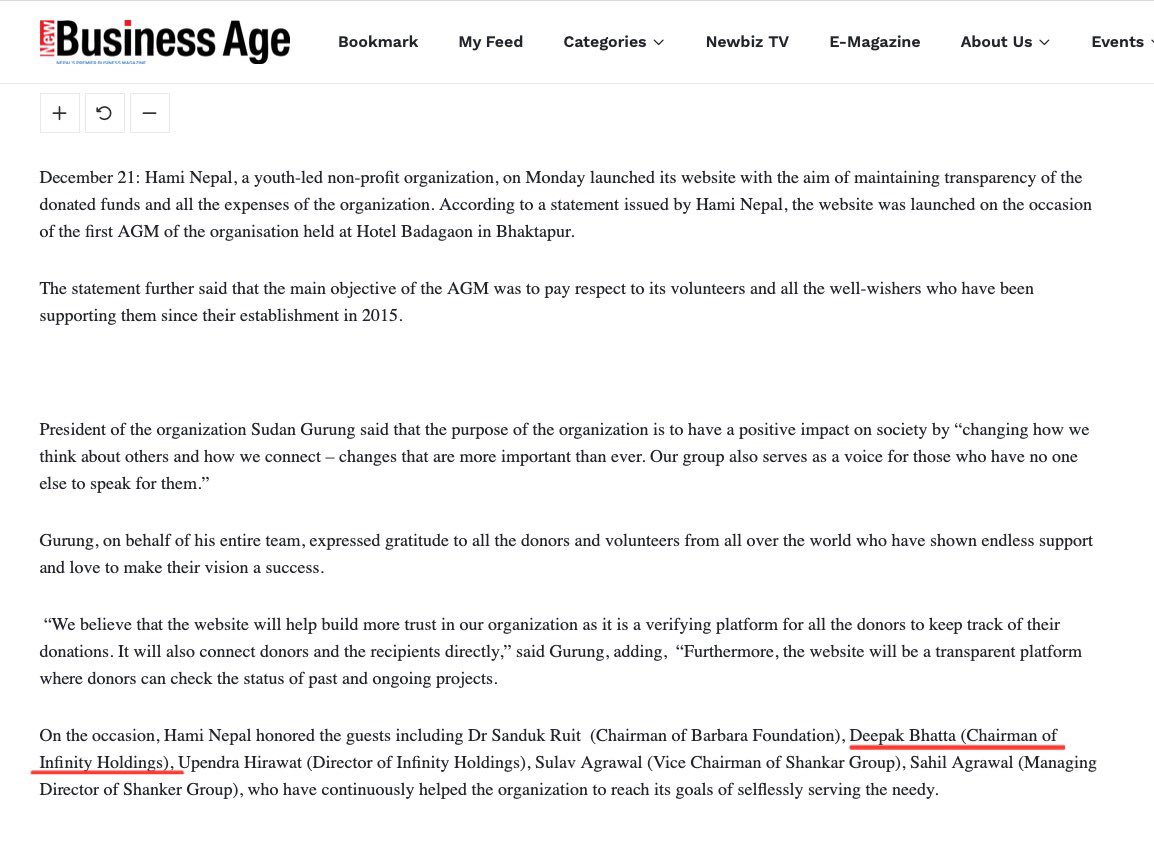
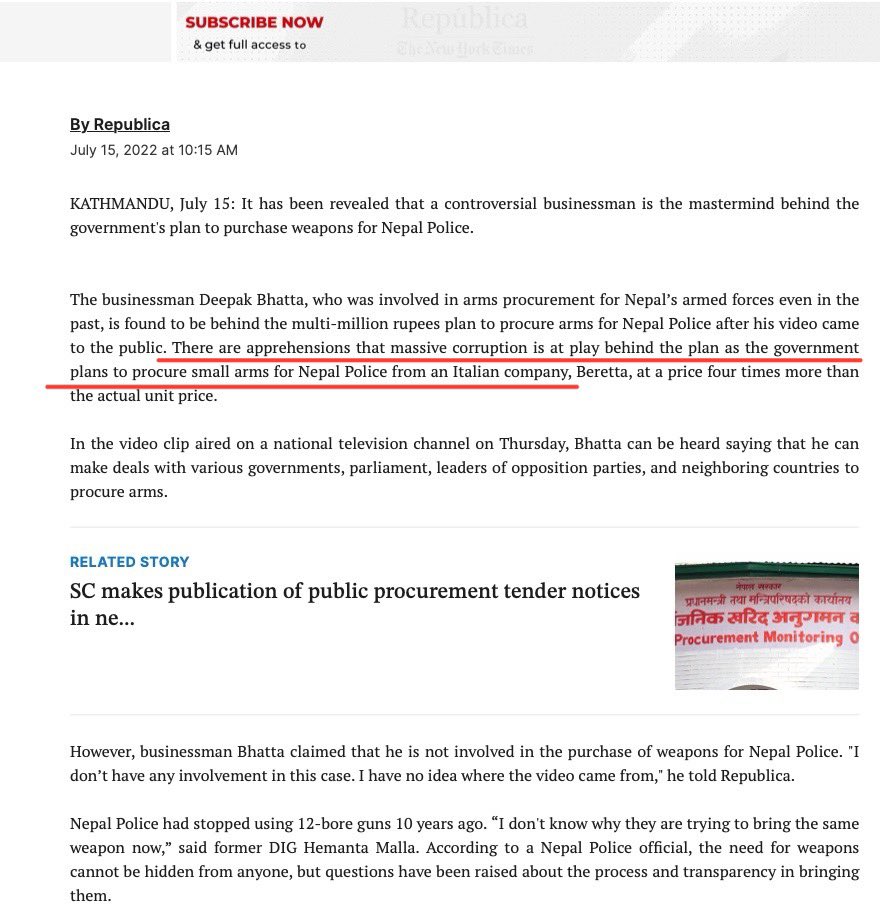
As of now, questions surrounding the organization’s funding raise eyebrows. One of its primary backers is businessman Deepak Bhatta, who, according to My Republica, is alleged to have orchestrated a controversial arms procurement deal involving Nepal Police and an Italian company. Bhatta, known for his arms trading connections, faces corruption charges in this case.
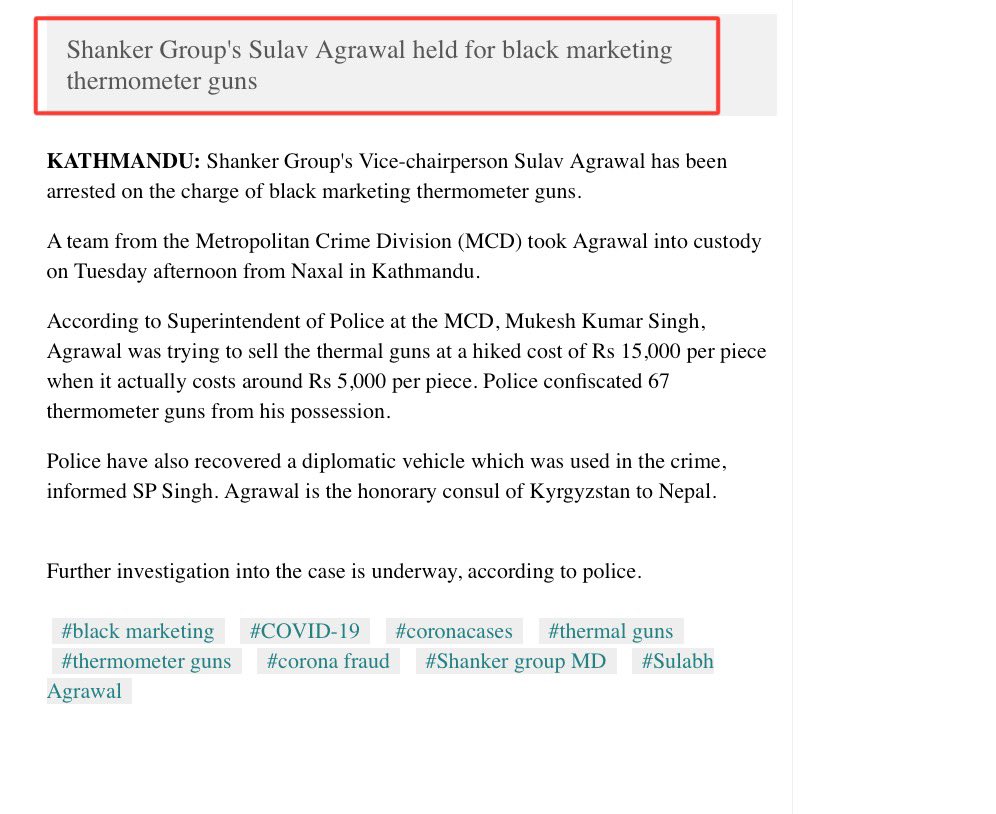
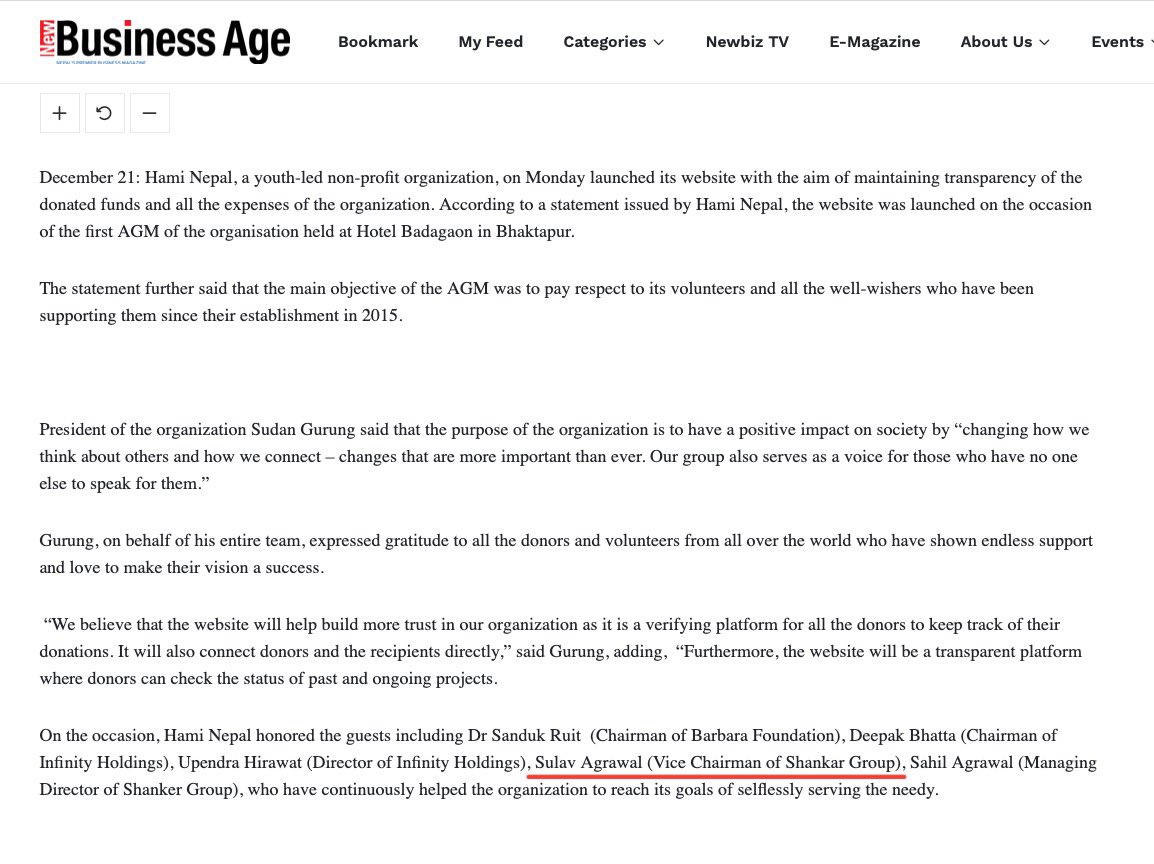
Another key financial supporter is Sulav Agrawal of the Shanker Group, who was reportedly arrested for black-market dealings in thermometer guns during the COVID-19 pandemic.
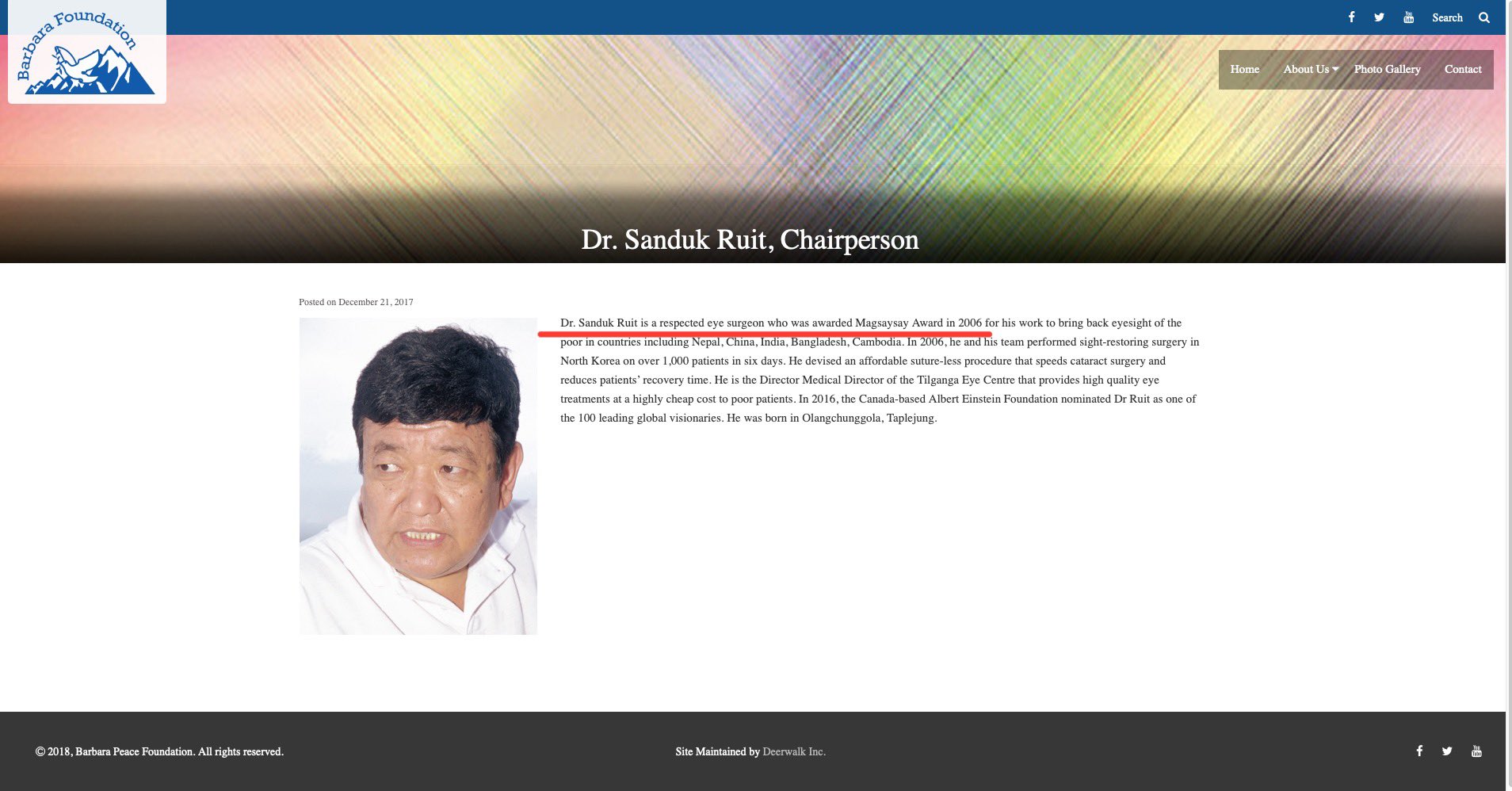
Additionally, Dr. Sanduk Ruit, a recipient of the Magsaysay Award an honor with historic ties to American geopolitical interests has also contributed to the group.
These associations have led to uncomfortable questions. While Sudan Gurung positions himself as a figurehead of anti-corruption and civic integrity, his movement is, ironically, being funded by individuals facing serious allegations of unethical or illegal activity. Critics argue that this contradiction undercuts the credibility of the protest and raises doubts about whether this movement is as free from vested interests as it claims. Gurung’s partnership with donors connected to arms deals and pandemic profiteering invites scrutiny over the integrity of the cause he leads, challenging the image of an untainted grassroots revolution.
(This article is based on an X Thread By Vijay Patel)
Subscribe to our channels on Telegram, WhatsApp, and Instagram and get the best stories of the day delivered to you personally.
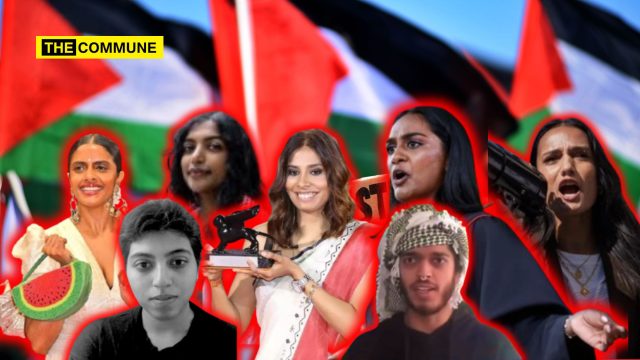
Between 2024 and 2025, a wave of pro-Palestine activism by Indians abroad has drawn global attention, sparking debates on free speech, academic freedom, and political accountability. From university campuses in the United States to red carpets in Europe and even the tightly regulated streets of Singapore, Indian-origin students, artists, and professionals have voiced solidarity with Gaza in diverse and often controversial ways. Their actions ranging from fiery speeches and essays to symbolic gestures and disruptive protests have not only highlighted the intensity of global outrage over the Israel-Palestine conflict but also triggered sharp institutional and political responses. In this report, we compile 10 such instances.
#1 Filmmaker Anuparna Roy Voices Support for Palestine at Venice Film Festival
At the 82nd Venice Film Festival on 7 September 2025, Indian filmmaker Anuparna Roy made headlines by using her Best Director acceptance speech to express solidarity with Palestine. Hailing from Purulia in West Bengal, Roy declared that every child deserves peace and freedom, including those in Palestine. Acknowledging her words could upset her country, she said it “doesn’t matter anymore.”
The remarks were widely reported in India and abroad, sparking heated debate on whether cultural platforms should be used for political statements. The filmmaker’s bold stance has since gone viral, drawing both praise and criticism on social media.
#2 MIT Bans Indian-American Student Megha Vemuri After Pro-Palestine Speech
On 29 May 2025, MIT’s Class of 2025 President Megha Vemuri, an Indian American student, was banned from the graduation ceremony after a fiery pro-Palestine speech. Addressing peers in Cambridge, Massachusetts, she accused MIT of maintaining ties with Israel’s military, which she linked to atrocities against Palestinians. Vemuri said MIT was complicit in attempts to “wipe Palestine off the face of the earth.”
MIT’s class president, Megha Vemuri, spent her graduation speech bashing Israel.
Then President Sally Kornbluth spoke immediately after and oh boy was that awkward. pic.twitter.com/PjsBNEQxmy
The university swiftly barred her, citing violations of event rules. Her remarks drew global attention, with activists praising her courage and critics accusing her of politicising an academic event. Video clips of her speech quickly went viral.
#3 Georgetown Scholar Badar Khan Suri Arrested Amid Pro-Palestine Activity
On March 20, 2025, Badar Khan Suri, a postdoctoral fellow at Georgetown University’s Alwaleed Bin Talal Center, was arrested outside his Virginia home on charges of promoting Hamas propaganda under the guise of pro-Palestine activism. Married to a U.S. citizen from Gaza, Suri had been vocal about Gaza’s plight through academic and online forums. U.S. authorities accused him of spreading extremist content, triggering deportation proceedings. His arrest has sparked criticism from civil liberties groups, who argue that dissent is being criminalised. Supporters insist his work was academic in nature, while detractors view it as a front for radical propaganda.
#4 Columbia Student Ranjani Srinivasan Self-Deports After Visa Revocation
On 15 March 2025, Columbia University doctoral student Ranjani Srinivasan left the U.S. after her visa was revoked over alleged support for pro-Palestine protests. The Indian-origin student in urban planning had participated in campus demonstrations against Israel’s actions in Gaza. U.S. authorities accused her of supporting Hamas, a claim she denied. Facing deportation, she voluntarily self-deported on 11 March 2025. Her case has drawn widespread attention as part of a broader crackdown on campus activism in the U.S.
#5 MIT Scholar Prahlad Iyengar Suspended Over Pro-Palestine Essay
In December 2024, MIT suspended Indian-origin PhD scholar Prahlad Iyengar for publishing a controversial essay titled On Pacifism in the student journal Written Revolution. The piece featured images linked to the Popular Front for the Liberation of Palestine (PFLP), a designated terror group, and language that officials said “could be interpreted as a call for violent protests.” MIT barred Iyengar from campus, sparking a debate over the boundaries of academic freedom. While some defended Iyengar’s right to express dissent, others said he crossed into glorification of violence.
#6 Actress Kani Kusruti Shows Solidarity with Palestine at Cannes 2024
At the Cannes Film Festival on 24 May 2024, Indian actress Kani Kusruti made a symbolic statement of solidarity with Palestine by carrying a clutch shaped like a sliced watermelon. The fruit has become a global emblem of the Palestinian cause due to its resemblance to the Palestinian flag’s colors. Kusruti, attending the screening of her film, instantly drew global media attention. While some lauded her courage, others accused her of politicising the red carpet. She later faced trolling online but defended her gesture as an act of conscience. The Cannes spotlight amplified the visibility of her protest worldwide.
#7 Shruthi Kumar Speaks for Pro-Palestine Students at Harvard
On 13 May 2024, Shruthi Kumar, an Indian-origin student from Harvard University’s Class of 2024, publicly criticised the institution during its commencement ceremony for barring 13 classmates from graduating due to pro-Palestine protests. Addressing the audience, Kumar said she could not celebrate while her friends and their families suffered injustice.
“Solidarity is not dependent on what we know”: In Harvard graduation speech, Indian American student, Shruthi Kumar, stands with Gaza, pro-Palestine protesters
Her emotional speech resonated widely, highlighting the tensions between student activism and institutional discipline. Videos of her remarks circulated on social media, earning her praise from pro-Palestine groups.
#8 Indian Student Leads ‘Azadi’ Chants for Palestine at Columbia
On 21 April 2024, an Indian student at Columbia University became the face of viral campus protests by leading chants of “Azadi” (freedom) for Palestine. Videos showed her shouting slogans such as “Palestine ki Azadi” and “Chheen ke lenge, Azadi” during mass demonstrations.
An Indian student leads the chants demanding freedom for Palestine at Columbia University. pic.twitter.com/ygkfsisUqo
The footage spread rapidly on social media, amplifying the visibility of student-led pro-Palestinian activism across U.S. campuses. While her identity was not officially disclosed, her slogans drew sharp reactions, hailed by activists as inspiring and criticised by detractors as incendiary. The chants linked South Asian protest traditions with the global Palestine solidarity movement.
#9 Microsoft Engineer Vaniya Agrawal Protests Gaza War at Company Event
On 6 April 2025, Indian-origin Microsoft engineer Vaniya Agrawal disrupted the company’s 50th anniversary celebration in Redmond, Washington, by accusing its leadership of enabling Israel’s military actions in Gaza. Addressing tech giants including Bill Gates and Satya Nadella, she alleged Microsoft’s AI technologies were being used to “murder 50,000 Palestinians.”
Her fiery remarks stunned attendees and quickly went viral. Agrawal resigned shortly after, effective April 11.
#10 Indian Woman Charged in Singapore for Pro-Palestine Procession
On 1 June 2024, 35-year-old Indian woman Annamalai Kokila Parvathi was formally charged in Singapore for organising a pro-Palestine procession without a permit earlier that year. Despite the city-state’s strict protest laws, she and two others led a march to express solidarity with Gaza. Authorities imposed additional bail conditions, though the court later allowed her to visit her grandparents in Kerala after posting an extra SGD 10,000. The case underscores Singapore’s zero-tolerance stance on unauthorised protests.
Subscribe to our channels on Telegram, WhatsApp, and Instagram and get the best stories of the day delivered to you personally.
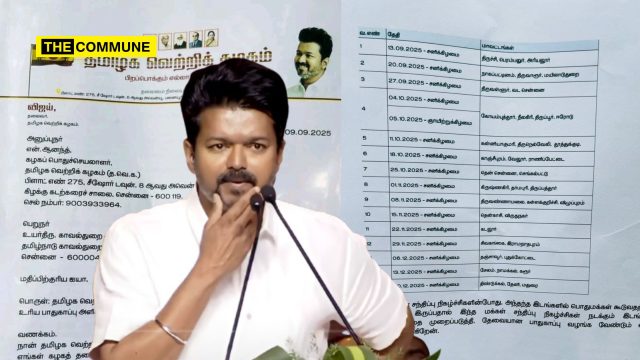
Following the conclusion of his second state-level conference, Tamilaga Vettri Kazhagam (TVK) chief and part-time politican Vijay has announced his first state-wide political tour, set to begin on 13 September 2025, in the central Tamil Nadu districts of Trichy, Perambalur, and Ariyalur. However, what has drawn widespread attention and ridicule is the nature of his schedule. Vijay’s tour is limited strictly to Saturdays, a decision that has sparked significant criticism across media and political circles.
Many question how such large districts could be meaningfully covered in a single day, and the consensus is growing that Vijay appears to be engaging in politics only as a weekend hobby. This has led to the label of “weekend politician” being attached to him, suggesting a lack of seriousness and full-time commitment to public life.
TVK’s general secretary, N. Anand, has formally written to the Director-General of Police, requesting security for the tour, which is expected to conclude on 20 December. The announcement comes just a week after TVK’s second major state conference in Madurai on 21 August, which attracted a sizable crowd.
At the event, Vijay sought to position TVK as a credible alternative to the ruling DMK. However, the conference itself, which ran from 3:30 p.m. to 7:30 p.m., raised eyebrows for its brevity. Vijay’s own speech lasted a mere 35 minutes and notably avoided addressing pressing state issues such as law and order, governance failures, or current political developments.
The tour itinerary, once made public, quickly went viral on social media not for its ambition, but for its glaring limitations. Vijay plans to visit different regions exclusively on Saturdays, often targeting multiple districts on the same day. These visits are expected to involve brief public interactions, some reportedly lasting only 15 minutes and scheduled after sunset. This minimalist approach has been widely mocked online, with critics describing it as an insultingly shallow effort from someone who aspires to lead the state. Many have gone so far as to liken his weekly public appearances to religious darshans, accusing Vijay of assuming a god-like stature where the mere act of showing up is seen as doing the people a favor.
The tour itinerary, now viral online, outlines visits to several districts exclusively on Saturdays:
Sep 13: Trichy, Perambalur, Ariyalur
Sep 20: Nagapattinam, Tiruvarur, Mayiladuthurai
Sep 27: Tiruvallur, North Chennai
Oct 4–5: Coimbatore, Nilgiris, Tiruppur, Erode
Oct 11: Kanniyakumari, Tirunelveli, Thoothukudi
Oct 18: Kancheepuram, Vellore, Ranipet
Oct 25: South Chennai, Chengalpattu
Nov 1: Krishnagiri, Dharmapuri, Tirupattur
Nov 8: Tiruvannamalai, Kallakurichi, Villupuram
Nov 15: Tenkasi, Virudhunagar
Nov 22: Cuddalore
Nov 29: Sivaganga, Ramanathapuram
Dec 6: Thanjavur, Pudukottai
Dec 13: Salem, Namakkal, Karur
Dec 20: Likely to conclude in Dindigul, Theni, Madurai
Political commentators have drawn sharp contrasts between Vijay’s campaign strategy and the rigorous, hands-on styles of veteran politicians. Former Chief Minister Edappadi K. Palaniswami, for instance, managed to campaign across 74 constituencies in just 30 days, despite being in his seventies. Prime Minister Narendra Modi is also frequently cited, having spoken at over 226 public rallies in a single election cycle, along with more than 100 padayatras. Historical leaders like NTR, MGR, Annadurai, and Kamarajar are remembered for their relentless dedication to grassroots campaigning and their deep connections with the people. By comparison, Vijay’s efforts are seen as superficial and celebrity-driven, lacking the authenticity and hard work expected from someone entering public service.
The underlying criticism is not merely about the number of meetings or their duration but about what this approach reveals about Vijay’s mindset. Critics argue that he is trying to translate his film stardom into political capital without undergoing the rigors of political life. They claim he is relying on visibility and fan loyalty rather than addressing real issues, building trust, or presenting policies. His refusal to campaign on Sundays or engage for more than a few minutes a week is viewed as a sign of elitism, arrogance, and complete disconnect from democratic values. Some even suggest that this signals a belief that the Tamil electorate is naive enough to vote simply because of his celebrity presence an attitude considered both disrespectful and dangerously out of touch.
Adding to these concerns is the lack of substance in his public speeches. Observers point out that Vijay has so far failed to address any local or regional issues in his appearances. Unlike seasoned politicians who immerse themselves in the unique challenges of each constituency, he appears to be on a promotional tour, reminiscent of his movie marketing campaigns. This has led to the accusation that he is treating politics as an extension of his film career rather than a platform for public service. His schedule, spanning four months but featuring only 14 public meetings and no concrete engagement with the grassroots, reinforces the view that he is ill-prepared for the responsibilities of political leadership.
The comparison with historical political figures further underscores the point. Leaders like Annadurai and Kamarajar built their reputations through sheer hard work, traversing towns and villages, organizing public meetings, and speaking directly to people’s concerns. Even film-based leaders like MGR and NTR transitioned into politics only after committing themselves fully to campaigning, often attending multiple events a day and engaging extensively with the public. Vijay’s limited and passive approach, by contrast, seems to lack any of the urgency or vision associated with such predecessors.
In conclusion, critics argue that Vijay is not a genuine political leader, but a celebrity attempting to mimic political involvement without understanding its responsibilities. His brief weekly appearances, minimalist tour schedule, and failure to address real issues suggest a disinterest in governance and public engagement. For many, Vijay’s political entry appears more like a vanity project than a serious movement, and his reliance on stardom rather than substance is viewed as both disrespectful to the people and harmful to democratic values. As one observer aptly put it, Vijay is not leading a political revolution he is simply stepping onto another stage, expecting applause.
Subscribe to our channels on Telegram, WhatsApp, and Instagram and get the best stories of the day delivered to you personally.
In the wake of a seismic GenZ-led protest movement that toppled the government of Prime Minister KP Sharma Oli and forced the resignation of President Ramchandra Paudel in Nepal, one figure has emerged from the chaos as both a symbol of hope and a subject of intense scrutiny: Balendra “Balen” Shah, the 35-year-old Mayor of Kathmandu. Once known for his incendiary rap lyrics, Shah now finds himself at the pinnacle of a youth-driven demand to lead the nation as interim Prime Minister.
His journey from a civil engineer and rapper to the most powerful independent politician in Nepal is a story of populist appeal, nationalist fervor, and allegations of foreign influence that has put the future of the Himalayan nation in a precarious balance.
From The Recording Studio To City Hall: The Rise Of A Populist
Balen Shah, was born on 27 April 1990, in Naradevi, Kathmandu, to a Newar Buddhist family of Maithil Madhesi origin. He currently serves as the 15th mayor of Kathmandu Metropolitan City. His father, Ram Narayan Shah, worked as an Ayurvedic practitioner, while his mother, Dhruvadevi Shah, was a homemaker who profoundly influenced his character and outlook. Balen Shah’s background is unconventional for a politician.
Shah attended V.S. Niketan Higher Secondary School for his 10+2 studies before pursuing a bachelor’s degree in civil engineering from Himalayan Whitehouse International College. He later obtained a master’s degree in structural engineering from Visvesvaraya Technological University (VTU) in Karnataka, India, establishing an educational connection with India that would later become part of his complex relationship with the neighboring country.
He first gained fame as a rapper, using his music as a vehicle for sharp social and political commentary.
His lyrics were direct attacks on the political establishment, with lines like, “All those who protect the country are fools. All the leaders are thieves, they are looting and eating the country.” Songs like ‘Balidan’ (Sacrifice) became anthems for a disillusioned youth, channeling widespread anger against corruption and ineffective governance.
In May 2022, leveraging this massive popularity, Shah ran as an independent candidate for the mayor of Kathmandu. In a stunning victory, he became the city’s first mayor to win without the backing of a major political party, a clear signal of the public’s thirst for an outsider. His campaign was not without controversy; he was accused of using a black blazer with the Nepali flag, a move that drew a complaint to the Election Commission but only served to bolster his anti-establishment image.
The GenZ Protests: Instigator Or Inspired Leader?
The events of September 2025 catapulted Shah from a local administrator to a national figure. The protests, initially sparked by a government ban on social media apps, were allegedly planned by Sudan Gurung, the founder of the NGO ‘Hami Nepal’. However, Balen Shah is widely seen as their primary promoter and beneficiary.
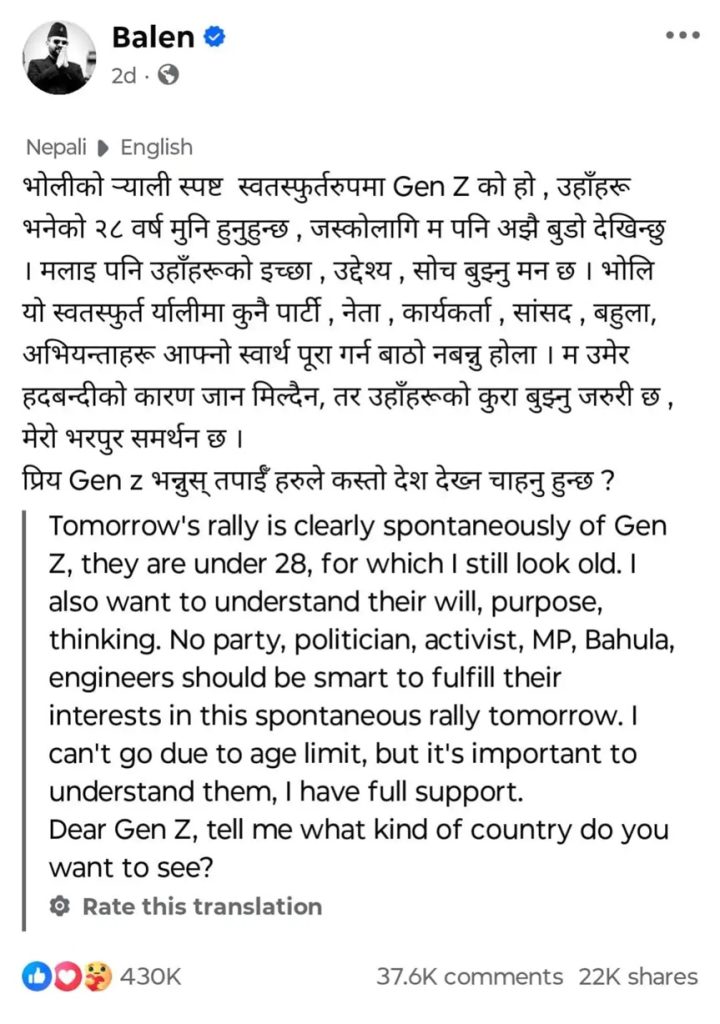
On 7 September 2025, Shah posted a pivotal message on Facebook expressing his “full support” for the planned GenZ demonstrations. He framed it as a spontaneous movement of the youth, cautioning established political parties against hijacking it for their own interests. While stating he could not attend due to the protesters’ age limit (under 28), his endorsement was a powerful catalyst.
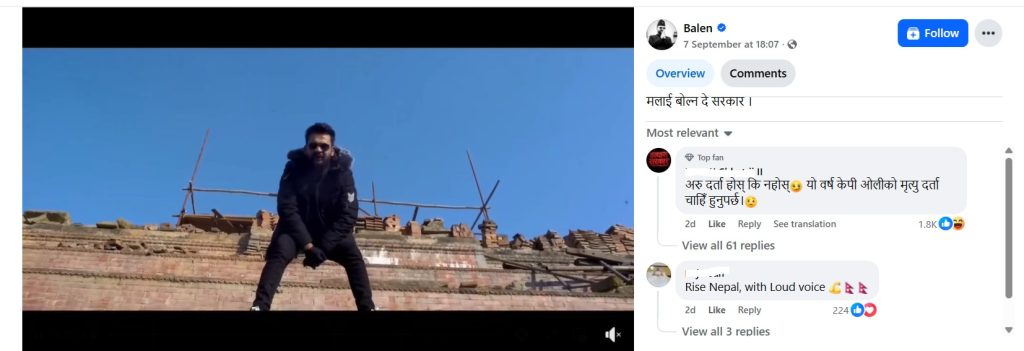
Image Source: OpIndia
The following days saw massive, and later violent, protests across Nepal. As the demonstrations escalated from digital rights to demands for the government’s resignation, resulting in 19 deaths and over 300 injuries, Shah’s role evolved. His social media posts, including a repost of his anti-government song ‘Balidan’ with the caption “Sarkar mujhe bolne de” (Government, let me speak), were seen as fuelling the fire.
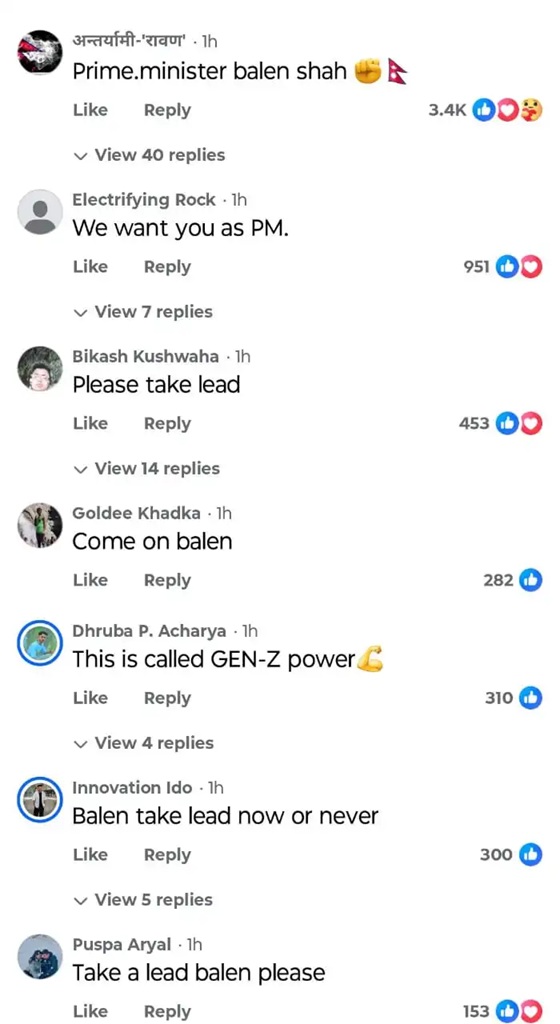
When the government fell on 9 September 2025, the chorus of support for Shah reached a fever pitch. His Facebook page was flooded with comments like “We want you as PM” and “Please take Lead Balen.”
Image Source: OpIndia
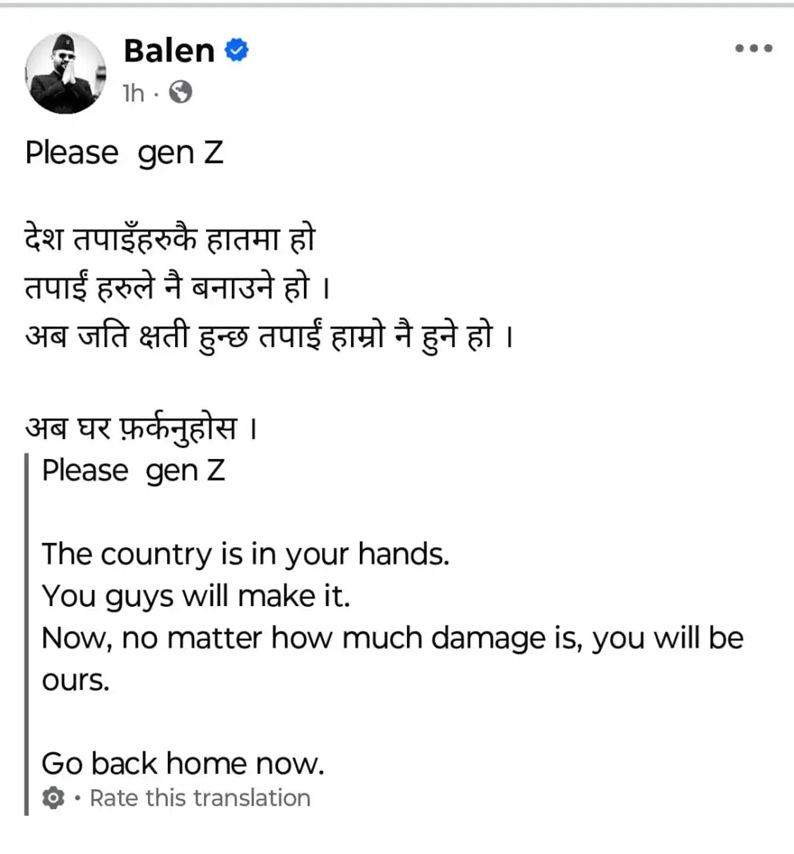
Local media began seriously touting him as the next Prime Minister. In a move to position himself as a statesman, Shah then appealed to the protesters, writing, “Please GenZ, the country is in your hands… Now, no matter how much damage happens, you will remain ours. Now go back home.”
Image Source: OpIndia
A Complex Web Of Alleged Foreign Connections
Shah’s sudden rise to national prominence is shadowed by persistent questions about his international affiliations, with accusations pointing in two contradictory directions: towards both the United States and China.
Links To The United States:
Shah has maintained a visible and consistent relationship with the US Embassy in Nepal.
He first met US Ambassador Dean Thompson in 2022, with the ambassador sharing pictures of the meeting.
Great introductory meeting with Mayor of Kathmandu @ShahBalen yesterday. I particularly enjoyed discussing the ways we can work together on cultural preservation! pic.twitter.com/brEDyR7kq4
— U.S. Ambassador Dean R. Thompson (@USAmbNepal) December 2, 2022
Reports emerged of another meeting in 2024 where the Ambassador Thompson reportedly invited Shah to visit America.
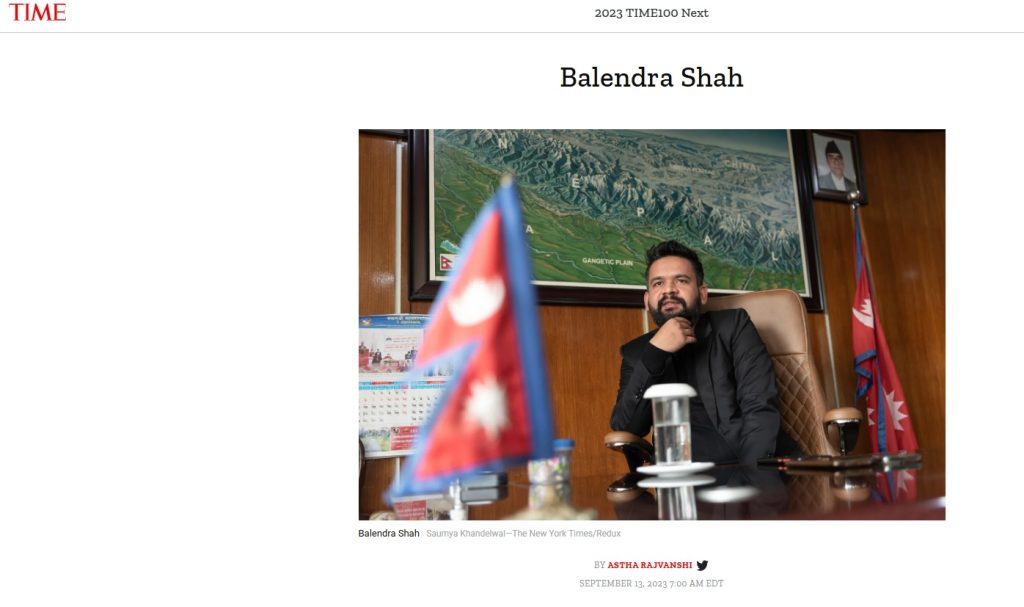
His recognition in international media, including being named in Time Magazine’s top-100 influential people of 2023 and coverage in The New York Times, is cited as evidence of his Western connections.
Links To China:
Conversely, Shah has also been accused of being an asset of Chinese intelligence (MSS).
Critics point to his frequent meetings with Chinese embassy staff and journalists before his mayoral election, alleging Chinese funding was instrumental in his victory.
However, on meeting Chinese ambassador Chen Song, he said: “The festivals celebrated by the citizens of #Nepal & #China can be similar, the dress and food can be similar & this relationship can be promoted at the civil level”, contrary to his Nepali existence dialogue. 8/9 pic.twitter.com/JOQYiq7GQ0
In June 2023, he hung a controversial “Greater Nepal” map in his office that claimed parts of Indian territories (Uttarakhand, Himachal Pradesh, and Sikkim).
Nepal🚨 In response to the 'Akhand Bharat' mural in #India's new Parliament building, Kathmandu Mayor Balendra Shah has put up a new 'Greater Nepal' map in his office. pic.twitter.com/rMtEijGN2f
This move was widely celebrated and promoted by Chinese state-affiliated media handles on Weibo, who used it to criticize India.
On 9 June 23, a government Verified handle of "Communist China" was found promoting "Balen Shah's" Greater Nepal movement. Spitting venom on #BJP, the #CPC handle said: #India has the ambition to Annexe neighbors. Although #China has itself annexed #Tibet.
His policies as mayor, particularly a brutal crackdown on Kathmandu’s street vendors to make space for Chinese outlets, alienated his poor and middle-class support base and aligned with alleged Chinese interests.
– and what hurt the most to the Nepali community was that he ordered a brutal crackdown on Kathmandu’s poor street vendors and daily wage earners to make space for Chinese outlets. Many people lost their daily income and cursed Balen shah.
6/9 pic.twitter.com/oFK8K4dCYt
Before the elections, he was often seen with #Chinese embassy staff and journalists in several restaurants, a typical cover, and practice of Chinese intelligence #MSS.
Who once talked about a common #Nepali people, caused havoc within less than a year of taking office.
4/9 pic.twitter.com/nPBG36pDJv
A consistent thread through Shah’s career is his vehement Nepali nationalism, which often manifests as anti-Indian sentiment.
In 2023, Balendra Shah announced that he called off his planned visit to China following the release of a new Chinese map on Monday, which depicts Limpiyadhura, Kalapani and Lipulekh – territories claimed by Nepal – as part of India.
His political stances include:
The Adipurush Ban: He threatened to ban Indian Bollywood films in Kathmandu over a dialogue in the film ‘Adipurush’ that referred to Sita as India’s daughter, only being overruled by Nepal’s Supreme Court.
The Map Controversy: The installation of the “Greater Nepal” map was a direct response to the “Akhand Bharat” mural in India’s new Parliament building, escalating a cartographic war between the two nations.
Rhetoric: He has consistently criticized Indian influence in Nepal, accusing Nepali institutions of being “Indian slaves” and protesting against what he terms “cultural intervention.”
⚡ Who is Balen Shah aka Balendra Shah and why do people consider him anti-India?
Popularly known as “Balen,” the 35-year-old is a rapper-turned-politician who has served as Kathmandu’s 15th mayor since May 2022. He won as an independent candidate, becoming the first to hold the… https://t.co/6vBAOmWXGLpic.twitter.com/N3cfb8p0q7
Interestingly, Newslaundry’s Manisha Pande praised his “administrative” capabilities because Kathmandu was very clean.
Controversies And Criticism As Mayor
Despite his populist image, Shah’s tenure as mayor has been fraught with controversy and accusations of hypocrisy and corruption. Critics allege:
He failed to resolve Kathmandu’s chronic solid waste management crisis despite promises, with accusations of misallocated funds. Funds for 250 public toilets and ambulances for the city were allegedly embezzled. His vow to remove illegal billboards turned into accusations of taking kickbacks from advertising companies.
𝐁𝐀𝐋𝐄𝐍 𝐒𝐇𝐀𝐇: – Vowed to resolve Solid Waste Management but ate the allocated money – Ate money allocated for 250 public toilets and ambulances for Kathmandu city – Vowed to remove extra billboards but ended up taking kickbacks from advertising companies 5/9 pic.twitter.com/krsmwfPAb5
Most damagingly, as mentioned above his crackdown on poor street vendors to allegedly accommodate Chinese businesses caused many to lose their livelihoods, leading to a significant backlash from his original support base.
Nepal: A Nation At Crossroads
Balen Shah stands at a historic juncture. To his supporters, he is the only incorruptible, strong leader who can break the cycle of failing traditional parties and represent the aspirations of Nepal’s youth. To his detractors, he is a dangerous populist, potentially manipulated by foreign powers, be it the West’s toolkit for regime change or China’s expansionist ambitions, whose nationalist rhetoric masks an agenda that is ultimately “anti-Nepal.”
The alliance between Sudan Gurung’s on-ground mobilization and Balen Shah’s charismatic promotion has proven potent enough to bring down a government. The question now is whether this partnership will succeed in installing Shah as Prime Minister and, if so, what direction a “Balen-led” Nepal would take. The world, and particularly regional powers India and China, are watching closely, aware that the stability of the entire region could be influenced by the rise of the rapper-turned-mayor who now dreams of leading a nation.
A recent exposé by OpIndia has brought attention to the Centre for the Study of Developing Societies (CSDS), highlighting its role within a foreign-funded network of NGOs and think tanks allegedly working in opposition to India’s national interests. The report claims that CSDS plays a key part in shaping political narratives that favor external agendas, while presenting itself as an academic and civil society institution but manipulating public discourse and weakening democratic frameworks under the guise of research and activism.
This report thoroughly examines the CSDS’s institutional history, ideological leanings, funding sources, and global partnerships. The central thesis is that CSDS functions as a key node in a transnational ecosystem involving foreign governments, media outfits, and ideological lobbies that often presents a hostile posture towards India’s elected leadership, its cultural fabric, and its majority population. This influence, it argues, serves foreign policy goals of external powers under the guise of academic neutrality and activism.
Centre for the Study of Developing Societies (CSDS)
Established in 1963 by Rajni Kothari, CSDS has long operated with a critical stance toward India’s Hindu majority, democratic institutions, and nationalist movements. The founding ties to foreign-backed entities such as the Asia Foundation, allegedly a front for U.S. intelligence activities during the Cold War, cast early doubts on its independence.
CSDS’s research over the decades has consistently focused on accentuating caste divisions, framing Hindus as oppressors, and portraying the Indian state as authoritarian or exclusionary. The institution has been accused of laundering such narratives through academic frameworks to provide ideological ammunition for global lobbies antagonistic to India’s sovereignty.
Foreign Funding and Strategic Partnerships
Though CSDS receives some funding from Indian government bodies such as the Indian Council of Social Science Research (ICSSR), a significant portion of its resources come from foreign institutions raising concerns over external influence in domestic policy debates. Notable funders include:
Konrad Adenauer Stiftung (Germany): A foundation linked to Germany’s ruling CDU party, which has contributed over ₹2.6 crore. Its mandate to promote Western democratic values has sometimes clashed with Indian sociopolitical realities, particularly under nationalist governments.
International Development Research Centre (Canada): A government-run entity that funded nearly a third of CSDS’s annual budget for eight years. The center is also known for backing identity politics and minority-centric movements, raising concerns in light of Canada’s open support for Khalistani separatism.
Siemenpuu Foundation (Finland): Backed by the Finnish Foreign Ministry, it funds CSDS-linked ecological and tribal rights projects. However, critics claim its platforms serve as safe spaces for anti-Hindu and far-left ideologues, some of whom are sympathetic to Naxalite extremism.
Berggruen Institute (USA): Its publication Noema has frequently published ideologically charged, anti-India content, often authored by individuals connected with Pakistan or Western think tanks critical of Indian policy.
Ford Foundation, Open Society Foundations (Soros), Omidyar Network: These foundations are globally recognized for supporting regime change, civil unrest, and identity-based activism. Their support to CSDS, especially through collaborative projects like the “Indian Muslims Project,” has amplified narratives around oppression, Islamophobia, and “rising fascism” in India.
Sciences Po (France): Contributions from its FNSP branch have helped fund CSDS operations. Prominent faculty like Christophe Jaffrelot have regularly produced critiques of Hindu nationalism and India’s democratic trajectory.
Links to Foreign Media, Intelligence Fronts, and Investigative Outlets
The report outlines CSDS’s connections with international media networks and organizations that claim to support “media freedom” and “investigative journalism.” These include Bellingcat, OCCRP, RSF, GIJN, and Reporters’ Collective many of which are funded by institutions tied to Western governments and intelligence-linked NGOs like the National Endowment for Democracy (NED).
This network creates a feedback loop, CSDS-affiliated academics produce politically charged research, which is then amplified by global media. These reports subsequently inform international freedom indexes and policy papers that depict India in a negative light justifying more foreign intervention and funding for the same actors.
Strategic Objectives and Narrative Engineering
The report identifies four major thematic areas in CSDS’s work:
Fragmenting Hindu Society: Research is used to amplify caste divisions, distancing marginalized groups like Dalits, OBCs, and Adivasis from broader Hindu identity thus weakening social cohesion and the nationalist movement.
Promoting Dalit-Muslim Solidarity: CSDS frequently pushes narratives that tie Dalit and Muslim grievances together, portraying both as oppressed by the Hindu state, an ideological alignment often seen in left-Islamist alliances.
Portraying Hindus and the State as Oppressors: Key CSDS figures and associated journalists consistently portray Hindus as communal or violent, irrespective of evidence. Events like the 2002 Gujarat riots or the 2020 Delhi violence are used as case studies without acknowledging counter-narratives or legal findings.
Challenging Indian Sovereignty: CSDS-backed studies and protests often target national integrity, especially concerning issues like Kashmir, the Northeast, and citizenship laws. The research often supports street-level activism that mirrors the objectives of foreign stakeholders.
Links to Hostile Entities and Adversarial Groups
The analysis outlines the alignment of CSDS and its ecosystem with a range of anti-India or radical elements:
Western regime-change actors: Many CSDS funders like NED, OSF, and Ford Foundation have a track record of engineering political change in various parts of the world.
Pro-Khalistan and pro-Islamist actors: The involvement of Canadian funding sources, known for supporting Sikh separatists, as well as links to anti-CAA protests, raises red flags.
China’s indirect influence: Through think tanks like Berggruen Institute, individuals and ideas sympathetic to China or hostile to Indian unity are given platforms within CSDS-linked academic discussions.
Underlying Strategy and Long-Term Agenda
The report highlights a consistent method: foreign actors with specific geopolitical goals collaborate with Indian intellectuals and NGOs to sow distrust, exacerbate identity conflicts, and delegitimize India’s governance model. These efforts are designed not just to criticize policy but to actively influence political outcomes often favoring regimes or ideologies more amenable to Western or Chinese influence.
Their silence on anti-Hindu violence, forced conversions, or terrorist threats while being highly vocal on real or perceived minority grievances suggests an intentional ideological bias, not mere academic neutrality.
The Centre for the Study of Developing Societies, along with its allied NGOs and media partners, represents what the report calls a “narrative warfare complex” where foreign funds, ideological activism, and selective research converge to challenge India’s internal stability and global image.
To safeguard democratic integrity and national sovereignty, the report calls for greater transparency, regulatory oversight, and scrutiny into how such institutions operate, who funds them, and what agendas they push especially when they operate under the guise of research and civil society.
In an era of hybrid warfare and information manipulation, civil society institutions must not become unwitting instruments of foreign interference.
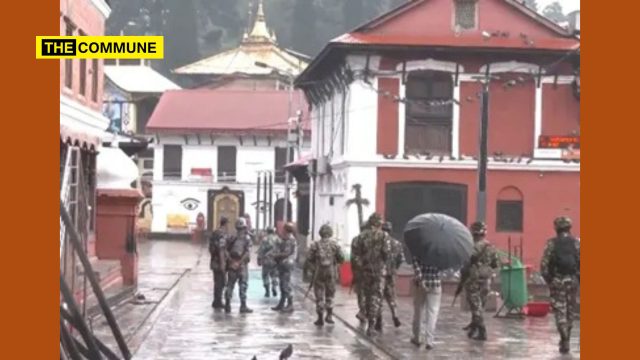
The historic Pashupatinath Temple, one of Nepal’s most revered religious sites, has been closed to visitors on Wednesday due to escalating violent protests across the country. The Nepalese Army has been deployed to ensure security around the temple premises and maintain peace.
The temple closure comes amid nationwide anti-government protests that turned violent on Monday, led primarily by youth opposing recent government decisions. The unrest escalated after Nepal’s Prime Minister K.P. Sharma Oli resigned on Tuesday amid growing pressure.
Protesters targeted the residences of President Ramchandra Paudel and other top political leaders and vandalised the Parliament building. According to official sources, at least 22 people died and more than 500 were injured during clashes on Monday between protesters and security forces.
The clashes were triggered after the widespread demonstrations by the youth who called a ban on 26 social media platforms an attack on freedom of expression. Following the violence, the government lifted a controversial ban on 26 social media platforms late Monday.
In addition, Home Minister Ramesh Lekhak and several other ministers resigned amid the crisis. The Nepalese Army began deploying troops late Tuesday in Kathmandu to control the situation. India has increased vigilance along the Nepal border and advised its citizens in Nepal to avoid travel and remain indoors.
Prime Minister Narendra Modi chaired a meeting of the Cabinet Committee on Security (CCS) to discuss the deteriorating situation. He expressed deep anguish over the loss of young lives and stressed the importance of peace and stability in Nepal.
“Many young people have lost their lives. The stability, peace, and prosperity of Nepal are of utmost importance to us. I humbly appeal to all my brothers and sisters in Nepal to support peace,” PM Modi said in an X post. Flights to and from the capital have been suspended, and the Army has stepped in to maintain order.
-IANS
Subscribe to our channels on Telegram, WhatsApp, and Instagram and get the best stories of the day delivered to you personally.
Tamil Nadu has witnessed alarming levels of cyber fraud this year, with the public losing nearly Rs 1,010 crore to various scams until July, according to data released by the Tamil Nadu Cyber Crime Wing. Officials said that swift intervention has helped freeze Rs 314 crore of the cheated amount, while Rs 62.4 crore has been returned to victims after obtaining necessary court approvals.
In comparison, cyber fraud losses stood at a staggering Rs 1,673 crore in 2024. Of this, Rs 772 crore was frozen and Rs 84 crore eventually restored to victims. While the rising scale of such crimes highlights the deepening menace of online fraud, authorities maintained that Tamil Nadu continues to be at the forefront nationally in combating cyber threats and preventing people from being fully victimised.
The Cyber Crime Wing has undertaken a series of high-impact operations this year. In a statewide crackdown codenamed ‘Operation Thiraineeku-I’, officers arrested 76 accused in connection with 135 FIRs and 20 Community Service Registers (CSRs) linked to 158 complaints filed through the National Cybercrime Reporting Portal (NCRP).
The total reported loss in these complaints alone was Rs 41.97 crore. Officials said the operation not only brought multiple cybercriminals to justice but also sent out a strong deterrent message to fraudsters targeting people through online loan scams, investment frauds, and phishing.
On a broader scale, Tamil Nadu played a significant role in the Pan-India ‘Operation Hydra’, targeting cyber criminals across state borders. As part of this initiative, seven offenders from Uttarakhand, Jharkhand, Assam, and Delhi, who were involved in high-impact cybercrime networks, were arrested.
These individuals were said to be operating organised fraud syndicates using fake call centres and digital manipulation tactics to siphon off large sums from unsuspecting victims. In another tough measure, the state has detained 18 cyber offenders under the stringent Goondas Act, underscoring its zero-tolerance approach.
Senior officials noted that these actions are intended not only to penalise the guilty but also to safeguard potential victims by dismantling fraud networks before they inflict wider damage. Authorities have urged the public to remain vigilant, avoid sharing personal information online, and report suspicious activity immediately through the NCRP portal or state helplines.
-IANS
Subscribe to our channels on Telegram, WhatsApp, and Instagram and get the best stories of the day delivered to you personally.