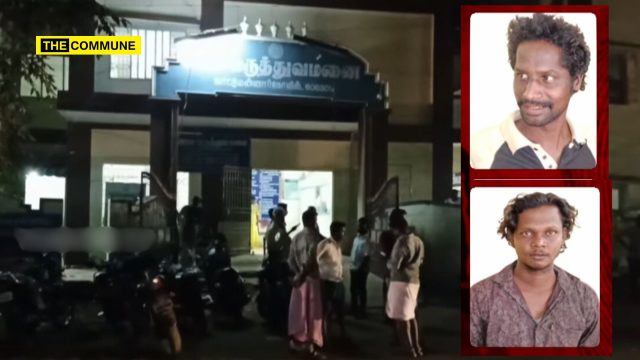
Panic gripped the maternity ward of the Kattumannarkovil Government Hospital after two youths allegedly entered the facility armed with sickles and threatened doctors, staff, and patients.
According to hospital sources, the incident occurred when Abinesh and Ayyappan allegedly barged into the maternity ward and began behaving in an aggressive and unruly manner. Staff members said the two appeared to be under the influence of alcohol and cannabis at the time of the incident.
Hospital employees acted quickly to prevent the situation from escalating and managed to restrain the two men by locking them inside a room within the premises.
Police were immediately alerted, and officers arrived at the hospital shortly afterward. The two youths were taken into custody and later remanded to judicial custody.
The incident caused fear among patients and attendants at the hospital, particularly in the maternity ward where several women were receiving treatment. Police have registered a case and are continuing their investigation into the matter.
Subscribe to our channels on WhatsApp, Telegram,Instagram and YouTube to get the best stories of the day delivered to you personally.
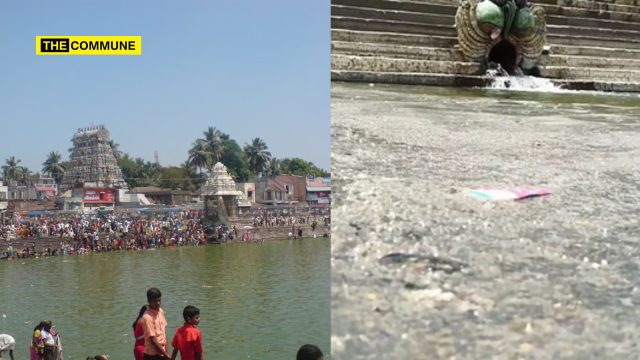
Devotees visiting the historic Mahamaham Tank in Kumbakonam, Thanjavur district, were shocked on Sunday after black, foul-smelling sewage water was seen flowing into the sacred tank through its inlet channel, triggering widespread outrage among residents and pilgrims.
Videos showing the contaminated water entering the tank circulated widely on social media, prompting public concern over the condition of one of Tamil Nadu’s most revered temple water bodies.
Devotees Notice Foul Smell
As reported in Dinamani, according to eyewitnesses, visitors who arrived at the tank on 15 March 2026 noticed a strong stench in the area and soon discovered that dark sewage-like water was entering the tank through the inflow channel. Several devotees who had come to perform rituals and take a holy dip were seen turning away in disgust after attempting to sprinkle the water and noticing the foul smell.
The incident sparked immediate demands from residents and social activists for authorities to drain the tank completely and refill it with clean water.
HR&CE Offers Explanation
Officials from the Tamil Nadu Hindu Religious and Charitable Endowments Department stated that the tank is usually filled with water from the Arasalar River through borewells.
According to the department, water had recently been drawn from the river after a long interval, and accumulated waste and sediment in the inflow channel may have entered the tank along with the water. Authorities maintained that the water currently flowing into the tank is clean.
MLA Inspects Site
Following media reports, Sakkottai K. Anbalagan visited the tank to inspect the situation. Municipal corporation workers were subsequently deployed to the site, and the accumulated waste was cleared from the inlet area.
Sacred Site of Major Festival
The Mahamaham tank is among the most sacred water bodies in Tamil Nadu. The Mahamaham Festival, held once every 12 years, attracts nearly one crore pilgrims who gather to take a ceremonial holy dip.
Located near the Kasi Viswanathar Temple complex, the tank is jointly maintained by the HR&CE Department, the Water Resources Department, and the Kumbakonam Municipal Corporation.
However, activists say this is not the first time contamination concerns have surfaced regarding temple tanks in Kumbakonam and have called for long-term structural solutions to prevent sewage inflow into the sacred water body.
Subscribe to our channels on WhatsApp, Telegram,Instagram and YouTube to get the best stories of the day delivered to you personally.
The Supreme Court of India on 11 March 2026 declined to hear a petition challenging a 144-year-old provision that exempts Muslims from mandatory registration and stamp duty requirements when gifting immovable property, directing the petitioner to instead approach the Law Commission of India. Let us learn a little bit about this law.
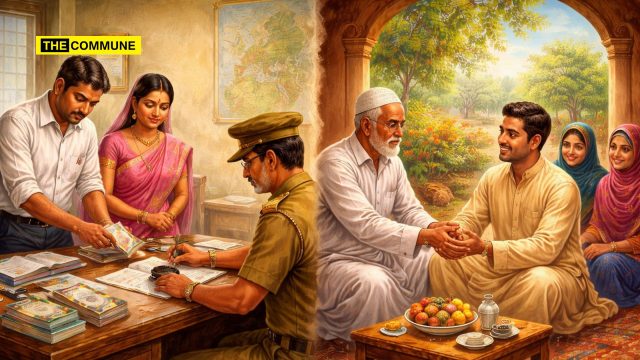
When a Hindu, Christian, or Sikh gifts a piece of land to a family member, they must execute a written deed, register it at the sub-registrar’s office, and pay stamp duty to the state government – a cost that typically ranges between 3% and 7% of the property’s market value. If they skip any of these steps, the gift is legally invalid.
When a Muslim gifts the same piece of land to a family member, none of that is required.
This is not a loophole or an administrative oversight. It is the law and it has been so since 1882.
How the Law Is Structured
The Transfer of Property Act, 1882, enacted by the British colonial administration governs property transactions in India. Chapter VII of the Act deals with gifts of immovable property.
Section 123 mandates that all gifts of immovable property must be made through a signed, attested, and compulsorily registered instrument. Under the Stamp Act, 1899, the gift deed must also carry stamp duty before it is accepted for registration.
Section 129, however, carves out a direct exemption. It states that nothing in Chapter VII shall affect any rule of Mohammedan law. This means Muslim gifts, known as Hiba under Islamic personal law are governed entirely outside this framework.
Under Hiba, a valid gift requires only three elements: a declaration of intent by the donor, acceptance by the recipient, and delivery of possession of the property. The gift can be made orally. It does not require a written deed. It does not require registration. And it does not attract stamp duty.
A Concrete Illustration
Consider two scenarios involving the same piece of land worth ₹50 lakh:
A Hindu father gifts land to his son – He must execute a gift deed, pay stamp duty of approximately ₹1.5–3.5 lakh (depending on the state), and register the deed at the sub-registrar’s office. Only then does the son have legal title.
A Muslim father gifts land to his son – He declares his intent, his son accepts, possession is transferred. The gift is legally complete. No paperwork. No government office. No payment.
The Legal Basis
Section 129 is not a stand-alone anomaly – it is part of a broader architecture of personal law in India, where inheritance, marriage, and property matters are governed by religion-specific codes. The Muslim Personal Law (Shariat) Application Act, 1937 reinforces the application of Islamic personal law, including Hiba, for Muslims in India.
Courts have consistently upheld the validity of unregistered Hiba transactions – the Supreme Court and various High Courts have ruled that an oral Hiba, if accompanied by delivery of possession, creates a valid and enforceable title.
The Provision Is Now Being Questioned
The differential treatment came under direct legal scrutiny on 11 March 2026, when Advocate Hari Shankar Jain petitioned the Supreme Court, arguing that Sections 123 and 129 together violate Articles 14 and 15 of the Constitution which guarantee equality before the law regardless of religion.
The Supreme Court declined to hear the challenge on merits and instead directed the petitioner to approach the Law Commission of India – the body that advises Parliament on legal reforms. The court noted that the law has existed for 144 years without a constitutional challenge and that Parliament is the appropriate forum for any amendment.
The provision has remained unchanged since 1947, through multiple governments, despite periodic debates over uniform civil law in India.
Subscribe to our channels on WhatsApp, Telegram,Instagram and YouTube to get the best stories of the day delivered to you personally.
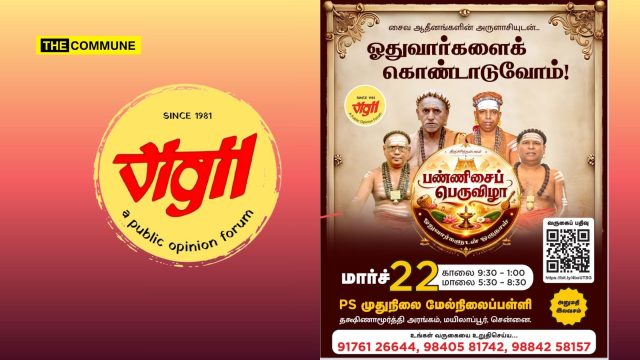
A cultural event celebrating Tamil devotional music and heritage, titled “Pannisai Peruvizha,” is set to be held in Mylapore later this month with the aim of promoting traditional Tamil arts and honouring individuals working to preserve them.
The programme is being organised by Vigil – A Public Opinion Forum, which said the initiative seeks to revive interest in Tamil language, culture, and classical devotional music traditions.
The event will take place on 22 March 2026 (Sunday) at the PS Higher Secondary School Auditorium, Dakshinamurthy Hall, Mylapore, Chennai. The programme will be conducted in two sessions – 9:30 am to 1:00 pm and 5:30 pm to 8:30 pm.
The festival is intended to recognise scholars, musicians, and practitioners who have been working to preserve ancient Tamil musical traditions such as Pannisai, which has deep roots in temple culture and devotional literature.
While there is frequent concern about the declining prominence of Tamil language and arts, responsibility for preserving them rests not only with governments and educational institutions but also with society itself.
The event is meant to encourage renewed public engagement with Tamil language and culture, particularly among younger generations, and to honour those who continue to sustain traditional Tamil art forms.
Participation in the event is free, and members of the public, music enthusiasts, and supporters of Tamil culture are invited to attend. Interested participants can register at https://bit.ly/4bxUTSG
Originally active from the 1990s to 2010, VIGIL is a Chennai-based initiative that brought together intellectuals, scholars, and citizens to deliberate on matters of national and cultural relevance. Past events have been graced by the likes of Swami Dayananda Saraswati and other luminaries, reinforcing VIGIL’s commitment to informed, values-based civic engagement.
Subscribe to our channels on WhatsApp, Telegram,Instagram and YouTube to get the best stories of the day delivered to you personally.
The National Investigation Agency has begun an investigation into reports of a group allegedly involved in the forced religious conversion of Hindus operating in Mayiladuthurai district.
As reported in Dinamalar, the development comes in the backdrop of the 2019 murder of Ramalingam, a functionary of the Pattali Makkal Katchi from Thirubhuvanam. Ramalingam had been opposing alleged attempts to convert Hindus in the region and had recorded videos exposing the activities of the conversion network, which he later shared on social media.
He was subsequently murdered in 2019 by individuals associated with the banned organisation Popular Front of India. The murder case has since been under investigation by the NIA.
According to sources, reports have now emerged that certain individuals belonging to the Christian community in the region are again attempting to carry out religious conversions. A Rashtriya Swayamsevak Sangh functionary identified as Adithyan had allegedly released videos exposing these activities and attempted to prevent the conversions.
Following this, Adithyan was arrested by the Tamil Nadu Police attached to the Thiruvidaimarudur police station.
The NIA has now taken note of the developments and initiated inquiries into the matter. Officials said the agency has received information that members linked to the conversion network connected to Ramalingam’s murder may currently be staying in the Thirumullaivasal area.
Investigators have reportedly obtained certain video evidence suggesting ongoing conversion activities in the region, based on which further inquiries are being conducted.
Officials added that associates of an alleged Islamic State operative identified as Albasith, who is said to hail from Thirumullaivasal, have also been brought under the investigation.
The NIA has reportedly begun field inquiries in Mayiladuthurai district as part of its probe into the alleged network and its possible links to earlier cases.
Subscribe to our channels on WhatsApp, Telegram,Instagram and YouTube to get the best stories of the day delivered to you personally.
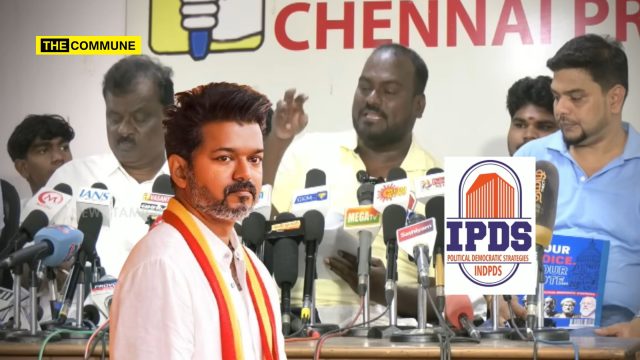
A controversy has erupted over an election opinion poll released by the IPDS organisation run by former students of Loyola College, after journalists questioned the methodology and claims made by its president, Thirunavukkarasu, during a press conference.
The survey, which appeared favourable to actor Vijay’s Tamilaga Vettri Kazhagam (TVK), has drawn scrutiny following allegations that as much as ₹2 crore may have been involved behind the release of what can be described as a questionable poll.
Presenting the findings, Thirunavukkarasu claimed that the 2026 Tamil Nadu Assembly election could see significant shifts in voter preferences. According to him, respondents who were asked who should become Chief Minister most frequently named Chief Minister MK Stalin and actor Vijay. Edappadi K. Palaniswami was placed in second position, followed by Annamalai, Seeman, Kanimozhi and Udhayanidhi Stalin.
He argued that public dissatisfaction with both the DMK and AIADMK had created space for an alternative force, claiming that Vijay could emerge as a “kingmaker” in the election. The survey also claimed that among voters aged 18-19, about 39% expressed support for TVK, and projected that a possible TVK alliance could secure around 28% of the vote.
The survey also noted that TVK leads the projected vote share.
TVK – 19.20%
DMK – 17.70%
AIADMK – 15.32%
NTK – 6.00%
Congress – 4.5%
BJP – 3.50%.
DMDK – 2.55%
VCK – 2.00%
Other parties collectively account for 9.41 percent of the projected vote share. Notably, a significant 20.26 percent of respondents remain undecided, indicating a considerable portion of the electorate has yet to finalize their choice.
However, the claims soon came under intense questioning from journalists.
Thirunavukkarasu stated that the AIADMK alliance could lose deposits in nearly 80 constituencies and said that TVK might come second in around 80 seats while having the potential to win about 50 constituencies. He further claimed that the DMK alliance, despite being strong, might win only about 90 seats and could trail by roughly six% in vote share.
When reporters asked which constituencies the AIADMK alliance would lose deposits in, he declined to provide details. “I will tell that next time. If I say it now it will not be good. I have constituency data, but I should not say it now,” he said.
Further questions were raised about the poll’s assumptions. News Tamil reporter Latha asked how the survey could present projections for a “TVK alliance” when no party had officially formed an alliance with Vijay’s party. In response, Thirunavukkarasu said the survey assumed that the Congress might join such an alliance.
When the reporter pointed out that the survey listed 19% vote share for TVK alone and 28% for a TVK alliance, he responded that 19% represented the party’s “core vote share,” while the higher number was based on a hypothetical alliance scenario.
Questions were also raised about why the survey mentioned a “Naam Tamilar alliance” even though Naam Tamilar Katchi had already announced that it would contest the election independently. Thirunavukkarasu dismissed the criticism, telling reporters that their interpretation was “wrong”.
As questioning intensified, Thirunavukkarasu appeared visibly uncomfortable and said that the survey combined both projections and assumptions. He eventually attempted to end the press conference and leave the venue.
However, when reporters continued asking questions, he turned angrily toward News Tamil reporter Latha, pointed his finger at her and demanded, “Which channel are you from? What is your name?”
Subscribe to our channels on WhatsApp, Telegram,Instagram and YouTube to get the best stories of the day delivered to you personally.
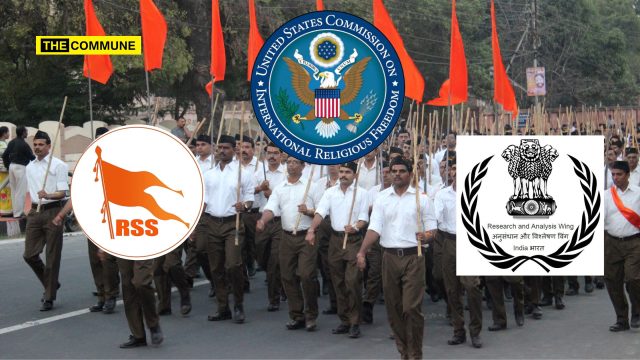
The United States Commission on International Religious Freedom (USCIRF) has, in its 2026 Annual Report, done something unprecedented – it has named the Rashtriya Swayamsevak Sangh (RSS), India’s largest and most respected cultural organisation, as a target for U.S. sanctions.
Every now and then the USCIRF publishes a ‘report’ defaming India. The November 2025 report was about “Systematic Religious Persecution in India” which read less as an objective assessment and more as a politically motivated dossier that ignores the foundational wounds of the Hindu community to paint a picture of unidirectional persecution.
In its 2026 ‘report’, they target the 100-year-old volunteer organization, the Rashtriya Swayamsevak Sangh.
What the Report Claims
The report claims that religious freedom conditions in India deteriorated in 2025, citing legislation, law enforcement practices, and mob violence that it says disproportionately affected religious minorities such as Muslims and Christians. It highlights the expansion and enforcement of anti-conversion laws in several states, which include stricter penalties and broader definitions of religious conversion. The report also discusses the use of laws such as the Foreign Contribution Regulation Act (FCRA), the Unlawful Activities Prevention Act (UAPA), and policies connected to citizenship and immigration enforcement, arguing that these measures have been used against minority communities and activists.
According to the report, the year also saw vigilante attacks and communal violence, including incidents involving mobs targeting Muslims and Christians, as well as violence linked to cow protection laws and communal tensions after a terrorist attack in Kashmir. It also raises concerns about detentions, deportations of Rohingya refugees, and expulsions of Bengali-speaking Muslims in Assam.
The report further discusses government actions affecting religious institutions, including the Waqf legislation and policies affecting religious educational institutions, which it says increased state control over minority religious bodies.
What USCIRF Recommended
The report urges the U.S. government to impose targeted sanctions on both the RSS and India’s Research and Analysis Wing (RAW) for their “responsibility and tolerance of severe violations of religious freedom”. The proposed measures include:
Asset freezes on the organisations and their affiliates
Entry bans into the United States for involved individuals
Pressing India to allow U.S. bodies like USCIRF and the State Department to conduct in-country assessments of religious freedom conditions
Linking future U.S. security assistance and bilateral trade with India to improvements in religious freedom
Impose targeted sanctions on individuals or entities it believes are responsible for religious freedom violations.
Restrict arms sales to India under provisions of the Arms Export Control Act.
In addition, it recommends that the U.S. Congress pass legislation requiring reporting on alleged transnational repression targeting religious minorities abroad.
What USCIRF Actually Is
USCIRF is not a neutral human rights body. It is a U.S. government-funded advisory commission with a well-documented track record of bias against non-Christian, non-Western civilisational contexts. Its commissioners have included individuals with documented ties to Islamist lobby groups, Pakistani American activist networks, and Christian evangelical missionary organisations.
Critically, USCIRF cannot impose sanctions. It has no legal authority whatsoever.
The Sources Behind the Report: Follow the Money
USCIRF’s India chapters do not emerge from neutral fact-finding. They are built almost entirely on inputs from a specific ecosystem of organisations:
The Indian American Muslim Council (IAMC), which openly celebrated this report and has historically advocated for designating the RSS as a terrorist group
Hindus for Human Rights, a U.S.-based group that consistently amplifies anti-Hindu, anti-India narratives under the cover of “human rights” language
Church-linked missionary bodies and Kashmiri separatist-adjacent networks
These are not neutral observers. These are organisations with a stated agenda: the delegitimisation of Hindu majoritarian politics in India. USCIRF launders their inputs into official U.S. government-adjacent reports, giving them a veneer of institutional credibility they do not deserve.
India’s Government Was Right to Reject It
India’s Ministry of External Affairs has consistently called USCIRF reports “biased and politically motivated” and “a deliberate agenda rather than a genuine concern for religious freedom”. In 2025, the MEA went further – calling for USCIRF itself to be designated as an “entity of concern”. That is extraordinary diplomatic language, and it is entirely justified.
India has a Constitution that guarantees equal rights to all citizens. India has an independent judiciary. India holds free elections. To compare India’s record to countries that USCIRF also designates as CPCs, countries where people are executed for apostasy, where churches are bulldozed by the state, where minority communities face genocide, is intellectually dishonest and geopolitically motivated.
In the end, the USCIRF report says far more about the ecosystem producing it than about India itself. An advisory body with no enforcement authority has attempted to place a century-old Indian volunteer organisation, the Rashtriya Swayamsevak Sangh, in the crosshairs of sanctions based on inputs from a narrow advocacy network.
Subscribe to our channels on WhatsApp, Telegram,Instagram and YouTube to get the best stories of the day delivered to you personally.
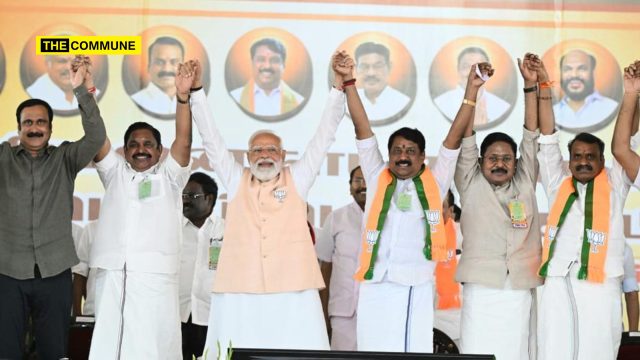
The National Democratic Alliance is projected to gain an early edge in key southern battlegrounds, particularly in Tamil Nadu, according to the latest Matrize opinion survey released shortly after the Election Commission of India announced the schedule for Assembly elections across five states.
The Commission on Sunday declared that Assembly elections will be held in Assam, West Bengal, Tamil Nadu, Kerala and Puducherry, with voting beginning on 9 April 2026 and counting scheduled for 4 May 2026.
Chief Election Commissioner Gyanesh Kumar announced that polling in Assam, Kerala and Puducherry will take place in a single phase on 9 April 2026. Tamil Nadu will vote in a single phase on 23 April 2026, while West Bengal will go to the polls in two phases on 23 April and 29 April 2026.
At the announcement, the Commission stated that final electoral rolls had been published following intensive revisions and that Central Observers had been deployed under Article 324 of the Constitution and Section 20B of the Representation of the People Act, 1951, to oversee preparations and ensure free and fair elections.
Tamil Nadu: NDA alliance projected ahead
As reported in IANS, in the 234-seat Tamil Nadu Legislative Assembly, the Matrize survey projected the All India Anna Dravida Munnetra Kazhagam–led NDA alliance to emerge ahead of the ruling Dravida Munnetra Kazhagam bloc.
The poll projected the AIADMK-led alliance securing between 114 and 127 seats with a vote share of about 39-40 percent. The ruling DMK-led alliance was projected to win between 104 and 114 seats with a vote share of 37–38 percent.
The survey indicated that the DMK remained strong in the Chennai region, where it was projected to outperform its rivals by 7-8 percentage points and retain a majority of the 37 constituencies.
The poll also suggested that the newly formed Tamilaga Vettri Kazhagam led by actor Vijay could emerge as a significant third force, with a projected vote share of 14-15 percent and an estimated 6-12 seats.
The Mamankam (Maha Makham) Festival is underway in Kerala and will conclude on 3 February 2026. It has been reported that with each passing day, the crowds have been increasing and is a perfect stepping stone to Hindu awakening in Kerala where Hindus are not the majority.
The numbers seem to have caused certain leftist portals a lot of heartburn and they came up with a shoddy narrative to show the Mamankam in a bad light.
On 31 January 2026, leftist rag The News Minute published yet another pathetic episode of “Let Me Explain”. It took nearly two weeks for The News Minute (TNM) to finally assemble an “explanatory” outrage video on 31 January, packaged as investigative journalism. That delay itself is telling: outrage was manufactured, in the most cringest sense.
What Pooja Prasanna’s Let Me Explain episode actually does is not “contextualise” history but force a predetermined ideological narrative onto a living cultural event, using absolutist claims, selective scholarship, and speculative motives.
As always, in this article, we dismantle down their lies one by one.
“Kumbh Has Nothing to Do With Mamankam”: A False Absolutism
TNM repeatedly insists that Kumbh and Mamankam/Mahamakham are fundamentally unrelated, “nothing to do with each other,” “not an oblation festival at all.” This is historically sloppy.
Yes, Mamankam was deeply political, centred on kingship, succession, and ritualised violence. But to claim it had nothing to do with ritual is simply false. Mamankam did involve:
Ritual bathing in the Bharathapuzha
Worship at Thirunavaya temples
Cyclical gatherings every 12 years
Large-scale fairs combining religion, politics, trade, and spectacle
Likewise, Kumbh has never been a purely spiritual bathing ritual. It has always combined kingship, political legitimacy, trade networks, monastic power, and mass congregation.
A fair statement would be: Mamankam and Kumbh are not identical, but they share structural similarities, and modern organisers are consciously drawing from the Kumbh template.
TNM instead chooses absolutist language to delegitimise the very idea of regional Hindu adaptation.
“It Had Nothing to Do With Hindu or Muslim”: Historical Erasure Disguised as Pluralism
One of the most misleading claims in the video is that Mamankam had “nothing to do with Hindu or Muslim.” TNM is just stripping the context. Medieval Kerala was not a religion-neutral vacuum. Mamankam was anchored in:
Hindu temples and Brahmin settlements
Saivite and Vaishnavite ritual orders
Sacred geography centred on Thirunavaya
At the same time, Muslim merchants and warriors played important roles, including ceremonial and military functions. That shows shared participation, not religious irrelevance.
TNM slides from a valid point (“Muslims were part of the structure”) to an absurd conclusion (“therefore it had nothing to do with Hindu or Muslim”). That leap exists only to delegitimise any contemporary Hindu framing.
The “Northern Imposition” Myth: When Adaptation Is Branded as Colonisation
The video claims that river aarti with multi-tiered lamps is “almost unheard of in Kerala” and therefore an “artificial northern imposition.”
This is historically illiterate. Kerala has long traditions of:
Deepam and vilakku rituals
Temple lamp festivals
Deeparadhana
Processional lighting tied to sacred geography
What is new is the scale and visual idiom, consciously inspired by Varanasi and Haridwar. That is adaptation, not imposition.
Calling it “artificial” denies local agency and assumes that Kerala’s Hindus are incapable of choosing pan-Indian symbols on their own terms. Ironically, this is cultural paternalism masquerading as resistance.
The South Has Mamankam Too
It is also misleading to suggest that large, twelve-year Hindu river gatherings are somehow alien to the South. Mamankam in Kerala and Mahamaham in Tamil Nadu can examples of this. Though they are not identical festivals, they can be compared to some extent. Both are major assemblies held once every twelve years on or around riverbanks, and this shared duodecennial cycle has led several scholars to group Kumbh, Mahamaham and Mamankam as part of a broader family of twelve-year Hindu commemorations. Where they differ is in their core logic.
Mamankam at Tirunavaya on the Bharathapuzha was a medieval politico-ritual assembly, where kingship, martial display, temple worship and trade converged, and authority for the next twelve years was symbolically contested on the nilapaduthara platform. Mahamaham at Kumbakonam, by contrast, is primarily a ritual bathing and merit-seeking festival, centred on the Mahamaham tank, where devotees believe multiple sacred rivers converge, with little or no political function. It occurs once every twelve years in the Tamil month of Masi (February–March) when the Magam (Magha) star is ascendant – the last in February 2016 and the next scheduled for February 2028.
The existence of Mahamaham alone punctures the claim that Kumbh-style or duodecennial river festivals are a purely North Indian phenomenon being “imposed” on the South.
“The Only Reason Is Hindu–Muslim Polarisation”: Speculation Presented as Fact
Perhaps the most revealing line in the video is the claim that the “only reason” for sacralising the Bharathapuzha is to create a Hindu–Muslim divide in Malappuram. This is just narrative setting – they want to put this seed of doubt in the viewer’s head. And they do it without evidence, just words. TNM projects motive and then treats it as settled truth.
The organisers themselves speak of cultural revival, reconnecting with civilisational roots, and pan-Hindu solidarity. This is what irks the left. One may disagree with that ideology, but disagreement is not proof of communal conspiracy. TNM collapses potential social effects into declared intent, a classic activist trick.
Environmental Alarmism With Selective Memory
TNM invokes pollution at North Indian Kumbhs to raise environmental alarms, while carefully avoiding comparisons with:
Sand mining in Bharathapuzha
Long-standing encroachments
Construction along riverbanks
Secular fairs and commercial exploitation
All done under the Communist & Congress regimes. But TNM will not open their mouths to question all that.
If “any intervention harms rivers,” then ritual gatherings are not uniquely culpable. TNM’s framing exists to reinforce a narrative: Hindu ritual = ecological threat, while secular or commercial damage fades into the background.
The False Binary: “Secular Heritage” vs “Hindu Spectacle”
The video romanticises 1990s “secular” Mamankam commemorations as neutral heritage while portraying the present festival as ideological distortion. They are just being dishonest.
Both are interpretive projects. Earlier festivals downplayed ritual, temples, and sacred meaning. The current one foregrounds them.
One is not inherently more “truthful” than the other. TNM simply treats its preferred framing as default reality and labels the rest as dangerous revisionism.
The Real Story: Panic Over Hindu Re-Assertion
Mahamakham did not erupt overnight. It unfolded peacefully from 18 January 2026, in public view. TNM’s outrage arrived late because it had to be assembled, not observed.
What truly unsettles TNM is not historical distortion, environmental harm, or communal tension, it is the sight of Hindus reclaiming their Dharma and spaces unapologetically, drawing from pan-Indian symbols without asking for elite approval.
Kerala’s history has always been layered – ritual, political, plural, and sacred at once. TNM’s problem is not with distortion, but with the wrong layer gaining confidence.
And that is why this “explain” video is a hurriedly put together last-minute ideological firefight.
Subscribe to our channels on WhatsApp, Telegram,Instagram and YouTube to get the best stories of the day delivered to you personally.
On 1 February 2026, Finance Minister Nirmala Sitharaman presented the Union Budget 2026-27, and once again, the “mocking brigade” was ready with their stale scripts. For years, a specific section of the political ecosystem has treated the Mumbai-Ahmedabad High-Speed Rail (MAHSR) as a ghost project – something to be ridiculed in drawing rooms and cynical tweets as a “waste of money” or a “perpetual delay”.
When the Finance Minister, as part of the proposals, had announced on another 7 High Speed Rail projects (including two connecting Chennai with Bangalore and Hyderabad), with a capital outlay of almost Rs.2.90L Crores, the visionless political opposition and their subservient media persons started their usual rant on “paper-train” theory.
In this article, I seek to explain why the critics have no feet to stand, with decades being spent in “feasibility study paralysis”, and how the current leadership is making sure that these “Growth Connectors” aren’t just lines on a map, but a blueprint for the new India.
The Cost of Lost Decades: 2004–2014
If the leaders who ruled India between 2004 and 2014 had even a fraction of the current government’s vision, Indians would already be traveling in Bullet Trains today. Instead, those ten years were defined by:
Policy Paralysis: Infinite “pre-feasibility” reports that gathered dust in Rail Bhavan while the world raced ahead.
Lack of Ambition: A mindset that believed India was “not ready” for world-class technology, preferring to keep the common man stuck in crumbling, slow-moving infrastructure. It was almost as if the ruling dispensation found perverse pleasure in the poverty porn that they were the sole creators.
Inefficiency & Apathy: It took the current government to move from paper to pillars, signing the landmark deal with Japan in 2015.
It is a rich irony that the same ex-rulers, who were thrown out not just for historic corruption, but for their sheer inability to execute a single transformative project, are the ones mocking the “delay” today. Their mocking comes from a place of deep insecurity: they are baffled by a government that actually delivers.
The Global Context: India is Racing, Not Crawling
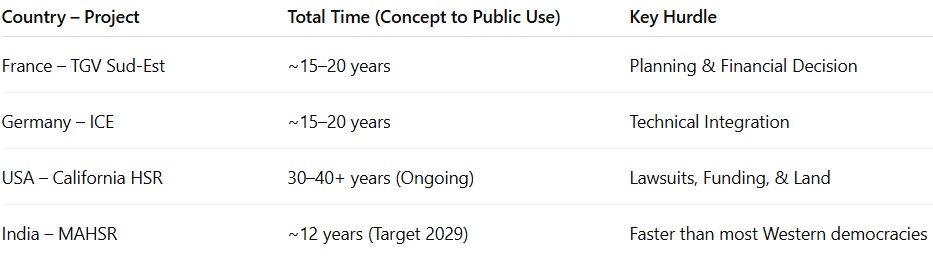
Building a Bullet Train is not like laying a highway; it is building a 500-kilometer precision instrument. When critics compare India to other nations, they conveniently hide the facts about “Democratic Friction”, inherent in a free nation. Despite being a vibrant democracy navigating intricate land laws, India is on track to complete its first HSR in roughly 12 years, outpacing the timelines of veteran players like France and Germany.
The only nations moving faster are autocracies where land is seized overnight and dissent is met with silence. Naming this specific neighbor often rattles India’s previous rulers, who had the audacity to sign a private MoU with the perpetual masters of that regime, a place where dictatorship is the law, and opposition can lead to instant disappearance. India has chosen the harder, more honorable path: building world-class infrastructure while respecting the rule of law.
Crushing the “Delay” Narrative: February 2026 Status
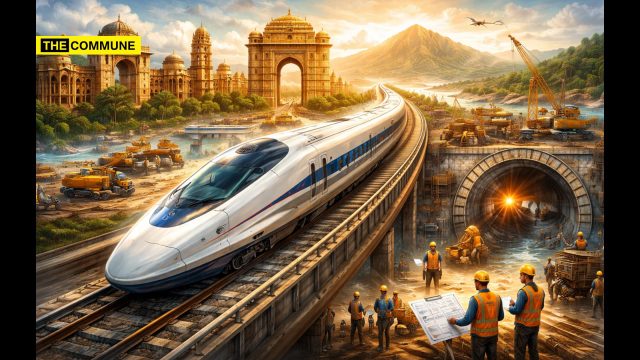
The “Bullet Train” is no longer a PowerPoint; it is a 508-km construction site humming with activity.
56% Physical Progress: As of February 2026, the project has crossed the halfway mark and entered its decisive phase.
100% Land Acquired: Despite years of sabotage by the previous state government in Maharashtra, the current administration has secured 100% of the land (1,396 hectares).
Engineering Feats: In January 2026, engineers achieved a major breakthrough in the 1.5-km Mountain Tunnel-5 in Palghar, followed by the MT-6 breakthrough on February 3, 2026.
Undersea Milestone: Work is in full swing on the 7-km undersea tunnel – a first for Indian infrastructure.
The “Growth Connector” Era
Budget 2026 has proven that Mumbai-Ahmedabad was just the laboratory. The future is a 4,000 km HSR network attracting ₹16 lakh crore in investment.
Mumbai-Pune: Reducing a 3-hour crawl to a 48-minute dash.
Delhi-Varanasi: Connecting the National Capital to the Spiritual Capital in just 3 hours 50 minutes.
Chennai-Bengaluru: Shrinking the journey to a mere 1 hour 13 minutes.
Chennai-Hyderabad through Amaravati and Tirupati: Three State Capitals. Four Cities. One speedy route to economic prosperity.
The savings in time, and a significant savings in cost compared to an air travel, implies that the distance shrinks and the city expands. One can work for a Bangalore company staying in Chennai. A comfortable return trip to Hyderabad from Chennai can be a daily affair. The fact that it connects another Capital city, and the spiritual destination in Tirupati implies a potential for much bigger and better infrastructural utilisation.
Conclusion
The mocking comes from those who couldn’t even electrify half of India’s rail tracks in 60 years. They are naturally baffled by a government that is building undersea tunnels and 350 km/h corridors.
India didn’t just need a train; it needed the WILL to build it. And this Government has it in abundance. In 2029, when the first Shinkansen-class train rolls out, it won’t just be carrying passengers; it will be carrying the pride of a Viksit Bharat that finally left the “efficiency-less” past behind.
Subscribe to our channels on Telegram, WhatsApp, and Instagram and get the best stories of the day delivered to you personally.