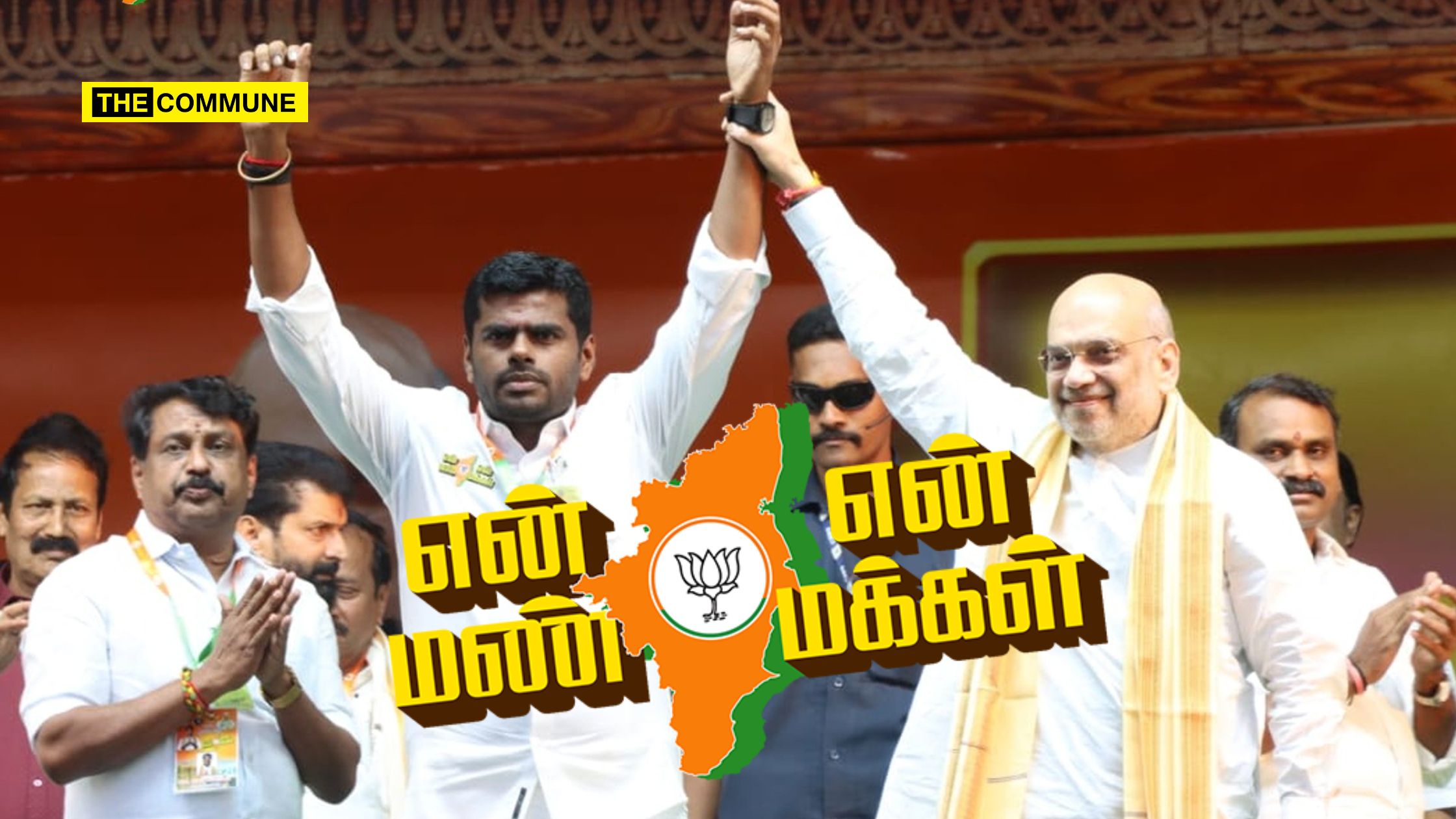
On 28 July 2023, Union Home Minister Amit Shah inaugurated the ‘En Mann, En Makkal’ padayatra (foot march) campaign spearheaded by BJP Tamil Nadu President K. Annamalai in Rameshwaram, Tamil Nadu.
The campaign, which translates to ‘My Land, My People,’ is seen as the BJP blowing the conch for the 2024 Lok Sabha elections. The yatra aims to cover all 234 Assembly constituencies in the state in a span of 100 days.
Massive crowd thronged the venue of the inauguration ceremony in Rameshwaram, with more than a lakh people in attendance according to a few sources.
Massive crowd throng the venue of the En Mann En Makkal inauguration ceremony at Rameshwaram
Union Home Minister Shri Amit Shah also released a book titled “Tamizhukkum Tamizhagathrikum – Modi Enna Seidhar” (What did PM Modi do for Tamil and Tamil Nadu?). Over 1 crore copies of this book will be distributed across the state during the course of the yatra.
As Home Minister Amit Shah introduced BJP Tamil Nadu President Annamalai, the crowd went into a frenzy cheering for the latter.
Addressing an enthusiastic crowd, Home Minister Amit Shah launched a blistering attack on the DMK and Tamil Nadu Chief Minister MK Stalin.
He called the MK Stalin-led DMK government in Tamil Nadu as the most corrupt in the entire country and said that Stalin should be ashamed of himself for not dismissing Minister Senthilbalaji who has been sent to jail for corruption.
“Stalin is afraid that Senthilbalaji may reveal the secrets if he is removed as Minister.”, Amit Shah said.
He also hailed Annamalai and said that one tweet from him is enough to shake the DMK government.
Annamalai said that the En Mann, En Makkal yatra has the potential to alter the political situation of Tamil Nadu.
Click here to subscribe to The Commune on Telegram and get the best stories of the day delivered to you personally.
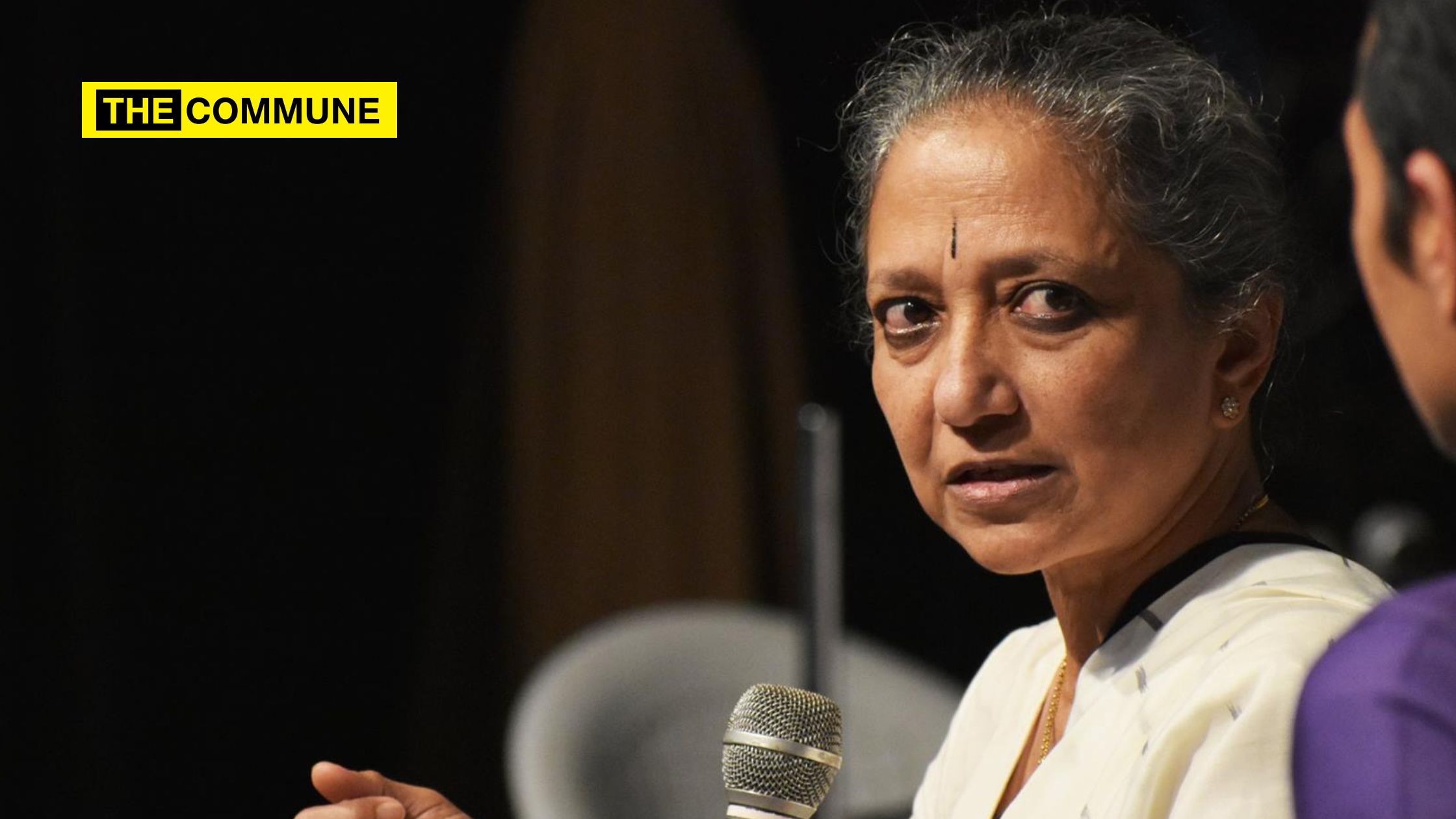
The Kalakshetra issue has subsided but most media channels did not cover a very important part of the whole issue. The complaint against former Director, Leela Samson.
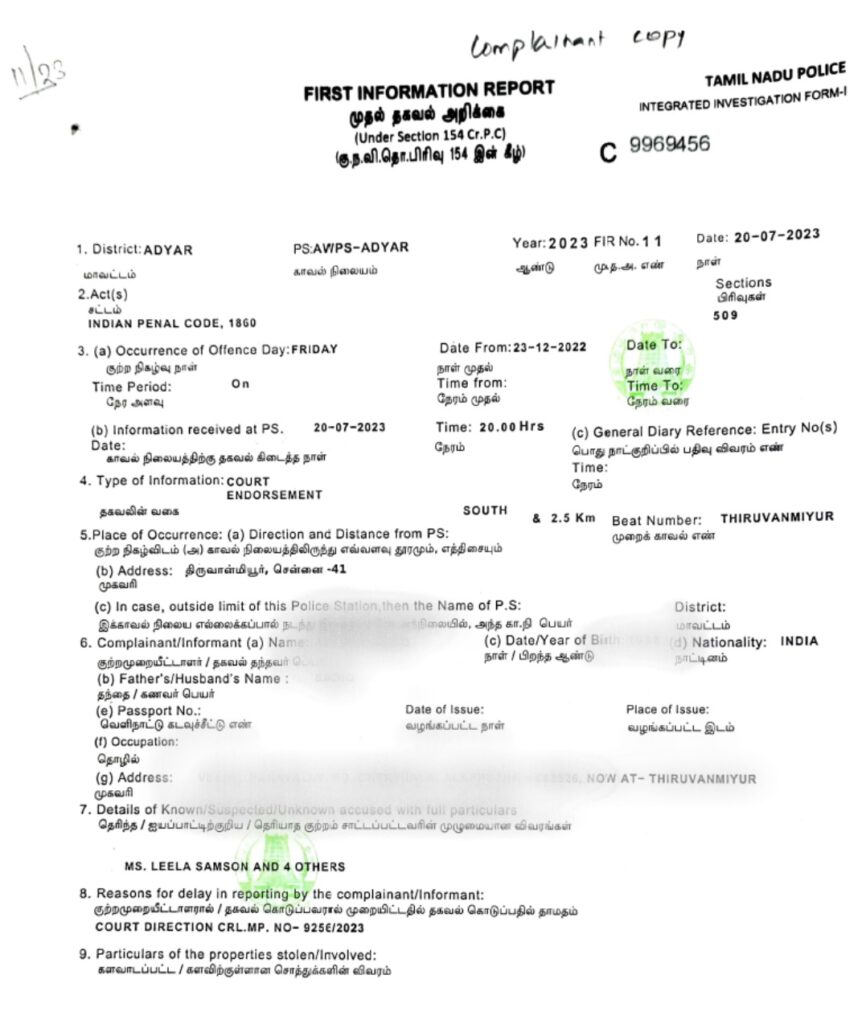
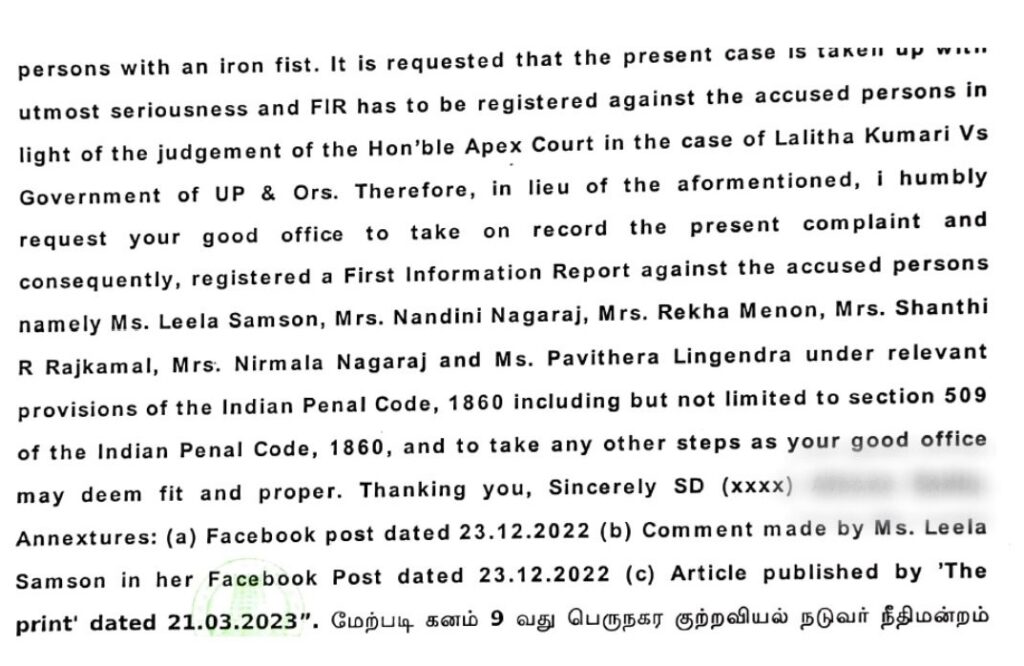
In an FIR copy that has surfaced that names Samson and 4 others, dated 20 July 2023, the complainant has accused Leela Samson of the derogatory and disparaging post made against her with the intent to insult her modesty.
The complainant was a dance intern at the Rukmini Devi College of Fine Arts (“RDCFA”) and has been associated with the institution for the past 7 years. The FIR states that the complaint pertains to the post made by Ms. Leela Samson, former director of the Kalakshetra Foundation on her Facebook profile in December 2022.
The post has been deleted but the complainant claims that it has brought ill repute to her name and upheaved her personal and academic life. She also accuses Samson of having written the post with a highly vindictive agenda.
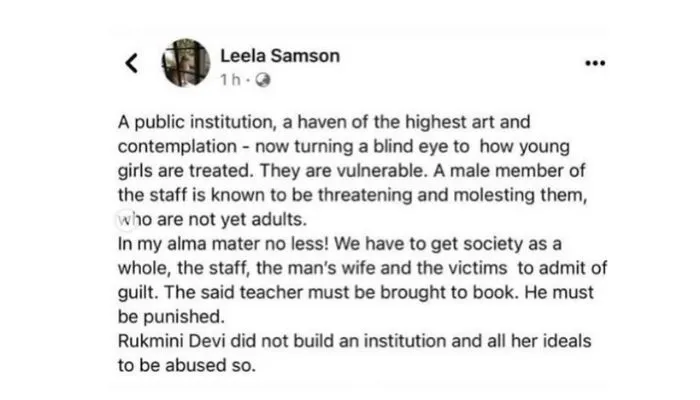
The post made by Samson alleged that a male staff member indulged in acts of sexual harassment inside the campus. The alleged male staff member mentioned therein is one Mr. Haripadman who happened to be one of the complainant’s mentors and he had trained her for years together.
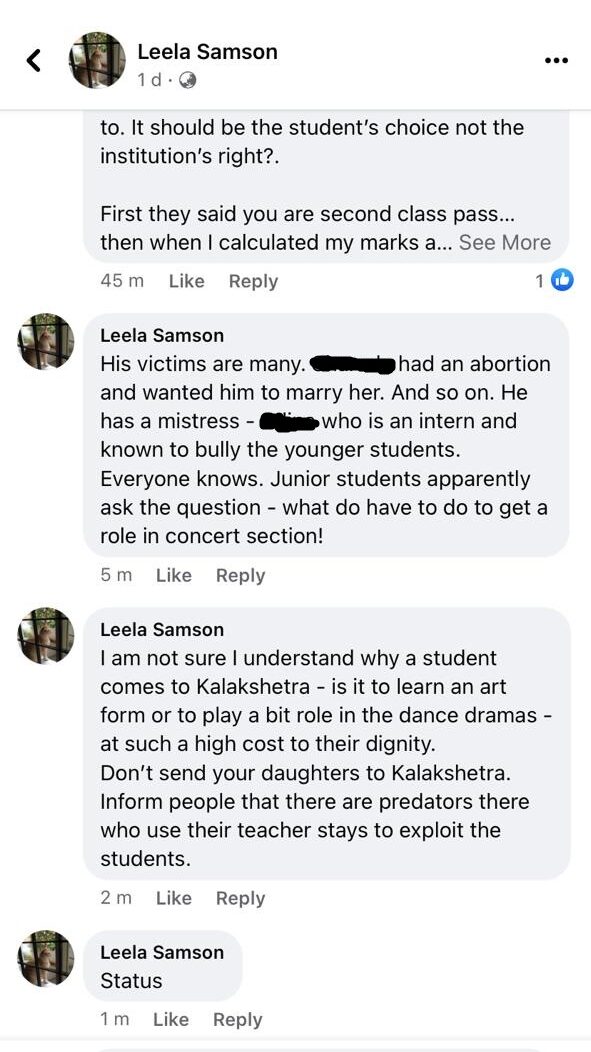
In the comments section of the now-deleted Facebook post made on 23 December 2022 by Leela Samson, the complainant says that various comments were made about the alleged misdemeanours committed by Mr. Haripadman and that what was particularly disconcerting was that her name was linked in an uncharitable manner with Mr. Haripadman in one of those comments on the Facebook post.
The comments said, “His victims are many. (Name hidden) had an abortion and wanted him to marry her. And so on. He had a mistress who is an intern – (name hidden) known to bully the younger students. Everyone knows. Junior students apparently ask the question – what do have to do to get a role in the concert section!”
The comment on the Facebook post mentions the complainant’s name (removed for anonymity), although misspelled makes an explicit reference to her and the FIR says that it has given rise to an immense upheaval of her personal and academic life. The contents of the comment, at first glance, besides being false and baseless, are patently derogatory, disparaging, and vituperative, which projects the complainant in an extremely disparaging manner, the FIR said.
The context, tone and tenor of Leela Samson’s post gives away that she had used the word “mistress” with a sexual connotation.
The reference to the complainant as a “mistress”, the FIR said, was an attack against her dignity and an affront to her modesty and as such attracts the provision of Section 509 of the Indian Penal Code, 1860.
Section 509 says, “Word, gesture or act intended to insult the modesty of a woman. Whoever, intending to insult the modesty of any woman, utters any words makes any sound or gesture, or exhibits any object, intending that such word or sound shall be heard, or that such gesture or object shall be seen, by such woman, or intrudes upon the privacy of such woman, (shall be punished with simple imprisonment for a term which may extend to three years, and also with fine).”
The complainant who felt wronged filed a complaint against Leela Samson during the Kalakshetra issue for unjustly damaging her reputation and publicly violating her dignity. The Adyar All Women Police Station, responsible for investigating the allegations against Kalakshetra Foundation and Haripadman, was also looking into the complaint against Leela Samson.
The police subsequently closed the complaint against Samson. When the complainant asked for the reason, she was informed that Samson claimed “mistress” meant “ejamaani” (in Tamil ejamaani means a feudal landlady) in the context of the intern giving tuitions to Haripadman’s son. As Samson had already removed her post, the police found her explanation “satisfactory” and decided to close the case.
— Sandhya Ravishankar (@sandhyaravishan) May 31, 2023
The FIR that has been shared with The Commune also said that the tone of the now-deleted Facebook post and the comments section indicate that they have been made only to pursue an ulterior motive of vengeance against the Foundation and the current management members, through any means necessary, even if such means were to include the outright defamation of a young student such as the complainant.
The FIR further says, accordingly, Ms. Samson has dragged the complainant’s name into this entire episode to reinforce her self-perceived narrative of deeply rooted corruption and rot in the institution. The FIR said that Samson dragged the complainant’s name without doing any prior fact-checking. The FIR also says, “Before mentioning my name in the Facebook post, it would have been prudent and proper for Ms. Leela Samson to have checked with me about the veracity or genuineness of the rumours she was supposedly hearing about me. The same was not done. There was not even a shred of truth to the allegations mentioned in the comment.”
The complainant also stated that Mr. Hari Padman had been her mentor ever since the first post-diploma year and had been on good terms with his entire family including his wife, and children and that was the reason why she visited his residence. She underscores that there was nothing more to this other than that of a mentor and student relationship.
The Kalashetra Foundation’s Internal Complaints Committee conducted an inquiry and found no truth in the allegations made in the Facebook post about the alleged relationship.
Various media houses published articles about the inquiry, which further affected the individual’s reputation. The complainant also listed the websites where her name has been mentioned with regard to the inquiry conducted by the Internal Complaints Committee of the foundation and some of these publications can be accessed in the below links.
(a) Kalashetra Chennai has a PoSH problem. Students fume, gag order imposed, art world shaken – The Print
(b) Sexual harassment allegations at Chennai’s famous Kalakshetra, college issues gag order – The News Minute
The complainant accused specific individuals, including Nandini Nagaraj, Rekha Memon, Shanthi R Rajkamal, Nirmala Nagaraj, and Pavithra Lingendra, of contributing to their mental agony by spreading rumors and treating them poorly.
The complainant expressed strong dismay at Ms. Leela Samson’s attempt to damage their hard-earned reputation among peers. The individual blames Ms. Leela Samson’s initial Facebook post for triggering the events that caused them distress and stress. She also accused specific members of the teaching staff and fellow students of actively causing discomfort in their personal and academic life.
Nandini Nagaraj: A member of the teaching staff who treated the complainant with visible disgust and disapproval based on baseless rumours, which adds to their mental agony.
Rekha Menon: Another member of the teaching staff who spread gossip about the individual and Mr. Hari Padman
Shanthi R Rajkamal: A dance tutor who made an inappropriate reference to defamatory rumours about the complainant during a public event, which further escalated her distress.
Nirmala Nagaraj: Delivered a manipulative and condescending speech, making direct references to the rumours about the complainant and Mr. Hari Padman. This intensified the mental torture they were experiencing as all fellow students started focusing on them and the rumors.
Pavithra Lingendra – A fellow student who was involved in spreading rumours and targeting their friends.
It must be noted that Leela Samson’s Facebook posts along with articles published by the likes of The News Minute had snowballed into a controversy with full fledged protests by students forcing the institution to close down temporarily. Dance teacher Haripadman, who became the main target of the protest was arrested and sent to Puzhal jail with his bail application being rejected by the Saidapet court.
He was subsequently granted bail by the Saidapet court on 6 June 2023 after the police failed to file chargesheet against him within the stipulated time.
It was only on 27 July 2023 that the police filed a chargesheet in the case.
While a few media outlets had reported about the chargesheet being filed against Hari Padman, none has yet reported about the FIR filed against Leela Samson and others individuals.
Click here to subscribe to The Commune on Telegram and get the best stories of the day delivered to you personally.
A former professor of the Jawaharlal Nehru University in Delhi, and the current Chairperson of the Centre for Economic Studies and Planning at the JNU, shared a video of a man assisting pedestrians to cross the road during the rains. She tweeted the video with the caption, “So much of “New India” with its old inequality in this video: collapsing infrastructure devastated by climate change, human ingenuity grasping any income-earning opportunity in a jobless economic context, barefoot worker serving the middle class…”
So much of "New India" with its old inequality in this video: collapsing infrastructure devastated by climate change, human ingenuity grasping any income-earning opportunity in a jobless economic context, barefoot worker serving the middle class… pic.twitter.com/wGsUCuExB9
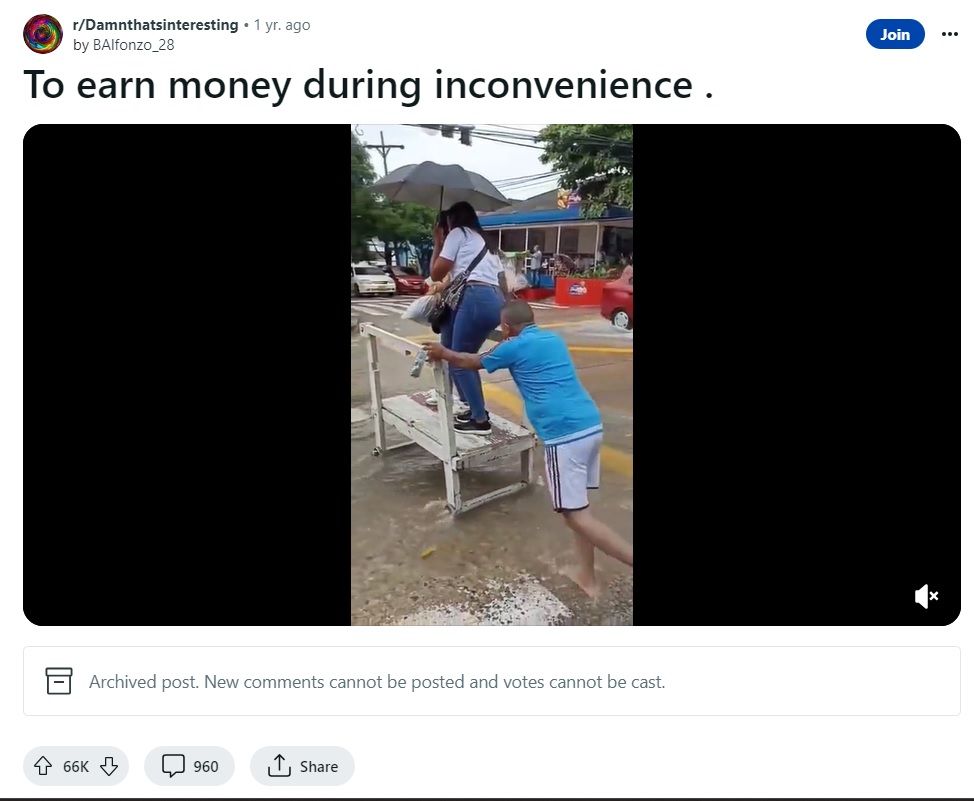
What Ms. Ghosh did not realise was that this video is not even from India and not a recent one as well. The video was reportedly taken in Barranquilla, Colombia, and gained attention as a viral video on Reddit last year. In the footage, a man is seen using a makeshift push cart to assist pedestrians in crossing a flooded road, and he accepts payment for his service.
Source: Reddit
In the video, a man wearing a blue t-shirt and going barefoot is shown collecting money from two pedestrians to help them cross a rainy, flooded street. He places the cash in a bottle and then proceeds to move a wooden cart, which already has two people on board, to the other side of the road. The video captures people patiently waiting for their turn to be assisted by the man’s wooden cart as he continues to ferry them across the street. Despite the challenging conditions, the man remains barefoot while performing his service. Throughout the footage, several automobiles can be seen navigating the flooded roadway.
Netizens found it amusing to observe how individuals who claim to be intellectuals from institutions like JNU and hold teaching positions at foreign universities, recognized as esteemed economists with numerous awards and international positions, can readily share content without verifying its accuracy.
Meet Jayti Ghosh. She is proffer at JNU and one of the supporter of terrorist Afzal Guru.
She is considered a great economist and the international ecosystem has given her so many awards and positions.
That’s why she is sharing fake news with a video from another country and… https://t.co/UVM1mkci6Z
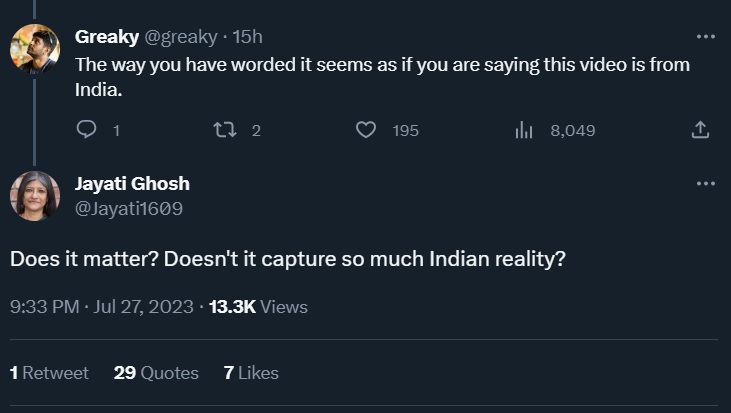
When a Twitter user pointed out the mistake, Ms. Ghosh was quick to reply, “Does it matter? Doesn’t it capture so much Indian reality?”
Jayati Ghosh criticised the Indian government in February 2016 for suppressing the student protests to commemorate the capital punishment sentence given to Afzal Guru. Her name along with that of Sitaram Yechury and Yogendra Yadav were allegedly mentioned as co-conspirators in the supplementary chargesheet in the Delhi riots case.
Click here to subscribe to The Commune on Telegram and get the best stories of the day delivered to you personally.
In a recent speech at a ‘Save Manipur’ campaign organized by the Left Democratic Front (LDF) in Kannur district, senior Communist Party of India (Marxist) (CPI(M)) leader P Jayarajan issued death threats directed at the Kerala unit of BJP and its youth wing, Yuva Morcha.
Shamseer, the MLA from Thalassery constituency representing CPI(M) and the Speaker of the Kerala Assembly, stirred controversy while speaking at the inauguration of the ‘Vidya Jyothi project’ in Kunnathunad constituency, Ernakulam district. During his speech, he referred to Hindu gods like ‘Ganapati’ and the ‘Pushpaka vimana’ associated with Ravana as mythical concepts lacking scientific evidence. Shamseer also suggested that in the era of artificial intelligence, such ideas should be discarded as myths.
Addressing the crowd, Jayarajan warned that any Yuva Morcha member who dared to oppose AN Shamseer, would meet a grim fate, with their place being in the mortuary. The ominous words from the influential CPI(M) leader did not go unnoticed, as the BJP quickly responded by filing a police complaint against Jayarajan for his inflammatory statements.
Two days prior, K Ganesh, the Kerala state secretary of Yuva Morcha, allegedly made a menacing statement during a protest held against Speaker AN Shamseer. He suggested that Shamseer may have made derogatory comments about Hindus, implying that Shamseer believed he would not suffer a fate like TJ Joseph, whose hand was brutally chopped off by Islamic extremists on accusations of blasphemy.
In response to Jayarajan’s intimidating speech, BJP Kerala president K Surendran demanded that the police register a case against the CPI(M) leader for issuing a death threat. He also called for Jayarajan’s removal from the post of Khadi Board chairman, citing his alleged involvement in multiple murder cases and accusing him of attempting to disrupt peace.
Reacting to the threats, Yuva Morcha state president CR Praful Krishna asserted that their organization would not be intimidated. He accused Jayarajan of playing to the gallery, attempting to appease party members and Islamists with his provocative speeches.
BJP and Yuva Morcha have declared their intention to persist with their protest against Speaker Shamseer over his alleged derogatory remarks about Hindus. Surendran asserted that the government’s lack of action regarding Shamseer’s comments emboldened Muslim League volunteers to raise anti-Hindu slogans. “If appropriate action had been taken against Shamseer,” Surendran remarked, “the members of the Muslim League would not have dared to speak in such a manner.”
Click here to subscribe to The Commune on Telegram and get the best stories of the day delivered to you personally.
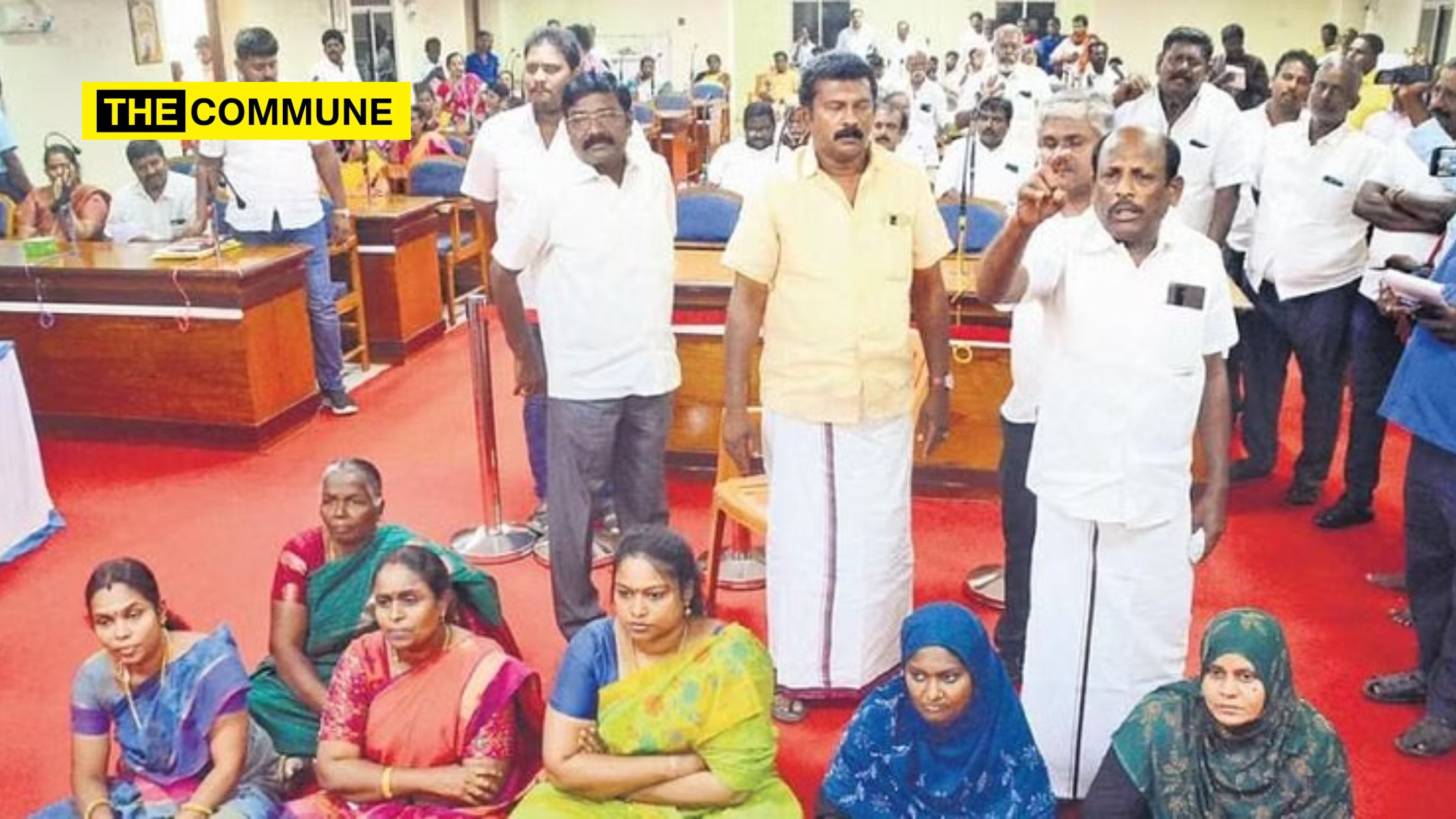
During the council meeting on Thursday, 27 July 2023, some women councillors of the Dravida Munnetra Kazhagam (DMK) from Tirunelveli Corporation held a protest, claiming that former Minister TPM Mohideen Khan, who is also the party’s Tirunelveli central district unit in-charge, had threatened their lives.
Few DMK women councillors of Tirunelveli Corporation alleged that the DMK district in-charge & former Minister TPM Mohideen Khan posed a life threat to them and protested during the council meeting pic.twitter.com/IbH9lNDyTE
At the beginning of the meeting, Tirunelveli Zone’s Chairperson, Maheshwari, made a direct accusation against Mr. Khan, alleging that he had threatened her life. In this video above, you can see, she says, “The district in charge gave us death threats, how is this fair?”
The alleged threat occurred in relation to the selection of candidates for the Corporation’s taxation appellate committee election, which took place on Thursday. According to Maheshwari, Mr. Khan issued the threat while both the Mayor and the Deputy Mayor, K.R. Raju, were present, but they did not respond to the situation.
The ladies were asked her not to discuss party-related matters and asked her to put forth any issues related to her ward.
To this, the lady councillor said, “So are we not important? Can you speak like this by calling only the Corporation Chairman?”
The lady councillor continued, ” There are 55 of us, who is he going to kill?”
The Mayor replied, “The election was transparent and all of you voted in the elections.”
Following the election of nine members to the taxation appeal committee, Mayor PM Saravanan and Commissioner V Sivakrishnamurthy presided over the council meeting. However, during the meeting, six councillors sat on the floor and insisted on receiving an explanation from the mayor. The Mayor kept repeating that they should only discuss ward-related matters and these were unnecessary issues to be discussed.
Despite Commissioner Sivakrishnamurthy’s efforts to calm the situation, the councillors remained unsatisfied. As a result, both the mayor and the commissioner left the meeting briefly but later returned after some time.
The internal conflicts within the ruling DMK party spilled over into the Corporation Council meeting, where these councillors sat on the floor in front of Mayor P.M. Saravanan to make their accusations.
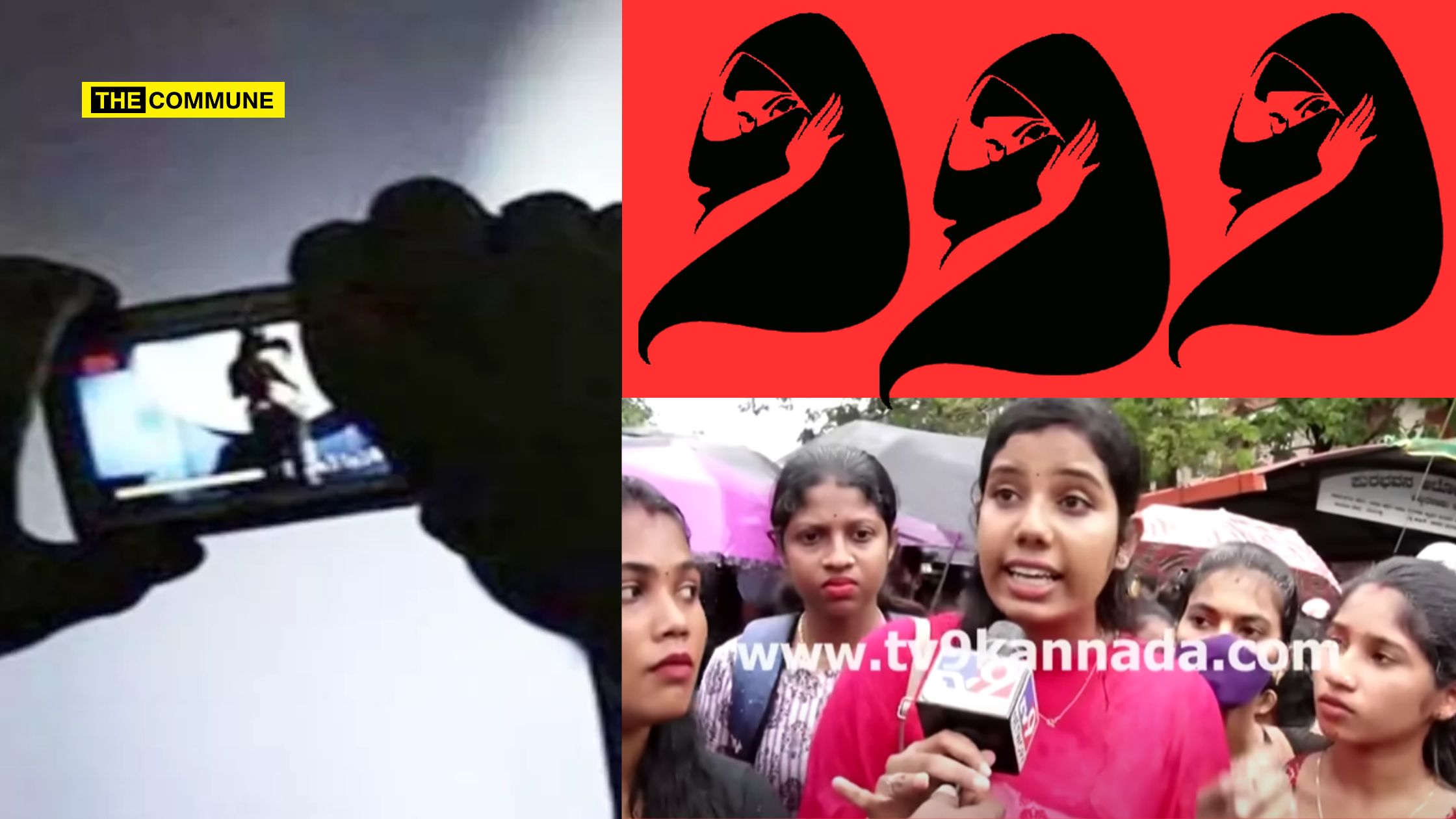
Students of Netra Jyoti College in Udupi have come forward with shocking revelations about the bathroom video case. In an interview with TV9 Kannada, a student disclosed that Muslim women had been secretly recording videos of Hindu girls for over a year and sharing them with Muslim boys. The college management was allegedly aware of the situation but did not take any action until the recent incident came to light. The administrator of the college reportedly trivialized the issue by giving the Muslim girls a ‘simple punishment’.
“After capturing videos on their mobile phones, the Muslim girls exchanged the phones with their male friends, who waited in a car outside the college during the afternoon lunch hour. Despite bringing this to the attention of the college management, no action was taken. The victim reported the matter to the management on the 18th, but they didn’t take it seriously. When we became aware of it on the 20th, we immediately protested. The mobile phones were exchanged by the three Muslim girls with Muslim guys from Ucchila, arriving on Pulsar bikes and cars. The names of the three Muslim girls involved are Shafa, Alfiya, and Shabnaz.”, a student of the college told TV9 Kannada.
The student also tells that one Abdul Khader serves as the college administrator and upon coming to know of the incident, he had apparently given a “thoughtful response to the three Muslim girls” by instructing them to write five times that they will not engage in such behavior again.
“He asserted that the actions of the three Muslim girls were merely a joke and should not be considered seriously. However, we question whether a similar situation, like someone secretly filming their family’s women in their home restroom, would be dismissed with such leniency and merely given a homework assignment as punishment. This had occurred six months ago as well, but the college management chose to close the matter without conducting any investigation. The videos were being shared with Muslim men from Ucchila.”, the student further added.
All College Student Power (ACSP), a Karnataka-based organization, penned a letter to the Superintendent of Police, Udupi district, on July 21st, addressing a concerning crime at Netra Jyoti College. The incident involved three female students from the Muslim community secretly filming Hindu female students and sharing the videos through mobile phones. According to the ACSP’s letter, the students at Netra Jyoti College became aware of the situation on July 20th and expressed their protest against it.
The three students along with the college management board have been booked under Sections 509 (intending to insult the modesty of a woman), 175 (intentionally omitting to produce a document), 204 (destroys any document or electronic record), and 34 (common intention) of the Indian Penal Code (IPC), and Section 66E (captures, publishes or transmits the image of the private area of any person) of the Information Technology Act.
It is noteworthy to mention that leftist media outlets like The New Minute brushed off this incident as an instance of ‘bullying’ and stated that the video was promptly deleted upon the victim’s confrontation. According to the article, the girls involved defend their actions as a mere “prank”.
Click here to subscribe to The Commune on Telegram and get the best stories of the day delivered to you personally.
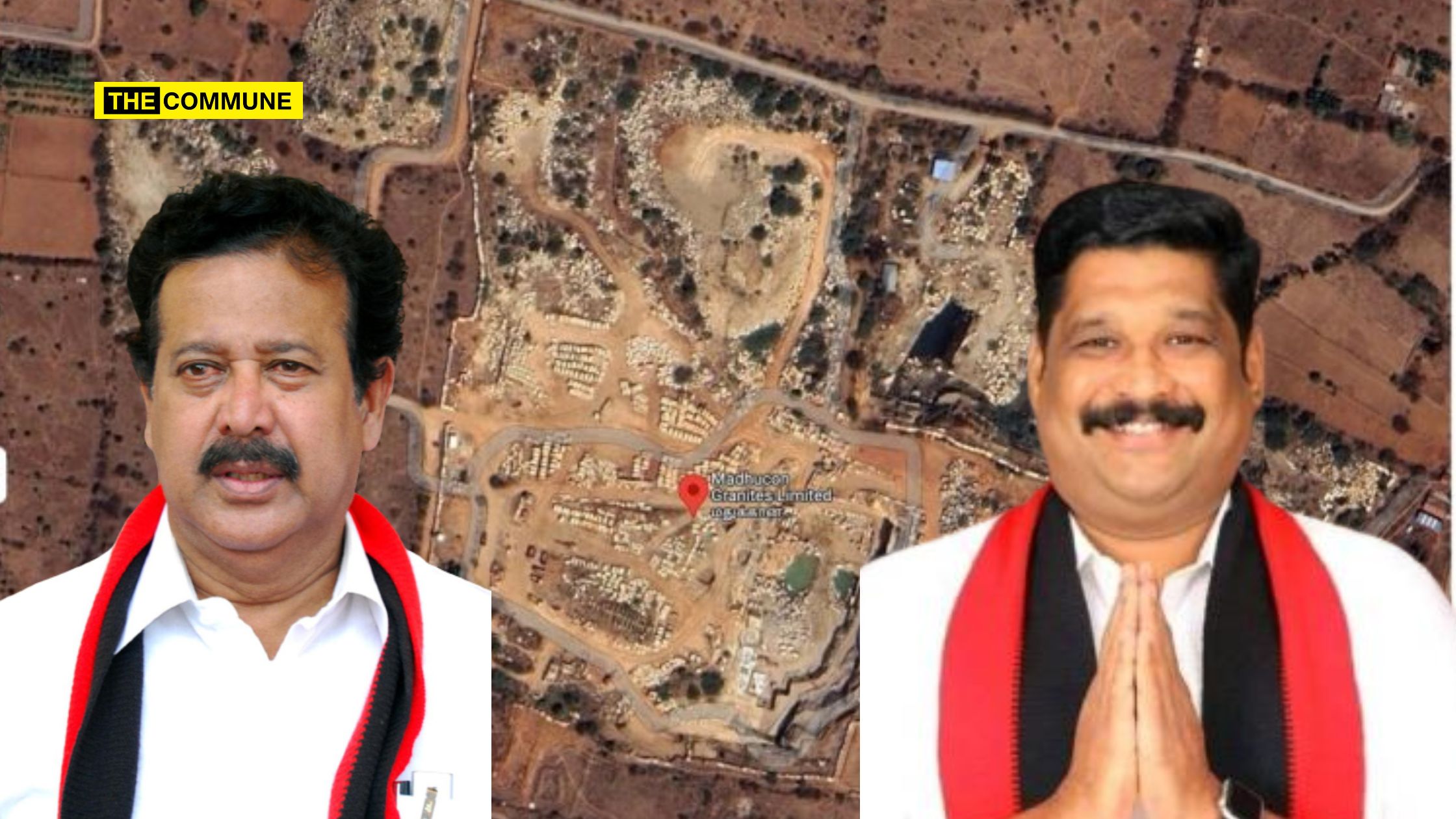
In a bombshell video released on his YouTube channel, prominent political commentator Maridhas has shed light on the alleged instances of corruption by DMK Minister Ponmudi and his MP son, Gautham Sigamani, both of whom are under the Enforcement Directorate’s (ED) scanner.
Both Ponmudi and his son were grilled overnight by the ED officials, in connection with a money laundering case linked to an alleged illegal sand mining.
Illegal Mining Of Red Sand
அமைச்சர் பொன்முடி அவர் மகன்கள் மருமகள்கள் என மொத்த குடும்பத்தையும் சிறையில் அடைக்க வேண்டும். அத்தோடு இவர்கள் கூட்டாக இந்த கொள்ளை அடித்துச் சேர்த்த அனைத்து சொத்துகளும் அரசு கையகப்படுத்த வேண்டும்! ஏன் முழு விவரம் இங்கே -> (1/18) pic.twitter.com/wiFrhBmuPM
The core of the investigation revolves around accusations of illegal mining of red sand without paying the mandatory seigniorage fee during Ponmudi’s tenure as the Minister of Mines and Minerals from 2007 to 2011. Reportedly, this alleged illicit activity resulted in a staggering loss of ₹28.36 crores to the Tamil Nadu Government. Ponmudi now finds himself grappling with charges of abusing and misusing his powers while holding the ministerial position.
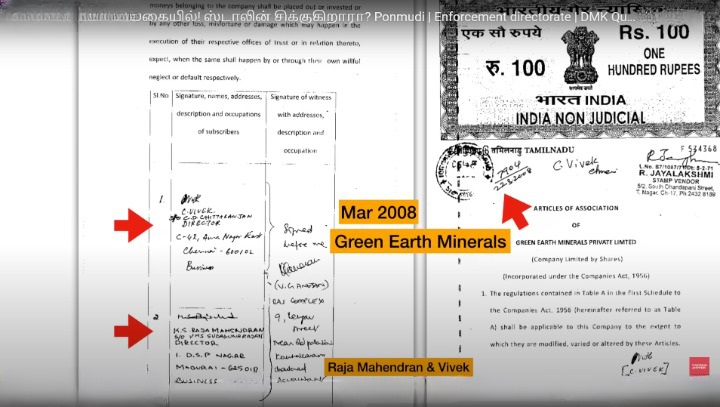
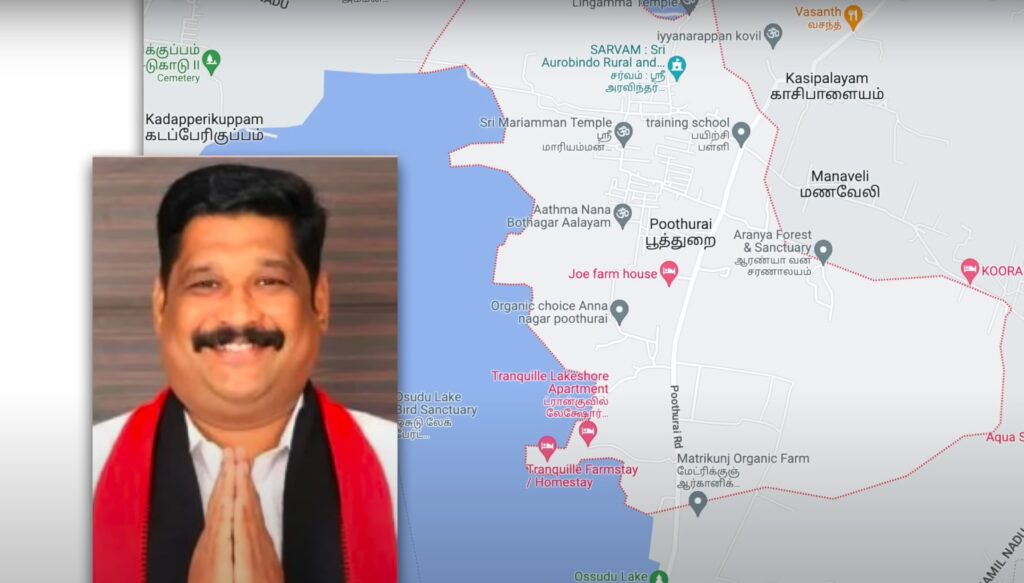
Maridhas in his video shares that the Green Earth Minerals company gained its first mention in a First Information Report (FIR) filed regarding the alleged scrapping of red soil, a valuable mineral resource, in the village of Poothurai. According to this screengrab, the firm was established on 22 March 2008 by two people named Vivek and Raja Mahendran.
Screengrab of Maridhas Answers Video
The FIR, filed in 2012, accused Minister Ponmudi’s son, Gautham Sigamani, and several others associated with them of conducting this scrapping operation without paying the appropriate fees to the government for nearly 60,000-70,000 lorry loads of resources.
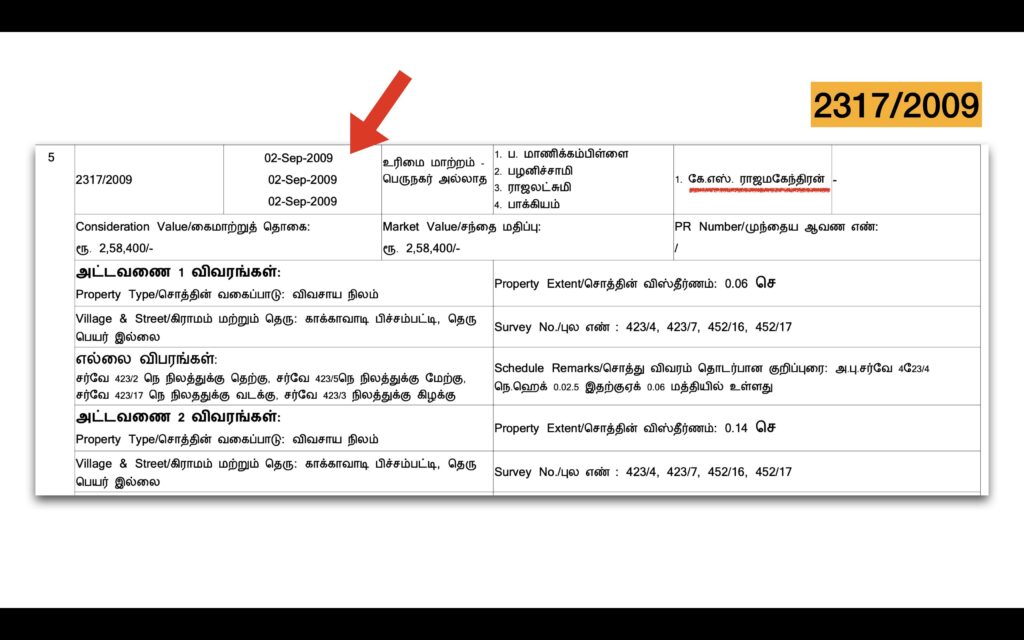
Screengrab of Maridhas Answers Video
However, it should be noted that the current video released by Maridhas does not pertain to the Poothurai village but involves another village, K Pichampatti, in the Karur district. The Tamil Nadu ministry reportedly discovered the presence of granite in the area, and it is alleged that a scam unfolded under Ponmudi’s watch.
Maridhas has accused Ponmudi of being involved in the illegal scrapping of granite from the abundant areas in K Pichampatti, along with some known associates. Interestingly, the land where the granite is abundant has been registered under the name of Raja Mahendran, who is connected to the founder of Green Earth Minerals company. Gautham Sigamani, the son of Minister Ponmudi, is also linked to this company.
As per the available information, Raja Mahendran acquired this land in September 2009 from 16 individuals, further connecting him to the alleged illegal mining operation.
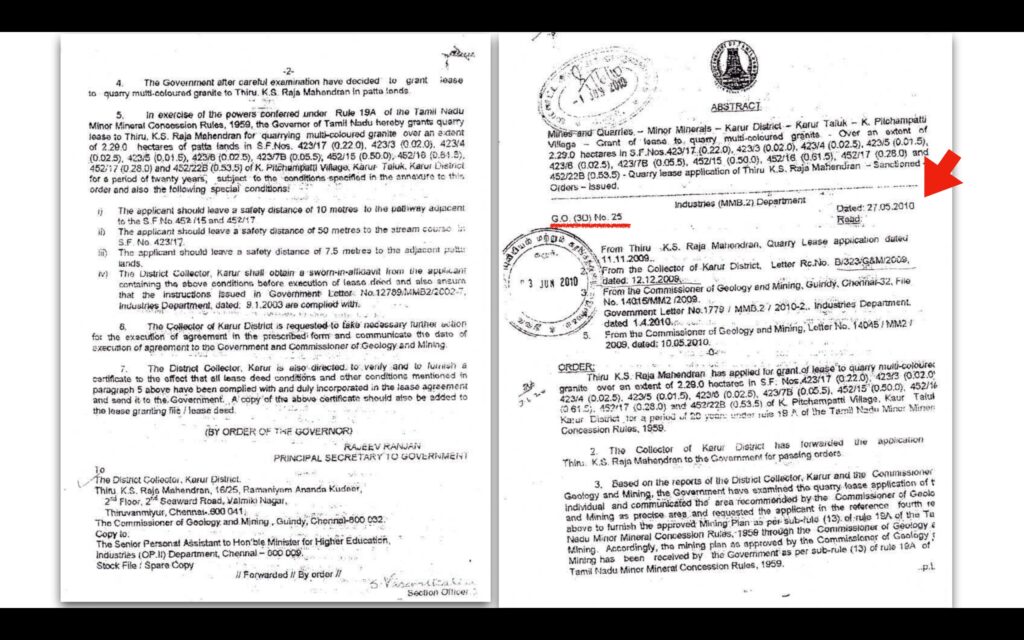
Maridhas has released a third document that appears to shed further light on the alleged granite scam involving Minister Ponmudi and his associates. The document in question is a Government Order (GO) released in November 2009 when Ponmudi held the position of Minister.
According to Maridhas, this GO holds significant importance as it comes just two months after the transfer of land ownership to Raja Mahendran, a person linked to the founder of Green Earth Minerals company, and also reportedly connected to Ponmudi’s son, Gautham Sigamani.
The GO states that Raja Mahendran was granted permission to cut granites from a 6-acre area, with a depth of up to 90 feet. What raises suspicion is the duration of the permission, which extends from 2010 to 2030. The timeline of events, along with the absence of a public tender for the valuable granite-rich land areas identified by the government, indicates potential foul play in the process.
The lack of a transparent bidding process and the timing of the permission raise questions about the fairness and legality of the decision. Maridhas’ allegations point to the possibility of cronyism and misuse of power, with the GO potentially serving as crucial evidence to establish a connection between Ponmudi and the alleged illegal mining operations.
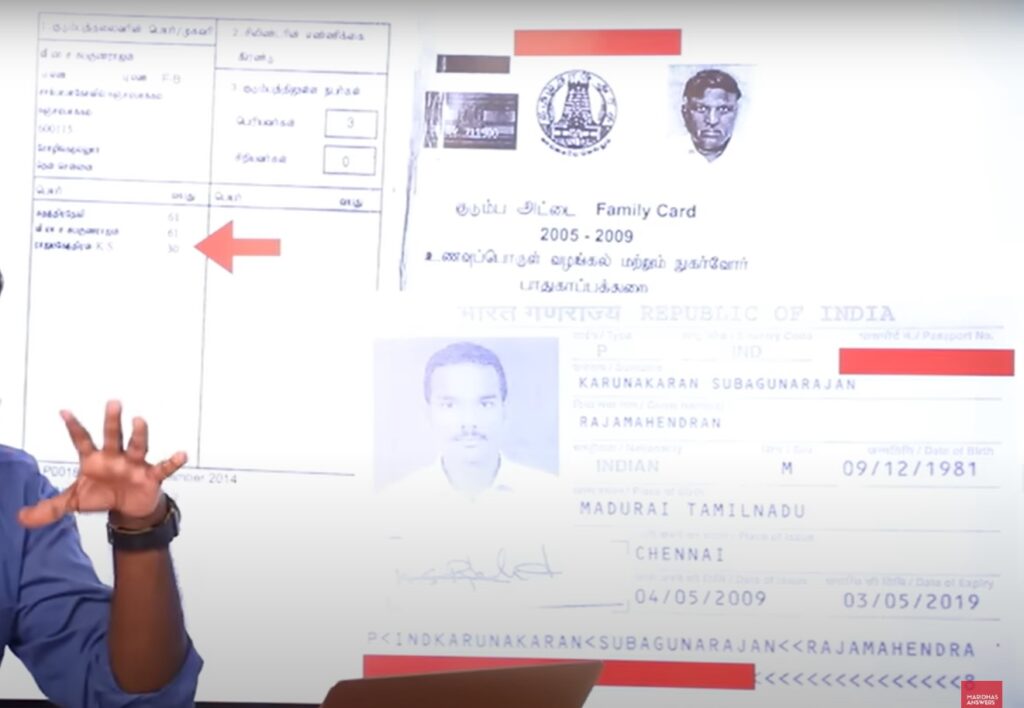
Maridhas has brought to light concerning information about Raja Mahendran, the individual granted permission to extract granite from the 6-acre area in K Pichampatti. Maridhas highlights that at the time of the GO issuance in November 2009, Raja Mahendran was just 27 years old, and seemingly lacking significant experience in the mining sector.
This revelation raises serious doubts about Raja Mahendran’s ability to carry out such an extensive scam single-handedly. Considering the complexities and challenges involved in large-scale granite extraction, it appears implausible for an inexperienced individual to orchestrate the entire operation alone.
Maridhas has aptly pointed out that the alleged involvement of big mineral companies or influential players in the mining sector may be a crucial factor in enabling Raja Mahendran to conduct the scam. The suspicion of a possible collusion between Raja Mahendran and powerful entities further adds weight to the accusations of corruption and misuse of power in this case.
Screengrab of Maridhas Answers Video
The question of who may have been aiding Raja Mahendran in this operation becomes a pivotal aspect of the investigation.
Maridhas’ ongoing investigation into the granite scam has uncovered a potential connection between Madhucon Granites Limited, based in Andhra Pradesh, and the controversial activities in K Pichampatti. Maridhas has raised suspicions about the involvement of DMK in this matter.
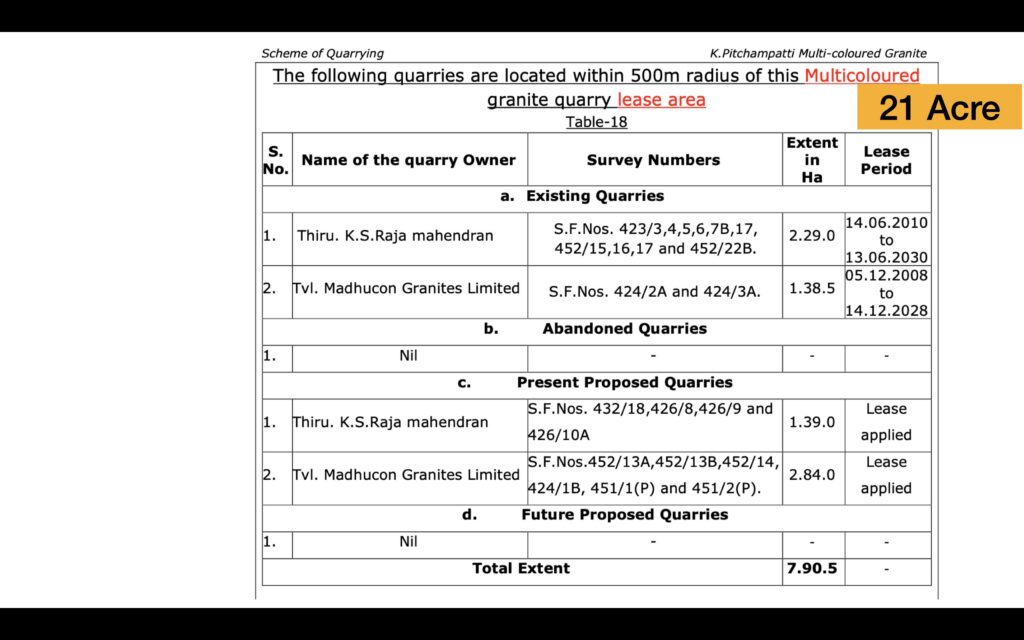
Maridhas released documents that provide evidence of Raja Mahendran’s and Madhucon Granites Limited’s land acquisitions in the same area where the granite scam is alleged to have taken place. The survey numbers mentioned in the documents link both entities to the area in question.
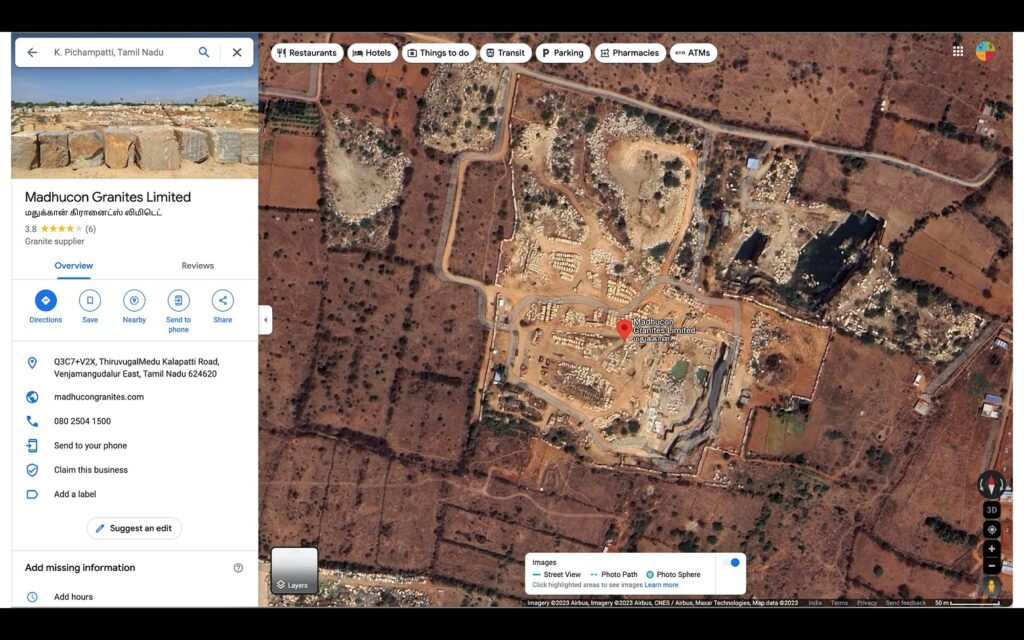
Madhucon Granites Limited boasts a significant 37-year experience in granite quarrying, and it has a quarry on Google Maps covering around 34 acres. However, it is intriguing to note that the government has only permitted a much smaller area of 6 to 7 acres for granite extraction.
The fact that Madhucon Granites Limited acquired land in the same area around the same time that Green Earth Minerals Company was established raises serious suspicions. The timing and proximity of these activities strongly suggest a potential connection between the two entities and the alleged scam.
In a powerful conclusion to his video, Maridhas has appealed to the Enforcement Directorate (ED) to thoroughly investigate the suspicious activities of Madhucon Granites Limited in connection with the alleged granite scam involving Minister Ponmudi and his son, Gautham Sigamani.
Maridhas’ investigation and the documents he released have raised significant concerns about the involvement of Madhucon Granites Limited in the procurement of granite from the same area where the alleged scam took place. The stark difference between the size of the government-permitted area and the extent of Madhucon’s quarry on Google Maps has added weight to the suspicions.
Recently in Puducherry, Chanakyaa Network’s CEO Rangaraj Pandey hosted a debate on the Uniform Civil Code (UCC). The panelists included Mohan Kumaramangalam from the Congress and SP Udayakumar, also known as ‘Kudankulam’ Udayakumar, who argued against the idea that the UCC had a political agenda behind it. On the other side, Professor Rama Sreenivasan and public speaker Manikandan supported the topic, asserting that the Uniform Civil Code was crucial and necessary for the country.
SP Udayakumar spearheaded the Kudankulam Nuclear Power Plant protests during UPA regime in 2012. He was referred to as a protestor who was funded by foreign agencies to carry out protests against the nuclear power plant by former Prime Minister Manmohan Singh.
SP Udayakumar in his speech which lasted about 30 minutes claimed many falsities.
that the UCC will ensure minorities like Muslims and Christians live life as second-class citizens, that they will be enslaved
that Varanasi will be the capital of India
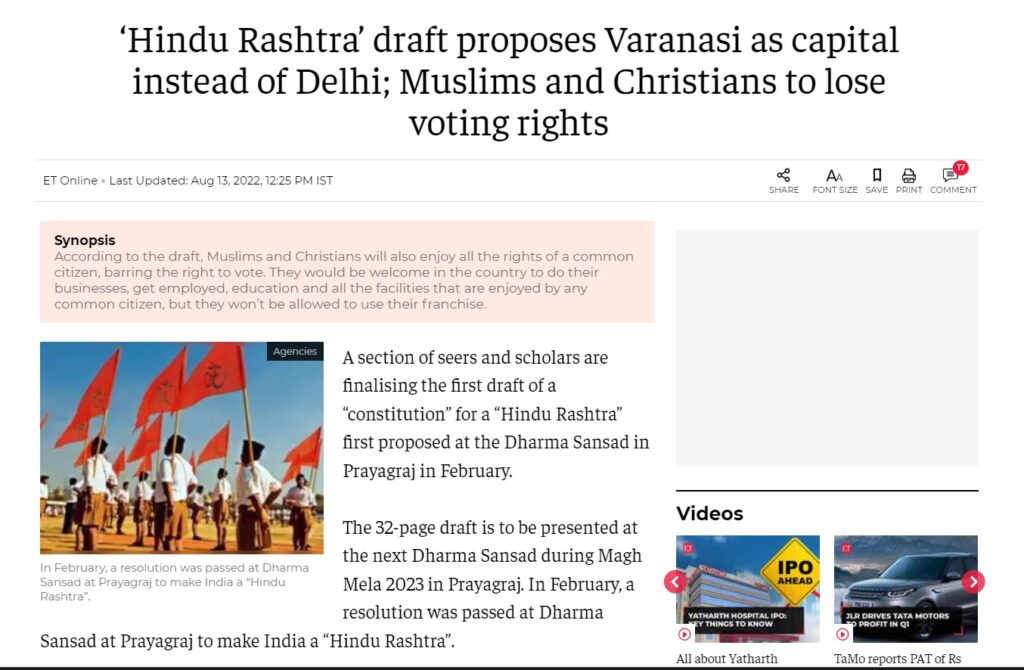
When the mediator, Rangaraj Pandey asked him who said so or where he had read about minorities having to live life as second-class, he claimed it was published in an English newspaper and would share the link with Pandey. The link that was shared with him turned out to be an article in the Economic Times about a draft proposed by several Hindu seers and scholars with respect to a “Hindu Rashtra”.
Source: ET
Udayakumar read the Hindu Rashtra draft and confused it for the UCC draft. No one (no layman) has seen or has access to the draft of the UCC as of today.
None of the representatives from the government have ever mentioned anything about shifting the capital city from New Delhi to Varanasi.
On Marriage
He claimed that the UCC will dictate who can marry whom and that UCC will also decide who receives the inheritance in a family.
On Hinduism
He continued saying that Hindus were not a united set of people, they were divided by castes and separated by Varnas. To this mediator, Rangaraj Pandey asked if he can call the people of Puducherry as Tamilians. Stumped, Udayakumar said Puducherry also had French citizens so he could not address everyone as Tamilians. Pandey responded saying that there are Anglo Indians living in Tamil Nadu so how could he call everyone living in Tamil Nadu as Tamilians but refuse to call people of Puducherry as Tamilians just because it was separated from Tamil Nadu. Dumbfounded, Udayakumar could not give a response to that. Pandey went on to clarify why he gave that example – he said that just because Puducherry is not in Tamil Nadu, we cannot not call them Tamilians. Extrapolating this to Hinduism, he said that even if there are dozens of sects in Hinduism, it is not separatism.
On Veer Savarkar
Udayakumar in his speech quoted Veer Savarkar as having stated “Ek Dev Ek Desh Ek Bhasha Ek Jaati Ek Jeeva Ek Aasha”. When mediator Rangaraj Pandey pointed out that he has mentioned Savarkar as having said Ek Jaati, Udayakumar refutes it saying he meant one race. He continued to say that he had a problem with this “ek” – same for all and that it will not work in a country like India.
On Various “Hindu” Ideology Parties Trying To Get UCC Implemented
Udayakumar stated that since independence, the Hindu leaders have been trying to indicate their true intentions of getting a Uniform Civil Code implemented in the country. He lists that in 1947, the Ram Rajya Parishad founded by Swami Karpatri, in its manifesto talks of establishing Ram Rajya in India, providing army training for the youth, repealing the anti-shastric Hindu code bill. Udayakumar claimed that the Parishad wanted to retain casteist society and rules. The Hindu code bill was about polygamy, divorce, inheritance, guardianship and made mixed marriages possible. Since the Ram Rajya Parishad was against the Hindu Code Bill, he said that they were casteist.
The Jan Sangh had also mentioned the UCC in their manifesto in 1967, he said.
He then said that the Bharatiya Janata Party was formed in 1980 and that the Jan Sangh merged with it as well. He says it has been on the party’s manifesto since then. He also pointed out that along with the implementation of the UCC, abrogation of Article 370,renaming Minorities Commission as Human Rights Commission and building Ram Mandir in Ayodhya has been the longterm aim of the BJP.
He also claimed that in 2020, a private member bill for the implementation of UCC was put forth by BJP member Kirodi Lal Meena in the Rajya Sabha, and that this was a very calculated move by the party. He claims that the introduction of UCC in Uttarakhand by Chief Minister Dhami and in Himachal Pradesh are also calculated moves of the government.
UCC – A Mode To Threaten Minorities
He claimed that the implementation of the UCC will enslave the minorities and threaten their existence.
Udayakumar claimed that the leaders following the Hindu ideology spread misinformation and fear mongering among unsuspecting citizens that since Muslim men can indulge in polygamy, they can beget many more children than Hindus can and thus increase their population. The result would be, he said, a change in demography wherein the Muslims would become the majority population and Hindus will become a minority and that the Muslims will divide the country further following Jinnah’s two nation theory.
He also said that minorities, especially Muslims have lost their peace of mind, they are scared, they are worried that if this Kaatu Aatchi (regressive rule) continued, what could happen in the country going forward.
UCC As A Tool To Cover Up Failures
He claimed that since the RSS was going to celebrate its 100th anniversary in 2025 and that since the elections were just around the corner, the Bharatiya Janata Party (BJP) having nothing to showcase as achievements wanted to bring in the UCC to prove a point.
He claimed that inflation was at its highest and that unemployment was rampant across the country. Contrarily, it is a well-known fact that inflation in India can be attributed to various external factors such as Corona pandemic, Russia-Ukraine war and over the past decade, the inflation is averaging at about 6% over the past decade. In June 2023, it was at around 4%.
Unemployment rate in India decreased to 7.70% in May from 8.10% in April 2023.
Udayakumar also claimed that the rupee was diminishing in value and that small businesses are suffering while only a few select businessmen are enjoying success. He also said that people are suffering every single day.
Bharat Mata Ki Jai
There were sporadic chants of the phrase Bharat Mata ki Jai which irked Udayakumar and he said that in the past 9 years, this is the biggest achievement of the BJP government – to make people chant Bharat Mata ki Jai.
In total, he said that unity is different from uniformity and that a diverse country like India must not be made “uniform”. Udayakumar based his whole argument at the event on a misunderstanding and misreading of a news article.
Click here to subscribe to The Commune on Telegram and get the best stories of the day delivered to you personally.
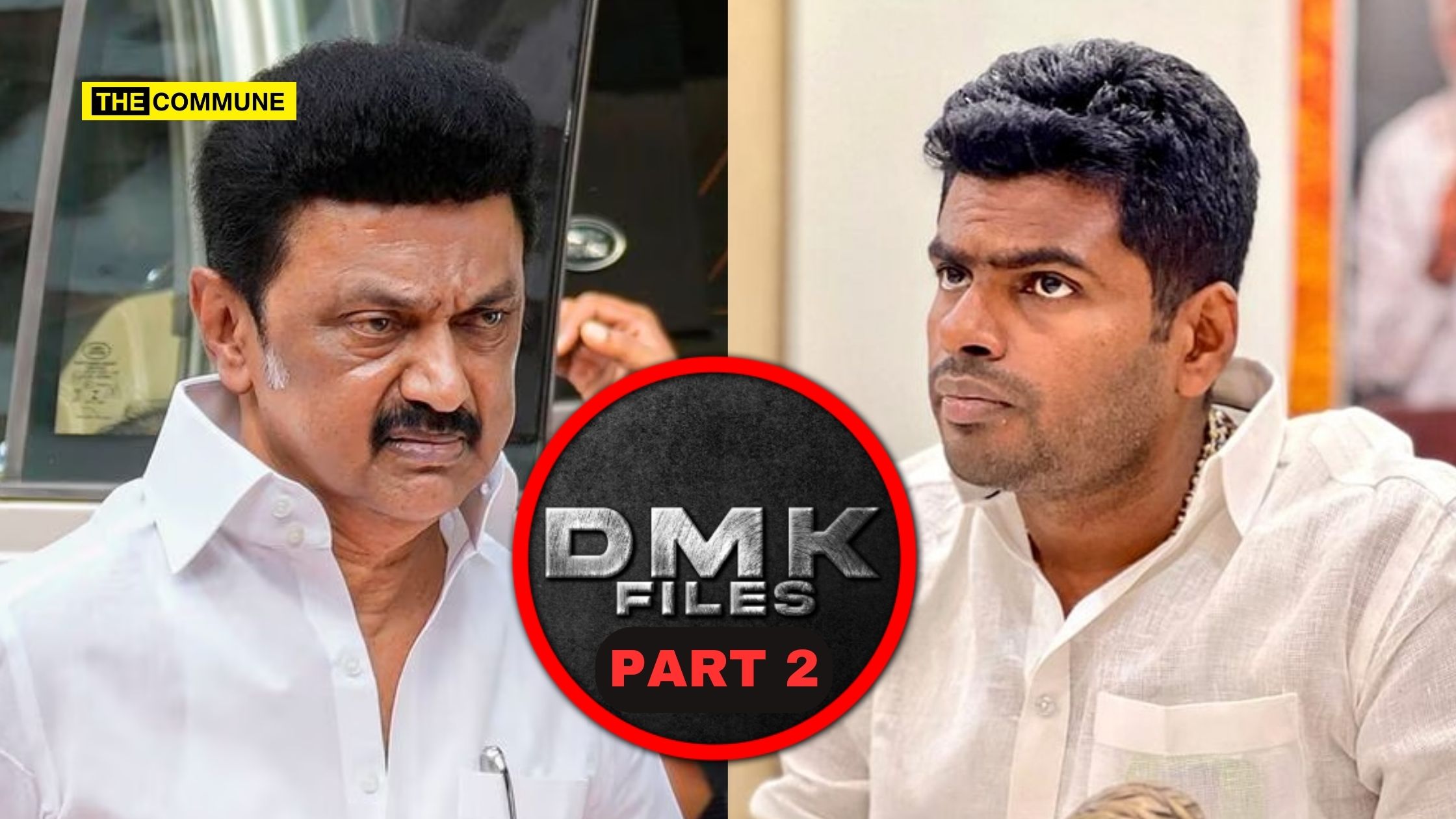
The much-awaited second part of DMK Files was released by Tamil Nadu BJP President K. Annamalai on 26 July 2023.
Earlier in the day, the BJP Tamil Nadu President along with a few members of the party met Tamil Nadu Governor RN Ravi and presented the documents detailing the alleged instances of corruption by DMK leaders and their benamis.
“We presented a memorandum seeking his excellency’s intervention & suitable action concerning Part 2 of DMK files with documents on Benami connected to the DMK Ministers/MLAs/MPs & the first family & 3 scams for a value of ₹5600 Crores,” Annamalai said.
Today, along with the Senior leaders of @BJP4TamilNadu, we had the opportunity to meet our Hon Governor of TN, Thiru RN Ravi avl.
We presented a memorandum seeking his excellency’s intervention & suitable action concerning Part 2 of DMK files with documents on Benami connected… pic.twitter.com/QJv7DHdkk3
Annamalai also released a 16 minute video detailing three alleged scams which includes ₹3000 Crore ETL Infrastructure Services Limited Scam, ₹2000 Transport Department Scam and ₹600 Crore Scam in Tamil Nadu Medical Service Corporation.
The video begins with the allegation that one family (hinting at Karunanidhi’s family) has accumulated assets worth several crores through corruption.
ETL Infrastructure Services Limited Scam
The Electronics Corporation of Tamil Nadu Limited (ELCOT), a public sector undertaking of the Tamil Nadu Government launched a new subsidiary company called Elnet Technologies Limited (ETL) on 16 July 1990. It was started with a share capital of ₹10 lakhs with 1 lakh shares at ₹10 per share.
“One Thiagarajan Chettiyar is made director of this new company. 1 share is allotted to him which is worth ₹10 only.”, the video says.
In 2004, ETL launches another subsidiary company called ETL Infrastructure Services Limited that focuses on building commercial spaces and IT parks.
“ETL Infrastructure Services Limited has 50,000 shares in total of which 49,000 shares were held by ETL and 1 share by Thiagarajan Chettiyar’s wife Unnamalai Thiagarajan.”, the video presentation says.
On 13 February 2004, Vivek Hariharan IAS is posted as Chairman Director and Unnamalai Thiagarajan as Executive Director.
In July 2004, the authorized capital was subsequently increased from ₹10 crores to ₹25 crores and ₹30 crores in December 2004. By the end of the financial year 2004-05, the authorized share capital was raised to ₹55 crores and ₹100 crores in FY 2005-06.
“10 crore shares worth ₹100 crores at ₹10 per share as authorized share capital gets raised to 120 crore shares worth ₹1200 crores of which 116 crore shares are ordinary shares and 4 crore shares are preference shares.”, the DMK Files 2 video claims.
Many foreign companies also invest in the new entity. In November 2006, IL&FS is allotted shares worth ₹25 crores. ETL Power Services is allotted shares worth ₹184.5 crores in August 2008. Around ₹59 crore worth shares are allotted to 4 entities linked to Thiagarajan Chettiar.
In March 2008, ETL Power Services allots 20,250,000 shares to a Singapore company called Greater India Infrastructures. In the same month, its share capital is raised from ₹25 lakhs to ₹200 crores.
In September 2008, shares of ETL Power Services worth ₹184 crores is bought by the Singapore company which thereby becomes a major shareholder of ETL Power Services.
In February 2010, ETL Infrastructure Services gets renamed as Indian Green Grid Group and subsequently gets changed to IG3 Infra Limited in July 2011. Singapore entity Greater India Infrastructures becomes an important shareholder of this entity.
Now, ETL Power Services which held shares worth ₹184.5 crores in ETL Infrastructure Services is now IG3 Infra Limited.
Unnamalai Thiagarajan who held only one share in ETL Infrastructure Services is the director of Singapore company Greater India Infrastructres which is a major shareholder in IG3 Infra Limited.
Through these complex transactions, the company ETL Infrastructure Services comes under the control of Thiagarajan Chettiar and Unnamalai Thiagarajan.
Aathmika Holdings
This company is said to be a shell company of Thiagarajan Chettiar’s family formed with an investment of ₹1 lakh. However, this company holds 11.23% of the shares in multi-crore company IG3 Infra Limited. The Singapore-company Greater India Infrastructures has transferred all its ETL Power Services shares to Aathmika Holdings.
In November 2020, tax sleuths raid IG3 Infra Limited. As per the income tax authorities, IG3 Infra Limited (previously known as Indian Green Grid Group Limited), a publicly incorporated company established in February 2004 and owning the Chennai One IT Special Economic Zone (SEZ), has been found to conceal foreign income amounting to ₹200 crore. This income, received through share subscriptions, is subject to taxation in India for the shareholders involved.
The search revealed that the group recently obtained five shell companies, which were employed to divert a substantial sum of ₹337 crore from the main group company through the issuance of fraudulent invoices and without conducting any legitimate business through these entities. All the investments were transferred to Aathmika Holdings.
The New Indian Express had reported that the income tax department had initiated proceedings against IG3 Infra Limited under Black Money Act, 2015 for not disclosing foreign assets or beneficial interest in the financial assets schedule of the income tax returns.
ETL which held 99% of the shares in ETL Infrastructure Services in 1990 holds just 0.57% of shares as of today.
It is worth noting that ETL Infrastructure Services was started by a government company ETL. Annamalai’s DMK Files alleges that between 2006 and 2011 when the DMK was in power, the company was fully privatized by Thiagarajan Chettiar and his family who were minor shareholders, through a labyrinth of shell companies.
In 2008, when C. Umashankar IAS who was the head of the ETL then tried to find how a ETL Infrastructure Services, a government company got converted into a private company he was shunted out. He had also tried to find about what happened to the 26 acres of government land whose value today is around ₹3000 crores.
Though the then Opposition leader, the late J. Jayalalithaa raised the issue, the matter saw no progress and eventually died down. She had called the suspension of Umashankar IAS as a case of victimisation for daring to take on the Maran brothers (Dayanidhi Maran and Kalanithi Maran).
It was alleged that IG3 Infra Limited had encroached Pallikaranai marshland and a case pursued in the Madras High Court. The Tamil Nadu Government in its affidavit acknowledges the company to be a private company, saying that it has not encroached any marshland.
The Questions Asked By DMK Files
“During 2006 – 2011, Thiru. MK Stalin was the Industries Minister of Tamil Nadu. How did DMK allow land worth ₹3000 crores which was allotted to ETL Infrastructure Services, go to a private entity?”, Annamalai’s DMK Files video asks.
“What is the mystery wherein Mr. Thiagarajan Chettiar who was a director in Elnet Limited which was started in the year 1988, was instrumental in starting a similar government company of the same name which eventually came under his control?”, the DMK Files video further alleges.
“What is the mystery of him changing his name to Shanmugham Thiagarajan?”, the DMK Files video adds.
“What is the mystery that all of this happened during the erstwhile DMK government?”, the DMK Files video alleges asking what is the Directorate of Vigilance and Anti-Corruption (DVAC) doing about it.
According to Annamalai’s DMK Files video, when details about these were sought from ELCOT through the Right To Information (RTI), they got a response that they are no records available.
The Tamil Nadu BJP has sought a detailed investigation into all the entities which has invested in ETL Infrastructure Services.
Transport Department Scam
APM Group had built a website for the Commissionerate of Transport And Road Safety of the Tamil Nadu Government for registering for vehicle conspicuity and retro fitment.
The DMK Files video alleges that 6 companies, namely – Reflomax, Raatanjey & Co, MNTech, Digicop, Avery, Tracole Techonologies – got recognized as distributors of reflective tapes and rear marking tapes on the same date of application. It claims that only select few companies are being allowed to apply through this portal and recognized as authorized distributors. It is alleged that the APM Group controls and moderates all aspects including those who can use the portal and the details of the registered companies.
According to the DMK Files video, the companies – Raatanjey & Co, Digicop, Tracole Techonologies, Sri Appu Direct Private Limited, and Sai Sukran Ventures Private Limited have no prior experience in reflective tapes and rear marking plates.
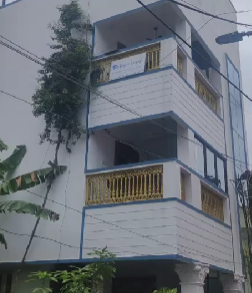
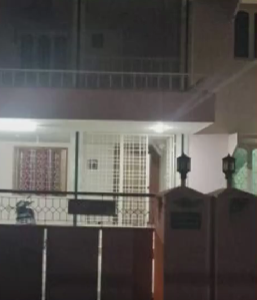
The video also shows a pictures of seemingly residential buildings located in different places across Tamil Nadu said to be functioning as offices of the few entities mentioned above.
Digicop office in NeelankaraiRaatanjey office in Rajapalayam
The DMK Files video further goes on to elaborates on the volume of the total business involved in reflective tapes and rear marking plates.
Total vehicles in Tamil Nadu – 2.5 crores
Number of vehicles required to show fitness certificate in a year – 30 lakhs
Approximate length of reflective tapes required for a vehicle – 33 metres
Approximate total length of reflective tapes required in a year – 33 x 30 lakh = 9.9 crore metres
Approximate cost of a reflective tape – ₹150
Annual revenue from selling reflective tapes – ₹150 x 9.9 crore meteres = ₹1485 crores
Number of heavy duty vehicles – 18 lakhs
Approximate number of rear marking plates required in a year – 18 lakh
Approximate cost of rear marking plates – ₹1500
Annual revenue from selling rear marking plates – ₹1500 x 18 lakh = ₹270 crores
It is alleged that Goods and Services Tax (GST) worth several crores have been evaded.
According to the calculations, ₹316 crores is the GST amount that was supposed to be collected for ₹1755 crore revenue generated through reflective tapes and rear marking plates. However, money is collected in cash and routed across Tamil Nadu through hawala transactions to avoid paying GST, the video claims.
There is also an audio clip of an alleged phone conversation between a collection agent and one Louis Kathiravan, a personal secretary of Transport Minister SS Sivasankar. In the audio, the Minister’s personal secretary can be heard demanding bribe money from the collection agent.
The DMK Files video alleges that 30% of the net profit ₹1276 crores earned, amounting to ₹383 crore was supposed to be paid as tax which has been evaded.
“Our allegations is that Transport Minister Sivasankar’s job has been to collect ₹2000 crores annually and give it to Udhayanidhi Stalin.”, the DMK Files video says adding that as a quid pro quo, advertisements of Rose Fertility Clinic run by Minister Sivasankar’s wife SS Gayathri Devi has been allowed to be placed in government buses.
Tamil Nadu Medical Services Corporation Scam
The Tamil Nadu Medical Services Corporation (TNMSC) releases a list of the eligible companies allowed to supply pesticides of which one of them is a company called Paramount Pesticides based in Meerut, Uttar Pradesh which supplies pesticides and other chemicals to various state governments.
In Tamil Nadu certain companies are supplying pesticides to the Tamil Nadu Medical Services Corporation (TNMSC) by claiming to be the agents/distributors of Paramount Pesticides. These companies are – Sri Balaji & Co in Udumalaipettai, Sri Durga Enterprises in Chennai’s Ernavur, Sri Sethu Enterprises in Chennai’s West Mambalam, Sri Vaari Agencies in Chennai’s Anna Nagar, Sri Nadiyambal Agency in Vizhupuram.
Paramount Pesticides had written to the Tamil Nadu government on 15 June 2022 that its letter to the TNMSC dated 14 November 2018 was being misused by a few companies. The Uttar Pradesh-based company clarified that it had entered into no contract with any such companies for the supply of the chemicals. It said that a letter dated 25 August 2021 claiming to enlist authorized entities for the supply of pesticides is a fake one and urged TNMSC to cancel the agreements it signed with the impersonating entities.
In one instance, a letter of Paramount Pesticides having a Chennai address is sent to Assistant Director of Town Panchayat, Coimbatore Zone regarding the supply of pesticides for the next two years referring to the original letter to the TNMSC dated 14 November 2018. It claimed Sri Nadiyambal Agency in Vizhupuram as its authorized entity to supply the pesticides. It is noteworthy to mention that there is already a DVAC case against Sri Nadiyambal Agency
No action has been taken against them, even though Paramount had complained to the government saying that action must be taken against these companies as they are not its agents, Annamalai said. This is said to be causing loss of ₹300 crore per year to the exchequer.
The Big Box
Apart from documents pertaining to the above scams, BJP Tamil Nadu led by Annamalai also submitted documents related to nine ministers and their benamis to the Tamil Nadu Governor, the details of which have not been made public.
Click here to subscribe to The Commune on Telegram and get the best stories of the day delivered to you personally.
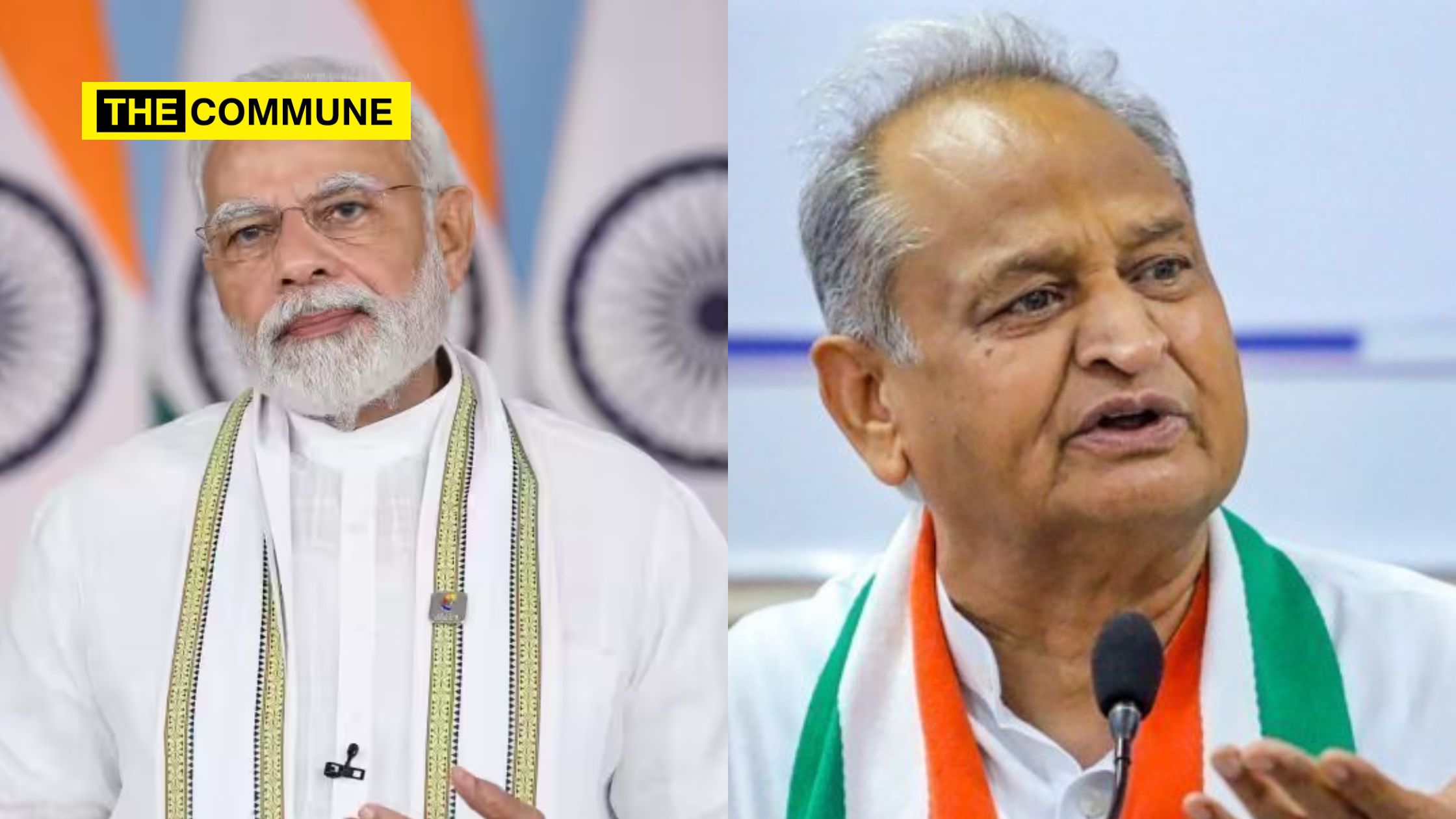
In a rather surprising action, the Prime Minister’s Office took to Twitter to respond to and call out Rajasthan Chief Minister’s accusations he had tweeted earlier.
Chief Minister Ashok Gehlot tweeted to the Prime Minister earlier on 27 July 2023, that the PM was visiting Rajasthan and that the PMO had removed his pre-scheduled 3-minute address from the programme, and that he would not be able to give a welcome speech to the PM, hence, he said, he was welcoming PM Modi through the tweet.
माननीय प्रधानमंत्री श्री नरेन्द्र मोदी जी, आज आप राजस्थान पधार रहे हैं। आपके कार्यालय PMO ने मेरा पूर्व निर्धारित 3 मिनट का संबोधन कार्यक्रम से हटा दिया है इसलिए मैं आपका भाषण के माध्यम से स्वागत नहीं कर सकूंगा अतः मैं इस ट्वीट के माध्यम से आपका राजस्थान में तहेदिल से स्वागत करता…
Gehlot further added, “The inauguration and foundation laying of 12 medical colleges taking place today is the result of the partnership between the Government of Rajasthan and the Centre. The project cost of these medical colleges is Rs 3,689 crore, of which Rs 2,213 crore is the share of the Center and Rs 1,476 crore of the state government. I also congratulate everyone on behalf of the state government. ”
The Prime Minister’s Office (PMO) responded to the allegation by stating that Rajasthan Chief Minister Gehlot had indeed been invited by protocol.
They tweeted, “In accordance with protocol, you have been duly invited and your speech was also slotted. But, your office said you will not be able to join.
During PM Narendra Modi’s previous visits as well you have always been invited and you have also graced those programmes with your presence.”
The PMO also added, “You are most welcome to join today’s programme. Your name is very much there on the plaque of the development works as well. Unless you have any physical discomfort owing to your recent injury, your presence will be deeply valued.”
Government sources indicated that one of the events was specifically organized for the veteran Congress leader to attend in person. However, he expressed a desire to join the programme in Sikar through videoconference, which deviated from the normal process or protocol for such events, according to the sources.
Rajasthan Chief Minister had also tweeted his 5 demands that had been included in his speech for the programme in the same tweet. These demands include continuing permanent recruitment in the army, waiving off loans of farmers from nationalized banks, conducting a caste census, providing financial assistance to medical colleges in three districts, and granting the Eastern Rajasthan Canal Project the status of a national importance project. He expressed hope that these demands would be addressed during the ongoing 7th Yatra conducted in the last six months.
Prime Minister Modi is scheduled to visit Rajasthan and Gujarat on the 27th and 28th of July. It is worth noting that this visit marks his seventh trip to Rajasthan in the last six months as the Prime Minister.
During a public event in Sikar, Prime Minister Modi will participate in various developmental initiatives. He will lay the cornerstone and dedicate numerous projects, including 1.25 lakh PM Kisan Samriddhi Kendras (PMKSKs). In addition, he will introduce a new type of urea coated with sulphur known as Urea Gold and inaugurate five new medical colleges. The event will also witness the distribution of the 14th installment of the Pradhan Mantri Kisan Samman Nidhi (PM-KISAN) program, among other significant announcements and initiatives.
Click here to subscribe to The Commune on Telegram and get the best stories of the day delivered to you personally.




Kerala CPI(M) Leader Issues Death Threats To BJP Workers For Challenging Speaker Shamseer’s Alleged Anti-Hindu Remarks
In a recent speech at a ‘Save Manipur’ campaign organized by the Left Democratic Front (LDF) in Kannur district, senior Communist Party of India (Marxist) (CPI(M)) leader P Jayarajan issued death threats directed at the Kerala unit of BJP and its youth wing, Yuva Morcha.
Shamseer, the MLA from Thalassery constituency representing CPI(M) and the Speaker of the Kerala Assembly, stirred controversy while speaking at the inauguration of the ‘Vidya Jyothi project’ in Kunnathunad constituency, Ernakulam district. During his speech, he referred to Hindu gods like ‘Ganapati’ and the ‘Pushpaka vimana’ associated with Ravana as mythical concepts lacking scientific evidence. Shamseer also suggested that in the era of artificial intelligence, such ideas should be discarded as myths.
Addressing the crowd, Jayarajan warned that any Yuva Morcha member who dared to oppose AN Shamseer, would meet a grim fate, with their place being in the mortuary. The ominous words from the influential CPI(M) leader did not go unnoticed, as the BJP quickly responded by filing a police complaint against Jayarajan for his inflammatory statements.
Two days prior, K Ganesh, the Kerala state secretary of Yuva Morcha, allegedly made a menacing statement during a protest held against Speaker AN Shamseer. He suggested that Shamseer may have made derogatory comments about Hindus, implying that Shamseer believed he would not suffer a fate like TJ Joseph, whose hand was brutally chopped off by Islamic extremists on accusations of blasphemy.
In response to Jayarajan’s intimidating speech, BJP Kerala president K Surendran demanded that the police register a case against the CPI(M) leader for issuing a death threat. He also called for Jayarajan’s removal from the post of Khadi Board chairman, citing his alleged involvement in multiple murder cases and accusing him of attempting to disrupt peace.
Reacting to the threats, Yuva Morcha state president CR Praful Krishna asserted that their organization would not be intimidated. He accused Jayarajan of playing to the gallery, attempting to appease party members and Islamists with his provocative speeches.
BJP and Yuva Morcha have declared their intention to persist with their protest against Speaker Shamseer over his alleged derogatory remarks about Hindus. Surendran asserted that the government’s lack of action regarding Shamseer’s comments emboldened Muslim League volunteers to raise anti-Hindu slogans. “If appropriate action had been taken against Shamseer,” Surendran remarked, “the members of the Muslim League would not have dared to speak in such a manner.”
Click here to subscribe to The Commune on Telegram and get the best stories of the day delivered to you personally.