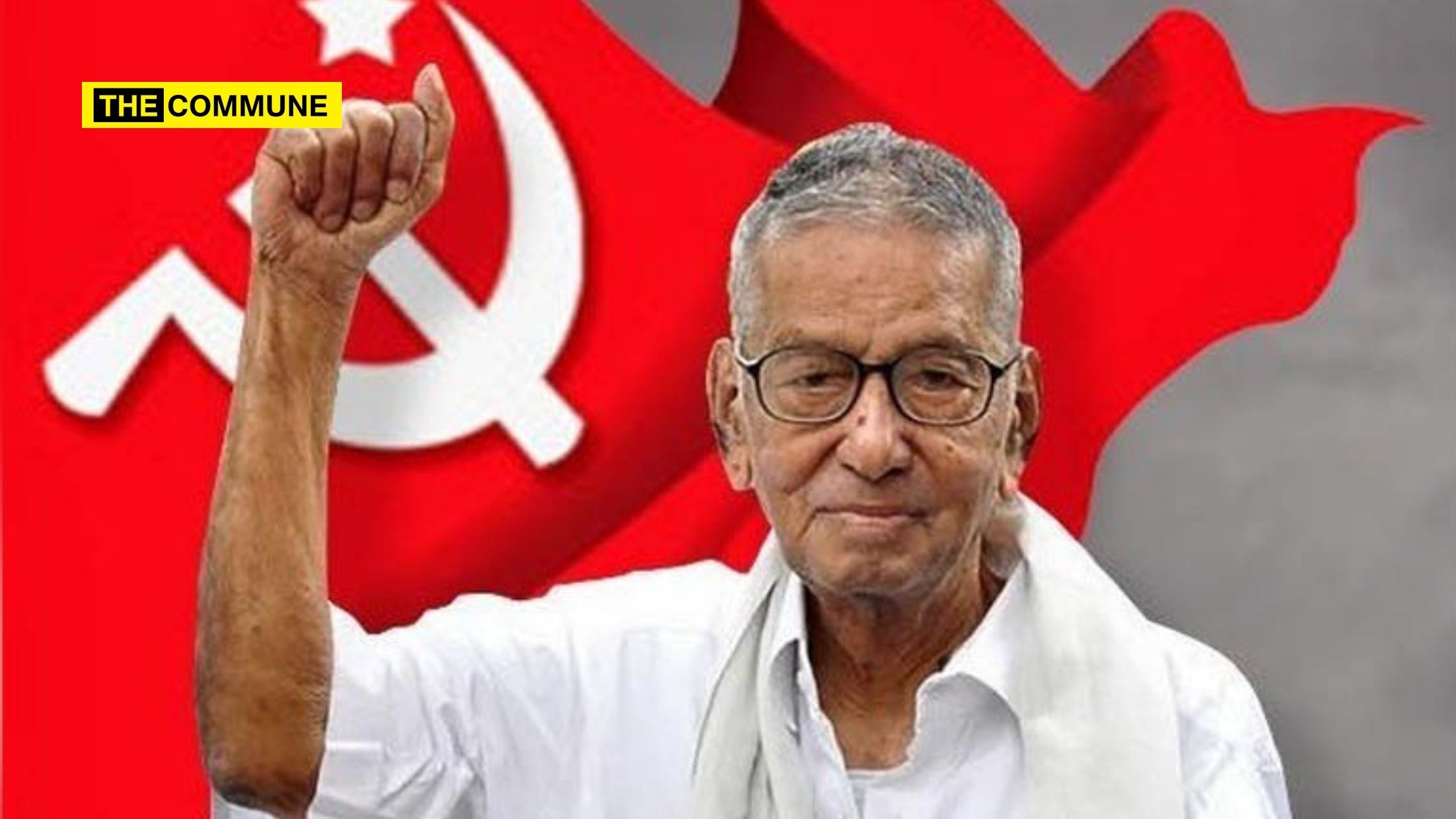
Did You Know? INC President Malikarjun Kharge Is A Victim Of Razakar Violence, Lost Mother And Sister
Since its inception, the Congress party has resorted to Muslim appeasement politics in the name of secularism. So much so that, the Congress party has today come to be known as a Muslim party, with the Muslims voting en-bloc. The 2023 Karnataka elections is a testimony to this phenomenon.
Congress leaders go out of the way to appease the so-called minority community sometimes at the cost of Hindus. This includes incumbent party President Mallikarjun Kharge.
But did you know that Kharge himself is a victim of Razakar Violence?
Who Are The Razakars?
The Razakars, the private militia of the Majlis-e-Itihadul Muslimeen (the pre-cursor to today’s AIMIM) headed Kasim Razvi, was sanctioned by the Nizam of Hyderabad to crackdown a civil uprising that was in favor of joining the Indian Union.
The Razakars, at the behest of the Nizam, went on a rampage going village after village plundering, kidnapping and murdering people. After getting the green signal from the Nizam, they started an ethnic genocide of Hindus in rural Telangana. The Bhairanpally massacre though not much spoken about remains etched in the consciousness of the people living in the region.
Kharge Lost His Family Members To Razakar Violence
Mallikarjun Kharge was born in 1942 in Varavatti village of Bhalki taluka in Bidar district to a Dalit family. His father’s name was Mapanna and mother’s name was Saibavva.
The incident happened in 1948 when Kharge was just 7 years old. Parts of what is today known as ‘Hyderabad Karnataka’ in which modern day Bidar falls, faced the wrath of Razakars. Bhalki, like several other villages up to Maharashtra, was under siege of the Razakars.
Mallikarjuna Kharge in an interview had narrated the story of his mother’s death in his childhood that would make one teary-eyed. He said that when he was playing near his house and his father was working in the agricultural field, the Razakars set fire to their tin shed house. Kharge lost his mother and sister to the fire set off by the Razakars while he himself had a narrow escape.
Apparently, Kharge and his father were left alone in the family, and no one came forward to give them shelter in the surrounding villages due to the fear of the Razakars.
In an interview to News 18, Priyank Kharge, the son of Mallikarjun Kharge said “My grandfather was working in the fields when a neighbour rushed to tell him that the Razakars had set their tin-roof home on fire. The Razakars were attacking every village in sight. They were a four lakh-strong army and were acting on their own as they did not have a leader. My grandfather rushed home, but could only save my father, who was within his arm’s reach. It was too late to save my grandmother and aunt who died in the tragedy.”
According to Priyank, his father and grandfather hid themselves in a dense shrubbery fearing for their lives. They then proceeded to meet their grandfather’s brother serving in the Army in Pune. However, he had gone to Gulbarga (Kalaburagi today).
Mallikarjun and his father went to Gulbarga and started life afresh there. Kharge’s father took up a job at a textile mill called MSK Mills.
This is the tragic story albeit less known story of the current Congress President Mallikarjun Kharge.
Click here to subscribe to The Commune on Telegram and get the best stories of the day delivered to you personally.


TNM Tries Hard To Brush Away The Reality Of Love Jihad Through Stray Secular Stories
The Kerala Story has been a constant buzz since its release. During the time when certain topics were ‘cancelled’ outrightly by the ‘Left-Liberal’ intelligentsia of Lutyens Delhi, one could never muster the courage to put these topics in to public debates whether in the name of creative freedom or realistic concerns. The appeasement politics practiced until not so long ago tend to keep a lid on these issue in the name of minority protection.
It seems that wind is blowing in a different direction now. But hashtags spurn out by leftist intelligentsia these days seems to ignore these facts and are trying hard to counter dispensation of truth at any cost. The art of ignoring the truth manifests itself in many ways but the truth has a unique character, one can ignore it or twist it but truth cannot be eradicated.
Ever since the release of the ‘The Kerala Story’ the leftist media mafia are trying hard to spin the narrative surrounding the movie, one such attempt has been the recent article that was published in ‘The News Minute (TNM)’.
Demolishing The Propaganda
Even though it may seem harmless at first, TNM has been working tirelessly to put out a narrative masking it as an alternative to ‘The Kerala Story.’ In the introduction to the article TNM author states that it is their initiative to highlight stories of communal harmony and unity from the state of Kerala and highlights a documentary called ‘Malappuram Beyond Tales.’ The documentary revolves in the Malappuram district of Kerala, district with highest Muslim population in the state.
The 23-minute documentary starts in Thunchan Parambu in Tirur and shows how a group of Muslim men band together to serve free drinks and milk to youngsters attending the Vijayadashami festival.
The programme then moves on to Shobha Parambu’s Sree Kurumba Bhagavathy temple, where the head priest is customarily nominated by the patriarch of a Muslim family. The ceremony in which the priest is appointed is also led by Bappu Haji, the title given to the eldest member of a Muslim family. This practise is still going on.
The following Malappuram narrative takes us to Thirunavaya’s lotus farms. The lotuses grown by Muslim farmers are sold to temples here, and the story then goes on to describe how the Valancherry Moonnakkal Juma Masjid provides free rice to the populace.
These are some excellent examples of communal harmony and there is no disputing that fact but the problem arises once these examples are put out as an alternative to the movie The Kerala Story.
Kerala has been always an adobe of communal harmony and there are historical records to back it. Kerala always welcomed refugees and minorities with open hands and has helped them to assimilate in to Indian culture. Jews who were prosecuted by Romans were given shelter by the Hindus in Kerala, Christianity was allowed to flourish here and it is interesting to also note that the first mosque outside the Arab world is in Kerala.
The common thread connecting all these stories are the secular nature of Hindus in Kerala and their mentality to protect the minorities. The saga of using love as a means for proselytising by Jihadists is a well-documented fact just like the above-mentioned instances of communal harmony.
TNM in this article blatantly tries to brush aside the truth behind ‘Love Jihad’ by dressing it with the stories of communal harmony instead of trying to discuss a real social issue called Love Jihad. Truth should not be countered with another truth. The only way to go about it is to accept both are real and healthy discussion can take place. Instead of that what we are witnessing in TNM article is ‘Liberal Cannibalism’ or ‘Cancel Culture.’
How Malappuram Became Muslim-Majority
Malappuram was once a Hindu majority district in Kerala, India. However, the demographics of the district have changed over time, and today Muslims make up over 70% of the population.
There are several factors that have contributed to this change, including the Moplah rebellions and the invasion of Tipu Sultan. The Moplah rebellions were a series of violent uprisings that took place in Malappuram and other parts of Kerala in the late 19th and early 20th centuries. During the rebellion many Hindus were killed or displaced. Tipu Sultan was a Muslim ruler of Mysore who invaded Malappuram in the 18th century. Tipu was a devout Muslim, and he was intolerant of other religions. He destroyed many Hindu temples and forced Hindus to convert to Islam. As a result of Tipu’s invasion, many Hindus fled Malappuram and settled in other parts of India.
The Moplah rebellions and the invasion of Tipu Sultan had a profound impact on the Hindu community in Malappuram. The rebellions led to the deaths of many Hindus, and the invasion led to the destruction of many Hindu temples. There are many Hindu temples in Malappuram that have been destroyed or damaged over the years by Muslims in the district. Some of the most notable examples include, the Thirunavaya Temple, which was destroyed by Tipu Sultan in 1789, Manjeri Temple was destroyed by the Moplah rebels in 1921 and these are only a few examples. As a result of these events, the Hindu population of Malappuram declined, and the district became a Muslim majority. Today temples in Malappuram are outnumbered by mosques.
The Hindu community in Malappuram is small and are outnumbered by Muslims. According to the 2011 census, Muslims make up 70.24% of the population of Malappuram, while Hindus are only 20.21%. This is a significant change from the 1901 census, when Hindus made up 57.8% of the population and Muslims made up only 26.6%.
In addition to Love Jihad, there have also been several instances of forced conversions to Islam in Malappuram. In 2017, for example, a Hindu woman named Hadiya was forcibly converted to Islam and married to a Muslim man. Hadiya was eventually able to return to her family, but the case highlighted the issue of forced conversions in Kerala.
In order to correct a wrong, one must first admit it but it seems that post the release of The Kerala Story the TNM gang has been trying hard to divert the attention from the issue of Love Jihad.
There is completely no wrong in portraying the stories of harmony from Kerala as the ‘Gods own country’ is famous for its secular and welcoming nature but no society is perfect and when someone courageously exposes the hidden snakes lurking under the secular façade, one should not cancel it in haste but debate the truth behind it patiently.
(Anand Krishna is a Kerala-based lawyer and columnist.)
Click here to subscribe to The Commune on Telegram and get the best stories of the day delivered to you personally.