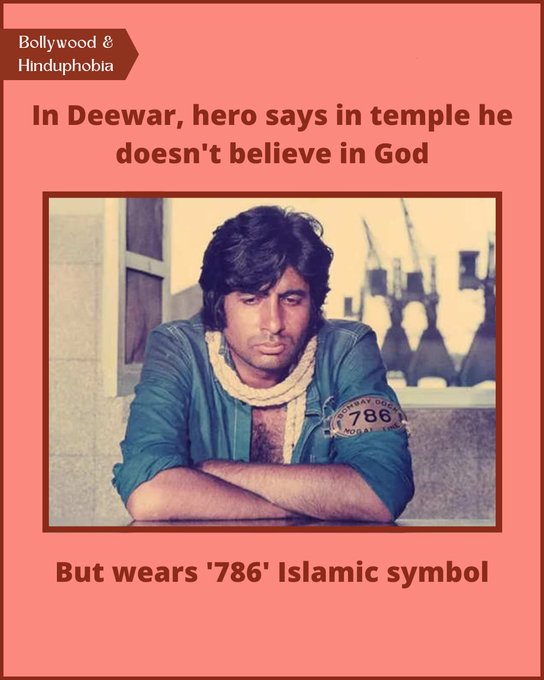
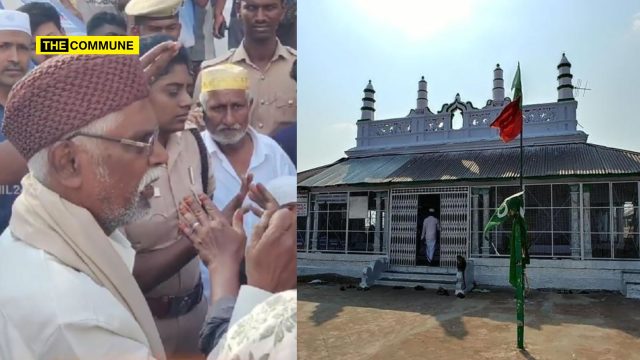
Tension prevailed at Thirupparankundram hill in Madurai ahead of the Ramzan festival after police imposed entry conditions on devotees visiting the Sikandar Badhusha dargah.
According to visuals from the spot, Muslim devotees who had gathered to offer prayers questioned the police for stopping them and delaying their access to the hill, stating that prayers were scheduled for the morning and that such restrictions had not been imposed in previous years.
Police personnel deployed on security duty stated that only after recording the name, address and other particulars of each person would they be allowed to proceed up the hill. Devotees and representatives of Islamic organisations objected to the measure, stating that prayers had been conducted peacefully every year and that collecting personal details on the day of the festival hurt their sentiments.
Large numbers of people had begun arriving at the hill from early morning to participate in the Ramzan prayers, leading to congestion at the entry point where the verification process was being carried out. The situation escalated into a heated argument between the police and the devotees.
Following the development, Thirupparankundram Assistant Commissioner of Police Sasi Priya reached the spot and stated that the procedure being followed was routine and applicable to all visitors, adding that no new restrictions had been introduced and urging the public to cooperate.
However, several devotees maintained that being held back in large numbers on a religious occasion was inappropriate and warned that such measures could affect communal harmony. The standoff between the police and the devotees led to a tense situation in the area.
Subscribe to our channels on WhatsApp, Telegram,Instagram and YouTube to get the best stories of the day delivered to you personally.
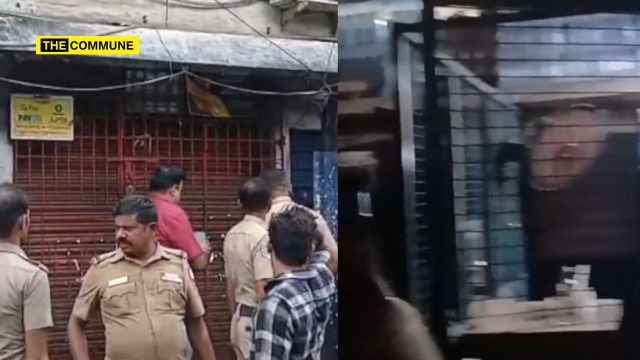
Residents of Sriram Nagar, located near IIT Madras in the Saidapet Assembly constituency, have alleged that a TASMAC liquor outlet in the area is operating in violation of prescribed norms, with sales reportedly taking place round the clock.
According to local residents, the shop is said to open even before the legally permitted hours, with liquor allegedly being sold continuously throughout the day and night. They claim that such illegal operations have contributed to a rise in disturbances and criminal incidents in the neighbourhood.
Residents further expressed concern over the impact on students, noting that school and college-going boys and girls frequently pass through the area and are being exposed to an unsafe environment due to the alleged activities around the outlet.
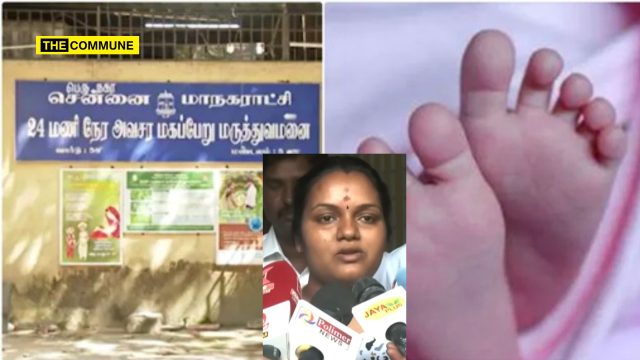
A fire triggered by an alleged electrical short circuit at a Corporation Hospital in Purasaiwalkam in Chennai has left a newborn baby with burn injuries, prompting an official investigation and raising concerns over safety protocols in public healthcare facilities, as reported in Tamil Getlokal.
According to initial reports, the incident occurred shortly after the infant’s delivery. The newborn, only hours old, sustained burns on the back and thigh. The baby has since been shifted to the Institute of Child Health for specialised treatment. Authorities have not yet released a detailed medical bulletin on the infant’s current condition.
Police have launched an inquiry into the cause of the fire, with preliminary indications pointing to an electrical fault within the hospital premises.
The child’s mother, who had delivered at the facility, described a sequence of events that has intensified scrutiny of hospital response and communication.
She stated that she had been under treatment for a prolonged period and chose the hospital based on the assurance of a senior doctor known to her. According to her account, the delivery procedure initially proceeded without complications, and she was briefly shown the baby following birth.
However, during the post-operative phase, she reported hearing panic among hospital staff. She stated that she witnessed the newborn sustaining burn injuries but was reassured by staff that the baby was safe.
The mother further stated that she has not been given clear information about her child’s condition. She expressed distress over being asked to proceed with discharge formalities without being informed about the baby’s status and demanded accountability from the hospital authorities.
The incident has sparked concern over emergency preparedness and electrical safety in government-run hospitals. Officials indicated that a detailed probe is underway to determine the exact sequence of events, including whether established safety protocols were followed.
Authorities are also expected to examine staff response during the incident and the communication provided to the patient’s family.
Further updates on the baby’s condition and the findings of the investigation are awaited.
Subscribe to our channels on WhatsApp, Telegram,Instagram and YouTube to get the best stories of the day delivered to you personally.
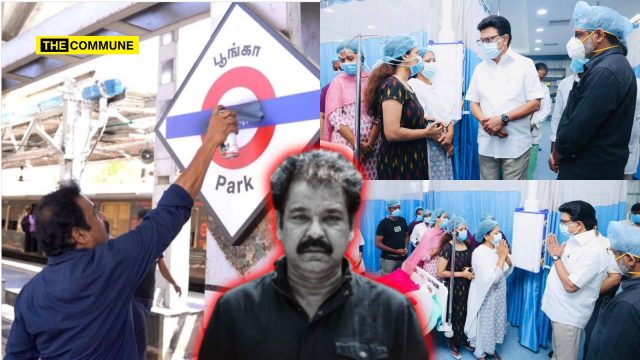
The death of May 17 Movement activist Siva Thileepan, who succumbed to injuries after jumping in front of a train during a protest against alleged Hindi imposition, has triggered political reactions and sharp criticism over the Chief Minister MK Stalin’s response.
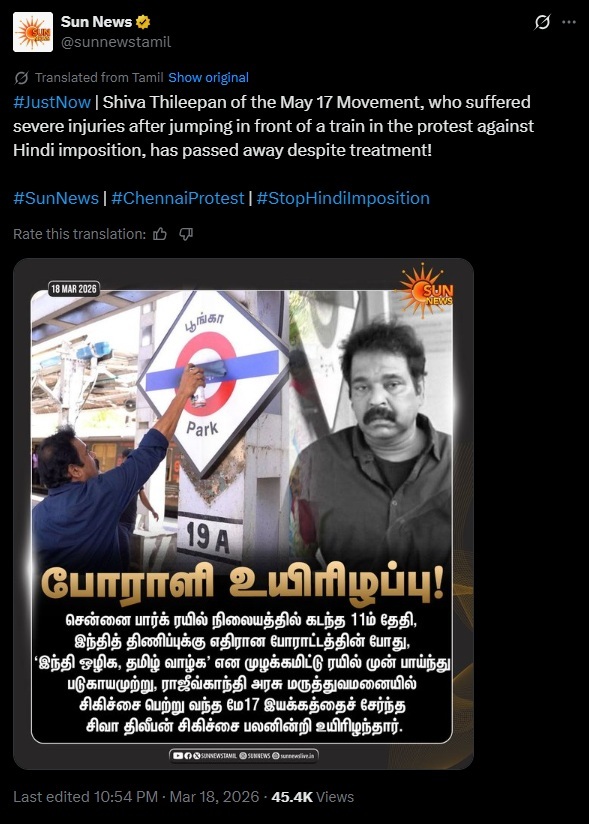
Tamil news channel Sun News first reported on 18 March 2026 that Thileepan had died despite undergoing treatment for severe injuries sustained during the incident.
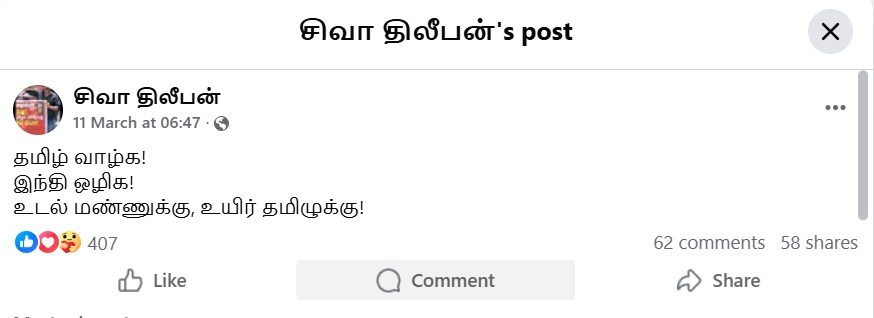
On 11 March 2026, during an anti‑Hindi protest at Park station, Thileepan was caught on camera taping over the Hindi portion of a nameboard and then, moments later, jumping in front of an oncoming train, reportedly declaring that his “body should become the weapon” against Hindi imposition. He had earlier posted on his Facebook saying, “Long live Tami! Down with Hindi! My body belongs to the earth; my life belongs to Tamil!”
He was rushed to Rajiv Gandhi Government General Hospital with grievous injuries and died on March 17 despite intensive treatment, a development Sun News reported on March 18 as a “language martyrdom”.
Stalin quickly moved to frame the incident in lofty rhetoric. In a long condolence post, he described Thileepan as a “brother” whose sacrifice weighed on everyone’s hearts, folded the death into a heroic lineage of anti‑Hindi agitations, and addressed May 17 leader Thirumurugan Gandhi and the family in the language of ideological comradeship. At the same time, he added a carefully worded appeal against future suicides and self‑immolation, urging cadres to use “innovative, peaceful, far‑reaching methods of struggle” made possible by technology.
He wrote, “No more lives should be lost from now on! During the struggle against Hindi script imposition, brother Mr. Siva Tileepan, overwhelmed with emotion, rushed in front of a train, and his passing despite intensive treatment weighs heavily on our hearts. The lives we have sacrificed in the language struggle are enough! No more lives should be lost from now on! With the help of technology, we have gained many innovative, peaceful, and far-reaching methods of struggle! We must defeat this Hindi imposition through our intellect, mental resolve, and love for Tamil! In this battle, our lives must not fall. Think about how Mother Tamil would survive if Tamil warriors like us perish. There are other ways to express our emotions; self-immolation is unnecessary—I earnestly plead and request this. I extend my deepest condolences and solace to Comrade Thirumurugan Gandhi, who mourns the loss of brother Siva Tileepan, to the members of the May 17 Movement, and to his family—including his two daughters filled with Tamil consciousness and his spouse.
#StopHindiImposition #SaveTamilLives”
இனி ஒரு உயிரும் போக வேண்டாம்!
இந்தி எழுத்து அழிப்புப் போராட்டத்தின்போது உணர்ச்சிவயப்பட்டு இரயில் முன் பாய்ந்த சகோதரர் திரு. சிவா திலீபன் அவர்கள் தீவிர சிகிச்சை பலனளிக்காமல் உயிரிழந்தது மனதைக் கனக்கச் செய்கிறது.
மொழிப்போரில் நாம் ஈந்த உயிர்ப்பலிகள் போதும்! இனி ஒரு உயிரும் போகக்…
— M.K.Stalin – தமிழ்நாட்டை தலைகுனிய விடமாட்டேன் (@mkstalin) March 18, 2026
The Chief Minister’s remarks have drawn criticism for the messaging risks politicising a tragic act of self-harm.
While Stalin formally advised against such extreme actions, his reference to “lives sacrificed in the language struggle” effectively frames the incident within a larger ideological narrative, potentially lending it symbolic legitimacy.
The act involved vandalism of public property followed by a fatal attempt on a railway track, raising concerns about law and order as well as public safety – issues that were not directly addressed in the political messaging.
The incident has reignited debate over the nature of protests surrounding language policy and the responsibility of political leadership in shaping public response.
While the State government has consistently opposed what it describes as “Hindi imposition,” critics argue that rhetoric around linguistic identity must be carefully calibrated to avoid encouraging extreme forms of protest.
At the same time, Stalin’s statement explicitly discouraged self-harm and called for non-violent, technology-driven forms of dissent, reflecting an attempt to balance political positioning with public caution.
Subscribe to our channels on WhatsApp, Telegram,Instagram and YouTube to get the best stories of the day delivered to you personally.
The Sangli Rural Police cancelled permission for the “Maharashtra Prayer Festival–2026,” a Christian missionary event organised at Kavalapur near Miraj, citing violations of conditions and allegations of misleading claims related to miraculous healings.
The programme, scheduled from March 13 to 15, was organised by the religious group Jesus Calls. The listed speakers included Paul Dhinakaran and Samuel Dhinakaran, along with other associates.
🚨 ‘Miracle Healing’ Event Stopped in Sangli
Police halted a Christian “Prayer Festival” of Paul Dinakaran in Sangli after allegations that the event involved claims of curing incurable diseases to influence or convert Hindus.
As reported in Sanatan Prabhat, according to police sources, the organisers allegedly promoted claims that serious and incurable illnesses could be cured through prayer. Authorities stated that such representations violated conditions imposed for the event.
Investigators noted that individuals were invited to share testimonies on stage. One participant reportedly claimed recovery from stage-four cancer after prayer, while another individual identified as Suji stated that a blood-related illness had been cured and that she achieved significant academic success following prayer intervention.
Police stated that these claims were presented in a manner that could mislead attendees into believing that medical conditions could be treated without professional healthcare.
The event also drew strong objections from local Hindu organisations, including Sakal Hindu Samaj, which alleged that the programme was aimed at religious conversion through inducement and unverified miracle claims.
Following both the reported violations and public opposition, Sangli Rural Police ordered the cancellation of the event. Police Inspector B. A. Talekar confirmed the action in an official communication.
FIR Registered Under Anti-Superstition Law
A case was registered against multiple individuals, including Dr. Dilip Bhore, Dr. Raosaheb Waghmare, Suji, and the event speakers. The charges relate to allegedly spreading misleading claims about curing serious illnesses through prayer alone.
The FIR was filed under provisions of the Maharashtra Prevention and Eradication of Human Sacrifice and other Inhuman, Evil and Aghori Practices and Black Magic Act, 2013, which criminalises exploitative practices and false claims of supernatural cures.
Subsequently, the Bombay High Court intervened after a petition challenged the police action. A bench comprising Madhav Jamdar and Pravin Patil held that the late-night cancellation of the event was procedurally improper and lacked sufficient evidence of law-and-order concerns or inflammatory content.
The court set aside the cancellation order, subject to conditions. The organisers were directed to comply strictly with the provisions of the anti-superstition law and submit a formal undertaking. Additionally, the State was instructed to appoint a vigilance officer to monitor the remaining sessions of the event.
The Maharashtra Anti-Superstition Act, enacted in 2013 following the assassination of activist Narendra Dabholkar, aims to prevent exploitative practices involving claims of supernatural powers or miracle cures.
Officials indicated that similar regulatory frameworks are under consideration in other States, including Tamil Nadu, amid increasing scrutiny of events involving faith-based healing claims.
Authorities stated that enforcement actions will continue where organisers are found to violate legal provisions or mislead the public.
Subscribe to our channels on WhatsApp, Telegram,Instagram and YouTube to get the best stories of the day delivered to you personally.
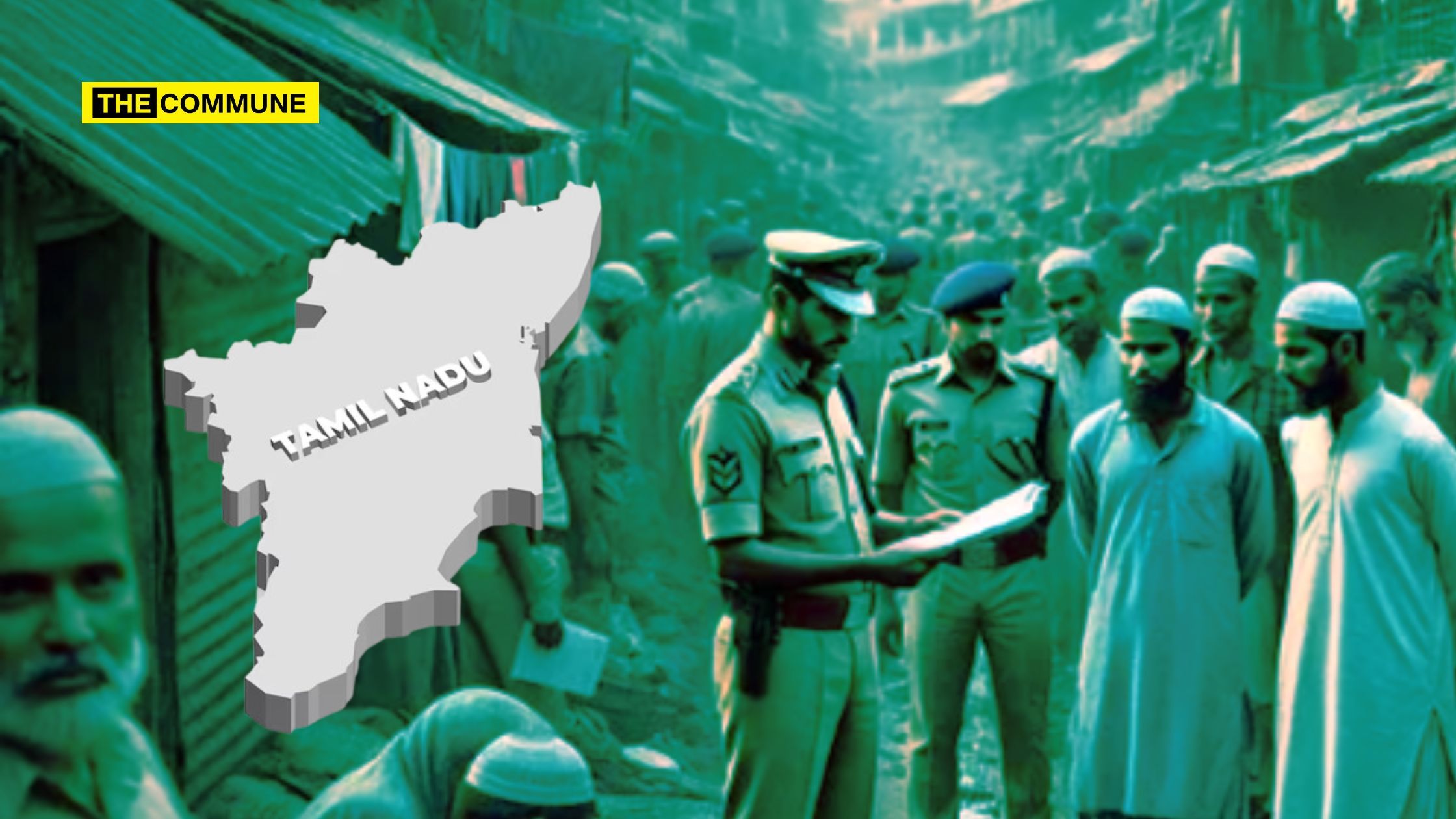
Authorities in Tamil Nadu on Friday, 20 March 2026, initiated the deportation process of 33 Bangladeshi nationals who had been detained in Salem district for residing in India without valid documentation, as reported in The Hindu.
According to police officials, the group was transported from Tiruchirappalli Railway Station aboard the Tiruchi–Howrah Super Fast Express. A separate coach was attached to the train for the detainees, who are being escorted by a special team of the Tamil Nadu Police, with logistical support from the Railway Protection Force.
Officials stated that upon arrival in West Bengal, the detainees will be handed over to the Border Security Force, which will oversee their repatriation to Bangladesh through designated border points.
The deportation forms part of an ongoing nationwide exercise initiated by the Union Ministry of Home Affairs to identify and remove foreign nationals residing in India without valid travel documents. Railway authorities indicated that coordination had been established with security personnel along the route to ensure the secure transfer of the detainees.
Tamil Nadu has, in recent years, intensified efforts to detect and deport undocumented foreign nationals. The State government constituted a Special Task Force to address the issue, following directives from the Union Home Ministry to all States and Union Territories to establish district-level mechanisms for identification and deportation.
Three detention centres are currently operational in the State at Tiruchirappalli, Cheyyar, and Attur, where suspected undocumented migrants are housed pending verification and deportation procedures.
Sources indicated that enforcement activity gained momentum following Operation Sindoor, a coordinated initiative under which several undocumented Bangladeshi nationals identified across multiple States were detained and transferred to border authorities. A significant number of such individuals had reportedly been residing in States along the India–Bangladesh border, including Assam, Tripura, Meghalaya, and Gujarat.
#WATCH | Tamil Nadu | A total of 33 Bangladeshi nationals who were lodged in the special refugee camp at Attur in Salem district were deported from Tiruchirappalli.
According to officials, the individuals had been detained in connection with various cases and for residing in… pic.twitter.com/3cVMnDQgi9
In Tamil Nadu, officials estimate that several thousand undocumented migrants, primarily from Bangladesh and Sri Lanka, may be residing in western districts such as Erode, Namakkal, Tiruppur, Coimbatore, Salem, and Karur. Investigations have indicated that some individuals had secured employment in local industries and obtained identity and address proofs through forged documentation facilitated by intermediaries.
Authorities stated that verification drives and enforcement actions will continue as part of the broader effort to address illegal immigration.
Subscribe to our channels on WhatsApp, Telegram,Instagram and YouTube to get the best stories of the day delivered to you personally.
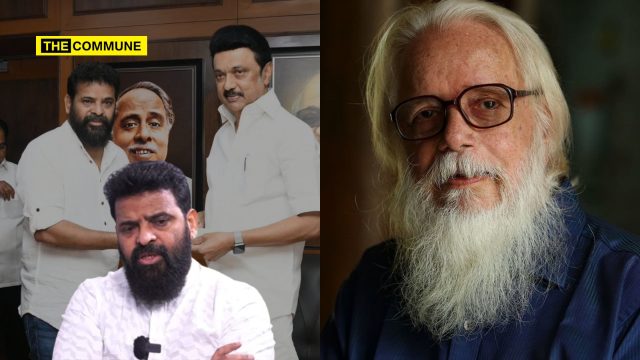
Ameer Sultan, a man linked to DMK and Islamist groups who has been accused of money laundering through drug trade has peddled baseless allegations about former ISRO scientist Nambi Narayanan.
The Dravidianist director was ranting about the increasing number of films coming sympathetic towards the Hindutva cause and said that that ever since Narendra Modi and the Bharatiya Janata Party came to power in 2014, cinema has increasingly been leveraged for political messaging rather than pure entertainment.
Targeting Nambi Narayanan, Ameer said “We also see films being made that depict Nambi Narayanan, who was accused of leaking military secrets, as a noble figure.”
It is to be noted that Ameer is a man who shares close ties with Jaffer Sadiq, a former DMK NRI Wing official accused of running an international drug-trafficking network. Dubbed Sadiq’s “bestie,” Ameer was named in an ED chargesheet alleging money laundering through films and was summoned by the NCB in April 2024 in connection with the smuggling of pseudoephedrine worth ₹2,000 crore. In October 2024, a special court summoned both Ameer and Sadiq as part of the ongoing money-laundering case.
Many on social media have slammed Ameer for insulting Nambi Narayanan.
Nambi Narayanan Case Timeline
In November 1994, Narayanan and his other scientist collegues in charge of the cryogenic technology transfer from Russia, were arrested by the Kerala Police on false charges of espionage. They were physically under the custory of IB officers. The case was eventually transferred to the CBI which concluded that the case was a sham.
Although the CBI submitted a closure report in 1996 stating that the espionage case was fabricated, the Communist government in Kerala had kept the issue lingering for decades.
The then CPI(M)-led government ordered more investigations which was struck down by the Supreme Court in in May 1998.
In September 1999, the National Human Rights Commission (NHRC) passed strictures against the government of Kerala for having damaged Narayanan’s distinguished career in space research along with the physical and mental torture to which he and his family were subjected.
The Supreme Court in 2018 ruled that Narayanan was not guilty of any of the espionage charges as accused by the Kerala Police and the bench called the case was “unnecessary” and that “he was implicated.” It also appointed a three-member panel headed by a former Supreme Court judge DK Jain to probe the arrest and torture of former space scientist Nambi Narayanan in the ‘ISRO spy scandal’ that turned out to be fake.
On 14 April 2021 the Supreme Court of India ordered a CBI probe into the involvement of police officers in the conspiracy after the DK Jain Committee report pointed out a conspiracy.
The Nambi Narayanan episode marks the darkest chapter in the history of Indian space as it curtailed India’s emergence as a space power by atleast two decades.
Subscribe to our channels on WhatsApp, Telegram,Instagram and YouTube to get the best stories of the day delivered to you personally.
For a long time, Kollywood behaved as if the Tamil audience was a lab rat: keep feeding it “message cinema”, sprinkle some Dravidianist ideology, sloganeering, add a few star cameos, and the box office would somehow cooperate.
For years, the audience also lapped up the garbage that was doled out in the name of ‘pure art’ and ‘absolute cinema’ and what not.
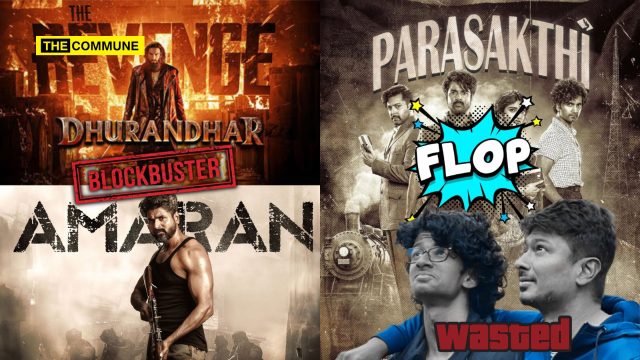
In 2024–26, the audience finally flipped the table. The clearest proof is how the same audience reacted to nationalistic films like Amaran and Dhurandhar, and how they have trashed Dravidianist ideology propagating films like Parasakthi.
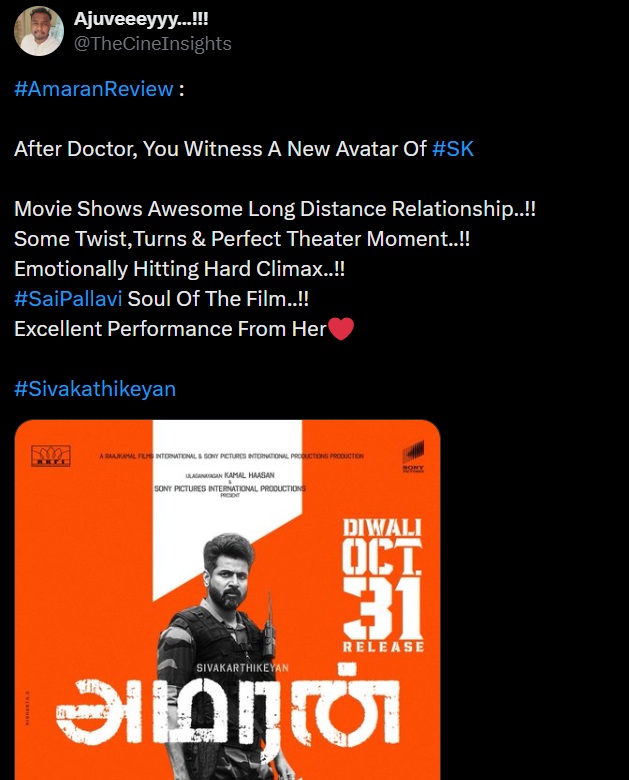
Let us take a look at Amaran. The film was a biopic based on the life of martyred army hero Mukund Varadarajan. The Tamil audience that has been starved for such nationalistic films, films on real heroes lapped it up like crazy.
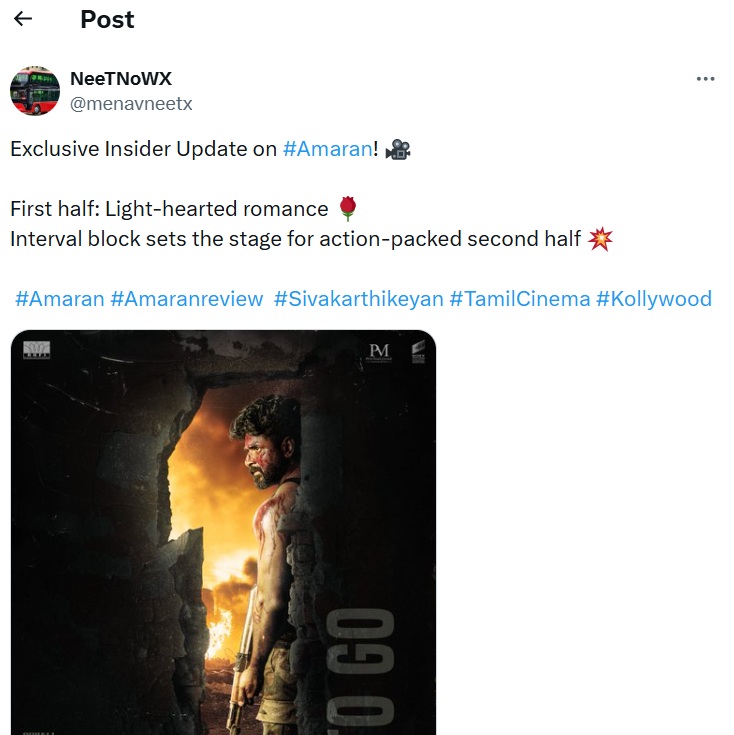
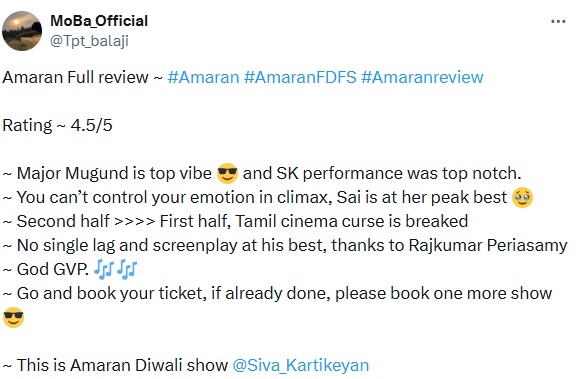
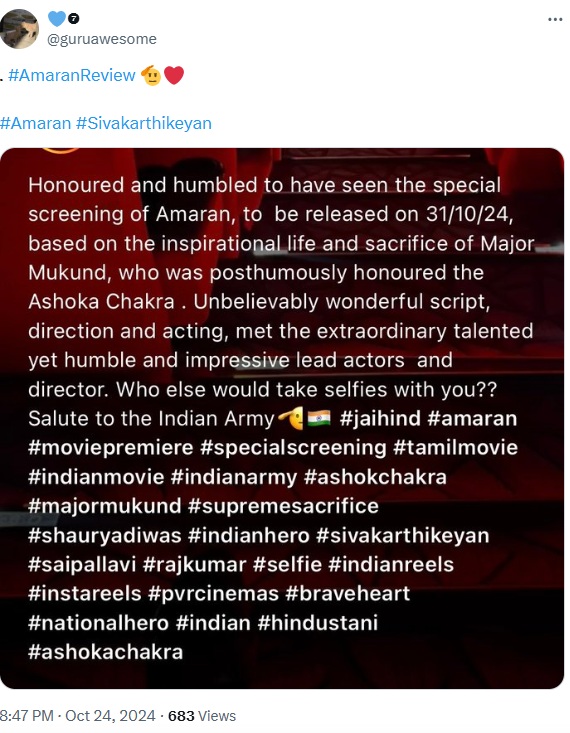
Fans of Sivakarthikeyan thoroughly enjoyed him in this avatar where he played Major Mukund Varadarajan. Here are some reactions.
While the film did have its shortcomings, it seemed to be a start in the right direction.
A year later, Dhurandhar was released – December 2025. Since it was a Hindi film, like with the rest of the country, there was no promotional activity, and purely through word-of-mouth, Tamil audiences cheered Dhurandhar too.
Come January 2026 and the Dravidianist ‘Parasakthi’ was released.
It faced a sharp and decisive rejection from audiences, turning from a heavily promoted Pongal release into a rapid box-office failure within days. After a fan-driven opening weekend, the film collapsed on its first Monday, with collections crashing nearly 70–80% from ₹10.1 crore on Sunday to around ₹3 crore, with some trade estimates placing it even lower. Its three-day India net stood at just ₹25–26 crore, far below expectations for a big-budget release.
Theatres across Tamil Nadu reported poor occupancy of around 18%, with empty screens and cancelled shows indicating a complete lack of audience “hold.” Negative word-of-mouth, citing a “preachy,” slow narrative and weak engagement further accelerated the decline. The film failed to attract family audiences and neutral viewers, relying only on an initial fan rush. What was projected as a prestige film has instead become a case study in how hype fails without audience acceptance.
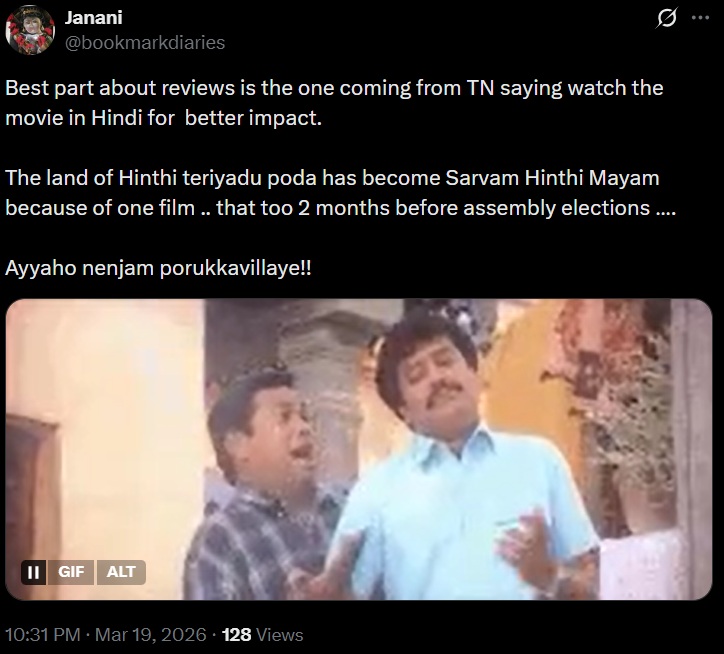
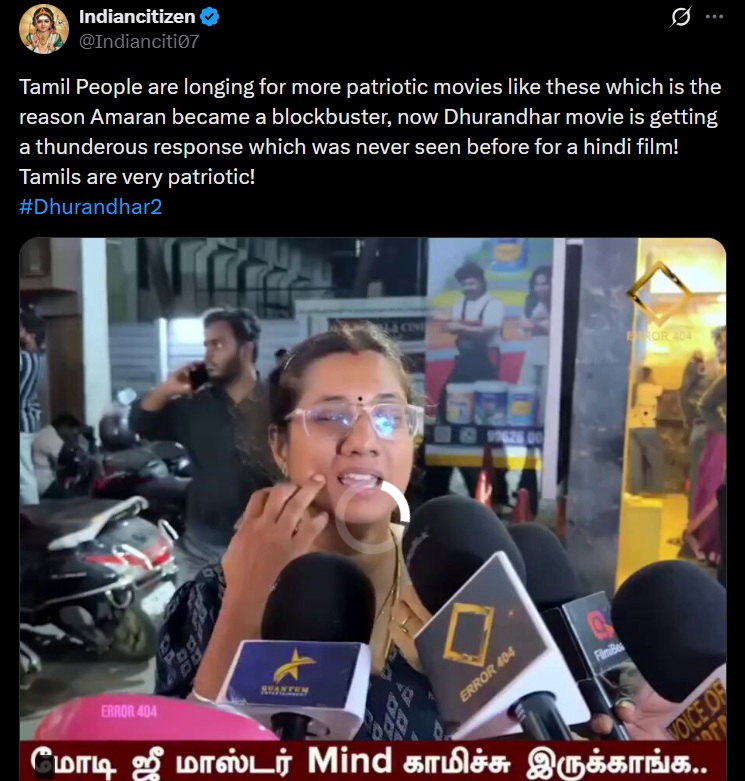
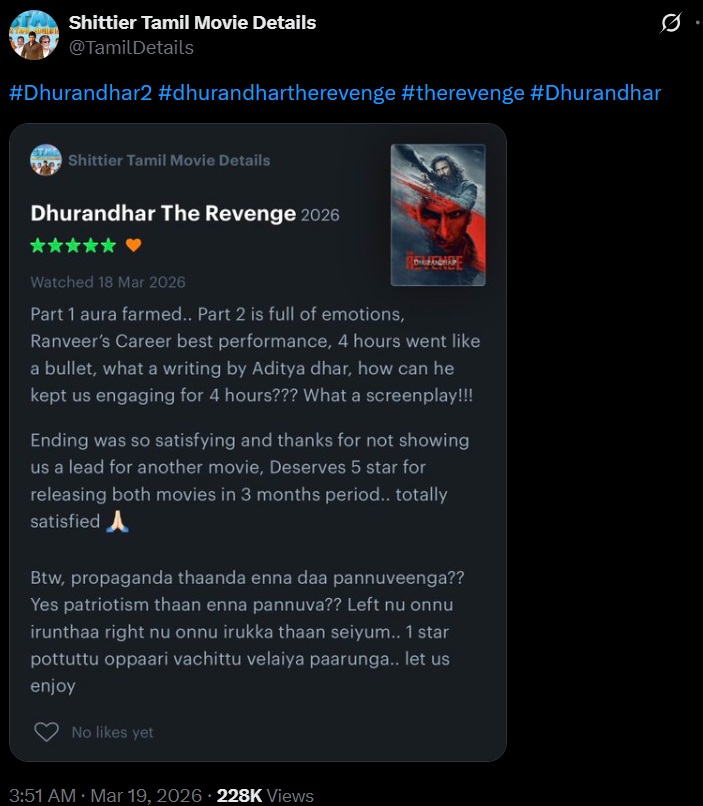
And now in March 2026, we saw Dhurandhar 2. Tamil audiences are enjoying it even more – to the point of recommending people to watch it in Hindi for maximum impact!
Viewer reviews as they leave the cinema halls in Tamil Nadu have all been praiseworthy of the film, as it should be.
It is noteworthy that audiences were in fact cheering for most of the scenes, that one can never come across in non ‘mass’ films – especially when PM Modi appears on the screen.
That’s the real story here. Tamil audiences are not suddenly “right wing” because they liked Amaran and Dhurandhar, nor are they “ignorant masses” because they rejected Parasakthi. They are simply done subsidising lazy, agenda-driven filmmaking. They have lived through a decade of Kollywood using the theatre as a classroom – anti-this, pro-that, lecture after lecture, with craft as an afterthought. Now they have seen what it feels like when someone spends the same money and time on story, staging and performance instead.
So yes, the Tamil audience is celebrating Amaran and Dhurandhar – not out of blind nationalism, but because those films deliver what Kollywood has been refusing to deliver: story, craft, emotional clarity, respect for the viewer. And it is trashing films like Parasakthi because people are done paying to be lectured and bored in the same sitting.
If Kollywood still pretends this is “confused audience taste” or fan wars, that’s its problem. The viewers have already moved on.
Subscribe to our channels on WhatsApp, Telegram,Instagram and YouTube to get the best stories of the day delivered to you personally.
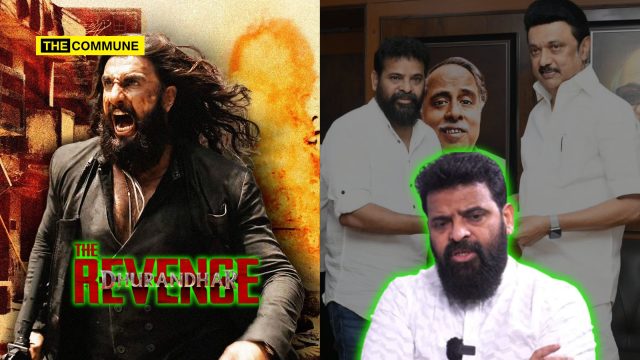
With Dhurandhar: The Revenge becoming a massive hit in Tamil Nadu, drug case accused DMK-linked Dravidian Stock director Ameer Sultan has been ranting about the film’s story and content.
The film, which lays bare Pakistan’s nexus of drugs and terrorism and the Islamist hostility toward those deemed “infidels,” appears to have struck a nerve with Ameer Sultan.
In an interview to a YouTube channel Ameer Sultan seems to be having problems with an Indian spy working against Pakistan for India’s interests.
“Recently a movie called Dhurandhar has released. A big hit! Wow. A patriotic film. One man goes from here and he struggles there (Pakistan) with terrorist gangs. That man is a nationalist! Entering another country and deceiving them is nationalism. If someone comes from there (Pakistan) to India, he’s a spy. If our guy goes to Pakistan, he’s a patriot. If he (Pakistani) comes here, he’s a spy for us but he’s a patriot there. How should one prove his patriotism? Who is deciding this?“, he says.
He further goes on to express his displeasure with people supporting India during India-Pakistan match.
“During an India-Pakistan match, if you support India, it is considered patriotism. You can’t enjoy the game. You can’t admire a player. You’ve to admire only your country!“, he says in the interview.
Commenting on Dhurandhar: The Revenge, Ameer Sultan ranted that ever since Narendra Modi and the Bharatiya Janata Party came to power in 2014, cinema has increasingly been leveraged for political messaging rather than pure entertainment. He claimed a pattern has emerged where films and media are used to advance the ruling party’s ideology—citing movies like The Kerala Story and The Kashmir Files as examples that project a Hindutva narrative and bolster the BJP, while portraying the Indian National Congress as weak and led by a “puppet” prime minister.”
He also called Nambi Narayanan as a man accused of leaking military secrets and said that films are being made on him in a heroic light, discounting the fact that the Supreme Court had held that Narayanan was “unnecessarily arrested and harassed” and ordered the Kerala government to pay him ₹50 lakh as compensation for mental cruelty and loss of dignity.
Madurai, Tamil Nadu: On ‘Dhurandhar: The Revenge’ film, Tamil film director Ameer Sultan says, “The film industry, which exists primarily to provide entertainment to the people, has increasingly been used for political purposes after 2014, when the BJP came to power. Since then,… pic.twitter.com/05or4ptbyw
Ameer Sultan, a Tamil filmmaker known for his Islamist-Dravidianist leanings, has faced growing scrutiny over his close ties with Jaffer Sadiq, a former DMK NRI Wing official accused of running an international drug-trafficking network. Dubbed Sadiq’s “bestie,” Ameer was named in an ED chargesheet alleging money laundering through films and was summoned by the NCB in April 2024 in connection with the smuggling of pseudoephedrine worth ₹2,000 crore. In October 2024, a special court summoned both Ameer and Sadiq as part of the ongoing money-laundering case. More recently, Ameer was accused of participating in a coordinated smear campaign against Justice G. R. Swaminathan, aligning with the DMK’s broader ideological ecosystem.
At a forum hosted by the Dravidianist YouTube channel “The Debate,” filmmaker Ameer attacked Sanatana Dharma and Brahmins, claiming as a Muslim he stood outside the caste system. He accused “Aryans” of creating caste, linked honor killings to Hindu epics, and praised DMK as Tamil Nadu’s positive force. His comments included sweeping generalizations, targeting practices like Vinayagar Chaturthi as dominated by “intermediate castes” while alleging Brahmins remain aloof. He also quoted EV Ramasamy Naicker (hailed as ‘Periyar’ by his followers) saying “Islam is the best medicine to eliminate racial discrimination.”
Subscribe to our channels on WhatsApp, Telegram,Instagram and YouTube to get the best stories of the day delivered to you personally.
Every time a film like Dhurandhar dares to show Pakistan as an adversary or Islamic terror as a real threat, a familiar chorus kicks in: “propaganda, anti‑Muslim, pro‑BJP.” What they wanted to portray to you was that until recently, Hindi cinema was some neutral, secular, apolitical space. That claim collapses the moment you look honestly at what Bollywood has been normalising since the 1950s.
Turning Hindus Into The Default Villain
Take the 1995 Mani Ratnam film Bombay. The film was praised as a “balanced” take on the 1992–93 riots but look at the visual grammar in the scenes you pointed out. The Muslim heroine is content and relaxed until she sees a group of Hindu sadhus in a peaceful temple yatra; the background score tightens, the camera lingers on her fear, and the audience is invited to read saffron as a threat by default.
Propaganda before Modi Government
Protagonist of Bombay movie (muslim lady) was very happy untill he saw hindu saints in peaceful mandir yatra and she looks terrified like she have seen goons.
As an audience you Will feel she is unsafe here , BGM made it more believable pic.twitter.com/EXeK1S2BHN
Later, when polite Ram Mandir donation‑collectors come to her door, she trembles as if a mob has arrived.
Another scene where hindus comes to her door steps to collect donation for ram mandir and they asking very politely but again she is shivering like they will kidnap her.
In another scene in the same film a Muslim character is selling bricks but the Hindu character ‘offends’ him by asking for bricks with the word RAM written on it.
Another scene where muslim character is selling bricks but hindu character comes and offend him by asking for bricks with RAM written on it. pic.twitter.com/XIT72ONHRc
This template repeats endlessly: Hindu symbols, temples, and sadhus are framed as sinister or regressive, while the Muslim figure is dignified, reasonable and unjustly persecuted.
From Begum Jaan & Rabbo To Radha & Sita
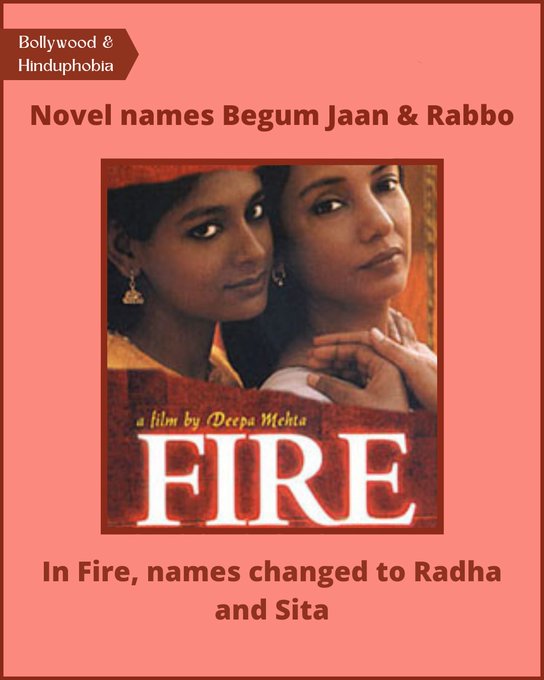
Deepa Mehta’s Fire openly credits Ismat Chughtai’s Lihaaf, a story about a Muslim begum and her servant Rabbo. In the original, the queer relationship sits inside a Muslim nawabi household. In the film, the names are changed to Radha and Sita, set in a Hindu home, borrowing directly from icons central to Hindu bhakti.
If this is “just creative freedom”, try to imagine the outrage if someone adapted a Hindu story and renamed the characters Aisha and Fatima to explore taboo sexuality. The decision is ideological: when you want to provoke and scandalise, you reach for Hindu names.
Real Muslims Scrubbed, Fictional Hindus Inserted
Consider Sherni. The real‑life case in Madhya Pradesh involved a forest officer K.M. Abharna and a notorious poacher Asghar Ali. In the film, the officer becomes Vidya Vincent, and the poacher morphs into Ranjan Rajhans, a kalawa‑wearing Hindu.
The broad plot is “inspired by true events,” but the communal identity of the villain is flipped. You are left with a textbook message: the problem is not Muslim lawlessness; it is Hindu corruption and patriarchy.
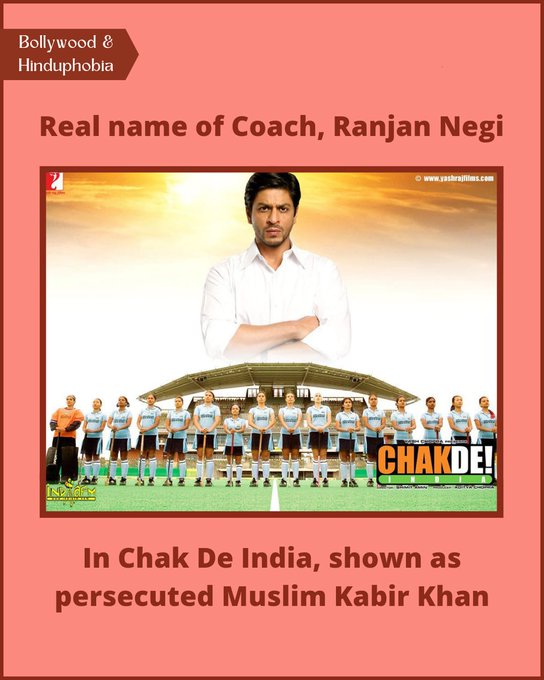
Similarly, Chak De! India draws heavily from the story of India hockey goalkeeper‑coach Ranjan Negi, who was vilified after the 1982 Asiad loss and later redeemed himself by coaching women’s teams. On screen, this becomes Kabir Khan, a Muslim falsely branded a traitor and hounded by a bigoted society.
The structural injustice is real but the choice to recode a Hindu into a Muslim martyr, in a story about patriotism and suspicion, is not value‑neutral.
Mocking Deities, Sexualising Icons
The list of casual Hinduphobia is long and old:
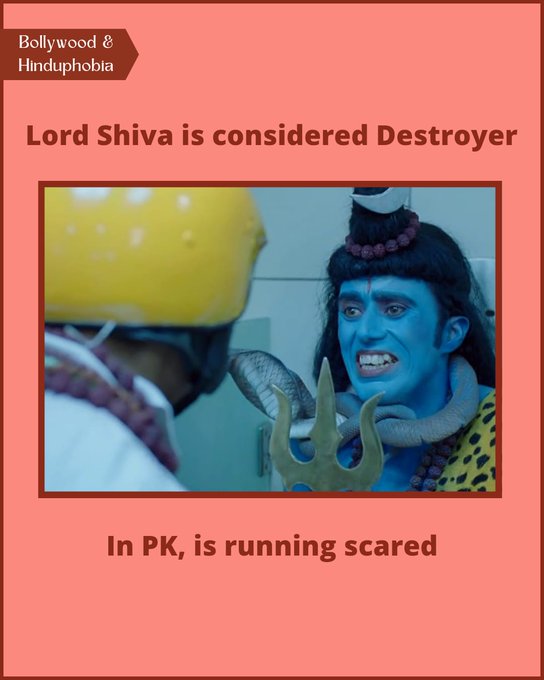
In PK, a man dressed as Lord Shiva is humiliated, chased and used as slapstick; petitions and PILs argued that the film mocked Shiva and ridiculed Hindu ritual specifically.
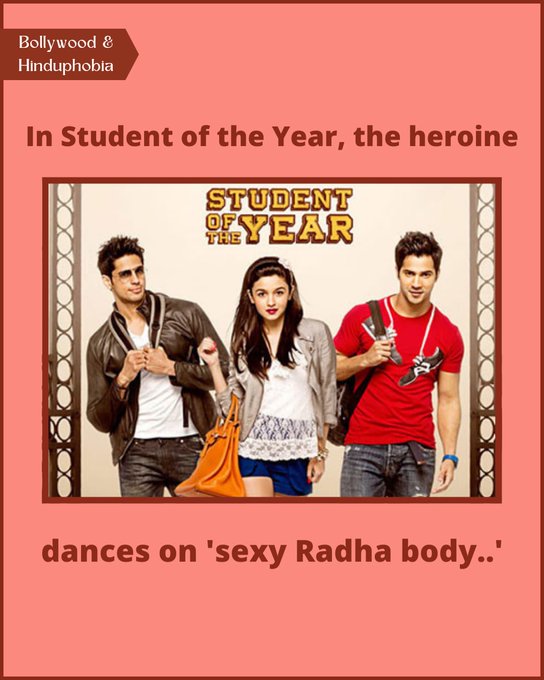
In Student of the Year, a peppy dance track calls Radha “sexy”, which led to protests and demands for a ban from groups who saw it as a deliberate trivialisation of a deeply revered figure.
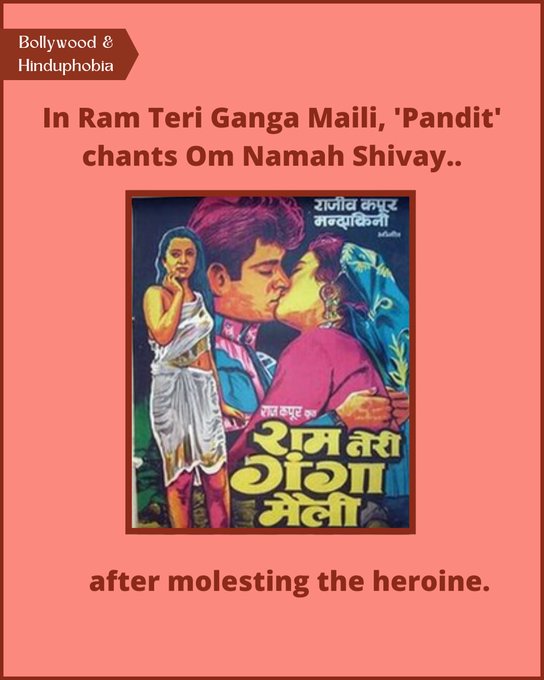
Ram Teri Ganga Maili features a so‑called pandit molester chanting “Om Namah Shivay” after assaulting the heroine, reinforcing the now familiar formula: outwardly religious Hindu equals hypocrite and predator.
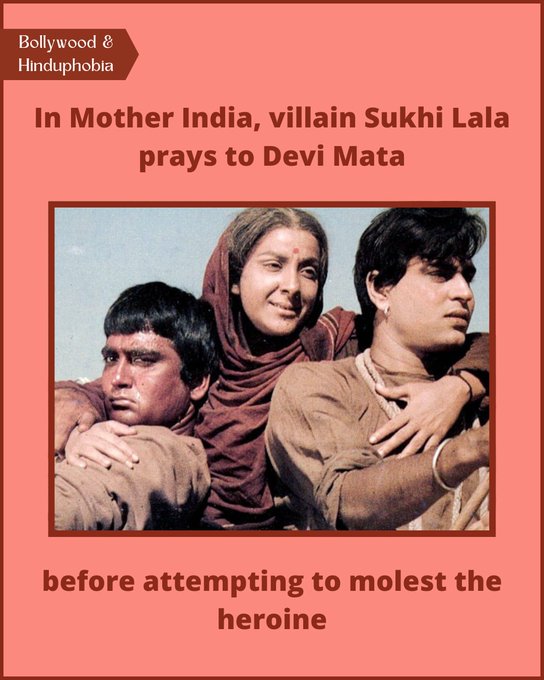
In Mother India, the lecherous moneylender Sukhilala prays at a Devi’s shrine just before attempting to molest Radha, visually tying a Hindu worshipping a Devi, a Hindu deity to immorality, villainous character.
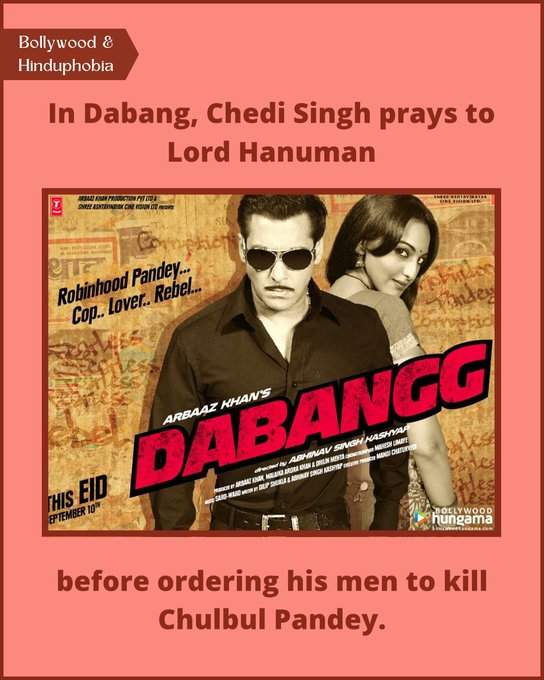
In Dabangg, villain Chedi Singh prays to Hanuman before ordering a killing.
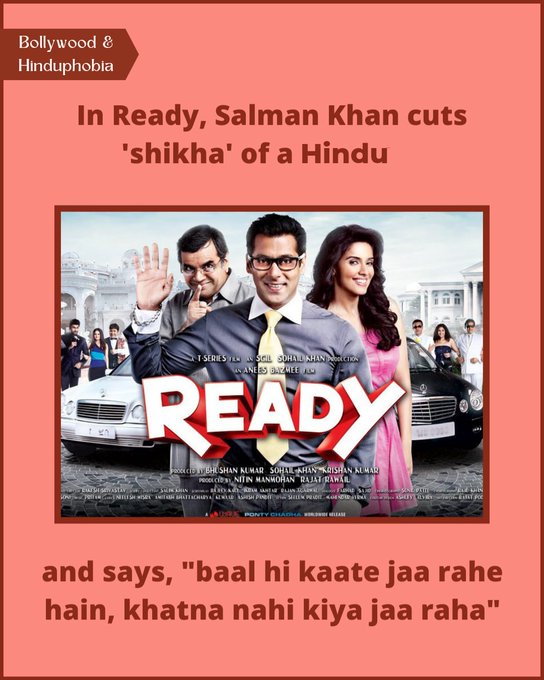
In Ready, Salman Khan casually cuts a Hindu boy’s śikha and cracks the line, “baal hi kaate jaa rahe hain, khatna nahi kiya ja raha,” turning a sacred symbol into an anatomy joke.
Over time, these are not random gags. They build a consistent association: Hindu ritual equals superstition or cover for violence; Hindu markers are safe to mock.
Selective Secularism In Symbols
Older films did it more subtly. In Deewaar, Amitabh Bachchan’s character tells his mother in a temple that he doesn’t believe in God yet walks around with “786” prominently displayed, signalling a soft corner for Islamic symbolism.
The message is clear: rejecting your own dharma is “cool”; signalling another faith is noble secularism.
In Mother India and Ram Teri Ganga Maili, abuse comes from figures wrapped in Hindu religiosity; in Bombay and Chak De, moral clarity comes from Muslims wronged by Hindu prejudice. None of this would be a problem if similar liberties were taken with churches, mosques and maulvis. The asymmetry is the point.
Propaganda Didn’t Start With Dhurandhar
So, when commentators call Dhurandhar “propaganda” merely because it refuses to whitewash Pakistan’s role or Islamist terror, they are not defending artistic purity; they are defending their own monopoly. For decades, Bollywood has run a soft ideological programme:
Normalise fear and suspicion of overt Hindu identity.
Sanitise or invert real cases where perpetrators come from other communities.
Use Hindu gods, symbols and priests as safe punchbags.
If Dhurandhar is to be interrogated for its politics, so be it. But honesty demands we admit that “propaganda” is not a 2020s invention. It has been built into scripts, casting, names and symbols since the black‑and‑white era. The difference today is that audiences have started to see the pattern and, increasingly, they’re not buying it on autopilot anymore.




 In Student of the Year, a peppy dance track calls Radha “sexy”, which led to protests and demands for a ban from groups who saw it as a deliberate trivialisation of a deeply revered figure.
 Ram Teri Ganga Maili features a so‑called pandit molester chanting “Om Namah Shivay” after assaulting the heroine, reinforcing the now familiar formula: outwardly religious Hindu equals hypocrite and predator.
 In Mother India, the lecherous moneylender Sukhilala prays at a Devi’s shrine just before attempting to molest Radha, visually tying a Hindu worshipping a Devi, a Hindu deity to immorality, villainous character.
 In Dabangg, villain Chedi Singh prays to Hanuman before ordering a killing.
 In Ready, Salman Khan casually cuts a Hindu boy’s śikha and cracks the line, “baal hi kaate jaa rahe hain, khatna nahi kiya ja raha,” turning a sacred symbol into an anatomy joke.
 Over time, these are not random gags. They build a consistent association: Hindu ritual equals superstition or cover for violence; Hindu markers are safe to mock.