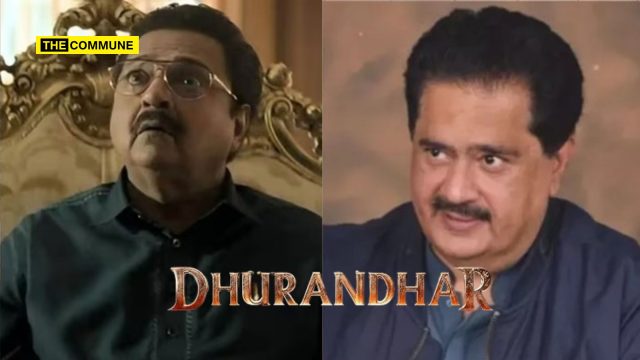
There is a particular kind of character who hands his enemies a weapon and then poses with it. Nabil Gabol – MNA, PPP, Lyari did exactly that when he proudly claimed on every Pakistani camera that Dhurandhar’s Jameel Jamali character was based on him.
Then (spoiler alert) Dhurandhar 2 revealed Jameel Jamali to be an Indian spy.
Act One: After Dhurandhar 1 (December 2025) – Basking
Nabil Gabol, sitting MNA from PPP, went on a Pakistani media tour proudly claiming that Jameel Jamali – the scheming, opportunistic Lyari politician played by Rakesh Bedi was reportedly based on him. His only complaint was that the film hadn’t done him enough justice. He told interviewers that Jameel Jamali was portrayed as too weak and too comedic, saying the character did not capture his real “dabangg” persona. He did not deny the inspiration – he demanded a more powerful version of himself on screen.
Pakistanis have started calling Nabil Gabol as Jameel Jamali after Dhurandhar..😂😂😂 pic.twitter.com/EiEkwTpSFv
— Cabinet Minister, Ministry of Memes,🇮🇳 (@memenist_) March 21, 2026
Act Two: After Dhurandhar 2 (March 2026) – Full Panic
In the sequel, Jameel Jamali is revealed to be an Indian spy.
Gabol’s tone changed overnight. He is now frantically distancing himself, insisting: “It’s not me. Don’t believe whatever is depicted in the film. It’s a crooked attempt by Indian filmmakers to deliberately distort and malign my character.”
His specific fear, stated explicitly in interviews, is that “illiterate or misinformed viewers in Pakistan who watch through VPNs or illegal downloads could mistake the fictional portrayal for reality and see him as an Indian spy, potentially putting him at risk.”
That is Nabil Gabol, on record, saying he is scared his own countrymen will think he is an Indian spy.
When asked if he would take legal action internationally, he admitted he “lacked the funds” to do so.
Rakesh Bedi, for his part, responded cleanly: “I didn’t portray him at all. The character was created through imagination by combining a variety of personalities.”
The Irony Is Surgical
The man who voluntarily, enthusiastically, repeatedly told all of Pakistan that a Bollywood film was based on his life is now desperately telling all of Pakistan that the same Bollywood film is absolutely not based on his life — because in Part 2, his character turns out to be working for RAW.
Your instinct about the Pakistan Army’s IQ is well-founded. Gabol himself appears to share your concern — which is precisely why he is in full damage-control mode. The internet, naturally, is not letting him forget a single word he said after Part 1.
Subscribe to our channels on WhatsApp, Telegram,Instagram and YouTube to get the best stories of the day delivered to you personally.
The proposition of a private billionaire, specifically Elon Musk, funding federal agency operations or paying federal employee salaries during a government shutdown is not a logistical workaround. It is a constitutional, legal, and democratic catastrophe waiting to materialize. This report expands upon foundational dangers: regulatory capture, congressional power subversion, Anti-Deficiency Act violations, economic fragility, and shifting allegiances and further identifies additional crisis vectors that the United States would face in both the near and long term. Backed by legislative history, financial data, and institutional analysis, this piece argues that permitting private funding of public employees would set the United States on an irreversible path toward neofeudal governance.
The Death of Regulatory Independence: When the Regulator Owes the Regulated
Regulatory independence is the cornerstone of a functioning market economy. Agencies such as the FAA, EPA, FCC, DOJ, and DHS are designed to enforce rules without fear or favor. This independence is not merely a procedural nicety – it is the mechanism through which consumer safety, environmental protection, and market competition are upheld.
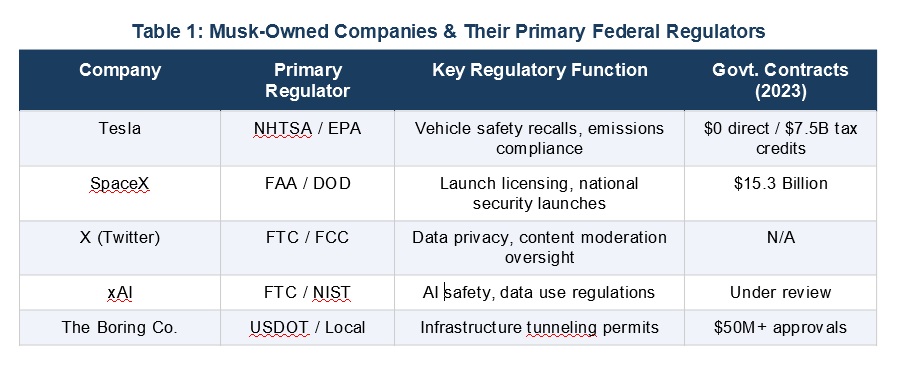
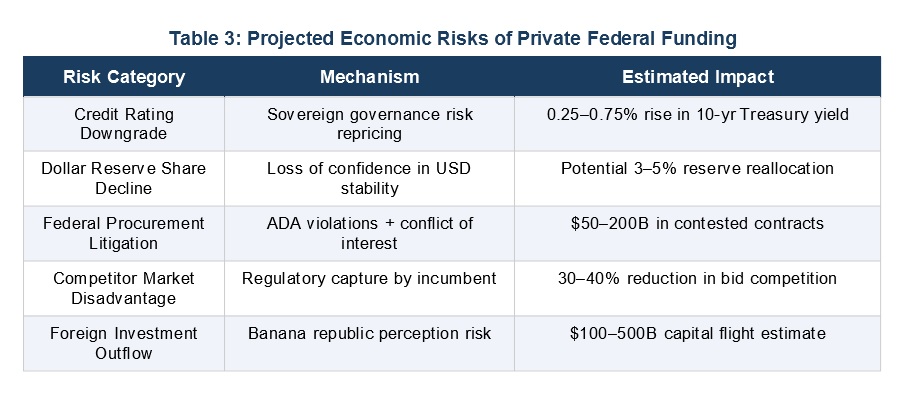
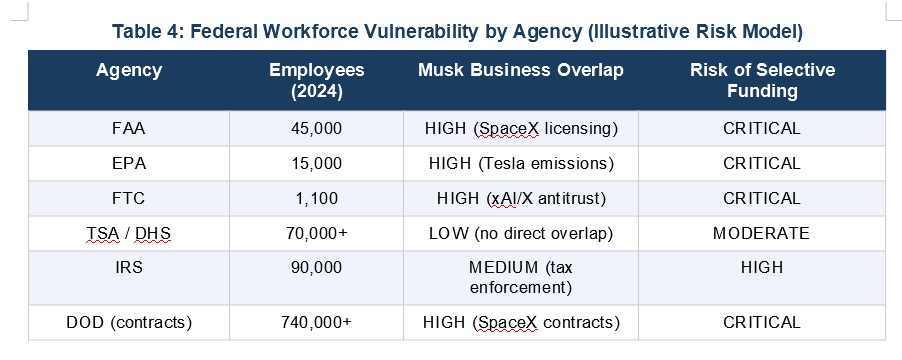
Elon Musk is not a passive actor in this ecosystem. He is the CEO of Tesla (subject to NHTSA and EPA oversight), SpaceX (subject to FAA licensing), xAI and X/Twitter (under scrutiny from the FTC and FCC), and has previously been investigated by the SEC. As of 2024, SpaceX alone had received over $15.3 billion in government contracts, according to USASpending.gov. His companies collectively employ over 140,000 workers directly regulated by federal agencies.
If Musk were to fund TSA agents, DHS personnel, or FAA employees, a structural conflict of interest of unprecedented scale is created. Even if explicit favoritism never occurs, the mere perception of dependence on a private benefactor compromises institutional integrity. Research in organizational psychology consistently shows that “benefactor bias” – an unconscious preference for the interests of financial supporters occurs even in rigorous professional contexts.
The stakes are staggering. The FAA approved SpaceX’s Starship launch licenses following extensive regulatory delays. The EPA has been scrutinized over Tesla’s manufacturing emissions waivers. A captured FAA could green-light unsafe launches. A captured EPA could ignore pollution violations. A captured SEC could overlook market manipulation. Each agency “sponsored” by Musk becomes, in effect, a subsidiary of his business empire.
Violating the Power of the Purse: The Collapse of Constitutional Checks
Article I, Section 9, Clause 7 of the U.S. Constitution is explicit: “No Money shall be drawn from the Treasury, but in Consequence of Appropriations made by Law.” The Framers did not include this clause as a technicality – it was the primary safeguard against executive tyranny. The power to fund government was deliberately placed in the hands of the elected legislature, not the executive and certainly not private citizens.
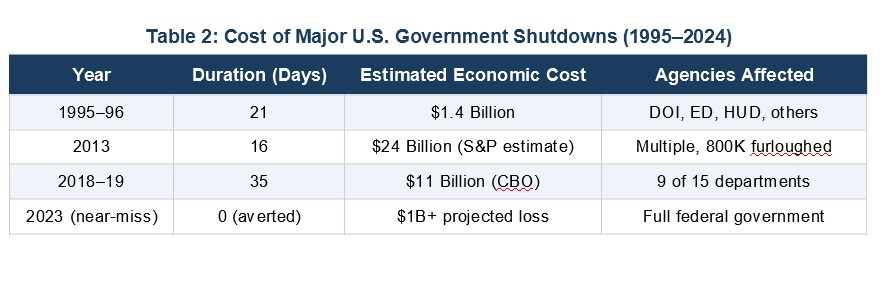
Government shutdowns, despite their economic pain, serve a democratic function. They are the fiscal pressure valve that forces legislative negotiation. Since 1976, the United States has experienced 22 government funding gaps. The 2018-2019 shutdown, the longest in U.S. history at 35 days, cost the economy an estimated $11 billion, according to the Congressional Budget Office (CBO). Yet it also produced a negotiated resolution and a temporary funding bill.
If a private billionaire can simply bypass this mechanism by writing personal checks to federal employees, Congress loses its only financial leverage. The incentive for lawmakers to negotiate, compromise, and represent constituents on budget issues evaporates entirely. Future shutdowns could be selectively “solved” by whichever billionaire has the most interest in keeping a particular agency running – not the one most essential to the public good.
This has a name in political science: the “fiscal hostage” problem in reverse. Instead of Congress using the budget as leverage against the executive, private wealth becomes leverage against democracy itself. A billionaire who keeps the TSA funded but lets the IRS starve is effectively setting fiscal priorities for the world’s largest economy.
The Anti-Deficiency Act: A Legal Minefield with No Exit
The Anti-Deficiency Act (ADA), codified at 31 U.S.C. §§ 1341–1342, prohibits federal agencies from accepting voluntary services or incurring obligations exceeding appropriated funds. It was first enacted in 1870 and has been strengthened through subsequent legislation, precisely because Congress recognized the danger of executive agencies becoming financially entangled with private interests.
Any attempt to have a private billionaire fund federal salaries would trigger immediate violations of the ADA. This is not a grey area. The Government Accountability Office (GAO) has issued multiple opinions affirming that federal agencies cannot accept gifts of services or funds that substitute for Congressional appropriations, even during shutdowns. The sole exception, accepting “emergency” services, is narrowly confined to immediate threats to life or property.
The legal chaos that would follow is multidimensional. First, the choice of which employees or agencies get funded by private money is itself a legally perilous act – it could constitute unlawful discrimination among federal workers. Second, employees who accept private compensation during a shutdown may forfeit back-pay entitlements normally guaranteed by the Government Employee Fair Treatment Act of 2019. Third, any contracts awarded during a period when an agency was privately funded could be legally challenged as tainted by conflicts of interest, potentially unraveling billions of dollars in federal procurement.
Legal scholars at Harvard Law’s Federal Budget Policy Seminar have noted that “a scenario in which a private citizen funds agency operations creates a constitutional void that existing statutes were never designed to address.” The resulting litigation could clog the federal courts for years, delay critical government functions, and cost taxpayers far more than the shutdown itself ever would.
Economic Fragility: Sovereign Risk and Market Destabilization
The United States dollar is the world’s primary reserve currency. As of Q1 2025, the dollar accounts for approximately 58.4% of global foreign exchange reserves, according to IMF COFER data. U.S. Treasury bonds are the benchmark for the global risk-free rate – the foundation upon which trillions of dollars in financial instruments are priced. This position rests entirely on the perception of the United States as a stable, sovereign, and predictable borrower.
The moment a private individual begins funding federal government operations, that perception fractures. Bond markets are acutely sensitive to sovereign governance risks. A scenario in which a billionaire’s personal wealth, which can fluctuate by tens of billions of dollars in a single day, becomes part of the formula for federal operations creates unprecedented volatility pricing into U.S. Treasuries.
Consider the market implications: Musk’s net worth dropped by approximately $200 billion between November 2021 and December 2022 due to Tesla stock declines. If federal operations were partially dependent on his financial capacity during this period, the implication for government stability is catastrophic. Credit rating agencies such as Moody’s and S&P, which already downgraded U.S. debt in 2023, would likely respond to such a development with further downgrades, pushing borrowing costs higher.
The competitive distortion effects are equally severe. Federal agencies that award contracts to aerospace, technology, automotive, or AI companies would be scrutinized as structurally compromised. Musk competitors: Boeing, Lockheed Martin, Rivian, Google DeepMind, and others would face a procurement process where the funding source of the evaluating agency is their direct rival. This would trigger immediate legal challenges, reduce competition for government contracts, inflate procurement costs, and ultimately burden taxpayers.
The Security Risk: Loyalty, Allegiance, and the Hollow Oath
Every federal employee, from the most junior TSA screener to the Director of the FBI, takes an oath to “support and defend the Constitution of the United States.” This oath is not ceremonial. It is the legal and moral foundation of a civil service that serves the public, not any individual. The Pendleton Civil Service Reform Act of 1883 was enacted precisely to break the “spoils system,” where government employment was tied to personal loyalty to political patrons.
Human psychology operates on the principle of reciprocity. Decades of social psychology research, from Robert Cialdini’s foundational work on influence to more recent studies in organizational behavior, confirm that individuals who receive material help from a benefactor develop measurable loyalties that influence their professional decision-making. When federal employees know that their mortgage was paid, their children were fed, and their retirement is secure because of Elon Musk’s personal largesse rather than the U.S. Treasury, the oath to the Constitution becomes a theoretical abstraction.
The national security implications are severe. During a contested election, a constitutional crisis, or a moment of conflict between a private billionaire’s interests and the public good, whose orders would agency employees follow? The agency head appointed by law? Or the man whose paycheck kept their family afloat? History offers grim precedents: in Weimar Germany, the erosion of loyalty to state institutions in favor of private patrons was a precursor to institutional collapse. In contemporary Venezuela and Hungary, the capture of civil service loyalties by executive-aligned private interests preceded democratic backsliding.
The Precedent Problem: Every Billionaire Gets a Turn
Perhaps the most underappreciated danger is the precedent. Once it is established that a private individual can fund federal operations during a shutdown, the principle cannot be restricted to one person. Jeff Bezos could fund the U.S. Postal Service and the FTC which regulates Amazon’s competitors. Larry Ellison could fund the Department of Defense’s technology divisions, where Oracle competes for contracts. The Koch Industries network could fund the EPA which regulates fossil fuel operations.
This is not hypothetical alarmism. It is the logical extension of the principle. In Citizens United v. FEC (2010), the Supreme Court’s ruling that political spending constitutes free speech opened floodgates that transformed U.S. campaign finance. A precedent permitting private funding of federal operations would dwarf the Citizens United impact in its consequences, converting entire government agencies into instruments of competitive private strategy.
The United States would effectively transform from a constitutional republic into a competitive oligarchy, where the wealthiest individuals vie to “sponsor” the agencies most strategically valuable to their empires. Public policy would no longer be determined by democratic deliberation but by the financial capacity and strategic interest of private wealth. The 2024 Forbes 400 list identifies 400 individuals with a combined net worth exceeding $5 trillion – more than enough to fund the entire discretionary federal budget of $1.7 trillion multiple times over.
Workforce Demoralization and the Collapse of the Civil Service
The federal government employs approximately 2.9 million civilian workers as of 2024, according to the Office of Personnel Management (OPM). These employees are compensated through a structured system governed by the General Schedule (GS) pay scale, a merit-based framework designed to ensure equal treatment, professional development, and non-partisan service. This system has been refined over 140 years since the Pendleton Act.
A tiered system in which some federal employees receive private funding while others do not would create catastrophic morale and equity crises. If Musk chooses to fund TSA and DHS but not the IRS or the EPA – agencies that directly regulate his businesses – the message to EPA scientists and IRS auditors is explicit: your work is less valued because it inconveniences the benefactor. Skilled professionals would exit the agencies starved of private support, resulting in a brain drain in the very departments most critical to regulatory enforcement.
Retention data already shows the civil service is under stress. A 2023 Partnership for Public Service survey found that 42% of federal employees under age 40 were considering leaving government service within three years, citing pay, flexibility, and perceived lack of institutional support. Introduction of private salary subsidies for select agencies would exacerbate this disparity, creating a two-tiered civil service, a “sponsored” class and an “abandoned” class with devastating effects on institutional cohesion.
International Perception and the Erosion of U.S. Soft Power
The United States has long derived geopolitical authority from the perception of stable, rule-based governance. The U.S. model of constitutional democracy has been exported, emulated, and advocated for globally – serving as the philosophical foundation for American foreign policy from the Marshall Plan to the post-Cold War order. That credibility rests on the assumption that U.S. institutions are funded by public taxation, governed by law, and answerable to elected representatives.
The revelation that a single private individual is paying the salaries of federal employees would reverberate in diplomatic, economic, and security arenas worldwide. U.S. allies in NATO, the EU, Japan, South Korea, and Australia who integrate defense, intelligence, and trade infrastructure with American federal agencies would face legitimate questions about the reliability and neutrality of U.S. government counterparts. Is an FAA safety certification credible if the FAA was funded by the CEO of a competing aerospace company? Is a DOJ antitrust decision trustworthy if the DOJ payroll was partially sustained by a technology oligarch?
Adversaries, particularly China and Russia, would exploit this narrative aggressively. Chinese state media would amplify the story as proof of “American plutocracy.” Russian information operations would use it to undermine confidence in U.S. democratic institutions among allied populations. The damage to U.S. soft power would be immeasurable and long-lasting, weakening America’s ability to lead coalitions, negotiate trade agreements, and set global governance norms.
The Structural Dismantling of Democratic Accountability
At its deepest level, the privatization of federal salary funding represents an attack on the concept of democratic accountability itself. In a democracy, citizens hold their government accountable through elections, taxation, and the rule of law. Citizens pay taxes; taxes fund the government; the government serves the citizenry. This cycle of accountability, money flows from the people to their representatives, then to the state is the operating system of democracy.
When a private actor inserts himself into this cycle, the loop breaks. Federal employees are no longer accountable to taxpayers through the chain of command. They are accountable, at least partially, to the private donor. Citizens who did not choose, elect, or consent to Elon Musk’s role in their governance have no mechanism to hold him accountable. He faces no ballot, no oversight committee, no electoral consequence for his choices about which agencies to fund and which to abandon.
The Anti-Corruption Index by Transparency International consistently identifies the independence of public institutions from private financial influence as the primary variable distinguishing high-trust from low-trust governance systems. Nations where private money flows directly into government operations such as certain Latin American and African states consistently rank among the most corrupt. The United States currently ranks 24th globally, a position that would be imperiled by formalizing private funding of public servants.
Conclusion: A Precedent the Republic Cannot Survive
The argument for allowing Elon Musk or any billionaire to fund federal salaries during a government shutdown is seductively simple: workers suffer, a wealthy person wants to help, why not? But this framing obscures the systemic devastation that would follow.
This analysis has identified nine distinct vectors of crisis: the capture of regulatory agencies that oversee the benefactor’s businesses; the subversion of Congress’s constitutionally mandated Power of the Purse; violations of the Anti-Deficiency Act that would trigger cascading litigation; economic destabilization of Treasury markets and U.S. sovereign credit ratings; the erosion of civil servant loyalty to the Constitution; the establishment of a precedent that invites every billionaire to sponsor their preferred agencies; the demoralization and stratification of the 2.9-million-person federal workforce; the corrosion of U.S. soft power and diplomatic credibility; and the fundamental dismantling of democratic accountability.
In aggregate, these outcomes constitute not a temporary administrative workaround but a structural transformation of the United States from a constitutional republic into a privatized oligarchy. The government shutdown mechanism despite its real and painful costs to workers is a democratic pressure valve. Its resolution must come through democratic means: negotiation, legislation, and accountability.
A government that cannot fund itself through the consent and taxation of its people has a political problem that demands a political solution. Replacing that political solution with the financial patronage of an unelected billionaire does not fix the problem – it destroys the system designed to solve it.
The United States was founded in explicit rejection of a system where wealth conferred governance rights. The very Declaration of Independence was a repudiation of a monarch whose authority derived from personal power rather than popular consent. To permit a 21st-century equivalent – a techno-feudal lord whose wealth buys him de facto control over the agencies that govern his competitors would be to betray that founding principle in the most consequential way possible.
The public funding of public servants is not a bureaucratic formality. It is the material expression of sovereignty. The moment it is surrendered to private wealth, sovereignty itself is surrendered and with it, the republic.
Ganesh Kumar is a geo-political analyst.
Subscribe to our channels on WhatsApp, Telegram,Instagram and YouTube to get the best stories of the day delivered to you personally.
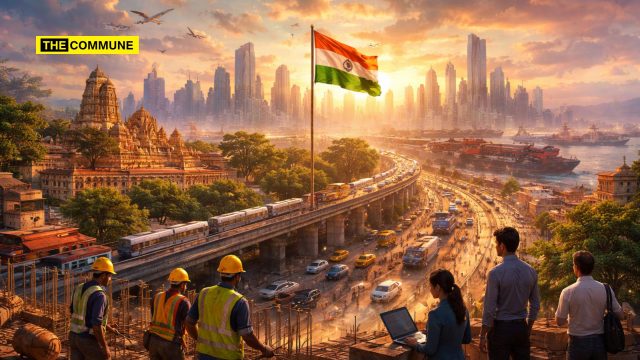
The idea that India might escape the so-called “middle-income trap” has long been treated with skepticism in global economic circles. The trap, as defined by institutions like the World Bank, describes a stage where countries rise from poverty but then stagnate before achieving high-income status. Historically, very few nations have made that leap just a few dozen in the last several decades.
Yet a recent argument in the Washington Examiner suggests that India may be one of the rare exceptions. That claim, while optimistic, is not without merit. In fact, when one steps back and examines India’s trajectory particularly under the current political and economic framework it becomes clear that this is not merely wishful thinking, but a grounded assessment of structural transformation.
At the heart of the optimism lies India’s sustained economic growth. Even conservative projections place India’s GDP growth in the range of 6-7% annually in the coming years, with periods of higher expansion already witnessed. This is not just about numbers; it is about consistency. Unlike many Latin American or Southeast Asian economies that surged and then stalled, India’s growth has shown resilience across global shocks from financial crises to pandemics.
But growth alone does not guarantee escape from the trap. What matters is the quality and drivers of that growth. This is where India’s model diverges significantly from others. Unlike export-heavy economies such as China, India’s growth has been deeply rooted in domestic consumption. With consumption accounting for roughly two-thirds of GDP, India has built a broad-based internal market that acts as a stabilizer against global volatility. This internal demand is powered by a rising middle class, urbanization, and a steady expansion of digital and financial inclusion.
Another crucial factor is governance reform. Over the past decade, India has undergone a series of structural changes tax reforms like GST, insolvency laws, digitization of welfare, and a strong push toward infrastructure development. These reforms are not cosmetic; they address long-standing inefficiencies that historically slowed India’s economic momentum. The expansion of highways, railways, ports, and digital infrastructure has dramatically reduced transaction costs and improved productivity.
Equally important is the competitive federalism that has emerged across Indian states. Unlike centralized economies, India’s 28 states are increasingly competing for investment, innovation, and industrial growth. This internal competition creates a dynamic ecosystem where policy experimentation is encouraged and best practices are replicated. Such decentralized dynamism is often absent in countries that fall into the middle-income trap.
Demographics further strengthen India’s case. While many middle-income countries face aging populations, India remains a young nation. A large working-age population provides both a labor force and a consumer base. If harnessed correctly through education and skill development, this demographic dividend could sustain growth for decades.
However, optimism must be tempered with realism. India’s journey is far from guaranteed. One of the biggest challenges is employment. Despite strong GDP growth, job creation has not always kept pace. Wage growth has also remained modest in many sectors, limiting consumption expansion. If India fails to generate sufficient high-quality jobs, its demographic advantage could turn into a liability.
Inequality is another concern. While India’s overall inequality levels are lower than some developed nations, wealth concentration at the top remains significant. A growth model that disproportionately benefits the elite risks undermining social cohesion and long-term demand.
There is also the challenge of transitioning from investment-driven growth to innovation-driven growth. The World Bank and other institutions emphasize a “3i” strategy: investment, infusion of technology, and innovation as essential for escaping the trap. India has made progress in the first two stages, particularly through infrastructure and technology adoption, but innovation remains uneven. While sectors like IT and startups are thriving, manufacturing innovation and deep-tech development need further strengthening.
Yet, what distinguishes India from many other middle-income countries is not just economics it is political stability combined with a clear long-term vision. The goal of becoming a developed nation by 2047, marking 100 years of independence, is not merely symbolic. It provides a strategic direction that aligns policy, investment, and public expectations.
Critics often argue that India’s democratic system could slow down decision-making compared to authoritarian models like China. But this critique overlooks a key advantage: democratic legitimacy. Policies that emerge from democratic consensus are more sustainable and less prone to abrupt reversals. Over time, this stability can be more valuable than speed.
Moreover, India’s global positioning has strengthened significantly. Trade agreements, such as the recent deal with the European Union, and deeper engagement with major economies like the United States, are integrating India more firmly into global supply chains. This integration is crucial for technology transfer, export growth, and capital inflows – all essential ingredients for escaping the middle-income trap.
There is also an intangible but powerful factor at play: civilizational confidence. For decades after independence, India’s economic policy was marked by hesitation and ideological constraints. Today, there is a noticeable shift toward assertiveness and ambition. This change in mindset both within the government and among the people cannot be quantified, but it plays a significant role in shaping economic outcomes.
The Washington Examiner’s argument ultimately rests on a simple but compelling premise: India is doing enough of the right things, at the right time, and at the right scale. It is building infrastructure, reforming institutions, leveraging technology, and engaging globally all while maintaining democratic stability.
Of course, history is littered with countries that seemed poised for greatness but fell short. The middle-income trap is not a myth; it is a well-documented reality. But history is not destiny.
India’s path will depend on whether it can sustain reforms, deepen human capital investment, and ensure that growth translates into widespread prosperity. If it succeeds, it will not just escape the middle-income trap it will redefine the development narrative for the 21st century.
In that sense, the question is no longer whether India can escape the trap. The more relevant question is whether it can do so while remaining true to its democratic ethos and inclusive aspirations. If the answer is yes, then India’s rise will not merely be an economic story it will be a civilizational one.
Dr. Prosenjit Nath is a techie, political analyst, and author.
Subscribe to our channels on WhatsApp, Telegram,Instagram and YouTube to get the best stories of the day delivered to you personally.
There is a word for a party that endorses a Supreme Court verdict that millions of Hindus regard as a desecration of their most sacred pilgrimage, then shelters the man accused of looting gold from that very shrine, and then when election season arrives in Kerala produces campaign videos invoking the name of Lord Ayyappa as though it were a vote-harvesting prop. The word is not hypocrisy. Hypocrisy implies some residual shame. What Congress has done with Sabarimala is something colder and more calculated: it is the systematic instrumentalisation of Hindu faith for electoral arithmetic, with no principle beneath it at any stage.
Act One: The Endorsement
When the Supreme Court’s September 2018 verdict allowing women of all ages to enter Sabarimala came down, millions of Kerala Hindus responded with spontaneous, sustained, months-long protest – one of the largest grassroots mobilisations in recent Kerala history. Women formed a 620-kilometre human wall. Devotees blocked approaches to the temple. The message from the believer was unambiguous: this was not a question of gender equality. This was a question of the unique, centuries-old nature of Lord Ayyappa’s celibate form, and the rights of a religious tradition to govern its own practice.
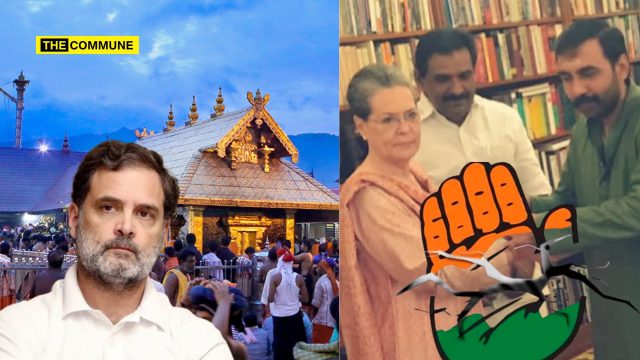
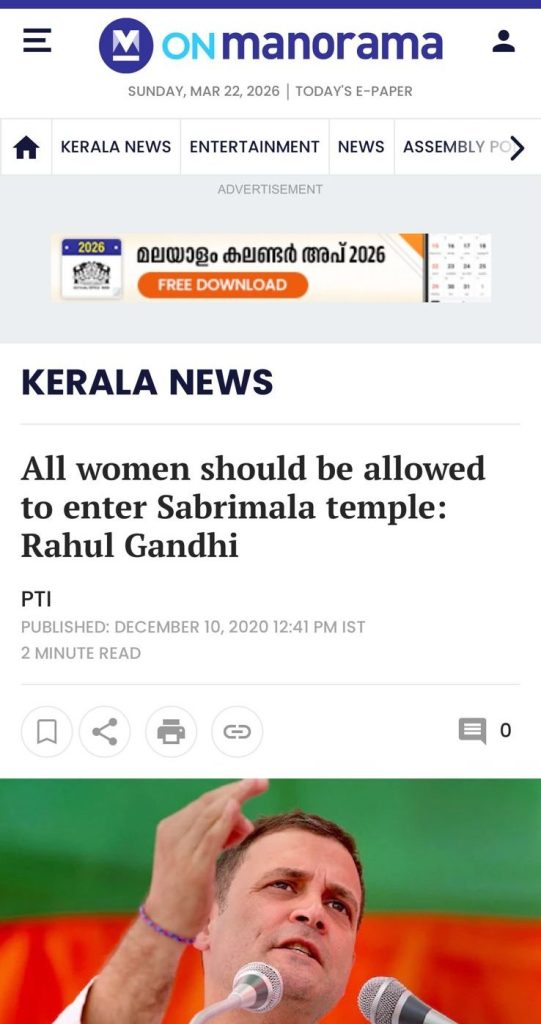
Rahul Gandhi’s response was to endorse the verdict. In December 2020, he stated publicly that all women should be allowed entry into Sabarimala, throwing Congress’s weight behind a judicial intervention that the faithful had already rejected with their feet.
Image Source: X
This was the Congress that claims to respect India’s plural traditions; this was the Congress that, when Hindu devotees protest the disruption of their faith, sides with the disruption. The message to the believer was clear: your tradition is negotiable, your sentiment is a lobby to be managed, and your deity’s identity is subject to revision by those who know better.
Act Two: The Gold Theft and the Photograph
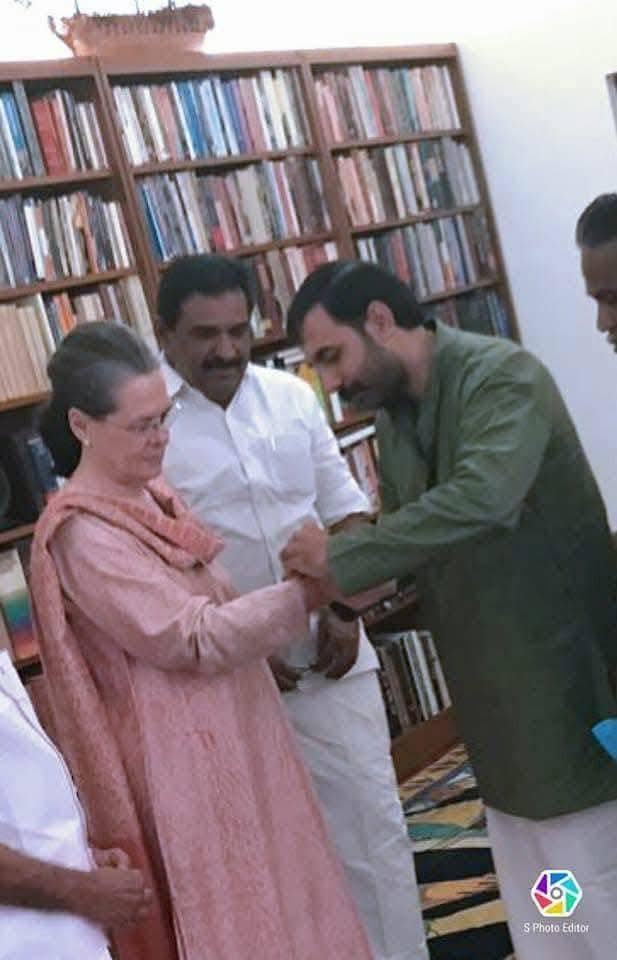
Then more recently came the Sabarimala gold theft case. The primary accused Unnikrishnan Potti, a man whose proximity to the Congress ecosystem was not incidental, was photographed in the company of Sonia Gandhi herself on multiple occasions. The photograph does not prove conspiracy.
Image Source: X
It proves something nearly as damaging: that the Congress party’s network in Kerala had, at its accessible edges, individuals whose conduct toward Sabarimala was not reverential but predatory. The party that endorsed disruption of the temple’s traditions had, within its orbit, someone now accused of robbing the deity’s consecrated gold. There is a straight line from treating Sabarimala as a political battleground to treating it as a resource to be exploited.
Act Three: The Campaign Video
Now it is March 2026. Kerala assembly elections are approaching. And INC Kerala’s official X account has posted a campaign video, invoking Ayyappa, attacking the incumbent government over corruption at the temple, asking rhetorically why the Global Ayyappa Sangamam was conducted “after looting Ayyappa’s gold.” Congress, the party that told devotees their traditions did not matter, is now posturing as the protector of Lord Ayyappa’s honour. The party whose leader endorsed the dismantling of Sabarimala’s customs now wraps itself in the deity’s name to harvest votes.
അയ്യപ്പന്റെ സ്വർണം വരെ കൊള്ളയടിച്ചിട്ട് ആഗോള അയ്യപ്പ സംഗമം നടത്തിയത് എന്തിനാണ്.. അവിടെയും അഴിമതി നടത്തി. ഭകതർ മിണ്ടില്ല എന്ന് കരുതി ഒന്നു അറിയില്ല എന്ന് കരുതരുത്. പൊതു ജനം കഴുതയല്ല! pic.twitter.com/aVKayRIA62
This is not a pivot. It is not a rethink. It is not even a politically motivated conversion that could be taken at face value. It is a campaign video from a party that has demonstrated, in sequence: contempt for the devotee’s position in 2018-2020, proximity to the accused in the gold theft case, and now electoral opportunism in 2026. Lord Ayyappa is, in Congress’s political calendar, an adversary when his traditions inconvenience the party’s progressive signalling, a non-issue when his gold is being stolen by those in the party’s network, and a mascot when his name can win seats.
The Pattern Is Not Sabarimala-Specific
This is the standard Congress operating model with Hindu institutions. Endorse every judicial or legislative intervention that weakens the autonomy of Hindu religious practice: temple takeovers, entry disputes, festival regulations under the banner of reform. Simultaneously ensure that the party’s Muslim and Christian minority vote banks face no equivalent “reform” pressure on their personal law or institutional autonomy. Then, at election time, pivot back to whichever Hindu symbol or deity is locally resonant and produce content that implies the party has always been on the side of the faithful.
The Kerala Hindu voter watching that INC Kerala campaign video today should ask one question: what has changed? Rahul Gandhi’s 2020 statement endorsing women’s entry into Sabarimala has not been retracted. The photograph of the gold theft accused with Sonia Gandhi has not been explained. The Congress party’s position on the Supreme Court verdict has not been publicly reversed. What has changed is the electoral calendar. And that, for Congress, is sufficient reason to discover that Lord Ayyappa’s gold matters even if it did not matter enough, at any point over the last eight years, to stand with the people who protect his temple.
Subscribe to our channels on WhatsApp, Telegram,Instagram and YouTube to get the best stories of the day delivered to you personally.
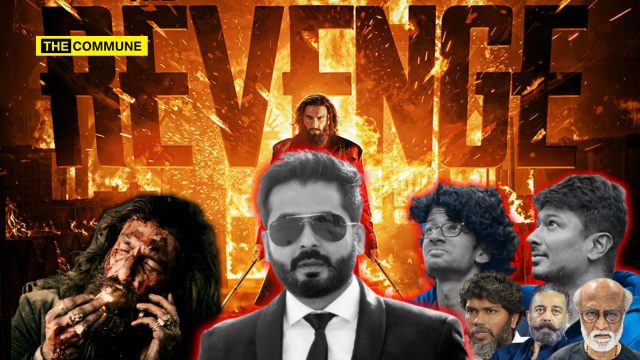
A film breaks box office records across the country. Tier-2 cities from Tirunelveli to Pollachi to Tiruppur report sold-out shows. The Tamil-dubbed version earns ₹7.05 crore in four days without a single Tamil star attached. And from the sprawling, opinionated, ceaselessly self-promotional world of Kollywood, or rather Dravidianwood – not a word.
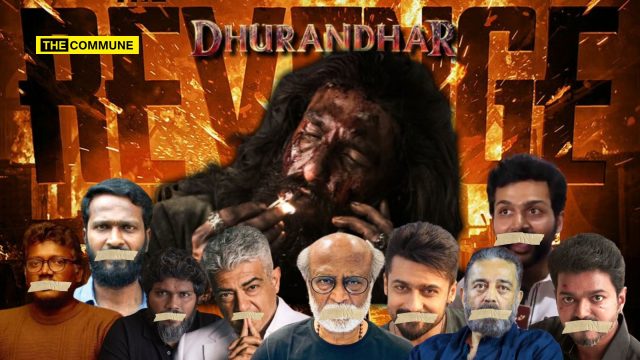
No congratulatory posts on X. No “What a film!” Instagram stories. No gracious acknowledgement from any of the so-called A-listers such as Suriya, Karthi, Vijay, Rajinikanth, Kamal Haasan, Siddharth, Pa Ranjith, Mari Selvaraj who would ordinarily bend over backwards to signal solidarity with any production that carries the right ideological passport.
The same people would otherwise virtue signal movie goers and whine about audiences not going to the theatre to watch movies. Is this not an opportune time to celebrate the return of audiences to theatres?
Tamil cinema, an industry that never misses an opportunity to celebrate itself, to moralise about cinema’s social responsibility, to lecture the country on what constitutes “meaningful” storytelling, has looked at Dhurandhar 2: The Revenge and chosen, with extraordinary discipline, to say absolutely nothing.
The contrast with Tollywood is brutal and telling. Mahesh Babu, Allu Arjun, Jr NTR, Vijay Deverakonda, Ram Charan, Telugu cinema’s biggest names, watched the film on opening day, first show, and immediately took to social media with effusive, unprompted praise.
#DhurandharTheRevenge is an explosion executed with perfect precision!!!! The finest version of Ranveer unleashed and how… 💥💥💥 The way Aditya Dhar has conceived and delivered this standing ovation worthy experience is remarkable 👏🏻👏🏻👏🏻 Special mention to Maddy’s performance…
Just Watched #Dhurandhar2⁰Patriotism with swag 🇮🇳
A film that will make every patriot proud 🇮🇳⁰Many clap-trapping moments 👏🏽
BLAST! 💥
Congratulations to the entire team.⁰Fine performances by @ActorMadhavan garu & all actors . Technical brilliance .
#DhurandharTheRevenge is raw, gripping and impactful 🔥@AdityaDharFilms brings scale and emotion together seamlessly. What he has done with this film is truly remarkable.@RanveerOfficial delivers a phenomenal performance – full of intensity and holds your attention…
SS Rajamouli, who has no personal stake in the film’s success, called it a triumph.
I loved Dhurandhar-1, but The Revenge surpassed the original in both scale and soul.
The writing, casting, technical execution, music, world design and direction are flawless…. But it’s the emotional stakes that really ground it.
The Telugu industry, knowing full well the ‘ideological controversy’ that surrounds a Kashmiri Pandit director making a film about intelligence operations and national security, chose courage over calculation.
Tamil cinema chose the opposite.
Rajinikanth is not a man who struggles to find his phone when a film moves him. In April 2017, he called Baahubali 2 “Indian cinema’s pride” and SS Rajamouli “God’s own child” within hours of watching it. In October 2022, he watched Kantara and immediately told the world: “You gave me goosebumps, Rishab. Hats off to you as a writer, director and actor.” In June 2024, he watched Kalki 2898 AD and typed“WOW! What an epic movie!” before the ink on his ticket stub could dry. This is a man with a proven, documented reflex for public celebration of Indian cinema when it achieves something extraordinary. That reflex has now mysteriously jammed. Dhurandhar 2: The Revenge, one of the biggest Indian films of 2026, is playing to packed houses including in his own base. The man who called a Telugu film “Indian cinema’s pride” cannot find it within himself to offer even a perfunctory acknowledgement. The Superstar, it turns out, only has a conscience when the film in question does not threaten his relationship with the Dravidian establishment.
Vijay, now TVK chief and aspiring Chief Minister of Tamil Nadu, spent an entire film career playing the righteous common man standing against the corrupt establishment. He understood audience sentiment well enough to build an electoral movement on it. But Vijay has not found a single word to say about a film that his own presumed voters have turned out to watch in droves – can he not speak up for the industry he belongs to (or is it belonged to?) Vijay seems to want to “aura farm” with silence as his weapon. Sorry, not working. Well, he has been maintaining silence even for his own film Jana Nayagan after it faced hurdles with the censor board. A man who cannot speak for himself certainly will not speak for Dhurandhar 2. His silence on this film is, at minimum, consistent with his broader political cowardice and at maximum, a deliberate signal to the Dravidianist ideology that he knows which films Tamil Nadu is and is not permitted to celebrate.
Ajith Kumar is often positioned as Kollywood’s most apolitical superstar, the one man who stays out of the ecosystem’s virtue wars. His fans celebrate his studied indifference to industry politics as a form of integrity. And yet, when his own Good Bad Ugly released in April 2025, the industry closed ranks around it – screening it, promoting it, rallying for it. That solidarity flows one way. When a Hindi film, directed by a Kashmiri Pandit, starring Ranveer Singh, a Sindhi and R. Madhavan, fills Tamil Nadu’s single screens with paying audiences – Ajith’s studied silence is not aloofness. At the very least, he can support a fellow Sindhi after all, Sindhi blood flows through his veins. And in celebrating Dhurandhar, audiences are not doing hero worship – there is an awakening, a sense of patriotism and genuine love for well-made cinema. Can Ajith not support that?
This is not an accident or an oversight. These are people who tweet about everything under the sun while praising the Dravidian party at the helm while also posting for each other’s birthdays, foreign film awards, social causes, rainfall. The idea that Dhurandhar 2, one of the biggest Indian films of 2026, simply escaped their notice is laughable. The silence seems deliberate, coordinated, and cowardly. It reflects the iron grip that the Dravidian political-cultural ecosystem exercises over its artists – an unwritten code that says: you may celebrate anything except that which the party and its allied intelligentsia have not pre-approved.
And what has that ecosystem decided about Dhurandhar 2? The hostility was visible even before the film released. When Tamil Nadu theatres cancelled shows on opening day, ostensibly over technical delays, the online Dravidian ecosystem barely concealed its satisfaction. Prakash Raj, the ecosystem’s ever-reliable attack dog, took a “subtle dig” at the wave of Telugu stars praising the film, insinuating that their appreciation was motivated by “obligations.”
The film’s content, its theme of intelligence and national security, its Kashmiri Pandit authorship – all of it makes it radioactive for a cultural establishment that has spent decades positioning Tamil identity as inherently sceptical of Indian nationalism.
But the audiences of Tamil Nadu never got that memo.
They turned up in Tirunelveli, in Pollachi, in Dindigul, in Tiruppur. They filled seats in interior towns. They watched a Hindi film in Tamil dubbing and they left satisfied. The disconnect between Tamil cinema’s English-social media-verified gatekeepers and the actual Tamil-speaking public has never been more starkly visible. Ordinary Tamils do not hate India. They are not reflexively suspicious of patriotism. They are not, as the Dravidianist echo chamber insists, ideologically quarantined from the rest of the country. They simply want good cinema, and when good cinema arrives, they recognise it, with or without their industry’s permission.
What Dravidianwood’s silence reveals is not sophistication. It is fear. Fear that acknowledging a film like Dhurandhar 2 would invite the wrath of the political establishment that funds, protects and validates their careers. Fear that a single tweet of appreciation might cost them their next government award, their next state-sponsored premiere, their next comfortable seat at a DMK cultural event.
Telugu stars were brave enough to tweet. Tamil film industry Dravidianwood’s members were not. That single fact says more about the state of creative freedom in Dravidianwood than any press conference ever could.
Subscribe to our channels on WhatsApp, Telegram,Instagram and YouTube to get the best stories of the day delivered to you personally.
The Aditya Dhar film Dhurandhar 2: The Revenge seemed to have a smooth ride in Tamil Nadu so far, until Monday, 23 March 2026.
As reported by The Hindu reporter Mohamed Imranullah, a woman advocate named Sheela made an oral mention before the Madras High Court, urging action against the release of the Ranveer Singh-starrer Dhurandhar 2: The Revenge.
The mention was made before Chief Justice Sushrut Arvind Dharmadhikari and Justice G. Arul Murugan. She submitted that the film deals with political issues and should be banned in Tamil Nadu in view of the model code of conduct currently in force due to the impending Assembly elections.
Taking note of the submission, the Bench asked the advocate to file an appropriate petition if she wished to pursue the matter further.
A woman advocate named Sheela makes an oral mention before #MadrasHighCourt Chief Justice Sushrut Arvind Dharmadhikari and Justice G. Arul Murugan regarding Ranveer Singh starrer #Dhurandhar2TheRevenge She says that the movie revolves around political issues and hence it should… pic.twitter.com/lOMyKuNeHR
For years, Tamil cinema’s ecosystem has operated within a tight ideological comfort zone. Narratives, heroes, villains, even humour – all carefully orbiting a familiar political gravity. Step outside that line, and the system pushes back.
Not with noise. Not with endorsements. But with something far more disruptive – audience validation.
From cities to interior towns across Tamil Nadu, theatres have reported packed houses and sold-out shows. Not just in Chennai, but in Tier 2 and 3 towns – far from the echo chambers of elite discourse. The message is unmistakable: the audience is not where the ecosystem thinks it is.
The sold-out shows in Tirunelveli and Pollachi are not a footnote. They are a sentence.
Dhurandhar 2 super viral in TN… Tier 2-3 cities Hindi language screens sold out, full memes about Jameel, Uzair also by Tamil Youth… 1 film destroyed decades built Oppression depression constipation Dravidian Cancerous Ideology which millions were spent during movie propagation
For years, a specific ecosystem has operated a quiet but ruthless cultural veto over Tamil screens. Films are filtered through an unspoken test: does this cinema respect the Dravidian framework? Does it mock “Sanghi” characters? Does it position Brahmins as villains? Does it signal the right caste loyalties? Films that pass get industry promotion, Tamil media celebration, and social media amplification by thousands of blue-tick handles. Films that fail the test get quietly strangled – limited screens, hostile reviews, coordinated trolling of the cast.
And then Aditya Dhar arrived.
He is not from Tamil Nadu. He is not from the Dravidianist or leftist ecosystem, either. He is a Kashmiri Pandit who made Uri: The Surgical Strike from the scar of a genocide his community faced that the leftist ecosystem, including the Dravidian progressives, spent years refusing to acknowledge. He carries no caste stamp, no political godfather in TN, no pre-clearance from the ecosystem’s gatekeepers. He simply made a film about India, its soldiers and Indian justice, and trusted audiences to respond.
They did. In numbers that left no room for spin.
In January 2026, Sivakarthikeyan’s Parasakthi – a film that arrived with full ecosystem endorsement, DMK cultural backing, heavy Tamil media push, and the implicit promise of political relevance heavily choked at the box office. The contrast could not be sharper or more instructive. One film was built for approval from the cartel. The other was built for the audience. Tamil audiences, as they always do when the choice is honest, chose the latter.
What Dhurandhar : The Revenge’s Tamil Nadu performance dismantles is the central myth the Dravidian left has peddled for decades: that the Tamil audience is uniquely insulated from “nationalist sentiment,” that patriotism is a North Indian import, and that any film touching military valour or justice for victims of terrorism is ipso facto “BJP propaganda” and therefore unwatchable below the Vindhyas. The people queuing in Tirunelveli district’s tier-2 multiplexes, buying out shows in a Hindi film they watched in dubbed Tamil, did not consult others before buying their tickets.
Producers across Chennai are watching the numbers very carefully. The arithmetic is brutal: when a non-ecosystem film reportes housefull shows from Tamil Nadu in four days without a single Tamil industry star or a gram of Dravidian cred, the calculation of what Tamil audiences will actually pay for changes permanently. The ecosystem’s power was never cinematic; it was logistical – controlling screens, controlling reviews, controlling the narrative of what is “acceptable Tamil cinema.” That control just took its biggest hit in years.
Aditya Dhar may not yet fully grasp what he has accomplished south of the Vindhyas. He went after a story. He got a cultural earthquake.
Subscribe to our channels on WhatsApp, Telegram,Instagram and YouTube to get the best stories of the day delivered to you personally.
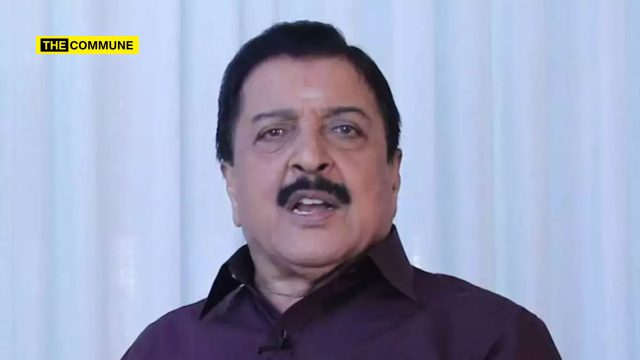
Actor Sivakumar on Wednesday inaugurated a newly opened branch of a restaurant and sweet shop in Anna Nagar, Chennai, and interacted with the media after tasting the food, as reported in News18 Tamil.
Speaking on changing food habits, Sivakumar said, “Today, it is impossible for a person to live without a hotel. When I came to Chennai, hotels were the only thing that saved my body for the first 10 years. At that time, I spent 45 rupees a month and ate for the whole month. Idli was 6 paise and vada was 5 paise. Today, times have changed. Money has lost its value. However, providing quality food is important.”
Responding to a question on whether he preferred home-cooked food or hotel food, he remarked, “Oh, come on! That’s like asking, ‘Do you prefer an actress or your own wife?’” (Laughs). “How could anyone look at an actress the way they look at their wife? Can you really raise children with an actress? Look at the kind of questions this guy is asking!”
He added, “Home-cooked food is the constant, the permanent choice; going to a hotel is just for a change of pace. If you eat at a hotel for all three meals, you’ll go crazy, you’ll end up with loose motions. For instance, if I go to a wedding in Coimbatore today, say we attend a wedding celebration for three days, there are 30,000 people eating there.”
Elaborating further, he said, “You have no idea what ingredients they’re using. If you spend three days eating in Coimbatore, you gain 2 kg in weight. By the fifth day, you’re suffering from loose motions. So, hotel food isn’t a permanent solution. That’s why, for me, it’s always home, wife, and children first; hotels come only second.”
On being asked about the secret to his youthful appearance, Sivakumar said, “A 16-year-old boy will remain young. What is this question? Now, when I wake up in the morning, I have eaten a handful of old rice, two glasses of buttermilk, papaya and guava slices. Get at least 7 hours of sleep, eat on time, go for a morning walk. Don’t sleep in an AC room. MGR proved to the world that an actor can travel. There is no chance of another actor being born like him.”
Reflecting on cinema and politics, he added, “Before Reynolds Reagan, MGR ruled the country. MGR had no heirs, no children. There is no chance of another being born like Sivaji, the greatest actor in the world. But he lost in politics. What I am saying is, no one has it all. Keep working hard, be happy with what God gives you and don’t compare yourself with anyone.”
When asked about the possibility of entering politics, Sivakumar responded on a lighter note, “I thought of becoming the Chief Minister during Kamaraj’s time, but I missed that opportunity.”
Subscribe to our channels on WhatsApp, Telegram,Instagram and YouTube to get the best stories of the day delivered to you personally.
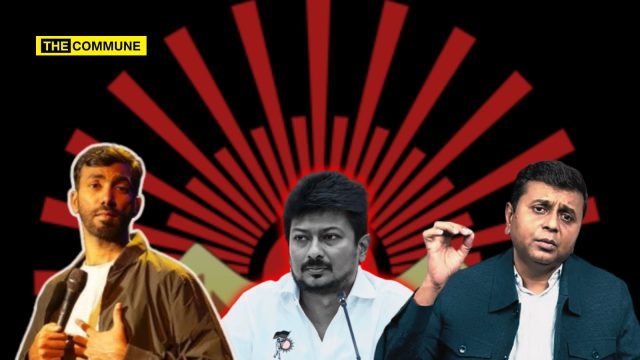
Stand-up comic Manoj Prabakar has found himself at the centre of an online backlash following clips from his recent political comedy set, with social media reactions spiralling beyond criticism of his material into sharp, often personal attacks invoking caste identities.
The controversy began after excerpts of Prabakar’s performance, which included jokes targeting political figures such as Udhayanidhi Stalin, circulated widely online. While some viewers praised his willingness to take on multiple political figures, a section of users said the jokes did not land and criticised the set as unfunny or forced.
In the clipping that is being shared on social media, Manoj Prabakar goes on to roast everyone in power, from Narendra Modi to MK Stalin to Udhayanidhi, and on the smug self‑image of Tamil Nadu itself. He tears into PM Modi’s 12 years in office, compares our gut to a stomach that has eaten only Gujarati food and is desperate even for “Italian Rahul,” and openly jokes about violence against minorities. He calls Tamil Nadu “UP–Bihar with more graduates,” nails our casual racism with the “vadakkan = N‑word” riff, and ridicules Periyar fanatics for stealing credit like Dhoni fanboys. Then he goes straight for the core of Dravidian power: DMK–AIADMK as the same corporate product, DMK as the “Aranmanai” dynasty franchise, and a state where you can become anything “except deputy chief minister” because that slot is reserved for the family.
That is the context in which the Udhayanidhi portion lands. Manoj explicitly says he likes DMK’s stated ideology on equality, but then rips into the entitlement of a son whose life was “settled” at tenth standard, whose “capacitor” career is built on constantly “taking charge,” whose GST jokes end with “SGST is going to his pocket,” and whose easiest constituency win is in a place that has voted DMK forever. It isn’t a Sanghi caricature; it’s an insider’s disappointment. He even underlines that he is from a DMK family, that his father is an “honest DMK supporter” who has supported “the entire DMK family tree,” and that he himself leans left, not right.
And yet, when this set hits X, the people baying for his blood are not BJP bhakts but the very Dravidianists he is broadly aligned with. The attack line is revealing: they don’t say, “your politics is wrong,” they say, “your audience is Mylapore maamis,” “this is a Nanganallur uncle rant,” “Tamil comics are Brahmin f***ers,” “privileged engineering graduates.” The villain they need is not “comic who bombed,” but “imagined Brahmin ecosystem” that supposedly owns him.
A Tamil standup comic makes some jokes on Udhayanidhi. Frankly, for me, they didn’t work. Apparently it didn’t for many others too. But rather than moving past that silly attempt at humour, you know what the D stockists did? Well, they made fun of — why not? — Tambrahms.… pic.twitter.com/WqydnIHMUn
In other words, if Manoj is going after the ecosystem; the DMK ecosystem responds or rather bullies him by going after Brahmins too.
Anyway, setting that aside for a moment. Let us also take a look at the remarks made to bully Prabakar for attacking the DMK.
@pmanojprabakar A failed Electrical engineer who sells populist jokes in the name of standup comedy with no social consciousness or political awareness. But you’re privileged and feels superior enough to evaluate someone else’s political journey and label it as disability. What… https://t.co/hrbxzM82nV
Lol did they pay people to laugh loudly near the mic? Most of this just seems like late 2000s Rahul Gandhi stuff that uncles would say standing. Nothing really specific to Udhayanidhi https://t.co/sSa2ReZt5Q
The set itself literally anticipates this: Manoj earlier complains that extreme left‑wing commenters keep calling Chennai comics “elite” and even branded him Brahmin despite him never mentioning his caste, and he jokes that if they want that tag so badly, they can go attack comics who have actually built their act around caste identity. He spells out that he is a left-winger himself, supposedly from a family of DMK supporters/Periyar admirers and still gets treated as suspect. The live‑show audience laughs; Dravidianist social media then proceeds to prove his point in real time.
These Dstocks are so predictable, Manoj is not a Brahmin and he made a joke about it as well in the same video. He is a left-leaning EVR fan, his father is a vehement DMK supporter. But the minute these Dstocks see somebody criticizing DMK, they resort to these usual crass… https://t.co/ZFxMvmmi98pic.twitter.com/AyuqiBVGkK
Tensions were reported from Kalampalayam village near Karamadai in Coimbatore district following an alleged attempt to carry out a burial on a pathway reportedly leading to a Hindu temple, prompting police intervention and protests at the site.
As reported in The Hindu, the incident occurred when family members and local residents attempted to bury a Muslim individual at a site described as a burial ground near the Ashurkhana Masjid. Police and Revenue officials intervened at the spot, following which members of the mosque committee were detained. This reportedly triggered protests by relatives of the deceased and members of the Muslim community, who demanded that the final rites be allowed without interference.
According to Hindu Munnani, the incident occurred on a pathway in Velayuthapuram that has been used by local Hindus for over 150 years to access the Angalamman temple. It is alleged that the land in question is government poramboke land and alleged that there had been earlier attempts to encroach upon it in the name of Waqf, which it said had been resisted.
Hindu Munnani further alleged that on 18 March 2026, the Islamist group brought the body of a person who was not connected to the village and attempted to carry out a burial on the pathway. The organisation alleged that the move was intended to establish control over the land and disrupt access to the temple. It also alleged that a pit had been dug at the site as part of the attempt.
A video shared on social media by Hindu Munnani shows police personnel, including senior officers, present at the spot and intervening to prevent the burial. According to the Hindu Munnani, tensions escalated when police intervened, and there were allegations that officers were attacked during the process. It was further stated that a woman police constable sustained injuries.
Hindu Munnani stated that protests were held by its members and local residents for several hours, following which the burial was halted.
The Kalampalayam area has witnessed similar tensions in the past over land access issues. In November 2023, residents had approached the district administration seeking access to a temple through land claimed by the Waqf Board, with reports at the time noting minor skirmishes and verbal disputes between groups over several months.
Further tensions were reported in June 2024 in the Karamadai–Mettupalayam belt when officials intervened to halt a burial on land under dispute, following complaints raised with revenue authorities.