A series of social media posts and circulating claims have raised questions over Pakistan’s projected role as a mediator in supposed United States–Iran talks, with emerging details indicating that the narrative of imminent negotiations may have been built on misleading or unverified information.
The sequence of events began with messages attributed to Pakistan’s military media wing, the Inter-Services Public Relations (ISPR), which were widely shared among journalists and on social media platforms. One such message stated:
“Breaking ‼️
Attributable to Government Sources
Iranian Foreign Minister Abbas Araghchi is expected to arrive in Islamabad tonight with a small delegation, according to government sources.
Following important discussions with the Pakistani mediation team, a second round of Islamabad peace talks between the United States and Iran is expected, government sources say.
A U.S. logistics and security team is already present in Islamabad to facilitate the negotiation process.”
This communication was reportedly circulated to multiple journalists and contributed to media reports suggesting that Pakistan was facilitating a fresh round of diplomatic engagement between Washington and Tehran.
Social Media Amplification and Claims
Several verified social media accounts echoed or amplified related narratives. A post by journalist Omar R. Quraishi referenced a meeting in Rawalpindi involving US Congressmen Jonathan Jackson, Jack Bergman, Thomas Suozzi, Pakistan Army Chief General Asim Munir, and acting US Ambassador Natalie Baker, citing ISPR as the source.
Another post by journalist Asma Shirazi claimed: “India has attacked three PAF airbases in Pakistan with missiles fired through Indian planes. India attacked Noor Khan airbase in Rawalpindi, Mureed Base and Shorkot Base.. Pakistans assets are safe… Now India be ready for our response… DG ISPR”
Separately, Osama Bin Javaid posted: “BREAKING: Reports of multiple attacks in Pakistan. Initial tally suggests at least four locations hit including MuzaffarAbad.
Nuclear armed India seems to have just attacked its nuclear rival Pakistan”
In a follow-up post, he added: “India’s late-night strikes resulted in 8 Pakistani fatalities and 35 injuries. A total of 24 impacts were reported in six localities, with two individuals still missing.
According to ISPR Director General Lt Gen Ahmed Sharif Chaudhry”
It’s funny how these “journalists” know when to explicitly state they’re quoting ISPR, vs when not to do that. Seems as if the point was to misguide foreign publications that depend on their local correspondents and/or media outlets’ reporting. https://t.co/SuPnGnXLM7 pic.twitter.com/dqFtup342b
— Omer (@soloflight95) April 25, 2026
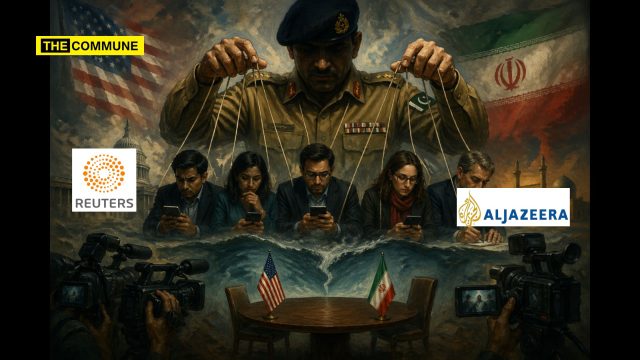
It turns out that Reuters in Pakistan, Al Jazeera, and a bunch of other so-called journalists are just copying forwards directly from Pakistani military WhatsApp groups and posting them as news.
Thats why all the leaks sound the same,its was all propaganda. https://t.co/TMCYE8VlCf pic.twitter.com/SdEDBKA6tl— Ali (@MerruX) April 25, 2026
Additional posts from multiple users, including Owais Tohid, Omar Quraishi, and Jana Choukeir, repeated claims that Iranian Foreign Minister Abbas Araghchi was expected to arrive in Islamabad with a small delegation and that a second round of US–Iran talks was likely following discussions with Pakistani mediators.
Step 1: Pakistan’s ISPR cooks up a fantasy forward.
Step 2: Send it on WhatsApp to eager journalists.
Step 3: Reuters in Pakistan, Al Jazeera and others post it as “breaking news”.
Step 4: The same propaganda now looks credible because it has famous logos on it.
That explains… https://t.co/XejQ0h6d1V
— Omer Ghazi (@OmerGhazi2) April 26, 2026
Iran’s Position
Despite the widespread circulation of such claims, statements from Iranian officials contradicted the suggestion of direct talks with the United States. Iranian Foreign Ministry spokesperson Esmaeil Baqaei stated on X: “We arrive in Islamabad, Pakistan, for an official visit. FM Araghchi will be meeting with Pakistani high-level officials in concert with their ongoing mediation and good offices for ending American-imposed war of aggression and the restitution of peace in our region.”
He further clarified, “No meeting is planned to take place between Iran and the US. Iran’s observations would be conveyed to Pakistan.”
Reports also indicated that Iranian President Masoud Pezeshkian conveyed to Pakistan’s Prime Minister Shehbaz Sharif that Tehran would not participate in what he described as “imposed negotiations” under pressure or blockade.
Claims of US Participation Fail to Materialise
Parallel reports suggested that US representatives, including Steve Witkoff and Jared Kushner, were expected to travel to Islamabad, with additional speculation about the possible involvement of Vice President JD Vance. However, these visits did not take place.
US President Donald Trump later stated: “We’re not going to spend 15 hours in airplanes all the time going back and forth to be giving a document that was not good enough, and so we’ll deal by telephone, and they can call us anytime they want.”
Iranian Foreign Minister Araghchi completed his visit to Pakistan without any meeting with US officials, and no negotiations occurred.
Allegations of Misinformation
Journalist Ryan Grim commented on the situation, stating: “It was never true that Aragchi had any plans to re-enter negotiations last week. Why would the Pakistanis say otherwise?”
He further wrote: “The erroneous news reports indicating that the U.S. and Iran would be restarting talks were produced because Pakistan’s ISPR sent the following incorrect update to many journalists. (They didn’t send it directly to me, but I was forwarded it.)”
The erroneous news reports indicating that the U.S. and Iran would be restarting talks were produced because Pakistan’s ISPR sent the following incorrect update to many journalists. (They didn’t send it directly to me, but I was forwarded it.)
This was the message:
“Breaking…
— Ryan Grim (@ryangrim) April 25, 2026
As reported in Moneycontrol, political sociologist David Miller also criticised the narrative, stating: “Perhaps because the Pakistani junta has been lying about every single thing since these ‘negotiations’ began? And even about the premises that established the negotiations (“Trump has agreed to the Ten Points” etc etc). Remarkable that any journalist would fall for their nonsense.”
Unethical Media Practices?
The situation has also led to scrutiny of journalistic practices. Several international outlets and correspondents from Al Jazeera, Reuters etc seem to have relied on forwarded messages originating from Pakistani military communication channels without independent verification. These media organizations and their journalists seemed to be just copying forwards directly from Pakistani military WhatsApp groups and posting them as news when the real job of reporters is to verify the news instead of forwarding.
WOW. Reuters too?
Just to be clear, the main job of journalists is NOT to forward the message they receive from a govt, but to figure out if it is true. That is the job, it seems nobody knows how to do that anymore. https://t.co/ZTLbkEaDIc— Waqas (@worqas) April 25, 2026
Outcome
With no US-Iran talks taking place and official Iranian statements contradicting the claims, the narrative of Pakistan facilitating imminent negotiations has come under question. The episode has highlighted discrepancies between circulated reports and confirmed diplomatic positions, raising concerns over the reliability of information flows linked to official and media sources.
Subscribe to our channels on WhatsApp, Telegram, Instagram and YouTube to get the best stories of the day delivered to you personally.