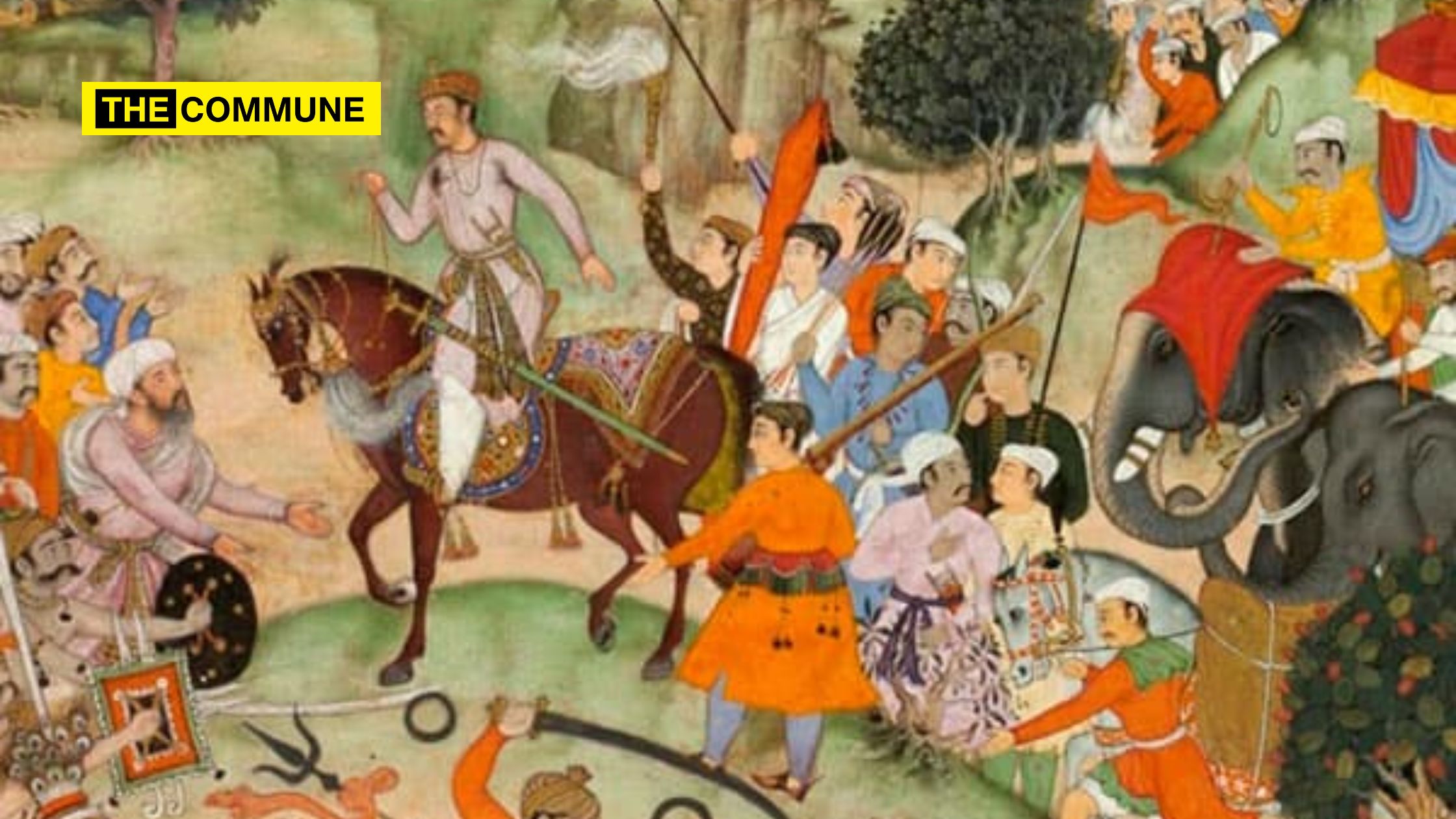
Since time immemorial, to be precise, for the last 3000 years, the two animals have been used immensely in battles: elephants and horses. Usually, three major characteristics define the usability of animals in battles: size, weaponry, and controllability. Elephant’s size is intimidating, while its tusks, feet, trunk and forehead are formidable weapons. Elephants, despite being intelligent, are relatively tough to train, especially for battlefield purposes. Horses, though, do not have a dreadful size, but they allow humans to sit comfortably on their backs. They are easily controllable and trainable, but their main asset is their speed, capability of travelling long distances and manoeuvrability due to their inner strength. They could even travel 100 miles per day. Had these Central Asian horses not been so capable, India may still have been basking in its ancient glory.
In contrast, Indian horses were found to be relatively weak, mainly due to heat and humidity in India. On the other hand, Indian elephants were found to be of excellent quality, even better than their African counterparts. Elephants have a special place in Hindu Puranic tales. Hindu god Ganesh has the head of an elephant and the epics Ramayana and Mahabharata extensively portray elephant warfare. In ancient India, the army consisted of four significant parts: infantry, cavalry, elephants and chariots, collectively called chaturanga. Thus, the game of chaturanga came into being that later evolved into the game of chess, wherein the Elephant (rook) is considered a powerful piece.
Historically, kings and commanders used elephants for myriad works like cargo vehicles to carry heavy loads over long distances due to their sheer size. Kautilya stated that breaking fortress walls, gates and towers was among the elephants’ essential functions and further declared that the victory of kings in battles depended mainly upon elephants. Other Indian writers also expressed the utility of elephants in no uncertain terms: Where there are elephants, there is victory; the kingdoms depend on elephants. One rightly said that ‘one elephant, duly equipped and trained in the methods of war, is capable of slaying six thousand well-caparisoned horses’; or ‘an army without elephants is as despicable as a forest without a lion, a kingdom without a king or as valour unaided by weapons.
In Europe, they were only used as draught animals to carry weights. Babur once stated that his elephants could carry even 500 kgs of load. Two or three sturdy elephants could bear arms and ammunition, usually requiring 500 men. Elephants can walk up to 16 Kms/hr and can move in any terrain, whether on a steep slope or plains. They can even cross rivers with relative ease, which makes them ideal for war. Further, most carnivore animals like lions and tigers are fearful of elephants providing the riders a safety net. In Asia in general and in India in particular, they were used extensively as war tanks to be used to ramrod enemy flanks. On the flip side, they are also known to be voracious eaters.
To tame elephants, extensive training was required for years, during which they were trained to trample down the enemy and kill them mercilessly. They were also taught to endure large sounds to acclimatize them to war noises, or else they would panic in battle. Animals were deliberately slaughtered in front of them to make them accustomed to the sight of blood. An elephant is finally considered tame and trained when it allows a man to ride on its back.
Elephants were integral to Hindu armies and used primarily for shock and awe. Hasan Nizami characterized the series of elephants as ‘mountains of steel’. These animals acted as command centres or a platform to throw javelins. Initially, Turk armies suffered heavy losses due to elephants. After a few initial reversals against Hindus, the Turks figured out myriad ways to neutralize elephants. They usually employed axes and arrows to hit the beast’s legs to hurt him, as its feet were susceptible. They also used to put caltrops or rods with spikes on the ground. They frequently used to cut its trunk with their sword, forcing it to run away from the battle. Turkish invaders used to throw burning naphtha (combustible oil) balls at the rushing elephants, thus harming them immensely. Mahmud used this technique to defeat Hindu Shahi king Anandpal when the Turks were on the verge of defeat. Afterwards, it became a standard operating procedure, to be used against marauding elephants. It significantly reduced the importance of elephants in wars. However, Hindus kept using them in the battles, even though they were more of a liability, given their slow mobility.
These animals were most useful with the enemies that had not fought against them earlier as happened with Ghori in the first battle of Tarain in 1191. Realising his mistake, Ghori reportedly practiced with dummy wooden elephants before attacking again in 1192. After the advent of gunpowder in the 16th century, the practical utility of this large but unpredictable pachyderm was reduced largely. Probably they were given up in favour of artificial and predictable weapons.
On the contrary, the Turks’ biggest strength was their large Turkoman horses. These horses required large arid tracts of grasslands that were not present in the cultivated plains of India with its humid climate. Even if the battles were lost, they could retreat safely at a fast speed due to their sturdy horses to prepare for the next conquest. With their weak Indian horses, Hindu armies could not chase them down. Even when Hindu kings wanted to finish the invader’s army, they could not. The Turkoman horse is the noblest in the whole of Central Asia and surpasses all other breeds in speed, endurance, intelligence, faithfulness and has a marvelous sense of locality. On their predatory expeditions, the Turkomans often covered 650 miles in the waterless desert in five days. They owed their power to the training of thousands of years in the endless steppes and deserts and to the continual plundering raids, which demanded the utmost endurance and privation of which horse and rider were capable. This swift mobility enabled the commanders to send soldiers on advanced reconnaissance and spying missions. The transmission of messages between Bin Qasim and the Caliph of Basra during the attack on Sindh was quick due to this characteristic. Ghazni could launch 17 attacks on India in just 25 years also points to this extraordinary mobility.
Due to their rigorous training, they developed into outstanding horse archers. They could aim and accurately shoot six arrows per minute. The effective range of the composite bow used to be 300 yards and a maximum of 500 yards. This ability could destroy sword-wielding Armenians from a distance from the Turk archers. Further, the latter’s bows were composite ones made of wood, horn and sinew. The strings were of animal hides that made them stronger. The main advantage of these bows was their higher power and smaller size. They also used nawaks (crossbows), arrows that easily pierced the enemy’s armour. Bows were accorded sacred status along with the horses. Turks also used metallic stirrups to deploy heavy cavalry on the battlefields, while Hindus used rudimentary stirrups made of wood.
Until the 12th century, Rajputs used to import 10,000 horses from Central Asia. However, Turks and Mongols later stopped exporting horses, fearing that the animals would be used against them only. After coming to India, most horses used to fall sick due to heat, improper feeding, and lack of horseshoes. Later on, crossbreeding was tried between Arabian and Indian horses so that the hybrid could survive in India’s humid weather. Famous Marwari horses were the output of this process only; still, they were no match for the Turkish horses. Its hilly and forested terrain was not suited for horses at all. Conversely, this terrain was perfect for the elephants and hence Indian rulers came to rely upon the elephants.
The combined factors of the continued use of elephants and the absence of sturdy horses contributed heavily in keeping Hindus under Islamic rule for 500 years.
(This article was originally published in Bharat Voice and has been republished here with permission.)
Click here to subscribe to The Commune on Telegram and get the best stories of the day delivered to you personally.



The Four Way Cross-Roads Of Andhra Politics: Which Way Will It Go?
The bifurcation of Andhra Pradesh in 2014 has led to economic and political turbulence for the residual state. As Andhra’s Chief Minister Chandrababu Naidu grappled with building a new state infrastructure, he lost the 2019 election to Jagan Mohan Reddy’s YSR Congress. Andhra politics is now a four-way battle, including Pawan Kalyan’s Jana Sena Party.
Bifurcation in 2014
The controversial bifurcation of the erstwhile Andhra Pradesh to create Telangana in 2014, initiated by the Congress-led UPA II government at the Centre, has had mixed results for both states. Telangana had its own set of challenges. However, the newly residual state of Andhra faced the brunt of economic and financial uncertainty, as the unified state’s largest city of Hyderabad, its largest revenue generator, went to Telangana. Andhra retained the second and third-largest cities of Vishakapatnam and Vijayawada.
While Telangana’s politics centred mainly around the newly victorious Telangana Rashtra Samiti (TRS) party, claiming success in the fight for bifurcation and the creation of Telangana, Andhra’s politics have played out on the shaky grounds of loss and uncertainty. The party that won the first election of the new state of Andhra, Chandrababu Naidu‘s Telugu Desam Party (TDP), had its work cut out for the first term. It had to draw up a new charter for the new residual state from the ground up, as it did not have a capital city yet. The state’s people pinned their hopes on Naidu, given his track record as the man behind Hyderabad’s meteoric progress, development and expansion and his reputation for digitization and governance.
Chandrababu Naidu’s TDP
Naidu’s job wasn’t an easy one. With no administrative infrastructure in place – everything from a legislature building to a capital city, high court, administrative offices, police quarters and a long list of other requirements for the functioning of a state had to be ideated, planned and implemented. Known as a man with a vision and a progressive mindset, Naidu’s ambitious plans for the new state of Andhra Pradesh needed time, effort and patience. While the educated sections of society understood this, most from the lower classes did not. The second election in the new state in 2019 turned his fortunes around.
Naidu lost his previous 2014 victory to Jagan Mohan Reddy’s Yuvajana Shramika Rythu Congress Party (YSRCP), a spin off from the Congress party (INC). Reddy rode to power on a wave of welfare schemes, sops for the lower classes, significant minority appeasement promises and caste-based politics that resulted in a divided Hindu vote. In contrast, a majority of Muslims and almost a hundred per cent of Christians voted for Reddy, whose family is of converted Christian stock.
BJP
Unlike Telangana, which now has a note-worthy BJP presence in its own right, Andhra does not have a stand-alone BJP presence. It hopes to improve its tally in the state, in which its presence and influence is still small despite strategic alliances. Interestingly, the state’s BJP was in partnership with the previous TDP party in power, with blessings from the BJP top brass, but made its displeasure clear when TDP leader and previous Andhra Chief Minister, Chandrababu Naidu campaigned against it in neighbouring South Indian states, after his frustrated attempts at requesting the BJP Central government to grant Special Status to the newly created state of Andhra.
With relations going sour between the TDP and the BJP over the request of Special Status for the state and Naidu’s attempt at bringing a “third front” together, Jagan Reddy’s YSRCP was able to cash in and accomplish electoral gains in the 2019 Andhra state elections. Jagan Reddy’s criminal record and imprisonment did not deter him from ambitions of electoral victory. Reddy has a whopping 31 cases against him that he continues to seek legal council for. He has spent 16 months in jail, after the CBI arrested him on embezzlement charges and the Supreme Court refused his plea for bail.
Pawan Kalyan
Aside from the political outfits of the TDP, BJP, and YSRCP, Telugu actor Pawan Kalyan‘s entry into Andhra politics makes it a four-way content for electoral victory in the 2024 Lok Sabha elections.
Pawan Kalyan is a famous Telugu actor and the brother of yesteryear Tollywood hero, “megastar” Chiranjeevi. Pawan Kalyan’s political party, the JSP (Jana Sena Party) was launched in 2014 and hopes to reap rewards in 2024 after ten years on the sidelines.
The JSP has been gaining momentum in the state and has been in the news lately for Pawan Kalyan’s vocal criticism of Jagan Reddy’s policies and the BJP leadership’s interest in a possible tie-up with his party. In this context, the recent meeting between PM Modi and Pawan Kalyan in Vishakapatnam assumes some significance.
Alliance Possibilities
The BJP and the Jana Sena party (JSP) have been in touch for a while now. Still, the intent of a formal political relationship between the two parties hasn’t always been clear, as the BJP exercises restraint in its comments and reactions to events unfolding in the state. The BJP appears to be on agreeable terms with the current YSRCP dispensation in Andhra and may not be inclined to overtly support the Jana Sena Party on the one hand and the YSRCP on the other. Naidu’s TDP and Pawan Kalyan’s JSP are strong critics of what many in Andhra see as an authoritarian, fiscally irresponsible rule of Reddy’s YSRCP government. In recent times, Naidu and Pawan Kalyan have come together and stood united for what they claim to be the State’s interests against Reddy’s misule, corruption and financial irregularities.
The BJP’s stance on current events in Andhra politics and its possible alliance with the JSP or any others is yet unclear as it chooses to play it safe by refusing to endorse a formal allegiance with any of the Andhra parties. At a time when the BJP-Jana Sena Party alliance in Andhra Pradesh seems cloudy and lacks the transparency that the JSP’s supporters are seeking, Prime Minister Narendra Modi appears to have met with and talked to the actor and JSP president, Pawan Kalyan into keeping their ambiguous relationship intact, at least for the time being. On a recent two-day visit to the Andhra coastal city of Vishakapatnam, P.M Modi invited Pawan Kalyan for a meeting, and the duo reportedly spent over half an hour together. What transpired between them remains a mystery, but Andhra’s political observers have speculated.
Chiranjeevi
Incidentally, at the opening ceremony of the 53rd International Film Festival of India (IFFI) on Sunday, Pawan Kalyan’s elder brother, film star Chiranjeevi, was selected for the “Indian Film Personality of the Year 2022” award, announced by Union Minister, Anurag Thakur. Chiranjeevi as well as his fans were overwhelmed after the announcement which was followed by Modi’s congratulatory message. While interacting with the media on the occasion, Chiranjeevi alluded to his stint in Andhra politics and stated that unlike him, his brother Pawan Kalyan would succeed in politics and “could reach great heights with the people’s blessings”.
Conclusion
The BJP and the Jana Sena’s informal partnership appears to be back on track for now, even after the latest BJP move. Alliances are still up for grabs as Andhra inches towards the next state elections scheduled to be held in or before June 2024.
Click here to subscribe to The Commune on Telegram and get the best stories of the day delivered to you personally.