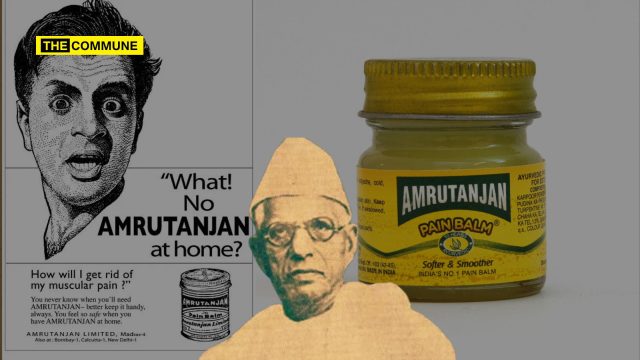
In 1893, a 26-year-old Telugu man with ink-stained ambitions and a chemist’s curiosity launched a balm in Bombay. He wasn’t a doctor. He wasn’t a pharmaceutical magnate. He was a journalist who had spent time in apothecary shops, first in Madras, then in Calcutta, quietly learning how pain could be formulated into relief. His name was Kasinadhuni Nageswara Rao Pantulu. The balm was Amrutanjan. Together, they would outlast the Empire.
The Man Before The Balm
Born on 1 May 1867, in Elakurru village, Krishna district – a flat, fertile strip of the Telugu heartland, Nageswara Rao was not a man who fit into a single category. He graduated from Madras Christian College in 1891 under Dr. Rev. Miller, whose discipline produced a generation of sharp, self-possessed Indian graduates. His mind was already being shaped by the writings of Kandukuri Veeresalingam Pantulu, the father of the Telugu Renaissance, whose essays on social reform and national pride circulated in journals that the colonial press could not quite suppress.
He moved to Bombay to work at a European firm, William and Company, and rose steadily through the ranks. But salaried employment was never going to hold a man like this. He had watched too many of his people pay European prices for European medicine, for ailments that could be treated far more cheaply if only someone had the will to try.
The Yellow Formula In a Market Owned By Others
The Indian pain relief market in the late 1800s was not empty – it was occupied. Imported menthol rubs, British-distributed ointments, and brands like Vicks VapoRub (an American product that had found eager distribution channels across the British Empire) dominated pharmacy shelves and colonial households alike. These products were expensive, foreign, and carried the quiet authority of Western medicine – the implicit message being that anything made locally was inferior by definition.
What Nageswara Rao produced in 1893 was a camphor-and-menthol-based analgesic – yellow, pungent, and aggressive in the best possible sense. It smelled nothing like the odourless, “refined” imported balms. It smelled like a monsoon had passed through a eucalyptus forest. It hit harder, lasted longer, and cost a fraction of what the imported alternatives demanded. The British Patent Medicine Tax had made imported drugs expensive for ordinary Indians — Rao deliberately undercut that price point, putting effective pain relief within reach of people the imported brands had never even considered as customers.
He classified Amrutanjan as an Ayurvedic Proprietary Medicine – a categorisation that was legally precise and strategically brilliant. By proving that his ingredients were rooted in ancient Indian pharmacology while his manufacturing was modern, he navigated the complex colonial tax structure that crushed purely Western drug imports. He used the British legal system as a competitive weapon.
His marketing was pre-modern in form but post-modern in instinct. He handed out free samples at music concerts and Sabhas, letting the balm sell itself through sensation. He sponsored songs and poems about it. In a country with low literacy and high communal memory, he understood that a brand had to be felt, heard, and smelled, and not merely read. Where imported balms advertised sophistication, Amrutanjan advertised experience. The overpowering scent that the imported brands quietly mocked became its greatest asset – a sensory signature that no one who encountered it once could ever forget. For years, the word “Bombay” was pressed into every tin lid – a quiet, unapologetic declaration that this came from Indian hands, Indian soil.
By the early 1900s, Amrutanjan had done something that colonial commercial logic said was impossible: it had made Indian consumers actively prefer an Indian product over a Western one – not out of patriotic obligation, but because it simply worked better.
The Balm And The Newspaper
Amrutanjan made Nageswara Rao wealthy enough to ask the next question: what should wealth do?
His answer was to fund Telugu journalism at a moment when it was most dangerous to do so. In September 1908, he launched Andhra Patrika as a weekly from Bombay. The paper was not neutral. It was built on his fierce belief in political emancipation for India, and specifically for a separate Telugu-speaking Andhra state. When the First World War broke out and the political atmosphere shifted, he moved the paper to Madras and converted it into a daily – the first Telugu daily newspaper from Madras, rolling off the press on 1 April 1914.
In January 1924, he launched Bharati, a Telugu literary journal. In 1926, he established the Andhra Grandha Mala – a publishing house that produced books at deliberately low prices, covering modern works, classical texts, and scientific volumes, explicitly to put knowledge within reach of the ordinary man. He was simultaneously running a company, editing a daily newspaper, funding a literary journal, and running a publishing house. Every jar of Amrutanjan sold was, in some measure, funding all of it.
Mahatma Gandhi, who visited his residence in December 1932, called him “Viswadaata” – the universal donor.
Revolutionary, Prisoner, Philosopher
In 1931, Nageswara Rao was jailed for six months for participating in Gandhi’s Salt Satyagraha. While in prison, he wrote a commentary on the Bhagavad Gita, arguing it was not a sectarian religious text but a universal scripture for all of humanity.
He served as President of the Andhra Pradesh Congress Committee for four consecutive terms between 1924 and 1934. He established over 120 libraries across Andhra districts. He was not simply a man who made a balm and printed newspapers. He was systematically building the infrastructure of a literate, politically conscious Telugu public – one tin, one newspaper, one library at a time.
The Meeting He Chaired, The State He Never Saw
The Sri Bagh Agreement of November 1937, a foundational compact between Telugu leaders ensuring equitable development across all Andhra regions as a precondition for demanding statehood was signed at Nageswara Rao’s own residence in Chennai. He chaired that meeting.
Five months later, on 11 April 1938, he passed away.
The Andhra state he spent his entire life fighting for came into existence on 19 December 1952 – fourteen years after he was gone. That is the particular cruelty reserved for people who build things larger than their own lifetimes.
The Tin That Survived Everything
Amrutanjan became a public limited company in 1936, two years before its founder’s death. In 2007, it was renamed Amrutanjan Healthcare Limited and diversified well beyond the balm. It is still headquartered in Chennai. Vicks is now a Procter & Gamble brand worth billions. Amrutanjan is a 133-year-old company still run out of the city its founder chose.
The tin still says “Bombay.”
There is one footnote that history doesn’t quite know what to do with: chess legend Bobby Fischer once asked Viswanathan Anand to bring him Amrutanjan from India because he couldn’t find it in Iceland. A brand that a Cold War-era American grandmaster was hunting for in the North Atlantic. Nageswara Rao, a journalist, revolutionary, publisher, prisoner, philanthropist, would have appreciated that enormously.
Subscribe to our channels on WhatsApp, Telegram, Instagram and YouTube to get the best stories of the day delivered to you personally.