Let us be honest about what happened on 24 March 2026. A man who spent eight years telling Tamil Nadu that its political establishment was rotten, who built an entire party on the promise of being different, cleaner, better walked into the headquarters of the party he once claimed to oppose, accepted their terms without a fight, and announced he would campaign for them for free. No seats. No symbol. No dignity. Just unconditional surrender dressed up as philosophy.
Kamal Haasan did not just betray his party workers that day. He confirmed what everyone had suspected for years: that there was never any real conviction behind MNM. Just an actor playing the role of a politician – and not even playing it well.
The Launch: All Theatre, No Substance
When Kamal Haasan launched Makkal Needhi Maiam in 2018, the production values were impeccable. The speeches were long, the vocabulary was impressive, and the ambition was presented as civilisational. He called the DMK and AIADMK two sides of the same rotten coin. He said dynasty had poisoned Tamil politics. He said Tamil Nadu deserved governance by competence, not inheritance. Crowds gathered. Cameras rolled. A generation of voters who were exhausted by the Dravidian duopoly dared to believe that this time, someone genuinely different had arrived.
What they did not ask, and should have, was a simple question: what has this man ever sacrificed? MGR built his political base over decades as a genuine mass leader before he ever founded a party. Jayalalithaa absorbed humiliations that would have broken lesser people. What had Kamal Haasan ever risked? He launched a political party from a position of complete personal comfort: a celebrated film career, wealth, international recognition and expected Tamil Nadu to reward him with power on the strength of speeches alone.
Two Elections, Zero Seats, Zero Accountability
The 2019 Lok Sabha elections were MNM’s first real test. The party secured approximately 4% of the vote share across Tamil Nadu and won nothing. For a man of genuine conviction, this would have been a call to rebuild from the ground – to go back to the people, understand the loss, and come back stronger. Instead, MNM limped forward with its organisational structure largely unchanged and its ground-level machinery as thin as the day it launched.
The 2021 Tamil Nadu Assembly elections offered a chance at redemption. MNM contested 154 of 234 seats. The result: zero seats won. Kamal Haasan himself contested from Coimbatore South and lost to BJP’s Vanathi Srinivasan by a narrow margin of 1,728 votes – a close defeat, but a defeat, nonetheless. The party that was supposed to reshape Tamil politics could not win a single constituency across the entire state, despite contesting in two-thirds of them.
In 2022, MNM contested the Tamil Nadu urban local body elections and did not just return negligible results, MNM drew a blank. Two elections, one local body outing, and eight years and the sum total of MNM’s electoral achievement was zero elected representatives at any level of government.
The Rajya Sabha Trap: Selling the Party for One Seat
In 2024, Kamal aligned MNM with the DMK for the Lok Sabha elections, justifying it as an anti-BJP necessity. The “third alternative” became a satellite of the very establishment it was created to challenge. But the transaction’s true price became visible in 2025, when the DMK rewarded Kamal personally with a Rajya Sabha nomination – pushed through using the DMK’s own legislative majority. Not won at the ballot box. Not earned through electoral struggle. Gifted, in exchange for services rendered.
This is the moment the story truly ends. With his personal ambition satisfied and a comfortable parliamentary seat secured, what happened to MNM after that point was irrelevant to Kamal Haasan because MNM was now irrelevant to his career.
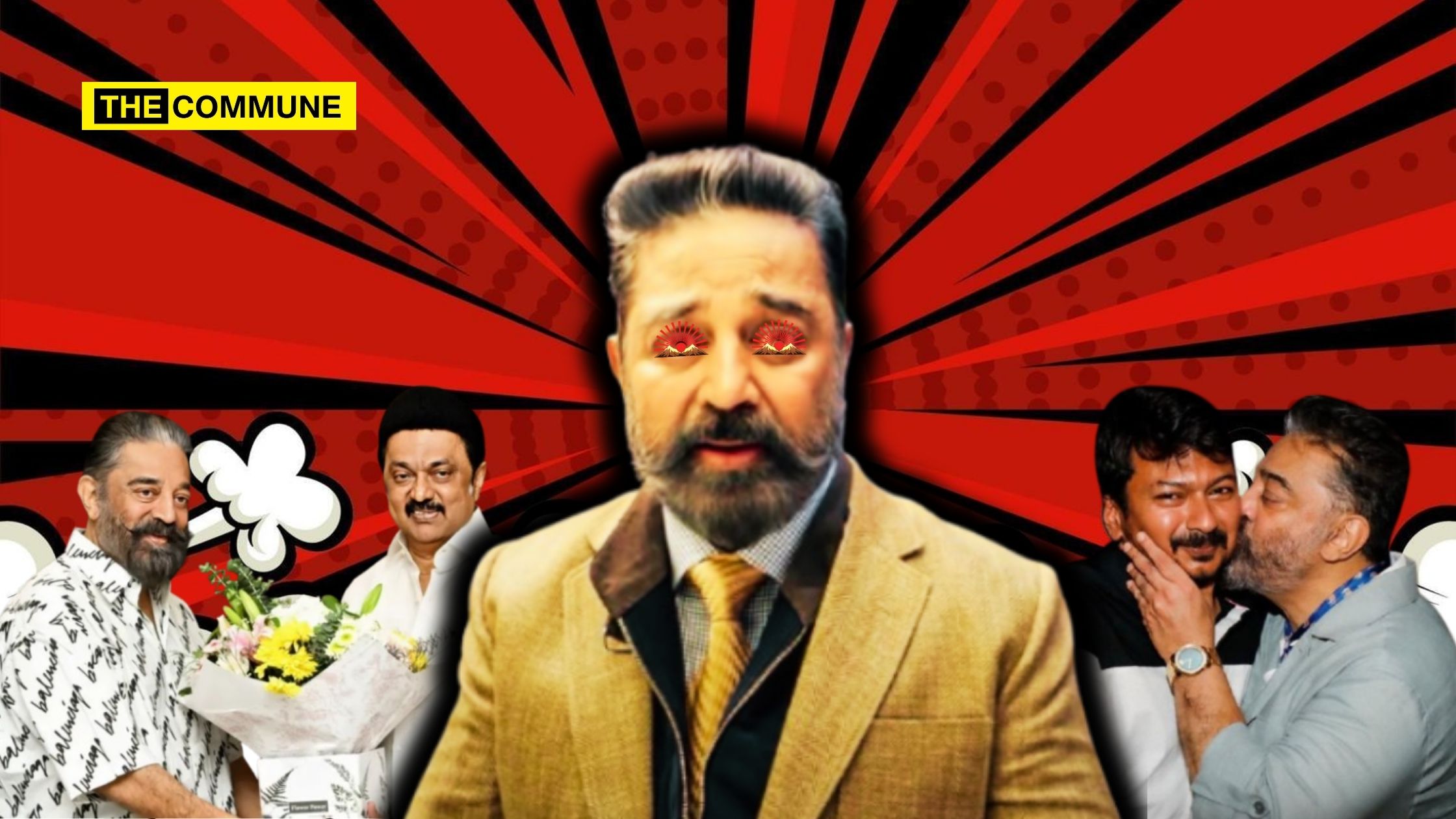
The proof came almost immediately. When 2026 seat-sharing talks began and the DMK offered a contemptible two to three seats, with the humiliating condition that MNM candidates contest under the DMK’s own symbol, erasing the battery torch entirely, Kamal did not fight. He did not walk out. He announced unconditional surrender, called it duty, and posed for photographs. MK Stalin, barely concealing his satisfaction, called the decision “magnanimous,” said history would praise it, and asked Kamal to campaign across Tamil Nadu – for free, with no agreement, no seats, and no future.
The Volunteers He Abandoned
The part of this story that gets consistently buried is the thousands of MNM workers who are not Rajya Sabha members. The volunteers who quit stable careers to work for the party. The people who walked door-to-door through summer heat in 2021 for candidates who lost everywhere. The young idealists who believed that the battery torch stood for something the rising sun and the two leaves did not.
These people were used. They were used to build Kamal Haasan’s political profile, to give him the credibility to walk into DMK headquarters and be treated as a significant figure, to justify the Rajya Sabha nomination. And when their usefulness was exhausted, when Kamal had what he personally needed, they were abandoned without a second thought. Not a single one of them will see their party’s symbol on a ballot paper on April 23. Their leader did not even have the decency to fight for them before folding.
The Final Insult: Invoking MGR
Kamal Haasan has repeatedly invoked MGR to frame his politics – saying publicly in 2021 that “invoking MGR is my salute to him.” This is the final, most unforgivable act of this entire episode.
MGR was expelled from the DMK on 10 October 1972, founded the AIADMK one week later, and never went back. He built a party in direct, uncompromising opposition to the DMK, won every election he contested as party chief, governed Tamil Nadu for over a decade, and died in office – never once trading his party’s independence for personal comfort.
Jayalalithaa faced a disproportionate assets conviction in 2014, spent 22 days in prison, was acquitted by the Karnataka High Court in 2015, and returned to power. Every attack on her – legal, political, personal hardened her opposition to the DMK rather than softening it. She never once sought accommodation from the party she spent her career fighting.
The defining quality of both leaders was not rhetoric – it was consistency under pressure. Kamal Haasan had nothing but rhetoric. When the pressure came, in the form of a Rajya Sabha seat, he folded instantly.
He is not MGR. He is not Amma. He is an actor who played principled rebels on screen for five decades and discovered, when it actually counted, that he had no idea how to be one in real life.
Tamil Nadu gave him eight years, two elections, and every benefit of the doubt. What it received in return was a press conference, a philosophical speech about duty, and a Rajya Sabha MP now campaigning for the son of the man who runs the very dynasty Kamal Haasan was supposed to dismantle.
The battery torch has gone out. It was never really lit.
Subscribe to our channels on WhatsApp, Telegram, Instagram and YouTube to get the best stories of the day delivered to you personally.