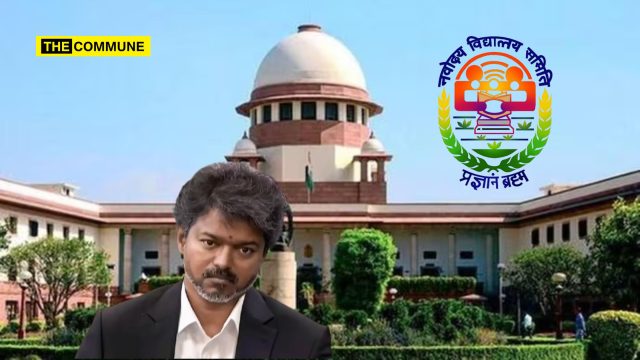
The Supreme Court on Thursday, 17 September 2026, told the Tamil Nadu government that it needs to change its “mindset” towards the teaching of Hindi in schools in the State, while hearing a case concerning the establishment of Jawahar Navodaya Vidyalayas (JNVs) in Tamil Nadu, as reported in Bar and Bench.
A Bench comprising Justices BV Nagarathna and AG Masih made the observations during the hearing of The State of Tamil Nadu Vs. Kumari Maha Sabha, a case concerning the State government’s resistance to the establishment of Navodaya schools.
Navodaya Vidyalayas are centrally funded, co-educational residential schools run by the Navodaya Vidyalaya Samiti under the Union Ministry of Education. Their establishment in Tamil Nadu has been opposed by the State government, which has raised concerns, among other issues, that the schools follow a three-language policy that includes Hindi, in contrast to Tamil Nadu’s two-language policy.
“You have to change your mindset, it can’t be that Hindi will not be taught in the soil of Tamil Nadu,” Justice Nagarathna observed during Thursday’s hearing.
The Bench also remarked that people in Chennai should not alienate those in Delhi.
“We are saying in addition to all the good things you’re doing in your State, having something in addition will not bring down your standards. Coming from Delhi, will not lower the standards of Chennai. People in Chennai should not alienate Delhi and vice versa,” the Court said.
The observations came after the Tamil Nadu government raised concerns about the lack of cooperative federalism in the country.
The Supreme Court was hearing Tamil Nadu’s challenge to a Madras High Court judgment directing the State to establish Navodaya Vidyalayas in every district.
The Madras High Court had held that Navodaya Vidyalayas did not violate the Tamil Nadu Tamil Learning Act. It also ruled that the State’s blanket refusal to establish the schools curtailed students’ right to choose educational institutions.
The High Court had directed the Tamil Nadu government to provide temporary accommodation for 240 students in each district.
Tamil Nadu subsequently approached the Supreme Court, arguing that education policy falls within the State’s exclusive domain and that its two-language policy was incompatible with the Navodaya model.
In December 2025, the Supreme Court had directed the Tamil Nadu government to identify the land required for establishing Navodaya Vidyalayas in every district within six weeks. The State government subsequently filed an application seeking recall of that order.
On Thursday, however, the Supreme Court declined to recall the direction and granted the State another three months to comply with the order.
At the same time, the Bench said representatives of the Central and State governments could hold further discussions on the policy concerning the establishment of the schools.
Justice Nagarathna observed that Navodaya Vidyalayas were not contrary to the State’s policy and said the States needed to engage in dialogue with respect to their language policy.
Senior Advocate Jaideep Gupta, appearing for the Tamil Nadu government, disagreed.
“It is against the State policy. It supersedes Tamil. This kind of unification is not the purport of the Constitution. It is not a Central government school. It is a school run by a society. There is an adamancy that Hindi must predominate,” Gupta said.
The Bench, however, maintained that the State would have to make the land available for construction of the schools.
“We can’t say that a Central government policy is left to the State to accept or not,” the Bench said.
Gupta argued that the policy was optional and said that issuing a mandamus would upset 75 years of practice.
Justice Nagarathna responded that the State would have to follow the general policy applicable to Navodaya schools.
Gupta then said that the State policy could be better and that the Tamil Nadu government would sit with the Centre to discuss its implementation.
“We will have to see whether this cooperative federalism works only one way or both ways,” Gupta said.
Justice Nagarathna observed that there had been a change in the State government and that the Court expected a corresponding change in mindset.
Gupta, however, maintained that cooperative federalism could never work in only one direction. He also argued that matters of policy could not be enforced through judicial directions.
The Court rejected the argument and reiterated its direction to the State.
“Comply with our earlier order. We are not asking you to acquire land. We are only asking to identify. We are concerned with the good of everybody. There is a need for dialogue. You can’t say I won’t accept a policy. Today it is education, tomorrow it will be something else. You have to relax this rigidity in your mind,” the Court said.
Justice Nagarathna further said that the State should treat the Central scheme as its own.
Gupta, however, submitted that the expenditure associated with the schools would ultimately have to be borne by the State government.
“The teachers will ultimately look to us for payment. And they will not pay it. Their (Central government’s) track record is abysmal. They have still not paid for Sarva Sikshya Abhiyaan. This is completely political. This is not cooperative federalism at all,” he said.
The Bench nevertheless maintained that the issue was ultimately one of mindset.
“Have a dialogue. If there is any difficulty after the dialogue, you tell us. This is not going to lower your standard of education. It will provide more opportunity,” the Court said.
Additional Solicitor General KM Nataraj, appearing for the Centre, said that the State government only had to provide the land for the schools, while the rest of the requirements would be taken care of by the Central government.
“Ultimately everybody must work together. That perception that you are surrendering to the Central government should not be there,” Justice Nagarathna replied.
The matter will next be heard on December 14.
Subscribe to our channels on WhatsApp, Telegram, Instagram and YouTube to get the best stories of the day delivered to you personally.