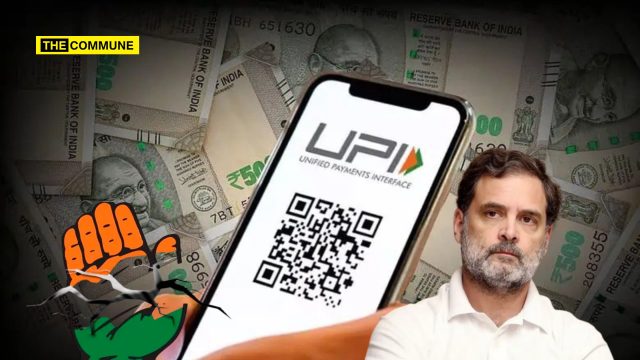
Congress leader Rahul Gandhi has accused the Narendra Modi government of “surrendering to American pressure” over the 0.4% Merchant Discount Rate (MDR) that will be implemented on specified UPI merchant transactions above ₹2,000 from October 15, 2026.
The new framework has already been announced by the National Payments Corporation of India (NPCI), with the government confirming that MDR will apply to specified person-to-merchant transactions above ₹2,000. The MDR will be borne within the merchant payment ecosystem, while UPI will remain free for person-to-person payments and for merchant transactions up to ₹2,000.
Gandhi, however, has presented the decision as the result of pressure from the United States.
“Just like with the U.S. Trade Deal, compromised PM Modi is once again surrendering to American pressure,” Gandhi said, alleging that the government had opened the door to MDR on merchant transactions above ₹2,000, as reported in The Hindu.
But the Parliamentary record raises a significant question about the Congress’s present opposition: the Standing Committee on Finance had already called for a viable revenue mechanism to make the UPI ecosystem financially sustainable and six Congress MPs, including former Finance Minister P. Chidambaram, were members of the committee when the issue was examined.
What the Parliamentary Committee Actually Said
The Thirty-Second Report of the Standing Committee on Finance (2025-26), dealing with the Demands for Grants of the Ministry of Finance’s Department of Financial Services, specifically addressed the financial sustainability of UPI.
In the report, the committee noted that the existing government incentive covered only a fraction of the industry’s actual costs and identified a “structural funding gap” affecting long-term investment in UPI infrastructure.
“The Committee observe that while UPI is expected to process up to 150 billion transactions per month and add 600 million new users, the current government incentive covers merely 11% of the industry’s actual costs and 14% of potential MDR collections, creating a structural funding gap impacting long-term infrastructural investment.”
The committee then recommended that the government explore a revenue model for UPI. The committee recommended that the Department of Financial Services should explore a “self-reliant, tiered revenue model.”
“The Committee recommend that while the proposed 3-year multi-year scheme and cashback components are necessary to democratize digital payments in untapped Tier 3-6 cities, the Department of Financial Services must concurrently explore a self-reliant, tiered revenue model.”
It further stated, “The Committee would like to emphasize that establishing a viable revenue mechanism is critical to ensuring the UPI ecosystem achieves financial sustainability without perpetually straining the Government exchequer.”
The recommendation is significant because it directly addressed the question now at the centre of the MDR debate: how UPI can continue expanding without indefinitely relying on government support to meet the costs of the payment infrastructure.
The committee also acknowledged that the proposed multi-year scheme and cashback components were necessary to expand digital payments, particularly in Tier 3 to Tier 6 cities.
Congress is hyperventilating over UPI MDR, and Rahul Gandhi is misleading the nation by presenting it as some sudden decision taken under American pressure.
𝐁𝐮𝐭 𝐡𝐞𝐫𝐞 𝐢𝐬 𝐰𝐡𝐚𝐭 𝐭𝐡𝐞 𝐏𝐚𝐫𝐥𝐢𝐚𝐦𝐞𝐧𝐭𝐚𝐫𝐲 𝐫𝐞𝐜𝐨𝐫𝐝 𝐬𝐚𝐲𝐬. ⬇️
The Standing Committee on… pic.twitter.com/ibCuixuXyG
— BJP (@BJP4India) September 17, 2026
Six Congress MPs Were On The Committee
The composition of the Standing Committee on Finance for 2025-26 included 31 members, with 21 from the Lok Sabha and 10 from the Rajya Sabha.
Among them were six Congress MPs:
- Gaurav Gogoi
- K. Gopinath
- Kishori Lal
- Manish Tewari
- P. Chidambaram
- Pramod Tiwari
Other opposition members included MPs from the Samajwadi Party, DMK, RSP, Trinamool Congress, YSRCP and AAP.
P. Chidambaram, a former Finance Minister and one of the Congress party’s most prominent economic voices, was himself a member of the committee that examined the sustainability of the existing UPI financing model.
That makes the parliamentary record particularly relevant to the political claims now being made about UPI MDR.
It also establishes that the financial sustainability of UPI and the need for a revenue mechanism were already being discussed and formally recommended in Parliament.
That makes the claim that the issue has suddenly emerged because of American pressure difficult to reconcile with the Parliamentary record.
What is Actually Changing From October 15?
From October 15, specified person-to-merchant UPI transactions above ₹2,000 will attract an MDR of 0.4%, capped at ₹300 per transaction. Person-to-person transactions remain free, while payments to merchants up to ₹2,000 and transactions covered by the zero-MDR framework for small merchants also remain free.
The Finance Ministry says approximately 96% of P2M transactions will remain unaffected. It has also clarified that MDR is not a tax collected by the government or NPCI; it is distributed among participants in the payments ecosystem.
Banks have been advised to ensure that merchants do not pass the MDR directly on to customers, and UPI applications are prohibited from imposing platform fees or hidden charges on customers.
The Actual Political Contradiction
The debate over MDR is legitimate. But claiming that it was suddenly imposed because of American pressure ignores the Parliamentary record.
The Standing Committee on Finance had already identified UPI’s funding gap and called for a viable revenue mechanism to ensure its long-term sustainability without continually burdening the government exchequer.
Six Congress MPs, including P. Chidambaram, were on that committee.
The 0.4% MDR will be implemented from October 15. Whether this specific framework is the right one is a separate question. But Rahul Gandhi’s “American pressure” narrative leaves out the domestic policy discussion that preceded it.
Rahul Gandhi’s Congress seems to be playing Dr Jekyll & Mr Hyde – Support sustainability in Parliament, then cry “American pressure” when it is implemented.
Subscribe to our channels on WhatsApp, Telegram, Instagram and YouTube to get the best stories of the day delivered to you personally.