Woke leftist EVR fanboy and Carnatic vocalist TM Krishna has repeatedly projected himself as a crusader against sexual harassment, institutional abuse and the culture of silence in the classical arts. He has readily positioned himself at the forefront of controversies involving institutions such as PSBB and Kalakshetra. But when a longtime friend and musical collaborator faces serious sexual abuse charges, Krishna suddenly invokes an ongoing investigation as a reason for silence.
So, does this commitment to accountability come with a different set of rules when the person accused belongs to his own inner circle?
The contrast between Krishna’s earlier interventions against institutions such as Padma Seshadri Bala Bhavan (PSBB) and Kalakshetra Foundation and his response to the allegations against Bhaskar is difficult to ignore.
When allegations surfaced against institutions he was willing to criticise, Krishna was outspoken, confrontational and categorical. When a close associate of over two decades faces four felony charges in the United States involving an alleged minor victim, however, he has suddenly discovered the virtue of restraint.
2018: Carnatic Music’s ‘Open Secret’
When the #MeToo movement brought allegations of sexual harassment against prominent personalities in Carnatic music and Bharatanatyam into public view in 2018, Krishna emerged as one of the vocal critics of the ecosystem.
He described sexual harassment in classical arts circles as an “open secret” and admitted that he too had remained silent despite knowing about instances of abuse.
Speaking to Scroll.in, he said, “The truth is that all of us, including myself, have kept quiet and allowed for the ‘normalisation’ of such behaviour. We even went a step further and blamed the women for whatever may have happened.”
He also called for an end to elevating musicians and gurus to the status of “demi-gods”.
In October 2018, a statement shared by Krishna and endorsed by more than 200 members of the Carnatic music community called for civil society investigations into allegations and structural measures to prevent future abuse.
The message was unmistakable: silence was complicity, institutional prestige could not shield the accused, and accountability had to come before protecting reputations.
2021: PSBB School And The Sexual Harassment Allegations
In May 2021, allegations of sexual harassment against commerce teacher G. Rajagopalan at Chennai’s Padma Seshadri Bala Bhavan (PSBB) School triggered widespread outrage.
Several current and former students accused the teacher of inappropriate behaviour, sexual harassment and misconduct. Students also alleged that complaints had previously been made to the school authorities without adequate action.
Krishna publicly backed the students who came forward, thanked them for their courage and criticised attempts to dismiss the allegations as politically motivated.
He challenged those seeking to defend the institution’s reputation instead of addressing the allegations and demanded that the safety of children take precedence over protecting the school’s legacy.
The teacher was subsequently arrested under the POCSO Act and other provisions. Chennai Police filed a chargesheet in October 2021, reportedly containing witness statements, screenshots and other evidence.
The point here is not that Krishna should not have supported the students. He absolutely should have. The question is whether the same willingness to speak forcefully about accountability and institutional responsibility applies when the accused is personally close to him.
2023: Kalakshetra And His Attack On Institutional Defensiveness
In March 2023, allegations of sexual harassment against faculty members at Chennai’s Kalakshetra Foundation triggered student protests and a major controversy.
The institution’s initial response, which dismissed the allegations as rumours and claimed that they were intended to malign its reputation, drew sharp criticism.
Krishna did not hold back.
On 27 March 2023, he wrote an open letter to Kalakshetra Foundation Chairman S. Ramadorai, condemning the institution’s response.
He described its conduct as follows, “The response of the institution has been disappointing. The lack of sensitivity, the aggressive tone, and the dismissiveness is unbecoming.”
He was also furious that the allegations were being framed as an attack on the institution and burdened with political and religious insinuations.
Krishna further argued that the hierarchical nature of the institution made it difficult for students, particularly those from modest backgrounds and small towns, to challenge authority figures.
He wrote, “No process of enquiry will be effective unless the atmosphere is caring and compassionate towards those who are alleging sexual abuse, in these cases, young students and alumni. When the place is so hierarchical, no one will speak freely and fearlessly.”
He demanded concrete action to address the complaints and insisted that institutional reputation could not take precedence over student safety.
I am disappointed with Kalakshetra’s dismissive response to the complaints of sexual abuse. Here’s my open letter to the Chairman of #Kalakshetra. https://t.co/w4PFhmUFUg
— T M Krishna (@tmkrishna) March 27, 2023
However, subsequent developments in the case received considerably less attention.
Hari Padman was arrested on 3 April 2023, following a complaint by a former student, on allegations of sexual harassment and criminal intimidation. The Kalakshetra board suspended him and terminated three other faculty members.
But in May 2023, students questioned by the Adyar All Women Police Station had not made sexual harassment allegations against Hari Padman. Around 15 female students had reportedly been questioned, with most not making allegations against him or the institution. Some reportedly told police that they had not lodged complaints against him.
The National Commission for Women, which had taken cognisance of the matter, reportedly found no evidence supporting the allegations, according to the report.
In June 2023, Hari Padman secured default bail after the police failed to file a chargesheet within the statutory 60-day period from his remand.
Yet Krishna’s public intervention had already helped place Kalakshetra’s institutional response under intense scrutiny.
The question now is straightforward: if Krishna believed that allegations against Kalakshetra demanded such forceful public intervention even while investigations were underway, why does an ongoing investigation suddenly become a reason for silence when his own longtime friend and collaborator faces serious charges?
2026: Suddenly, Investigations Are Underway And He Cannot Speak
Now comes the H.N. Bhaskar case.
Bhaskar, a 50-year-old Carnatic violinist who has shared numerous stages with Krishna and been his friend and collaborator for over two decades, is facing four felony charges in the United States involving alleged sexual offences against a minor.
According to the San Diego Superior Court records, a criminal complaint was filed on 6 November 2026. The charges include two counts of oral copulation involving a person under 18 and two counts of sexual penetration with a foreign object involving a person under 18.
The allegations concern incidents said to have occurred between September 4 and September 26, 2026.
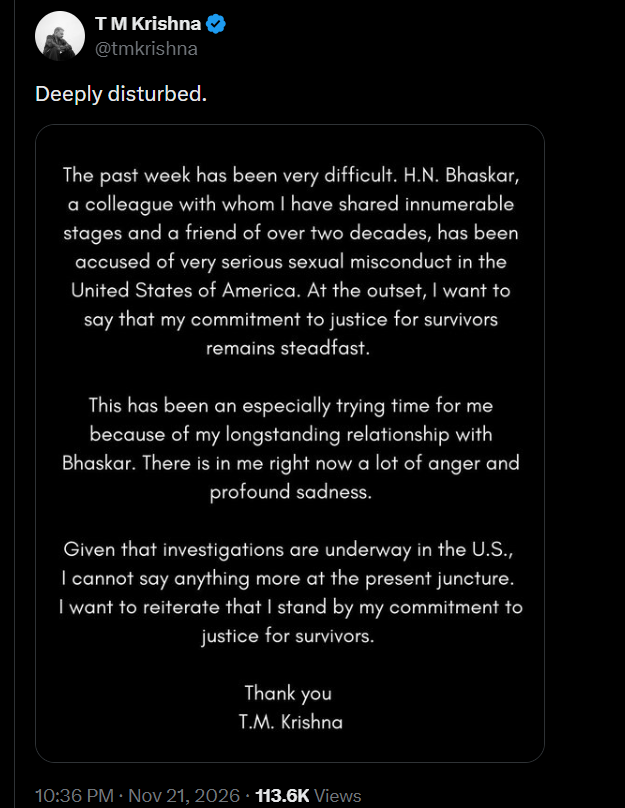
Following the emergence of the case, Krishna issued a statement titled ‘Deeply Disturbed’.
He wrote, “The past week has been very difficult. H.N. Bhaskar, a colleague with whom I have shared innumerable stages and a friend of over two decades, has been accused of very serious sexual misconduct in the United States of America. At the outset, I want to say that my commitment to justice for survivors remains steadfast.”
He went on to describe his personal distress: “This has been an especially trying time for me because of my longstanding relationship with Bhaskar. There is in me right now a lot of anger and profound sadness.”
And then came the crucial line: “Given that investigations are underway in the U.S., I cannot say anything more at the present juncture.”
This is where the contrast becomes glaring.
When allegations concerned PSBB, Krishna publicly challenged the institution’s defenders. When Kalakshetra was accused of being dismissive, he wrote an open letter condemning its response. He questioned institutional hierarchies, challenged attempts to protect reputations and insisted that allegations must be taken seriously even before investigations concluded.
But when the accused is his own longtime friend, the ongoing investigation suddenly becomes a reason for silence.
Nobody is asking Krishna to declare Bhaskar guilty. The charges have not been adjudicated, and Bhaskar is entitled to due process. But due process and public accountability are not mutually exclusive.
Why was there no comparable hesitation when he publicly criticised PSBB and Kalakshetra? Why was the possibility of an investigation not a reason to exercise similar restraint then?
And if institutional reputation should never come before the safety and dignity of survivors, why should personal relationships now complicate that principle?
Principles For Others, Excuses For His Own
TM Krishna cannot have it both ways. He cannot lecture institutions about complicity, condemn their defensiveness, question their integrity and demand accountability while suddenly retreating behind the shield of an ongoing investigation when his own close associate is accused. Nobody is asking him to pronounce Bhaskar guilty.
The question is why the same restraint was conspicuously absent when PSBB and Kalakshetra were in the dock. If silence is complicity when others are accused, what does he call his own silence now? Survivor advocacy cannot be a convenient political performance, switched on against institutions one dislikes and switched off when the accused happens to be a friend of two decades.
Subscribe to our channels on WhatsApp, Telegram, Instagram and YouTube to get the best stories of the day delivered to you personally.