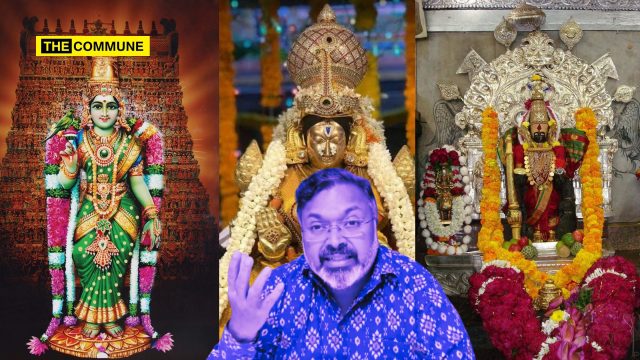
In an interview with India Today journalist Rajdeep Sardesai, Pattanaik was asked why there was a gap between the powerful position of women in Hindu mythology and their subordinate position in society.
When Sardesai pointed to the idea of the female goddess as evidence of women’s prominence in Hindu religious traditions, Pattanaik responded: “But we don’t worship women in India. Who said we worship women in India?”
He added, “We built a Ram temple without Sita, saying that he’s a child but didn’t show his mother. We are worshipping Krishna without Radha. If you go to Shrinathji temple, there is no Radha. If you go to the Krishna temples of South in if you go to Pandharpur, there is no Rukmini. If you go to the Krishna temples of Udupi and Tirupati, there is no Lakshmi kept in the same shrine. She is not there. I’m sorry, it’s a delusion of people that women are worshipped in our country. We are not. They do their rituals, which are their personal rituals. Our gods today, look at the posters across India. Shiva is shown without Shakti. Durga is shown without her family. Krishna is shown with Arjun more than Radha. Strange, no? In a battlefield rather than Madhuban. And Ram seems to be always alone. Why? In every poster he’s alone. So where are the women? Does it reflect our society? It shows so much about our society. If you just see in the old tantric temples, the goddess sat on the lap, they looked into each other’s eyes. The goddess was erotic. So the erotic goddess becomes the romantic goddess and finally now gods are all about solitude and our religion today is controlled by celibate men who go to Paris and say women shall not be seen anywhere around us.”
Why are female deities not given equal space to male gods in our temples asks @devduttmyth . Listen in.
— Rajdeep Sardesai (@sardesairajdeep) November 15, 2026
The claim that women are not worshipped in India collapses the moment one steps outside Pattanaik’s cherry-picked examples. India is home to an enormous, living tradition of Goddess worship. Some of the country’s most celebrated pilgrimage centres are not dedicated to male gods with female consorts relegated to the sidelines. The Goddess herself is the presiding deity.
Kanchi Kamakshi, Madurai Meenakshi, Kollur Mookambika, Sringeri Sharadamba, Vaishno Devi, Kanyakumari Bhagavathi, Kamakhya, Shanta Durga, Jwala Devi, Chamundeshwari, Kolhapur Mahalakshmi, Horanadu Annapoorneshwari, Mata Kheer Bhawani, Mylapore Karpagambal, Thiruvanaikaval Akilandeswari, Melmaruvathur Adi Parashakti – these are not obscure shrines that can be brushed aside as exceptions. They are prominent centres of worship, drawing devotees from across the country.
And this is only the beginning. The tradition extends across the Shakti Peethas spread throughout the Indian subcontinent. Tell the devotees of Vaishno Devi, who undertake an arduous mountain pilgrimage to worship the Divine Mother, that women are not worshipped in India. Tell the devotees at Kamakhya, where the Goddess is supreme, that Goddess worship is merely a delusion. Tell the devotees of Madurai’s Meenakshi Amman Temple that the Goddess occupies no central place in Hindu religious life.
At Madurai, Meenakshi is the presiding deity alongside Sundareswarar and is traditionally worshipped before him. At Kamakhya in Assam, the Goddess is the principal deity, and the annual Ambubachi Mela draws devotees to celebrate her menstruation. Goddess worship is not some rare exception in Hinduism. It is practised across India, in thousands of temples and countless households. These are living expressions of Shakti worship.
Nor does Goddess worship begin and end with famous temple complexes. Across India’s villages and towns, grama devatas are central to everyday religious life. Mariamman, Kaliamman, Yellamma, Poleramma and countless local manifestations of the Goddess are worshipped by communities. Durga Puja, Kali Puja, Lakshmi Puja and Saraswati Puja place the Goddess at the heart of major religious and cultural celebrations. This is not a rare practice but woven into the religious life of millions.
Pattanaik’s argument also makes a fundamental mistake: he treats the absence of a consort from a particular temple or image as proof that the Goddess is not worshipped. The fact that a Krishna temple does not house Radha, or that a depiction of Shiva shows him without Parvati, tells us nothing about the vast and independent tradition of Devi worship. Hinduism does not require every deity to appear alongside a consort in every shrine or representation. Its traditions encompass different forms of worship, theological interpretations and manifestations of the divine.
His claim about the Ram temple in Ayodhya is equally false. The Shri Ram Janmabhoomi complex has shrines dedicated to Maa Bhagwati and Maa Annapurna. The Sapt Mandapam includes shrines dedicated to Mata Ahalya and Mata Shabari, while Sita is present in the Ram Darbar on the first floor. Ram Lalla is worshipped in the ground-floor sanctum in his child form. The choice to depict and worship Ram in his Bal Swaroop does not mean the wider temple complex has erased anyone.
There is another problem with Pattanaik’s language. Why reduce the Goddess to the phrase “female deity”? Hindu traditions recognise her as Devi, Shakti, Adi Parashakti and the Divine Mother. She is not simply a female counterpart to a male god. In Shakta traditions, the Goddess is the supreme reality herself. Reducing this vast theological tradition to a question of whether women appear alongside male gods in temple images betrays a startling disregard for the very religious traditions being discussed.
Of course, the worship of the Goddess does not automatically translate into equality for women in society. The contradiction between the exalted position of women in religious traditions and the discrimination women face in everyday life is a legitimate subject of discussion. But that is an entirely different argument from claiming that India does not worship women.
Sardesai asked a legitimate question about the gap between the position of women in mythology and their status in society. Pattanaik could have examined that contradiction. Instead, he made a sweeping declaration that ignores an entire civilisation’s extensive tradition of Goddess worship.
One can debate patriarchy, discrimination, women’s representation and the role of women in religious institutions. But to declare that women are not worshipped in India while overlooking Meenakshi, Kamakshi, Mookambika, Kamakhya, Vaishno Devi, the Shakti Peethas and countless village goddesses is not an intellectual critique. It is an extraordinary erasure of Hindu religious reality.
Subscribe to our channels on WhatsApp, Telegram, Instagram and YouTube to get the best stories of the day delivered to you personally.