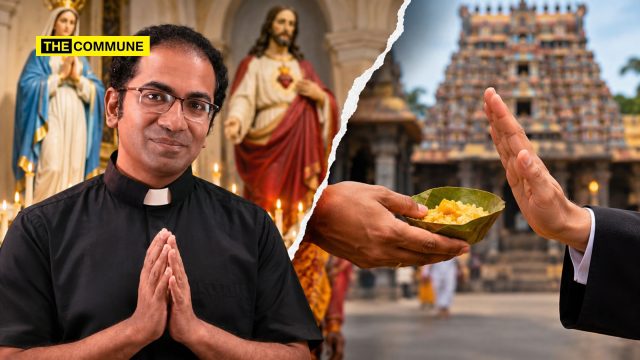
A video posted by the Instagram account Bombay Jesuits (@bombayjesuits), which identifies itself as a Catholic religious order, has resurfaced and gone viral, with a priest explaining why Christians should refuse Hindu prasadam and arguing that consuming food offered to Hindu deities could amount to participation in idol worship and compromise their religious faith.
Originally posted on 15 July 2025, the reel has gained renewed attention for its explanation of how Christians should respond when offered prasadam during Hindu festivals and religious celebrations. The account has over 13,700 followers and identifies itself with the tagline ‘For the Greater Glory of God’.
Beginning his video with the question, “Can Christians eat prasad without compromising their faith? Let’s clear the confusion.”, the priest went on to explain the Catholic Church’s position on consuming food offered during Hindu religious rituals.
He presented a hypothetical situation in which a Christian attends an office celebration or visits a friend’s home during a religious festival, where food blessed as ‘prasad’ during a Hindu ritual is distributed.
“You are at an office celebration or a friend’s home during a religious festival. A plate is passed around with ‘prasad’ (food) blessed during the Hindu ritual. Do you eat it or do you politely decline?” he asked.
The priest then claimed that the Catholic Church strictly prohibits participation in idol worship and that Christians should not consume food offered to a deity if doing so involves participation, even passive participation, in the religious ritual.
“The Catholic Church teaches that participation in any form of idol worship is strictly forbidden. If you are present during a ritual where the food was offered to a deity, and you join even passively, you should not eat that food,” he said.
However, he distinguished between participating in a religious ritual and accepting food as a gesture of friendship or hospitality, suggesting that the latter could be permissible under certain circumstances.
“However, if you weren’t part of a ritual and the food is offered as a sign of friendship or hospitality and there’s no risk of causing scandal or confusing others about your beliefs, it may be acceptable to eat it. It’s important to distinguish between joining a cultural celebration and participating in a religious ritual,” he explained.
Emphasising the need for Christians to exercise discernment, the priest said they should consider whether accepting such food could compromise their faith or create confusion about their religious beliefs.
“The key therefore is discernment. Always ask, will this harm my faith or lead others to misunderstand it? When in doubt, politely decline but always show respect,” he said.
Concluding the video, he reiterated that Christians should avoid idol worship while maintaining respect towards people of other faiths.
“To sum up, while idol worship is always a clear no, we are still called to approach others with respect and grace. In all things, glorify God,” he said.
View this post on Instagram
Christian Priest explains how to reject Hindu food (Prasad).
Still Hindus keep sending their children to Xtian schools who hate us, allow them to groom our children to hate themselves and we pay them millions to further convert more Hindus.
Wake up! https://t.co/ZfUBnaQyPZ
— Arun Pudur (@arunpudur) November 13, 2026
So Why Do Churches Have Jesus/Mary Statues?
The video exposes a glaring double standard in how Catholic institutions view Hindu religious practices. Catholic churches are filled with statues of Jesus Christ, Mother Mary and various saints. Devotees kneel before these statues, offer flowers, light candles, pray and participate in processions carrying sacred images. The Catholic Church defends these practices by distinguishing between worshipping an idol and venerating the person represented by an image. Its own Catechism (Paragraph 2132) explicitly makes this distinction. But when Hindus worship through murtis and receive prasadam offered to their deities, the practice is dismissed as idol worship. Why should one religion’s use of sacred images be treated as legitimate devotion while another’s is portrayed as something Christians must avoid? If the Catholic Church expects Hindus to respect its theological distinctions, it should extend the same courtesy to Hindu beliefs and practices. Respect for other faiths cannot be a one-way street.
Subscribe to our channels on WhatsApp, Telegram, Instagram and YouTube to get the best stories of the day delivered to you personally.