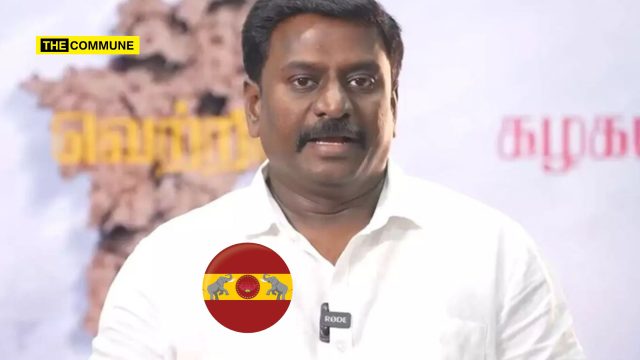
Tamil Nadu’s new School Education Minister TVK’s A Rajmohan has firmly declared that the TVK government will not compromise on the state’s two-language policy, even if the Union government continues to withhold PM SHRI education funds. But the minister’s own past statements, along with the educational model followed by institutions associated with the TVK ecosystem, are now raising sharp questions about political hypocrisy and double standards, as reported in Deccan Herald.
Speaking to reporters after a departmental review meeting, Rajmohan reiterated that the TVK government would continue Tamil Nadu’s long-standing policy of Tamil and English alone in schools.
“Two-language policy is not just a policy of the Tamil Nadu government, it is also one of the fundamental principles of the TVK. We are clear that the state will continue to follow the two-language policy and there is no change in that,” he said.
When asked about the PM SHRI scheme and the Centre’s insistence on the three-language formula, Rajmohan accused the Union government of using funds as pressure tactics against Tamil Nadu.
“For the past two years, that fund has not reached us, and that is a huge sorrow. That money is not for us; it is not for the officials. That money is for the students, for the girl students. Blocking it for any reason is deeply painful, and it is unacceptable. At the same time, we will not yield to any indirect pressure. As I said at the beginning, just as land rights and women’s rights are basic rights of the Tamilaga Vettri Kazhagam, the bilingual policy is also a declared policy of our party. There is no question of any change in that.”
He then invoked Singapore’s development model to justify the government’s stand.
“This is not only here; even in Singapore, Lee Kuan Yew did the same thing. He transformed a country from scratch into a first-world nation. To connect with the world there, he used English. He said other languages like Chinese can be used locally, but English is sufficient for global communication. So we will not submit to any indirect pressure. There is no place here for compromise on policy. We are not compromising on our principles. There is no question of policy compromise here.”
#JustNow | “இரு மொழிக்கொள்கையில் சமரசம் இல்லை” பிஎம் ஸ்ரீ திட்டம் – அமைச்சர் ராஜ்மோகன் விளக்கம்#PMShri | #Rajmohan | #TVK | #LanguagePolicy | #School | #Education pic.twitter.com/Qr5Ilo4KL7
— Polimer News (@polimernews) May 19, 2026
The remarks came shortly after SFI representatives met Chief Minister C Joseph Vijay, who reportedly assured them that the TVK government would never dilute the two-language formula of Tamil and English.
However, Rajmohan’s latest position has now collided head-on with his own past statements from his days as a YouTuber and political commentator, where he openly praised key aspects of the National Education Policy and argued in favour of multilingual learning.
In a video clip that has now gone viral across social media platforms, Rajmohan had earlier stated: “When a child is at a learning age, only if you speak to that child in its mother tongue and introduce knowledge through that mother tongue will the child develop a good mindset to learn it. Many scholars have said this. According to the new education policy, we must provide mother-tongue-based education to the child at least till the fifth standard. Both public and private schools should not deny this.”
He had also strongly endorsed the NEP’s emphasis on Indian languages and multilingual education.
“No matter how many lakhs you charge as fees in a private school, if you are in Tamil Nadu you must teach Tamil as a language. This is a very, very important point. Another important aspect they have mentioned is about Tamil. They have said that Tamil and the other seven classical languages must be offered as options in all schools across India. If a student wants to learn Tamil, they should be able to do so not only in Tamil Nadu but even in Uttar Pradesh if they wish to learn Tamil there.”
Rajmohan had further welcomed the inclusion of additional Asian languages in schools.
“You must teach Tamil because it is one of the classical languages. Just as they emphasize giving importance to Indian languages, they have also said that Asian languages must be offered, such as Korean.”
மனிதனுக்கும் தற்குறிக்கும் உள்ள வித்தியாசம் pic.twitter.com/EZ14oSkZFf pic.twitter.com/cMIPAjU4ZA
— கமலி❤️ (@Shivasakthi238) May 19, 2026
The resurfaced video has now triggered accusations that Rajmohan has dramatically reversed his own position after entering electoral politics under TVK.
The controversy has also drawn attention to Vijay Vidhyashram Senior Secondary School in Padur, Chennai, an institution associated with actor-turned-Chief Minister Joseph Vijay’s family. The school, affiliated with the CBSE system, recently released recruitment advertisements seeking teachers for multiple subjects including Hindi.
The advertisement specifically lists vacancies for “TGT – Hindi” alongside other teaching positions, directly highlighting that Hindi instruction already exists within the institution operating under the CBSE framework.
Now, one wonders how the TVK government can publicly oppose the three-language formula and accuse the Centre of imposing Hindi while institutions linked to the same political ecosystem continue functioning under a CBSE structure that accommodates multilingual education, including Hindi teaching. This is exactly what the DMK did – ministers and MLAs owned CBSE schools where 3 language policy was implemented but opposed the NEP for the state.
The issue has also reignited debate over whether Tamil Nadu’s continued refusal to join the PM SHRI scheme is ultimately costing students access to central education funds while other states, including Left-ruled Kerala, have chosen to participate despite political differences with the Union government.
💡The problem is not for DMK or TVK. The loss is for the students of Tamil Nadu. Even Kerala has agreed to PM Shri.
What is “Vijay Vidhyashram” School’s policy given its affiliation with the CBSE? Can someone ask Rajmohan or CM Joseph Vijay? https://t.co/2mzZhXc4Tt pic.twitter.com/ejjjcA3u8A
— Saikiran Kannan | 赛基兰坎南 (@saikirankannan) May 19, 2026
The controversy has further exposed what can be described as a glaring contradiction within the TVK ecosystem itself. While the government publicly attacks the three-language formula and rejects any policy associated with multilingual education, institutions linked to the same ecosystem continue operating under the CBSE framework where Hindi and additional language instruction are already part of the system. Ordinary government school students are being denied opportunities that remain available in elite private and CBSE institutions.
Subscribe to our channels on WhatsApp, Telegram, Instagram and YouTube to get the best stories of the day delivered to you personally.