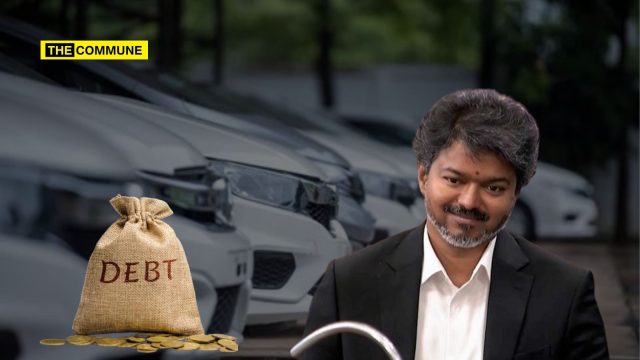
Tamil Nadu Chief Minister C. Joseph Vijay’s decision to provide every MLA with a government car, ₹75,000 a month towards fuel, maintenance and driver expenses, and another ₹25,000 for an assistant will add a sizeable recurring burden to the State exchequer, even as Tamil Nadu continues to carry a debt burden running into several lakh crore.
Making a suo motu statement in the Assembly on Wednesday, 19 August 2026, Vijay announced that all 234 MLAs would be provided the additional facilities. He said the move was intended to help legislators travel across their constituencies, inspect development works, meet residents and ensure that government welfare schemes reach beneficiaries.
The announcement came after Kattumannarkoil MLA L.E. Jothimani raised the issue in the Assembly on 12 August 2026, pointing out that some legislators did not have cars and therefore faced difficulties in travelling around their constituencies.
Vijay said necessary amendments would be made to the law and orders issued to implement the scheme.
But behind the political justification lies a straightforward question: how much will the taxpayer have to pay for it?
₹74.88 Crore In The First Year
There are two components to the proposed expenditure — the cost of purchasing the vehicles and the recurring monthly allowances.
There are 234 MLAs in the Tamil Nadu Assembly.
If the government procures vehicles at an indicative average cost of ₹20 lakh each, the one-time vehicle purchase would work out to approximately:
234 × ₹20 lakh = ₹46.8 crore
The recurring allowance is another ₹1 lakh per MLA every month:
- ₹75,000 for fuel, maintenance and driver expenses
- ₹25,000 for an assistant
That works out to 234 × ₹1 lakh = ₹2.34 crore per month
Over 12 months, the recurring expenditure would therefore be approximately ₹28.08 crore per year
Add the vehicle procurement cost and the first-year expenditure comes to around ₹74.88 crore.
The vehicle purchase component is a one-time cost under this calculation, while the ₹28.08 crore annual allowance would recur every year, subject to the government’s eventual rules and revisions.
In other words, the scheme does not end with the first-year ₹74.88 crore bill. The recurring component alone could cost the exchequer more than ₹28 crore every year.
And that is before accounting for possible increases in vehicle costs, allowances, replacement vehicles or other administrative expenses.
₹13.18 Lakh Crore Debt And More Perks
The timing of the announcement is what makes the expenditure worth examining.
Tamil Nadu is already carrying an enormous debt burden. According to the fiscal figure cited by the government, the State’s outstanding debt, including public sector undertakings, is around ₹13.18 lakh crore.
Against that backdrop, the proposed ₹56.16 crore first-year expenditure may appear tiny.
Indeed, mathematically, it represents roughly 0.0042% of ₹13.18 lakh crore.
But that is not the real question.
A government cannot justify every new expenditure simply by comparing it with a much larger debt number and declaring it insignificant.
The question is whether a government facing a massive debt burden should be expanding privileges and facilities for elected representatives when those representatives already have access to salaries, allowances and government machinery.
The ₹56 crore figure may be microscopic relative to the State’s debt. But it is still ₹56 crore of public money in the first year, followed by a recurring annual commitment.
“MLAs Are Pillars Of Democracy”
Vijay defended the decision by saying MLAs are “one of the important pillars of democracy”.
He also pointed to the increasing number of first-time MLAs without established political or financial backgrounds and said they should not have to depend on others for transportation or administrative support.
The Chief Minister further invoked the pledge taken by TVK candidates when they were introduced on 29 March 2026. According to Vijay, the candidates had promised transparent and corruption-free governance.
That raises an obvious question.
Does corruption-free governance require every MLA to be given a government car, ₹75,000 a month for its running and another ₹25,000 for an assistant?
There may well be a legitimate argument for ensuring that MLAs can travel to remote constituencies and discharge their responsibilities. But there is a difference between providing logistical support where genuinely necessary and creating a blanket entitlement for all 234 legislators.
The government has chosen the latter.
A Blanket Benefit For All 234 MLAs
The announcement applies across party lines.
Every MLA, irrespective of constituency size, financial circumstances or existing resources, is to receive the same package.
That means a legislator from a relatively urban constituency and one representing a vast rural constituency would receive the same ₹1 lakh monthly support.
The government could have considered targeted transport arrangements, shared constituency vehicles, reimbursement against verified official travel, or support based on actual requirements.
Instead, it has opted for a universal package.
That is administratively simpler, politically popular among legislators and considerably harder to roll back once introduced.
The Real Cost Is The Precedent
₹56 crore may be tiny against Tamil Nadu’s ₹13.18 lakh crore debt. But debt grows through thousands of such “small” commitments.
The TVK government promised a “new beginning”. It should distinguish between what MLAs need for their work and what taxpayers are being asked to fund for their convenience.
Once 234 MLAs get cars, fuel, drivers and assistants, the recurring bill stays with the taxpayer.
Small against the debt, perhaps. But hardly a sign of fiscal restraint.
Subscribe to our channels on WhatsApp, Telegram, Instagram and YouTube to get the best stories of the day delivered to you personally.