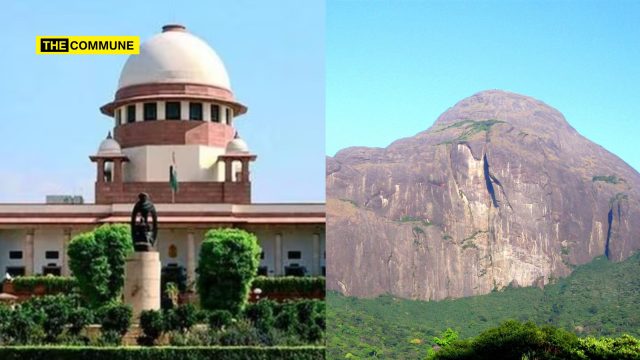
The Supreme Court has ordered the immediate removal of encroachments and demolition of illegal structures across the ecologically sensitive Agasthyamalai landscape spanning Tamil Nadu and Kerala, while directing stringent disciplinary, penal and criminal action against officials found to have facilitated or permitted unlawful activities within protected forest areas. The court also warned that paramilitary forces could be deployed if state authorities fail to implement its directions, as reported in Hindustan Times.
The Agasthyamalai landscape, one of South India’s most important biodiversity hotspots, includes the Agasthyamalai Biosphere Reserve and several protected areas such as the Periyar Tiger Reserve, Srivilliputhur-Megamalai Tiger Reserve, Kalakkad-Mundanthurai Tiger Reserve, Kanyakumari Wildlife Sanctuary, Srivilliputhur Grizzled Squirrel Wildlife Sanctuary, Meghamalai Wildlife Sanctuary and Thirunelveli Wildlife Sanctuary.
A Bench comprising Justices Vikram Nath and Sandeep Mehta, in an order released on 30 May 2026, observed that decades of administrative inaction had allowed encroachments, illegal constructions and habitat degradation to proliferate across the region.
“The present proceedings concern not merely questions of regulatory compliance or administrative accountability, but strike at the very heart of environmental governance and the constitutional obligation of the State to preserve and protect ecologically sensitive regions, fragile ecosystems, and critically endangered wildlife for the benefit of present and future generations,” the Bench stated.
The Court directed authorities to prepare a division-wise, time-bound encroachment eviction plan with clearly defined timelines, measurable milestones and officer-level responsibilities. The plan is to be submitted to the Central Empowered Committee (CEC) within one month and must include physical eviction of encroachers, rehabilitation measures wherever applicable, legal action against violators and ecological restoration of reclaimed forest lands.
In one of its strongest directives, the Court ordered that all illegal resorts, commercial establishments and tourism-related infrastructure operating within the Megamalai region and other forest lands be rendered non-operational immediately and dismantled in accordance with law. It further directed the disconnection of electricity connections and unauthorised transmission lines serving such encroachments.
The Bench also ordered that all government establishments, facilities and unauthorised infrastructure located inside forest areas, including within the Srivilliputhur-Megamalai Tiger Reserve, be discontinued, relocated, dismantled and removed from forest land within six months.
Taking serious note of the role played by public authorities, the Court directed that “stringent disciplinary, penal, and criminal action” be proposed against all officials, officers and heads of departments who commenced, facilitated, approved or permitted illegal infrastructure works in forest areas, particularly within the Meghamalai Wildlife Sanctuary and the broader Agasthyamalai Biosphere. A comprehensive status report on the action taken is to be filed before the CEC within three months.
The Court also highlighted findings in the CEC report showing that 118 serving and retired government employees were among the identified encroachers in the Srivilliputhur-Megamalai Tiger Reserve.
“Disciplinary and legal action shall be initiated against all identified 118 Government servants found to be encroachers, in accordance with Rule 3 of the Tamil Nadu Government Servants’ Conduct Rules, 1973 and other applicable laws,” the Court ordered. It further directed the Tamil Nadu government to consider imposing additional penalties and environmental restitution charges on present and former government employees found to have encroached upon forest land.
According to reports examined by the Court, more than 4,600 encroachers occupy over 5,000 hectares of forest land within the Srivilliputhur-Megamalai Tiger Reserve alone. The CEC also found that 116 government and public utility structures had been constructed inside forest areas without statutory approval.
The Bench observed that encroachments across the Agasthyamalai landscape had persisted for decades despite repeated directions from the Madras High Court, previous orders of the Supreme Court and recommendations by expert bodies. It noted that government amenities and welfare schemes continued to be extended to encroachers even as enforcement measures remained inadequate.
While acknowledging the humanitarian challenges associated with evicting economically vulnerable occupants, the Court held that rehabilitation could not become a substitute for environmental protection.
“The obligation to provide adequate rehabilitation is a legitimate and important one, but it must be discharged in tandem with, and not as a substitute for, the discharge of environmental obligations,” the Bench observed.
To ensure compliance, the Supreme Court directed the concerned states to file monthly compliance reports and ordered quarterly verification reports from the CEC. The Court further held that if the state governments fail to implement its directions, the CEC would be at liberty to recommend the deployment of paramilitary forces to assist in the removal of encroachments.
“அகஸ்தியர் மலை ஆக்கிரமிப்புகளை அகற்றிடுக”#Tamiljanam | #Agasthyamalai | #newsupdate pic.twitter.com/bZ5RDh03Fr
— Tamil Janam (@TamilJanamNews) June 3, 2026
The matter has been posted for further monitoring on 1 September 2026, with the CEC directed to submit a fresh status report before the next hearing.
Subscribe to our channels on WhatsApp, Telegram, Instagram and YouTube to get the best stories of the day delivered to you personally.