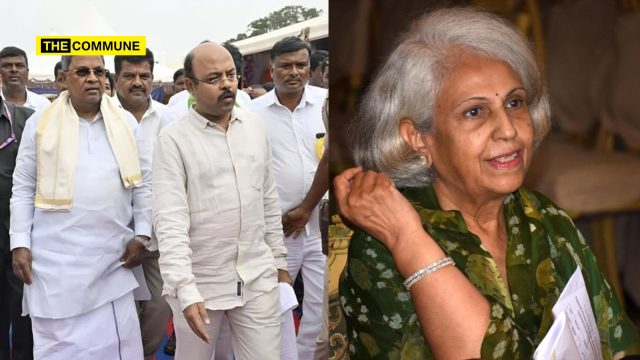
Pramoda Devi Wadiyar, a member of the erstwhile Mysuru royal family, has rejected Karnataka Congress MLC and son of former CM, Yathindra Siddaramaiah’s remarks that the state government had generously allowed the Wadiyar family to reside in Mysuru Palace, asserting that their continued residence is protected by court orders, as reported in Deccan Herald.
“Our continued residence in Mysuru Palace is due to the subsisting orders of the High Court and cannot, therefore, be characterised as an act of governmental generosity or as a favour extended to our family,” she said at a press conference held at Mysuru Palace on Wednesday, 4 November 2026.
The controversy erupted after Pramoda Devi made suggestions regarding the conduct of the state government’s Dasara celebrations and complained about the alleged arrogant behaviour of police personnel on 25 October 2026. Responding to her remarks, Mysuru District In-charge Minister Yathindra Siddaramaiah had claimed that Mysuru Palace belonged to the government and that the royal family had been generously permitted to reside there.
Rejecting this claim, Pramoda Devi said that Maharaja Jayachamaraja Wadiyar, her father-in-law, had submitted a list of his private immovable properties, including Mysuru Palace, when he entered into an agreement with the Governor General of India on 23 January 1950.
She said the list was accepted and confirmed by V.P. Menon, then Secretary to the Union Government, on 8 January 1951. The then Chief Secretary of the erstwhile Mysore State government was also a signatory to the agreement.
Pramoda Devi further referred to an 28 October 1972 communication from the Union Home Ministry to state chief secretaries, which stated that the abolition of royal privileges under the 26th Constitutional Amendment did not affect properties recognised as the private properties of former rulers under settlements with them.
She also explained the circumstances under which portions of the Palace were made available to the state government for maintenance and management after Jayachamaraja Wadiyar’s death in September 1974.
According to her, the government had requested her mother-in-law, Maharani Tripurasundarammani, and her husband, Srikantadatta Narasimharaja Wadiyar, to issue a letter agreeing to hand over certain portions of the Palace for maintenance.
When these portions were opened to visitors, it was agreed that gate collection proceeds and lease amounts from visitors and tenants would be used for maintenance, repayment of certain debts and clearing outstanding tax arrears. However, she alleged that the proceeds from gate collections were diverted to the government treasury.
Pramoda Devi said that aggrieved by the alleged mismanagement and diversion of funds, her husband withdrew the letter under which certain portions of the Palace had been handed over for government maintenance. After the government failed to respond to his correspondence, he approached the Karnataka High Court.
She said the High Court passed an order in 1997 in favour of Srikantadatta Wadiyar, directing the government to hand over the portions of the Palace within 30 days. Instead of implementing the order, the state government enacted the Mysore Palace (Acquisition and Transfer) Act, 1998.
The Act is currently under challenge before the court, she said, arguing that the very use of the term ‘acquisition’ in the legislation showed that the government did not originally own the Palace.
Row Over Ambari Royalty
Pramoda Devi also addressed the dispute over the use of the golden howdah, or Ambari, during the Mysuru Dasara Jamboo Savari procession.
While Yathindra Siddaramaiah had described the payment made by the state government for using the Ambari as rent, she clarified that it was royalty.
She said the government pays royalty because the Ambari is used commercially in publicity materials and for selling tickets for the Jamboo Savari procession.
Addressing the selection of the elephant that carries the Ambari, Pramoda Devi admitted that there was no formal protocol requiring the Forest Department to consult her. However, she asserted that as the owner of the Ambari, she had the right to know which elephant would be entrusted with it.
“The safety of the Ambari, the elephant and the people gathered is of paramount importance to me,” she said.
Questioning why she should provide the Ambari without being consulted, she added that she had even suggested that the government make its own Ambari to avoid paying royalty.
Rajamata Pramoda Devi Wadiyar has just set the record straight: the government never “gave” the Wadiyar family a place in Mysuru Palace the residential portion is theirs, protected by court order, not charity.
A sharp rebuttal to Yathindra Siddaramaiah, who claimed they were merely “left a small portion to stay in, like their father’s property.”
#MysuruPalace
— ಸನಾತನ (सनातन) (@sanatan_kannada) November 5, 2026
Subscribe to our channels on WhatsApp, Telegram, Instagram and YouTube to get the best stories of the day delivered to you personally.