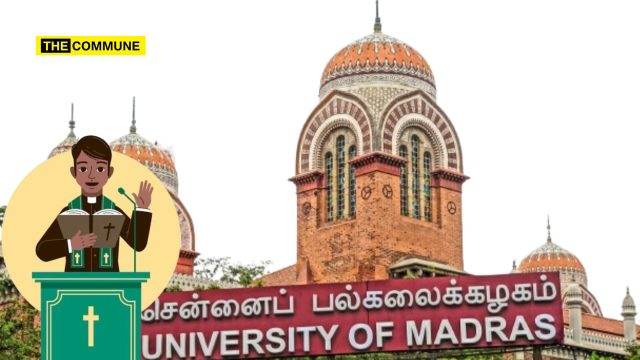
The University of Madras is considering the introduction of a postgraduate degree in Christian Studies across its affiliated Arts and Science colleges from the academic year 2026–27. The proposal, listed as Item No. 6 in the agenda for the University Syndicate meeting scheduled for 5 November 2026, which has now been rescheduled to 6 November 2026, raises questions about the nature and content of the proposed programme.
According to the agenda document The Commune has accessed, the recommendation was made by the Board of Studies in Christian Studies (Common), which met on 11 May 2026, under the chairmanship of Dr. K. James Ponniah.
This is Madras University Syndicate meeting agenda
See item 6 of the agenda and explanation at page 34
https://t.co/TA1p1vt2GN
@sgurumurthy https://t.co/fgkITQSIz4
— துக்ளக் டிஜிட்டல் (@ThuglakD) November 4, 2026
The Board resolved to recommend the introduction of the M.A. Christian Studies programme in affiliated Arts and Science colleges from the 2026–27 academic year. The resolution states that the course is prescribed by the Tamil Nadu State Council for Higher Education (TANSCHE) template.
The proposal has now been placed before the University Syndicate for consideration. This means that the recommendation is awaiting the Syndicate’s decision and should not be treated as an already approved programme.
The more important question, however, is what exactly will be taught under this degree.
Will the programme involve the academic study of Christianity, its history, philosophy and influence on society? Or will its syllabus contain theological instruction, including the teaching of Christian doctrines, religious practices and faith-based training?
The distinction is important in the context of Article 28 of the Indian Constitution, which prohibits religious instruction in educational institutions wholly maintained out of State funds. The Supreme Court’s landmark judgement in Aruna Roy v. Union of India (2002) clarified that academic education about religions is different from religious instruction involving the teaching of the tenets, rituals and practices of a particular faith.
The proposal also brings back questions surrounding the functioning of religiously oriented programmes within institutions affiliated with the University of Madras.
Earlier Controversies Reg Christian Bible Studies
In January 2025, we had reported allegations concerning Loyola College’s Sathya Nilayam campus in Thiruvanmiyur, where an M.A. Philosophy programme was alleged to cater predominantly to Catholic students, particularly those undergoing religious and missionary training. The allegations included questions about the programme’s affiliation, admission practices and the manner in which degrees were issued.
In August 2025, the University of Madras submitted a report to the National Human Rights Commission (NHRC) confirming serious irregularities in Loyola College’s M.A. Philosophy programme. The programme was allegedly being conducted at Sathya Nilayam, a Jesuit centre in Thiruvanmiyur, instead of the approved college campus, without the required university approval.
The University’s inspection found that the Philosophy Department lacked basic infrastructure, including dedicated classrooms, a faculty room, a departmental library and signage. The inspection team also found no students present during its visit, with classes reportedly being conducted in a common seminar hall.
The report further flagged irregularities in faculty appointments, including lecturers who allegedly did not meet UGC qualification requirements and instances of staff being counted as full-time faculty at both Loyola College and Sathya Nilayam. It also found that the college had failed to submit mandatory category-wise admission data despite repeated reminders, raising concerns over compliance with Tamil Nadu’s reservation norms.
The University concluded that Loyola College had not complied with UGC guidelines, government orders and university norms in conducting the M.A. Philosophy programme. It subsequently barred the college from admitting students to the programme for three years.
The Legal Rights Protection Forum (LRPF) subsequently approached the Tamil Nadu Governor, the NHRC and other authorities, alleging that the programme was being used to facilitate the admission of Christian seminarians and Jesuit missionaries while excluding non-Christian students.
In January 2026, LRPF submitted another petition to Governor R.N. Ravi, seeking the withdrawal of Loyola College’s minority and autonomous status. The forum also sought a comprehensive investigation, retrospective cancellation of degrees awarded through the programme from 1998, suspension of government funding and other regulatory action.
The immediate question before the University Syndicate is whether to approve the proposed M.A. Christian Studies programme. But before such a programme is introduced across affiliated colleges, the syllabus, admission criteria, academic objectives and safeguards against religious instruction deserve public scrutiny.
A university’s academic framework must remain transparent, and students must know precisely what they are being offered under the name of a postgraduate degree.
Subscribe to our channels on WhatsApp, Telegram, Instagram and YouTube to get the best stories of the day delivered to you personally.