On 23 May 2026, U.S. Secretary of State Marco Rubio kicked off his first official four-day tour of India by making a high-profile visit to Mother Teresa’s Mother House and the Missionaries of Charity headquarters in Kolkata. Accompanied by his wife, Jeanette D. Rubio, and U.S. Ambassador to India Sergio Gor, Rubio paid homage at Saint Teresa’s tomb and interacted with the congregation’s nuns.
US Secretary of State Marco Rubio pays homage at the tomb of Mother Teresa in Kolkata pic.twitter.com/BnskeYYg74
— Sidhant Sibal (@sidhant) May 23, 2026
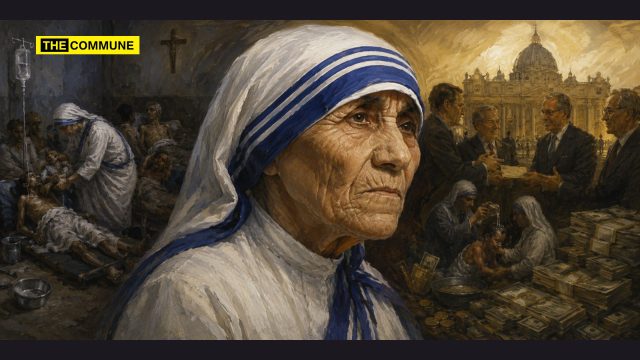
It is time to revisit the thought whether she was a ‘Mother’, a Saint or something else. Mother Teresa is still framed as a global symbol of compassion, a “saint of the gutters” whose “legacy of service” supposedly dignified the poorest of the poor. But when you actually examine how she ran her order, who funded her, and what she believed about suffering and women, the halo quickly looks like a propaganda product. The record assembled by Christopher Hitchens and others points not to a healer of the poor, but to someone who sacralised poverty, minimised medical care, cultivated dirty patrons, and quietly advanced a conversion project on the most vulnerable people she could find.
Friend of Poverty, Not of the Poor
Christopher Hitchens spent years investigating Mother Teresa. He wrote The Missionary Position, fronted the documentary Hell’s Angel, and even testified as part of the devil’s‑advocate process in her beatification. His central conclusion was blunt, “Mother Teresa was not a friend of the poor. She was a friend of poverty.”
Her order, the Missionaries of Charity, founded in 1950, grew into a global network of “homes for the dying”, orphanages, and shelters. By her death in 1997, they claimed hundreds of centres across more than a hundred countries. The branding was simple: radical simplicity, white saris, bare floors, little equipment – presented as the purest expression of Christian charity among the destitute.
Hitchens’ point was that this was aesthetic and ideological. The poverty and suffering weren’t just conditions to be mitigated; they were treated as holy in themselves, a theatre of sanctified pain that justified keeping facilities primitive even when money poured in.
Houses of the Dying, Not of the Healing
Mother Teresa’s operations aren’t mainly criticised by the atheists on the internet; it comes from doctors, ex‑volunteers and journalists who saw her homes up close.
There are several repeat themes:
Minimal medical treatment even for treatable conditions: Reports from her Kolkata homes describe places closer to emergency shelters than hospitals: little diagnostic work, weak triage, and a pattern of keeping patients in those homes rather than moving them into fully equipped government or private hospitals – even when donations could have paid for better care.
Reused needles and poor hygiene: Volunteers and medical professionals reported reused syringes and substandard hygiene, conditions that would be scandalous even in a struggling public hospital.
Withholding of pain relief: Humanist organisations and critics document cases where strong painkillers were denied or tightly rationed, not because of cost but because pain itself was seen as spiritually meaningful.
One anecdote Hitchens highlighted is telling. A patient suffering unbearable pain from terminal cancer reportedly told Mother Teresa how much he was hurting. She is quoted as replying, “You are suffering like Christ on the cross. So Jesus must be kissing you.”
That line isn’t compassion; it’s a theology that reframes torture‑level pain as a kiss from God, and thus an experience to be accepted rather than aggressively treated. Her homes weren’t houses of the curing; they were houses of the dying, and they were designed to stay that way.
Rubio is visiting the Missionaries of Charity in Kolkata. Sergio Gor was there just days ago, reflecting on Mother Teresa’s “legacy of service.” It is a good time to revisit what that her legacy actually was.
Christopher Hitchens spent years investigating Mother Teresa. He…
— Ram (@ramprasad_c) May 22, 2026
Where Did the Money Go?
None of this can be brushed off by claiming she was too poor to do better.
By the 1980s and 1990s, the Missionaries of Charity were receiving millions of dollars in donations from Europe, North America, and elsewhere: governments, corporations, rich individuals. Yet the conditions in her facilities stayed stubbornly austere.
Hitchens’ question was simple: if money wasn’t the issue, why didn’t she upgrade care?
- No significant investment in modern pain management.
- No serious attempt to turn major centres into properly equipped hospitals.
- No systemic programme to train nurses or doctors within her order to a professional standard.
The obvious explanation is that she didn’t want to. The whole point was to keep the operations visibly “poor” even while funds accumulated at organisational level, because that visual poverty was what made Western donors feel they were touching the “real” cross of Christ. Her brand depended on those images of extreme deprivation. Improving the conditions would have undermined the myth.
A Friend of Fraudsters and Dictators
If she was serious about gospel morality, her choice of friends and donors should have reflected that. Instead, they read like a catalogue of the very people any honest preacher would confront.
Charles Keating
Charles Keating, the American savings‑and‑loan mogul, pulled off one of the biggest financial frauds of his era, swindling mainly elderly investors and later being convicted for it.
Mother Teresa accepted over a million dollars from Keating, and when he went to trial, she wrote to the judge asking for clemency, praising his generosity.
The prosecutor replied, explaining that Keating’s money had been stolen from his victims and politely asked whether she would return those funds to the people they were taken from. Hitchens notes that she never answered and never gave the money back.
So much for siding with the defrauded poor over the rich fraudster; she stayed loyal to the money.
Duvalier’s Haiti and Enver Hoxha’s Albania
Haiti under the Duvalier family was notorious for its brutal dictatorship, torture, and murder. She visited and publicly praised the regime as “generous,” accepting a high national honour from them.
She also spoke approvingly of Enver Hoxha’s Albania, one of the most repressive communist regimes, framing it in glowed terms despite the reality of prisons and persecution.
Hitchens’ verdict was that she was “a friend to the worst of the rich”, attaching herself to crooks, tyrants and political machines when it suited her order’s fundraising and influence. That’s not some minor stain; it’s a pattern of aligning with power against justice.
The Covert Conversion Machine
Strip away the PR and you see why religious minorities, especially in India, view her order with deep suspicion: conversion was not a bug; it was built into the system.
Former Missionaries of Charity nuns have described being taught to baptize dying patients in secret.
Nurses were allegedly told to ask: “Do you want a ticket to heaven?” – a deliberately vague question for someone in agony, often not fully conscious or fluent in English.
If the patient nodded or didn’t resist, the sister would wipe a damp cloth on the forehead and quietly recite the baptismal formula, effectively making the person a Christian in the Church’s records without any informed consent.
Hindus and Muslims dying in her homes were thus post‑facto counted as Christian “converts” without ever understanding what had been done to them. Official Missionaries of Charity rules say they don’t impose the faith, but in practice this sacramental ambush gave them the numbers and the spiritual narrative they wanted.
In modern India, authorities have also probed the order for conversion‑related charges:
In Gujarat (2021), police filed a case alleging that a Missionaries of Charity girls’ home forced girls to wear crosses and read the Bible under the state’s anti‑conversion law.
A court ultimately dropped the case for lack of evidence, but the episode shows how deeply the conversion suspicion runs when Christian charity operates in a majoritarian environment.
This isn’t a hallucination – secret baptisms and softly enforced Christian practices around vulnerable people are part of the record.
Baby‑selling and Child‑care Scandals
The order has also been directly implicated in illegal baby‑selling.
In 2018 in Jharkhand:
Police arrested a Missionaries of Charity nun and a staffer for selling infants from a shelter for unmarried mothers, with at least one child allegedly sold for the equivalent of about $2,000.
Authorities said as many as four babies might have been sold illegally to childless couples, prompting a nationwide review of the order’s adoption practices.
The Missionaries claimed they had already stopped formal adoption work, blaming rogue individuals. But the scandal exposed how easily children under their care could be commodified and moved under the table, in exactly the way you’d expect from a poorly monitored religious institution with huge trust and little transparency.
Against the Only Real cure For Poverty
Hitchens also hammered home that she opposed what he called the only known cure for poverty: the emancipation of women.
She was a hard‑line opponent of divorce, contraception and abortion, even in cases of rape or when a woman’s life was at risk, aligning herself with the most conservative Vatican positions.
In societies where poor women have no control over childbearing, this stance translates directly into larger families, more child labour, and deeper entrenchment of poverty.
In his words, she helped keep women in “a livestock version of compulsory reproduction,” and that is not an accident; it flows from her theology. She didn’t just fail to challenge structural poverty; she actively reinforced the gender and reproductive rules that create it.
An Attack On Hypocrisy
The criticism of Mother Teresa, especially from Hitchens, is best understood as a defence of that core ethic against a cult of suffering, obedience and money that hid behind her sari and smile. The only reason she wasn’t shredded by public scrutiny in her own lifetime is that she operated at a time when global media and Indian elites were happy to accept a “living saint” narrative and look away.
If the same operation ran today – reused needles, withheld painkillers, secret baptisms, money from crooks and dictators, it would be filmed, uploaded, and prosecuted. The fact that she dodged that level of accountability doesn’t clean her record; it just shows how much damage a carefully constructed myth can do when nobody is allowed to question it.
Subscribe to our channels on WhatsApp, Telegram, Instagram and YouTube to get the best stories of the day delivered to you personally.