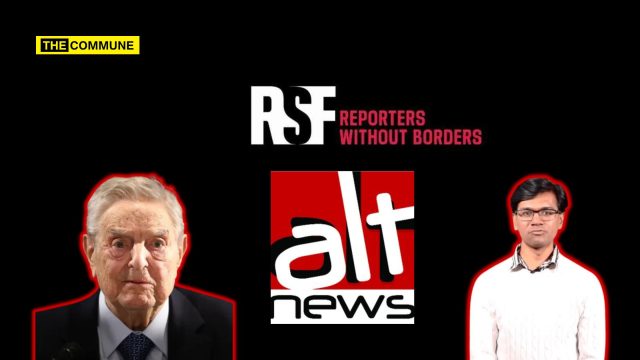
A year after nominating leftist ‘news’ portal The News Minute’s Dhanya Rajendran for ‘Impact Prize 2025’, the Soros-backed Reporters Without Borders (Reporters Sans Frontières) has now shortlisted alleged fact-checking ‘portal’ Alt News run by Mohammad Zubair and Pratik Sinha, under Impact Prize category for ‘Press Freedom’ Awards 2026.
Top 5 donors of RSF
1. European Union
2. NED (CIA)
3. OSF (George Soros)
4. Mac Arthur Foundation
5. Ford Foundation (CIA)All these groups are part of the Deep State ecosystem. ‘Awards and recognition’ are given to shortlisted assets who work in the Deep State’s interest.… pic.twitter.com/Qpkl6Wsy94
— STAR Boy TARUN (@Starboy2079) May 23, 2026
The jury for this year’s awards includes alleged journalist Rana Ayyub and Hamid Mir, editor-in-chief, writer and anchor of Pakistani GeoNews.
In 2025, after the fake allegations made by The News Minute on Dharmasthala, this nomination was made to Dhanya Rajendran.
Who Is RSF?
Reporters Without Borders (RSF), the Paris-based international media watchdog, presents itself as an organisation dedicated to defending press freedom across the world. However, critics argue that RSF increasingly operates not merely as a journalism advocacy body, but as part of a wider Western ideological ecosystem that seeks to influence political narratives in developing countries, including India, as reported in OpIndia.
RSF receives funding from several Western governments and philanthropic organisations, including the French Foreign Ministry, the European Commission, Sweden’s SIDA agency, the Ford Foundation, and the National Endowment for Democracy (NED), a U.S.-funded organisation that has frequently been accused by critics of acting as a soft-power instrument for advancing American geopolitical interests abroad. The organisation has also been associated ideologically with networks backed by billionaire investor George Soros and his Open Society Foundations (OSF).
Soros has repeatedly spoken against nationalist governments across the world and has openly criticised Prime Minister Narendra Modi’s government in India. Over the years, OSF-linked funding networks have supported a range of NGOs, academic initiatives, activist platforms, media ventures and civil society groups that are often sharply critical of the Indian government and Hindu nationalist politics. These collectively shape an international narrative portraying India as increasingly authoritarian and intolerant under the BJP.
Anti-India RSF
RSF’s own commentary on India is evidence of political bias. Its reports and country assessments have often adopted terminology commonly used by anti-BJP activists, including phrases such as “Godi Media” and references to Modi supporters as “Bhakts.” Such language undermines RSF’s claim of neutrality and reflects ideological hostility rather than objective media analysis.
Let us take a look at RSF’s annual World Press Freedom Index rankings. India’s ranking had already declined significantly during the Congress-led UPA years between 2004 and 2013, but they argue that international discourse around “press freedom decline” became sharply amplified only after Narendra Modi assumed office in 2014. RSF’s rankings often place India below countries facing far more severe levels of journalist killings, censorship, civil conflict or imprisonment of reporters, leading opponents to describe the index as politically selective and methodologically inconsistent.
A broader ecosystem of foundations, NGOs, fact-checking initiatives and digital media platforms tied to Western philanthropic funding increasingly shapes discourse around India internationally. Organisations linked to or funded by networks associated with Soros, Omidyar Network, Media Development Investment Fund (MDIF), and similar institutions have invested in independent journalism platforms, legal advocacy groups and policy initiatives in India. These are attempts to steer political narratives and delegitimise ideological opponents under the language of liberal activism and press freedom.
Within this debate, international journalism awards and recognitions can also be seen as part of a larger influence ecosystem. Such recognitions can provide global legitimacy to journalists and activists aligned with certain ideological positions, making domestic criticism of their reporting easier to frame as hostility toward press freedom itself. Western publications and institutions frequently cite RSF rankings and reports while assessing India’s democratic credentials, further amplifying the organisation’s influence in international discourse surrounding the country.
Subscribe to our channels on WhatsApp, Telegram, Instagram and YouTube to get the best stories of the day delivered to you personally.