The Jharkhand protests did not begin because of the Cockroach Janta Party. They began because of the Jharkhand Public Service Commission. But BBC would like you to believe otherwise – that the Cockroach protests were what propelled the JPSC protests.
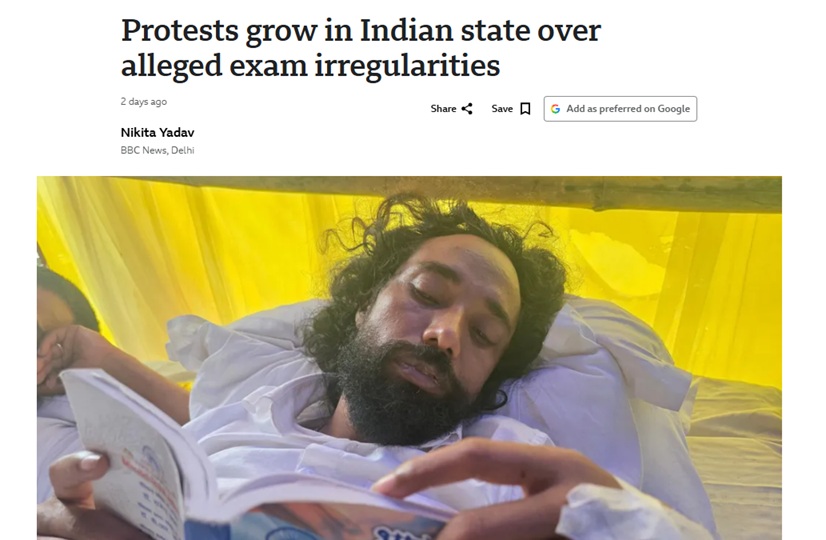
On 19 April 2026, the JPSC conducted the preliminary exam for its 14th Combined Civil Services recruitment. When results were declared on 2 July 2026, candidates flagged alleged OMR tampering, uneven cutoffs and leaked papers. Protests started immediately after that result – not after any national youth movement told them to. This is also not Jharkhand’s first such fight: state job aspirants have been protesting JSSC and JPSC exam “irregularities” going back to at least 2024, when thousands demonstrated outside the JSSC office over the JGGLCCE exam. The grievance is local, specific and old.
BBC’s 6 August report on the protests opens with the standard facts: students demanding the exam be cancelled, a CBI probe, Chief Minister Hemant Soren promising an investigation and then moves to this: “The protests have gained national attention after a much larger youth-led demonstration in Delhi over exam paper leaks led to the resignation of a federal minister last month. The Cockroach Janta Party (CJP)… which led the Delhi protests has announced its support to the protesters.”
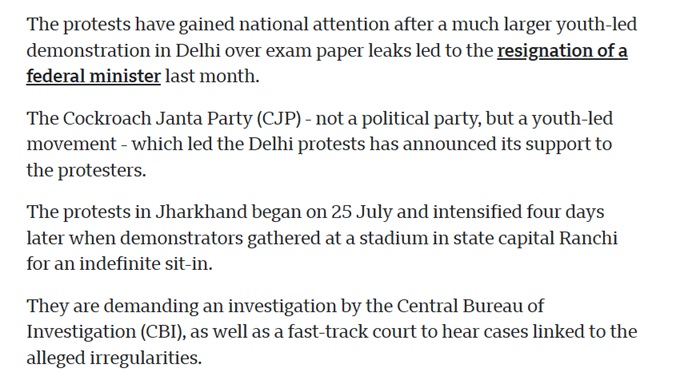
Placed where it is, right after the protest’s basic facts and before any of the CID probe or arrest details, that framing does real work: it tells the reader that Jharkhand’s protests belong in the same story as CJP’s, that Jharkhand’s protesters are drawing legitimacy or momentum from Delhi. It isn’t a factual error, Dipke did announce solidarity but it inverts what actually happened.
The protest organisers say so themselves. Vinay Mehta, part of the Jharkhand protest’s core committee, told ThePrint that the CJP-led Jantar Mantar protests gave the group confidence that “accountability can be sought” – after they had already launched their indefinite protest. He was explicit that this was not their first agitation, just their first one that didn’t end within a day. The Jharkhand movement drew morale from Delhi’s example. It did not originate there, and its cause has nothing to do with the CJI’s cockroach remark or the CJP’s founding.
What actually happened with CJP and Jharkhand deserved to be the story, and BBC left it out entirely. Dipke and CJP stayed silent on Jharkhand for close to two weeks after protesters began asking for their support. When pressed on the show Double Check by journalist Sanket Upadhyay on why CJP had not shown up, Dipke said he and spokespersons Ashutosh Ranka and Ratna Singh were too exhausted and unwell after the Jantar Mantar protests to travel. Around the same time, CJP leaders were seen travelling to Dipke’s hometown of Chhatrapati Sambhajinagar, which is what triggered accusations online that the illness excuse was selective. Only after that backlash did Dipke hold a press conference announcing CJP’s support and a planned visit to Ranchi. Some protesting students have since said publicly they don’t want CJP leaders to show up at all.
That is the real relationship between the two protests: Jharkhand’s students built and sustained their own movement on a grievance that predates CJP by months, drew inspiration but not direction from Delhi, and got a reluctant, reactive gesture of solidarity from Dipke only after being criticised for its absence. BBC’s framing — CJP up top, “announced its support” stated plainly, no mention of the two-week silence or the contested illness claim — makes CJP look more central and more responsive than the record supports, and makes an independent, homegrown protest look like an offshoot of someone else’s movement.
Subscribe to our channels on WhatsApp, Telegram, Instagram and YouTube to get the best stories of the day delivered to you personally.