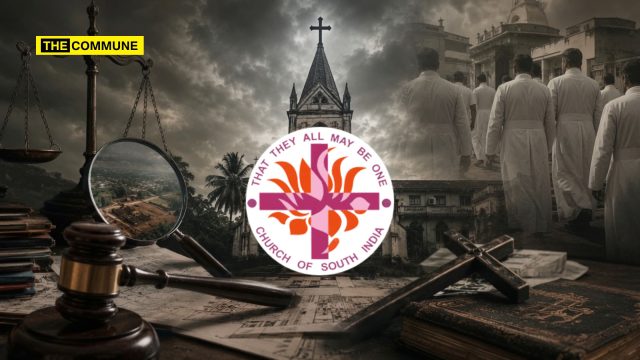
The Church of South India (CSI), one of India’s largest Protestant denominations and among the country’s biggest religious property holders, is facing mounting legal, financial and administrative challenges across multiple states, with courts, investigative agencies and law enforcement authorities examining allegations ranging from disputed land transactions and medical admission fraud to contempt proceedings against bishops and violent internal factional clashes.
Over the past two years, the CSI and its associated trusts, dioceses and office-bearers have found themselves at the centre of a series of controversies involving land worth hundreds of crores, alleged money laundering, internal governance disputes and criminal proceedings.
Land Fraud
Madurai Land Sale Case: High Court Orders CBI Probe Into Alleged Illegal Sale Of Government Land
One of the most significant cases emerged from Tamil Nadu, where the Madurai Bench of the Madras High Court in November 2024 directed the Central Bureau of Investigation (CBI) to register a case and investigate the alleged illegal sale of 31.10 acres of government land at Tallakulam in the heart of Madurai city.
The order was passed by Justice K.K. Ramakrishnan on a Public Interest Litigation filed by D. Devasahayam, president of the Christian Minorities Unit.
According to the petition, the land had originally been allotted by the government to the American Board of Commissioners for Foreign Missions (ABCFM), later known as the United Church Board for World Ministries, for the establishment of an industrial home for needy women and for agricultural activities whose income was to be used for their welfare.
The petitioner alleged that officials of the CSI Madurai-Ramnad Diocese, in collusion with government officials and private parties, fabricated a power deed and sold the property in violation of the original conditions attached to the grant.
After examining the records, the High Court observed that the materials disclosed a prima facie case warranting investigation. The court noted that the properties of the United Church Board for World Ministries had subsequently vested with the Church of South India Trust Association (CSITA) and that there were allegations of conspiracy and collusion in the sale of the land.
The court also referred to the resumption clause contained in the original government order, which stipulated that if the land was not used for its intended purpose, it should revert to government ownership. Observing that the government continued to be the owner of the property, the court held that church authorities had no jurisdiction to sell it and directed the CBI to investigate the matter.
Supreme Court Revives Andhra Pradesh CSI Land Fraud Case
In another major setback for CSI-linked entities, the Supreme Court in April 2026 restored criminal proceedings relating to the alleged fraudulent transfer of 7.75 acres of CSITA land in Ananthapuramu, Andhra Pradesh.
A Bench comprising Justices Ahsanuddin Amanullah and R. Mahadevan set aside an Andhra Pradesh High Court order that had quashed the criminal case.
The dispute centred on allegations that a CSITA resolution authorised the sale of only one acre of land for ₹1 crore, but a subsequent sale deed transferred the entire 7.75-acre property. The State alleged that the transaction was executed at a consideration far below prevailing market value and without mandatory institutional approvals.
Examining the records, the Supreme Court noted that the resolution relied upon in the sale deed authorised only the sale of one acre, whereas the actual transfer involved 7.75 acres. The Court further observed that no subsequent resolution authorising the larger transfer appeared in the CSITA records.
The Bench held that questions regarding trust property are matters of legitimate public concern and restored the criminal proceedings, allowing the trial to continue.
Kerala Medical College Capitation Fee And Money Laundering Case
The CSI has also been under scrutiny in Kerala in connection with allegations involving Dr. Somervell Memorial CSI Medical College and Hospital in Karakonam, Thiruvananthapuram, which is administered by the CSI South Kerala Diocese.
The Enforcement Directorate (ED) filed prosecution complaints naming several individuals, including former CSI Bishop A. Dharmaraj Rasalam, medical college director Dr. Bennet Abraham and church secretary T.T. Praveen.
Investigators alleged that large sums of unaccounted money were collected from students and parents under the promise of securing MBBS and postgraduate medical seats. According to the allegations, many candidates allegedly paid amounts running into tens of lakhs of rupees, with some reportedly paying up to ₹92 lakh, but did not receive admissions once NEET-based admission procedures were enforced.
The ED alleged that funds collected through the scheme were diverted into parallel channels outside official accounting systems.
The investigation led to raids, attachment proceedings and freezing of certain assets. Courts have also examined applications relating to restitution of seized funds to alleged victims. The proceedings remain subject to judicial scrutiny.
Court Sentences For Top Leadership
High Courts Sentence CSI Bishops In Contempt Cases
Several CSI bishops and senior office-bearers have also faced contempt proceedings before High Courts.
In 2021, in the St. George’s Cathedral dispute, the Madras High Court found Rt. Rev. Dr. J. George Stephen, Bishop in Madras, along with other church officials, guilty of civil contempt for failing to implement a previous court order relating to membership records. The court imposed sentences of simple imprisonment and fines.
In another matter in 2018 involving the Tuticorin-Nazareth Diocese, the Madurai Bench of the Madras High Court sentenced Bishop Rev. S.E.C. Devasahayam and a diocesan treasurer to civil imprisonment after finding deliberate violations relating to diocesan election processes and voter list management.
The cases reflected growing judicial intervention in church administration and internal electoral disputes.
Karnataka Courts Intervene In Governance Disputes
In Karnataka, courts have repeatedly dealt with disputes involving the CSI Trust Association, diocesan administration and governance issues.
Court proceedings examined allegations that office-bearers had attempted to bypass injunctions and status quo orders concerning diocesan administration, financial management and organisational control.
The prolonged disputes ultimately resulted in judicial intervention, including the appointment of retired judges in supervisory roles over certain aspects of church administration and financial oversight, according to court records and related proceedings.
Violent Internal Clashes And Police Intervention
Apart from legal and financial controversies, several CSI dioceses have witnessed internal factional conflicts that have occasionally escalated into violence.
One of the most widely reported incidents occurred in 2021 in the Coimbatore Diocese, where a diocesan executive committee meeting allegedly descended into physical violence following disputes relating to financial administration and trust management. Police registered criminal cases after an administrative committee member was allegedly assaulted during the confrontation.
In Andhra Pradesh’s Narsapuram region, disputes over ecclesiastical administration and control of church properties have periodically led to confrontations between rival factions, necessitating police intervention.
Similar tensions have been reported in Chennai and other dioceses, where rival groups have clashed over voter lists, administrative appointments and diocesan elections, forcing law enforcement authorities to maintain order during sensitive meetings.
🚨 BREAKING: The Church of South India (CSI) is facing unprecedented legal and financial turbulence as the Supreme Court of India, the CBI, and the Enforcement Directorate (ED) crack down on massive multi-million rupee scams, fraudulent property sales, and internal brawls across… pic.twitter.com/3keuhsXf5b
— Dharmic Indians (@dharmic_indians) June 24, 2026
Growing Judicial And Regulatory Scrutiny
Taken together, the land disputes, financial investigations, contempt proceedings and governance battles have resulted in unprecedented scrutiny of CSI-linked entities by courts, investigative agencies and regulatory authorities.
While many of the matters remain under investigation or trial and the accused have denied wrongdoing, the cumulative effect of the proceedings has significantly increased judicial oversight over various aspects of church administration, property management and financial governance.
The outcomes of these cases are likely to have long-term implications not only for the CSI and its affiliated institutions but also for the governance of religious trusts and charitable bodies across India.
Conclusion
If repeated judicial intervention, criminal investigations and allegations of large-scale financial and property mismanagement are sufficient grounds for governments to oversee Hindu temples, the same logic must apply to churches. The State cannot selectively exercise control over one faith’s institutions while leaving others to self-regulate. Either all major public religious institutions should come under the same statutory administrative framework, or none should. Equal laws—not selective secularism—are the only constitutionally defensible path forward.
Subscribe to our channels on WhatsApp, Telegram, Instagram and YouTube to get the best stories of the day delivered to you personally.